Fiji Supports
pp. 37-42 · Read in the full issue
South Pacific
Trade Committee
A proposal for a South Pacific Business Co-operation Com mittee to discuss common South Pacific trade problems is sup
ported by Fiji’s Chief Minister,
Ratu K. K. T. Mara.
Ratu Mara said in Sydney in December, during a brief visit to attend a memorial service to Mr.
Harold Holt (see p. 28) that Fiji would welcome greater access to busi ness people able to support Fiji’s industrial effors.
“Fiji will give such a scheme its support,” Ratu Mara said.
The proposal for a South Pacific Business Co-operation Committee was first put forward by leading South Australian businessman Mr. R. B.
Gall, in an article in PIM in October (p. 21). Mr. Gall is a member of the Australia-Japan Business Co operation Committee, and had pro posed that Australia should spear head establishment of a South Pacific Committee along the same lines.
In December Mr. Gall discussed the proposal at a meeting of the Australia-Japan Business Co-opera tion Committee in Canberra, and got the committee’s support.
Co-operation
In Canberra Mr. Gall said that if there was to be prosperity for the people of the South-West Pacific there had to be co-operation between the “haves” and “have nots”. He believed that the highly fragmented South Pacific community must benefit from the operation of a com mittee formed to discuss common problems.
He suggested that a steering com mittee be set up to investigate whether South Pacific businessmen really thought the committee was desirable. He said such a committee, to begin with, could consist of interested persons from Fiji, Tonga, Western Samoa, Australia and New Zealand. He envisaged that every territory covered by the South Pacific Commission, including the French territories, would be represented eventually.
Rata Mara said in Sydney that Fiji would be willing to supply suit able nominations for a steering com mittee.
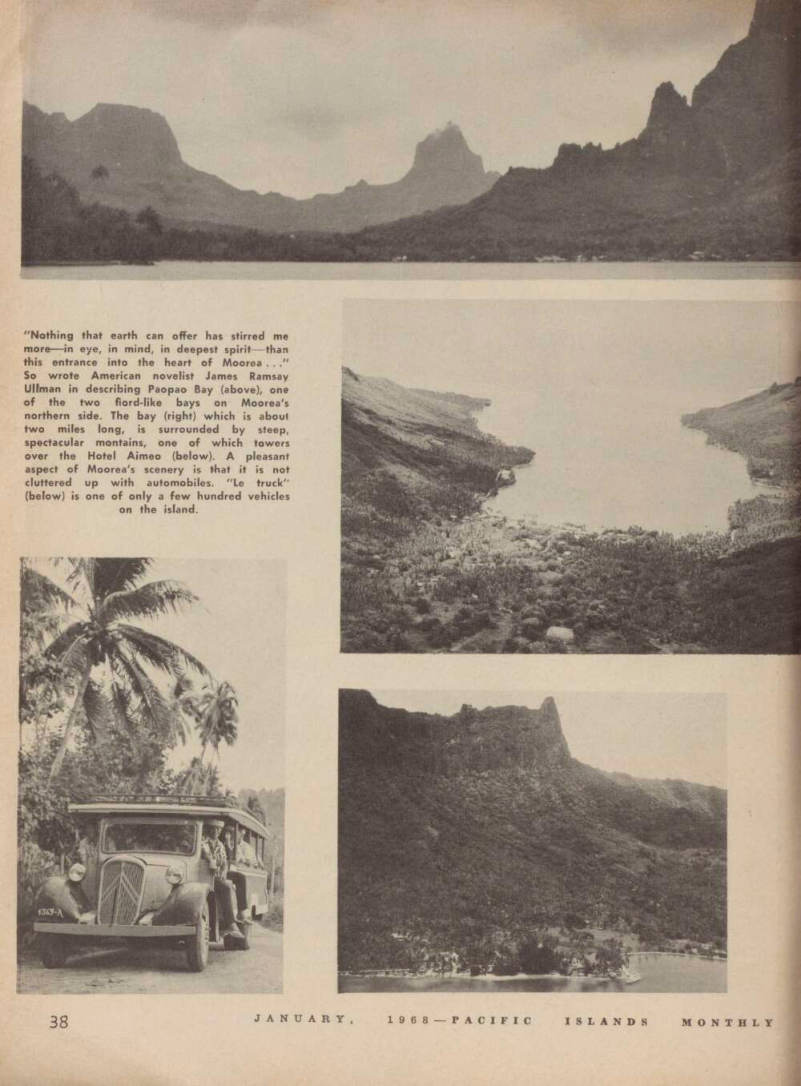
"Nothing that earth can offer has stirred me more—in eye, in mind, in deepest spirit—than this entrance into the heart of Moorea..."
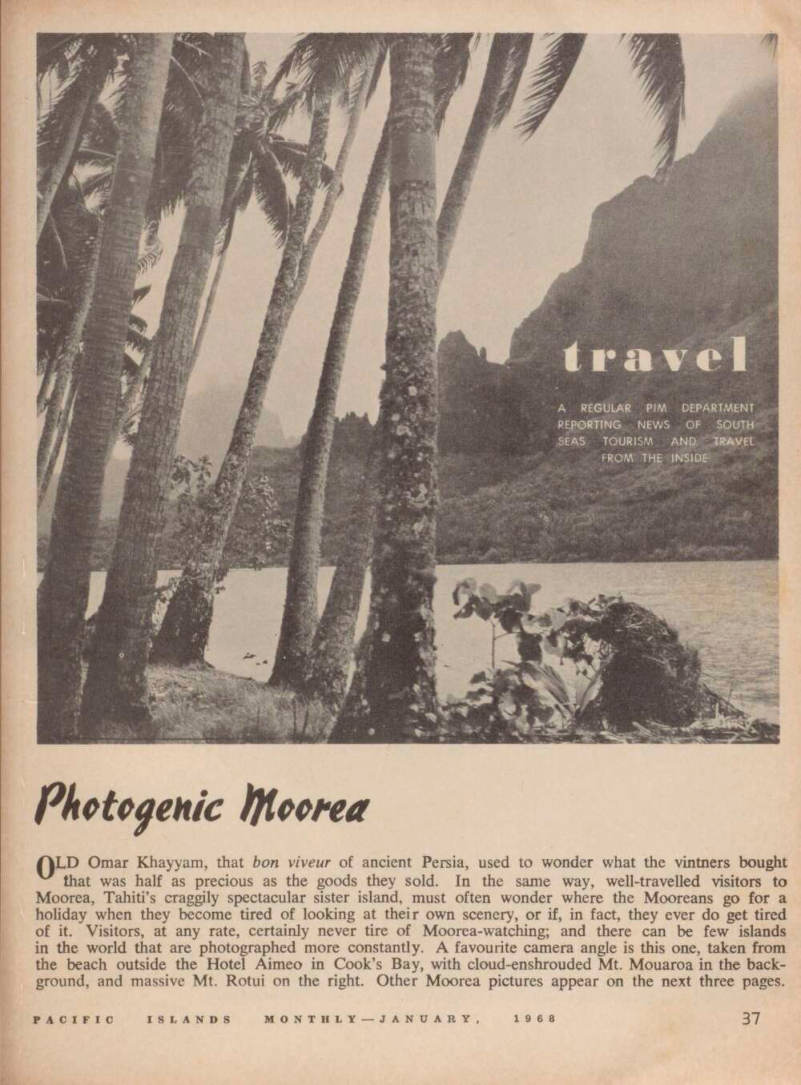
So wrote American novelist James Ramsay Ullman in describing Paopao Bay (above), one of the two fiord-like bays on Moorea's northern side. The bay (right) which is about two miles long, is surrounded by steep, spectacular montains, one of which towers over the Hotel Aimeo (below). A pleasant aspect of Moorea's scenery is that it is not cluttered up with automobiles. "Le truck" (below) is one of only a few hundred vehicles on the island.
There are three places for tourists to stay on Moorea the Hotel Aimeo, the Hotel Bali-Hai (above) and the Club Mediterranee. The Bali-Hai is run by three young Americans, and there fore has a special appeal for US visitors.
Visitors to Moorea who make a tour round the island will often get the feeling that they have stepped back into the early 19th century, as many of the houses are still built along the architectural lines introduced at that time by missionaries of the London Missionary Society. This is particularly so in the Papetoai district (where the two houses above and accompanying horse were photographed), as that district was once the South Pacific headquarters of the LMS. The IMS missionaries at Papetoai built the first stone church in the Sooth Seas — an octagonal one modelled on the Surrey Chapel of the Rev.
Rowland Hill, of London. The octagonal church, which was opened for worship in 1829, is still in good repair and is still in use. Photos in this section are by Rob Wright, Qantas, Tahiti Noi-Gray Line, and Robert Langdon.