Philp director
pp. 37-156 · Read in the full issue
Veteran Burns Philp director buried at sea
By a staff writer
While he wasn’t a true sailor and hadn’t been to sea for more than 40 years, Joseph Mitchell still loved the sea and the Pacific Islands. So, when he died at 93, on December 9, unnoticed by the Australian business world, it was no surprise that his ashes were scattered from the Bums Philp flagship MV Bulolo, while it was headed north for New Guinea.
Bulolo’s captain and BP fleet com modore, Brett Hilder, with Mr.
Mitchell’s grandson. Dr. David Slade, consigned Mr. Mitchell’s ashes to the Pacific in privacy off Cape Byron, north New South Wales, on December 21. Joseph Mitchell was a man who shunned publicity all his life.
Yet no one disputed his title of Grand Old Man of the Pacific Islands —a tag he had more than earned dur ing an unequalled 75 years’ service with the Big Firm—Burns Philp and Co. Ltd. He retired as general manager in July, 1966, after 24 years in that position.
As a tall, 16-year-old youth from the little town of Picton, New South Wales, Joseph Mitchell joined Burns Philp on March 17, 1891. He was
(Continued on p. 153)
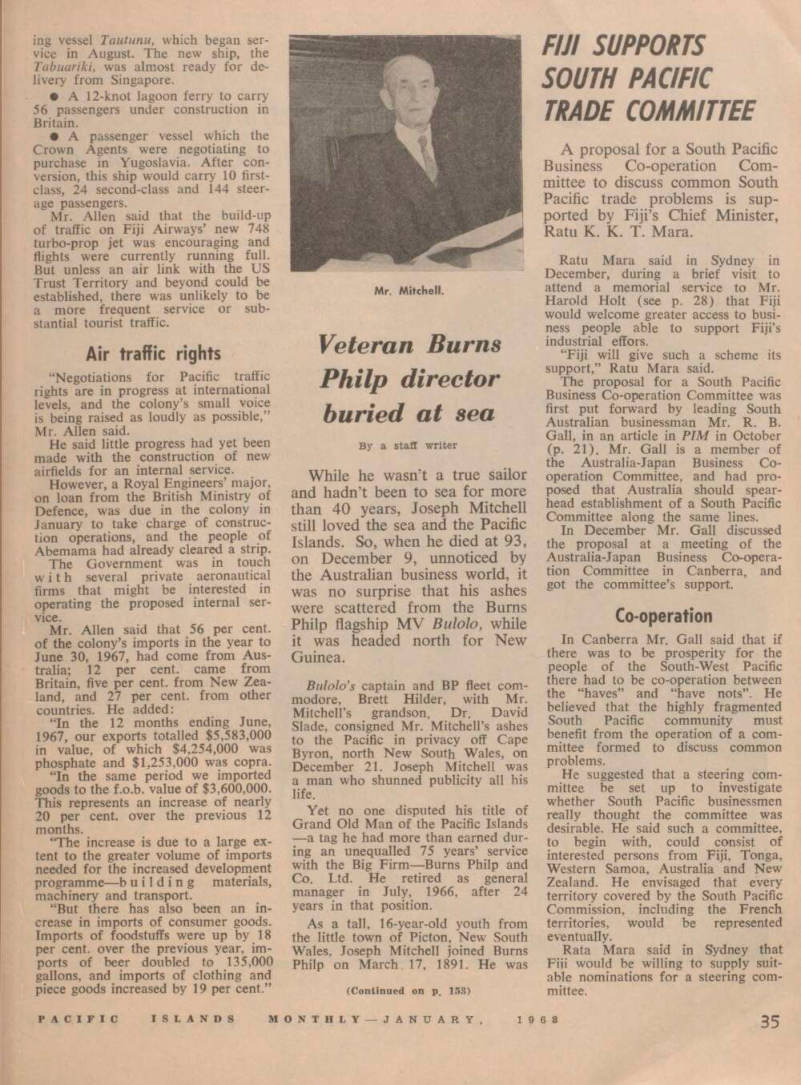
Mr. Mitchell.
an office boy on a salary of about £1 a week.
After five years in the BP Sydney office, he was sent to Vila in May, 1895, to manage the Australasian New Hebrides Co. which was started by Melbourne and Sydney businessmen in 1888 and in which BP had an interest. This company was liquidated in 1897, BP taking over all the properties.
The 21-year-old manager found the New Hebrides rough and lawless, and life there was an adventure.
The Condominium Government was not formed until 11 years later, and the community ruled itself. A French or British warship turned up in Vila about once a year to “hold court and generally to thrash out an nri,o IS xr 6S ’ u. -a a r M?K II n T S " , y ? ung Joe Mitchell fine. No regulations
meant no taxes, and profits were high. A solid Australian six feet two inches tall, he more than held his own with the French, and trading thrived.
Those days made an impression on him that was to last all his life.
Many years later he would speak of contacts all over Melanesia and Polynesia, but about the New Hebrides he was prepared to yarn for any length of time.
“I was a lot happier at that time than I ever was later in countries with a lot of laws,” he said once.
Early supercargo
Mitchell returned to Sydney from Vila in August, 1896, and for the next 11 years worked in the firm’s Island department, making several exploratory trips in the BP steamers Titus and Tam bo to New Guinea, the Caroline Islands, the Solomons, Ocean Island, Norfolk Island and the Gilbert and Ellice Islands.
In March, 1898, as supercargo aboard the small Titus, he pioneered a new trade route to the Marshall Islands, which at the time were owned by Spain but largely German influenced.
His wife, Irene, whom he had married in 1897, accompanied him on many of his trips, seeing many islands seldom visited by white women.
There were only about 20 Euro peans in the Solomons in those days and attacks from natives were so numerous that few dared reside on the main islands of Malaita and Guadalcanal. They placed their houses on offshore islands or lived in their boats.
Mr. Mitchell liked to recount an early trip to Ocean Island.
“No one knew much about the place, so I decided to go ashore and have a look around,” he said. “We did some trade with the natives and I walked right across Ocean—and I, like many others, never guessed that that upraised mass of apparently broken coral was nothing but a vast heap of phosphatic rock, worth millions of pounds.”
Although Mitchell made no mil lions out of Ocean Island’s phosphate, he was to go on and do it for the BP trading and investment empire.
In 1908 he was sent to Thursday Island, centre of a booming pearl shell trade. It was mostly his making that BP set up the profitable Wyben Pearling Co. Ltd. in January, 1913.
Wyben Pearling Co. gave him his first directorship at the age of 38.
Recalled to Sydney in 1912, Mr.
Mitchell was appointed a branch inspector for BP interests in the South Seas, a post which meant constant travelling. He checked company operations in New Guinea, the Solomons, Fiji, Samoa and Tonga.
This was a period of steady ex pansion.
World War I decimated the strong BP fleet of ships and in 1917 the branch inspector was sent to San Francisco to charter schooners to carry consignments of copra from the Islands to the US West Coast.
He set up a US subsidiary, Burns Philp Co. of San Francisco, which is still making money today as a buying office for BP branches.
February, 1918, found him in New
Zealand, where he set up a BP branch in Auckland.
BP expanded rapidly after World War I and it was decided to form Burns Philp (South Sea) Co. Ltd. in January, 1920, to control all BP operations eastwards of NG.
Apart from a quick trip to Fiji to oversee the new subsidiary’s interests, from about 1920 on until World War II he was permanently stationed in Sydney as general manager of the South Seas company.
In 1929, at the age of 55, he was made a director of the parent com pany—a position he held for nearly 40 years.
GIVI in 1942
In January, 1942, Mr. Lewis Armstrong retired as BP general manager and Mitchell was given the helm. He was then 68, an age when most men retire. He was a director of 19 associated companies, but he directed many more later.
For the next quarter century, more than any other man, he could claim to be “running the South Pacific”.
Decisions involving millions of pounds were made in his wood-panelled first-floor office in Bridge Street.
He directed much of the huge sums BP invested as it built up an invest ment portfolio which today is worth more than $4l million.
At the age of 92, in 1966, he finally admitted to personal friends that he was feeling “a little weary”.
He had decided to retire.
Up to his very last day’s work he had been picked up and driven to the office from his home at Strath field, arriving always before 9 a.m.
His office friends had quite a battle persuading him to leave at 4 p.m. instead of 5 p.m. to avoid the peak-hour rush.
During his short retirement he spent much of his time doing odd jobs around his Strathfield home, for he had always hated to be idle.
Mr. Mitchell’s first wife, Irene, died during World War 11. They had a daughter, Mrs. Slade, of Strathfield.
After his wife’s death he married Miss Ethel Vassie, who had been his secretary for more than 20 years..
She survives him.