"Black Future"
pp. 36-37 · Read in the full issue
Ahead For The
Gilberts
The Gilbert and Ellice Islands
Colony is facing a “very black
future” because of the exhaus tion in nine to 11 years of the
phosphate deposits at Ocean
Island.
The GEIC Resident Commissioner, Mr. V. J. Andersen, said this when he opened the inaugural session of the colony’s new House of Repre sentatives in December. The House consists of 23 elected members, two ex-officio members and five appointed members.
Mr. Andersen said that when the export of phosphate from Ocean Island ceased, the GEIC would lose about half of its revenue and about 600 jobs.
“All this means that we must watch every single penny we spend,” he said, “that we must do as much as possible with voluntary labour, that we must develop every asset we have, and that we must go out of our way to obtain all possible external assist ance.”
Mr. Andersen said that following discussions on Ocean Island phos phate in New Zealand in September, it had been agreed that: • The phosphate should be pro duced at the most economical ex traction rate possible—thought to be about 550,000 tons a year compared with the existing rate of 450,000 tons. • There would be a basic price for the phosphate similar to the basic price for Nauru phosphate. This had been assessed at SAll from January 1. • The difference between the actual cost of production on Ocean Island and the basic price would be shared between the Banaban land owners and the GEIC. However, the cost of production could not yet be assessed, and the division of the financial benefits into royalties for the Banabans and taxation for the GEIC had still to be decided by the Secre tary of State.
First budget
Mr. M. D. Allen, the colony’s Senior Assistant Secretary, Finance, enlarged on Mr. Andersen’s remarks on the phosphate industry when he presented the first budget to the new House.
He said that in the year to June
30, 1967, the British Phosphate Com missioners exported 437,500 tons of Ocean Island phosphate compared with 320,000 tons the previous year.
In this period, colony workers on the island had received over $700,000 in wages.
The new plan to calculate royalties for the Banabans and taxation for the colony on an agreed basic price for the phosphate would result in “a higher rate of benefit” for both parties.
“The Banabans are pressing strongly for a bigger share, and the GEIC government has been invited to put forward the colony’s case for increased benefits,” Mr. Allen said.
Record copra year
Mr. Allen went on to say that 1967 had been a record year for copra pro duction in the colony. To the end of November, 10,650 tons had been produced and 10,759 tons exported.
The total estimated production for the year was 11,000 tons, compared with the previous record of 10,125 tons in 1963, 8,447 tons in 1966 and 9,733 tons in 1965.
There were several reasons for the higher production of copra. One was that there had been a series of good rainfall years; another was the in centive provided by a copra rebate scheme: and a third was an increased demand for imported foodstuffs and other goods, which created a need for more money.
Mr. Allen said that improved com munications were vital for the economic development of the colony, and that several additions were to be made to the colony’s shipping fleet.
These were: • A sister ship to the 84 ft tour
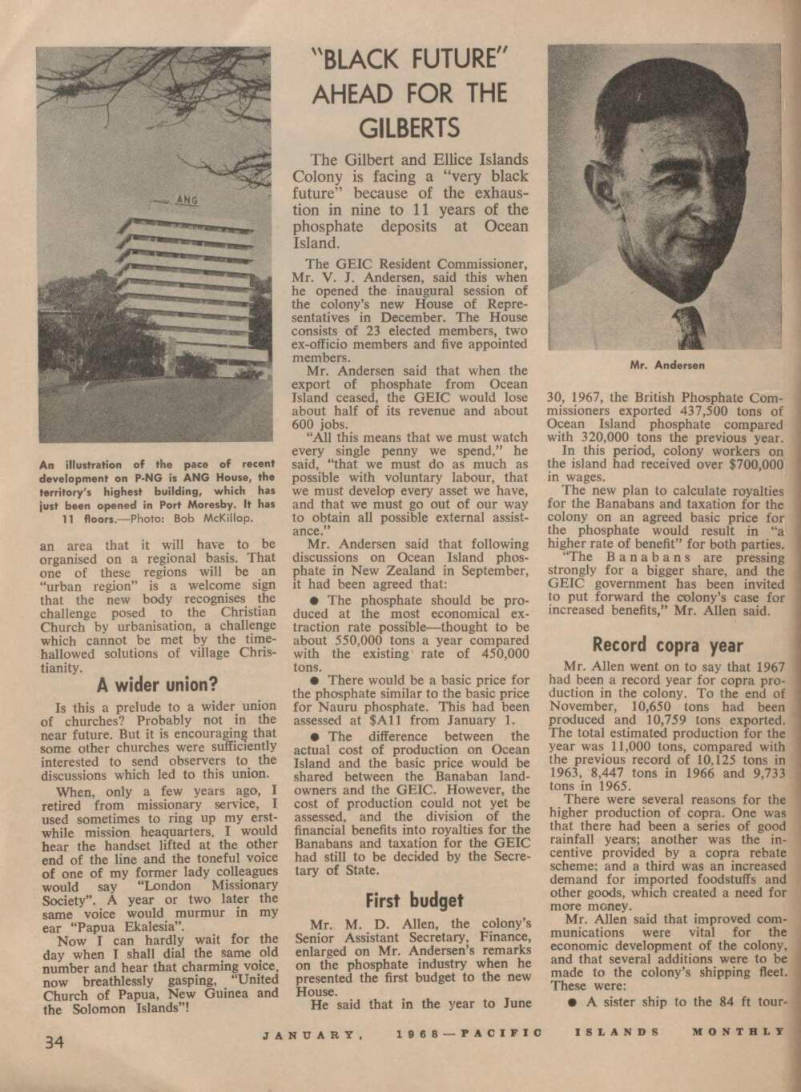
Mr. Andersen
ing vessel Tautunu, which began ser vice in August. The new ship, the Tabuariki, was almost ready for de livery from Singapore. • A 12-knot lagoon ferry to carry 56 passengers under construction in Britain. • A passenger vessel which the Crown Agents were negotiating to purchase in Yugoslavia. After con version, this ship would carry 10 first class, 24 second-class and 144 steer age passengers.
Mr. Allen said that the build-up of traffic on Fiji Airways’ new 748 turbo-prop jet was encouraging and flights were currently running full.
But unless an air link with the US Trust Territory and beyond could be established, there was unlikely to be a more frequent service or sub stantial tourist traffic.
Air traffic rights
“Negotiations for Pacific traffic rights are in progress at international levels, and the colony’s small voice is being raised as loudly as possible,”
Mr. Allen said.
He said little progress had yet been made with the construction of new airfields for an internal service.
However, a Royal Engineers’ major, on loan from the British Ministry of Defence, was due in the colony in January to take charge of construc tion operations, and the people of Abemama had already cleared a strip.
The Government was in touch with several private aeronautical firms that might be interested in operating the proposed internal ser vice.
Mr. Allen said that 56 per cent, of the colony’s imports in the year to June 30, 1967, had come from Aus tralia; 12 per cent, came from Britain, five per cent, from New Zea land, and 27 per cent, from other countries. He added; “In the 12 months ending June, 1967, our exports totalled $5,583,000 in value, of which $4,254,000 was phosphate and $1,253,000 was copra.
“In the same period we imported goods to the f.o.b. value of $3,600,000.
This represents an increase of nearly 20 per cent, over the previous 12 months.
“The increase is due to a large ex tent to the greater volume of imports needed for the increased development programme—b uild i n g materials, machinery and transport.
“But there has also been an in crease in imports of consumer goods.
Imports of foodstuffs were up by 18 per cent, over the previous year, im ports of beer doubled to 135,000 gallons, and imports of clothing and piece goods increased by 19 per cent.”