New Guinea Assembly Stakes...
pp. 34-36 · Read in the full issue
To The Point
With
Percy
Chatterton
They're lining up at the barrier for the New Guinea Assembly Stakes...
In Papua and New Guinea 1968 is election year, and the signs are that the elections for P-NG’s second House of Assembly are going to excite jar more interest, and a far more intelli gent interest, among the people at large than those of 1964. In the first place there is better understanding of the nature and work of the House. This is true even though it is also true that many voters continue to think of the worth of their member in terms of what he can bring home in the form of amenities — roads, bridges, schools, etc. —for his electorate.
In the second place there is better understanding of the mechanics of the electoral process. This is in part due to the educative effect of the 1964 elections, but still more to the adoption in local government elec tions of the same procedures as those used in national elections.
This means that since 1964 most of the people of the territory have had at least one trial run at the local level of the operation in which they will be taking part at the national level between February 17 and March 16.
On the other hand, there is still a lot of confused thinking over the two types of electorates, last time “open” and “special”, this time “open” and “regional”.
The territory is split up twice, once into a large number of small elec torates (the open electorates), and again into a small number of large electorates (the regional electorates), and every voter votes twice, once in his open and once in his regional electorate. And to make things more complicated local voters living out side the electorates in which they were born can choose between voting in the electorates in which they are resident and the electorates in which they were born.
New qualifications
In 1964, while the candidates in the open electorates could be of any race, those in the special elec torates had to be “non-native” and all were in fact Europeans. In the new regional electorates the qualifi cation for candidature will be an educational, not a racial one; and while one may welcome this change, the fact remains that it will make it harder for the unsophisticated voter to distinguish one from t’other.
So it is good news that, while the colour of the candidates will no longer offer the voters any clues, the colours of the ballot papers will. In 1964, voters were faced with a ballot paper which listed the can didates in the appropriate open and special electorates on one piece of paper, and not a few informal votes derived their informality from this snare.
This time, we are assured, the names of candidates in open and regional electorates will be printed on separate papers, white for open and coloured for regional electorates.
Complicating the situation, too, is the adoption of the Australian system of preference voting. In the early days of local government councils, voting was effected by the candidates standing up in an open space and their supporters lining up behind them. The candidate with the shortest tail dropped out, and his supporters joined another line to indicate their second choice. So the process of elimination continued.
Preferential system
This visual kind of preference voting was easy for Papuans and New Guineans to understand; but numbering names on a ballot paper is another story, especially when the number of candidates is considerable, as it was in 1964 and probably will be again this year.
Fortunately the electoral law pro vides that a vote is not informal if all preferences are not indicated; so long as the intention of the voter is clear the vote is valid. Had this not been so, the tally of informal votes in 1964 would have been very large indeed.
However, there are many people in the territory who think that the
preferential system is too difficult and too sophisticated for New Guinea, and that the British “first past the post” system would be more suitable.
The device of requiring a deposit, forfeitable if the candidate fails to secure a certain proportion of primary votes, originated, I believe, in Britain after World War I, and was intended to keep down the number of candidates standing in any one electorate by discouraging independent and splinter-party candi dates with little hope of success from giving it a go.
If this was the purpose of the intro duction of the device to New Guinea, where candidates have to pay down a deposit of fifty dollars, it did not achieve its purpose in 1964 and seems unlikely to do so in 1968. On the other hand it could well militate against adequate representation of the subsistence farmers who still form the bulk of the population.
The new House will be bigger than the old. It is amusing in retrospect to recall that when, in the early 1960’5, the Foot Report (the report to the Trusteeship Council of a UN Mission headed by Sir Hugh Foot of Britain) recommended a legislature of 100 members, there were howls of derision from within the territory.
“Far too big”, “Quite unnecessary”, were among the milder comments.
Not long after, the House of As sembly was established with 64 members. The new House will number 94. as near as maybe to Sir Hugh Foot’s figure.
It is fashionable these days in the territory to deride the UN in general and the Trusteeship Council in particular: and there can be no doubt that some very foolish state ments have somethimes been made by members of UN Missions and have
even found their way into resolutions of the General Assembly.
The demand for “free elections” in the territory, three years after the Administration had leant over back wards in its efforts to ensure that the 1964 election should be as free as they possibly could be, is a glaring example of such foolishness.
But, these gaucheries should not blind us to the fact that from time to time the UN has come up with some very on-the-ball criticisms and some very constructive recommenda tions, which have sometimes, perhaps, prodded the Australian Government and the territory’s Administration into actions which would not other wise have been taken or which would have been taken more tardily.
I remember one occasion in the House when a succession of speakers rose to “rubbish” the UN. At the coffee break I joined an astringent academic who had been listening from the public gallery.
“They don’t seem to realise”, he commented, “that if it wasn’t for the UN they probably wouldn’t be here”.
I suppose that the UN crack about free elections was really aimed at the special electorates. It is just as well that they have been eliminated.
But it is worth recalling that they were introduced in response to the strongly expressed desire of the native people of the territory that a means should be founded of ensuring that there would be some non-official European members in its first elected legislature.
It is a fact that the 10 Europeans elected to represent these electorates have tended to be anti-rather than pro-Administration, and that there has never been anything approaching a bloc vote of European members.
Even if there had been, it could have been defeated by a bloc vote of indigenous members.
What now?
What will be the position in the new House?
As native and non-native candidates will be opposing one another in both open and regional electorates, it is impossible to foresee how many Euro pean members will be elected. But those who do show up in the House next June will have got there on a predominantly native vote, and it is even more unlikely than it was in
the old House that they will ever vote as a bloc.
The votes on which the Govern ment will be able to rely will be those of the 10 official members plus those of the elected members who will become members of the Admin istrator’s Executive Council and of some others who, though not in the council, will hold assistant-ministerial rank.
If my arithmetic is correct, they will number 25 in a House of 94.
So the Government will still have to woo a substantial number of “free” votes to get its majorities.
Will it also have to woo the sup port of party blocs? We now have five parties. Reading from left to right (on my rating, though it’s hard to be sure!) they are: PANGU, United Christian Democratic, National Progressive (NAPRO), Ter ritory Country and All Peoples.
How many candidates will they field? How many of these will win seats? How many members elected as independents will later declare allegiance to one or other of them?
We shall know the answers to the first two questions quite soon, and to the third perhaps by the end of 1968.
In the meantime, one thing is for sure. In 1968 the vast majority of voters will vote for a person, not for a party. In 1972 it may be other wise. fpURNING from politics to A religion, the new year will bring another important event in the pro gress of the territory—a union of churches. The uniting churches are the Papua Ekalesia, the Port Moresby
United Church, and the Methodist churches in Papua, New Guinea and the British Solomon Islands Protec torate, and they will unite under the name of “The United Church of Papua, New Guinea and the Solomon Islands”, a collocation of initials which no amount of ingenuity can weld into a pronounceable name in the same way as that in which the Evangelical Lutheran Church of New Guinea has become ELCONG.
How church has grown
'Hie Papua Ekalesia is the church which has grown out of the work of the London Missionary Society, which began near Port Moresby in 1872 and spread along the whole southern coastline of Papua and into much of the hinterland on the southern side of the main range.
The Port Moresby United Church grew out of an English language church established by the LMS in the 1890’s in the then tiny township of Port Moresby.
Since the war it has been under the control of the United Church Board, a Congregational-Presbyterian- Methodist link-up which is also responsible for united churches in Darwin and Alice Springs; and, with the upsurge of secondary and tertiary education, it has drawn an increasing number of English-speaking Papuans and New Guineans into its ambit.
The Methodist churches which will be participating in the union are the product of the missionary effort of Australian and New Zealand Methodism since the 1880 s.
The new church will cover so large
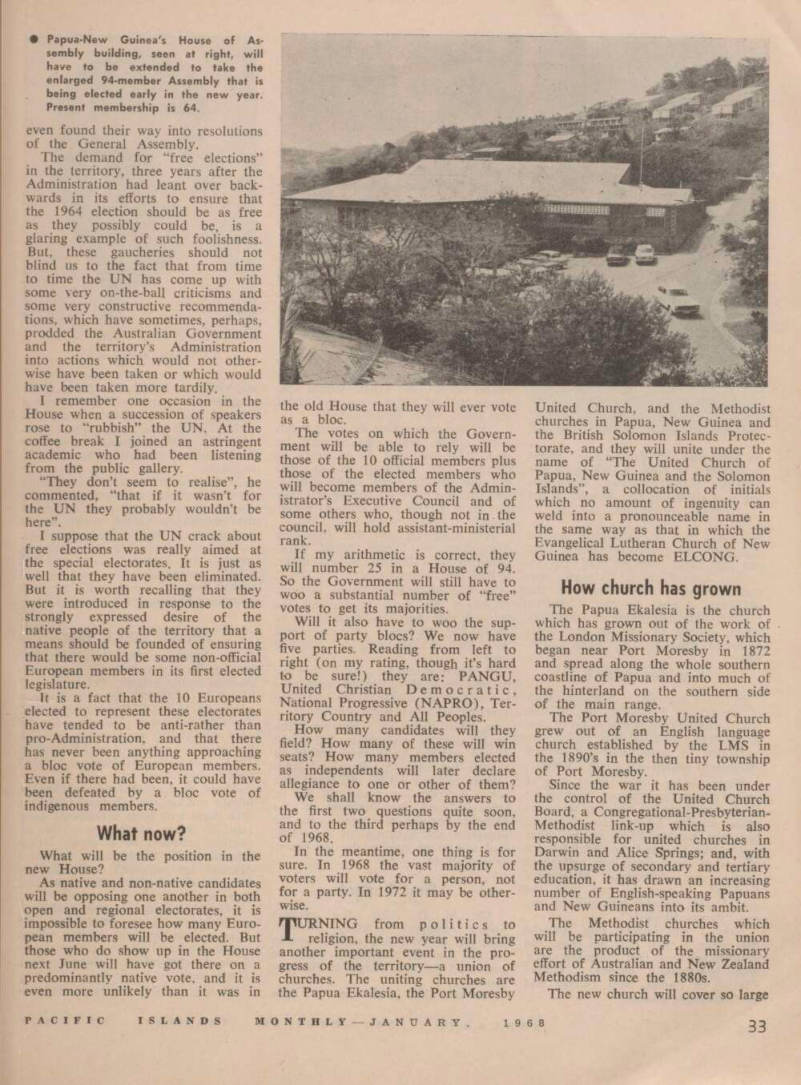
Papua-New Guinea's House of As sembly building, seen at right, will have to be extended to take the enlarged 94-member Assembly that is being elected early in the new year.
Present membership is 64.
an area that it will have to be organised on a regional basis. That one of these regions will be an “urban region” is a welcome sign that the new body recognises the challenge posed to the Christian Church by urbanisation, a challenge which cannot be met by the time hallowed solutions of village Chris tianity.
A wider union?
Is this a prelude to a wider union of churches? Probably not in the near future. But it is encouraging that some other churches were sufficiently interested to send observers to the discussions which led to this union.
When, only a few years ago, I retired from missionary service, I used sometimes to ring up my erst while mission heaquarters. I would hear the handset lifted at the other end of the line and the toneful voice of one of my former lady colleagues would say “London Missionary Society”. A year or two later the same voice would murmur in my ear “Papua Ekalesia”.
Now I can hardly wait for the day when I shall dial the same old number and hear that charming voice, now breathlessly gasping, “United Church of Papua, New Guinea and the Solomon Islands”!
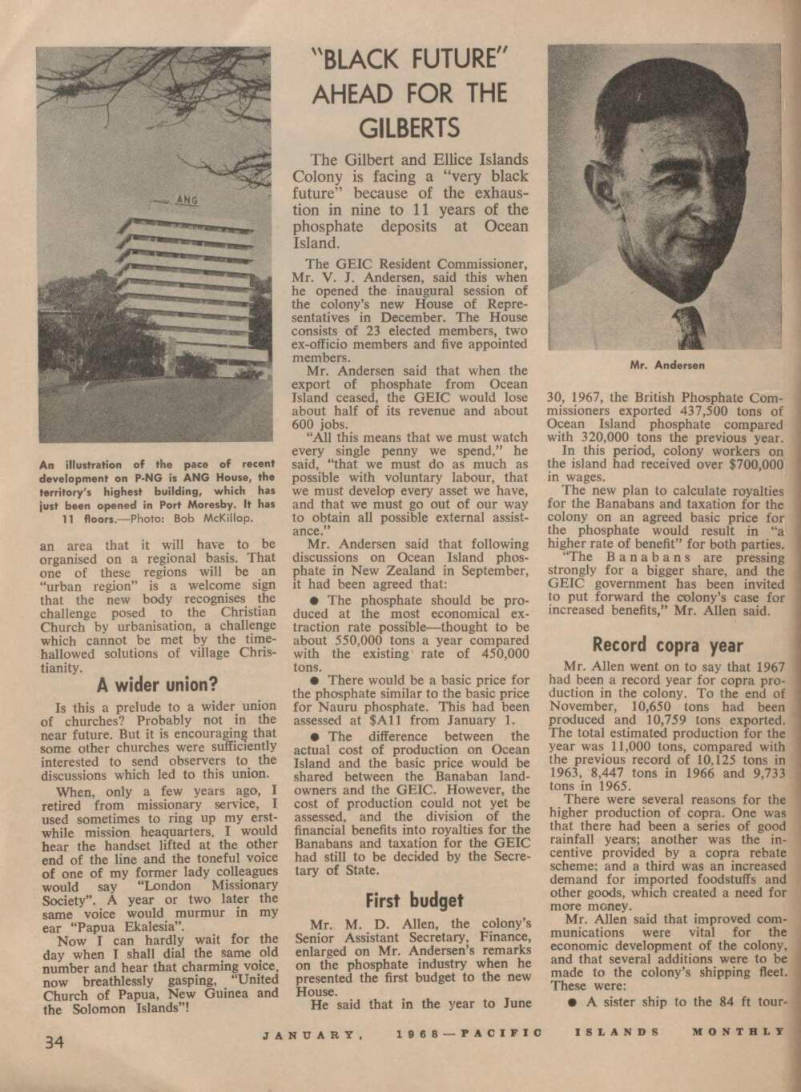
An illustration of the pace of recent development on P-NG is ANG House, the territory's highest building, which has just been opened in Port Moresby. It has 11 floors. Photo: Bob McKillop.