Museum; Now
p. 95 · Read in the full issue
First A Gauguin
One For Loti
By a staff writer
The success as a tourist draw ird of the Paul Gauguin
luseum at Papeari, Tahiti, has
ispired that island’s tourist jthorities to draw up plans for similar museum to com lemorate the French novelist ierre Loti.
OTI, whose real name was Julien * Viaud, visited Tahiti as a young ival officer in the frigate Flore for veral weeks in 1872.
This glimpse of Tahiti in the later ys of Queen Pomare IV, when the and was still only a French protec rate and not a fully-fledged colony, spired him to write a romantic •vel describing an idyllic love affair tween himself and a young native '1 called Rarahu. It also painted vivid word picture of the Tahiti of ose times.
The novel was first published in iris under the title, Rarahu, Idyle *lynesienne, in 1879. It has since en republished in numerous French itions as the Mariage de Loti, and is 11 popular in the French-speaking )rld.
Translation
An English translation appeared in 25, but the story is rather too itimental for Anglo-Saxon tastes, d there are probably few English ;aking people these days who have sr read it.
The idea of building a museum to ti was first mooted after the Gov lor of French Polynesia, Mr. Jean :urani, returned from a visit to ris in July.
At a Press conference on his Paris p, Mr. Sicurani said that the iseum was “still in the realm of ;ams”, but that if it could be built, would house relics and documents the later days of Queen Pomare and of Loti’s connection with hiti. ; ‘At present,” the Governor went , “the Maison Loti project lacks patron, it lacks cash, and it lacks id for the building. But it does least have the precedent of the uguin Museum, which was opened Papeari two or three years ago.”
Since July, means have apparently ;n found to finance the museum
project, for early in September it was announced that the administrative council of Tahiti’s Office de Develop ment du Tourisme had decided to go ahead with it. An inquiry is now being made to determine how the project can best be carried out.
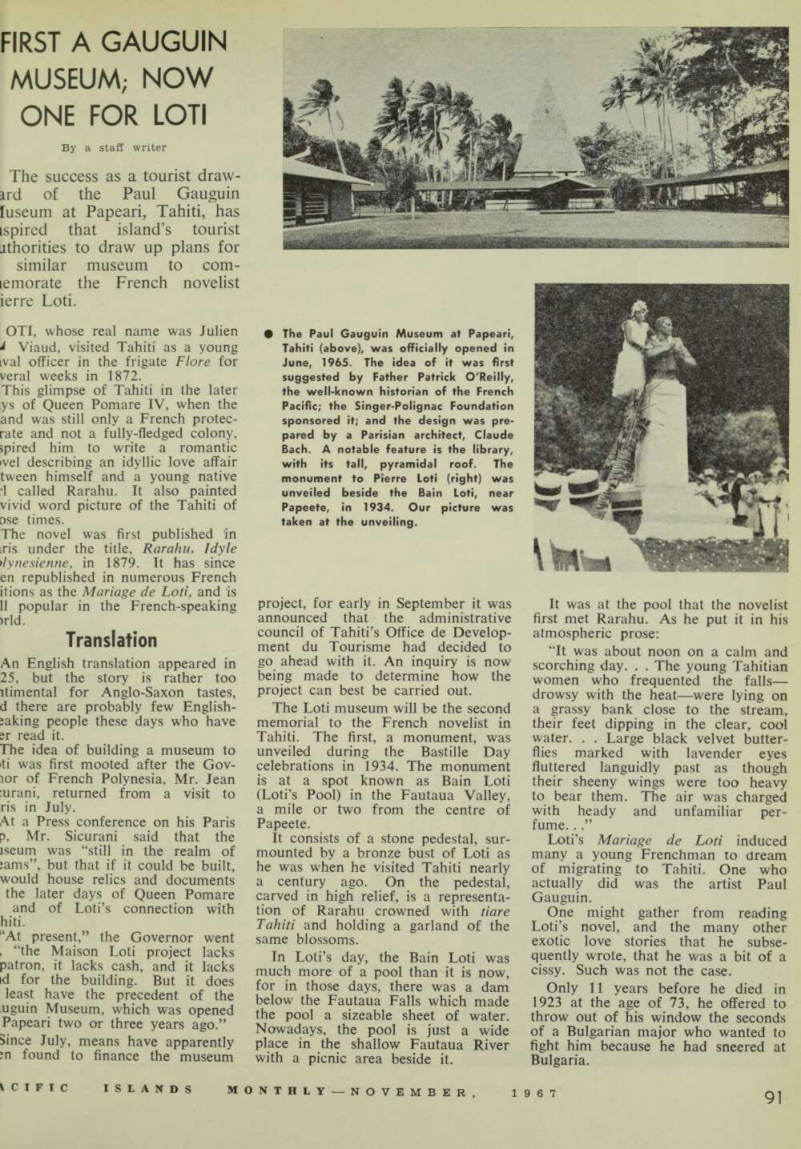
The Loti museum will be the second memorial to the French novelist in Tahiti. The first, a monument, was unveiled during the Bastille Day celebrations in 1934. The monument is at a spot known as Bain Loti (Loti’s Pool) in the Fautaua Valley, a mile or two from the centre of Papeete.
It consists of a stone pedestal, sur mounted by a bronze bust of Loti as he was when he visited Tahiti nearly a century ago. On the pedestal, carved in high relief, is a representa tion of Rarahu crowned with tiare Tahiti and holding a garland of the same blossoms.
In Loti’s day, the Bain Loti was much more of a pool than it is now, for in those days, there was a dam below the Fautaua Falls which made the pool a sizeable sheet of water.
Nowadays, the pool is just a wide place in the shallow Fautaua River with a picnic area beside it.
It was at the pool that the novelist first met Rarahu. As he put it in his atmospheric prose: “It was about noon on a calm and scorching day. . . The young Tahitian women who frequented the falls— drowsy with the heat—were lying on a grassy bank close to the stream, their feet dipping in the clear, cool water. . . Large black velvet butter flies marked with lavender eyes fluttered languidly past as though their sheeny wings were too heavy to bear them. The air was charged with heady and unfamiliar per fume. ..”
Loti’s Mariage de Loti induced many a young Frenchman to dream of migrating to Tahiti. One who actually did was the artist Paul Gauguin.
One might gather from reading Loti’s novel, and the many other exotic love stories that he subse quently wrote, that he was a bit of a cissy. Such was not the case.
Only 11 years before he died in 1923 at the age of 73, he offered to throw out of his window the seconds of a Bulgarian major who wanted to fight him because he had sneered at Bulgaria.
• The Paul Gauguin Museum at Papeari, Tahiti (above), was officially opened in June, 1965. The idea of it was first suggested by Father Patrick O'Reilly, the well-known historian of the French Pacific; the Singer-Polignac Foundation sponsored it; and the design was pre pared by a Parisian architect, Claude Bach. A notable feature is the library, with its tall, pyramidal roof. The monument to Pierre Loti (right) was unveiled beside the Bain Loti, near Papeete, in 1934. Our picture was taken at the unveiling.