Yesterday
p. 97 · Read in the full issue
Marching Rule, a cargo cult movement in the Solomons, was in the news in PIM 20 years ago this month. United States wartime troops with large amounts of money to spend were thought to have started the movement, which began on Malaita and, over two years, had spread to Isabel, Guadalcanal and other islands. In North Malaita, natives had built 43 houses, which stood empty waiting for goods and cargoes to come from across the sea. The BSIP Government had gaoled 35 natives, not for being Marching Rule members, but for setting up illegal courts and imprisoning and fining other natives.
OTHER items in PIM, for November, 1947, included:
MEAT-STARVED territorians
in New Guinea were in for some relief because Mr. A. W.
Anderson, Sydney’s “sausage king”, was sending his ship, Wayama, to Lae and Rabaul with a cargo of meat, “Presum ably Mr. Anderson is not in this business for the good of his health, but if the venture is suc cessful and the territory is assured of a plentiful supply of fresh meat, territorians will rise up as one, and call his name blessed,”
PIM said.
Steamships Trading Co. Ltd., Burns Philp’s only serious competitor in Papua, reported a record profit of £34,314 and paid a 10 per cent, dividend for the year ended July 31, 1947. During
the Japanese invasion in 1942-44, the company had faced almost complete ruin but it had re covered and was in a sound position.
A CATALINA plane, owned by the Societe Francaise de Transports Aeriens du Pacifique Sud, had inaugurated a monthly air service from Noumea to Tahiti with calls at the New Hebrides, Fiji, Samoa, Tonga and the Cooks.
The single fare was £AIOO.
MR. Nicolas (“Tibby”) Hagen, well-known throughout the South Pacific in commerce circles, died in Noumea on November 3, aged 68, He was so well-known that when a friend in Paris sent out a cablegram addressed simply "Tibby, South Pacific”, it was delivered to Mr. Hagen in Nou mea within a few hours.
ALONE Japanese soldier had been captured on Guadal canal, where the war had been over for more than two years.
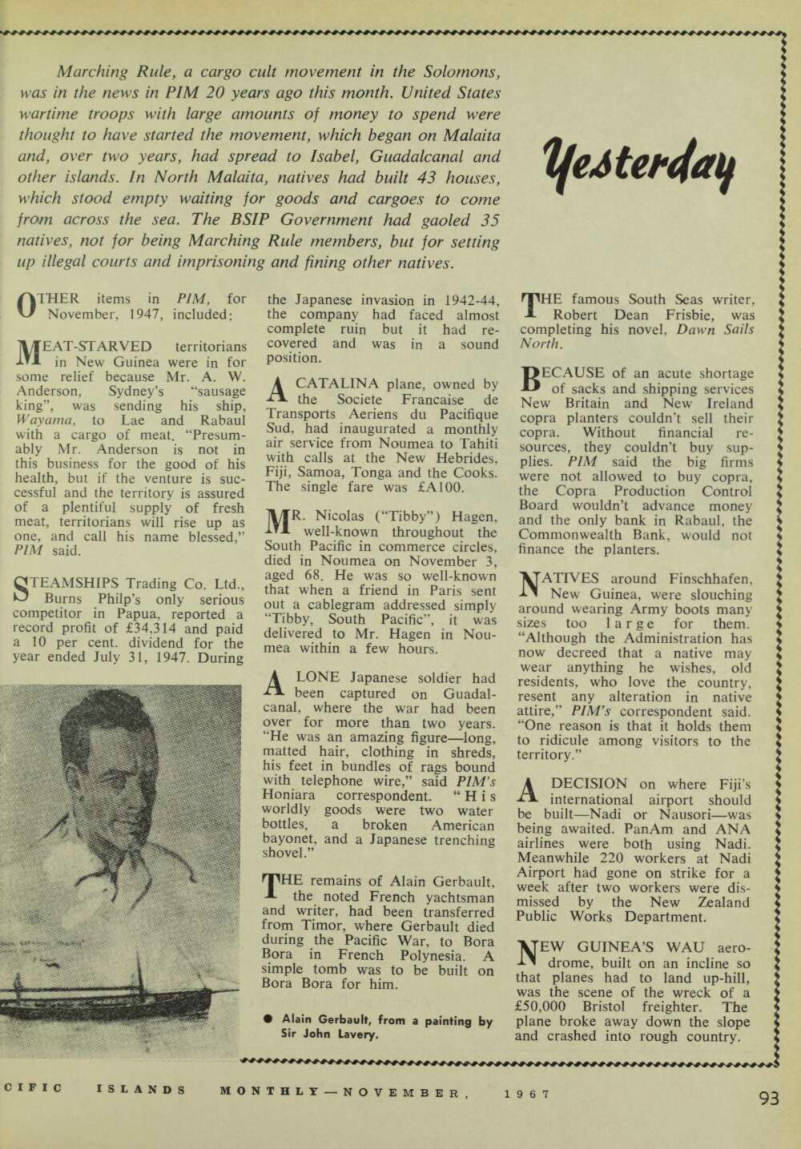
“He was an amazing figure—long, matted hair, clothing in shreds, his feet in bundles of rags bound with telephone wire,” said PlM’s Honiara correspondent. “His worldly goods were two water bottles, a broken American bayonet, and a Japanese trenching shovel.” remains of Alain Gerbault, -I- the noted French yachtsman and writer, had been transferred from Timor, where Gerbault died during the Pacific War, to Bora Bora in French Polynesia. A simple tomb was to be built on Bora Bora for him.
THE famous South Seas writer, Robert Dean Frisbie, was completing his novel, Dawn Sails North.
BECAUSE of an acute shortage of sacks and shipping services New Britain and New Ireland copra planters couldn’t sell their copra. Without financial re sources, they couldn’t buy sup plies. PIM said the big firms were not allowed to buy copra, the Copra Production Control Board wouldn’t advance money and the only bank in Rabaul, the Commonwealth Bank, would not finance the planters.
NATIVES around Finschhafen, New Guinea, were slouching around wearing Army boots many sizes too large for them.
“Although the Administration has now decreed that a native may wear anything he wishes, old residents, who love the country, resent any alteration in native attire,” PlM’s correspondent said.
“One reason is that it holds them to ridicule among visitors to the territory.”
A DECISION on where Fiji’s international airport should be built—Nadi or Nausori—was being awaited. PanAm and ANA airlines were both using Nadi.
Meanwhile 220 workers at Nadi Airport had gone on strike for a week after two workers were dis missed by the New Zealand Public Works Department.
New Guinea’S Wau Aero
drome, built on an incline so that planes had to land up-hill, was the scene of the wreck of a £50,000 Bristol freighter. The plane broke away down the slope and crashed into rough country.
• Alain Gerbault, from a painting by Sir John Lavery.