dogs, pearl shell
pp. 91-93 · Read in the full issue

Croc, skins, bikes, dogs, pearl shell tor 50 years they were his business
By staff writer KEN McGREGOR
Two days after joining Burns Philp and Co. Ltd. in June, 1915, as a junior clerk in the
firm’s Island shipping depart
ment, 16-year-old Bill Morrison was in strife.
He was attending a meeting in BP’s old offices in Bridge Street, Sydney, opposite their familiar head quarters of today. Colonel James Burns and other directors of the firm were present.
A short, red faced man called out “Harry”, once, twice and then three times—the last time glaring at Mor rison.
“My name’s not Harry, sir,” Mor rison told the man, hesitantly.
“1 don’t care what your name is, sonny,” the red-faced man said, “you’re in Harry’s old office and that’s good enough for me.”
The red-faced man, it turned out was Mr. Adam Forsyth, a BP direc tor, and such was the authority of such august personages in those days that it was several years before Bill Morrison was recognised as Bill instead of Harry.
Mr. Morrison told me this on his retirement from BP’s recently after nearly 50 years’ service.
Forty-six years of this time was spent buying, selling and handling Islands produce. For many years he was head of the firm’s produce department, and for the last three years he controlled BP’s shipping fleet as the general shipping manager.
Mr. Morrison in his time handled so many varieties of Islands produce that he took a good 10 minutes to remember them all.
The list is a veritable Who’s Who of Pacific Islands products—copra, pearl shell, green snail shell, beche de-mer, cocoa, coffee, ivory nuts, trochus, rubber, Papuan gum, turtle shell, gold, crocodile skins and Birds of Paradise feathers.
Supercargoes
“When I joined the firm, they still had two supercargoes Arthur Haynes, who covered the Marshall Islands, and Robert Etheridge, who worked in the New Hebrides,” Mr.
Morrison said. “Neville Chatfield, who had previously worked the Gilberts and Solomons, had just left.
“Etheridge was a naturalist, and whenever he was in the Hebrides, which was pretty often, he used to buy skeletons from the native burial grounds. He resold the skeletons to museums all over the world and died a wealthy man.
“Skeletons were probably the only
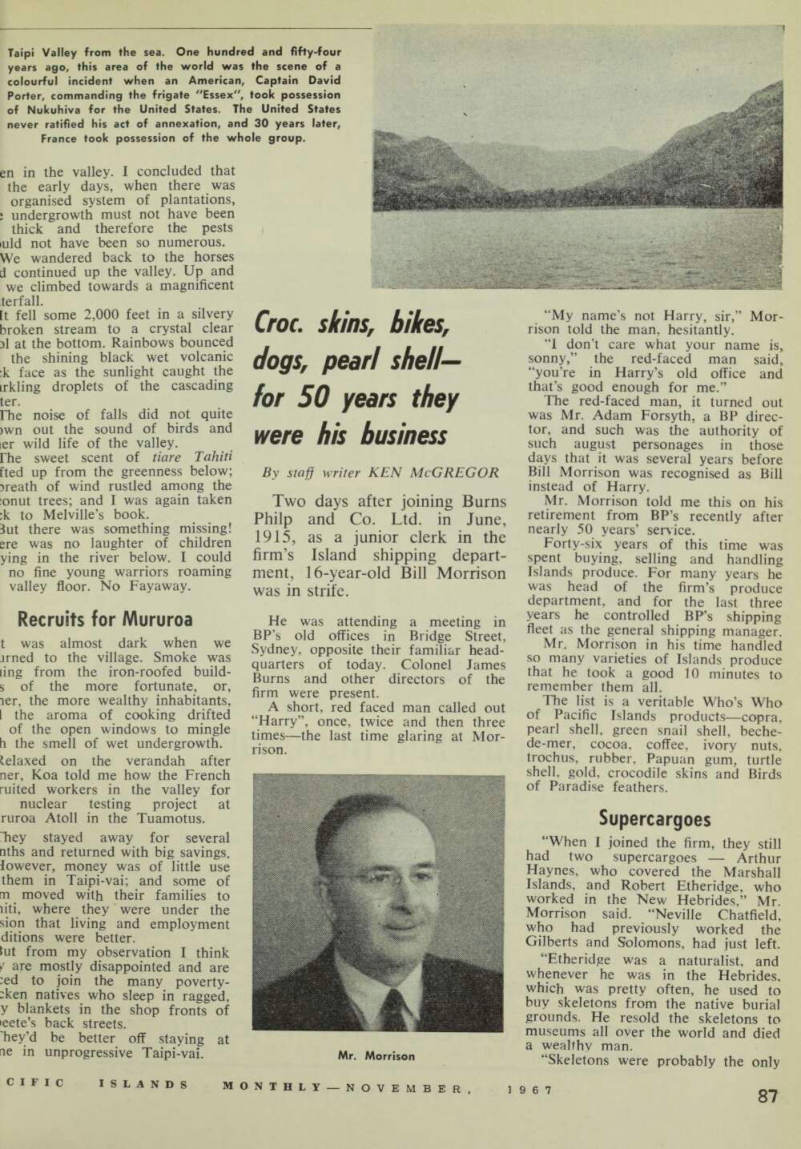
Taipi Valley from the sea. One hundred and fifty-four years ago, this area of the world was the scene of a colourful incident when an American, Captain David Porter, commanding the frigate "Essex", took possession of Nukuhiva for the United States. The United States never ratified his act of annexation, and 30 years later, France took possession of the whole group.
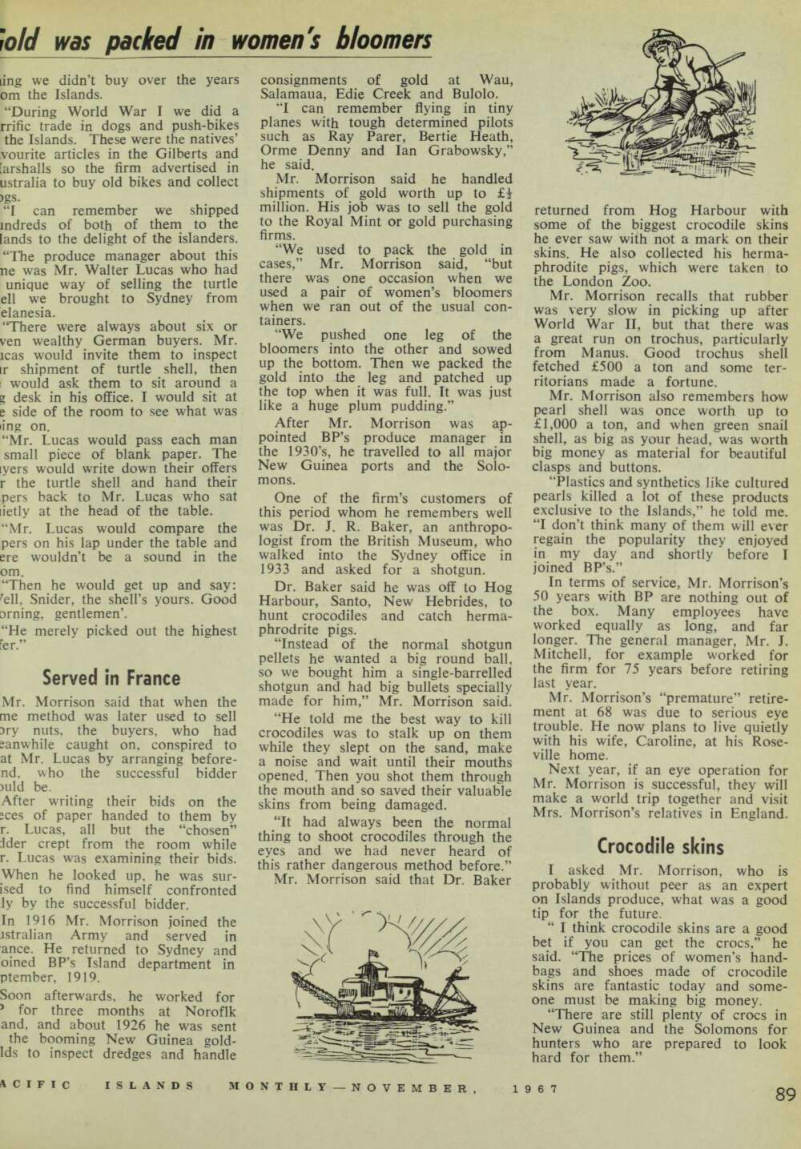
Mr. Morrison
hid was packed in women's bloomers
ling we didn’t buy over the years om the Islands.
“During World War I we did a rrific trade in dogs and push-bikes the Islands. These were the natives’ vourite articles in the Gilberts and [arshalls so the firm advertised in ustralia to buy old bikes and collect )gs.
“I can remember we shipped mdreds of both of them to the lands to the delight of the islanders.
“The produce manager about this ne was Mr. Walter Lucas who had unique way of selling the turtle ell we brought to Sydney from elanesia.
“There were always about six or ven wealthy German buyers. Mr. icas would invite them to inspect ir shipment of turtle shell, then i would ask them to sit around a g desk in his office. I would sit at e side of the room to see what was ing on.
“Mr. Lucas would pass each man small piece of blank paper. The lyers would write down their offers r the turtle shell and hand their pers back to Mr. Lucas who sat lietly at the head of the table.
“Mr. Lucas would compare the pers on his lap under the table and ere wouldn’t be a sound in the om.
“Then he would get up and say: Snider, the shell’s yours. Good arning, gentlemen’.
“He merely picked out the highest fer.”
Served in France
Mr. Morrison said that when the me method was later used to sell 3ry nuts, the buyers, who had sanwhile caught on, conspired to at Mr. Lucas by arranging before nd. who the successful bidder )uld be.
After writing their bids on the ;ces of paper handed to them by r. Lucas, all but the “chosen”
Jder crept from the room while r. Lucas was examining their bids.
When he looked up, he was sur ised to find himself confronted ly by the successful bidder.
In 1916 Mr. Morrison joined the jstralian Army and served in ance. He returned to Sydney and oined BP’s Island department in ptember, 1919.
Soon afterwards, he worked for 5 for three months at Noroflk and, and about 1926 he was sent the booming New Guinea gold ids to inspect dredges and handle
consignments of gold at Wau, Salamaua, Edie Creek and Bulolo, “I can remember flying in tiny planes with tough determined pilots such as Ray Parer, Bertie Heath, Orme Denny and lan Grabowsky,” he said.
Mr. Morrison said he handled shipments of gold worth up to £i million. His job was to sell the gold to the Royal Mint or gold purchasing firms.
“We used to pack the gold in cases,” Mr. Morrison said, “but there was one occasion when we used a pair of women’s bloomers when we ran out of the usual con tainers.
“We pushed one leg of the bloomers into the other and sowed up the bottom. Then we packed the gold into the leg and patched up the top when it was full. It was just like a huge plum pudding.”
After Mr. Morrison was ap pointed BP’s produce manager in the 1930’5, he travelled to all major New Guinea ports and the Solo mons.
One of the firm’s customers of this period whom he remembers well was Dr. J. R. Baker, an anthropo logist from the British Museum, who walked into the Sydney office in 1933 and asked for a shotgun.
Dr. Baker said he was off to Hog Harbour, Santo, New Hebrides, to hunt crocodiles and catch herma phrodrite pigs.
“Instead of the normal shotgun pellets he wanted a big round ball, so we bought him a single-barrelled shotgun and had big bullets specially made for him,” Mr. Morrison said.
“He told me the best way to kill crocodiles was to stalk up on them while they slept on the sand, make a noise and wait until their mouths opened. Then you shot them through the mouth and so saved their valuable skins from being damaged.
“It had always been the normal thing to shoot crocodiles through the eyes and we had never heard of this rather dangerous method before.”
Mr. Morrison said that Dr. Baker
returned from Hog Harbour with some of the biggest crocodile skins he ever saw with not a mark on their skins. He also collected his herma phrodite pigs, which were taken to the London Zoo.
Mr. Morrison recalls that rubber was very slow in picking up after World War 11, but that there was a great run on trochus, particularly from Manus. Good trochus shell fetched £5OO a ton and some ter ritorians made a fortune.
Mr. Morrison also remembers how pearl shell was once worth up to £l,OOO a ton, and when green snail shell, as big as your head, was worth big money as material for beautiful clasps and buttons.
“Plastics and synthetics like cultured pearls killed a lot of these products exclusive to the Islands,” he told me.
“I don’t think many of them will ever regain the popularity they enjoyed in my day and shortly before I joined BP’s.”
In terms of service, Mr. Morrison’s 50 years with BP are nothing out of the box. Many employees have worked equally as long, and far longer. The general manager, Mr. J.
Mitchell, for example worked for the firm for 75 years before retiring last year.
Mr. Morrison’s “premature” retire ment at 68 was due to serious eye trouble. He now plans to live quietly with his wife, Caroline, at his Rose ville home.
Next year, if an eye operation for Mr. Morrison is successful, they will make a world trip together and visit Mrs. Morrison’s relatives in England.
Crocodile skins
I asked Mr. Morrison, who is probably without peer as an expert on Islands produce, what was a good tip for the future.
“ I think crocodile skins are a good bet if you can get the crocs,” he said. “The prices of women’s hand bags and shoes made of crocodile skins are fantastic today and some one must be making big money.
“There are still plenty of crocs in New Guinea and the Solomons for hunters who are prepared to look hard for them.”