Melville’s cannibal valley
pp. 89-91 · Read in the full issue
Typee Revisited: A Trek To
I It is now more than 120 years since the American novelist Herman Melville, then a young sailor, spent several months among the cannibals of Taipi Valley on Nukuhiva, Marquesas Islands, after deserting from a whaling ship. In those days, the valley supported a thriving population. Melville's experiences among the "Typees" provided him with the material for his first book. Today, the Taipi Valley is largely deserted and is seldom visited. Here one of its rare visitors,Australian yachtsman Ken Mills, tells what it is like . . .
By Ken Mills
Herman Melville will live long in the minds of all those who go down to the sea in small ships and no doubt many will recall one of his earlier books, Typee.
This book, first published in 1846, tells of the writer’s adventures as captive of a cannibal tribe who inhabited Taipi-vai, an enchanting valley on the island of Nukahiva, Marquesas.
RECENTLY I visited this remote valley, but unlike Melville, I lew what was on the other side of e Nukahiva plateau. Yet the ivenutre was nonetheless exciting.
It was early morning when I set f to climb the forbidding mountains irrounding the valley of Taiohae, id it was not until the sun was well ftv the zenith that I could look >wn on the tiny white yacht in [uch I had come *° Nukahiva, mg peacefully m the bay far below.
The hardest part of the trek over, continued on across sunburnt lling hills. Here and there a clump pandanus trees broke the monony; a herd of wild cattle grazed i a distant hillside; clouds raced dsc overhead. Some of the clouds emed so close that I imagined I and reach up and grab one of them ±ey were borne westward by the ssh trade wind.
Suddenly my eyes focused on a le of black volcanic rocks just to
the left of the track. Closer inspec tion showed that they were carved, but the carvings were not the doing of some recent passer-by.
They were grotesque faces, with huge gaping mouths and eyes sur rounded by crazy concentric circles.
Ancient fortress
Although some of the rocks were worn by ages of wind and rain, for the most part they were pretty much as they must have been in the days when the strong Taipi tribe waged war against the weaker tribes of the Haapa and Taiohae valleys.
I was standing on an ancient fortress, a sort of no-man’s land, beyond which no warrior dared trespass without fear of losing his life. Now there was nothing more fierce to be seen than a couple of mountain ponies nudging each other in the shade of a lonely pandanus tree.
As I walked along, the narrow path I passed a group of pae paes (house platforms) which showed that in times gone by many people must have lived on the plateau of Nuka hiva, mostly in the depressions between the ridges, and nearer Taipi vai than Taiohae valley.
Soon I was half-running, half sliding down the steep descent into lush Taipi-vai.
A silvery waterfall sparkled and ant-like figures were moving about on the black sand beach where the blue Pacific waves dashed themselves to a foamy death.
Except for the few iron roofs that reflected the waning sunlight, the scene must have been exactly the same as that which Melville saw more than 100 years ago.
Children giggled
Possibly many more people roamed the valley floor, maybe he even heard the crying of children.
Once down in the valley, I waded across a swiftly flowing mountain stream which meandered through its centre. People silently stared as I walked along a roadway towards a shop. Children giggled and some even stepped off the path to let me pass.
Then a woman’s voice called: “Attend!”
I spun round to see a middle-aged but well-preserved Polynesian woman hurriedly making her way towards me. “I am Koa Clarke,” she said in French. “Where have you come from?”
“I have walked over from Taiohae Bay after arriving from Tahiti in a yacht,” I replied as well as my poor French would permit. (Over)
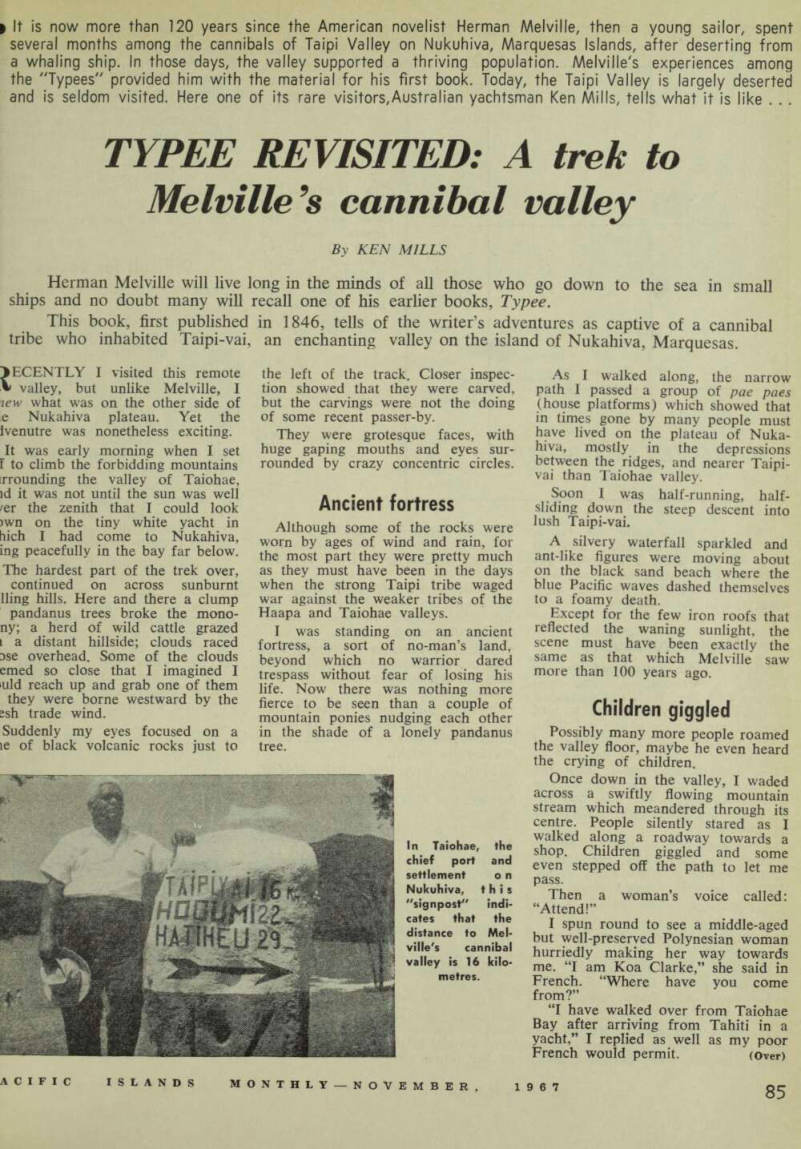
In Taiohae, the chief port and settlement on Nukuhiva, this "signpost" indi cates that the distance to Mel ville's cannibal valley is 16 kilo metres.
“Well you must come and stay at my house,” she insisted. “Stay as long as you like”. I accepted this unexpected invitation and went with her to a two-storey house, the most luxurious in the valley.
Limited vocabulary
Mme, Clarke introduced me to Lucien, a Frenchman, who was staying with her. With my somewhat limited French vocabulary, I told them of my interest in the old Poly nesian culture, and Koa suggested that I take a ride with her up the valley, where she would show me an ancient temple—a relic of the times before the white man had left his unsavoury mark on the valley and its inhabitants.
I mounted one of the horses she fetched and slid into the unique wooden saddle as comfortably as my Western posterior would allow.
As we rode up the valley, it was not too hard to picture the many dark, healthy warriors whom Melville wrote about.
The many fruit and coconut trees by the wayside showed that the valley could once have supported a thriving community.
The many pae paes by the side of the narrow track could easily have been crowned with thatched huts,
although the brightly-coloured pareus which hung in the open windows of the few houses spoiled the image a little.
Suddenly we swung off the main track and the unshod ponies climbed the steep muddy hillside with the agility of mountain goats.
When we came to a clearing, Koa told me to dismount and follow her into the dense foliage 50 yards or so further up the hill.
To my amazement I found that we were in a level area of crumbling ruins surrounded by stone tikis, some six feet in height.
Further back, and half hidden, were more tikis. Some were upright but most of them had tumbled on to their sides.
Koa explained that this was the remains of what once was the temple of the Taipi tribe. It was here that they used to hold their sacrifices and occasionally decapitate an enemy warrior before devouring him.
From the descriptions in Melville’s Typee, I could almost have rebuilt the temple and filled it with hundreds of handsome warriors waiting to feast.
After a very uncomfortable and somewhat scaring ride back to Koa’s house, Lucien suggested that we take a swim in the river just in front of her house.
I stripped off and dived into the] cold, refreshing water. It helped stop the aches and pains from unac
customed horse-riding.
The water was deep and clear: and for almost half an hour I swam in the stream. But there was no Fay a way that Melville spoke about— only one Australian, one Frenchman and half-a-dozen brindle children of vague ancestry splashing and talking in a mixture of Polynesian, pidgin- French and a word or two of English, more often than not used completely out of context.
Difficult for ponies
Next day Koa and I set off to the end of the valley.
As we left the scattered huts of the village, the track became difficult even for the mountain-bred ponies to traverse.
Among the thick foliage beside the track I noticed scores of pae paes, most of them obviously had not been used for many years.
There were bridges and retaining walls to stop the rivulets washing away the gardens.
Koa dismounted and told me to do likewise. I followed her through dense undergrowth to where there was a larger than usual pae pae nestling beneath towering black cliffs.
A clear mountain stream ran through what must have once been the front yard.
This was the place where Mel ville had lived, according to Koa.
She showed me the different rooms, the remains of a stone oven, and the low walls that surrounded the house. Meanwhile, I slapped the an noying no-no flies from my legs and wondered if these pests had always
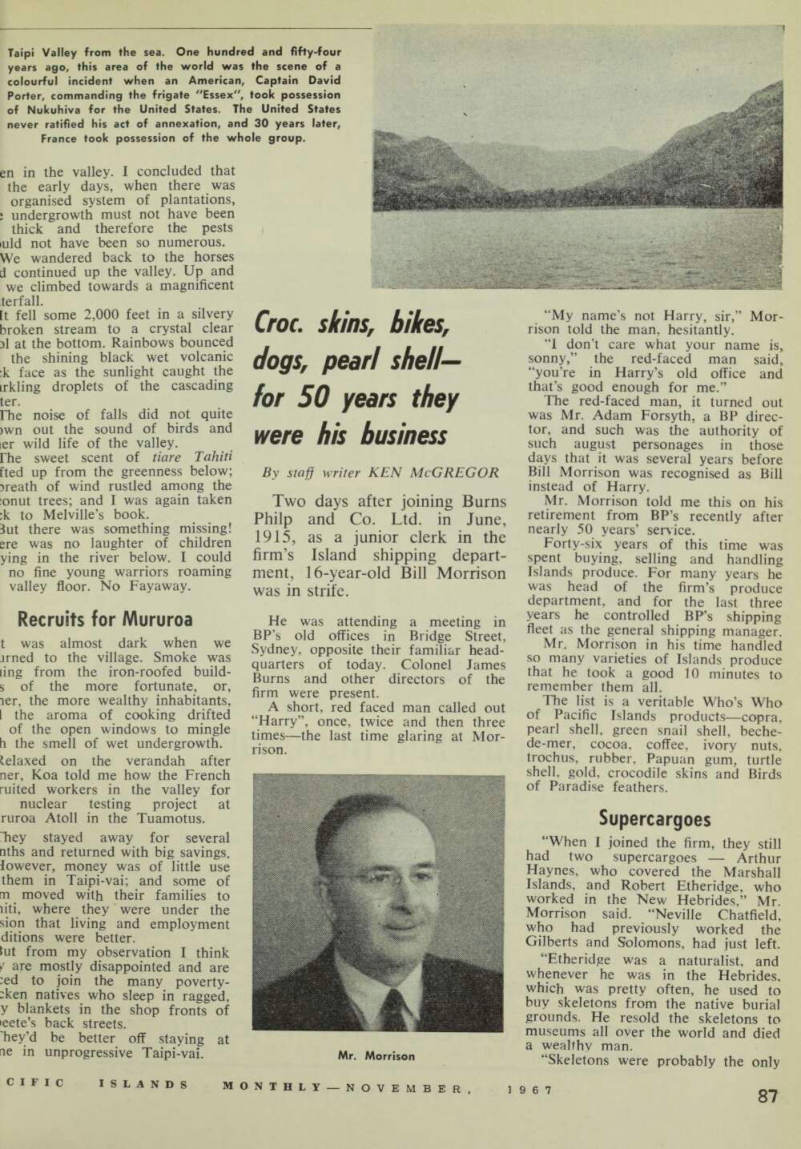
A Marquesan tiki.
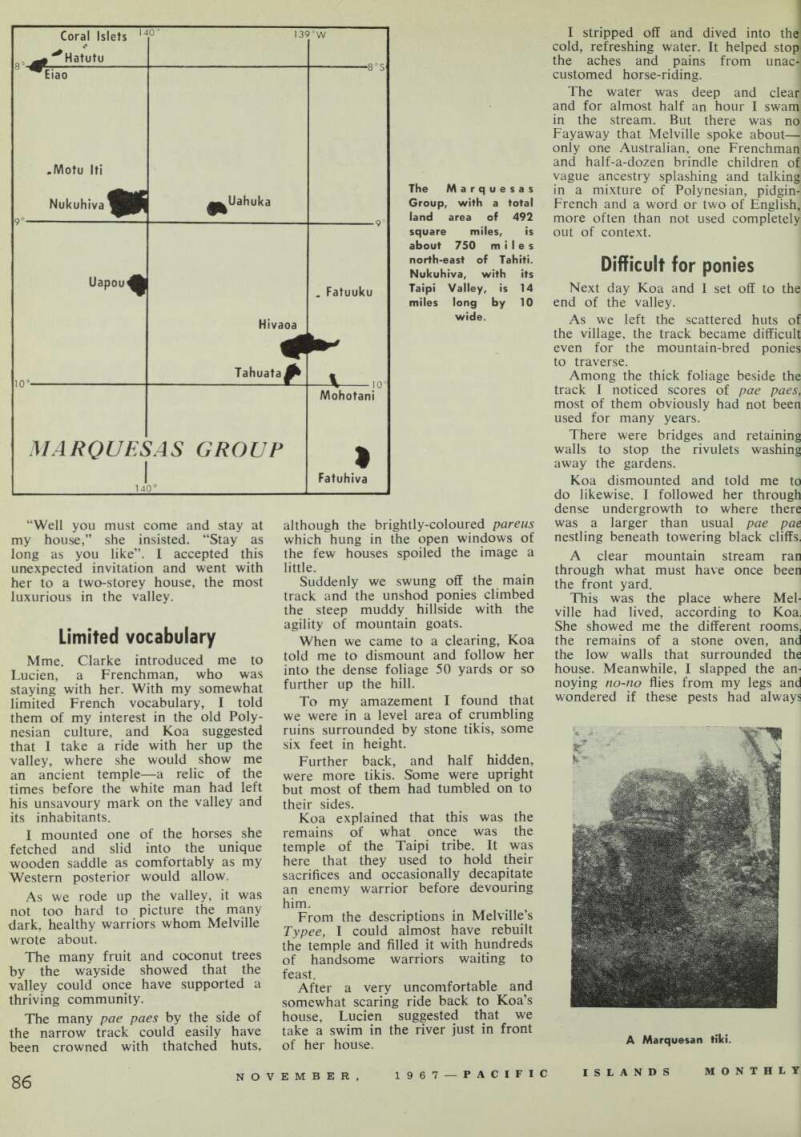
The Marquesas Group, with a total land area of 492 square miles, is about 750 miles north-east of Tahiti.
Nukuhiva, with its Taipi Valley, is 14 miles long by 10 wide.
en in the valley. I concluded that the early days, when there was organised system of plantations, ; undergrowth must not have been thick and therefore the pests iuld not have been so numerous.
We wandered back to the horses d continued up the valley. Up and we climbed towards a magnificent terfall.
It fell some 2,000 feet in a silvery broken stream to a crystal clear d 1 at the bottom. Rainbows bounced the shining black wet volcanic :k face as the sunlight caught the irkling droplets of the cascading ter.
Hie noise of falls did not quite >wn out the sound of birds and ier wild life of the valley.
Fhe sweet scent of tiare Tahiti fted up from the greenness below; wreath of wind rustled among the :onut trees; and I was again taken :k to Melville’s book, Jut there was something missing! ere was no laughter of children ying in the river below. I could no fine young warriors roaming valley floor. No Fayaway.
Recruits for Mururoa
t was almost dark when we jrned to the village. Smoke was ling from the iron-roofed build s of the more fortunate, or, ier, the more wealthy inhabitants, I the aroma of cooking drifted of the open windows to mingle h the smell of wet undergrowth.
Relaxed on the verandah after ner, Koa told me how the French ruited workers in the valley for nuclear testing project at ruroa Atoll in the Tuamotus. hey stayed away for several nths and returned with big savings, lowever, money was of little use them in Taipi-vai; and some of m moved with their families to liti, where they were under the sion that living and employment ditions were better, lut from my observation I think 7 are mostly disappointed and are :ed to join the many poverty :ken natives who sleep in ragged, y blankets in the shop fronts of icete’s back streets. ’hey’d be better off staying at tie in unprogressive Taipi-vai.