past, present and future
pp. 22-23 · Read in the full issue
Frank new view of the BSIP— past, present and future
If there were any doubts that the remarkable Rev. Dr.
Charles Fox will be forgotten in the Solomons after his death, they can be dispelled. At the age of 89 he has just published a book which is his guarantee that he will be remembered.
'Y'HE Story of the Solomons came off the Melanesian Mission’s press, DOM Publications, in the Solomons in October, for the benefit of local schools. And what a fascin ating little book it is!
The two-paragraph preface by Dr.
Fox hardly does it justice. He writes: “Bishop Alfred Hill asked me to write something for our schools. I first taught Solomon Islanders and learnt to speak one of their languages in 1902, at St. Barnabas school, Norfolk Island; spent some months on San Cristobal in 1908; and finally settled in the Solomons, where I still live, in 1910. So I have known a good deal of their history.
“I offer this story to the new generation of our people—with one apology. I do not think I have done justice, through my ignorance, to the people of the Western Islands.
They are fine people; so is their art.”
Frank
The Story of the Solomons is a book of less than 100 pages but in it the author’s scholarship and his 60 years’ experience of the Solomons coalesce to produce a re freshingly frank and unexpected outline of modern Solomons’ history.
Dr. Fox manages to discuss develop ment of the Solomons through both Island and Western eyes. He is probably the only writer alive who could have successfully done this.
Although his narrative continually refers to “we”, meaning the Islanders, there is no doubt in the reader’s mind that he has also taken into account Western attitudes. The re sult is balance.
He is able to point to both the evils and advantages of colonialism; the evils and advantages of life in the Solomons before the coming of the European.
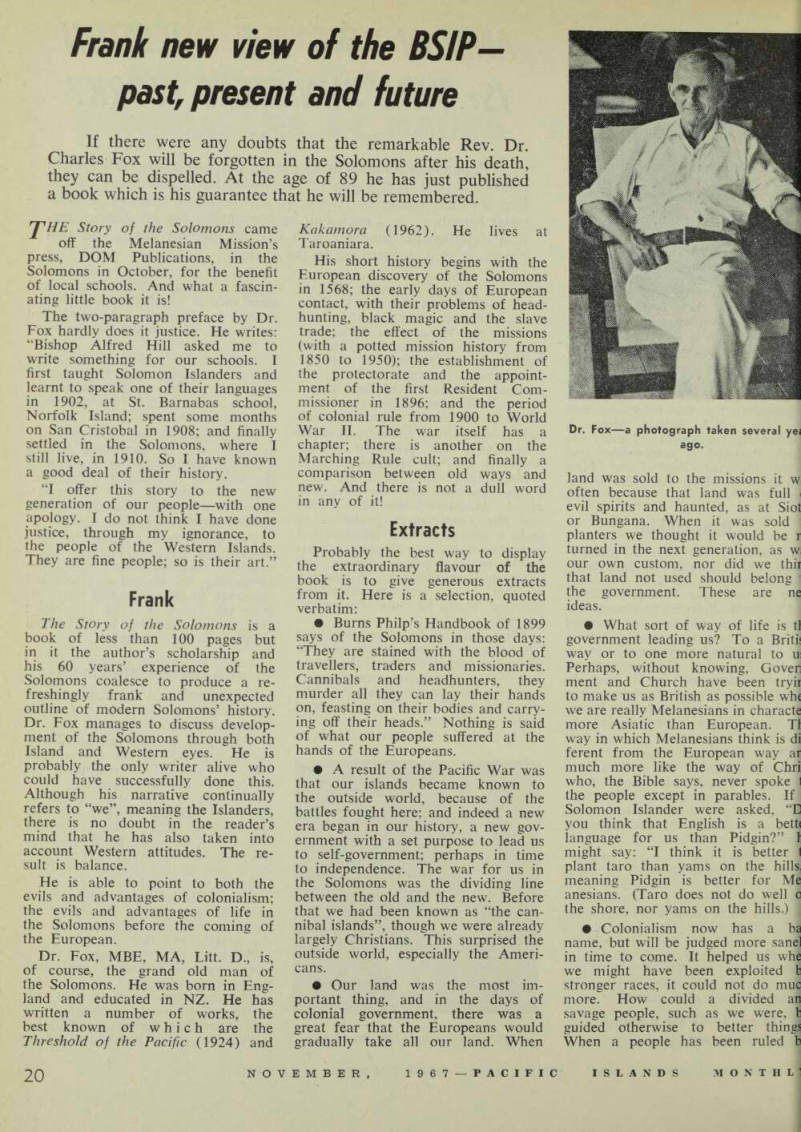
Dr. Fox, MBE, MA, Litt. D., is, of course, the grand old man of the Solomons. He was born in Eng land and educated in NZ. He has written a number of works, the best known of which are the Threshold of the Pacific (1924) and
Kakamora (1962). He lives at Taroaniara.
His short history begins with the European discovery of the Solomons in 1568; the early days of European contact, with their problems of head hunting, black magic and the slave trade; the effect of the missions (with a potted mission history from 1850 to 1950); the establishment of the protectorate and the appoint ment of the first Resident Com missioner in 1896; and the period of colonial rule from 1900 to World War 11. The war itself has a chapter; there is another on the Marching Rule cult; and finally a comparison between old ways and new. And there is not a dull word in any of it!
Extracts
Probably the best way to display the extraordinary flavour of the book is to give generous extracts from it. Here is a selection, quoted verbatim: • Burns Philp’s Handbook of 1899 says of the Solomons in those days: “They are stained with the blood of travellers, traders and missionaries.
Cannibals and headhunters, they murder all they can lay their hands on, feasting on their bodies and carry ing off their heads.” Nothing is said of what our people suffered at the hands of the Europeans. • A result of the Pacific War was that our islands became known to the outside world, because of the battles fought here; and indeed a new era began in our history, a new gov ernment with a set purpose to lead us to self-government; perhaps in time to independence. The war for us in the Solomons was the dividing line between the old and the new. Before that we had been known as “the can nibal islands”, though we were already largely Christians. This surprised the outside world, especially the Ameri cans. • Our land was the most im portant thing, and in the days of colonial government, there was a great fear that the Europeans would gradually take all our land. When
land was sold to the missions it w often because that land was full i evil spirits and haunted, as at Siot or Bungana. When it was sold planters we thought it would be r turned in the next generation, as w; our own custom, nor did we thii that land not used should belong i the government. These are ne ideas. • What sort of way of life is tl government leading us? To a Britii way or to one more natural to u Perhaps, without knowing, Coven ment and Church have been tryii to make us as British as possible wh« we are really Melanesians in characte more Asiatic than European. Tl way in which Melanesians think is di ferent from the European way ar much more like the way of Chri who, the Bible says, never spoke 1 the people except in parables. If Solomon Islander were asked, “E you think that English is a bett< language for us than Pidgin?” 1 might say: “I think it is better 1 plant taro than yams on the hills, meaning Pidgin is better for Me anesians. (Taro does not do well o the shore, nor yams on the hills.) 1 • Colonialism now has a ba name, but will be judged more sane] in time to come. It helped us whe we might have been exploited b stronger races, it could not do muc more. How could a divided an savage people, such as we were, b guided otherwise to better things When a people has been ruled b
Dr. Fox —a photograph taken several year ago.
iother race for the sake of gain, at is an evil thing, but there have en different motives in colonialism d not all have been bad. In our rlier years of colonial rule the ief thought was that it did so little r us in education and seemed to ve no real purpose or goal. It is without resources to do more. • What is worst in colonial rule the spirit of superiority in the rul y race; to think of those ruled as a lower plane, sometimes despised, metimes treated as children or olescents (untrue, as well as galling) d as incapable of ruling themselves, icy are only inferior to the ruling :e in knowledge, which the rulers lerit from centuries of civilisation, any Europeans think a man is ; erior because he is brown; not be ase he is poor, not because he is educated, but just because he is pwn. • Even in the days of fighting if ;re was much cruel and cowardly hting there was also courage, dar l and adventure. Our people were h in art, and drama, in merry isting and dancing, in the un itten and handed down stories, ey were in love with their farms, :y loved the sea; these things were aracteristics of our race. They re ined to be built upon in a happier ure. • We can and must adapt cur ves to this new way of life with ifidence in our future as we grow numbers and new knowledge, but ;r remaining Solomon Islanders; ;ping what was good in our old y of life.
Marching rule
3f the Marching Rule movement Malaita, Dr. Fox says it was only tly a cargo cult. It was sponsored a desire to return to the old way life and reject the British way life, strongly encouraged by the ;i-colonial talk of the friendly lericans. Part of the Solomons way life was village government: lien anything was to be decided : whole village met and everyone cussed it,” Dr. Fox writes, “last all the chief gave his decision. We 1 doubt the British way of count ; heads to decide, thinking heads t equally as wise.”
Fhe book has a bibliography, ich unfortunately has a number of nting errors, and which would be )re useful if it included fuller de ls of authors and dates. This per ps can be done in a later edition and there certainly will be one, for deserves to keep on selling.—Sl,
The Story Of The Solomons.
P.M. Publications, Taroaniara, BSIP. 35.)