Spanners in the works from Fiji's union leaders
pp. 23-25 · Read in the full issue
Fiji's union leaders
From a Suva correspondent It began on Thursday, October 5. And the question Fiji people are still asking at month’s end is—when will it finish, this wave of industrial unrest which is bedevilling the colony at one of its most crucial times?
Self-government or independence are somewhere along the road.
Financiers overseas are considering pouring money into Fiji’s tourist in dustry. And given racial and in dustrial peace, Fiji has a big chance of making the grade, but its chances are being sold out by politicians and wild-cat trade unionists.
On October 5, in obviously planned combined operations, two unions—the Airport, Hotel and Cater ing Workers’ Union and the Municipal Workers’ Union—without warning brought out 800 men. Of these, 400 were members of the former union working on building projects in Suva, and nearly 400 were Suva City Council workers.
The claims
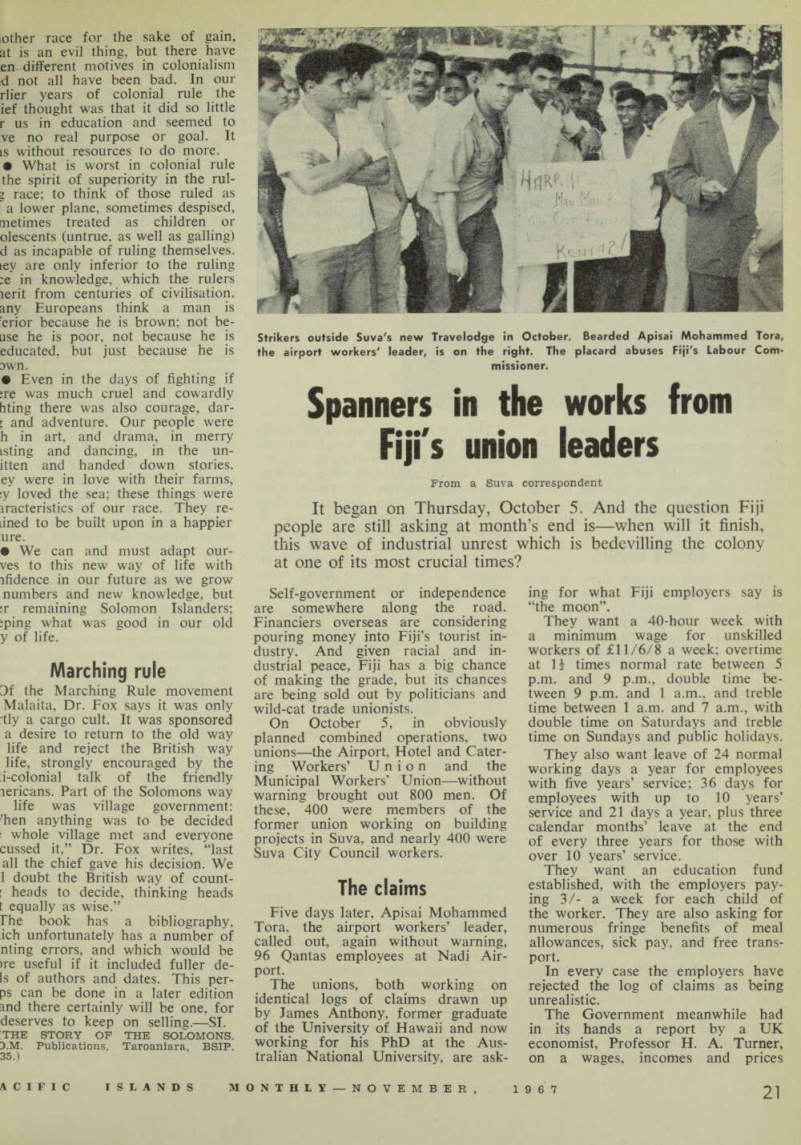
Five days later, Apisai Mohammed Tora, the airport workers’ leader, called out, again without warning, 96 Qantas employees at Nadi Air port.
The unions, both working on identical logs of claims drawn up by James Anthony, former graduate of the University of Hawaii and now working for his PhD at the Aus tralian National University, are ask
ing for what Fiji employers say is “the moon”.
They want a 40-hour week with a minimum wage for unskilled workers of £ll/6/8 a week; overtime at H times normal rate between 5 p.m. and 9 p.m., double time be tween 9 p.m. and 1 a.m., and treble time between 1 a.m. and 7 a.m., with double time on Saturdays and treble time on Sundays and public holidays.
They also want leave of 24 normal working days a year for employees with five years’ service; 36 days for employees with up to 10 years’ service and 21 days a year, plus three calendar months’ leave at the end of every three years for those with over 10 years’ service.
They want an education fund established, with the employers pay ing 3/- a week for each child of the worker. They are also asking for numerous fringe benefits of meal allowances, sick pay, and free trans port.
In every case the employers have rejected the log of claims as being unrealistic.
The Government meanwhile had in its hands a report by a UK economist, Professor H. A. Turner, on a wages, incomes and prices
Strikers outside Suva's new Travelodge in October. Bearded Apisai Mohammed Tora, the airport workers' leader, is on the right. The placard abuses Fiji's Labour Com missioner.
policy for Fiji, which called for the establishment of an Incomes and Prices Advisory Board, and actually suggested a brake on wage increases for unskilled workers because of the rapidly closing gap between the wages of the skilled and the un skilled (see p. 23).
To the brink
The strikers brought Suva to the brink of chaos on the morning of Wednesday, October 11. About a thousand people gathered at the Suva bus station and a lightning strike of bus and taxi transport workers began.
It was obvious that intimidation was playing its part and the atmos phere at the bus station began to thicken when Apisai Tora, after ask ing police permission to speak, harangued the crowd.
There was some nervousness in the city, which retained vivid re collections of December, 1959, when a similar situation developed into rioting which no one has forgotten.
Tora told the restive crowd he did not want a repetition of 1959.
But he congratulated the trans port workers on coming out on strike in support of his union. (Who brought them out is a mystery, be cause the Transport Workers’ Union hadn’t voted for it).
It was obvious the bus drivers didn’t want to strike, but few strikers can intimidate as effectively as the Fijian striker. The situation looked ugly but the police stepped in quietly and made “specials” out of buses with co-operative drivers.
The transport workers’ strike petered out from then on. It was not broken by the Government, as has since been suggested in some quarters.
But the situation did remain tense until late in the morning, when Fiji’s Chief Minister, Ratu K. K. T.
Mara, acted. Back only a few days from his world tour, he went on the air from the Fiji Broadcasting Com mission studios and in quiet tones made the Government’s position clear.
It was obvious from his first few sentences that there would be no repetition of 1959, when the Govern ment of the day handled the situa tion badly.
Mara's speech
“There were signs of unrest in Suva this morning,” Ratu Mara began. “Transport services have come to a halt. There are indications of the possibility of interference with essential services.
“There are also, unfortunately, indications of intimidation of some of the workers who are being forced by threats and not by peaceful persuasion to leave their jobs.”
His next sentence really meant something.
“Government will not tolerate this,” he said. “It will use all necessary powers to ensure that the law-abiding citizen can go on his peaceful way unmolested, unafraid and free to act as he wishes within the law!”
That lifted the tension like a curtain. Buses and taxis rolled again.
Nervousness disappeared and it
hasn’t been back. Public Safel) Regulations were imposed and they were still in force at the end oj October.
Behind the scenes, the unior leaders were having other problems Some of the strikers were getting s little impatient at the stalemate, and a little light in the pocket.
Sweet reason
On October 12 peace feelers and talks got nowhere. Then, almost out of the blue on Friday the 13 th, came sweet reason. All the builders and municipal workers would go back tc work while talks got underway.
The builders went back on that day, and the council workers reported for duty on the Monday.
Then there were hopes that the Qantas workers would go back, foi the airline offered to negotiate a wage increase which would be back-dated to August 1 if the workers would go back immediately.
But, on Sunday, October 15, the union rejected the offer.
And on October 18 they gave notice that they intended to bring out, after 28 days, the airport fire men. The firemen are an essential service, and as such cannot legally strike without having first given 28 days’ notice.
Qantas might bypass
The union also decided to boycott the Government’s board of inquiry into the dispute, which opened before an Australian judge, Sir Trevor Gould, and closed its public sittings on October 21 without a single union representative having been present.
Qantas, Fiji Airways, the Master Builders’ Association, the Fiji Em ployers’ Consultative Association, the Government’s Ministry of Finance, the Fiji Visitors Bureau and the City Council, all made written sub missions. But the workers’ case went by default. Even the Industrial Workers’ Congress, which has been regarded as a most responsible body by most employers, kept silent.
Qantas made some oral sub missions, through Mr. P. J. C. Rogers of their industrial relations depart ment, which contained an overt threat that Qantas would overfly Nadi if the strike continued.
The two building companies.
Cementation Overseas Ltd., who are building the new Travelodge Hotel and the Development Bank, and W.
C. Hines (Fiji) Ltd., builders of the new Government Buildings extensions and the new Suva Town Hall, began
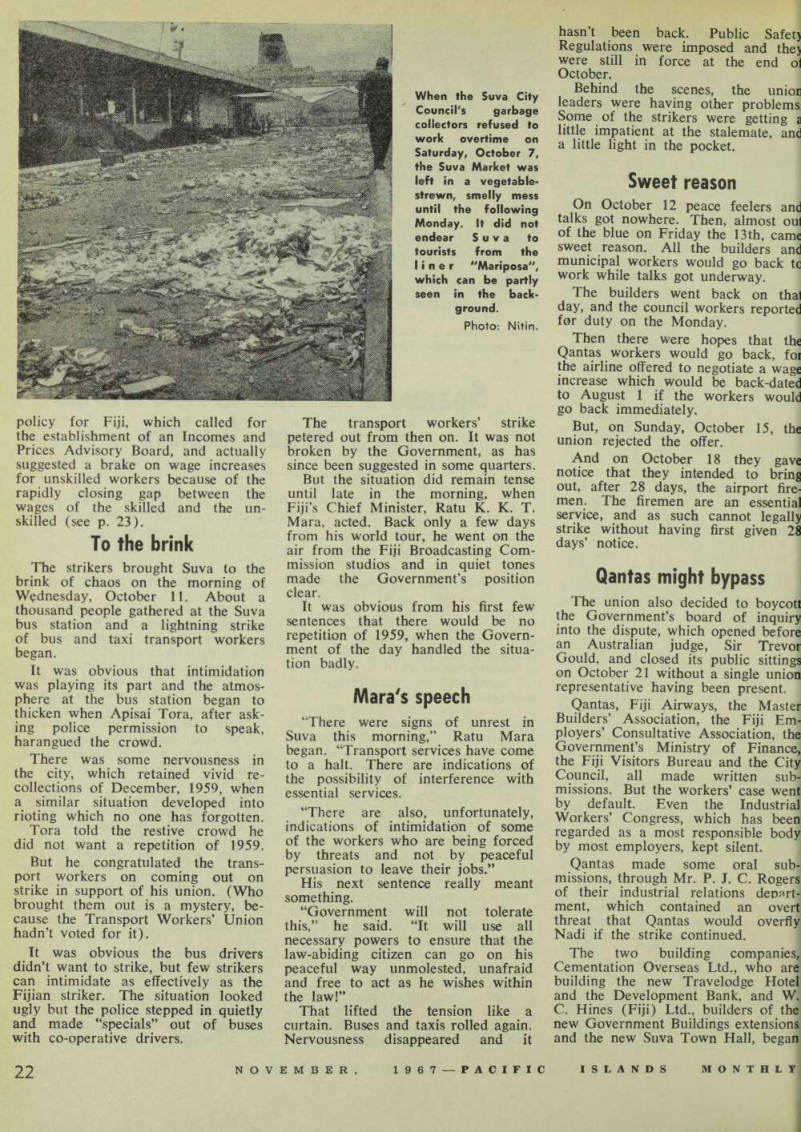
When the Suva City Council's garbage collectors refused to work overtime on Saturday, October 7, the Suva Market was left in a vegetable strewn, smelly mess until the following Monday. It did not endear Suva to tourists from the liner "Mariposa", which can be partly seen in the back ground.
Photo: Nitin.
ks with the Airport, Hotel and itering Workers’ Union which, for good reason at all, caters for the ilding workers.
These were still in train on :tober 30, but talks which were to ve begun between the Municipal orkers’ Union and the City Council [lapsed before they began.
The Suva Mayor, Cr. Harvey mt, told the union the council mid not allow the union’s advisers, >ya and Company, to take part in : talks, although they would make filities available for the union to tisult its legal advisers, who could up office outside the conference Dm.
More trouble
The union reacted to the Mayor’s vision by walking out. The council ;n offered to allow the adviser be present at the talks but not take part in the discussions, but : unions’ reply to this was to give days’ notice of intention to strike.
And there it rested on October with Fiji facing a very uncertain ure —airport workers still out and municipal workers again threaten- The Fiji Government has made clear that unions can act freely thin legal requirements. They can rsuade others to strike by peaceful >ument but there must be no eats, no intimidation—and no ting.
Meanwhile behind the scenes the deration Party is indulging in its (ourite sport of fishing in troubled ters. (Its members comprise the •position in the Legislative Council,
but the Opposition is on strike too.
It walked out of the House on Sep tember 1 on a political issue).
The Federation’s propaganda sheets and journals have attacked the Gov ernment for what it calls intervention in the strikes, and its English language paper, published at Nadi, has increased its virulent attacks on members of the Government and on the Europeans in general.
Its leaders individually have given support to the striking unions who, curiously enough, have taken action to improve the workers’ standard of living against only European-con trolled organisations.
The only recruiting that has been done by the Airport Hotel and Cater ing Workers’ Union has been done among workers employed by Euro pean overseas firms.
The living wage
Two members of the Federation Party are acting as advisers to the striking unions.
The party has made no pronounce ment on this matter of a living wage for workers, but the big problem of course is that a sudden increase in wages of the kind envisaged in these logs of claims would bring on in flation. There was certainly no support in Professor Turner’s report for such a drastic uplift of wages and conditions demanded by the two unions.
Footnote: Both logs of claims by the Airport Hotel and Catering Workers’ Union, and the Municipal Workers’ Union, are identical, even to the mispellings.