Yesterday
p. 93 · Read in the full issue
South Seas hotels were in the news when PIM went to press this time 20 years ago. In Western Samoa, the manage ment of the well-known Casino Hotel had changed hands; and in Port Moresby, the Papua Hotel, which had been conceived 10 years previously, had opened its doors. Of the Papua, PI M's Port Moresby correspondent said: “It will be an unexpected oasis of luxury in the otherwise ramshackle wastes of New Guinea.”
OTHER items from PIM for October, 1947, included; A TRUSTEESHIP Mission from the United Nations, after a visit to Western Samoa, had recommended that the territory be granted much more self-govern ment but that the New Zealand Government should continue to act as “protector and adviser”.
A Controversial Liquor
bill, designed to remove restrictions on the consumption of liquor by Fiji-Indians, was to come before Fiji’s Legislative Council. A former Governor, Sir Alexander Grantham, described it as part of the government’s policy of removing racial discrimination.
QANTAS Airways was to start air services between Australia and Norfolk Island with a Lancastrian aircraft and between Australia and Lord Howe Island with a Catalina flying-boat. Both services were to be from Sydney and were to start “soon”. Norfolk Island already had an air link with Auckland.
SEVERAL birds of paradise from Mt. Hagen had arrived in Sydney to be featured in the New Guinea section of Taronga Zoological Park. They included four species which had not been seen outside the territory before.
EUROPEAN and Samoan cocoa planters were looking forward to a very good crop in Western Samoa. “With cocoa quoted at £215 per ton, f.o.b. Apia, cocoa planters doubtless constitute the most prosperous class in the terri tory”, said PIM. “The high cost of living bothers them little, their only complaint being that it has become increasingly difficult to find a sufficient supply of Samoan plantation-labour”.
THE Deed of Cession Memorial, a great obelisk erected by the Fijians in Suva in 1889 to
commemorate the signing of the Deed of Cession (1874) and the Golden Jubilee of Queen Victoria (1887), was to be demolished and a new memorial, smaller in size, built in Suva. The old obelisk stood near the old Government Buildings, which had been demolished. A cathedral for the diocese of Polynesia was to be built on the site.
Madame le riche, nee Elisabeth Paddon, last surviving daughter of the famous English mariner, Captain Paddon, had died in Noumea. Captain Paddon had a big trading or ganisation at He Nou before the French occupied New Caledonia.
A WORLD-WIDE shortage of caustic, used with coconut oil to make soap, had caused a shortage of soap in Fiji. Prices had risen accordingly, from 1/2 to 7/- a bar for ordinary washing soap, and 1/- to 10/- a packet for soap-flakes.
BIKINI Atoll natives, who had been transferred to Rongerik Island when the United States began testing atom bombs on the atoll in 1946, were reported to be homesick. US Navy experts said that while conditions were quite safe at Bikini, the lagoon con tained radio-active water.
SIX Samoan boys, inspired by Wild West and crime movies and armed with several shotguns and revolvers, had absconded from Apia with the motor launch Wyban, two dinghies and the government launch, Pilot. Air plane searches around the coasts of Samoa had failed to find the boys and shipping had been alerted to watch out for them.
PLANTATION work was pick ing up again in the war scarred New Britain area. A steady flow of Sepik natives was arriving in Rabaul and planters had chartered a flying-boat to bring the workers north.
Population of the Cook Islands stood at 14,821, an increase of 2,000 since 1936. In the 15 islands of the group, males outnumbered females by 626.
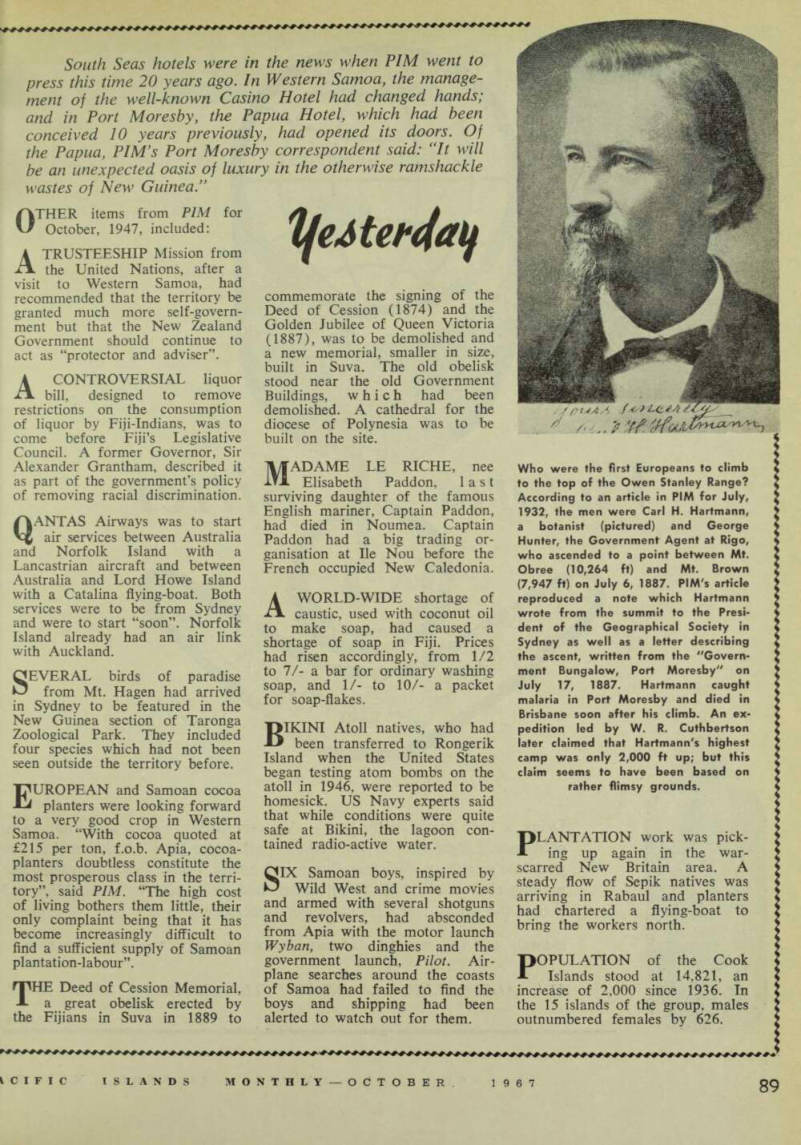
Who were the first Europeans to climb to the top of the Owen Stanley Range?
According to an article in RIM for July, 1932, the men were Carl H. Hartmann, a botanist (pictured) and George Hunter, the Government Agent at Rigo, who ascended to a point between Mt.
Obree (10,264 ft) and Mt. Brown (7,947 ft) on July 6, 1887. PIM's article reproduced a note which Hartmann wrote from the summit to the Presi dent of the Geographical Society in Sydney as well as a letter describing the ascent, written from the "Govern ment Bungalow, Port Moresby" on July 17, 1887. Hartmann caught malaria in Port Moresby and died in Brisbane soon after his climb. An ex pedition led by W. R. Cuthbertson later claimed that Hartmann's highest camp was only 2,000 ft up; but this claim seems to have been based on rather flimsy grounds.