Islands Go Back More
pp. 89-91 · Read in the full issue
His Memories Of The
Than 60 Years
By staff writer KEN McGREGOR
One of the few men alive today who can remember the Gilberts, the Ellice Islands, the Marshalls, the Carolines and the Marianas as they were at the turn of the century is Mr. Neville Chatfield, a sun tanned octogenarian, who lives in a comfort able home in the Sydney suburb of Killara.
rR 12 years until 1914, Mr.
Chatfield plied the Central and South Pacific as a supercargo in Burns Philp steamers and schooners, visiting almost every island in those areas and meeting many of the bizarre and colourful people who lived there.
Mr. Chatfield left the Pacific during World War I when he married a Victorian girl. He subsequently ran an importing-exporting business in Sydney, first with a partner and then on his own.
He has never been back to the Pacific, but even after more than 60 years, he has not forgotten nor lost interest in the Islands.
For nearly 30 years he has been an occasional contributor to PIM under the name of “Supercargo”.
He has dozens of old photographs of people and places in the Islands, and several old maps of the Gilbert and Ellice Groups—the islands he liked best.
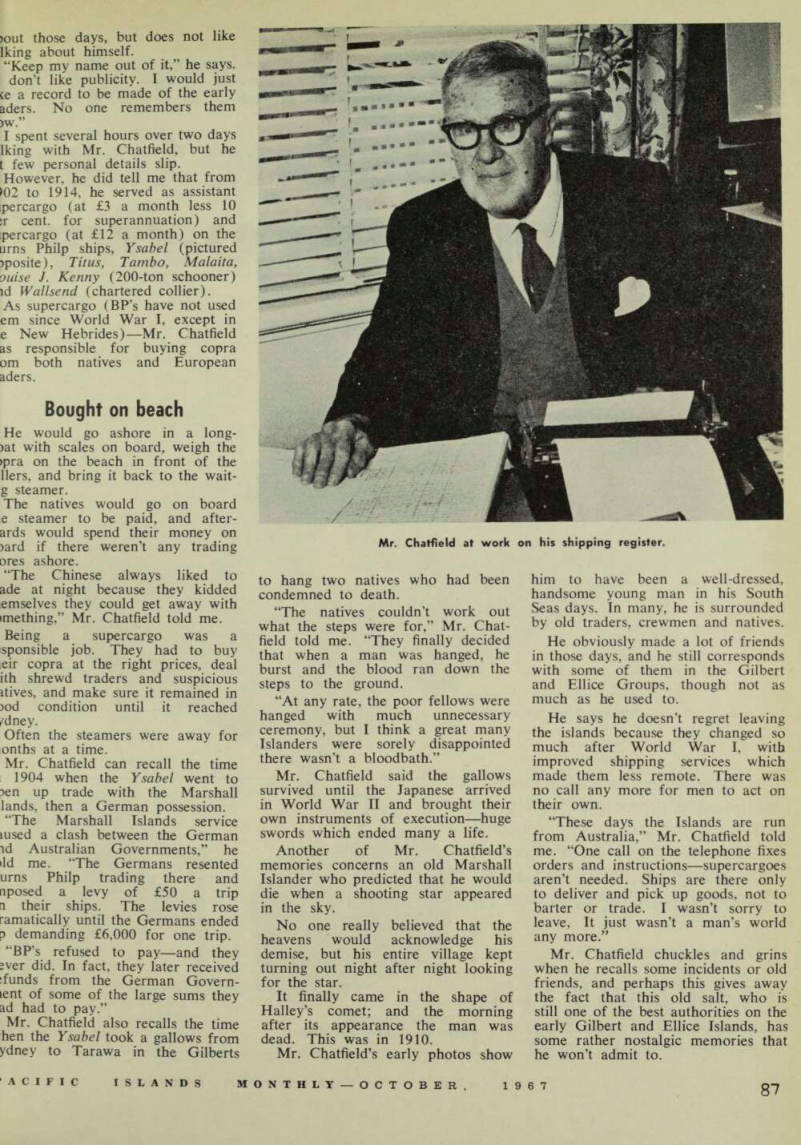
One of Mr. Chatfield’s hobbies over the years has been to compile a register of all the ships leaving Australia for the Islands and return ing between 1883 and 1914. His register gives details of each ship’s cargo and her passengers, One entry, dated March 21, 1900, for example, reads like this: “Ysabel, 524 tons, Captain T. Williams, from New Hebrides, Norfolk Island, Lord Howe Island ... 700 bags copra, 193 bags coffee, 869 bags maize, 22 casks arrowroot, 97 bags pickling onions, 68 bags de mer, 61 hides, 62 bags and 169 cases palm seeds, seven cases fruits, six cases plants, one bag horsehair. . . .” (The names of the ship’s passengers follow), It is amazing how well Mr. Chat field can bring to mind shipwrecks. friends, storms and incidents of his days in the Pacific. It is all as if he was there last year, and not more than half a century ago.
He is more than pleased to yam
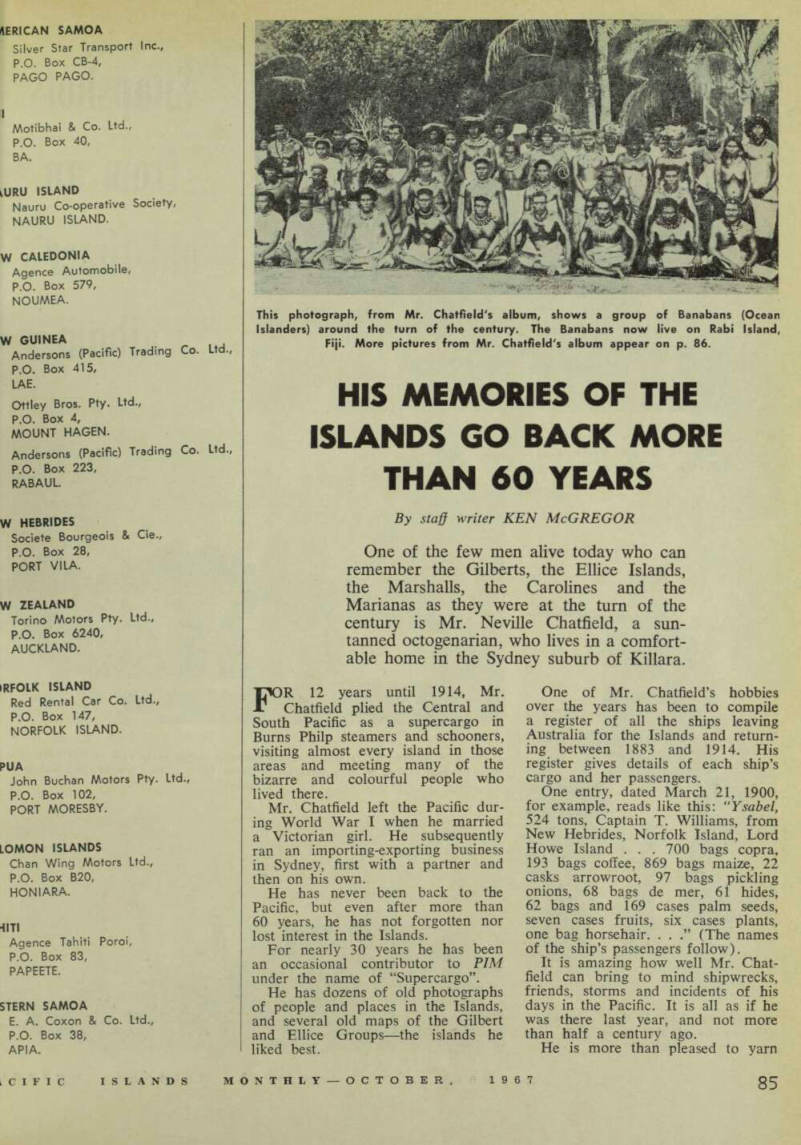
This photograph, from Mr. Chatfield's album, shows a group of Banabans (Ocean Islanders) around the turn of the century. The Banabans now live on Rabi Island, Fiji. More pictures from Mr. Chatfield's album appear on p. 86.
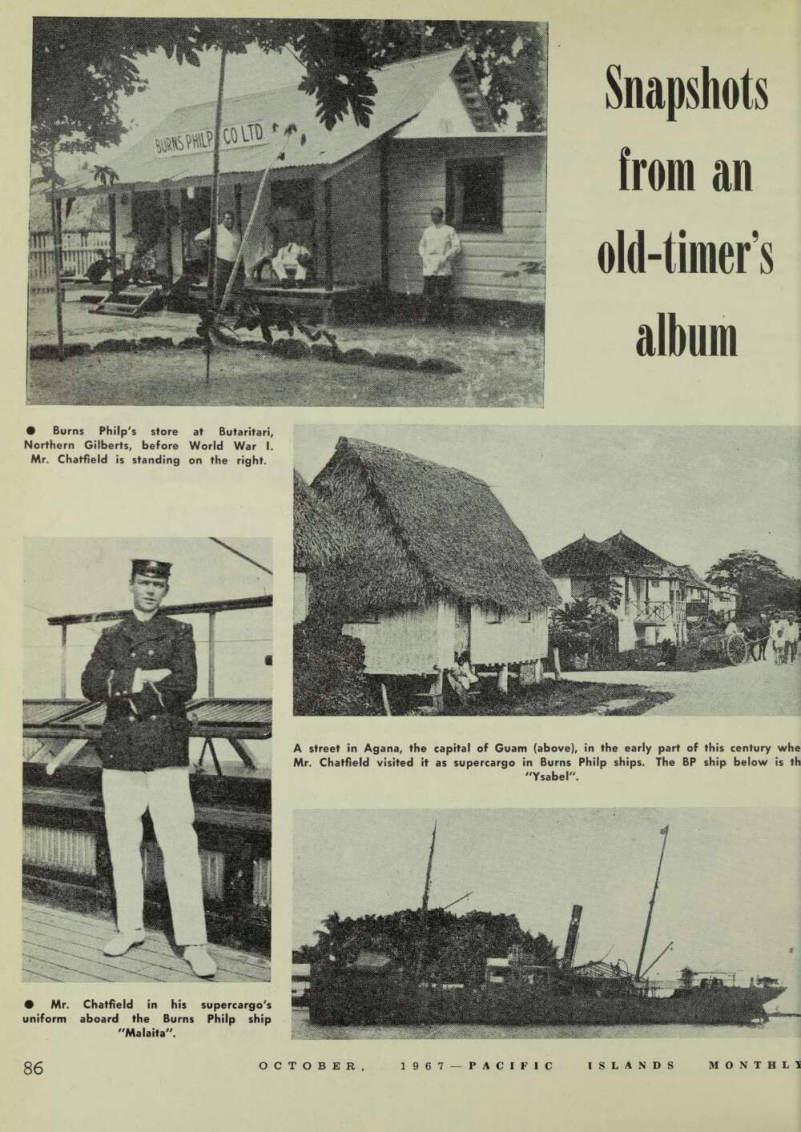
• Burns Philp's store at Butaritari, Northern Gilberts, before World War I.
Mr. Chatfield is standing on the right.
Snapshots from an old-timer’s album
• Mr. Chatfield in his supercargo's uniform aboard the Burns Philp ship "Malaita".
A street in Agana, the capital of Guam (above), in the early part of this century when Mr. Chatfield visited it as supercargo in Burns Philp ships. The BP ship below is the "Ysabel".
>out those days, but does not like Iking about himself.
“Keep my name out of it,” he says, don’t like publicity. I would just ce a record to be made of the early aders. No one remembers them )W,”
I spent several hours over two days Iking with Mr. Chatfield, but he t few personal details slip.
However, he did tell me that from >O2 to 1914, he served as assistant ipercargo (at £3 a month less 10 ;r cent, for superannuation) and ipercargo (at £l2 a month) on the urns Philp ships, Ysabel (pictured Dposite), Titus, Tambo, Malaita, ouise J. Kenny (200-ton schooner) id Wallsend (chartered collier).
As supercargo (BP’s have not used em since World War I, except in e New Hebrides) —Mr. Chatfield as responsible for buying copra om both natives and European aders.
Bought on beach
He would go ashore in a long >at with scales on board, weigh the >pra on the beach in front of the Hers, and bring it back to the wait g steamer.
The natives would go on board e steamer to be paid, and after ards would spend their money on >ard if there weren’t any trading ores ashore.
“The Chinese always liked to ade at night because they kidded emselves they could get away with imething,” Mr. Chatfield told me.
Being a supercargo was a sponsible job. They had to buy eir copra at the right prices, deal ith shrewd traders and suspicious dives, and make sure it remained in )od condition until it reached Often the steamers were away for onths at a time.
Mr. Chatfield can recall the time 1904 when the Ysabel went to ien up trade with the Marshall lands, then a German possession.
“The Marshall Islands service lused a clash between the German id Australian Governments,” he ild me. “The Germans resented urns Philp trading there and aposed a levy of £5O a trip a their ships. The levies rose ramatically until the Germans ended p demanding £6,000 for one trip.
“BP’s refused to pay—and they jver did. In fact, they later received ;funds from the German Govern icnt of some of the large sums they ad had to pay.”
Mr. Chatfield also recalls the time hen the Ysabel took a gallows from ydney to Tarawa in the Gilberts
to hang two natives who had been condemned to death.
“The natives couldn’t work out what the steps were for,” Mr. Chat field told me. “They finally decided that when a man was hanged, he burst and the blood ran down the steps to the ground.
“At any rate, the poor fellows were hanged with much unnecessary ceremony, but I think a great many Islanders were sorely disappointed there wasn’t a bloodbath.”
Mr. Chatfield said the gallows survived until the Japanese arrived in World War II and brought their own instruments of execution—huge swords which ended many a life.
Another of Mr. Chatfield’s memories concerns an old Marshall Islander who predicted that he would die when a shooting star appeared in the sky.
No one really believed that the heavens would acknowledge his demise, but his entire village kept turning out night after night looking for the star.
It finally came in the shape of Halley’s comet; and the morning after its appearance the man was dead. This was in 1910.
Mr. Chatfield’s early photos show
him to have been a well-dressed, handsome young man in his South Seas days. In many, he is surrounded by old traders, crewmen and natives.
He obviously made a lot of friends in those days, and he still corresponds with some of them in the Gilbert and Ellice Groups, though not as much as he used to.
He says he doesn’t regret leaving the islands because they changed so much after World War I, with improved shipping services which made them less remote. There was no call any more for men to act on their own.
“These days the Islands are run from Australia,” Mr. Chatfield told me. “One call on the telephone fixes orders and instructions—supercargoes aren’t needed. Ships are there only to deliver and pick up goods, not to barter or trade. I wasn’t sorry to leave, It just wasn’t a man’s world any more.”
Mr. Chatfield chuckles and grins when he recalls some incidents or old friends, and perhaps this gives away the fact that this old salt, who is still one of the best authorities on the early Gilbert and Ellice Islands, has some rather nostalgic memories that he won’t admit to.
Mr. Chatfield at work on his shipping register.