Fiji's First Missionaries
pp. 85-87 · Read in the full issue
Spent Fearful Weeks As
Shipwrecked Castaways
By Jane Gregor
According to most of the history books, the Rev. William Cross and the Rev. David Cargill were the first European missionaries to reach Fiji. Even the small white monolith in Suva’s famous “Triangle” proclaims unequivocally, “Cross and Cargill, first missionaries, arrived 14th October, 1835.”
lUT that’s not quite the whole story. There were, in fact, hers before them, albeit inadvert it arrivals.
They were members of the London issionary Society, who were fleeing th their families from native dis tances in Tahiti.
They landed on Fijian territory tly because their ship, the brigantine ibernia, under Captain William impbell, ran aground on November ), 1809, on the Great Sea Reef )rth of Vanua Levu en route to ustralia. They spent nearly two retched months on small islands F the Vanua Levu coast.
The full story is told in an extract
from the journal of one of the mis sionaries, Brother John Davies, which was published by the Hakluyt Society in 1922 with the Journal of William Locker by.
The missionaries embarked in the Hibernia in Tahiti in the first week of November, 1809—Captain Camp bell having explained to them that he intended to call at Fiji where he hoped to obtain a cargo of sandal wood. They left Tahiti with the schooner Venus in tow.
The two ships sailed south-west wards with favourable breezes, and on November 10, Brother Davies noted happily in his journal that “several of the Feejee islands were
discovered”. But disaster struck that same night.
“About half-past ten last night,”
Brother Davies recorded next day, “we were suddenly alarmed with a cry on deck that we were almost on a reef.
“The women and children were in no small degree of terror and con sternation.
“Moors and Lascars who were our crew ran to get their own chests, not regarding what would become of the vessel. . .”
It is not hard to picture the alarm of everyone on board . . . the dark night in unknown waters . . . with the islands “very erroneously described in the Gazeteers,” as Davies put it.
"Humanity, tenderness"
Captain Campbell, moreover, was apparently the first sailor of his times to attempt to approach the Fiji group from the northern side of Vanua Levu, so neither he nor his crew had the faintest idea of what they were getting themselves into.
Many of the passengers were already in bed when the ship struck, but everyone eventually took to the brig’s boats.
They spent the rest of the night and most of the next day looking— so far as one can judge from the journal—for an opening in the reef
which would carry them safely out to sea once their vessel was repaired.
“At this time the humanity and tenderness of the Captain and officers should not be forgotten,” Davies recorded.
The modern reader of Davies’ journal is apt to find himself study ing maps at this point to try to determine exactly where the hapless missionaries were.
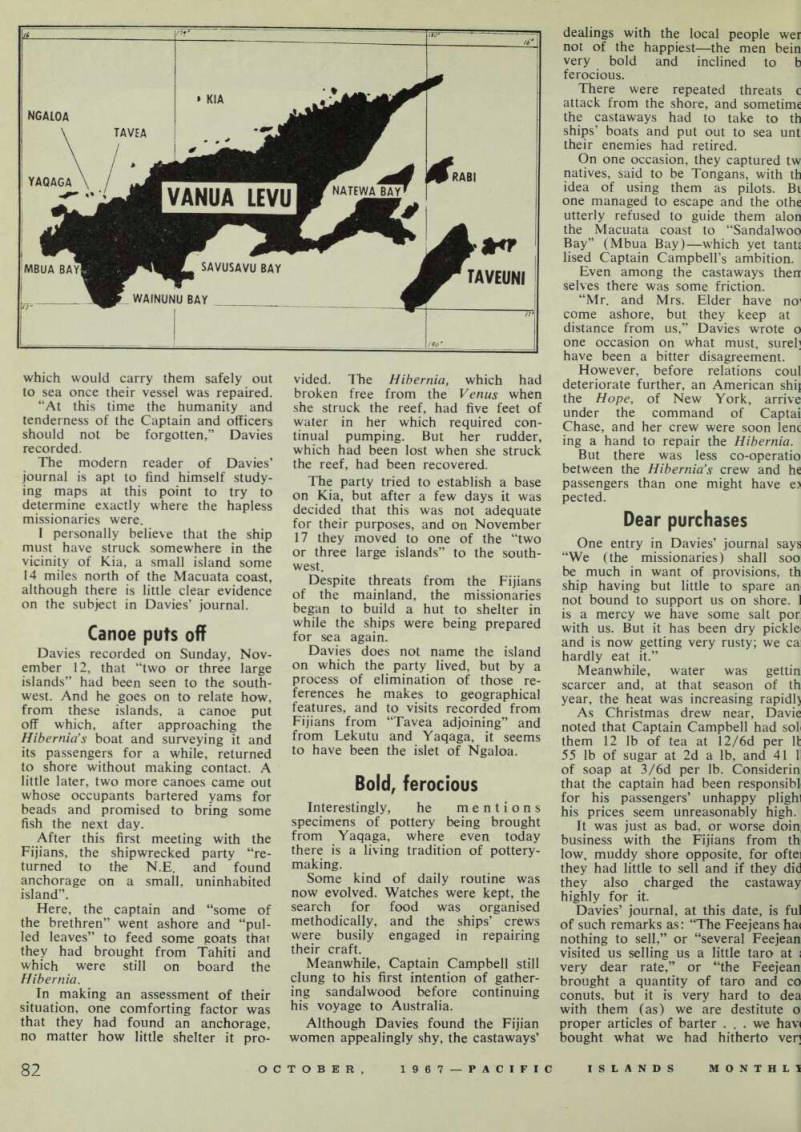
I personally believe that the ship must have struck somewhere in the vicinity of Kia, a small island some 14 miles north of the Macuata coast, although there is little clear evidence on the subject in Davies’ journal.
Canoe puts off
Davies recorded on Sunday, Nov ember 12, that “two or three large islands” had been seen to the south west. And he goes on to relate how, from these islands, a canoe put off which, after approaching the Hibernia’s boat and surveying it and its passengers for a while, returned to shore without making contact. A little later, two more canoes came out whose occupants bartered yams for beads and promised to bring some fish the next day.
After this first meeting with the Fijians, the shipwrecked party “re turned to the N.E. and found anchorage on a small, uninhabited island”.
Here, the captain and “some of the brethren” went ashore and “pul led leaves” to feed some goats that they had brought from Tahiti and which were still on board the Hibernia.
In making an assessment of their situation, one comforting factor was that they had found an anchorage, no matter how little shelter it pro
vided. The Hibernia, which had broken free from the Venus when she struck the reef, had five feet of water in her which required con tinual pumping. But her rudder, which had been lost when she struck the reef, had been recovered.
The party tried to establish a base on Kia, but after a few days it was decided that this was not adequate for their purposes, and on November 17 they moved to one of the “two or three large islands” to the south west.
Despite threats from the Fijians of the mainland, the missionaries began to build a hut to shelter in while the ships were being prepared for sea again.
Davies does not name the island on which the party lived, but by a process of elimination of those re ferences he makes to geographical features, and to visits recorded from Fijians from “Tavea adjoining” and from Lekutu and Yaqaga, it seems to have been the islet of Ngaloa.
Bold, ferocious
Interestingly, he mentions specimens of pottery being brought from Yaqaga, where even today there is a living tradition of pottery making.
Some kind of daily routine was now evolved. Watches were kept, the search for food was organised methodically, and the ships’ crews were busily engaged in repairing their craft.
Meanwhile, Captain Campbell still clung to his first intention of gather ing sandalwood before continuing his voyage to Australia.
Although Davies found the Fijian women appealingly shy, the castaways’
dealings with the local people wer not of the happiest—the men bein very bold and inclined to b ferocious.
There were repeated threats c attack from the shore, and sometime the castaways had to take to th ships’ boats and put out to sea unt their enemies had retired.
On one occasion, they captured tw natives, said to be Tongans, with th idea of using them as pilots. Bi one managed to escape and the othe utterly refused to guide them alon the Macuata coast to “Sandalwoo Bay” (Mbua Bay)—which yet tant.
Used Captain Campbell’s ambition.
Even among the castaways then selves there was some friction.
“Mr. and Mrs. Elder have no 1 come ashore, but they keep at distance from us,” Davies wrote o one occasion on what must, sureb have been a bitter disagreement.
However, before relations coul deteriorate further, an American shij the Hope, of New York, arrive under the command of Captai Chase, and her crew were soon lent ing a hand to repair the Hibernia.
But there was less co-operatio between the Hibernia’s crew and he passengers than one might have e? pected.
Dear purchases
One entry in Davies’ journal says “We (the missionaries) shall soo be much in want of provisions, th ship having but little to spare an not bound to support us on shore. 1 is a mercy we have some salt por with us. But it has been dry pickle and is now getting very rusty; we ca hardly eat it.”
Meanwhile, water was gettin scarcer and, at that season of th year, the heat was increasing rapidlj As Christmas drew near, Davie noted that Captain Campbell had sol them 12 lb of tea at 12/6d per 11 55 lb of sugar at 2d a lb, and 41 1 of soap at 3/6d per lb. Considerin that the captain had been responsibl for his passengers’ unhappy plighi his prices seem unreasonably high.
It was just as bad, or worse doin business with the Fijians from th low, muddy shore opposite, for ofte they had little to sell and if they did they also charged the castaway highly for it.
Davies’ journal, at this date, is ful of such remarks as: “The Feejeans ha< nothing to sell,” or “several Feejean visited us selling us a little taro at ; very dear rate,” or “the Feejean brought a quantity of taro and co conuts, but it is very hard to dea with them (as) we are destitute o proper articles of barter ... we havi bought what we had hitherto ver
;ar, chiefly for pieces of Taheitean oth.”
Even the American captain, when jpealed to for provisions, declared itly that he had none to spare.
Yet, amidst searching for food and ater and keeping a look out for arring natives, the missionaries mtinued their “social and family □rship without interruption” though it was hard to find relief om the “very great heat”.
Meanwhile, there were growing imours of intertribal wars being Iked over among the Fijian chiefs; id Captain Campbell began to toy ith the idea of abandoning his >yage to Australia and, instead, of :companying Captain Chase to hina.
24-hour watch
Captain Campbell said that if he d go to China, he would have no >om for passengers, even if any of em were willing to change their ;stination!
As Christmas approached, the imours of unrest ashore grew ronger; and on December 28, 1809, was learned that there were plans nong the Fijians to kill all the white en encamped on Ngaloa, to abduct e women and children, and to sal as much property as they could.
The women and children were omptly sent on board the Hope hilst the men set up a 24-hour atch.
On New Year’s Day, 1810, Davies reported they were “still kept in a degree of alarm by the Feejeans”.
He added unhappily: “Lights shine on the shore and conch shells are blowing which we know are used in war”.
The days grew hotter and damper.
Anxiety mounted. Plans for the future were still uncertain.
But by now the carpenter of the Hope had completed his repair work on the Hibernia and all was in readiness for the three ships to sail.
"Lingered in fear"
Suddenly, there was no more talk in Davies’ journal of waiting to find sandalwood, no more talk of pro ceeding to China.
On January 9, 1910, two months after the Hibernia had come t o grief, the three ships sailed out of Vanua Levu lagoon.
For a few more days, according to Davies, they “lingered in fear” with
“little wind, a swell, and currents near the reefs”. But, finally, the war like Fijians, the muddy, swampy, steam-bath of the coast and the dreaded reef lurking so treacherously beneath the blue Pacific waters were left behind.
The Hibernia, after calling at Norfolk Island, reached Sydney on February 17, 1810. The missionaries immediately wrote to the governor of the colony “humbly soliciting the privilege of becoming settlers,” and the governor gave them what help he could.
Back to Tahiti
Most of the missionaries sub sequently returned to Tahiti, which, after what they had seen and heard in the savage “Feejees”, must have seemed a quiet haven of peace.
None of them, at any rate, had the urge to take up missionary work in Fiji, and it was left to William Cross and David Cargill to make the first attempt to convert the Fijians to Christianity.
If the Hibernia’s passengers could return today to the scene of their trials they would see little physical difference. But now, there is not the slightest atmosphere of danger; nothing could be less sinister.
Those who know the tiny islets which dot the Vanua Levu lagoon regard them as perfect little para dises, where the fishing is good and the water is calm.
Both Kia and Ngaloa are currently inhabited; while Macuata Island, to the east of Ngaloa, is the objective of regular trips for tourists.
Few of the tourists, I imagine, know of the drama which was played out in those parts by the little group who, technically, are entitled to the honour of being called Fiji’s first missionaries.
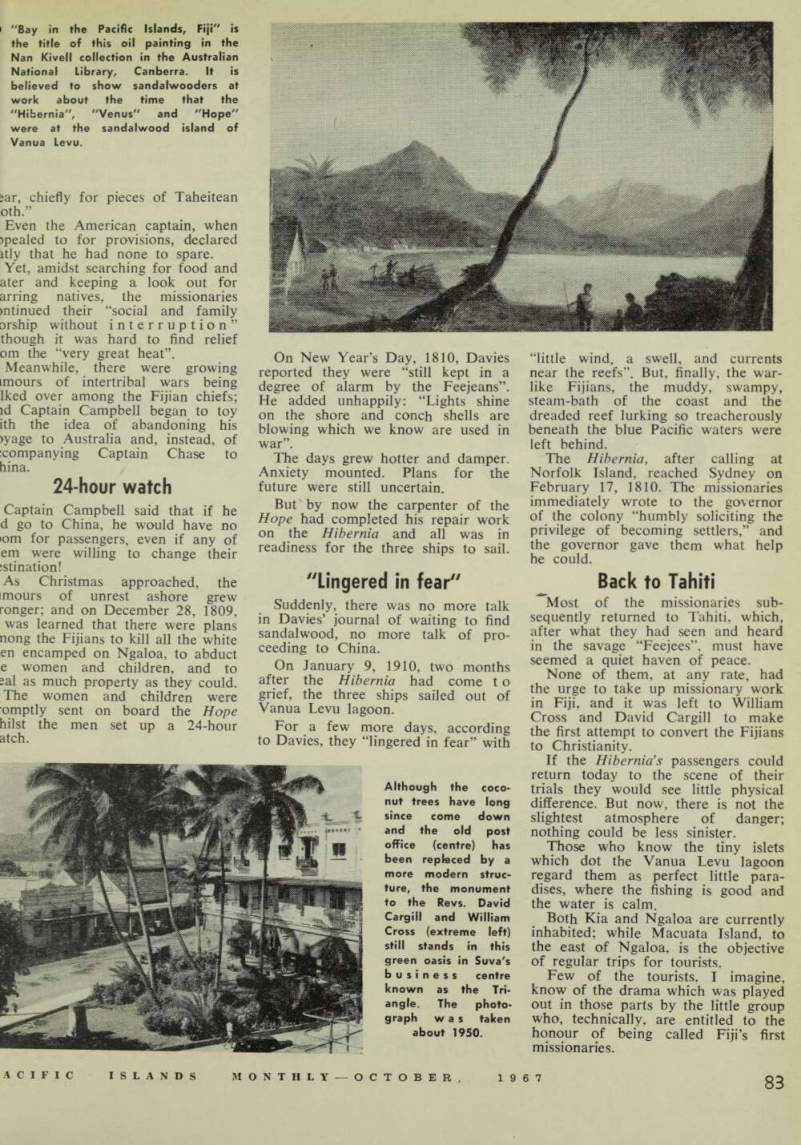
"Bay in the Pacific Islands, Fiji" is the title of this oil painting in the Nan Kivell collection in the Australian National Library, Canberra. It is believed to show sandalwooders at work about the time that the "Hibernia", "Venus" and "Hope" were at the sandalwood island of Vanua Levu.
Although the coco nut trees have long since come down and the old post office (centre) has been replaced by a more modern struc ture, the monument to the Revs. David Cargill and William Cross (extreme left) still stands in this green oasis in Suva's business centre known as the Tri angle. The photo graph was taken about 1950.