yes terday
p. 95 · Read in the full issue
Wallis Island, the tiny, isolated, seldom-heard-from outpost of France, 500 miles west of Samoa, was having a splurge of limelight 20 years ago this month. PIM reported that, following native unrest on the island, 11 Wallisians had been taken to Noumea by ship and imprisoned on He Nou, and the only British trader there, a Mr. Brabant, had been deported with his wife and two children. The king of Wallis had reportedly been deposed by the French for allegedly pro-British sentiments, and the French Resident had hastily returned to France.
OTHER items from PIM for August, 1947, were: AQANTAS Airways Dragon Rapide Aircraft had crashed into a large tree while on a trip between Lae and Bulolo. The two passengers were unhurt and the pilot slightly injured. All spent what was probably a pretty worried night in the tree before a land search party found them next day.
A SMALL motor vessel, the Rosalie, was to start a monthly shipping service from Auckland to Norfolk Island and New Cale donia.
She was to carry general cargo to the islands and return with timber and copra from New Cale donia and fruits and vegetables from Norfolk Island.
TONKINESE from French Indo china (now Vietnam) who had been brought to the New Hebrides by the French to work as labourers, were making themselves felt in the Condominium through a Tonkinese Commissioner, whose office in Vila’s main street boast ed a red flag and whose car car ried a smaller version of the flag on its bonnet. Most of the 8,000 Tonkinese wanted the French to send them home, but no ships were available.
WHOOPING cough and influ enza had caused several deaths on Rarotonga.
“Schools, churches, the cinema and all public gatherings have been closed for weeks,” said PlM’s correspondent. “Local shipping has been tied up, but official per mission has now been given for shipping and public meetings to resume.”
SUFFERING from beri-beri and tropical ulcers, Japanese soldiers were still turning up in
New Guinea. Three had been taken to Rabaul from Madang after hiding in the Bogadjim area since the war ended. One of them said he was a doctor and had built a large garden which grew root crops and fruits to feed himself and companions.
GIANT tree-climbing rats were in the news in New Guinea.
Of several rare specimens collect ed by an old territorian. “Nep”
Blood, one measured 34 inches.
This included a rough-scaled tail which acted as a “climbing iron.”
THE notorious New Caledonian bushranger, Gaston Dijou, was sentenced to five years’ gaol in Noumea for terrorising the west coast of the territory, killing cattle, stealing fowls and molest ing Asians. A charge against him of having attempted to kill a US military policeman was dropped.
THE New Hebrides were out of matches, A letter-writer to PIM said all matches for the territory were made in Melbourne, and these had missed the Burns Philp steamer which had arrived in Vila from Sydney. “I suppose the long-suffering population of these islands should be thankful that the New Hebrides are not included in the sphere of Tim buktu match manufacturers,” he said.
SIR Brian Freeston, Governor of the Leeward Islands, West Indies, had been appointed Governor of Fiji and British High Commissioner for the Western Pacific.
SAMOAN Area Airways, using chartered DC4’s, had begun an Hawaii-Pago Pago air service.
The company, owned and run by Samoan interests, planned to buy its own DC4 and a Catalina fly ing boat to pioneer new routes from Pago Pago to the “south and east.” Samoan hostesses added charm to the service and the com pany had refurbished Sadie Thompson’s Inn, at Pago Pago, for flying visitors. Sadie Thomp son’s, which is now part of Mr.
Max Haleck’s store, was the place where Somerset Maugham stayed in 1917 when he got the idea for his famous short story, Rain.
THE Kon Tiki raft, which left Callao, Peru, on April 29, 1947, had reached Raroia Atoll, in the Tuamotus, in early Aug ust, with six young Scandinavians.
Their 4,000 mile trip had shown what they set out to show—that the ancient Polynesians could have migrated to the Pacific by similar rafts from South America.
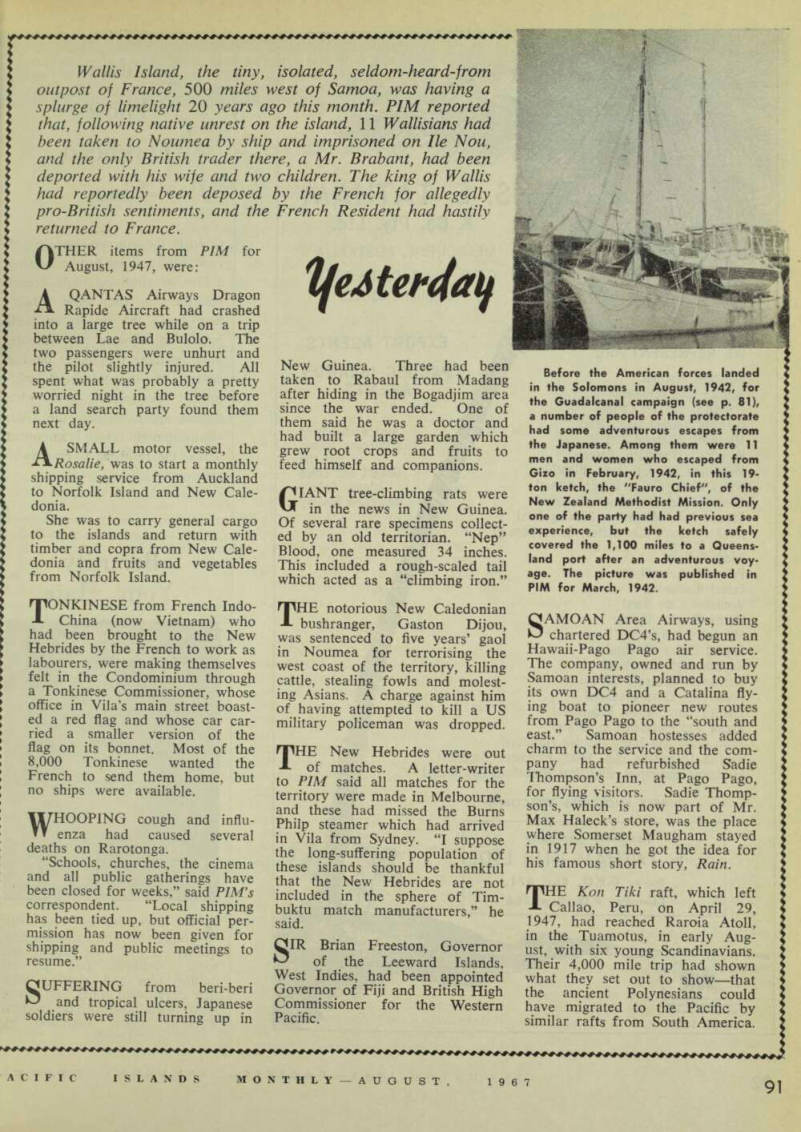
Before the American forces landed in the Solomons in August, 1942, for the Guadalcanal campaign (see p. 81), a number of people of the protectorate had some adventurous escapes from the Japanese. Among them were 11 men and women who escaped from Gizo in February, 1942, in this 19ton ketch, the "Fauro Chief", of the New Zealand Methodist Mission. Only one of the party had had previous sea experience, but the ketch safely covered the 1,100 miles to a Queens land port after an adventurous voy age. The picture was published in RIM for March, 1942.