The Strange Story
pp. 91-94 · Read in the full issue
Of Nauru's
Will Mariner
• One of the best known stories in the history of the South Pacific is that of Will Manner the young crew member of the British privateer "Port au Prince", who was stranded in Tonga for four years from 1806 to 1810 after the Tongans captured the "Port au Prince" and burned her to the waterline. Manner s story is well-known because a book was written about his adventures after he returned to London. Here is a story of a similar kind about which no book, or even an article, has previously been published . . .
By Robert Langdon
In mid-May, 1803, when the Royal Navy ship Buffalo was sailing from Sydney to Bengal, she put into New Caledonia for water and there discovered a beautiful harbour, near the present capital of Noumea, which her captain called St. Vincent’s Bay after the First Lord of the Admiralty.
Thirty-three years later, another HMS Buffalo sailed into St. Vincent’s Gulf, South Australia— another body of water honouring the same Sea Lord—and deposited on the gulf’s shores South Australia’s first Governor, Captain John Hindmarsh.
The coincidence of two ships called Buffalo sailing into two places called St. Vincent 33 years apart is, on the face of it, not particularly remark able.
But the recording of it is, in fact, probably as good a way as any to introduce the extraordinary story of Ernest Milner Hindmarsh Stephen, who was “dumped” on Nauru in the 1870’s at the tender age of 13, and who lived there for many years as a trader and government interpreter.
Ernest Milner Hindmarsh Stephen was a great-grandson of Captain (later Sir) John Hindmarsh, of the Buffalo, and the primary reason for his arrival in Nauru was that his father was manager of a nickel mine in New Caledonia, probably some where near the bay which the captain of the first Buffalo called St. Vincent.
Strong point
How E. M. H. Stephen’s father came to be managing this mine is not stated in the records that I have seen, but I do know that geology was a strong point in the Stephen family, and that more than one of its members earned his living by it at one time or another.
But the Stephen family made a name for themselves in other ways, too.
James Stephen, Jr., for example, was Permanent Under-Secretary at the Colonial Office about the turn of the 19th century, and his son John (1771-1833) was a judge.
John Stephen, who married a girl called Sibella Milner, migrated from England to Australia in 1824, and before long at least two of his sons had made their marks there.
One son, Alfred, became Crown Solicitor in Hobart; and another, George Milner Stephen (who in herited his mother’s maiden name) had a notable career as a public servant, legal practitioner, geologist and faith healer.
While working as a commissariat clerk in Hobart in 1838, George Milner Stephen was appointed Ad vocate-General and Crown Solicitor of South Australia by Governor Hindmarsh, of the Buffalo. And in 1840, he married the Governor’s daughter, Mary.
In 1841, this same Stephen, having returned to England, was elected a member of Cornwall’s Royal Geo logical Society, and a short time later, he went to Heligoland as secretary to his father-in-law, who, having beer recalled from South Australia, had
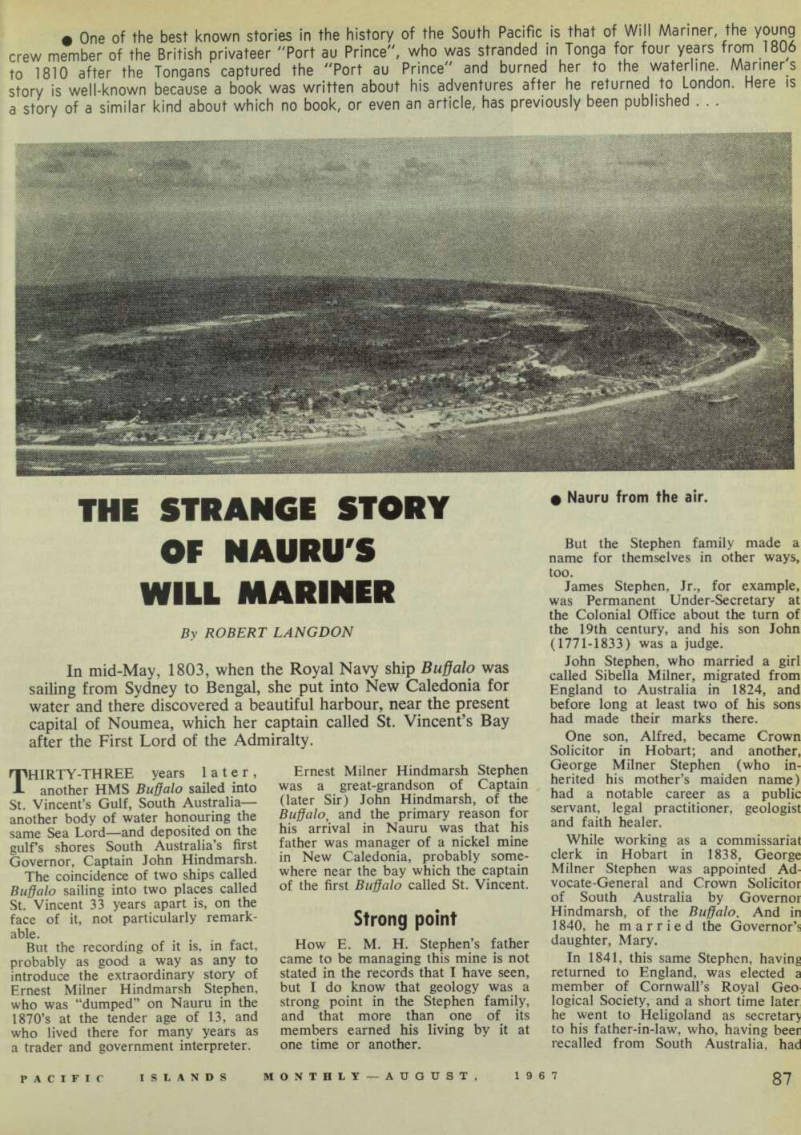
• Nauru from the air.
been appointed Governor of that island.
In 1846, G. M. Stephen returned to Australia, where he led such a full and variegated life that several columns are needed to describe it in the new Dictionary of Australian Biography.
Berth in ship
The DAB does not say how many children G. M. Stephen had, but one of them was Ernest Henry Hindmarsh Stephen, manager of the New Cale donian nickel mine mentioned above.
E. H. H. Stephen, a former lieutenant with the Royal Navy, was friendly with a Captain Champion, an American, who was skipper of the schooner Venus. The pair often met at one of Noumea’s hostelries.
At one of these meetings, Captain Champion suggested that his friend’s son, then aged 13, should accompany him on a voyage to the islands to gain experience of the world.
E. H. H. Stephen agreed to this proposal, and so young Ernest Milner Hindmarsh Stephen (whose second and third Christian names betokened his ancestry) was given a berth in the Venus.
Th Venus called at various islands picking up cargoes, and eventually reached Nauru. By the time Captain Champion had taken on another cargo there, he had a full ship, and it was impracticable for him to return to Noumea to deliver young Stephen to his father.
The skipper discussed his problem with various traders ashore, and one of them, named Michell, suggested that he should leave the boy with him, and that Captain Champion could pick him up and take him back to Noumea on his next trip.
Captain Champion, however, never returned to Nauru; nor did he go back to Noumea. So young Stephen was obliged to settle down on Nauru; and his father in Noumea was left wondering what had become of him.
Nauru in those days was well away from the tracks of most ships. Its vast phosphate deposits were still un discovered. And no European Power bad taken the slightest interest in it.
The few Europeans who lived on the island were ex-sailors who had lumped ship. Some of them, like
Michell, a Cornishman, had become traders. The rest were simply beachcombers.
As Michell was illiterate, young Stephen was useful to him in his store, although there was precious httle to sell m it.
All the stores were alike in this respect, for their owners were far more interested m obtaining spirits from passing ships than in the more essential commodities. Generally, their only trade goods consisted of tobacco, axes and any kind of gun the traders could get their hands on.
Some traders encouraged deadly feuds between the various Nauruan clans, and the Nauruans built up an enormous stock of arms. Life, otherwise, was monotonous.
Being on the Equator, the sun rose at 6 a.m. and set at 6 p.m., and as there were no lamps and plenty of mosquitoes, the evenings without a moon were very quiet affairs.
Coconuts and fish were the staple diet—most of the fish being eaten raw.
If a pig, dog or chicken was killed for a change of diet, the fire to cook it was lit by rubbing two sticks together.
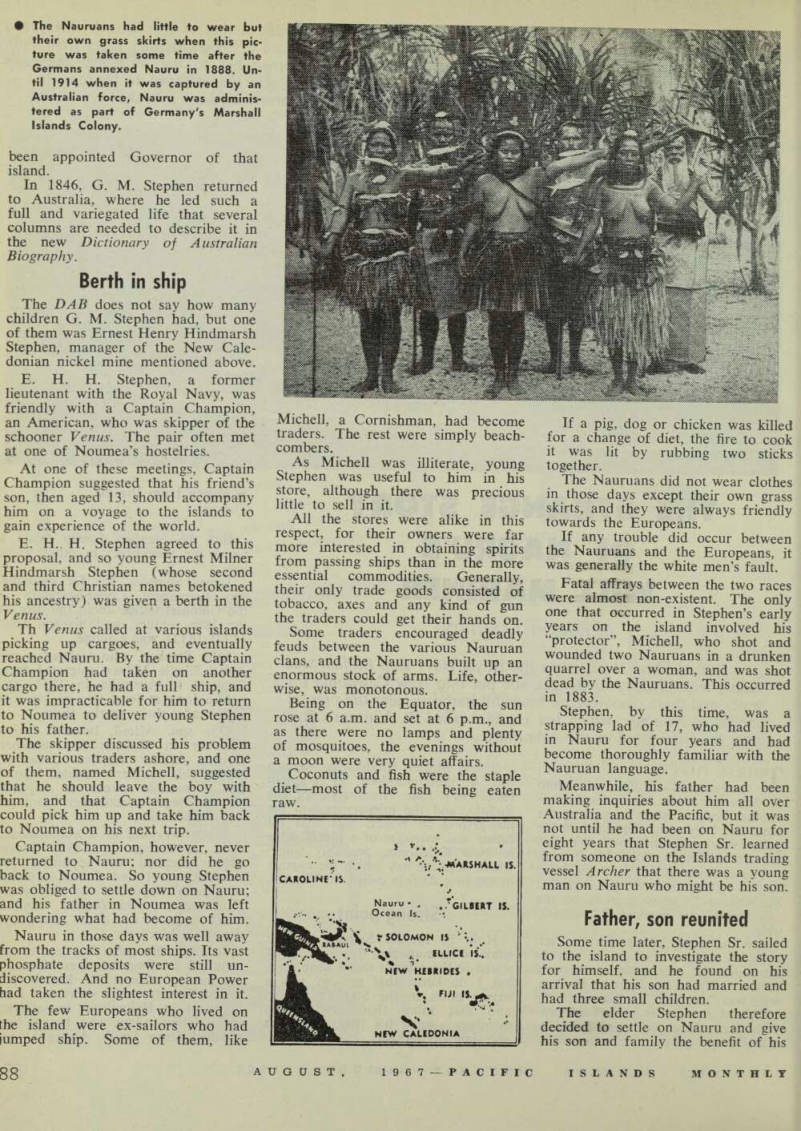
The Nauruans did not wear clothes in those days except their own grass skirts, and they were always friendly towards the Europeans.
If any trouble did occur between the Nauruans and the Europeans, it was generally the white men’s fault.
Fatal affrays between the two races were almost non-existent. The only one that occurred in Stephen’s early years on the island involved his “protector”, Michell, who shot and wounded two Nauruans in a drunken quarrel over a woman, and was shot dead by the Nauruans. This occurred in 1883.
Stephen, by this time, was a strapping lad of 17, who had lived in Nauru for four years and had become thoroughly familiar with the Nauruan language.
Meanwhile, his father had been making inquiries about him all over Australia and the Pacific, but it was not until he had been on Nauru for eight years that Stephen Sr, learned from someone on the Islands trading vessel Archer that there was a young man on Nauru who might be his son.
Father, son reunited
Some time later, Stephen Sr. sailed to the island to investigate the story for himself, and he found on his arrival that his son had married and had three small children.
The elder Stephen therefore decided to settle on Nauru and give his son and family the benefit of his
• The Nauruans had little to wear but their own grass skirts when this pic ture was taken some time after the Germans annexed Nauru in 1888. Un til 1914 when it was captured by an Australian force, Nauru was adminis tered as part of Germany's Marshall
Islands Colony.
education. He died of a heart attack about four years later.
Meanwhile, Nauru had been annexed by Germany following an agreement in 1886 between the Foreign Ministers of Great Britain and Germany to divide the islands of the Western Pacific between them.
The German flag was hoisted on Nauru on October 2, 1888, by Com missioner Sonnenschein, representing the Imperial German Government, who arrived at the island in the gun boat Eber.
Young Stephen, who was then 22, •ecalled the Eber’s visit 30 years ater in an article he wrote for the R abaul Record of September 1, 1917.
“They (the Germans) were here hree days,” he said, “during which ime the natives were ordered to bring n all their guns, ammunition, etc., inder penalty of having their mncipal men deported for life, if my guns, etc., were held back.
“In every other way the natives vere treated very well, and none of he man-o’-warsmen were allowed to ake anything from a native without laying well for it.
“The commander punished a :ouple of sailors before the natives or doing so.
Interpreter
“As soon as Commissioner ionnenschein landed, he came to me md asked if I would interpret.
“I was only too willing to do so, md was well recompensed for it. And hough, during the years following, learly all the traders became laturalised Germans, I never thought if such a thing, but I think I was Iways thought well of by the Gov rnment officials both here and in he Marshalls, being invited to all heir German functions.”
Stephen worked as an interpreter or the Germans throughout the 25 ears that they were in control of be island. He also worked as an iterpreter and overseer for the 'acific Phosphate Company, which egan exploiting the island’s phos hate on May 20, 1906.
If it had not been for Stephen, le PPC would probably not have een able to establish itself on Nauru s easily as it did, for he was one f the few Europeans ever to speak lauruan with fluency.
Stephen was involved in the phos hate industry right from the start, Dr on May 28, 1900, when Albert His, the discoverer of phosphate on eighbouring Ocean Island, arrived at lauru on a prospecting visit, Stephen as called in to act as interpreter etween him (Ellis) and the German •istnct Officer, Herr Kaiser.
Ellis knew, even before he reached Nauru, that its geological formation was similar to Ocean Island’s, and he therefore suspected that it probably contained phosphate as Ocean Island did.
When he called at the German District Officer’s office to seek per mission to prospect in the interior, he found that Herr Kaiser could not speak English, but through Stephen, Kaiser told him that there was nothing in the way of phosphate or guano on the island.
German warships, Kaiser said, had called at the island regularly with scientists, and they would have known if any such deposits existed, Stephen, however, suggested on his
own initiative that there might possibly be some guano in the interior where there were many seabirds, and when Ellis expressed a desire to go there, no objection was raised.
After crossing 400 yards or so of flat sandy country, Ellis came to a geologically old formation in which evidence of phosphate was every where.
“One felt instinctively that the deposit existed over the whole of the elevated interior, and that it must constitute the largest deposit of high grade phosphate yet found,” Ellis wrote 35 years later.
Such a deposit, before being exploited, naturally needed a far more intensive examination than
Ellis was then able to make, so experts from his company paid several visits to the island between 1900 and 1906.
Among the first of these experts was the company’s chemist, Alfred Stephen, who went to Nauru with Ellis and a consulting engineer, E.
Danvers Power, in 1901.
Ellis and Co. hired a party of Nauruans to dig test holes and they engaged Ernest Stephen to act as interpreter.
On the second day, Alfred Stephen said to Ernest; “How do you spell your name?” When the latter told him, Alfred Stephen said: “You are my cousin. I was told by Uncle Evelyn Stephen that I might possibly meet you on Nauru”,
Fruity melodrama
Melodrama—the fruity melodrama so beloved of the Victorian novelists —was thus enacted among the phos phate deposits of Nauru. The pair presumably shook hands, Stanley and Livingstone fashion, and that night Ernest took his newly-found cousin home to show him all the albums and the family Bible which his father had brought from Sydney when he arrived in search of him.
The two cousins remained in con tact thereafter—Alfred taking care of Ernest’s daughter May when she was sent to Sydney for schooling.
It may have been through the urging of Alfred Stephen, who was keenly interested in historical matters, that Ernest Stephen wrote his article for the Rabaul Record in 1917.
Students of Nauru’s history, at any rate, are grateful for Ernest Stephen’s excursion into journalism, for his article deals with a number of matters concerning the island which few people apart from himself were ever in a position to know and describe.
He said in his article, for example, that the name “Nauru” was not really the name of the island at all, but a corruption of the correct name, “Nawero”, which the early traders could not pronounce.
“The Nauruan language,” he went on “is absolutely distinct from any other in the Pacific Ocean, being, I would say, derived from nearly all the surrounding groups, there being many words of Gilbert, Caroline, Marshall and Solomons origin, the former being the only one to retain its original meanings. Nearly all words of the other groups still keep the prounciation, but the meaning is different.
“It all goes to show that the in habitants are descended from natives of these different groups, who have accidently drifted here and inter-
married, so creating a perfectly distinct language.
“You can see a slightly different type of native on parts of the island, viz., to the south they have curly hair, but not woolly; on the western side their hair is very straight indeed, showing their Gilbert descent. On other parts they seem to be of more mixed blood.”
Stephen thought the Nauruans were a fine race of people. They had little disease and both the men and the women were of fine physique.
Many of the women were “really pretty”, with luxuriant hair and beautiful white, even teeth, of which they were very careful.
“You very seldom see a badly pro portioned man or woman,” he said, “and they always have a smile and greeting for everybody, that being the reason why the island is called Pleasant.”
"Entirely different"
A little further on, however, Stephen said that “too much inter course with white men and the missions” had made the Nauruans an entirely different type of people from that of their forefathers.
“All they think of is cheating the whites and getting all they can out of them,” he said. “By going to church three times on Sundays, they think all their sins are forgiven and they start their rascality again on Mondays. Their religion is only skin
deep and is cast aside whenever the occasion requires. . .
Stephen, however, did not seem to think that there would be anything improper, if, at the end of World War I, the Australian Government took over Nauru’s phosphate deposits (which he said were estimated to be worth £250 million) and worked them for themselves.
As it turned out, the Australian Government, in conjunction with the British and New Zealand Govern ments, did take over the deposits at the end of the war—after they bought out the Pacific Phosphate Company for £3,531,500, obtained a mandate over the island from the League of Nations, and established an organisa tion known as the British Phosphate Commissioners to work the deposits.
One of the officials who figured prominently in the negotiations lead ing to the new arrangement was the British Colonial Secretary, Lord Milner. He, in all probability, came from the same family as Sibella Mil ner, Ernest Stephen’s great-grand mother.
I have been unable to establish when Stephen died, but it appears to have been within a few years of the publication of his article in the Rabaul Record. A son-in-law, Mr. Jack Mullins, who married Stephen’s daughter May, still lives on Nauru.
Part of this article is based on material written by Mr. Mullins, which has been in PlM’s possession for some years.
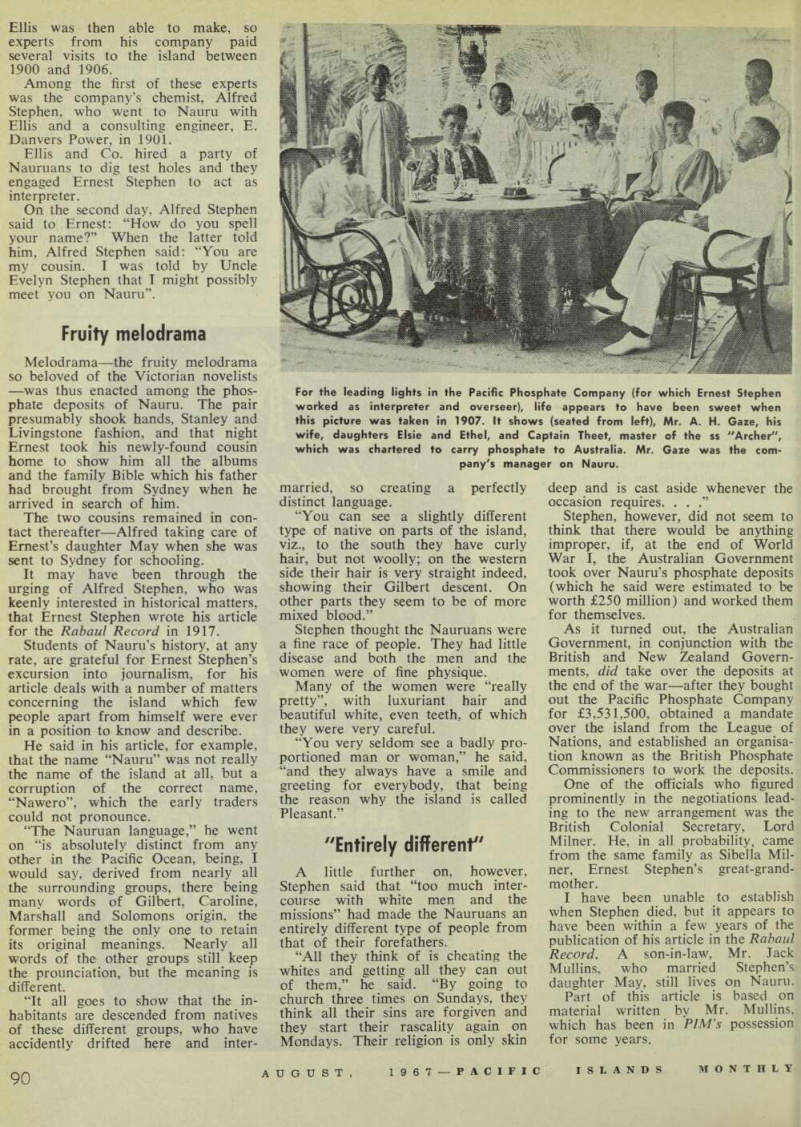
For the leading lights in the Pacific Phosphate Company (for which Ernest Stephen worked as interpreter and overseer), life appears to have been sweet when this picture was taken in 1907. It shows (seated from left), Mr. A. H. Gaze, his wife, daughters Elsie and Ethel, and Captain Theet, master of the ss "Archer", which was chartered to carry phosphate to Australia. Mr. Gaze was the com pany's manager on Nauru.