Book Reviews
p. 97 · Read in the full issue
Journalistic anecdotes of the islands
It’s taken him a long time to do it, but Melbourne writer Osmar White, whose journalistic stamping ground just after the war was in the islands north of Australia, has now given us some of his reminiscences of that time.
IE devotes half of a new book Time Now, Time Before, to ew Guinea, the Solomons and the ew Hebrides, and the other half South-east Asia, including Indo ;sia. The result is not incisive portage—nor is it meant to be— it a collection of stories that often e no more than colourful anec )tes selected from a mass of mate al.
Mr. White does recapture some the rough and ready atmosphere New Guinea in the late 1940’5, tien Ma Stewart ran a pub at Lae what had once been a barracks r army women, and when heaps scrap metal bordered rutted ads.
Although Mr. White changes imes, most Islands people will re gnise his characters. His Solo ons story deals entirely with an pedition he made to one of the itliers, and is in fact a character etch, and in the New Hebrides tells the story of the launching the Royal Harry by the British ;sident Commissioner, who wanted 3 own boat so as to match appear ces with the French Commission , who had the Marechal Foch. le Royal Harry comes to disaster, it not without a lot of fun.
Pandemonium
The story of the Royal Harry is ed to illustrate Mr, White’s intro ctory contention that the “British d French metropolitn governments, llowing the proclamation of the mdominium, saw to it that diamet ally opposed policies were for dated and followed in such matters native land alienation, labour laws d assistance to primary producers, icy consistently selected two dis ct types of administrators—men pronounced Anglo-Saxon tem rament and men of pronounced illic temperament—to preserve the
status and dignity of the partner powers with the backing of the machinery of the separate and joint authorities.”
Mr. White continues; “With the effluxion of time, British commercial influence in the area waned and the expatriate population became predo minantly French. This was all the more reason for the British to go to great lengths to assert their pre sence and to insist on exercising their legal and political rights. In the Pandemonium it was commonly acknowledged that an important part of the job of the British Resident Commissioner was to obstruct the French Resident Commissioner as far as possible, and that the job of the French Resident was to give tit for tat.
One-upmanship
“Under these circumstances, it is remarkable that the French and British communities nevertheless re mained on tolerably good terms with one another, even in times of severe stress, and the rival Residents com mitted to a never-ending trial of one-upmanship were often if not always on cordial personal terms.
“Generally speaking, the French Resident Commissioner in later years did not have to try as hard as his British counterpart, for French na tionals outnumbered British by five to one and controlled more than eighty per cent, of the economy.
The uneven situation was usually reflected in the type of officer chosen to keep the rival flags flying on poles of precisely equal height.
“This was certainly true in the period during which Gabriel Feron and Gilbert Lyttelton held office.
They were as different as chalk from cheese.”
And thus Mr. White goes into his anecdote of the Royal Harry.
This is a good example of his ap proach throughout the book, and
although it is all in good fun, most people, including Islands readers, will probably find more rewarding his stories on Indonesia and of Captain “Turk” Westerling, of brief notori ety.—ST.
(Time Now. Time Before. William
Heinemann. $4.75.)
Stamp oddities
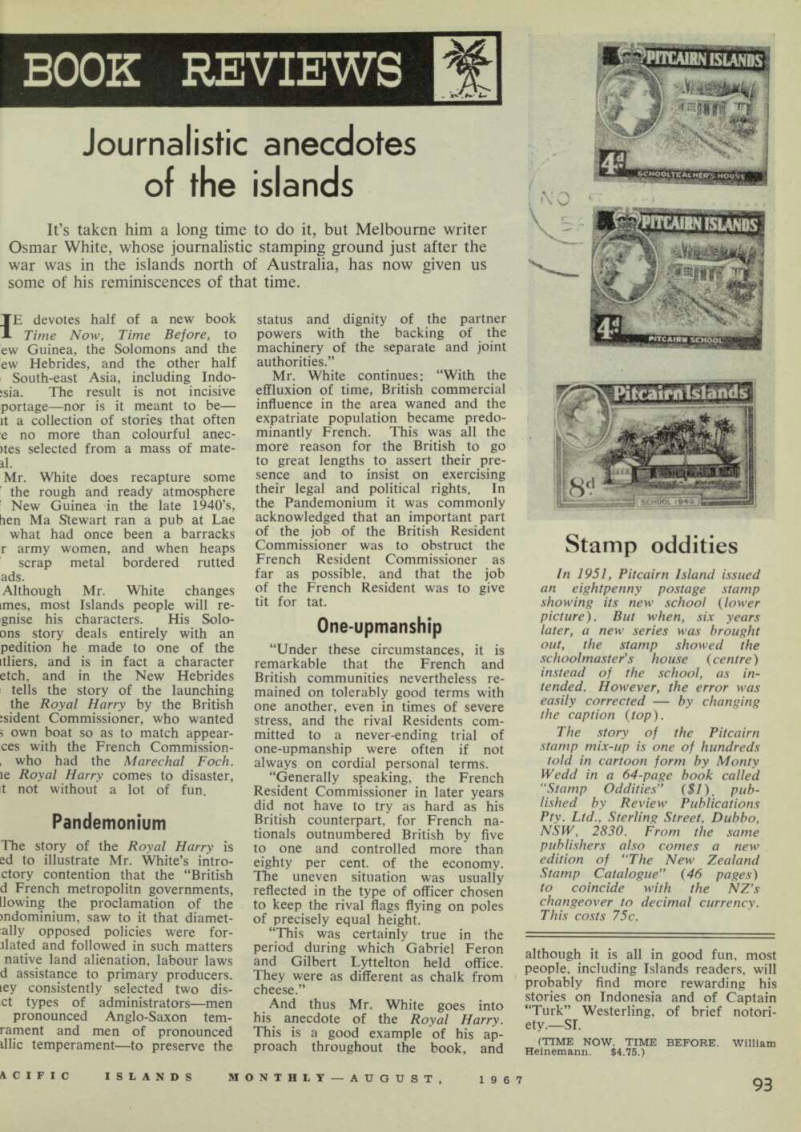
In 1951, Pitcairn Island issued an eightpenny postage stamp showing its new school (lower picture ). But when, six years later, a new series was brought out, the stamp showed the schoolmaster’s house (centre ) instead of the school, as in tended. However, the error was easily corrected- by changing the caption (top).
The story of the Pitcairn stamp mix-up is one of hundreds told in cartoon form by Monty Wedd in a 64-page book called “Stamp Oddities” ($1). pub lished by Review Publications Pty. Ltd., Sterling Street, Dubbo, NSW , 2830. From the same publishers also comes a new edition of “The New Zealand Stamp Catalogue” (46 pages) to coincide with the NZ’s changeover to decimal currency.
This costs 75c.