Where grim history and the lotus life go together
pp. 51-53 · Read in the full issue
lotus life go together
New Caledonia's Isle of Pines
By Kathleen Hancock
The Isle of Pines lying off the southern tip of New Cale donia was a French penal colony a century ago. Today its role as a holiday resort for the French of mainland New Caledonia and for sundry Australians and New Zealanders contrasts oddly with its grim past.
rHE island has a lot of surprises in store for the tourist. History nd hedonism rub shoulders on this wely spot, half an hour’s flight by Tanspac from Noumea.
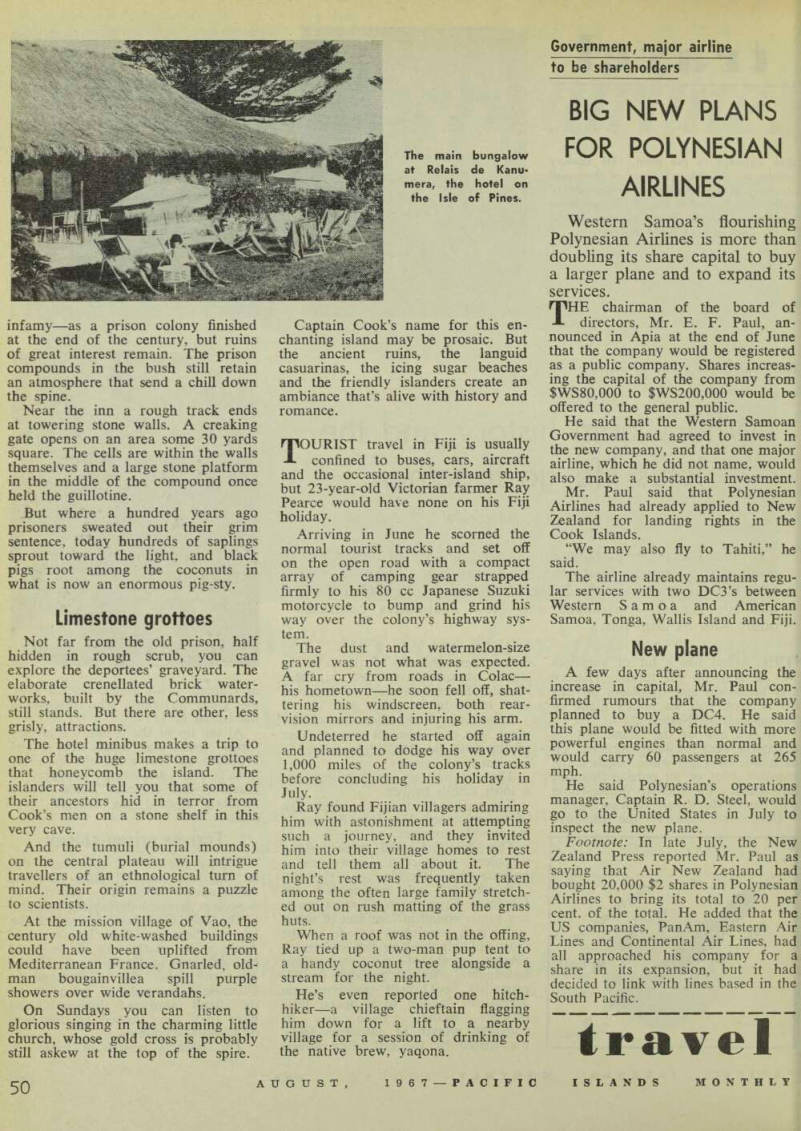
At one end of the island, set on narrow neck of land bordered on ach side by sugar-white beaches, the aystack roof of an outsize thatched ut shelters the lounge, dining-room nd bar of the Relais de Kanumera.
Bungalows built by the islanders
cluster beneath one of the few big stands of sandalwood left in these islands. The musky scent of the great trees hangs in the warm air.
According to the direction of the wind, you can swim off one or other of the twin beaches, separated by a few yards of isthmus.
The inn and its surroundings are a lotus eater’s heaven.
The cuisine is under the sharp eye of the manager, Mr. Jean Roques, a formidable gourmet.
The local fish—and particularly a succulent crustacean known as a popinee —is delectable.
Snorkeling and spearfishing are fabulous. Even the feeblest swimmer can putter round in four feet of water and watch a rainbow parade of the most unlikely looking fish swimming among coral of every colour imaginable. And a “pedalo” (pedal propelled boat) will transport you across the lagoon to a dozen little offshore islands. Each has its whiskery growth of casuarina trees, punctuated by the tall spiky fingers
of Captain Cook pines, named after the great navigator who discovered the island in 1774.
At the tip of the isthmus, a stone’s throw from the hotel, the island broadens out into a spatula of rolling land. The gendarme occupies a graceful old colonial house which formerly housed the island’s gov ernor.
Former prison colony
During the 1870’s, this small dot on the map was a place of some importance. The first convoy of deportees arrested during the troubles of the Paris Commune arrived on the Isle of Pines in 1872. Hundreds of Arabs exiled at the end of the great Kabyle revolt in Algeria were shipped out to join the Communards.
Ultimately, the political prisoners on the island numbered thousands, and later they were joined by numbers of habitual criminals.
The island’s period of fame—or
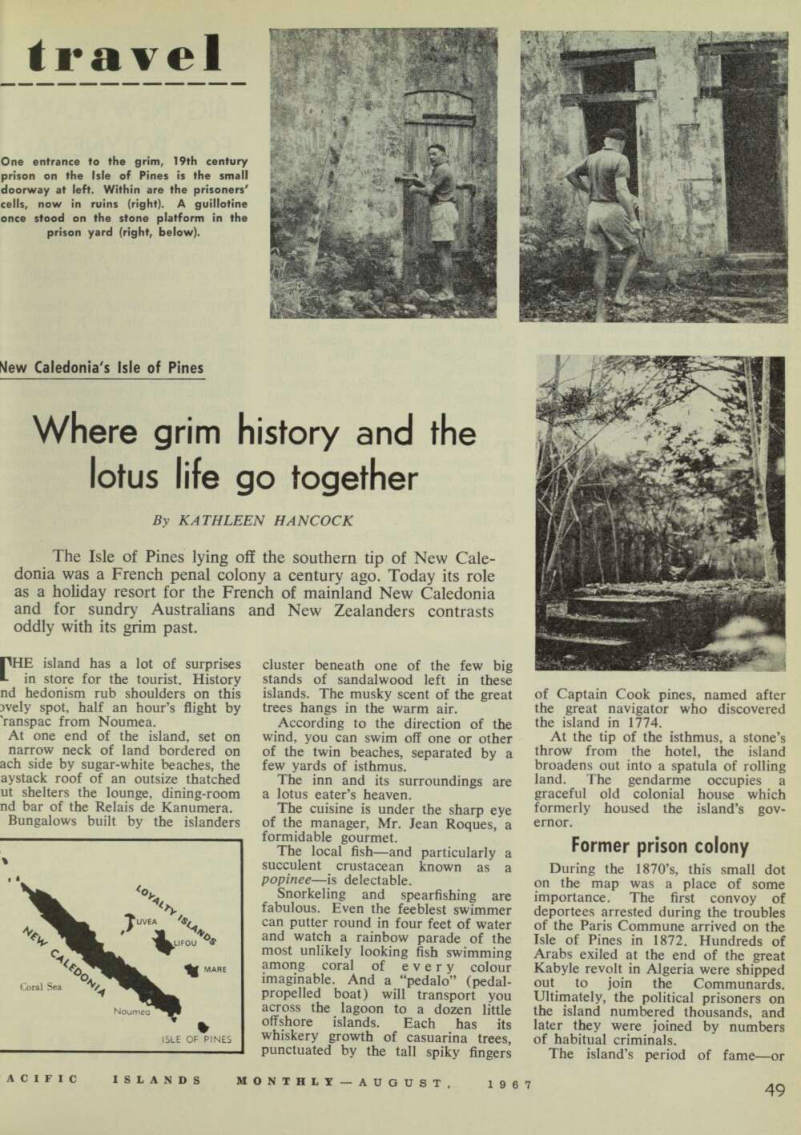
One entrance to the grim, 19th century prison on the Isle of Pines is the small doorway at left. Within are the prisoners' cells, now in ruins (right). A guillotine once stood on the stone platform in the
prison yard (right, below).
infamy—as a prison colony finished at the end of the century, but ruins of great interest remain. The prison compounds in the bush still retain an atmosphere that send a chill down the spine.
Near the inn a rough track ends at towering stone walls. A creaking gate opens on an area some 30 yards square. The cells are within the walls themselves and a large stone platform in the middle of the compound once held the guillotine.
But where a hundred years ago prisoners sweated out their grim sentence, today hundreds of saplings sprout toward the light, and black pigs root among the coconuts in what is now an enormous pig-sty.
Limestone grottoes
Not far from the old prison, half hidden in rough scrub, you can explore the deportees’ graveyard. The elaborate crenellated brick water works, built by the Communards, still stands. But there are other, less grisly, attractions.
The hotel minibus makes a trip to one of the huge limestone grottoes that honeycomb the island. The islanders will tell you that some of their ancestors hid in terror from Cook’s men on a stone shelf in this very cave.
And the tumuli (burial mounds) on the central plateau will intrigue travellers of an ethnological turn of mind. Their origin remains a puzzle to scientists.
At the mission village of Vao, the century old white-washed buildings could have been uplifted from Mediterranean France. Gnarled, old man bougainvillea spill purple showers over wide verandahs.
On Sundays you can listen to glorious singing in the charming little church, whose gold cross is probably still askew at the top of the spire.
Captain Cook’s name for this en chanting island may be prosaic. But the ancient ruins, the languid casuarinas, the icing sugar beaches and the friendly islanders create an ambiance that’s alive with history and romance.
TOURIST travel in Fiji is usually confined to buses, cars, aircraft and the occasional inter-island ship, but 23-year-old Victorian farmer Ray Pearce would have none on his Fiji holiday.
Arriving in June he scorned the normal tourist tracks and set off on the open road with a compact array of camping gear strapped firmly to his 80 cc Japanese Suzuki motorcycle to bump and grind his way over the colony’s highway sys tem.
The dust and watermelon-size gravel was not what was expected.
A far cry from roads in Colac— his hometown—he soon fell off, shat tering his windscreen, both rear vision mirrors and injuring his arm.
Undeterred he started off again and planned to dodge his way over 1,000 miles of the colony’s tracks before concluding his holiday in July.
Ray found Fijian villagers admiring him with astonishment at attempting such a journey, and they invited him into their village homes to rest and tell them all about it. The night’s rest was frequently taken among the often large family stretch ed out on rush matting of the grass huts.
When a roof was not in the offing, Ray tied up a two-man pup tent to a handy coconut tree alongside a stream for the night.
He’s even reported one hitch hiker—a village chieftain flagging him down for a lift to a nearby village for a session of drinking of the native brew, yaqona.
Government, major airline
to be shareholders
Big New Plans
For Polynesian
Airlines
Western Samoa’s flourishing Polynesian Airlines is more than
doubling its share capital to buy
a larger plane and to expand its services.
THE chairman of the board of directors, Mr. E. F. Paul, an nounced in Apia at the end of June that the company would be registered as a public company. Shares increas ing the capital of the company from $WS80,000 to SWS200,000 would be offered to the general public.
He said that the Western Samoan Government had agreed to invest in the new company, and that one major airline, which he did not name, would also make a substantial investment.
Mr. Paul said that Polynesian Airlines had already applied to New Zealand for landing rights in the Cook Islands.
“We may also fly to Tahiti,” he said.
The airline already maintains regu lar services with two DC3’s between Western Samoa and American Samoa, Tonga, Wallis Island and Fiji.
New plane
A few days after announcing the increase in capital, Mr. Paul con firmed rumours that the company planned to buy a DC4. He said this plane would be fitted with more powerful engines than normal and would carry 60 passengers at 265 mph.
He said Polynesian’s operations manager, Captain R. D, Steel, would go to the United States in July to inspect the new plane.
Footnote: In late July, the New Zealand Press reported Mr. Paul as saying that Air New Zealand had bought 20,000 $2 shares in Polynesian Airlines to bring its total to 20 per cent, of the total. He added that the US companies, PanAm, Eastern Air Lines and Continental Air Lines, had all approached his company for a share in its expansion, but it had decided to link with lines based in the South Pacific.
The main bungalow at Relais de Kanu mera, the hotel on the Isle of Pines.
Fiji’s Captain
Withers is off
to sea again
When Captain T. S. Withers ;old out his interest in Fiji’s popular Blue Lagoon Cruise a ;ouple of years ago, his friends wished him the best of luck in a veil-earned retirement.
BEHIND him was pioneering of tourist cruises to outer islands )f the group, commenced in a winkle jarge type of craft left over from he USAF operations in war-time 7 iji, named by the enterprising iviator-cum-mariner Turaga Levu to ;ive it a Fijian flavour.
His friends expected him to sit luietly on the beach from there on, effecting on the profitable past and ooking proudly on the present-day jperation now carried out by two uxury Fairmile launches. These eave the port of Lautoka twice weekly, packed to the gunwales with ourists for the Yasawa group of elands and its golden beaches where Tevor and his customers first plant d their footprints in the cause of ourism 17 years ago.
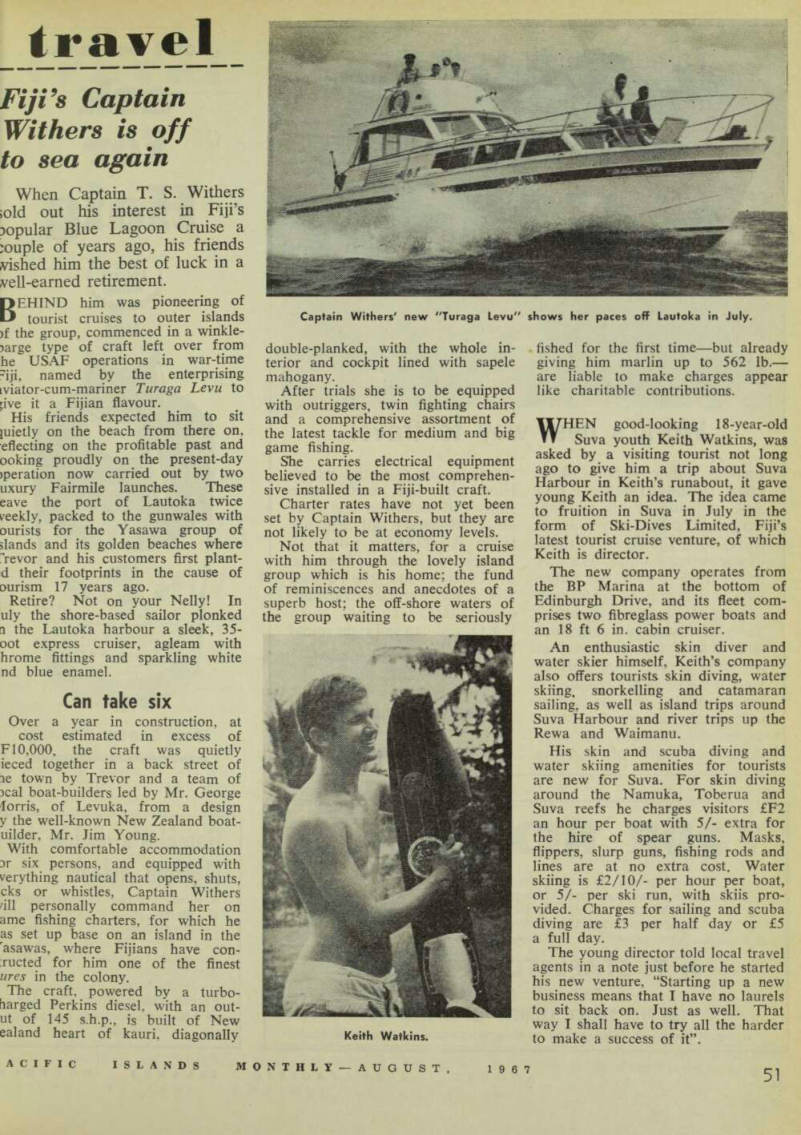
Retire? Not on your Nelly! In uly the shore-based sailor plonked a the Lautoka harbour a sleek, 35oot express cruiser, agleam with hrome fittings and sparkling white nd blue enamel.
Can take six
Over a year in construction, at cost estimated in excess of FI 0,000, the craft was quietly ieced together in a back street of le town by Trevor and a team of Deal boat-builders led by Mr. George lorris, of Levuka, from a design y the well-known New Zealand boat uilder, Mr. Jim Young.
With comfortable accommodation ar six persons, and equipped with verything nautical that opens, shuts, cks or whistles, Captain Withers dll personally command her on ame fishing charters, for which he as set up base on an island in the asawas, where Fijians have con ducted for him one of the finest ures in the colony.
The craft, powered by a turbo fiarged Perkins diesel, with an out ut of 145 s.h.p., is built of New ealand heart of kauri, diagonally
double-planked, with the whole in terior and cockpit lined with sapele mahogany.
After trials she is to be equipped with outriggers, twin fighting chairs and a comprehensive assortment of the latest tackle for medium and big game fishing.
She carries electrical equipment believed to be the most comprehen sive installed in a Fiji-built craft.
Charter rates have not yet been set by Captain Withers, but they are not likely to be at economy levels.
Not that it matters, for a cruise with him through the lovely island group which is his home; the fund of reminiscences and anecdotes of a superb host; the off-shore waters of the group waiting to be seriously
fished for the first time—but already giving him marlin up to 562 lb.— are liable to make charges appear like charitable contributions.
WHEN good-looking 18-year-old Suva youth Keith Watkins, was asked by a visiting tourist not long ago to give him a trip about Suva Harbour in Keith’s runabout, it gave young Keith an idea. The idea came to fruition in Suva in July in the form of Ski-Dives Limited, Fiji’s latest tourist cruise venture, of which Keith is director.
The new company operates from the BP Marina at the bottom of Edinburgh Drive, and its fleet com prises two fibreglass power boats and an 18 ft 6 in. cabin cruiser.
An enthusiastic skin diver and water skier himself, Keith’s company also offers tourists skin diving, water skiing, snorkelling and catamaran sailing, as well as island trips around Suva Harbour and river trips up the Rewa and Waimanu.
His skin and scuba diving and water skiing amenities for tourists are new for Suva. For skin diving around the Namuka, Toberua and Suva reefs he charges visitors £F2 an hour per boat with 5/- extra for the hire of spear guns. Masks, flippers, slurp guns, fishing rods and lines are at no extra cost. Water skiing is £2/10/- per hour per boat, or 5/- per ski run, with skiis pro vided. Charges for sailing and scuba diving are £3 per half day or £5 a full day.
The young director told local travel agents in a note just before he started his new venture, “Starting up a new business means that I have no laurels to sit back on. Just as well. That way I shall have to try all the harder to make a success of it”.
Keith Watkins.
Captain Withers' new "Turaga Levu" shows her paces off Lautoka in July.