Tonga's Coronation Was All
pp. 47-126 · Read in the full issue
Things To All Men
By STUART INDER, who was in Nukualofa for the coronation
Yes, but was Tonga’s coronation a success? And what was it really like in Nukualofa in coronation eek? Naturally everybody wants to know, but the coronation was one of those events which are all ings to all men, and the right answers don’t come pat.
start with, which ceremony do you mean? There were two. iere was a Westminster Abbey-type sctacle on the Tuesday, when they sssed in ermine, brocades, coronets, ;dals, three-cornered hats and ?pers, cutaways, and striped morn % suits of Victorian vintage.
Then there was the taumafakava, traditional installation, on the iursday, when the king and his bles and matapules —with mats Dund their middles—formed a great kava ring so the king aid hear them pay him allegiance Polynesian fashion.
For Tongans, both installations re a success. There was hardly a il of the 77,000 of them who was t involved in some way, whether cooking the pigs, waving a flag, ving a taxi or sitting for hours on ; malae listening to the oratory.
Whatever and whenever it was ppening they were all within reach their transistor radios, and on the nsistor the coronation coverage s very good indeed. Not a word of / of the major functions, from the ipel service to the football, could Tongans not pick up from on -spot broadcasts by ZCO, the ice of the Friendly Islands.
Move on, please
"or those of us who don’t speak ngan, the coronation was more : icult. At times it even became perate for us who, unfortunately, I’t look like Tongans and who s shone like naughty deeds in adise—the target of stone-faced ace guards, fat inspectors of ice and disciplined members of the ngan defence forces, all of them ?ued with the moving spirit, f for Tongans, even for stone ed palace guards, the coronation s undoubtedly a success, for me t ceremony leading up to the ipel, and the procession of the wned king and entourage back to palace next door, appeared to be nething of a mad hatter’s tea ty—at least, at my first look.
Squatting down in my roped-in enclosure, trying not to block the camera lens of my old friend Cec Lynch of the Australian magazine Woman’s Day, I found I was asking myself whether I ought to be taking the thing seriously. It was a sparkling South Seas day, with the surf on the reef, and what on earth were we all doing here?
Cec shook his head and gave a shrug, and apparently was having similar doubts. It was the shining, eager faces of the school children which gave me a twinge of conscience; it was obvious that for them, where else would anybody sensible be?
Press not invited
On reflection, they had the right attitude. Didn’t the Governor of Fiji still sometimes wear a plumed hat and sword, and the Speaker of the New Guinea Assembly a full bottomed wig and gown? And nobody made fun of them.
Christian Tonga held a Christian coronation, with its anointing, invest ing and enthroning, based on a Euro
pean pattern introduced last century for King George I. The kingdom has made the ceremony not an anachron ism but one of its own traditions, and when viewed this way the spectacle was fascinating.
The king hadn’t been keen to encourage too much publicity, I learned later, but it had sort of got away from him. His attitude was to his credit, in view of the mess the Press arrangements finally got into, and of some of the irreverent things the world’s newspapers had to say. (Wrote one reporter: “You can’t really report the coronation. It needs to be set to music”).
No reporter was allowed into the chapel, but they let one fellow put his nose against the window pane and peer in with the movie cameras which were also kept out. From every account of those who were there it was a successful, satisfying chapel service, run with un-Tongan precision.
The pomp and circumstance of the procession to the palace broke down when the king got to the door and turned to face the seated guests in the grounds. At this point
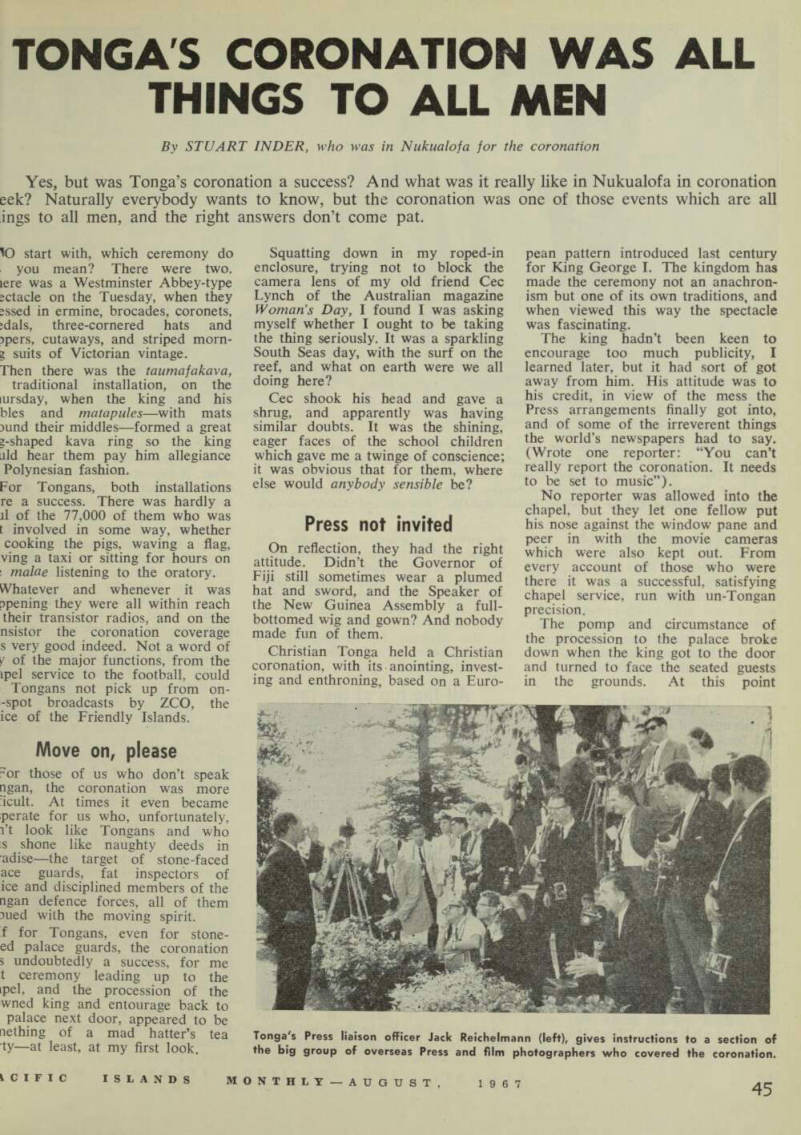
Tonga's Press liaison officer Jack Reichelmann (left), gives instructions to a section of the big group of overseas Press and film photographers who covered the coronation.
Fiji Government photographer Rob Wright, who has shot more modern Tongan history than anyone, had been invited to take some close-up colour photographs. But when the guests saw the newly-crowned king and queen merely standing there, they broke from their seats and banged away with amateur enthusiasm with their Instamatics and Brownies.
Open warfare
This angered the professionals, who had been told to keep to their roped enclosure, and they broke and ran too. After five minutes, when it looked like developing into open warfare, the palace guards entered the fray, unceremoniously clearing an open space to allow thousands of school children to wheel in through the gates in colourful, uniformed battalions, eyes sparkling with enthusiasm, to greet their king with flags and unbridled cheers.
For the next hour it was all a mad, gay scramble of peeling bells, saluting guns and wide smiles—as if they put on a coronation once a month for fun. This was the real Tonga, in all its sincerity.
The Big Week was now on, start ing with a garden party that very afternoon at Kauvai, “their Majesties’ country residence”, some miles out
of town, at which the Duke and Duchess of Kent met the guests over tea and orange drinks.
There were brass band com petitions, choir competitions, open air films, a harbour regatta, feasting, illumination of the seafront and islets in the harbour by flaming torches (tupakapakanava), traditional danc ing and fireworks.
All the fun of the fair
Tonga’s clubs opened their doors, nobody in the Dateline Hotel or anywhere else in Nukualofa went to bed that week. Tongans from throughout the kingdom erected makeshift camps on vacant pieces of land, and in the mornings the smoke of the cooking fires as the pigs were roasted blanketed the capital.
One great relief, everybody agreed, was that the P & O liner Canberra, with 1,400 passengers, had been delayed by the Middle East crisis and would not now arrive in Nukua lofa until the following week. That many extra people would have meant the capital being declared a disaster area.
The tupakapakanava ceremony, which was repeated for four nights, was a family affair. It was the youngsters who lit the flaming torches and who sat on the sea wall with
Mum and Dad, proudly adding thei lights to the masses, with spectacula effect. I expect never to see anythin] more fascinating than that might; spectacle of illumination.
It far outdid the fireworks display turned on by HMS Sirius and HMA!
Anzac, in typical naval rivalry. Th Royal Navy did the better job. Th Australian Navy’s explanation wa that their fireworks got wet.
For those who saw it, Thursday’ ancient royal kava installation of th king was the highlight of the week I am not sure that Tongan corona tions would not be just as satisfactor if they were built around nothing els< but the kava ceremony. The form an< order of Taufa’ahau’s chapel servio was designed especially for thi occasion—the work of the Roya Chaplain, the Rev. George Harris and a committee, although, as I havi said, it is based on British traditions The royal kava ceremony has it roots in Tongan history.
The royal kava ceremony
For most Tongans the kava cere mony is the real installation of the king. From all the outlying island! the chiefs had come to drink kavs with their monarch, and thus the ordinary man in Tonga was left in nc doubt of the authority of his chiefs They were the men who had sealed their office in the great kava ring.
There had been two rehearsals foi the chapel ceremony, both private and there was one for the royal kava installation, the previous week. This rehearsal was a vital one, for at it.
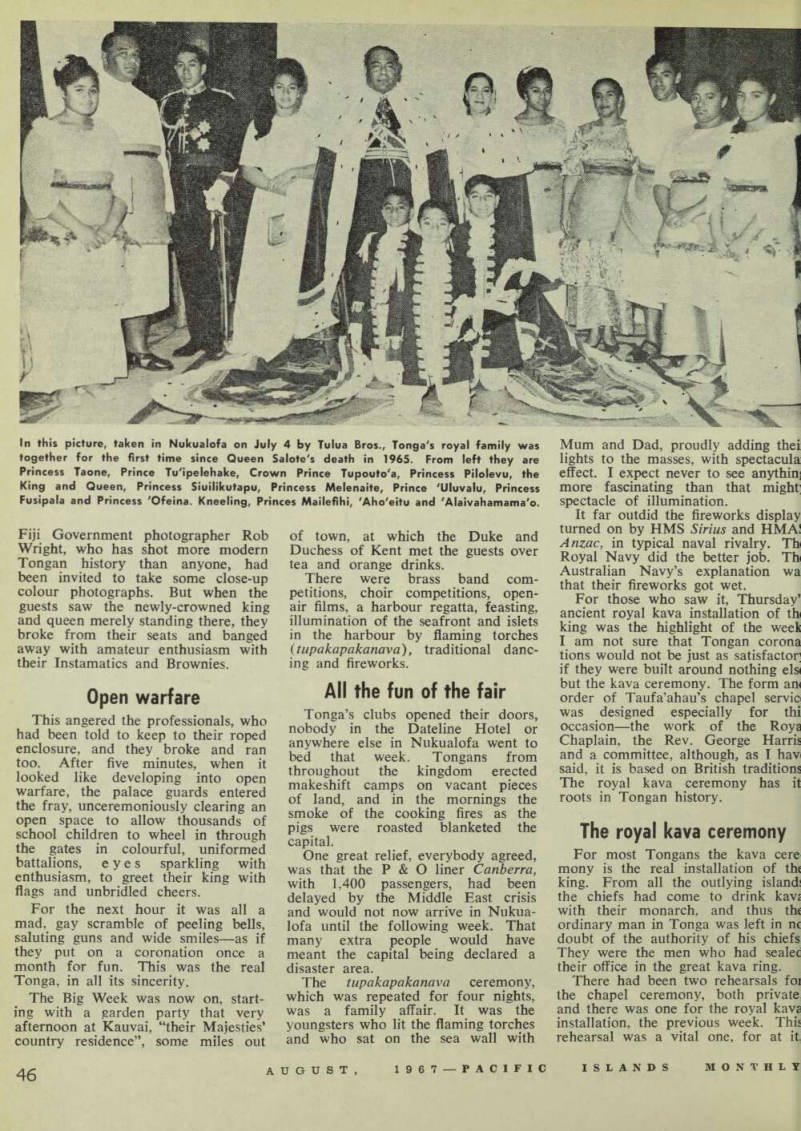
In this picture, taken in Nukualofa on July 4 by Tulua Bros., Tonga's royal family was together for the first time since Queen Salote's death in 1965. From left they are Princess Taone, Prince Tu'ipelehake, Crown Prince Tupouto'a, Princess Pilolevu, the King and Queen, Princess Siuilikutapu, Princess Melenaite, Prince 'Uluvalu, Princess Fusipala and Princess 'Ofeina. Kneeling, Princes Mailefihi, 'Aho'eitu and 'Alaivahamama'o.
i the absence of the king, the nobles id the matapules had argued out the rict order of seniority. But not be »re the participants had expressed ime views on the form of the cere ony itself, and it appeared there ere two schools of thought—the aditionalists, and those who felt ere had to be changes.
They sat and wondered
There was criticism expressed of e’ehala, Keeper of the Palace jcords and undoubted arbiter on ingan tradition. Ve’ehala was the an behind the royal kava arrange ents. It was hard to get at the facts, it I gather that Ve’ehala was gered by this schism, but he had support of the king.
The real event went off with eater harmony than some people d expected; starting a mere five urs’ late. Typically, nobody had ithered to tell the many would-be [lookers of the delay, or the reason r it—which was that traditionally e later in the day the ceremony ished the longer the monarch >uld reign.
Taufa’ahau should have no worries.
He got going at 4 p.m. and wearily climbed to his feet at 8.35 p.m.
By the time the climax was reached the light was too bad to allow the film people (harassed all day by policemen insisting they move from one spot to another) to film the first cup of kava. They appealed for permission to use lights, and were refused. They packed up in disgust and returned to the Dateline Hotel.
Back at the kava ceremony the lack of light soon became a problem;
the rows of coloured carnival lights draping the great pine trees as part of the general coronation festivities were hardly sufficient. So they drove in the king’s limousine, parking it across the mats with its headlights full on, and the ceremony droned to its close.
Thus, in the end, Tongan and Western influences shared the billing as usual, the Tongan way the more dominant.
Muddle
Official arrangements for VlP’s during coronation week always ap peared to be in a muddle. Seating was often missing, transport un reliable, invitations were frequently delivered to surprised sleepy-eyed VlP’s at two in the morning; instruc tions were contradicted, counter manded, forgotten.
The Press, particularly the film men, including the New Zealand National Film Unit which was at tempting to produce a full record of the coronation as a gift to Tonga, were either being hounded or ignored in long stretches, and could find nobody to discipline the Instamatic tourists who were making their task difficult.
The Press and some VlP’s were inclined to blame Tongan efficiency in general, and some officials in particular, for this state of affairs.
But it isn’t as simple as that.
When it came to handling VIP arrangements—such seemingly simple things as addressing and distributing up to 6,000 personal invitation cards and arranging transport—a small
(Continued on p. 120)
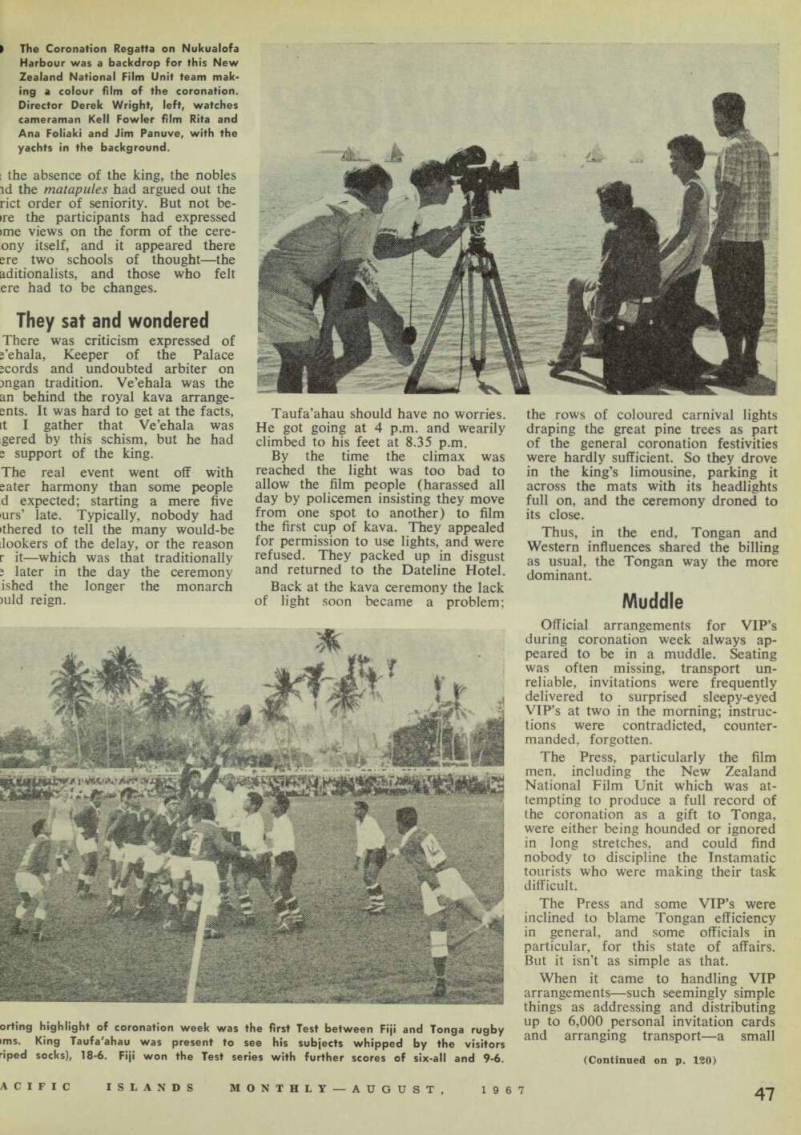
The Coronation Regatta on Nukualofa Harbour was a backdrop for this New Zealand National Film Unit team mak ing a colour film of the coronation.
Director Derek Wright, left, watches cameraman Kell Fowler film Rita and Ana Foliaki and Jim Panuve, with the yachts in the background.
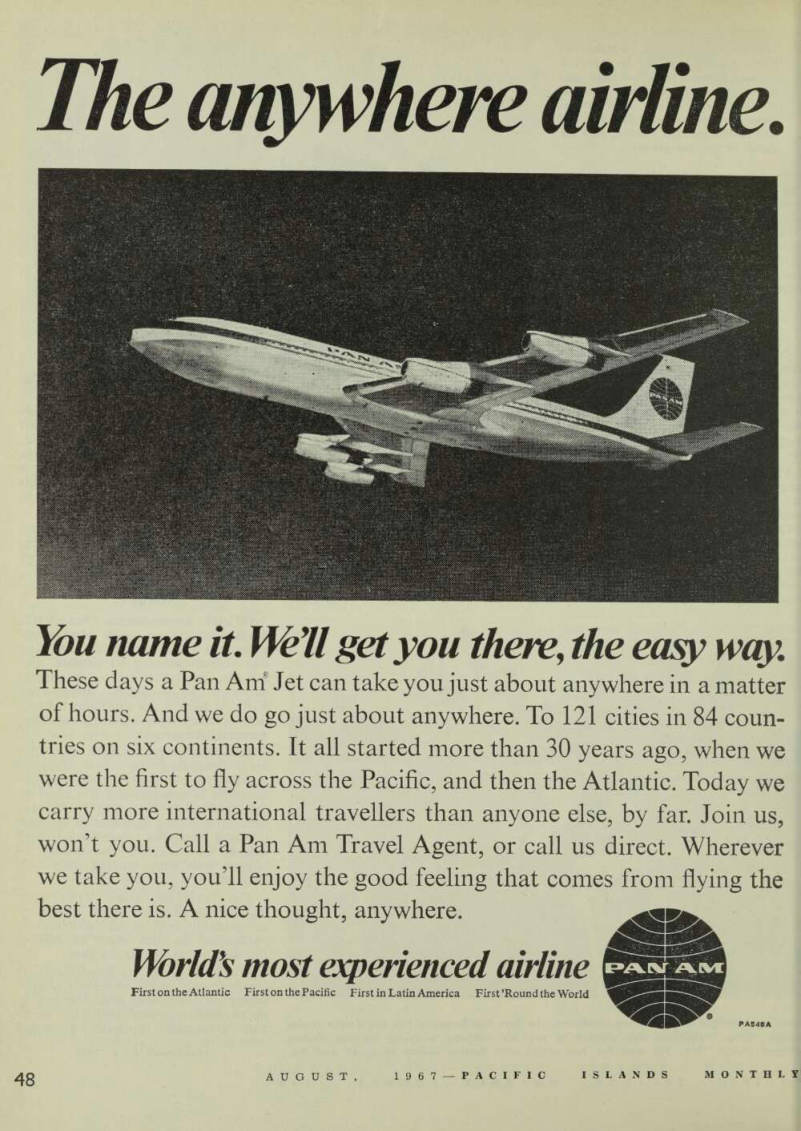
[?]orting highlight of coronation week was the first Test between Fiji and Tonga rugby [?]ms. King Taufa'ahau was present to see his subjects whipped by the visitors [?]iped socks), 18-6. Fiji won the Test series with further scores of six-all and 9-6.
group of officials was faced with a huge job under heavy pressure. Like the South Pacific Games, spectacles like coronations need full time organisers, and large numbers of casual helpers.
To know what Tongans can do, when they have the numbers, one merely need point to the success of such Tongan responsibilities as the feasting and the torch illumination.
The provision of food for that mighty multitude would have done credit to the logistic experts on the Second Front.
No, what mainly was lacking in coronation week was co-ordination.
And proper recognition that visitors have traditions too, and they cannot be expected to understand Tongan ways overnight. Why should Tongan communal life, with its genuine respect for the chiefs, be instantly understood by a visitor from Sydney or San Francisco?
Many times I heard somebody comment: “If they are so sure every thing is so perfect in this country, why do they let any visitors in at all!”
It was a fair reaction. Tonga can’t live on its own. It can’t continue to afford to be insular and parochial.
It can’t continue the way that King Taufa’ahau himself realises it works, as he explans in the foreword of Kenneth Bain’s new book, The Friendly Islanders:
“Tonga is always trying to get the best of both worlds,” he writes, “or all worlds if there are more than two. All this tends to confuse strangers, but it is the normal Tongan way of life!”
Having said all that, was Tonga’s coronation successful?
It was, whether you look on it as an event purely for Tongans, or for visitors.
Nothing went wrong with the cere monies themselves. Despite the man gremlins in some of the other activ ties in coronation week, everythin went off a lot better than, say, som aspects of the Second South Pacifi Games in Noumea last year.
Tonga in coronation week put it best foot forward, bumble-footed a it is inclined to be at times. And i everything that mattered, and especi ally in the general welcome with it friendliness and sincerity, the Tongan let nobody down, except in that on instance, of publicity. They hav drawn some of the wrong publicit; as a result of officialdom’s failur there, but they hurt only themselves And another thing worth notin that was good.
A number of people who als< had visited Tonga before commentet particularly on Nukualofa’s lack o street pests and would-be confideno men who normally are the bane o visitors. Like me, they hope that th( last of them really has gone, an< that their absence was not merely j temporary respite for the coronation If Tonga is to build up a touris market following the great advantag the coronation publicity has given it it does not want to spread its earlie reputation. Tourists to the Soutl Seas don’t want to be pestered b] children begging for coins, and thei fathers asking for $2O “to buy sorm school books” for their children, or j shirt for church, or offering to “shij a case of bananas, but pay now”.
The people of Royal Tonga ar< bigger than that, as the kingdom’: extraordinary coronation showed.