King Taufa’ahau
pp. 42-46 · Read in the full issue
will keep his hand on the helm
By Stuart Inder
When King Taufa’ahau acceded to the throne on the death of Queen Salote in December, 1965, he lost a post which had given him undoubted control of the kingdom. As Prince Tungi, he had since 1949 been Premier, Minister of Foreign Affairs, Minister of Education, Minister of Agriculture, and Chairman of the Tonga Copra Board and the Produce Board.
ALTHOUGH certainly his high birth would have guaranteed him support for anything he wanted to do whatever his positions, his specific executive authority in all these departments enabled him to exert a powerful influence on Tonga’s progress.
Since he came to the throne there have been no great changes because of the long period of mourning and the preparations for the coronation.
The question most asked in this interval has been whether the new king would revert to the passive role of a constitutional monarch and leave future developments to Cabinet under the new Premier, his brother Tu’ipelehake, or continue the way he has always operated.
It was a question I was interested in getting an answer to in coronation week, but right up to the end of the week I could get nothing positive: for every person I spoke to who felt that King Taufa’ahau would continue to play the role of Prince Tungi, there were those who felt that the king would eventually pass over his responsibilities to his brother. Some felt that Queen Salote’s death had taken Tungi by surprise, that he had been too involved with the kingdom’s affairs to be able to hand over quickly, although that was his inten tion.
At the end of the week I received a final opinion which seemed at last to be an accurate pointer to
the king’s intentions: It came from the king himself.
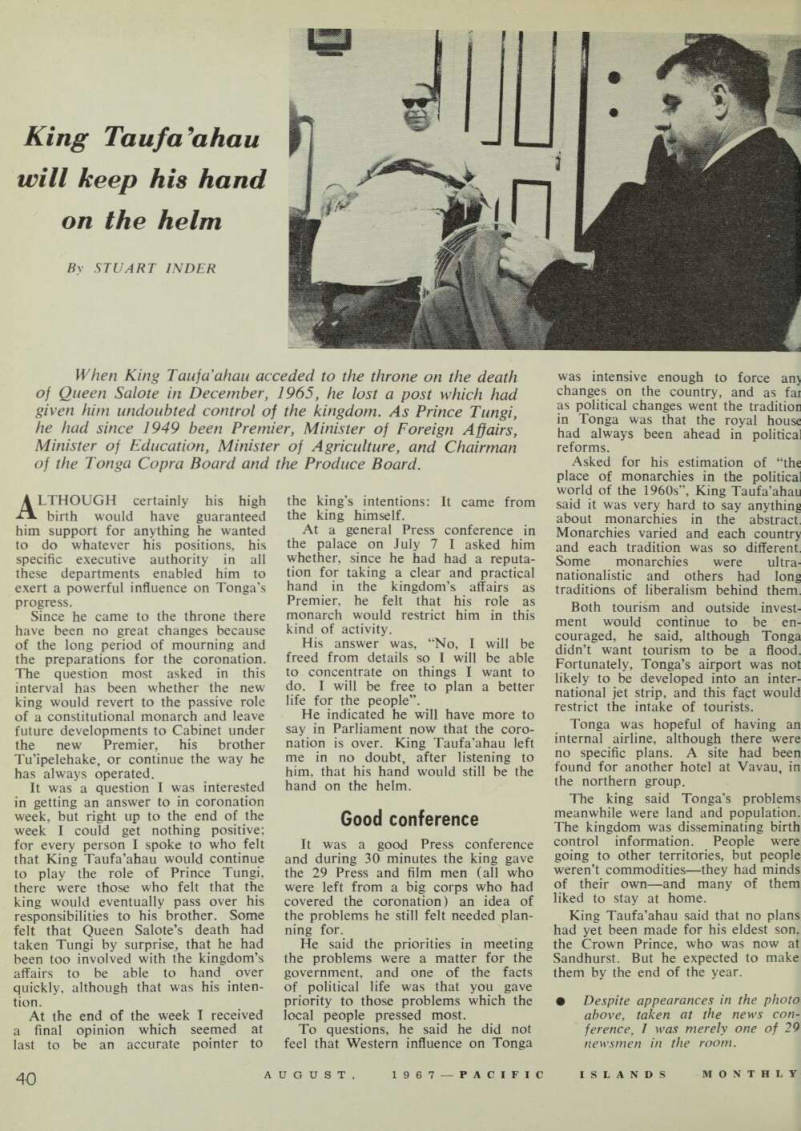
At a general Press conference in the palace on July 7 I asked him whether, since he had had a reputa tion for taking a clear and practical hand in the kingdom’s affairs as Premier, he felt that his role as monarch would restrict him in this kind of activity.
His answer was, “No, I will be freed from details so I will be able to concentrate on things I want to do. I will be free to plan a better life for the people”.
He indicated he will have more to say in Parliament now that the coro nation is over. King Taufa’ahau left me in no doubt, after listening to him, that his hand would still be the hand on the helm.
Good conference
It was a good Press conference and during 30 minutes the king gave the 29 Press and film men (all who were left from a big corps who had covered the coronation) an idea of the problems he still felt needed plan ning for.
He said the priorities in meeting the problems were a matter for the government, and one of the facts of political life was that you gave priority to those problems which the local people pressed most.
To questions, he said he did not feel that Western influence on Tonga
was intensive enough to force an> changes on the country, and as far as political changes went the tradition in Tonga was that the royal house had always been ahead in political reforms.
Asked for his estimation of “the place of monarchies in the political world of the 19605”, King Taufa’ahau said it was very hard to say anything about monarchies in the abstract.
Monarchies varied and each country and each tradition was so different.
Some monarchies were ultra nationalistic and others had long traditions of liberalism behind them.
Both tourism and outside invest ment would continue to be en couraged, he said, although Tonga didn’t want tourism to be a flood.
Fortunately, Tonga’s airport was not likely to be developed into an inter national jet strip, and this fact would restrict the intake of tourists.
Tonga was hopeful of having an internal airline, although there were no specific plans. A site had been found for another hotel at Vavau, in the northern group.
The king said Tonga’s problems meanwhile were land and population.
The kingdom was disseminating birth control information. People were going to other territories, but people weren’t commodities—they had minds of their own—and many of them liked to stay at home.
King Taufa’ahau said that no plans had yet been made for his eldest son, the Crown Prince, who was now at Sandhurst. But he expected to make them by the end of the year. • Despite appearances in the photo above, taken at the news con ference, I was merely one of 29 newsmen in the room.
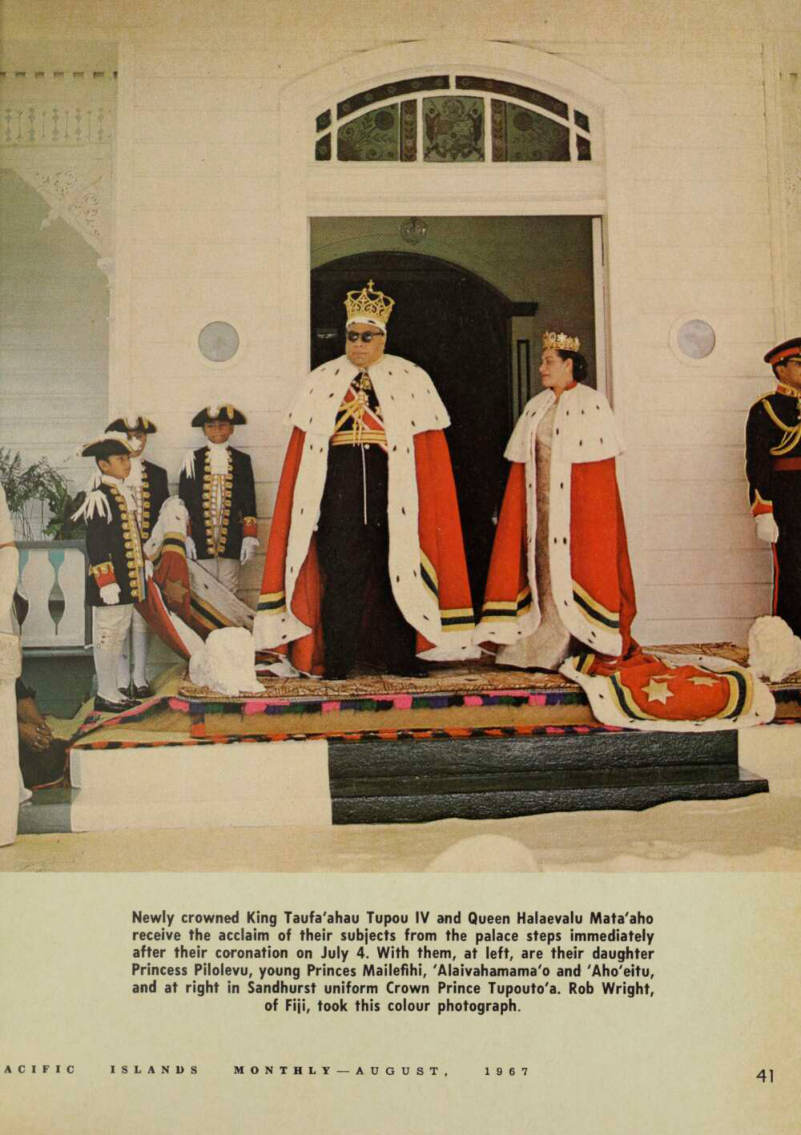
Newly crowned King Taufa'ahau Tupou IV and Queen Halaevalu Mata'aho receive the acclaim of their subjects from the palace steps immediately after their coronation on July 4. With them, at left, are their daughter Princess Pilolevu, young Princes Mailefihi, 'Alaivahamama'o and 'Aho'eitu, and at right in Sandhurst uniform Crown Prince Tupouto'a. Rob Wright, of Fiji, took this colour photograph.
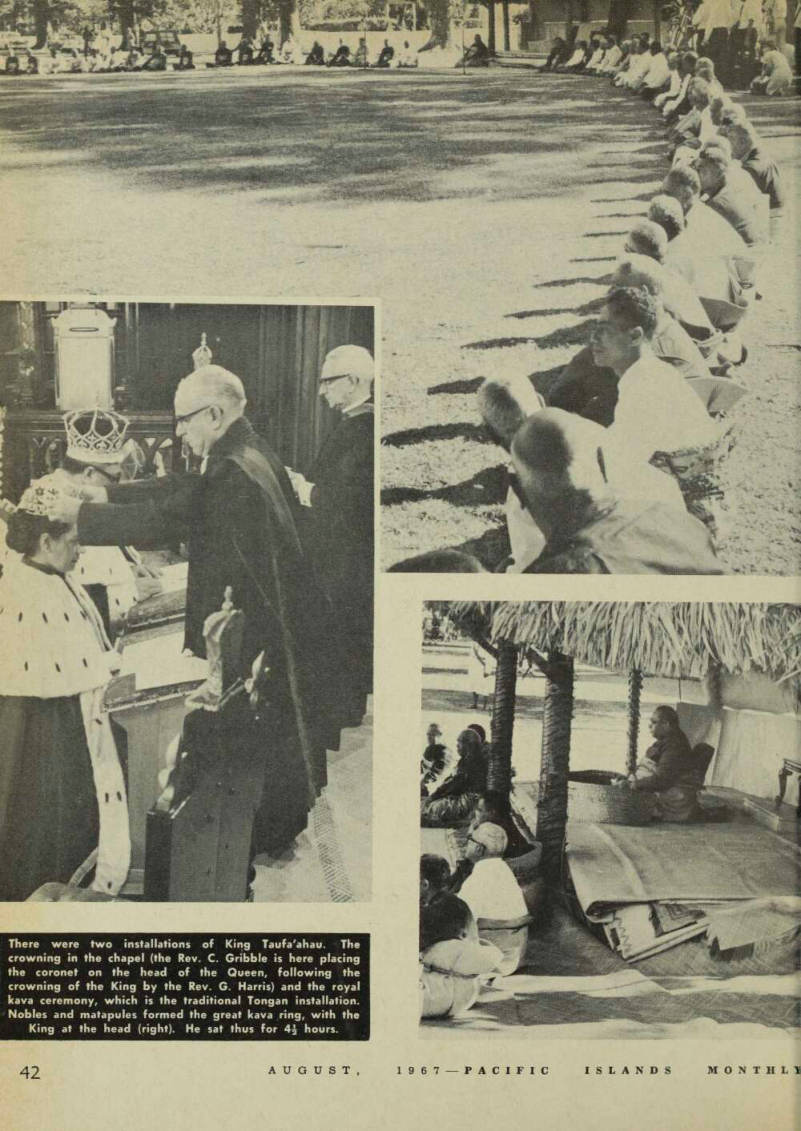
There were two installations of King Taufa'ahau. The crowning in the chapel (the Rev. C. Gribbie is here placing the coronet on the head of the Queen, following the crowning of the King by the Rev. G. Harris) and the royal kava ceremony, which is the traditional Tongan installation.
Nobles and matapules formed the great kava ring, with the King at the head (right). He sat thus for 4½ hours.
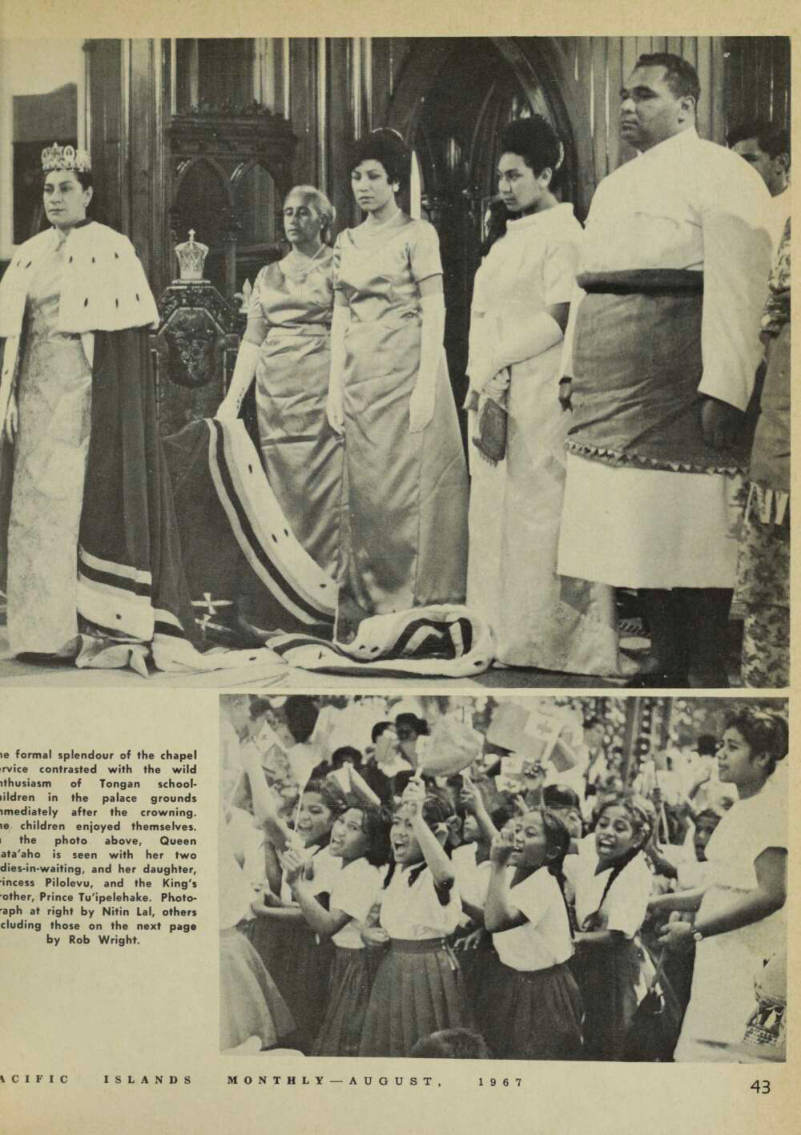
te formal splendour of the chapel irvice contrasted with the wild ithusiasm of Tongan school lildren in the palace grounds tmediately after the crowning, le children enjoyed themselves, i the photo above, Queen ata'aho is seen with her two dies-in-waiting, and her daughter, incess Pilolevu, and the King's •other, Prince Tu'ipelehake. Photo •aph at right by Nitin Lai, others eluding those on the next page by Rob Wright.
Spectacular dances such as this one performed by 500 girls from the Queen Salote College were a feature of the entertainment pro vided for official guests after the coronation feast. Below, Nukualofa was filled with scenes like this during the coronation, when mats seemed to be everywhere.
American visitor Robert Hunter enjoys the coronation feast, Tongan style.