Changes, Yes-But Tahiti
pp. 55-57 · Read in the full issue
And the French food's good if you know where to go
Is Still Tahitian
By Judy Tudor
If you think of Frenchmen as perpetually small, dark and argumentative, you are surprised at M. Gerard Gilloteaux, of the Tahiti Tourist Development Board, who is big, fair and can discuss even de Gaullism without either one-eyed fanaticism or enthusiastic vituperation.
TE is a bit of an Anglophile, too —possibly because he was once tached to a Scottish regiment as an terpreter and obviously enjoyed it, it his rapport with the British >esn’t extend as far as their food. 5 has some entertaining things to y about New Zealand cooking and have never dared ask what he ought about eating in even further it outposts of Empire.
He is, of course, an excellent guide where and what to eat in Tahiti and if you think that a guide ould not be necessary in a place “ size of Papeete, then obviously u haven’t been there for a long ne.
There are, in addition to the res trants in the big hotels, a score other good places, with French Chinese cooking; and whatever
else might be said of Tahiti in the era of the bomb, this fact alone places it in a different category to every other town in the South Pacific.
The visit before last he took us to the Royal Tahitian to try out some special kind of souffle. This time we had two excursions—to Papachou’s for lunch; and to La Chaumiere for dinner.
Papachou's place
Papachou came from France some years ago to be chef at Taaone Hotel —and because he used to hand out left-overs at the back door he got his nick-name (which hasn’t got any thing to do with cabbages but means “sugar-daddy”).
Now Papachou operates a res taurant of his own, in an old water front mansion on the Quai de
I’Uranie. In the best traditions of French family business, Madame Papachou sits at her raised desk in the restaurant and watches everything with eagle-eye; while Monsieur reigns supreme in the kitchen, emerging spotless in white apron and high hat only to receive your compliments on his food.
La Chaumiere is about four miles out of town. You take the Airport Road, pass the Hotel Tahiti, and about a mile from Faaa turn sharp left up the Pamatai Road into the hills. When I first discovered this road for myself in 1962, each bend revealed more breath-taking views, but all but the very lowest slopes were quite uninhabited. In 1964 when I went back again the houses had crept up a little further; but in 1967, thanks to the atomic tests and the tremendous impetous that building has got, new houses now decorate both sides of the road and march up the slopes.
Food is from France
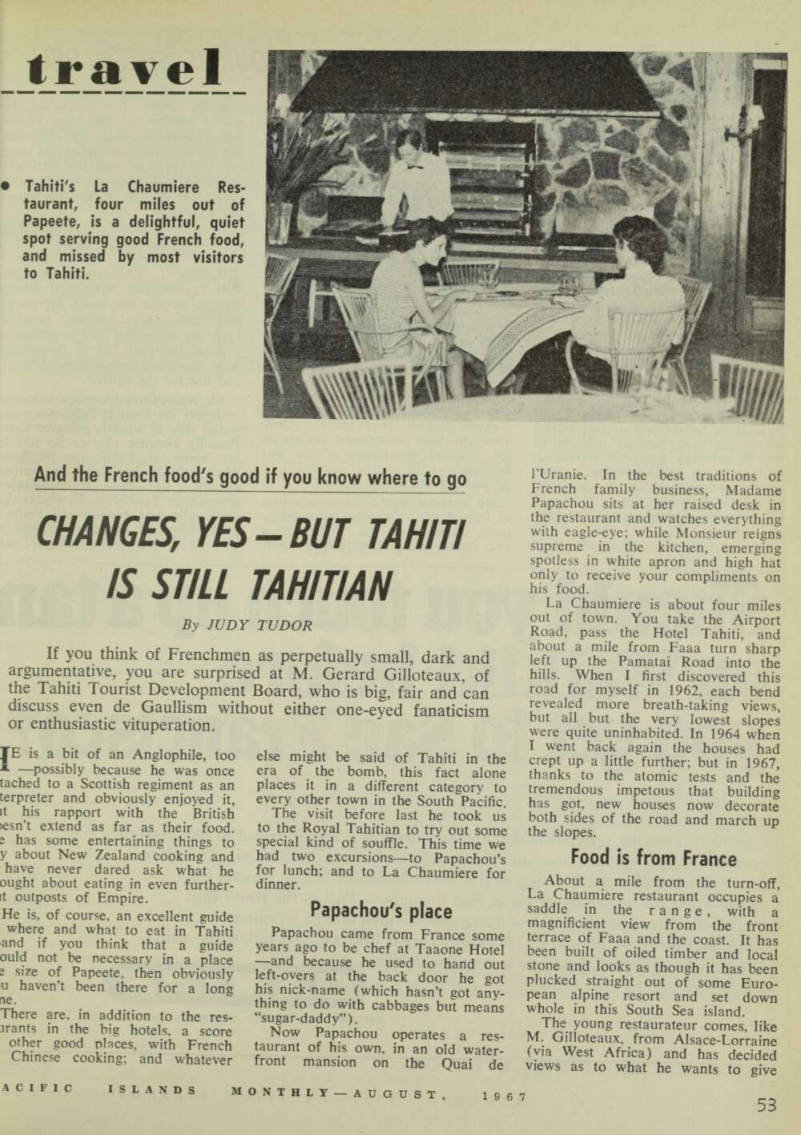
About a mile from the turn-off, La Chaumiere restaurant occupies a saddle in the range, with a magnificient view from the front terrace of Faaa and the coast. It has been built of oiled timber and local stone and looks as though it has been plucked straight out of some Euro pean alpine resort and set down whole in this South Sea island.
The young restaurateur comes, like M. Gilloteaux, from Alsace-Lorraine (via West Africa) and has decided views as to what he wants to give
• Tahiti's La Chaumiere Res taurant, four miles out of Papeete, is a delightful, quiet spot serving good French food, and missed by most visitors to Tahiti.
Tahiti in the way of a restaurant. The raw materials for the food he serves are all imported from France and he seems to rely entirely on word of mouth to attract custom. Probably most tourists pass through, never knowing that the place is there and so miss this delightful, quiet spot with its good food and beautiful surround ings.
In spite of what that American secret-weapon, Mrs. Gertrude Baker, says ( PIM , June, p. 54) I like French food. Even more, I like the things that go with French food. The good service, the right appointments, the wine, and the French approach to the whole thing—which is a matter-of fact blending of commonsense and pleasure.
Hotel school successful
Nonetheless, I imagine that what appears to be calm and well-ordered out front is not achieved in Tahiti without its heart-burnings and frayed nerves out back, because although to the French the hotel or restaurant business is an honourable profession, worthy of total and lifetime devotion, to the Tahitian it is apt to be some thing to be indulged in only so long as it’s fun.
In this department, the Tahiti hotel
Papeete's Rush Hour Is Sheer Hell
school—or to give it its more impressive French title, Centre d’Apprentissage Hotelier is now paying dividends.
The school was established about four years ago and at present trains 30 students at a time but expects to treble this number when the new technical school is built. Students are taught how to prepare food, how to serve it and the wine that goes with it.
Generally they emerge from the course with flying-colours, carrying on thereafter with a certain amount of old Tahitian unexpectedness. The head girl at our hotel, for example, used to flop down into a spare chair at our table every morning. Her feet, she said, were killing her be cause she had danced all night; what was more, she had a bad cold (and proved it with loud sniffs). Only after she had unburdened herself of the assorted encounters of the last 24 hours could she be persuaded to go and get our coffee.
By contrast was the young waiter at Papachou’s, who was supposed to have come from the Tuamotus a year before and had, until then, never
seen the inside of a restaurant. He was a student at the hotel school, getting some practical experience dur ing the vacation, and under the sharp eye of Madame and the indulgent one of M. Gilloteaux—the school is very dear to his heart—performed like a veteran.
The new Tahiti
ELEGANT restaurants and Tuamotuans playing French waiter are not the usual ingredients for South Seas charm and probably both are regarded by the purists as part of the long list of things that have, in recent years, changed Tahiti, and not for the better.
Dr. Bengt Danielsson, acknowledged authority on French Polynesia, takes a dim view of what is going on there.
Possibly because of this he has let his house in Tahiti, doesn’t know when he’ll be back and has become curator of the anthropological museum in Stockholm. He thinks that de Gaulle and France will make a convenience of French Polynesia so long as it suits them, then pull out.
n the resulting confusion, American ourists interests will take over.
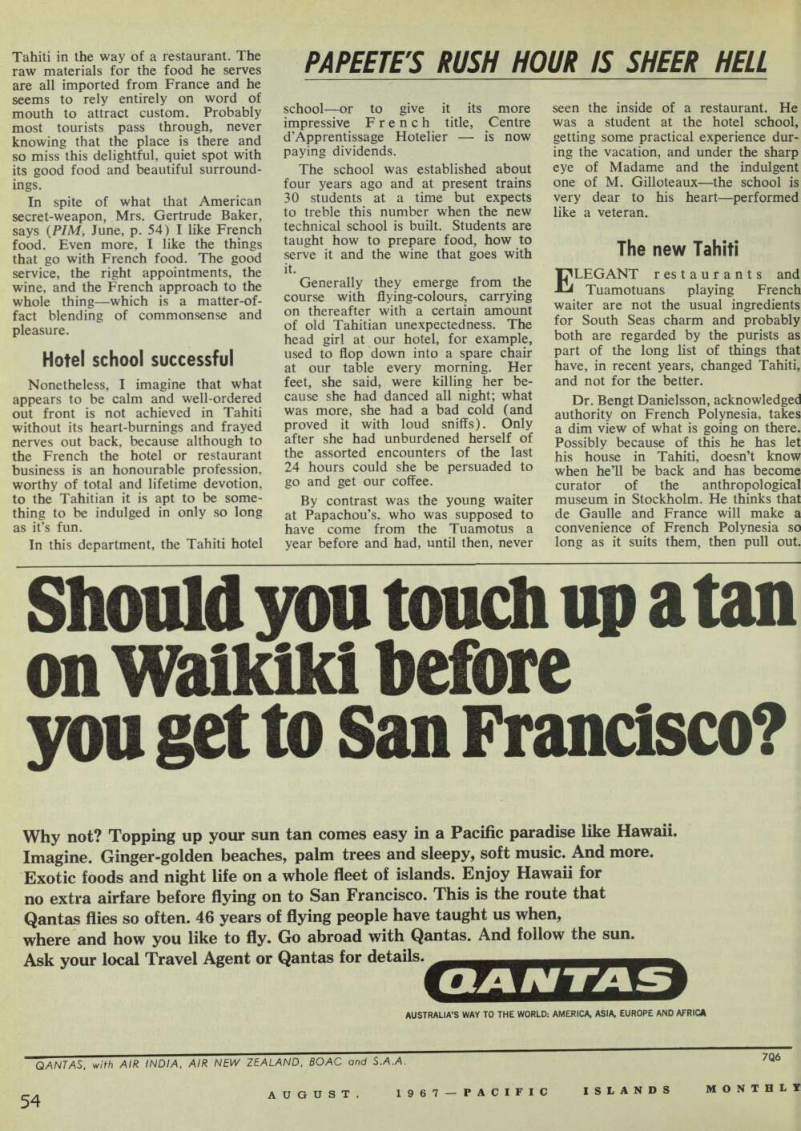
Whether the casual observer can gree or disagree with this dark licture or not, it is true that hysically Tahiti has virtually been lade-over in the last five years, Papeete has developed into an rban sprawl that takes in all the earer districts; and, right out as far s Papeari, what used to be small lantations seem to be in process of abdivision to make way for more ouses.
In five years, the motor traffic mst have increased four-fold so that le rush-hour, morning and night, is leer hell and extends 15 to 20 miles ut of Papeete, in a weaving single le of scooters, motorised-bikes and irs.
Inside the Papeete pass, French loney has built the fantastic new arbour that seems capable of berth ig most of the French Navy. The aterfront, too, has had a face-lift, it only in spots. From Quinn’s estward, with the exception of a w new buildings, including a new tablissements Donald emporium, it much the same; from Quinn’s east ard there has been a great deal of ;w building.
In the streets behind the water ont, new offices jostle old wooden (ops and the old cathedral clock ill stands at 10 to 10 one side. re another and 12 o’clock some here else.
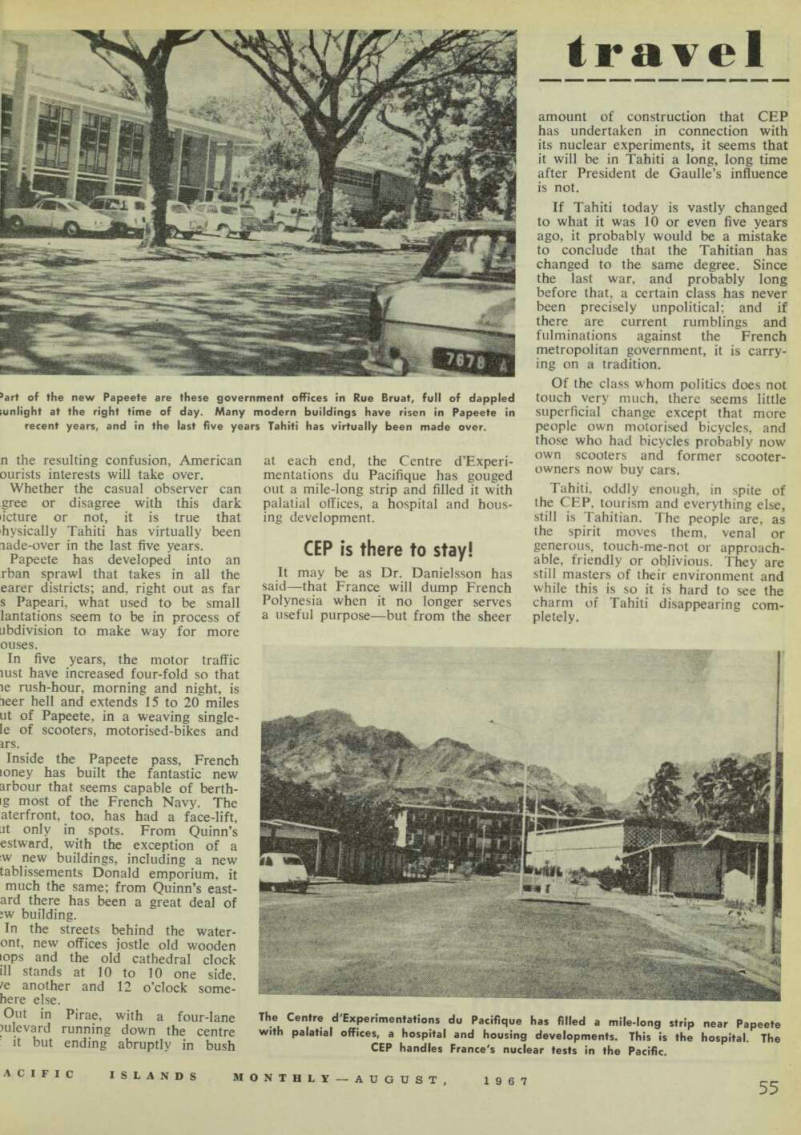
Out in Pirae, with a four-lane julevard running down the centre it but ending abruptly in bush
at each end, the Centre d’Experi mentations du Pacifique has gouged out a mile-long strip and filled it with palatial offices, a hospital and hous ing development,
CEP is there to stay!
It may be as Dr. Danielsson has said—that France will dump French Polynesia when it no longer serves a useful purpose—but from the sheer
amount of construction that CEP has undertaken in connection with its nuclear experiments, it seems that it will be in Tahiti a long, long time after President de Gaulle’s influence is not.
If Tahiti today is vastly changed to what it was 10 or even five years ago, it probably would be a mistake to conclude that the Tahitian has changed to the same degree. Since the last war, and probably long before that, a certain class has never been precisely unpolitical; and if there are current rumblings and fulminations against the French metropolitan government, it is carry ing on a tradition.
Of the class whom politics does not touch very much, there seems little superficial change except that more people own motorised bicycles, and those who had bicycles probably now own scooters and former scooter owners now buy cars.
Tahiti, oddly enough, in spite of the CEP, tourism and everything else, still is Tahitian. The people are, as the spirit moves them, venal or generous, touch-me-not or approach able, friendly or oblivious. They are still masters of their environment and while this is so it is hard to see the charm of Tahiti disappearing com pletely.
Part of the new Papeete are these government offices in Rue Bruat, full of dappled sunlight at the right time of day. Many modern buildings have risen in Papeete in recent years, and in the last five years Tahiti has virtually been made over.
The Centre d'Experimentations du Pacifique has filled a mile-long strip near Papeete with palatial offices, a hospital and housing developments. This is the hospital. The CEP handles France's nuclear tests in the Pacific.