Smith—But Why?
p. 91 · Read in the full issue
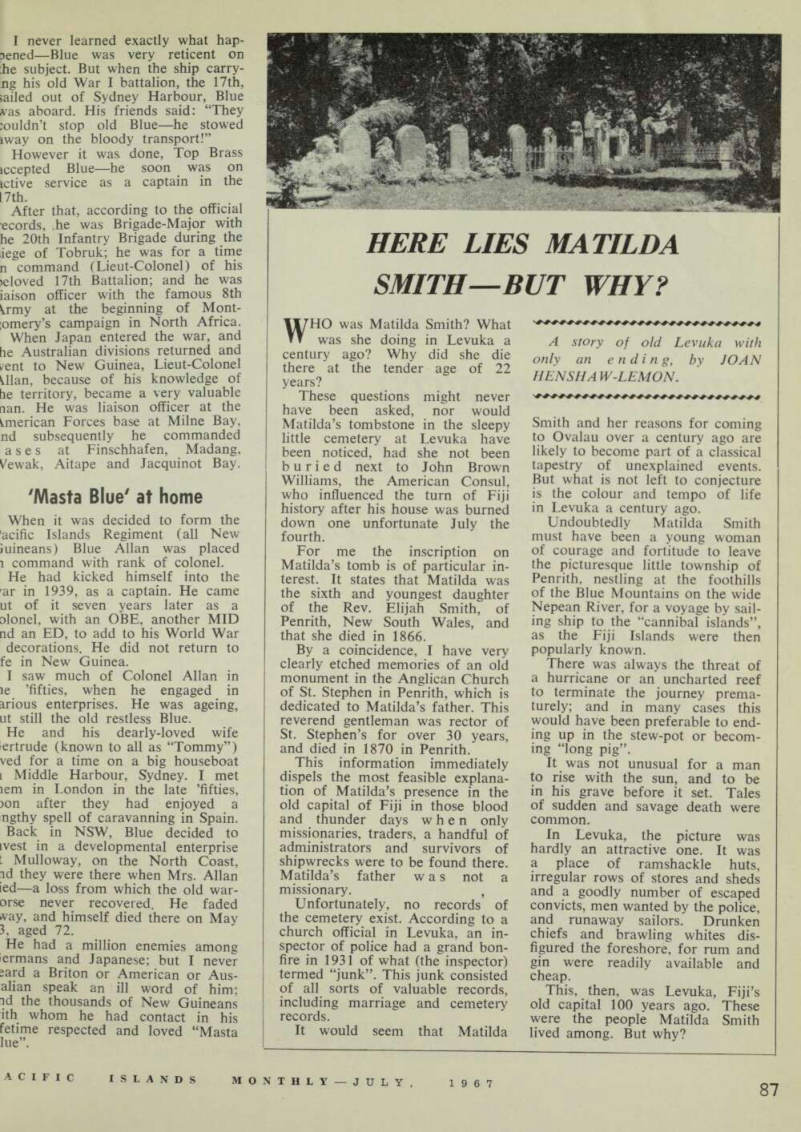
Here Lies Matilda
WHO was Matilda Smith? What was she doing in Levuka a century ago? Why did she die there at the tender age of 22 years?
These questions might never have been asked, nor would Matilda’s tombstone in the sleepy little cemetery at Levuka have been noticed, had she not been buried next to John Brown Williams, the American Consul, who influenced the turn of Fiji history after his house was burned down one unfortunate July the fourth.
For me the inscription on Matilda’s tomb is of particular in terest. It states that Matilda was the sixth and youngest daughter of the Rev. Elijah Smith, of Penrith, New South Wales, and that she died in 1866.
By a coincidence, I have very clearly etched memories of an old monument in the Anglican Church of St. Stephen in Penrith, which is dedicated to Matilda’s father. This reverend gentleman was rector of St. Stephen’s for over 30 years, and died in 1870 in Penrith.
This information immediately dispels the most feasible explana tion of Matilda’s presence in the old capital of Fiji in those blood and thunder days when only missionaries, traders, a handful of administrators and survivors of shipwrecks were to be found there.
Matilda’s father was not a missionary. , Unfortunately, no records of the cemetery exist. According to a church official in Levuka, an in spector of police had a grand bon fire in 1931 of what (the inspector) termed “junk”. This junk consisted of all sorts of valuable records, including marriage and cemetery records.
It would seem that Matilda
A story of old Levuka with only an ending, by JOAN
Hensha W-Lemon.
Smith and her reasons for coming to Ovalau over a century ago are likely to become part of a classical tapestry of unexplained events.
But what is not left to conjecture is the colour and tempo of life in Levuka a century ago.
Undoubtedly Matilda Smith must have been a young woman of courage and fortitude to leave the picturesque little township of Penrith, nestling at the foothills of the Blue Mountains on the wide Nepean River, for a voyage by sail ing ship to the “cannibal islands”, as the Fiji Islands were then popularly known.
There was always the threat of a hurricane or an uncharted reef to terminate the journey prema turely; and in many cases this would have been preferable to end ing up in the stew-pot or becom ing “long pig”.
It was not unusual for a man to rise with the sun, and to be in his grave before it set. Tales of sudden and savage death were common.
In Levuka, the picture was hardly an attractive one. It was a place of ramshackle huts, irregular rows of stores and sheds and a goodly number of escaped convicts, men wanted by the police, and runaway sailors. Drunken chiefs and brawling whites dis figured the foreshore, for rum and gin were readily available and cheap.
This, then, was Levuka, Fiji’s old capital 100 years ago. These were the people Matilda Smith lived among. But why?