Magazine Section
pp. 89-91 · Read in the full issue

Pacific Islands Monthly
Blue Allan: A big man who loved soldiering
By R. W. Robson
Only a few weeks had passed, after Hitler had thrown us into World War II in 1939, when big, burly “Blue”
Allan strode into my office and announced he was “await ing word from Victoria Barracks”.
BLUE” then was 44; and the rows of ribbons he carried on his miform on formal RSL occasions ncluded the Military Cross, and hree MlD’s won in distinguished ervice in Europe in 1916-18.
He loved soldiering. He went into Vorld War I in 1916 when he was 2. He then was a BA of Sydney Jniversity, and had been an articled lerk in a law firm. He won quick romotion, and was a well-decorated aptain, only 24, when the war was ver.
After that, the law had no attrac ons. He was in his late twenties hen he went off to New Guinea bout 1921 for the Expro Board, as plantation overseer; and he gave few Guinea a lifetime of service.
Zest for life
“Blue” (his red hair, red moustache id friendly smile made the Aus alian soubriquet inevitable) was a stless fellow, always ready for Iventure; and, if it was attended by ►ystering, so much the better. He as successively a New Ireland trader, Kavieng garage-owner, a gold ospector, a native labour recruiter, schooner captain, a copra inspector, Rabaul shipping agent New uinea veterans of “Time Before” low what those things mean. And ways he was a leading light of the SL.
He was president of the New uinea branch, and the first repre ntative of that branch at the Aus dian Congress.
I met him when on my first visit New Guinea, in the ’thirties. Shut behind that fever-packed barrier jungle and mountains was the
fabulous Edie Creek-Koranga-Bulolo goldfield, and I wanted a factual story for my new Pacific Islands Monthly. The men and women I met on that early visit were very strong types—in fact, only the tough survived.
“Go and see Blue Allan, over at Koranga,” said “Ma” Stewart, at Wau Hotel, when I said I would like to inspect a sluicing show in action.
On one of Warden Taylor’s skittish ponies, I rode across to the Koranga Creek.
From atop a high bank, across a gully of mud, I saw a huge column of water cutting away a 40-feet-high clay bank. A team of native labourers were as busy as ants, holding the nozzle and directing the flow of yellow mullock into a series of wooden races.
After a while a big fellow in a khaki shirt and helmet detached himself from one of the races and came across to me, wading through the muck in waist-high gum-boots.
This was Blue Allan. His smile indicated that any stranger was wel come, in that place.
Memorable evening
I spent a memorable evening with him, in his nearby comfortable house.
The hospitality which I enjoyed showed that, in addition to soldering on the Western Front, Blue had learned the art of choosing good liquor. Friendship, keen soldiering, good liquor—Blue Allan was known all his picturesque life for those.
A book would be neded to describe Allan’s colourful life in New Guinea. It is one of my deep regrets that I never persuaded him to write it.
He was prominent among the scores of remarkable men and women I met in New Guinea between the wars: miners, planters, traders, hotel keepers, airmen, recruiters, schooner captains, administrative officers and plain adventurers. They created an era that never can be repeated. They are now old and rapidly passing away, and no writer yet has done them justice.
It was his war
Blue Allan still was getting worth while gold when war came. He drop ped everything and hurried south.
I am sure he made big personal sacrifices in order to place his military skill and experience at the disposal of the Australia and the Britain that he loved, for all of his life he was an ardent patriot. His first call, in Sydney, was Victoria Barracks. He could not imagine a war going on without him.
I saw him occasionally after that in late 1939 and his friends gradually got the impression that all was not well with Captain H. T. Allan, MC.
The jauntiness and the confident smile faded away.
He had been told that there might be a job for him somewhere around the base, but Top Brass thought he was too old for active service. He scorned the base job, and hung around in Sydney for some weeks, getting fierce and insistent and chewing the ears of old comrades while the new battalions were lined up for transport to the Middle East.
Then he disappeared. (Over)
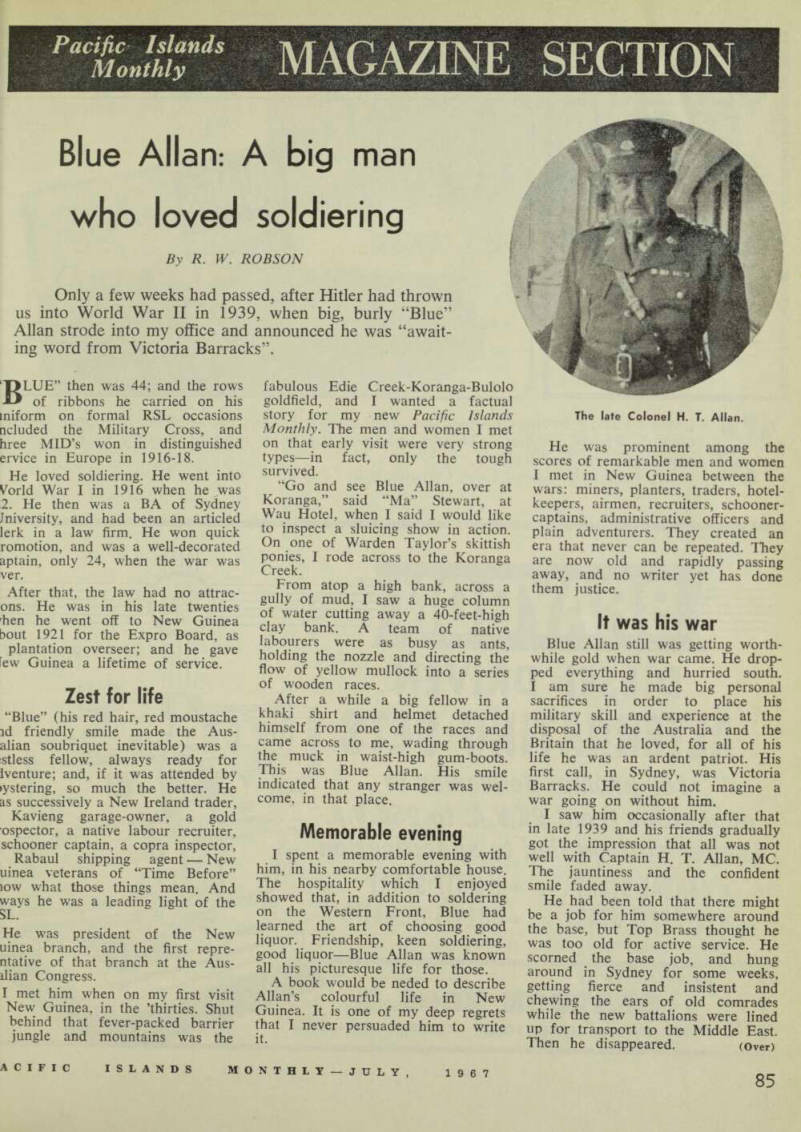
The late Colonel H. T. Allan.
I never learned exactly what hap pened—Blue was very reticent on ;he subject. But when the ship carry ng his old War I battalion, the 17th, jailed out of Sydney Harbour, Blue vas aboard. His friends said: “They wouldn’t stop old Blue—he stowed iway on the bloody transport!”
However it was done, Top Brass iccepted Blue —he soon was on ictive service as a captain in the 17th.
After that, according to the official ecords, .he was Brigade-Major with he 20th Infantry Brigade during the iege of Tobruk; he was for a time n command (Lieut-Colonel) of his >eloved 17th Battalion; and he was iaison officer with the famous 8th U*my at the beginning of Mont ;omery’s campaign in North Africa.
When Japan entered the war, and he Australian divisions returned and /ent to New Guinea, Lieut-Colonel Ulan, because of his knowledge of he territory, became a very valuable nan. He was liaison officer at the American Forces base at Milne Bay, nd subsequently he commanded a s e s at Finschhafen, Madang, Vewak, Aitape and Jacquinot Bay.
'Masta Blue 7 at home
When it was decided to form the acific Islands Regiment (all New luineans) Blue Allan was placed i command with rank of colonel.
He had kicked himself into the r ar in 1939, as a captain. He came ut of it seven years later as a olonel, with an OBE, another MID nd an ED, to add to his World War decorations. He did not return to fe in New Guinea.
I saw much of Colonel Allan in le ’fifties, when he engaged in arious enterprises. He was ageing, ut still the old restless Blue.
He and his dearly-loved wife ertrude (known to all as “Tommy”) ved for a time on a big houseboat i Middle Harbour, Sydney. I met lem in London in the late ’fifties, )on after they had enjoyed a ngthy spell of caravanning in Spain.
Back in NSW, Blue decided to ivest in a developmental enterprise t Mulloway, on the North Coast, id they were there when Mrs. Allan ied —a loss from which the old war orse never recovered. He faded vay, and himself died there on May 3, aged 72.
He had a million enemies among Germans and Japanese; but I never sard a Briton or American or Aus alian speak an ill word of him; id the thousands of New Guineans ith whom he had contact in his fetime respected and loved “Masta lue”.