Ship’S Gear With A
p. 92 · Read in the full issue
Tale
To Tell
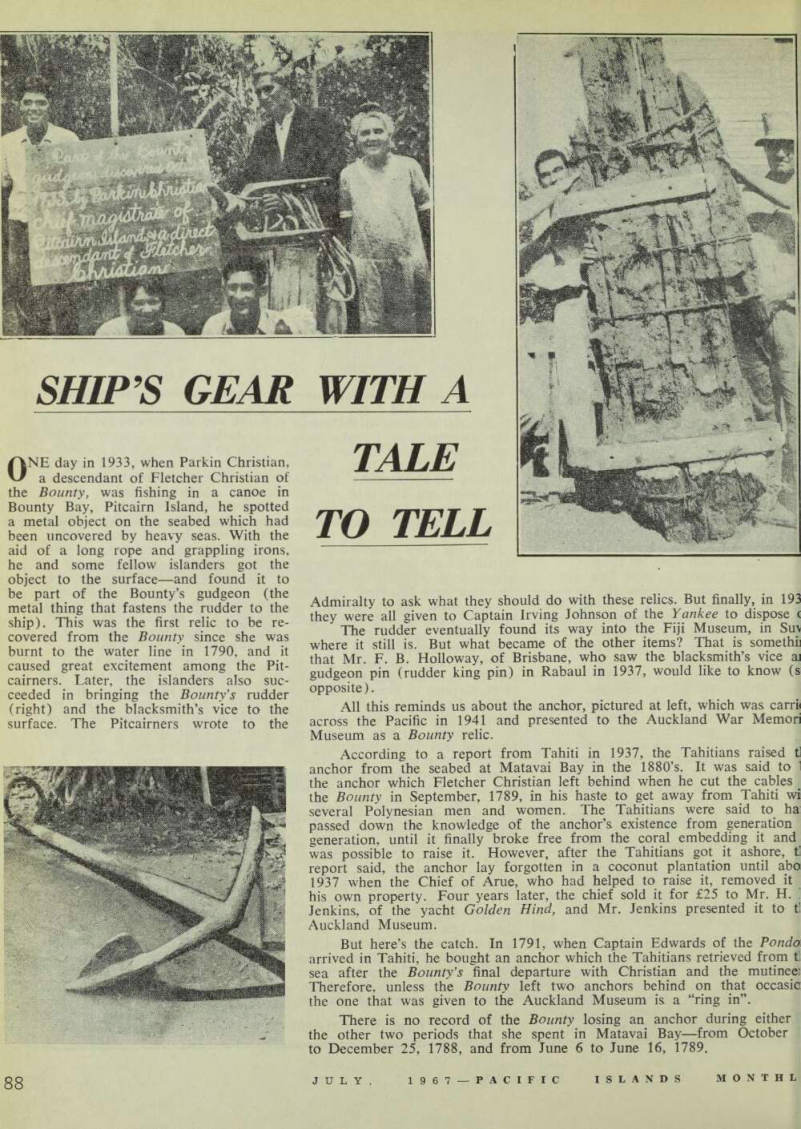
ONE day in 1933, when Parkin Christian, a descendant of Fletcher Christian of the Bounty, was fishing in a canoe in Bounty Bay, Pitcairn Island, he spotted a metal object on the seabed which had been uncovered by heavy seas. With the aid of a long rope and grappling irons, he and some fellow islanders got the object to the surface—and found it to be part of the Bounty’s gudgeon (the metal thing that fastens the rudder to the ship). This was the first relic to be re covered from the Bounty since she was burnt to the water line in 1790, and it caused great excitement among the Pit cairners. Later, the islanders also suc ceeded in bringing the Bounty’s rudder (right) and the blacksmith’s vice to the surface. The Pitcairners wrote to the
Admiralty to ask what they should do with these relics. But finally, in 19: they were all given to Captain Irving Johnson of the Yankee to dispose < The rudder eventually found its way into the Fiji Museum, in Su 1 where it still is. But what became of the other items? That is somethi that Mr. F. B. Holloway, of Brisbane, who saw the blacksmith’s vice a gudgeon pin (rudder king pin) in Rabaul in 1937, would like to know (s opposite).
All this reminds us about the anchor, pictured at left, which was earn across the Pacific in 1941 and presented to the Auckland War Memor Museum as a Bounty relic.
According to a report from Tahiti in 1937, the Tahitians raised t anchor from the seabed at Matavai Bay in the 1880’s. It was said to the anchor which Fletcher Christian left behind when he cut the cables the Bounty in September, 1789, in his haste to get away from Tahiti w: several Polynesian men and women. The Tahitians were said to ha passed down the knowledge of the anchor’s existence from generation generation, until it finally broke free from the coral embedding it and was possible to raise it. However, after the Tahitians got it ashore, t report said, the anchor lay forgotten in a coconut plantation until abc 1937 when the Chief of Arue, who had helped to raise it, removed it his own property. Four years later, the chief sold it for £25 to Mr. H.
Jenkins, of the yacht Golden Hind, and Mr. Jenkins presented it to t Auckland Museum.
But here’s the catch. In 1791, when Captain Edwards of the Pondc arrived in Tahiti, he bought an anchor which the Tahitians retrieved from t sea after the Bounty’s final departure with Christian and the mutinee Therefore, unless the Bounty left two anchors behind on that occasic the one that was given to the Auckland Museum is a “ring in”.
There is no record of the Bounty losing an anchor during either the other two periods that she spent in Matavai Bay—from October to December 25, 1788, and from June 6 to June 16, 1789.