travel
pp. 51-54 · Read in the full issue
Governor Urges Tonga
And Samoas To Club
Together On Tourism
A suggestion that the triangle consisting of American Samoa, Western Samoa and Tonga should develop and pro mote their tourist resources jointly was put forward by Ameri can Samoa’s Governor H. Rex Lee at the “Heart of Polynesia” tourist conference in Apia at the end of May.
HOVERNOR Lee said that while M any one of the territories could iuild up a reasonably thriving tourist ndustry on its own, the maximum xploitation of their resources could nly be achieved if travellers were ffered the variety which the three reas could provide.
As a start in joint co-operation, rovernor Lee recommended that the iree territories should adopt identical ntry forms, Customs regulations, ealth requirements and visa require lents for visitors.
"Friendly neighbours"
“However ... we should actively remote a wider circle of co-opera on,” he said. “Certainly, if the okelaus, Niue and the Cooks want lurist development, they should be icouraged to join our inner circle.
“This circle, however, should epand and co-operate closely with iji, Tahiti and New Caledonia. Each : us must recognise that a •osperous tourist development in any le of these areas is going to comple ent and improve our own develop ent. One weak section in this circle ill be damaging to all.
“We, of course, would hope that
travel
our ‘big brother to the North’, Hawaii, who has one of the most prosperous and fastest-growing visitor industries in the world, would adopt us and help us develop our infant in dustry. Likewise, we must maintain a very close working relationship with our friendly neighbours to the south, Australia and New Zealand.”
Governor Lee said that to ensure proper development of the tourist in dustry, the Islands governments con cerned had to: • Give guidance by reasonable regulations to the development of hotels and related facilities. • Make life easy and inviting for the tourist, and develop a unified approach. • Establish tourist boards to work in close co-operation. • Protect tourists from exploita tion. • Take care that their countries were clean and healthy. • Maintain the grace, charm and friendliness of Polynesia, but train
those who are to serve in the tourist industry. • Avoid sacrificing dignity and heritage for the sake of tourism.
Governor Lee said that the hotels in the area should reflect the culture and unique characteristics of the Polynesians.
“We must resist the pressures of some developers to build the cheapest and the easiest-built facilities for the sake of rushing into the business,” he said.
“Let’s face it, we cannot hope to match the luxury-style accommoda tions of some of the outstanding hotels in America, Europe or the Orient. Neither can we convince a tourist that he should pay an ad ditional thousand dollars or so in transportation to come to one of our islands to stay in a Western-style hotel that duplicates a second or third-class hotel in hundreds of our cities throughout America.
"Proper start"
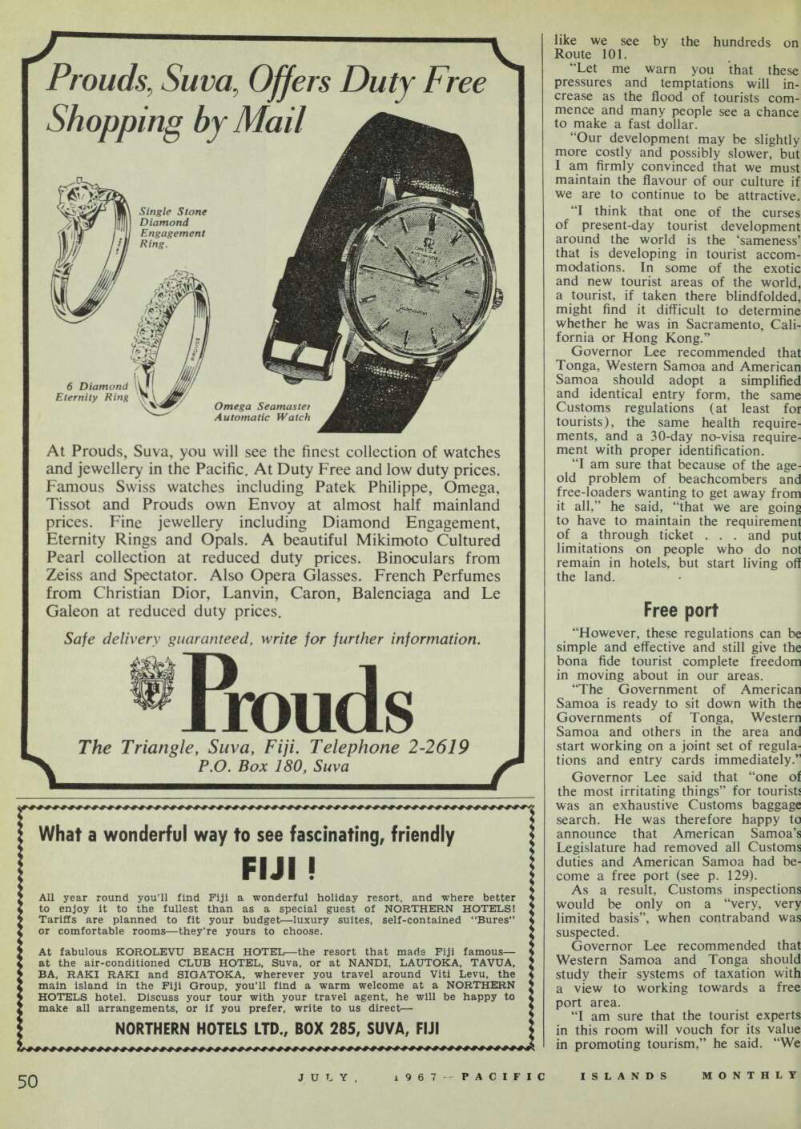
“I believe we have made a proper start in this direction with our Pago Pago Inter-continental that is owned by 1,400 Samoans. We are now planning our second hotel, and we hope to improve, if possible, on our Island theme—lsland-style architec ture.
“However, the pressures have been great, and the temptation has been strong, to acquiesce, for the sake of quick and cheap accommodations, to the many dozens of proposals that have been made to build small, pension, Western-style hotels or units
Part of Pago Pago's Samoan-owned Intercontinental Hotel.
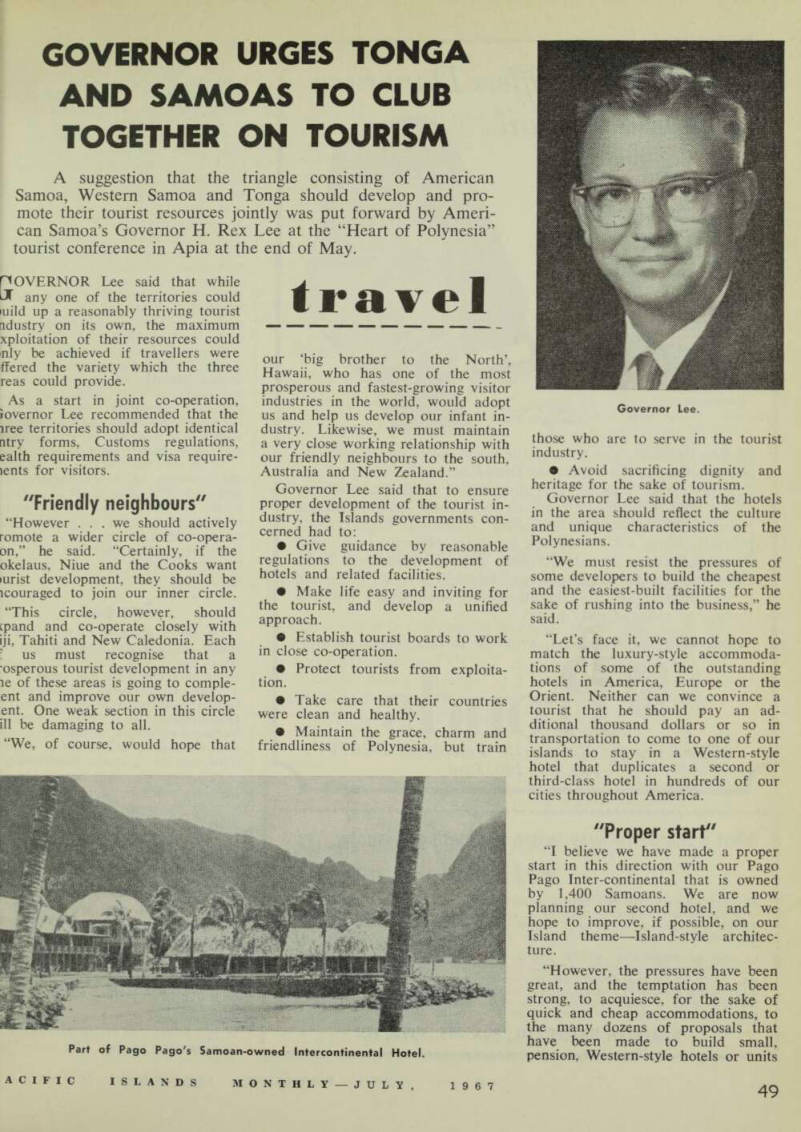
Governor Lee.
like we see by the hundreds on Route 101.
“Let me warn you that these pressures and temptations will in crease as the flood of tourists com mence and many people see a chance to make a fast dollar.
“Our development may be slightly more costly and possibly slower, but I am firmly convinced that we must maintain the flavour of our culture if we are to continue to be attractive.
“I think that one of the curses of present-day tourist development around the world is the ‘sameness’ that is developing in tourist accom modations. In some of the exotic and new tourist areas of the world, a tourist, if taken there blindfolded, might find it difficult to determine whether he was in Sacramento, Cali fornia or Hong Kong.”
Governor Lee recommended that Tonga, Western Samoa and American Samoa should adopt a simplified and identical entry form, the same Customs regulations (at least for tourists), the same health require ments, and a 30-day no-visa require ment with proper identification, “I am sure that because of the age old problem of beachcombers and free-loaders wanting to get away from it all,” he said, “that we are going to have to maintain the requirement of a through ticket . . . and put limitations on people who do not remain in hotels, but start living off the land.
Free port
“However, these regulations can be simple and effective and still give the bona fide tourist complete freedom in moving about in our areas.
“The Government of American Samoa is ready to sit down with the Governments of Tonga, Western Samoa and others in the area and start working on a joint set of regula tions and entry cards immediately.”
Governor Lee said that “one of the most irritating things” for tourists was an exhaustive Customs baggage search. He was therefore happy to announce that American Samoa’s Legislature had removed all Customs duties and American Samoa had be come a free port (see p. 129).
As a result, Customs inspections would be only on a “very, very limited basis”, when contraband was suspected.
Governor Lee recommended that Western Samoa and Tonga should study their systems of taxation with a view to working towards a free port area.
“I am sure that the tourist experts in this room will vouch for its value in promoting tourism,” he said. “We
re convinced in American Samoa lat the additional revenues brought bout by the increase in tourism ill more than offset any losses in ustoms revenues.
“Even with heavy Customs duties am convinced that an exhaustive ;arch of all luggage is wasteful and ill, in the long run, cost an area lore than it will produce in Customs ;venue.”
Visitors Bureau
Governor Lee said that in a survey f American Samoa’s requirements Dr starting a thriving tourist in ustry, experts from the Hawaii r isitors Bureau had recommended lat a Visitors Bureau or Tourist oard should be set up in both amoas and Tonga, and that there lould be close co-operation among lese.
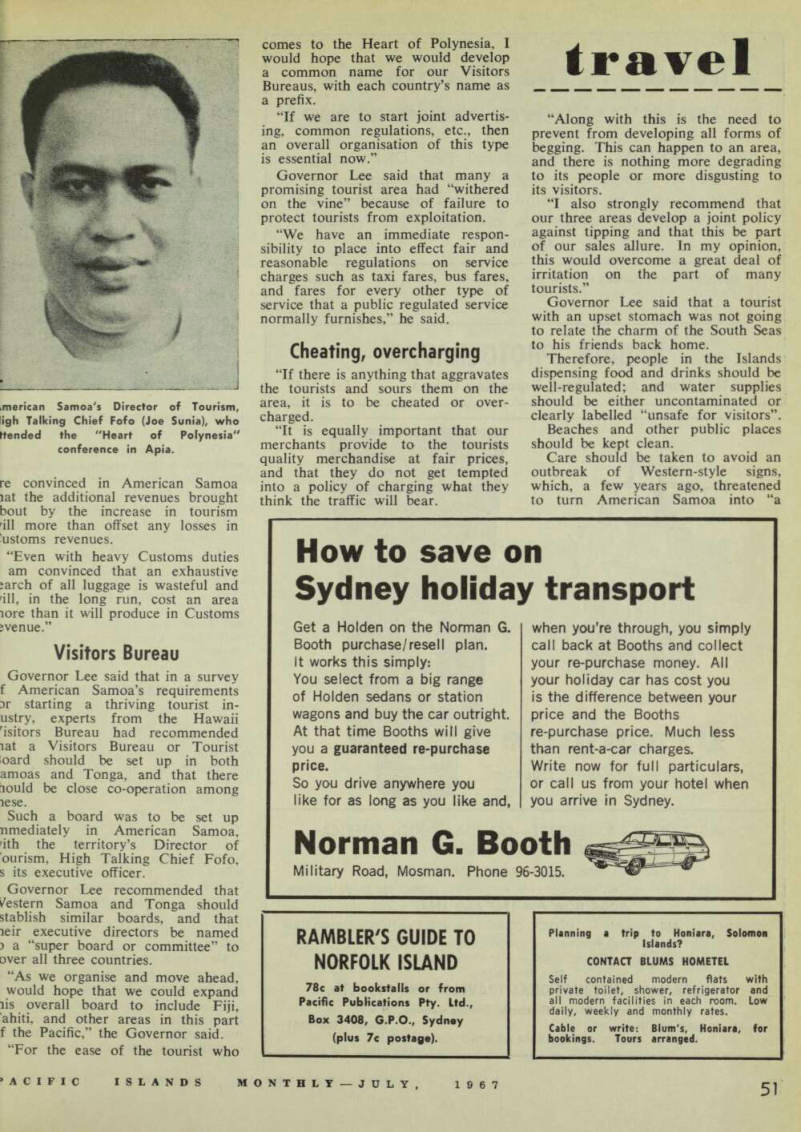
Such a board was to be set up nmediately in American Samoa, ith the territory’s Director of burism, High Talking Chief Fofo, s its executive officer.
Governor Lee recommended that /estern Samoa and Tonga should stablish similar boards, and that leir executive directors be named ) a “super board or committee” to aver all three countries.
“As we organise and move ahead, would hope that we could expand lis overall board to include Fiji, ahiti, and other areas in this part f the Pacific,” the Governor said.
“For the ease of the tourist who
comes to the Heart of Polynesia, I would hope that we would develop a common name for our Visitors Bureaus, with each country’s name as a prefix.
“If we are to start joint advertis ing, common regulations, etc., then an overall organisation of this type is essential now.”
Governor Lee said that many a promising tourist area had “withered on the vine” because of failure to protect tourists from exploitation.
“We have an immediate respon sibility to place into effect fair and reasonable regulations on service charges such as taxi fares, bus fares, and fares for every other type of service that a public regulated service normally furnishes,” he said.
Cheating, overcharging
“If there is anything that aggravates the tourists and sours them on the area, it is to be cheated or over charged.
“It is equally important that our merchants provide to the tourists quality merchandise at fair prices, and that they do not get tempted into a policy of charging what they think the traffic will bear.
“Along with this is the need to prevent from developing all forms of begging. This can happen to an area, and there is nothing more degrading to its people or more disgusting to its visitors.
“I also strongly recommend that our three areas develop a joint policy against tipping and that this be part of our sales allure. In my opinion, this would overcome a great deal of irritation on the part of many tourists.”
Governor Lee said that a tourist with an upset stomach was not going to relate the charm of the South Seas to his friends back home.
Therefore, people in the Islands dispensing food and drinks should be well-regulated; and water supplies should be either uncontaminated or clearly labelled “unsafe for visitors”.
Beaches and other public places should be kept clean.
Care should be taken to avoid an outbreak of Western-style signs, which, a few years ago, threatened to turn American Samoa into “a
American Samoa's Director of Tourism, [?]igh Talking Chief Fofo (Joe Sunia), who [?]ttended the "Heart of Polynesia" conference in Apia.
hodgepodge of indiscriminate posters”.
“Our Legislature passed a sign ordinance that permits adequate advertising, but keeps it within the bounds of good taste and in line with our Polynesian atmosphere,” Gov ernor Lee said. “It is much easier to regulate this type of thing before it gets out of hand.”
Governor Lee said it was the obligation of each Islands govern ment to provide training for key employees in the tourist industries; but there was a need to retain the individual characteristics of each country.
No magical cure-all
“Even though Tonga, Western Samoa and American Samoa have many things in common, there are individual personalities that should be maintained and developed if we are to exploit fully the advantages of the multi-island tour approach,” he said. “It serves us nothing if our services and facilities are identical.”
Governor Lee said that although tourism could provide new jobs and many new small business oppor tunities for the Islanders, it was not a magical cure-all for all economic problems, and the development of other resources should not be for gotten.
He urged that the Islands should not sacrifice their dignity and heritage: for the sake of tourism.
“There are some types of tourismi that would pervert and downgrade: our people,” he said. “No industry or enterprise is worth this price.”