"Last of the unspoiled islands"
pp. 55-56 · Read in the full issue
worries about its future
By staff writer KEN McGREGOR
“Last of the unspoiled islands ... a haven in the world of hurly-burly . . .” is how the travel brochures describe Lord Howe Island, 400 miles north-east of Sydney. You may be cynical, but it’s near enough to being true.
ORD HOWE, boasting the most 4 southerly coral reef in the world, id with a permanent population of me 260, has had the reputation for ;ars of being an away-from-it-all ace, perfect for honeymooners.
It has had the reputation for so ng that you are entitled to suspect at it is not true any more, that e world has long since caught up ith Lord Howe, as the world has ,ught up with many other South icific “paradises”.
On the contrary. There is still no ird sell on Lord Howe; there is not le hotel yet, no cars or motor cles for hire, no pin-ball machines, isitors are not asked to buy any ing, to go anywhere in particular, do anything special.
The attraction of Lord Howe, even lowing for its surprising scenery, is ill that hard-to-define easy-going it-of-the-rat-race charm. Lord Howe land is away-from-it-all.
Yet everyone living there, directly indirectly, depends on tourists for living—whether they are running a ass-bottomed boat for sightseeing i the coral reef or growing potatoes r sale to the eight guest houses.
All of the guest houses are owned and managed by islanders; and more than $1 million has been invested by islanders in the tourist trade. (All the permanent settlers are Australians except a couple of New Zealanders and a Cook Islander, Mrs.
Len Staples, who arrived on my plane in May.)
Guest houses
The guest houses, their owners and the number of beds available, are: Pine Trees, run by Mrs. E. M.
Kirby, with 75 beds, and 10 being installed.
Ocean View, Allen Wilson, 54 beds.
Leanda Lei, Roy Wilson, 45 beds.
Blue Lagoon, Barry Thompson, 30 beds.
Somerset, Alan Williams, 17 beds.
Valdon, Mr. H. O. Payten, 16 beds.
Trade Winds, Jim and Sheila Redhead, 13 beds.
Coral Court, Jim Whistler, eight beds.
Mr. Len Staples and his wife will open another guesthouse, the “Poly
nesian”, in November. This will accommodate 10 people.
There are several flats available for rent and islanders let rooms in their houses if necessary. Sometimes, at Christmas and during school vacations, the island’s population reaches 500 or so—more than double the permanent figure.
Compared with almost all other resorts in the Pacific, accommodation bills are low. The tariffs range from $9 a day for a room with its own shower and toilet to $6 or $7 a day for a room with the use of a communal toilet and bathroom. The tariffs cover all meals, which fre quently include generous helpings of locally-caught fish.
Getting there
While Lord Howe has no licensed hotel and there is not the vaguest possibility of it getting one, this doesn’t mean the island is “dry”.
Every afternoon at 4 o’clock, beer flows, very merrily most times, at the Bowling Club, The occasion is known locally as Choir Practice, so if someone invites you to what sounds like a singing exercise, don’t be fooled!
Half the fun of a trip to Lord Howe is getting to and from the island in the Sandringham flying boats.
These are run by Airlines of New South Wales, up to three times a week at Christmas. The return fare from Sydney is $76.40.
The flying-boats take off from Rose Bay, Sydney, and land three hours later in the island’s lagoon. Schedules are governed by the Lord Howe tides.
In this jet age, the Sandringhams
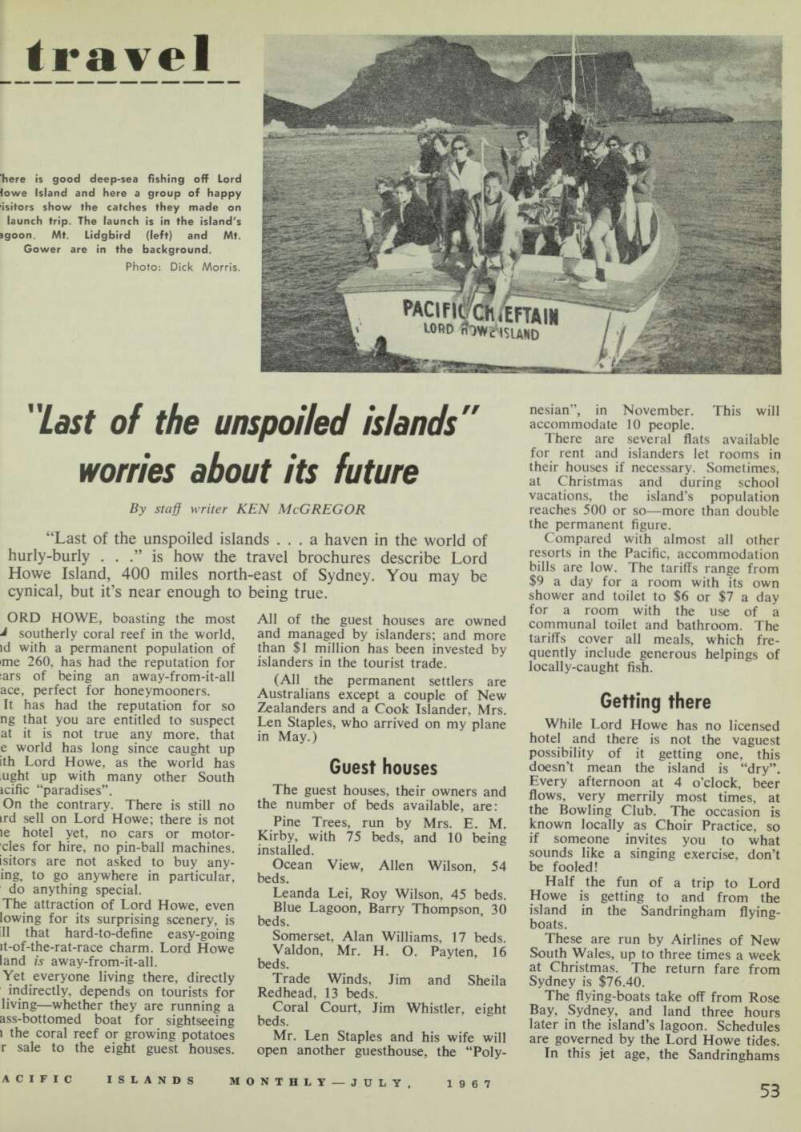
There is good deep-sea fishing off Lord Howe Island and here a group of happy [?]isitors show the catches they made on [?]launch trip. The launch is in the island's [?]goon. Mt. Lidgbird (left) and Mt.
Gower are in the background.
Photo: Dick Morris.
are sadly outdated. They can fly at only 7,000 feet at about 170 mph and so cannot avoid a few bumps here and there if bad weather comes along. But those serving Lord Howe are now almost unique. Flying-boats of any kind are virtually aircraft of the past.
While Lord Howe Island and spectacular Ball’s Pyramid, rising 1,800 ft out of the sea, are arresting sights for the traveller from the air, the most exciting part of the trip comes when your aircraft lands in the island’s lagoon.
The plane heads into the water at what seems a terrific pace, foam spurts up and the cabin windows are blotted out by spray. Then suddently you are staring at the crystal-clear green water outside and the plane is taxi-ing gently towards a jetty from which boats come out to take you ashore.
Plenty to do
In a quiet sort of way, there are plenty of things to do once you do get ashore.
You can swim, fish, skin-dive, hike, play tennis and bowls, go cycling, look for shells, climb mountains, go for boat trips, or just loaf and admire the scenery.
Lord Howe Island’s guest house owners frequently compare what their island has to offer with the attrac tions of Norfolk Island, 400 miles to the north-east —always to Lord Howe’s advantage.
Visitors who have seen both islands do, too. Of those I have met, all have said that Lord Howe is much cheaper than Norfolk Island and that there is more for children to do there.
All said Lord Howe’s long lagoon, numerous beaches and mountain
walks gave it quite an edge over Norfolk; that its scenery was far superior; and that it had a more relaxed, carefree atmosphere.
One family man from Sydney told me he had brought his family to Lord Howe every year since 1958 despite a trip to Norfolk last year.
“I was unimpressed with Norfolk,” he said. “It’s just a big plateau.
There isn’t a good beach and there is no variation in the scenery. It could be a piece of England dropped into the Pacific. Really it wasn’t my idea of a Pacific island at all.”
Transport doubts
The guest house proprietors say Lord Howe lacks some of Norfolk’s glamour because it is part of a Sydney electorate and a dependency of the NSW Government while Norfolk Island is a territory of Aus tralia.
“Also, the flying-boat service puts a lot of people off coming here because of operational hitches,” one guest-house owner told me. “Some times big air currents build up around Mt. Gower and Mt. Lidgbird and the flying-boats have to return to Sydney without landing, which is six hours’ flight for nothing.
“But these hitches are rare and most visitors feel Lord Howe is worth the small travel risks because it has more to offer than Norfolk Island.
Ours is a more typical Pacific island.”
One topic every islander is liable to talk about at great length is the flying-boat service. No, there are no complaints about it; everyone agrees it has always been good. In fact, if it went on unchanged till kingdom come Lord Howe Islanders wouldn’t bat an eyelid.
But this is not to be. The flying
boats, now as much a part of the island scene as its world-famouj Kentia palms, are to be pulled out ol service in 1970, so the island face: a fast-approaching transport crisis.
In talks with a cross-section ol the islanders, I found them dividec as to what they thought should re place the Sandringhams.
Some plumped for an airstrip am the use of Fokker Friendships; other felt other flying-boats should b< sought. The hopeful believed a shor take-off plane or a suitable amphibiai plane would be developed by 197( to save the day.
An elderly resident felt that Air lines of NSW was bluffing in its pull out announcement because it wa: after an increased government subsidy to operate the service. He though the flying-boats would fly for mam a long day yet.
The guest-house proprietors sai( development of all facilities wa jeopardised because of about the future and that little extri money could be invested until the; knew what would happen.
Influx of workers
It was pointed out to me that i the Government did decide to buih an airstrip, it would either be acres from Blinky’s Beach to the lagooi or from Ned’s Beach to the lagoon.
In either case, land in the lagooi would have to. be reclaimed am some of the very limited flat lam would have to be taken over.
However, the biggest danger ai airstrip would bring would be th< 100 or so workers needed to buih it. They would have to come fron Australia for at least three years With them would come their wive and children and—bingo—the island’ population would be doubled at least I doubt if the social life on Lon Howe could suffer this influx Development would shoot ahead ou of proportion and the place jus wouldn’t be what it was with th< Sandringhams.
The ideal solution, it seems, i no airstrip and an amphibian air craft, taking off from Mascot airpor and landing on the lagoon. But thi gets less likely as time goes on a Airlines of NSW has told th< islanders it has “no interest” in ai amphibian operation.
The guest-house proprietors hop< the NSW Government, the Common wealth Government, the Civil Avia tion Department, Airlines of NS\N and the Lord Howe Island Board wil get together soon to solve the trans port problem.
And that is just what these agencie should do.
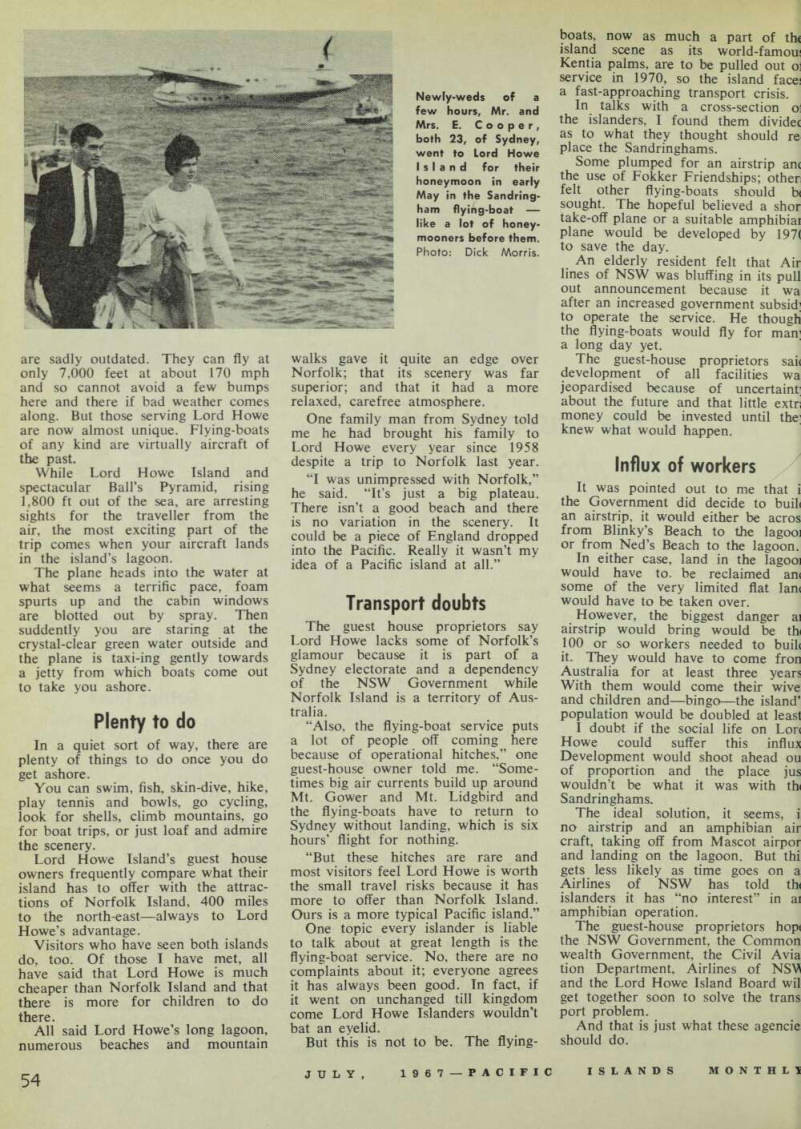
Newly-weds of a few hours, Mr. and Mrs. E. Cooper, both 23, of Sydney, went to Lord Howe Island for their honeymoon in early May in the Sandring
ham flying-boat -
like a lot of honey mooners before them.
Photo: Dick Morris.