travel
pp. 47-49 · Read in the full issue
US travel men cast their eager eyes on Polynesia's bosom
From special correspondents in Apia
The “Heart of Polynesia” visitor development conference held in Apia from May 29 to 31 was, according to almost every one of the 200 participants, a resounding success.
IT was exceedingly well organised; the programme provided stimulat ig discussion; and the various guest id panel speakers were top men terested in the travel industry in this irt of the world.
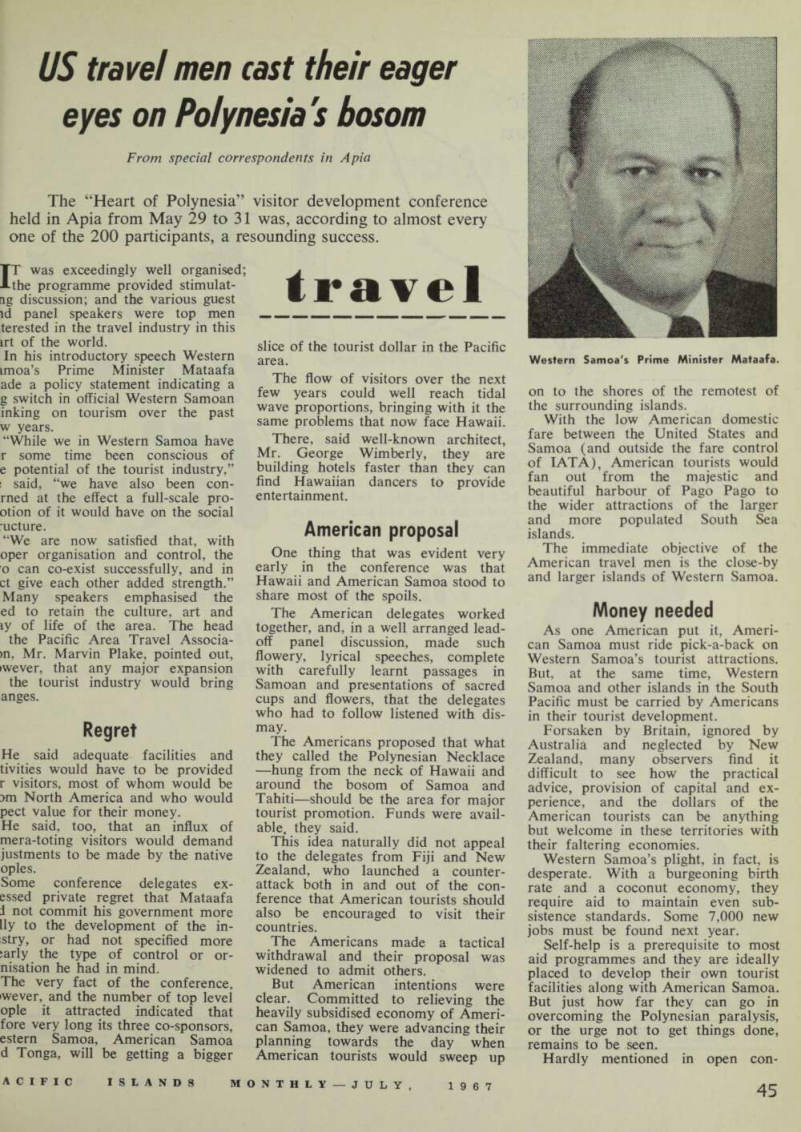
In his introductory speech Western imoa’s Prime Minister Mataafa ade a policy statement indicating a g switch in official Western Samoan inking on tourism over the past w years.
“While we in Western Samoa have r some time been conscious of e potential of the tourist industry,” ! said, “we have also been con rned at the effect a full-scale pro otion of it would have on the social •ucture.
“We are now satisfied that, with oper organisation and control, the o can co-exist successfully, and in ct give each other added strength.”
Many speakers emphasised the ed to retain the culture, art and iy of life of the area. The head the Pacific Area Travel Associa >n, Mr. Marvin Plake, pointed out, >wever, that any major expansion the tourist industry would bring anges.
Regret
He said adequate facilities and tivities would have to be provided r visitors, most of whom would be ;>m North America and who would pect value for their money.
He said, too, that an influx of mera-toting visitors would demand justments to be made by the native oples.
Some conference delegates ex essed private regret that Mataafa i not commit his government more lly to the development of the in istry, or had not specified more >arly the type of control or or nisation he had in mind.
The very fact of the conference, wever, and the number of top level ople it attracted indicated that fore very long its three co-sponsors, estern Samoa, American Samoa d Tonga, will be getting a bigger
travel
slice of the tourist dollar in the Pacific area.
The flow of visitors over the next few years could well reach tidal wave proportions, bringing with it the same problems that now face Hawaii.
There, said well-known architect, Mr. George Wimberly, they are building hotels faster than they can find Hawaiian dancers to provide entertainment.
American proposal
One thing that was evident very early in the conference was that Hawaii and American Samoa stood to share most of the spoils.
The American delegates worked together, and, in a well arranged lead off panel discussion, made such flowery, lyrical speeches, complete with carefully learnt passages in Samoan and presentations of sacred cups and flowers, that the delegates who had to follow listened with dis may.
The Americans proposed that what they called the Polynesian Necklace —hung from the neck of Hawaii and around the bosom of Samoa and Tahiti—should be the area for major tourist promotion. Funds were avail able, they said.
This idea naturally did not appeal to the delegates from Fiji and New Zealand, who launched a counter attack both in and out of the con ference that American tourists should also be encouraged to visit their countries.
The Americans made a tactical withdrawal and their proposal was widened to admit others.
But American intentions were clear. Committed to relieving the heavily subsidised economy of Ameri can Samoa, they were advancing their planning towards the day when American tourists would sweep up
on to the shores of the remotest of the surrounding islands.
With the low American domestic fare between the United States and Samoa (and outside the fare control of LATA), American tourists would fan out from the majestic and beautiful harbour of Pago Pago to the wider attractions of the larger and more populated South Sea islands.
The immediate objective of the American travel men is the close-by and larger islands of Western Samoa.
Money needed
As one American put it, Ameri can Samoa must ride pick-a-back on Western Samoa’s tourist attractions.
But, at the same time, Western Samoa and other islands in the South Pacific must be carried by Americans in their tourist development.
Forsaken by Britain, ignored by Australia and neglected by New Zealand, many observers find it difficult to see how the practical advice, provision of capital and ex perience, and the dollars of the American tourists can be anything but welcome in these territories with their faltering economies.
Western Samoa’s plight, in fact, is desperate. With a burgeoning birth rate and a coconut economy, they require aid to maintain even sub sistence standards. Some 7,000 new jobs must be found next year.
Self-help is a prerequisite to most aid programmes and they are ideally placed to develop their own tourist facilities along with American Samoa.
But just how far they can go in overcoming the Polynesian paralysis, or the urge not to get things done, remains to be seen.
Hardly mentioned in open con
Western Samoa's Prime Minister Mataafa.
irence was the area’s vital need to svelop local airlines, the key to ly success in supporting a new lurist playground. But there was enty going on in the background, i airlines jostled for position.
Although there is a wide pattern ! trunk route services between Aus alia and North America, soon to be ined by another US airline, the gional feeder air services leave uch to be desired.
Ancient DC3’s and little Herons ■etch themselves over wide areas blue ocean for which they were ver designed.
A welcome improvement will be e introduction by Fiji Airways of HS74B 40-seater, turbo-prop later is year. Further development to ; aircraft is limited by the lack of itable airfields.
In Western Samoa, for example, pia’s Faleolo airport is controlled r New Zealand aviation authorities.
Despite improvements to the strip, jw Zealand has so far not licensed for use by Fiji Airways’ HS74B. it there is a full jet strip at Pago igo not 30 minutes flying time away iere all airlines have been wel med by Governor Lee.
Frustrated
For Pan American, Qantas’ pur ase of Fiji Airways in 1958 and j subsequent sale of shares to )AC and Air New Zealand has ig been a major frustration, which s prevented it from penetrating the ii market and islands to the north.
It is not surprising, therefore, that n-Am now seeks to establish a :al airline in the Central Pacific it would compete with Fiji Air iys, with all the considerable ength and support at its disposal, t for this they need jet airfields d government-approved air routes.
The right to serve such routes are Id mainly by the UK for Fiji Air ys and by Western Samoa for lynesian Airlines.
Faced with the replacement of :ir DC-3s, Polynesian Airlines now ;k financial and technical assistance •m one of the established airlines.
The Americans, particularly, see s as an opportunity to get route hts through the back door; others a means of keeping them out.
Polynesia’s decision is awaited with ne apprehension by the airlines, lose delegates took advantage of i Apia conference to pay court to lynesian’s redoubtable chairman 1 managing director, Mr. Eugene ill.
See, also, "Governor urges Samoas and Tonga to club together on tourism", p. 49.