Yesterday
p. 95 · Read in the full issue
PIM 20 years ago told the story of a multiple tragedy at Rotuma, about 220 miles north of Fiji. Two men and seven boys were killed by the explosion of what was believed to have been a derelict bomb. The boys had found the bomb and were examining it when it exploded. No one knew how the bomb had got to Rotuma, but one theory was that it had been jetti soned by an American bomber, during the war, on its way back to Fiji.
OTHER items in PIM for June, 1947, included: THE American shipping com pany, Matson, had bought three freighters—renamed Ventura, Sonoma and Sierra —for the trans pacific trade from San Francisco to Sydney and Melbourne, via Pago Pago, Suva and Auckland.
The Sonoma left San Francisco on its first trip on June 4, 1947.
A GROUP of New Guinea busi nessmen had bought the Civilian Hostel, Rabaul, and were to rename it the Cosmopolitan.
Before the war, Rabaul’s Cosmo politan Hotel was run by Mr. A. J.
Gaskin, who had an interest in the new one.
THE Australian Government had decided to buy out Qantas Empire Airways Ltd., which then had planes serving northern Aus tralia, part of the England-Aus tralia route, and Papua-New Guinea. It also had a flying-boat service from Sydney to Suva, via Noumea.
AMISSION appointed by the United Nations Trusteeship Council was due to arrive in NZ in late June on the way to Western Samoa to investigate a Western Samoan petition for increased self government.
PLANTATIONS on Buka and Bougainville Islands were suf fering from an acute shortage of labour. “That old saying about Satan finding work for idle hands
is especially applicable to our native indigenes,” a correspondent said. “They (the natives) are not unknown to have a tendency to plot and scheme and turn on ‘cargo’ stunts at almost any tick of the clock.”
SISTER Merle Farland, a New Zealand nurse, was presented with the insignia of the OBE in Fiji for remaining in the Solomons after the Japanese attacked Rabaul in January, 1942. Sister Farland was the only woman from the Methodist Mission to stay. She was at Bilua, Vella Lavella, and visited New Georgia, Simbo and Choiseul while the islands were under Japanese occupation.
A SPECIAL civilian committee, appointed by the US Secretary of the Navy, Mr. James Forrestal, recommended immediate United States citizenship for the residents of Guam and American Samoa. (But today, 20 years later, those islanders are still US nationals, not citizens).
A CHRONIC shortage of water at Port Moresby was causing much inconvenience. The water main burst three times and supplies were cut further because tanks had not been built on to post-war houses.
OYSTERS were thriving in Fiji.
They were established in a mangrove swamp in Suva Bay in 1941 and six years later had spread along 150 yards of waterline. It was hoped to distribute the beds over a wider area as soon as possible.
IN a plea that Finschhafen should be made the new capital of New Guinea, a New Guinea corre spondent said: “It is the only place on the mainland where big ships can come right up. We have miles of coral roads (built by the Ameri cans), delightful surroundings, and a climate that puts Rabaul, Lae, Port Moresby and other places in the shade. Harbour facilities are unsurpassed—otherwise, why is the Navy here!”
A CHAIN of billiard rooms had been built in the district of Tahiti to combat alcoholism. Lads and young men were not patronis ing the beer saloons as they used to.
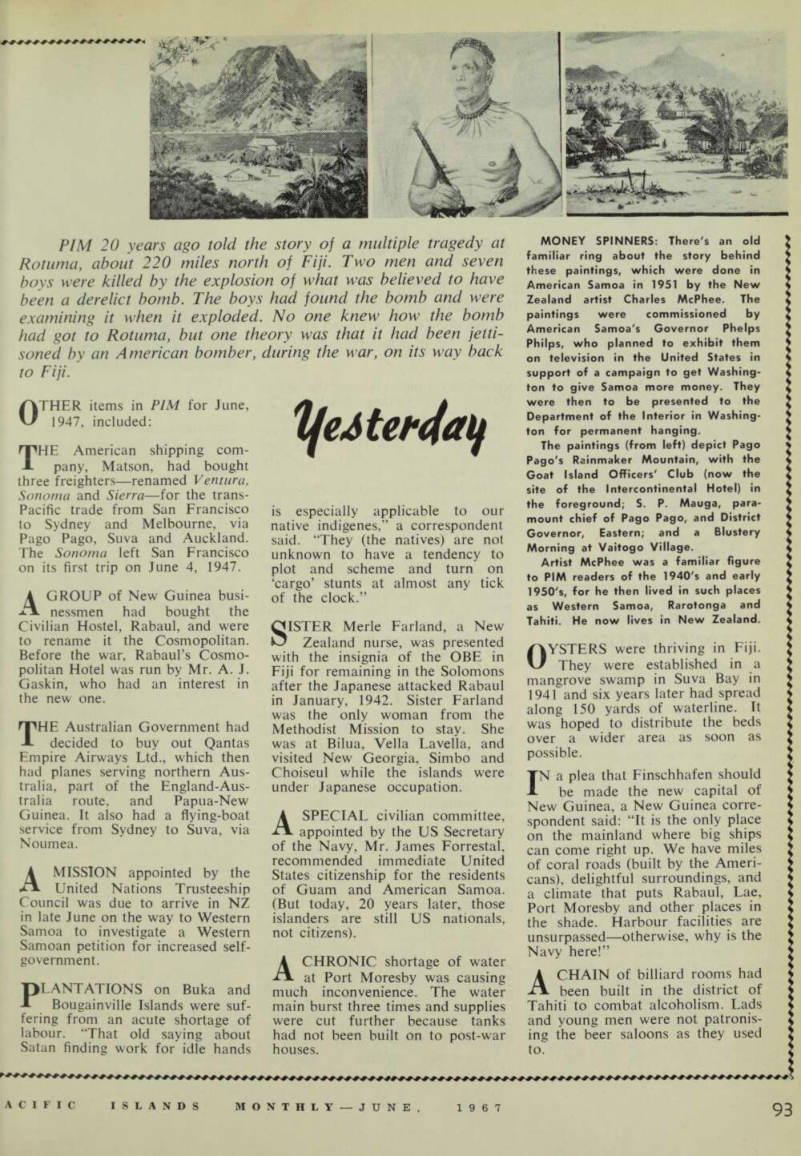
MONEY SPINNERS: There's an old familiar ring about the story behind these paintings, which were done in American Samoa in 1951 by the New Zealand artist Charles McPhee. The paintings were commissioned by American Samoa's Governor Phelps Philps, who planned to exhibit them on television in the United States in support of a campaign to get Washing ton to give Samoa more money. They were then to be presented to the Department of the Interior in Washing ton for permanent hanging.
The paintings (from left) depict Pago Pago's Rainmaker Mountain, with the Goat Island Officers' Club (now the site of the Intercontinental Hotel) in the foreground; S. P. Mauga, para mount chief of Pago Pago, and District Governor, Eastern; and a Blustery Morning at Vaitogo Village.
Artist McPhee was a familiar figure to PIM readers of the 1940's and early 1950's, for he then lived in such places as Western Samoa, Rarotonga and Tahiti. He now lives in New Zealand.