Book Reviews
pp. 96-99 · Read in the full issue
Does this settle it once and for all?
New light on where those Polynesians came from
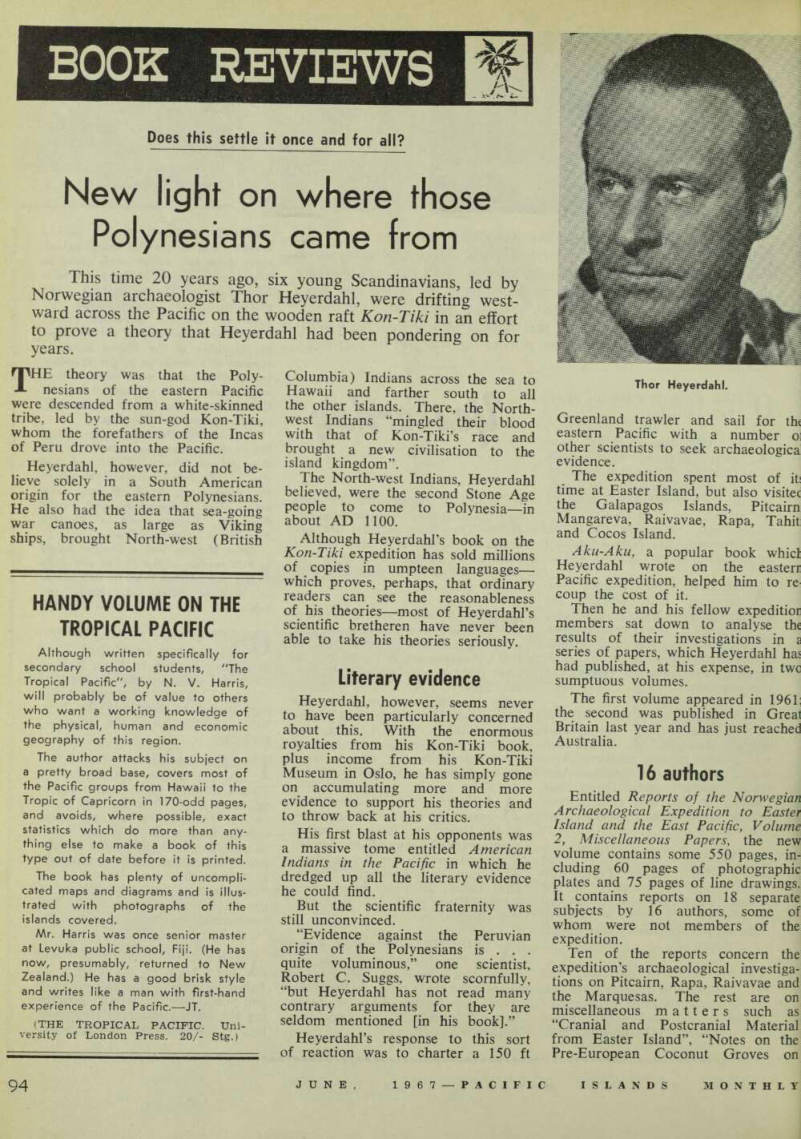
This time 20 years ago, six young Scandinavians, led by Norwegian archaeologist Thor Heyerdahl, were drifting west ward across the Pacific on the wooden raft Kon-Tiki in an effort to prove a theory that Heyerdahl had been pondering on for years.
T HE theory was that the Poly- A nesians of the eastern Pacific were descended from a white-skinned tribe, led by the sun-god Kon-Tiki, whom the forefathers of the Incas of Peru drove into the Pacific.
Heyerdahl, however, did not believe solely in a South American origin for the eastern Polynesians, He also had the idea that sea-going war canoes, as large as Viking ships, brought North-west (British
Columbia) Indians across the sea to Hawaii and farther south to all the other islands. There, the North west Indians “mingled their blood with that of Kon-Tiki’s race and brought a new civilisation to the island kingdom”.
The North-west Indians, Heyerdahl believed, were the second Stone Age people to come to Polynesia—in about AD 1100.
Although Heyerdahl’s book on the Kon-Tiki expedition has sold millions of copies in umpteen languages— which proves, perhaps, that ordinary readers can see the reasonableness of his theories—most of Heyerdahl’s scientific bretheren have never been able to take his theories seriously.
Literary evidence
Heyerdahl, however, seems never to have been particularly concerned about this. With the enormous royalties from his Kon-Tiki book, plus income from his Kon-Tiki Museum in Oslo, he has simply gone on accumulating more and more evidence to support his theories and to throw back at his critics.
His first blast at his opponents was a massive tome entitled American Indians in the Pacific in which he dredged up all the literary evidence he could find.
But the scientific fraternity was still unconvinced.
“Evidence against the Peruvian origin of the Polynesians is . . . quite voluminous,” one scientist, Robert C. Suggs, wrote scornfully, “but Heyerdahl has not read many contrary arguments for they are seldom mentioned [in his book].”
Heyerdahl’s response to this sort of reaction was to charter a 150 ft
Greenland trawler and sail for the eastern Pacific with a number oj other scientists to seek archaeologicai evidence.
The expedition spent most of its time at Easter Island, but also visited the Galapagos Islands, Pitcairn, Mangareva, Raivavae, Rapa, Tahiti and Cocos Island.
Aku-Aku, a popular book which Heyerdahl wrote on the eastern Pacific expedition, helped him to re coup the cost of it.
Then he and his fellow expedition members sat down to analyse the results of their investigations in a series of papers, which Heyerdahl has had published, at his expense, in two sumptuous volumes.
The first volume appeared in 1961; the second was published in Great Britain last year and has just reached Australia.
16 authors
Entitled Reports of the Norwegian Archaeological Expedition to Easter Island and the East Pacific, Volume 2, Miscellaneous Papers, the new volume contains some 550 pages, in cluding 60 pages of photographic plates and 75 pages of line drawings.
It contains reports on 18 separate subjects by 16 authors, some of whom were not members of the expedition.
Ten of the reports concern the expedition’s archaeological investiga tions on Pitcairn, Rapa, Raivavae and the Marquesas. The rest are on miscellaneous matters such as “Cranial and Postcranial Material from Easter Island”, “Notes on the Pre-European Coconut Groves on
Thor Heyerdahl.
r fascinating as a detective story
;os Island”, “The Blood Group letics of Easter Islanders and other ynesians”, and “The Concept of igo-Rongo among the Historic mlation of Easter Island”. )n the face of things, papers such these may seem pretty formidable the general reader. But they are, fact, as fascinating as a detective •y once you get into them.
Jenerally speaking, the most in :sting are those written by Heyer il himself, as he is more apt than other writers to draw conclusions m the material he studies, n a study of certain stone statues Oipona on the Marquesan Island Nukuhiva, Heyerdahl points out t: > Such monuments are to be nd on only three other islands in Pacific—Easter Island, Pitcairn 1 Raivavae (south of Tahiti).
I To the west of those islands, s necessary to go half way round world to Sumatra and the Celebes ore stone monuments —but not y similar ones—are again found. : if you go to the east, you can 1 remarkably similar ones in rby South America, leyerdahl says that some of the
Marquesan monuments are remark ably similar to those of San Augustin, in the South American republic of Colombia, and that they “seem to bridge the gap between the north western headland of South America and Raivavae” in idea and style, as well as geographically.
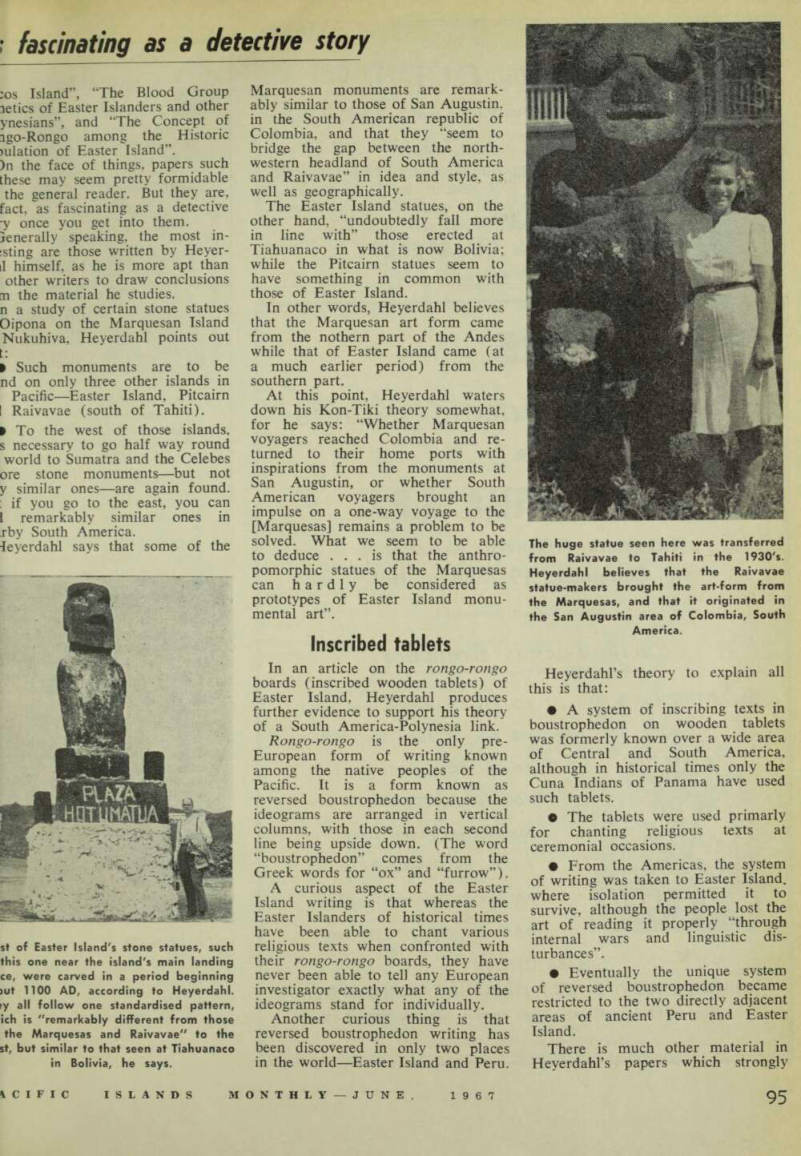
The Easter Island statues, on the other hand, “undoubtedly fall more in line with” those erected at Tiahuanaco in what is now Bolivia; while the Pitcairn statues seem to have something in common with those of Easter Island.
In other words, Heyerdahl believes that the Marquesan art form came from the nothern part of the Andes while that of Easter Island came (at a much earlier period) from the southern part.
At this point, Heyerdahl waters down his Kon-Tiki theory somewhat, for he says: “Whether Marquesan voyagers reached Colombia and re turned to their home ports with inspirations from the monuments at San Augustin, or whether South American voyagers brought an impulse on a one-way voyage to the [Marquesas] remains a problem to be solved. What we seem to be able to deduce ... is that the anthro pomorphic statues of the Marquesas can hardly be considered as prototypes of Easter Island monu mental art”.
Inscribed tablets
In an article on the rongo-rongo boards (inscribed wooden tablets) of Easter Island, Heyerdahl produces further evidence to support his theory of a South America-Polynesia link.
Rongo-rongo is the only pre- European form of writing known among the native peoples of the Pacific. It is a form known as reversed boustrophedon because the ideograms are arranged in vertical columns, with those in each second line being upside down. (The word “boustrophedon” comes from the Greek words for “ox” and “furrow”).
A curious aspect of the Easter Island writing is that whereas the Easter Islanders of historical times have been able to chant various religious texts when confronted with their rongo-rongo boards, they have never been able to tell any European investigator exactly what any of the ideograms stand for individually.
Another curious thing is that reversed boustrophedon writing has been discovered in only two places in the world—Easter Island and Peru.
Heyerdahl’s theory to explain all this is that: • A system of inscribing texts in boustrophedon on wooden tablets was formerly known over a wide area of Central and South America, although in historical times only the Cuna Indians of Panama have used such tablets. • The tablets were used primarly for chanting religious texts at ceremonial occasions, • From the Americas, the system of writing was taken to Easter Island, where isolation permitted it to survive, although the people lost the art of reading it properly “through internal wars and linguistic dis turbances”. • Eventually the unique system of reversed boustrophedon became restricted to the two directly adjacent areas of ancient Peru and Easter Island.
There is much other material in Heyerdahl’s papers which strongly
st of Easter Island's stone statues, such this one near the island's main landing ce, were carved in a period beginning out 1100 AD, according to Heyerdahl, [?]y all follow one standardised pattern, ich is "remarkably different from those the Marquesas and Raivavae" to the st, but similar to that seen at Tiahuanaco in Bolivia, he says.
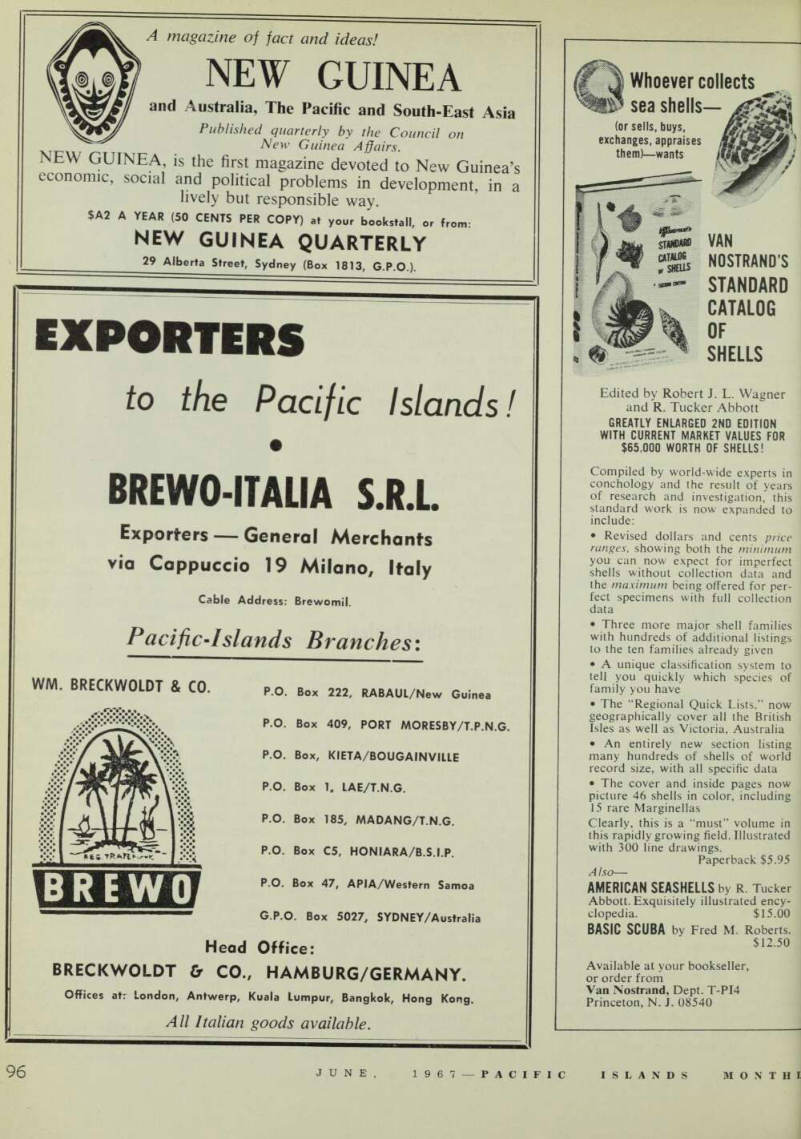
The huge statue seen here was transferred from Raivavae to Tahiti in the 1930'5.
Heyerdahl believes that the Raivavae statue-makers brought the art-form from the Marquesas, and that it originated in the San Augustin area of Colombia, South America.
*gests a link between South lerica and Polynesia.
But the paper that goes furthest in cussing the “Polynesian problem” not by Heyerdahl, but by Dr. Roy Simmons, of the Commonwealth •urn Laboratory in Melbourne, stralia.
Dr. Simmons analysed blood nples taken from Polynesians by mbers of the Heyerdahl ex lition at Easter Island and else ere. -Ie found that there were four nts of serological similarity be ;en the Polynesians and American lians, two between Polynesians and stralian aborigines, one with Indo ians, and none with Melanesians, cronesians and Ainu. -lowever, Dr. Simmons says one mot conclude from this that Polynesians originated in the icricas. Indeed, he says that “blood iup genetical studies do not tell the racial components of the 'ific peoples, or their paths of
No planned migrations
)r. Simmons believes, furthermore id this ought to make Andrew irp happy), that there were no nned migrations into Polynesia, that the Polynesian people spread inly by accidental voyages to all distant Polynesian islands.
There is,” he adds, “no Poly ian problem other than that ated by ourselves, for it would m that a handful of men and men from the east and the west, I not racial groups as we know m today, produced the Polynesian >ple as a distinctive entity among races of Man.”
Phis last sentence, in the eyes of ! reviewer is as sensible as any ;ement that has ever been made the origin of the Polynesians, t puts right on Heyerdahl’s side I on that of just about everyone * who ever had a theory on ere the Polynesians came from, t is like discovering the simple th that everyone you meet in Pitt eet, Sydney, is not descended from "irst Fleet convict and that their :estors did not arrive in Australia m the same place at the same e.—RL.
Reports Of The Norwegian
Hhaeological Expedition To
3Ter Island And The East
HFIC. Allen and Unwin, London. .10.)