Resourceful Band
pp. 90-93 · Read in the full issue

Fiji’S Pioneer European Women:
They Were A Tough, Brave,
By Jane Gregor
What makes the European women who settled in Fiji last century particularly fascinating to read about is not so much their differences from ourselves as their similarities.
FOR instance, in At Home in Fiji, written by one of the most articulate of the early lady visitors.
Miss Constance Gordon-Cumming, is the remark that, in 1877, it was peculiarly hard to train Fijian native girls to be house servants, as they seemed to have such poor memories.
Ninety years later I seem to hear echoes of that remark with monotonous frequency!
But Miss Gordon-Cumming, who accompanied Fiji’s first Governor to Levuka, is not really typical. Her two volumes, beautifully illustrated, make lively, fresh reading; but she was a privileged person from a wealthy family and, although remark ably intrepid by any standards— losing herself in the bush in her eagerness to explore and unafraid of possible dangers—she was backed by the comforts and resources of the Governor’s household.
Brave, tragic
The women who excite most curiosity and sympathy are those who preceded Miss Gordon-Cumming by some 30 years.
I think of such brave, sometimes tragic figures as Mrs. Binner, Mrs, Wallis, Mrs. Smythe, Mrs. Cross and poor, pathetic Mrs. Cargill who died at Rewa in 1840.
Whether married to missionaries or to planters, these dauntless women often shared the same, simple back ground. They sprang, for the most part, from decent upper-working or lower-middle class families in Britain, with a good, plain education to help them adapt themselves to the totally strange lives they were to lead.
They had a strong sense of duty to and love for their husbands, and, generally, a genuine desire to help the “savage creatures” they were to live among towards learning and betterment those twin Victorian ideals.
Margaret Cargill was, in fact, the first European woman to settle in
the Fiji Islands, although when, in 1833, she and her missionary husband David, arrived in Tonga from Scotland, they were met on the beach at Nukualofa by a small band of European men and women already established there for a year or two.
Poor Margaret! From her husband’s loving Memoir of Mrs. Cargill, written by him in 1841 on his lonely return to Scotland after his young wife had died at Rewa, it is easy to picture her as a sweet, self-effacing young girl.
Married at 23
Yet her meekness must have held a core of granite courage. Despite the clumsy verbal wrappings of the over-pious language fashionable in that day to a man of David Cargill’s calling, a clear portrait emerges of this gentle, delicate woman, and of their warm love for each other.
She was born at Aberdeen in 1809
Miss Gordon-Cumming.
1 met her husband when he was dying at the university there. They re both 17.
X seems to have been love at first ht, although they were not married il they were 23.
Margaret’s mother was a widow h little money, so the wedding s a homely affair, although every ; seems to have been happy about union and no one appeared to r t any apprehensions for their are.
Shortly after they were married Rev. Mr, Cargill took his young 3e half-way around the world to iga. By the time they reached se friendly isles, they already had Ir first baby, fheir first two years in the Pacific e spent at Tonga, working happily h other missionaries among people 3, for the greater part, seemed er to embrace Christianity. )avid mentions one old Tongan y who exclaimed that she “was te dead with love” for the mission I its preachers.
"Unknown" Fiji
dargaret Cargill suffered much u the heat and the privations of new life. n January, 1835, a second child son—was born, but he died next 'he poor young mother “meekly mined” to her baby’s loss, but not hard to imagine her distress, far from home and with no iical aid. )n the whole, however, those early s were contentedly busy, and it ; not until the autumn of that r, when the Cargills embarked on Blackbird for “unknown” Fiji, t the real hazards began. ? or a start, the captain of the ) did not have a correct chart of islands, and on sighting Lakeba, refused, for a couple of days, to mpt to find a passage to the st, which he had never seen ore. (And who would blame him!) Eventually, David Cargill, with his ipanion Cross, went ashore in a ghy and were greeted by “some 1 men, some armed with muskets, ers with spears”. )ne was seen with a club in his id and another had a bayonet ened to the end of a long staff,
while others carried bows and bundles of arrows.
The appearance of this group of Fijians was motley and by no means prepossessing. The faces of a few of them exhibited their natural colour.
Some where painted jet black and others red . . . and all of them were nearly naked.
The Lauans’ reception of the mis sionaries was one of utter astonish ment rather than of hostility, and in the afternoon it was considered safe for the whole party to disembark.
The party was housed in a large bare and “a homely repast was pre pared in a style of primitive simplicity”.
But the missionaries commented later: “What a restless night!” They were troubled by mosquitoes, by the ebullient curiosity of their hosts and also by the knowledge that “one of the dictates of the Feejean religion is to rob and murder the ship wrecked”.
Shortage of food
However, the Cargills, with Mr. and Mrs, Cross, remained in Lakeba for some time, despite trying con ditions and a serious shortage of nourishing food. Margaret wrote to her mother: “We have been here five days and all the food we’ve had is one fowl and a few yams”.
But if they themselves had little bodily food, at least they were able to give the Fijians spiritual nourish ment. Soon an open air service was held; sign language led to a modicum of understanding; and a mere 19 days after the missionaries’ arrival, the king and 50 of his people were con verted to Christianity, although the mind boggles at what the poor con verts could have known of their new religion after so short a time.
On December 5, 1835, another son was born to the Cargills—“the first child of European parents to be born in Feejee” as his father proudly re ported. The chief gave him the name of Lakeba, One wonders how Mrs. Cargill managed without even a midwife to help, with toddlers to rear, and often living on a subsistence diet.
Hurricanes added to their other difficulties. No ship called at Lakeba for 15 months, and Margaret was forced to sell her own and the children’s clothing for firewood. And, when a ship did arrive, she had to exchange her husband’s shirts for foodstuffs.
More babies
David’s Memoir notes that his wife continued cheerful and uncomplain ing before all privations. But the sorest trial was the departure, in 1838, of the Crosses.
Margaret and her three children had no servant, the Fijian girls still proving unsuitable for training at that stage.
However, she kept her ambition to be a part of her husband’s work and in addition to her household cares was soon teaching sewing, simple housewifery and hygiene to the village women and even began a Sunday School for the children.
And still the Cargill babies arrived!
And still they were welcomed. Of the birth of one of them David recorded touchingly: “20th July, 1838 ... a stout girl was born today.
Margaret had engaged the services of two confidential females to assist in nursing the little stranger, but their joy on the occasion was so great that for a time it incapacitated them from attending to their charge. The writer extended his ingenuity in adjusting the
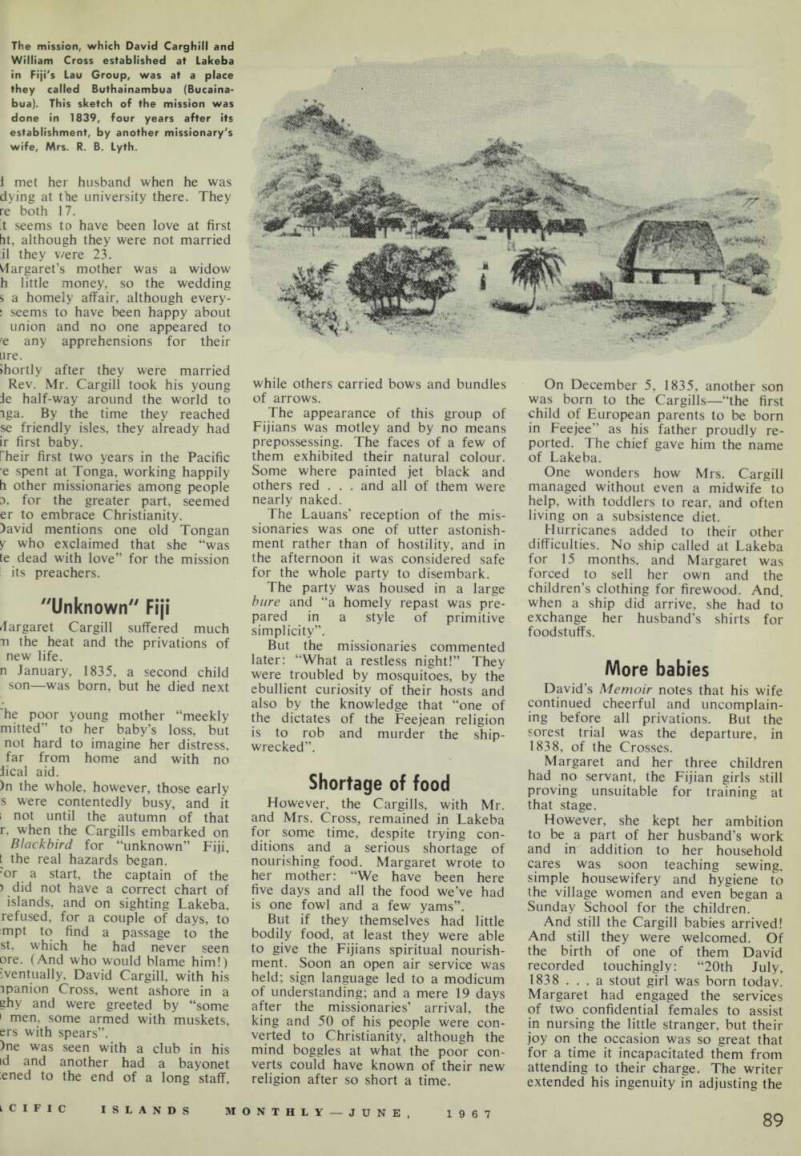
The mission, which David Carghill and William Cross established at Lakeba in Fiji's Lau Group, was at a place they called Buthainambua (Bucaina bua). This sketch of the mission was done in 1839, four years after its establishment, by another missionary's wife, Mrs. R. B. Lyth.
ruesome stories were too much for her
biliments of the lovely infant, but thout success; he endeavoured, wever, to atone for his awkward ss by affection and carefulness”.
But if life in Lau had been hard, ; next two years were to prove en worse.
In 1839 the family sailed to Rewa lere the first, early opposition to iristianity had only recently died wn. Tribal wars were frequent d there, cannibalism was far more svalent than it had been in keba.
The little family arrived in the ddle of a ’flu epidemic. It was ptember and already the weather ;s growing warmer.
One can picture the young mother, 11 finding the heat a constant trial, nng to make a home for her babies der the most primitive conditions, rifled of the ferocity of the natives, d suddenly faced with the task nursing them and their families— t with proven remedies, but by a •ies of trials and errors, whose ailts, if unsuccessful, could have iced her in danger of her own life.
But she perservered, quietly, deter nedly as always. David noted, nost complacently, one cannot but nk: “Mrs. Cargill used her skill d eventually found an antidote”, wonder who was more thankful, ic sick Fijians or young Margaret?
Another war
At the end of October another bal war broke out. During its urse the King of Rewa’s men cap ped 20 enemies, and into the »ckade surrounding the Cargill’s re was flung, one day, a severed ad, to be followed next morning by :ooked human limb.
At times the small house was bjected to attacks by stone-throw » and occasionally stray bullets re fired at it.
And all around them the Cargills re forced to see how old and ung alike mutilated the captured dies before cooking them.
At last, a protest was drawn from ig-suffering Margaret.
After a friendly Fijian had called tell David details of the battle, argaret, revolted by gruesome >ries, said; “Do not ask that man y more as a guest. David. I cannot ar it”.
As the months slipped by, the irfare lessened. But then came mily sickness; the youngest baby is seriously ill with dysentery which >uld not clear up; and David him
self became sick. There were fresh hurricanes, and, inevitably, fresh preparations for war between the tribes.
David and the baby finally re covered their health; but early in May, 1840, Margaret, again pregnant, began to suffer from persistent dysentery. However, out of the savagery and unrest around them came one blessing. The US ship Peacock put in to help restore order and David had the comfort of being able to get some help for his stricken wife from the ship’s surgeon. Despite this, and aid from the surgeon of the Sulphur, which arrived later, Margaret remained wretchedly ill for the next two or three weeks. Finally, on June 2, 1840, her baby was born prematurely and died, and she, too, died, quietly and uncomplainingly.
Moving story
It is a moving story and yet it was not all black. At various times the local inhabitants showed great kindness to the early missionaries who came among them with their in comprehensible exhortations and strange ideas.
David Cargill said that the Fijian ladies of Lakeba would say of his wife; “A marama yalo loloma ko Misisi Kakeli” (Mrs. Cargill is a lady of loving spirit).
While it is true that hardships and perils continued for many years after Margaret Cargill’s untimely death, and while it would be unjust to minimise them, reading some of the accounts of Fiji’s earliest Christian days one is often struck by the rapidity with which those resource ful pioneer women effected improve ments in their family living con ditions, creating clean, bright, loving homes out of little.
Only 10 years after Mrs. Cargill died in agony amid conditions of bestial savagery, Mrs. Wallis, wife of an American missionary, newly arrived in Bau, was writing: “I’ve had a house built . . . with three glass windows prettily ornamented with white fringed curtains. There is no house in Feejee half so pretty”.
And though she could also record such ghoulish details as that “the hands of the cooked bodies are generally given to the children to eat”, yet, when she left to return tc America, a chief, on board the ship, thrust his daughter of 10 at Mrs.
Wallis, begging her to take the child, teach her to read, to sew. to cook.
As the nineteenth century drew to its close, life was still difficult for Europeans in Fiji, especially for the women.
But where once homes had been non-existent and the earliest settlers had been grateful for the shelter offered by a simple bure, now the first clapboard houses were often “very old and dilapidated”.
By 1883, when cannibalism and tribal war had almost ceased, life was still sufficiently primitive for there to be no Sunday church collec tion. Instead, an annual meke was held on the village green at which the people would produce their offer ings either from their mouths or from the midst of their woolly hair.
Yet more and more visitors and missionaries were recording that they were “sorry to leave”.
“We have spent five happy years among the people”, wrote one family at the turn of the century, “and have grown very fond of them.”
Which brings us back to where we started. Back to the common bonds which unite us even across almost 100 years.
For “growing very fond of them” is a remark that one also frequently hears today.
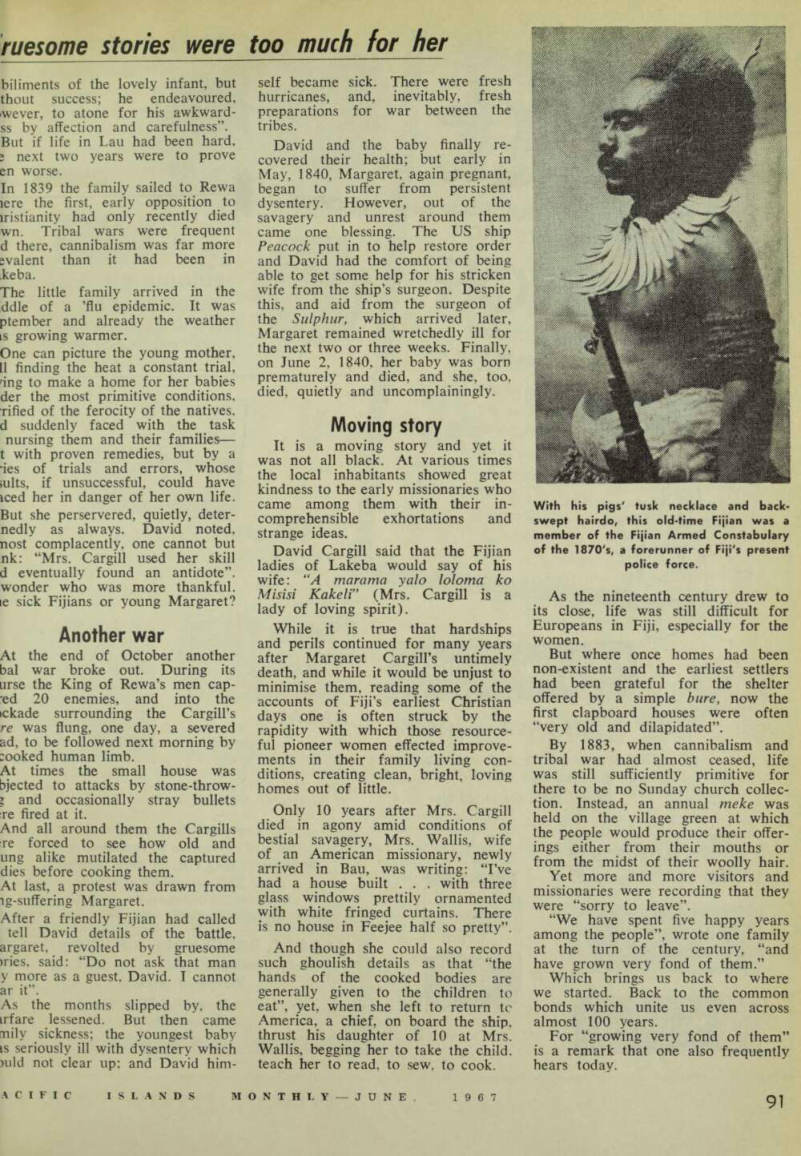
With his pigs' tusk necklace and back swept hairdo, this old-time Fijian was a member of the Fijian Armed Constabulary of the 1870's, a forerunner of Fiji's present police force.