Magazine Section
pp. 87-90 · Read in the full issue
Pacific Islands Monthly
It’s 200 years now since Englishmen discovered Tahiti’s girls—and
their " droll, wanton tricks”
By Robert Langdon
On the afternoon of June 19,
67, as the Royal Navy frigate
ilphin plodded westward
ross the Pacific, the lookout
;hted a lofty mountain looming
amidst the haze on the lar ard bow.
Y sunset the tops of several other 1 mountains could be seen, and the p was abuzz with excitement. Here, last, the Dolphin’s scurvy-racked w thought, was a land where fresh id could be had—a land where they ild rest after six months of cease » toil since entering the Straits of igellan.
Some of the crew also had the ion that they were on the verge an exciting historical discovery.
Jeorge Robertson, the ship’s sailing ster, expressed the thoughts of se men when he wrote in his rnal that night: “We now suposed saw the long wishd for Southern ntinent, which has been often talkd but neaver before seen by any ropeans.”
Frenchman's theory
fhe Dolphin’s crew soon found, vever, that they had not discovered “long wishd for Southern Con mt”. But they had, on the other id, made an unusually interesting :overy, for the land ahead was the i and languorous island of Tahiti, ose handsome, acquiescent Poly ian girls they were the first Euro ins to see. Robertson said the nd had “the most Beautiful ap rance its posable to Imagin’’, luropeans have never quite re ared from the impact that Tahiti I the Tahitians—particularly the men—had on the Dolphin’s men. >o now, with the 200th anniversary the Dolphin’s discovery close at id, this seems an appropriate time look back to see what the Dolphin 5 doing in that part of the Pacific 1767, and what happened when ship reached Tahiti.
The Dolphin's voyage was a direct result of a book published in France in 1756 in which the author, Charles de Drosses, claimed that an immensely rich land was to be found in the South Pacific. The discovery of this land, he said, was “the grandest, noblest, most useful enterprise a sovereign could undertake”, De Brasses’ theory proved of great interest to England’s King George 111, who, in June, 1764, ordered Com modore John Byron, the poet’s grand father, to search for the southern con tinent in the Dolphin.
When Byron returned without hav ing made any significant discoveries, the king ordered the Dolphin out again—this time under Captain Samuel Wallis.
Leaving England on August 22, 1766, in company with HMS Swallow, the Dolphin crossed the Atlantic in four months and entered the Straits of Magellan.
There the ships ran into such bad weather that four more months passed before they could get through the western end.
A day or two later, on April 11, 1767, the Dolphin lost sight of her consort in a fog, and the two ships did not meet again.
By mid-June, when the Dolphin reached the island of Mehetia after picking her way through the dan gerous Tuamotu Archipelago, the captain, first lieutenant and many of the seamen were down with scurvy and other illnesses, and most of the others were merely tottering on their feet.
Ominous grumbling
Their need for fresh fruit and vege tables was so great by this time that many of them grumbled ominously when Captain Wallis gave orders for the Dolphin to bear away from
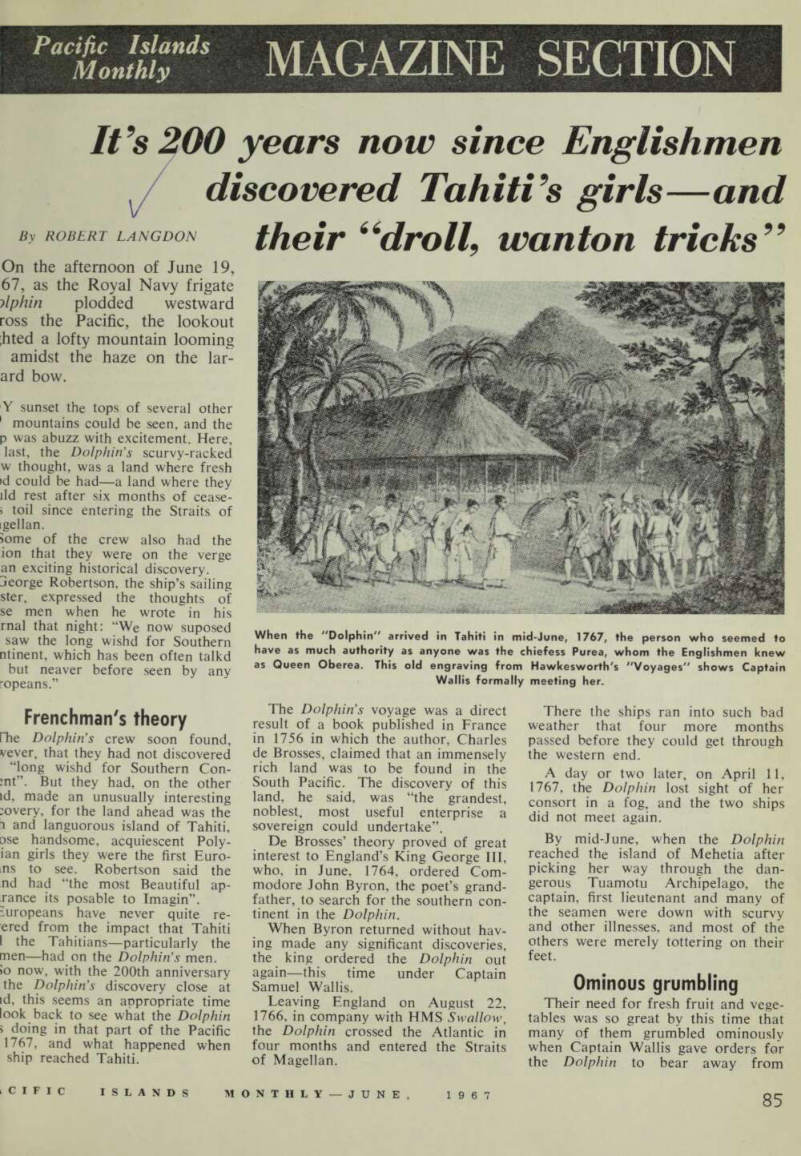
When the "Dolphin" arrived in Tahiti in mid-June, 1767, the person who seemed to have as much authority as anyone was the chiefess Purea, whom the Englishmen knew as Queen Oberea. This old engraving from Hawkesworth's "Voyages" shows Captain Wallis formally meeting her.
Mehetia, where these products seemed easily obtainable.
But the grumbling soon stopped when Tahiti’s mountains came in sight, for, as Robertson wrote in his journal, “we was almost Certain of finding all sorts of refreshments on this great Body of Land”.
The Englishmen made their first contact with the Tahitians soon after sunrise on June 20 when 100 canoes were paddled out to the ship as she rounded the island’s easternmost point, which Captain Cook later named Point Venus.
When some of the natives ventured aboard, the sailors tried to make them understand that they wanted to barter cloth, knives and trinkets for food.
Some of the sailors grunted like pigs, while others clucked like fowls to indicate that poultry was wanted.
The natives were quick to under stand, and some paddled shorewards to bring off the desired goods.
Others, however, remained on board pulling at the iron stanchions and ring bolts, unwilling to leave the ship without some ironwork.
Brisk trading
Eventually, they became so surly at the failure of their efforts that the crew had to fire a nine-pounder over their heads to frighten them. Within a few minutes, the natives had jumped overboard and had swum off to their canoes.
Next morning, when the Dolphin moved into a safe anchorage in Matavai Bay. the natives immediately surrounded her again in canoes laden with coconuts, fruit, fowls and pigs.
Trading was brisk for the rest of the day.
Friendly trading also took place on the second day. But when, during the next two days, the Englishmen tried
to get water ashore, they were intimi dated by the huge numbers of natives who crowded around them, and did not manage to get more than a few barrels filled.
Events took another turn soon after daylight on June 24, when about 500 canoes, bearing 4,000 natives, came out to the Dolphin, with one or two “fair young girls” in each.
All were playing—as Robertson put it—“a great many droll, wanton tricks” to attract the crew’s attention.
Possession ceremony
When the Englishmen crowded to the gunwales to watch the girls, their menfolk suddenly bombarded the ship with stones that were hidden in the bottoms of their canoes.
The Dolphin’s guards were ordered to open fire on the Tahitians; but this, instead of repelling them, only roused them to a more intensive onslaught.
In desperation, the big guns were ordered out, and a few rounds of grapeshot fired. This frightened the Tahitians so much that by noon not a single canoe was to be seen.
Next day, the few natives who ventured out to the ship were so eager to be friendly that the Englishmen decided they could now make their first landing on Tahitian soil, and— in true-blue explorer style—take possession of it.
As Captain Wallis and the first lieutenant were still confined to bed, the landing party was headed by the second lieutenant, Tobias Furneaux.
Furneaux hoisted a pennant on a long pole and took possession of Tahiti in the name of King George 111, naming it after him. The natives watched from a safe distance.
Next morning, they again showed signs of hostility, so Captain Wallis sent an armed party ashore to disable their canoes. From then on, the
Tahitians did everything they coul< to be friendly and hospitable.
When Furneaux made his secom landing that afternoon to get water the Tahitians came to meet hin waving banana palms and bringinj peace offerings.
Among the Tahitians were severa handsome young girls, whom thi chiefs ordered to stand in line so tha the English sailors could “take whid they lyked best”.
“And for fear our men had beei Ignorant and not know how to usi the poor young Girls,” Robertsoi wrote in his journal, “the old mei made signs how we should behave t( the Women.”
Furneaux’ men immediately begge< him to allow them to take a fev girls on board. This, however, wa refused, although Furneaux mad( signs to the girls that his men wouh visit them again.
When the watering party returnee to the Dolphin, the sailors told thei; shipmates that they had never seei more handsome women in their lives and they declared that they woulc rather live on two-thirds’ allowance
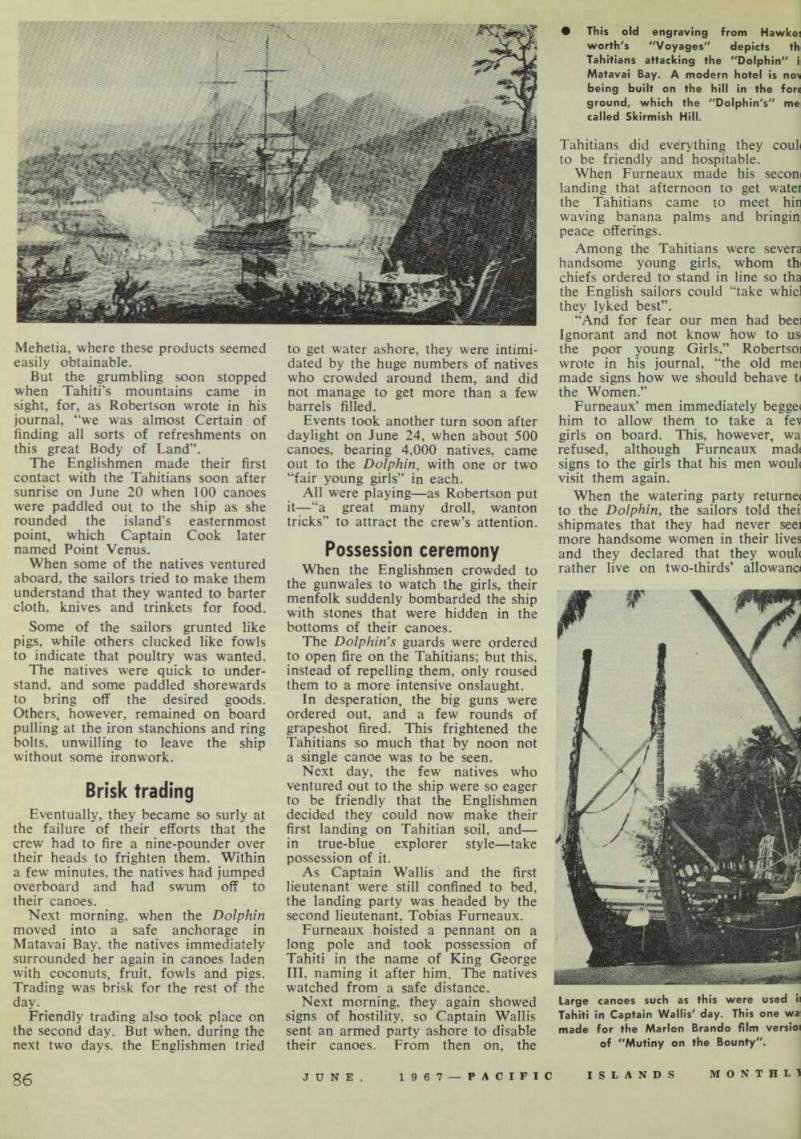
This old engraving from Hawkes worth's "Voyages" depicts the Tahitians attacking the "Dolphin" ii Matavai Bay. A modern hotel is nov being built on the hill in the fore ground, which the "Dolphin's" mei called Skirmish Hill.
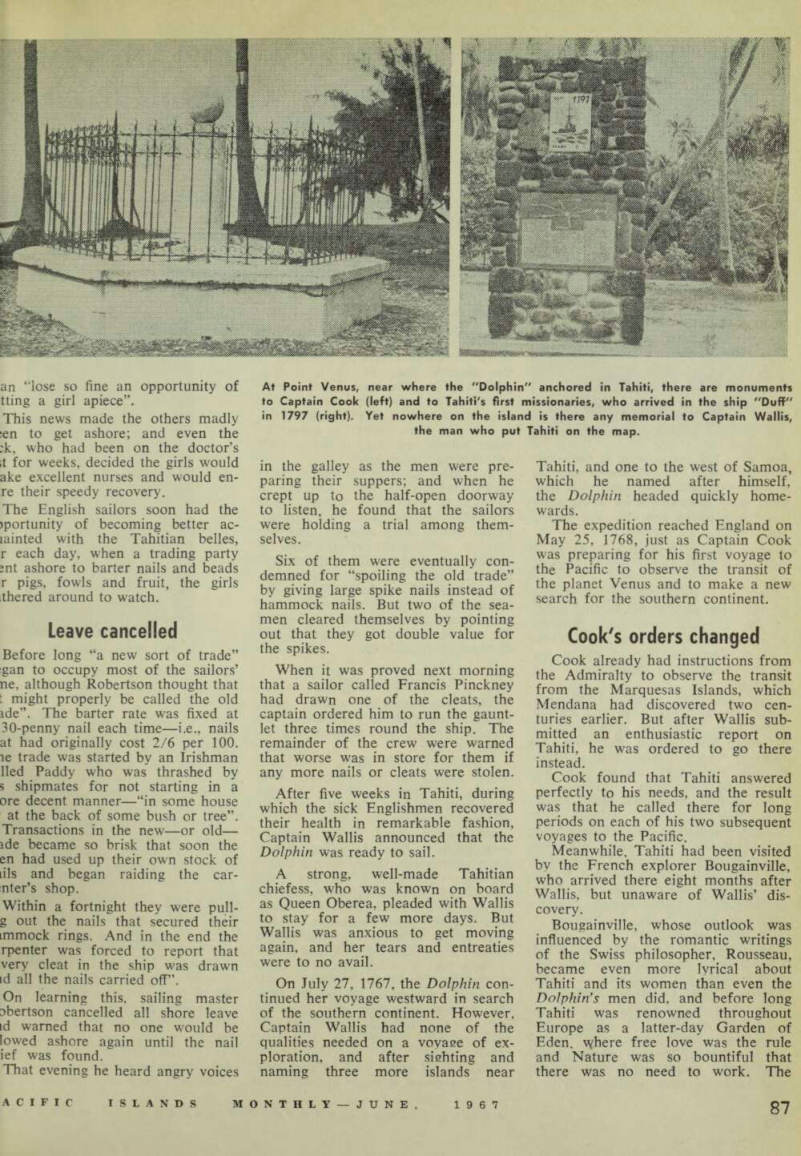
Large canoes such as this were used in Tahiti in Captain Wallis' day. This one was made for the Marlon Brando film version of "Mutiny on the Bounty".
an “lose so fine an opportunity of tting a girl apiece”.
This news made the others madly ;en to get ashore; and even the ±, who had been on the doctor’s it for weeks, decided the girls would ake excellent nurses and would en re their speedy recovery.
The English sailors soon had the )portunity of becoming better ac lainted with the Tahitian belles, r each day, when a trading party ;nt ashore to barter nails and beads r pigs, fowls and fruit, the girls thered around to watch.
Leave cancelled
Before long “a new sort of trade” gan to occupy most of the sailors’ ne, although Robertson thought that t might properly be called the old ide”. The barter rate was fixed at 30-penny nail each time—i.e., nails at had originally cost 2/6 per 100. le trade was started by an Irishman lied Paddy who was thrashed by s shipmates for not starting in a ore decent manner—“in some house at the back of some bush or tree”.
Transactions in the new—or old— ide became so brisk that soon the en had used up their own stock of tils and began raiding the car nter’s shop.
Within a fortnight they were pull g out the nails that secured their immock rings. And in the end the rpenter was forced to report that very cleat in the ship was drawn id all the nails carried off”.
On learning this, sailing master abertson cancelled all shore leave id warned that no one would be lowed ashore again until the nail ief was found.
That evening he heard angry voices
in the galley as the men were pre paring their suppers; and when he crept up to the half-open doorway to listen, he found that the sailors were holding a trial among them selves.
Six of them were eventually con demned for “spoiling the old trade” by giving large spike nails instead of hammock nails. But two of the sea men cleared themselves by pointing out that they got double value for the spikes.
When it was proved next morning that a sailor called Francis Pinckney had drawn one of the cleats, the captain ordered him to run the gaunt let three times round the ship. The remainder of the crew were warned that worse was in store for them if any more nails or cleats were stolen.
After five weeks in Tahiti, during which the sick Englishmen recovered their health in remarkable fashion, Captain Wallis announced that the Dolphin was ready to sail.
A strong, well-made Tahitian chiefess, who was known on board as Queen Oberea, pleaded with Wallis to stay for a few more days. But Wallis was anxious to get moving again, and her tears and entreaties were to no avail.
On July 27, 1767, the Dolphin con tinued her voyage westward in search of the southern continent. However, Captain Wallis had none of the qualities needed on a voyaee of ex ploration, and after siehting and naming three more islands near
Tahiti, and one to the west of Samoa, which he named after himself, the Dolphin headed quickly home wards.
The expedition reached England on May 25, 1768, just as Captain Cook was preparing for his first voyage to the Pacific to observe the transit of the planet Venus and to make a new search for the southern continent.
Cook's orders changed
Cook already had instructions from the Admiralty to observe the transit from the Marquesas Islands, which Mendana had discovered two cen turies earlier. But after Wallis sub mitted an enthusiastic report on Tahiti, he was ordered to go there instead.
Cook found that Tahiti answered perfectly to his needs, and the result was that he called there for long periods on each of his two subsequent voyages to the Pacific, Meanwhile, Tahiti had been visited by the French explorer Bougainville, who arrived there eight months after Wallis, but unaware of Wallis’ dis covery.
Bougainville, whose outlook was influenced by the romantic writings of the Swiss philosopher, Rousseau, became even more lyrical about Tahiti and its women than even the Dolphin’s men did, and before long Tahiti was renowned throughout Europe as a latter-day Garden of Eden, where free love was the rule and Nature was so bountiful that there was no need to work. The
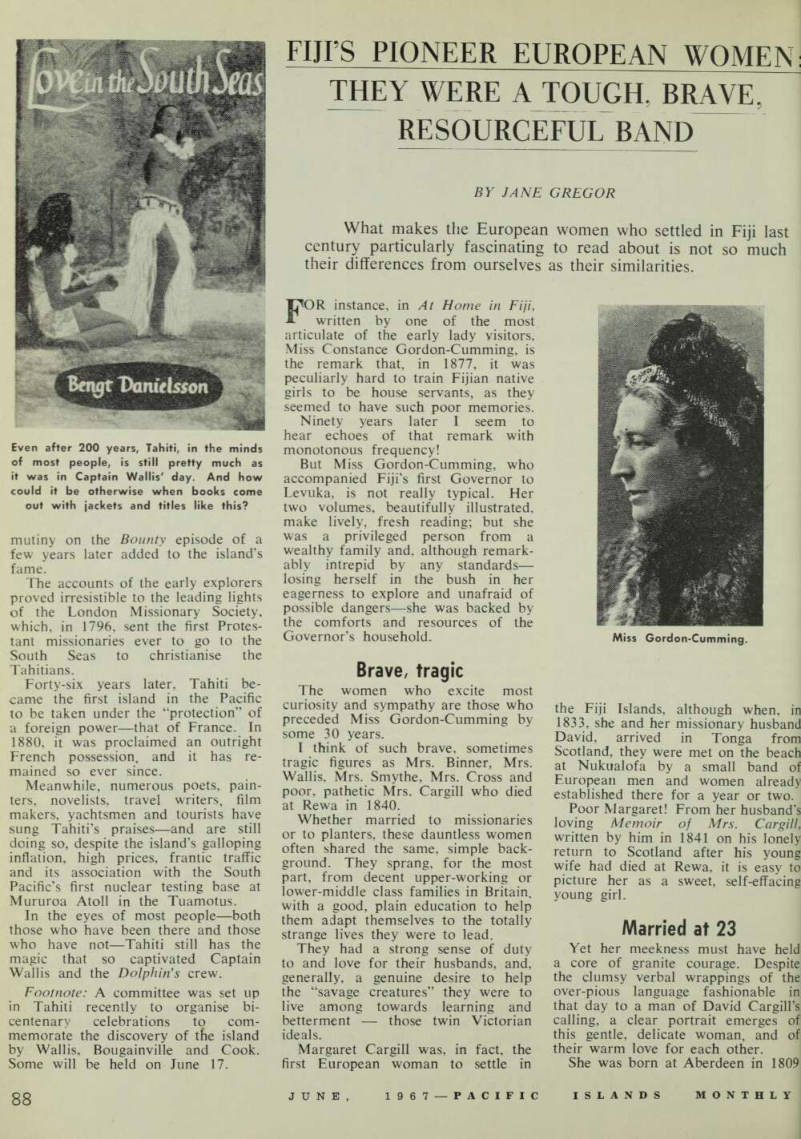
At Point Venus, near where the "Dolphin" anchored in Tahiti, there are monuments to Captain Cook (left) and to Tahiti's first missionaries, who arrived in the ship "Duff" in 1797 (right). Yet nowhere on the island is there any memorial to Captain Wallis, the man who put Tahiti on the map.
mutiny on the Bounty episode of a few years later added to the island’s fame.
The accounts of the early explorers proved irresistible to the leading lights of the London Missionary Society, which, in 1796, sent the first Protes tant missionaries ever to go to the South Seas to christianise the Tahitians.
Forty-six years later, Tahiti be came the first island in the Pacific to be taken under the “protection” of a foreign power—that of France. In 1880, it was proclaimed an outright French possession, and it has re mained so ever since.
Meanwhile, numerous poets, pain ters, novelists, travel writers, film makers, yachtsmen and tourists have sung Tahiti’s praises—and are still doing so, despite the island’s galloping inflation, high prices, frantic traffic and its association with the South Pacific’s first nuclear testing base at Mururoa Atoll in the Tuamotus.
In the eyes of most people—both those who have been there and those who have not—Tahiti still has the magic that so captivated Captain Wallis and the Dolphin’s crew.
Footnote: A committee was set up in Tahiti recently to organise bi centenary celebrations to com memorate the discovery of tfie island by Wallis, Bougainville and Cook.
Some will be held on June 17.
Even after 200 years, Tahiti, in the minds of most people, is still pretty much as it was in Captain Wallis' day. And how could it be otherwise when books come out with jackets and titles like this?