Yesterday
p. 93 · Read in the full issue
Weather stories were a feature of the April issue of PIM 20 years ago. Mare, one of the Loyalty Islands off the east coast of New Caledonia, had been hit by the most severe hurricane in living memory, which ruined houses, schools and plantations; and in Tahiti, the Papeete harbour waterfront was a shambles following a 100 m.p.h. gale which hit the harbour, wrecking several boats and damaging many others. Mean while, Western Samoans were sweltering in the hottest rainy season on record.
OTHER items in PIM for April, 1947, included: A CHARTER air service, Trans Oceanic Airways, to operate to P-NG, Netherlands East Indies, Malaya, New Hebrides, New Caledonia and other Pacific centres, had been formed in Syd ney. The company planned to fly passengers and freight in five Sunderland Mk 111 flying boats.
FOR the first time Indians out numbered Fijians in Fiji. A census taken in 1946 put Fiji’s population at just over a quarter million—l2o,4l4 of whom were Indians and 118,083 Fijians. PIM commented: “While the natural increase of the native Fijians and Rotumans is quite satisfactory, the growth of the Indians is phenomenal.”
Another 1946 census showed there were 55,734 people in French Polynesia—an increase of 12,000 in 10 years.
HIGH prices for copra and cocoa—£l9o a ton for cocoa beans were making growers happy in Western Samoa. How ever, the territory was threatened with a shortage of sugar and flour because a ship bringing sup plies was delayed in Sydney.
STRAY Japanese were still turn ing up in New Guinea and the Solomons. But several Allied troops had also gone bush. A South Australian deserter was found in the Ramu Valley, south of Madang, and an American was picked up at the back of Lae.
A SURVEY of the world copra market showed that where copra was permitted to run free, as in the Philippines, the market value was about twice that per mitted where the price was under sharp control, as in New Guinea.
SIR Alexander Grantham, Gov ernor of Fiji and British
High Commissioner for the Western Pacific for the previous two years, had been appointed Governor of Hong Kong.
THE first Norfolk Island post age stamps, depicting the island’s famous pine trees at Bali Bay, were about to be released.
Hitherto, the island had used Aus tralian stamps. PIM said the new stamps were “unimaginative in de sign”.
(George Aumuller. For
many years a very popular manager for Burns Philp at Samarai and elsewhere in P-NG, had died in Sydney.
THE effects of the war were still being felt in Rabaul and Lae. In Rabaul, water and sup plies were scarce, roads were terrible and there was no sanita tion system.
Lack of food and water and a
poor lighting system hampered efforts to revitalise Lae. No ships had arrived for months.
ISLANDERS at Pupapuka (Cook Islands) had claimed ancient rights to settle on uninhabited Nassau Island, 45 miles away.
Pukapukans had lived on Nassau in early times, but gave it up when long distance travel by canoe was interrupted by what is thought to to have been a cycle of frequent hurricanes.
AFRESH supply of pareu cloth was on its way by ship to the Islands. A Papeete corre spondent said Tahitians were re joiced that the cloth was coming and importers, to avoid a “mob scene” resembling the nylon stock ing riots in the United States, had advised buyers to place orders be fore the ship arrived.
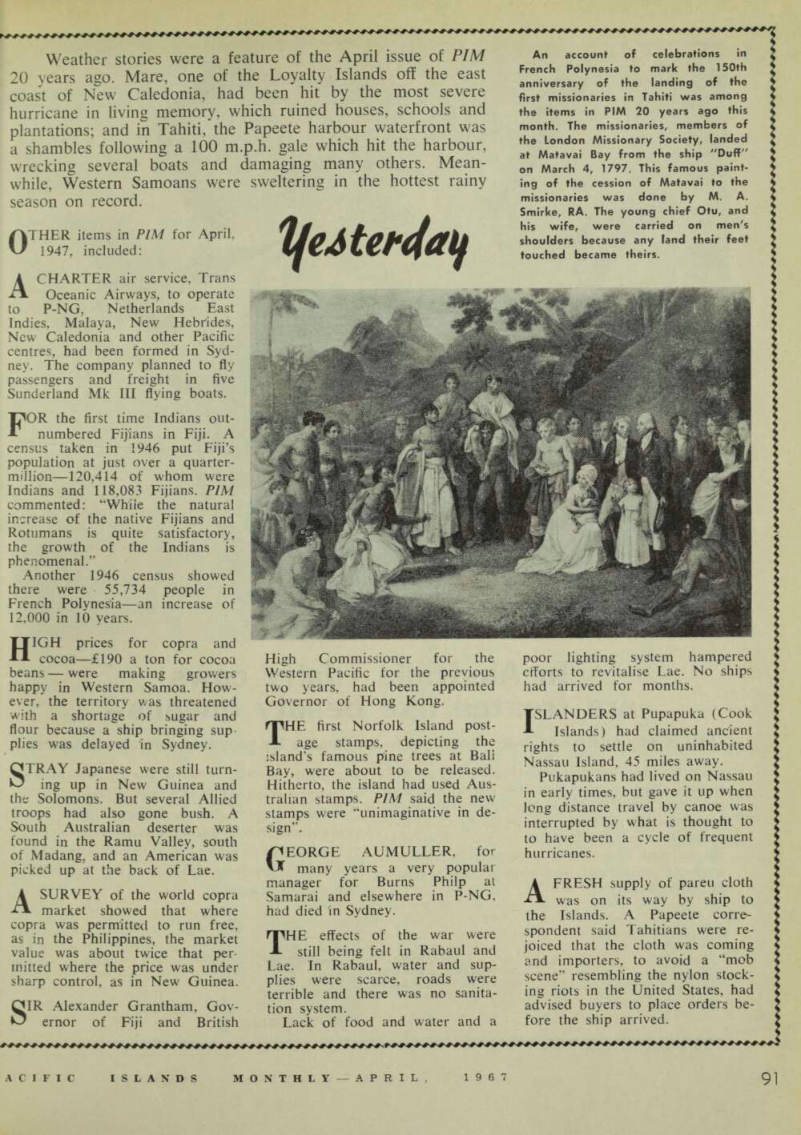
An account of celebrations in French Polynesia to mark the 150th anniversary of the landing of the first missionaries in Tahiti was among the items in PIM 20 years ago this month. The missionaries, members of the London Missionary Society, landed at Matavai Bay from the ship "Duff” on March 4, 1797. This famous paint ing of the cession of Matavai to the missionaries was done by M. A.
Smirke, RA. The young chief Otu, and his wife, were carried on men's shoulders because any land their feet touched became theirs.