deep belly-laughs
pp. 95-97 · Read in the full issue
Book Reviews
New Guinea - but with no deep belly-laughs
This month you can take your choice of native New Guineans: Kenneth E. Read’s The High Valley version; or the Margaret Spencer Doctor’s Wife in Rabaul version. If neither is precisely your own native New Guinean, then this is because as Margaret Spencer herself might have said—these things are very much according to the eye of the beholder.
HHIS is the third of Mrs. Spencer’s L Doctor’s Wife books. The other vo cover the New Guinea Highlands nd Papua.
All are based on the experiences le and her husband had in the ter tory between 1953 and 1961 when e was a medical officer with the administration and she, for part of le time, was an entomologist with n anti-malaria unit.
Her new book is not concerned overmuch with mosquitoes or other bugs; and only to a minor degree with anti-malarial work. This aspect of her life in P-NG merely provides the vehicle whereby she can record the contacts she makes with the native people around her and an opportunity for interpolating the history of the Gazelle Peninsula and adjacent areas.
Contemporary non-native people do little but flit through the back ground like nameless ghosts a characteristic of all her books and one that robs them of some per spective.
Highly emotional
From Rabaul excursions were made to Nissan and the Mortlocks and even as far as (then) Dutch New Guinea. But, naturally enough, a considerable amount of the narrative is devoted to the life and problems of the urban native—the semi sophisticate on the threshold of new delights, freedoms and bedevilments.
Although no one could consider her book a study in depth of any facet of New Guinea today, it pro vides fair background for anyone seeking an introduction to the ter ritory.
Read’s book is a different pro position. It is a highly emotional, personal approach to primitive man, all the more unusual perhaps because Read is an anthropologist, currently at the University of Washington, Seattle, although an Australian.
As a member of the Australian armed forces in the Pacific War, he had, for part of the time, one of those specialised jobs that allowed him to practise his profession.
He spent some time in 1944 in an Upper Markham village and this
gave him his taste for New Guinea.
After his Army service he spent two years in London; returned to Australia to teach at the Australian School of Pacific Administration, Sydney; and then, as a research fellow at the Australian National University, Canberra, found himself back in New Guinea, in 1950, at the beginning of a two-year term of field work in the New Guinea Highlands.
The High Valley is based on his experiences during those two years— not terribly far from what (to quote) “the local people called Humeleveka and the whites called Goroka”.
Simon-pure primitives
Goroka at this time had scarcely struggled into being, and it was not difficult to find virtually simon-pure primitive man within a short walk of the station.
The village of Susuroka, where Read went to live, had had contacts with Europeans, however (and could be reached even then by jeep), and it was for this reason that the head man, Makis, had walked in to the District Office and asked that a white man go to live among them.
This is not unusual at this level of advancement among New Guinea people. It usually stems from the fact that the community in question
lieves that the presence of a Euro an will produce benefits—perhaps bridge over a river, even a road; d. most of all, opportunities for de whereby the village will obtain :h desirable articles as axes and ives, stick-tobacco, salt and so on.
While Read realised this, and, in :t, it produced embarrassment and art-burning in him at later stages, also attributed far deeper motives Makis’ desire for his presence—a knowledge on Makis’ rt that change was just around the rner and a belief that Read could aply the emotional and cultural dge between the two cultures.
Whatever might be one’s own iction to this idea, a great many aple who have had long contact :h Melanesians will question Dther of Read’s assertions. This is it because, as he puts it, he wanted thing from these people but to live long them, he, of necessity, had a ;cial relationship with them.
Many people, not only anthropo ;ists, have had similar delusions.
Perhaps the best answer to such Dple comes from another expert primitive people. Dr. C. E. Fox, the Melanesian Mission in the
Solomons, who has given more years than anyone now living to selfless service to them.
Dr. Fox said in one of his books that if the native people had the privilege of getting rid of every European but one, it would be the trader they would keep.
Even though the whole tenor of Read’s story is the high emotional experience (Read’s, not the people among whom he lives) and that it is therefore something removed from the mundane life of the territory with its “whites” who build boxy bungalows and call places Goroka when they should be called Humeleveka — there will be few who are not trapped by the author’s lush carpet of words.
Plenty for ctiirlentc nemy ror siuuerm The story has pace and even suspense and through it Read emerges as a person who is not only having his emotions stirred, but one who is a somewhat nervy individual, repelled by, as well as attracted to, the things that are part of primitive village life. He is one who can be embarrassed and tonguetied and, although he does not say it, probably wishes a thousand times that he was somewhere else.
The Philistines among us will say serve him damned well right when, as a sworn-in. blood brother ° f . , a fami ! y ’ h . e i beC c ° with rapacious in-laws, or when he reverts to European thinking and
interferes with traditional custom to the extent of sending Makis’ wife to hospital when she is in difficult labour and thus displeases the village, Nonetheless, there is a great deal in this book for the student of New Guinea affairs, even though the circumstances that prompted it are now 16 years distant and the once primitive Susurokaese are now probably successful coffee growers, truckers along the Lae-Mt. Hagen road or pyrethrum tycoons,
Specialist vieWS
“ Human nature does not alter in a generation; and the New Guinea Highlanders, even more than most, have proved that they are capable of remaining themselves in spite of outward trappings. u c f , w »h Read s search for funda mental realities and Mrs. Spencers matter-of-fact skimming across the urban cream, there is little similarity between their two books, except in a complete lack of humour in either, Nothing of the rumbustious, ex trovert, deep belly-laugh New Guinea that still is, in this reviewer’s opinion, the vital essence of the territory, shows through and therefore neither can be regarded as New Guinea in microcosm. Both are specialist views, —JT.
(Doctor’S Wife In Rabaul. Robert
Hale $2 .30. the high valley. George Allen and Unwin Ltd. $6.35.)
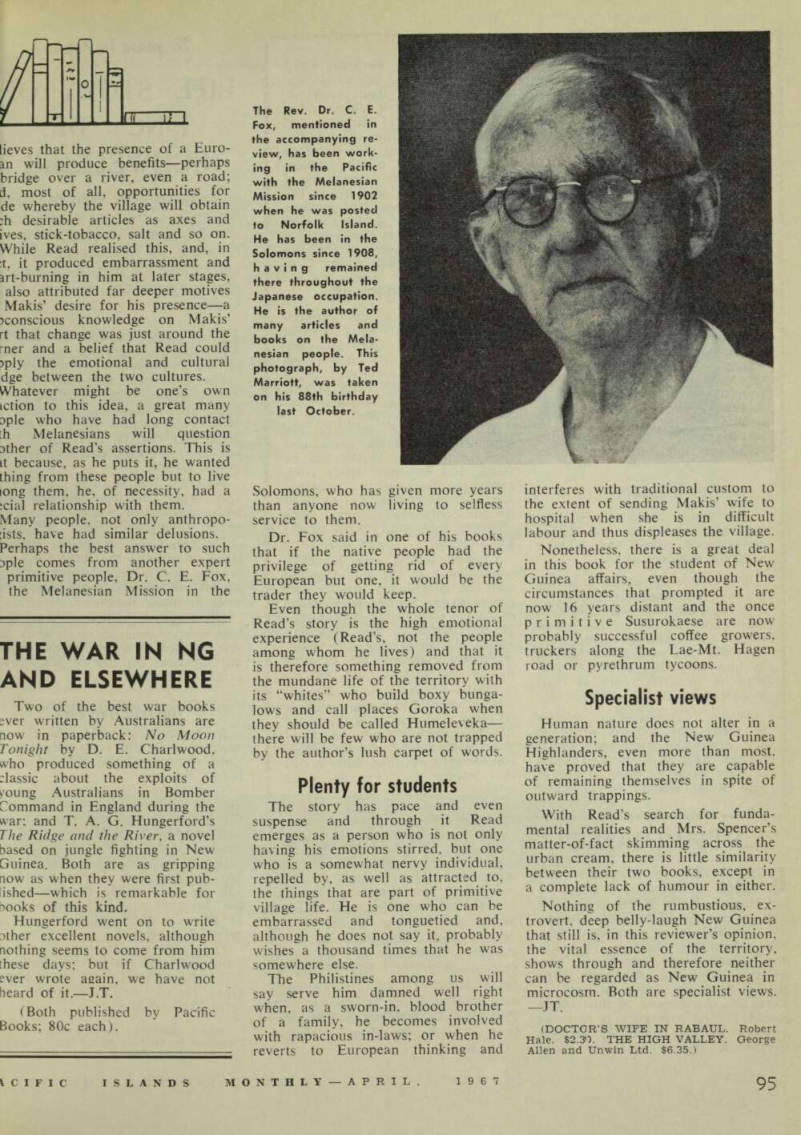
The Rev. Dr. C. E.
Fox, mentioned in the accompanying re view, has been work ing in the Pacific with the Melanesian Mission since 1902 when he was posted to Norfolk Island.
He has been in the Solomons since 1908, having remained there throughout the Japanese occupation.
He is the author of many articles and books on the Mela nesian people. This
photograph, by Ted
Marriott, was taken on his 88th birthday last October.