Montlily
Pacific Islands Montlily
The News Magazine Of The South Pacific
Since 1930
April,
1967 30 Aust. cents Three shillings 70 US cents ) French Pac. frcs.
ed at G.P.0., Sydney, for ision by post as a newspaper.
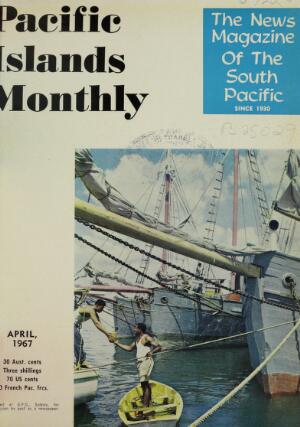
OUR COVER: Inter-island ships mooreo one of Suva's wharves carry evidence their nomadic trading life. These sn ships play a vital part in the life of Islands. Here is the real romance, the colour, of the South Seas, and Rob Wrr captures it all on one balmy, Fiji mornii
Advertisements & other items, pp. 2-4 (3 items)
April. 1967 - Pacific Islands Month
Born spoilers!
Between Port Moresby and Australia .. . that’s TAA's 'Bird of Paradise’ service.
And you’re spoilt in the nicest possible way. From welcome aboard, you might as well forget you’re thousands of feet above earth. Let’s pretend you’re at some sumptuous dinner party. Your hostess offers you canapes and aperitifs. Followed perhaps by delectable roast chicken, fruit salad and cream ... cheeses and coffee. And yes, wine with your meal as well!
That’s the TAA ‘Bird of Paradise’ Service.
So be spoilt. Book now. Contact your nearest travel agent or TAA: Port Moresby 2101 ■ Lae 2311 ■ Rabaul 2567 ■ Madang 78, 268 ■ Goroka 8 ■ Mt. Hagen 4 ■ Wewak 103 ■
TAA*
the Friendly Way
Q
TAAI
BURNS PHILP (SOUTH SEA) CO. LTD
GENERAL MERCHANTS AND SHIPOWNERS
HIPPING, CUSTOMS AND FORWARDING AGENTS
Fiji:
SUVA.
LEVUKA.
LAUTOKA.
LABASA.
SAVU SAVU.
BA.
SIGATOKA.
TAVUA.
ROTUMA ISLAND.
TAVEUNI.
BRANCHES
Samoa: Tonga:
APIA. NUKUALOFA.
PAGO PAGO. HAAPAI.
VAVAU.
NORFOLK ISLAND.
NIUE ISLAND.
AGENTS FOR:
QUEENSLAND INSURANCE CO. LTD.
BURNS PHILP TRUST CO. LTD.
SHELL COMPANY (P. 1.) LTD.
OVERSEAS AGENTS
BURNS, PHILP Cr CO. LTD., Sydney.
BURNS, PHILP Cr CO. LTD., London.
BURNS PHILP CO. OF SAN FRANCISCO
SHIPPING AGENCIES
• The New Zealand Shipping Co. Ltd. • Shaw Savill & Albion Co. Ltd. • Port Line Ltd. • Bank Line Ltd. • General Steamship Corporation Ltd. • Blue Star Line • Cunard Line • Compagnle des Messageries Maritimes • British India Steam Navigation Co. Ltd. • Royal Interocean Lines • Nederland Line Royal Dutch Mail/Royal Rotterdam Lloyd.
EXCLUSIVE DISTRIBUTORSHIPS INCLUDE
• AKAI TAPERECORDERS
• DUNLOP PRODUCTS
• EPIGLASS PRODUCTS
• FERGUSON TRACTORS
• HELENA RUBENSTEIN
• HITACHI ELECTRONICS
• HOLDEN VEHICLES
• JOHNSON'S WAXES
• ROLEX WATCHES
• REVLON COSMETICS
• PENTAX CAMERAS
• SUNBEAM APPLIANCES
INTERNATIONAL AIR TRANSPORT ASSOCIATION REPRESENTATIVES for
QANTAS EMPIRE AIRWAYS LTD. AIR NEW ZEALAND
REGISTERED OFFICE; SUVA, FIJI
Code Address: "BURNSOUTH"
reliable communications
in the field
transistorised HF packset
□ SlMPLE—
anyone can operate it.
□ LIGHTWEIGHT
—weighs less than 20 lb. including batteries.
□ LOW COST—
sells for less than $l,OOO.
□ 29 CHANNELS.
□ WATERPROOF
and ROBUST.
□ SSB/AM/CW,
Now available for early delivery, the Racal ‘Squadcal' TRA 906 Packset has been developed for use throughout the world wherever there is a need for mobile communications. Already tested and proven under all environmental and climatic conditions, the unit is lightweight yet strong enough to take the roughest treatment. In addition it will survive complete immersion in water. Range of up to 200 miles can be achieved and the unit can be maintained by relatively untrained personnel. Built to the same high standards for which RACAL is renowned. *Exclusive of any applicable Duty and Sales Tax.
A NAME TO COMMUNICATE
UOBOO
RACAL ELECTRONICS PTY. LTD .
HEAD OFFICE: 75-77 Chandos Street, Crows Nest, N.S.W. Telephone 43 0664.
BRANCH OFFICE: Suite 22, 533 St. Kilda Rd., Melbourne, VIC. Tel. 51 5726.
1
CIFIC ISLANDS MONTHLY APRIL, 1967
Pacific Islands
Monthly
Owned And Published By
Pacific Publications Pty. Ltd.,
29 ALBERTA ST. (G.P.O. BOX 3408), SYDQ
Telephones: 61-9197, 61-7101, 61-4365?<
Telegraphic Address: PACPUB, Sydney.
Chief Executives
Managing Director: R. W. Robson.
General Manager; Selwyn Hughes.
Book Publishing Division
Editor: Judy Tudor.
Pacific Islands Monthly
Editor: Stuart Inder.
Assistant Editor: Robert Langdon.
Branch Offices
Melbourne: Newspaper House, 247 Collins a Tel.: 63-7053.
Fiji: Pacific Publications (Fiji) Ltd., Fiji Tiil Building, 20 Gordon Street, SUVA, Tel.: 25*?
Fiji Times Office, Vidilo Street, LAUTOWI Tel.; 60-422.
Papua-New Guinea: Pacific Publications (M Pty. Ltd. Representatives: Mrs. Joan Car?
P.O. Box 16, PT. MORESBY (Tel.: 2504); fl Pat Robertson, P.O. Box 227, LAE; Mr. SZ Simpson, P.O. Box 154, RABAUL (Tel.; 255
Representatives
New Zealand: J. D. Whitcombe, C.P.O. 2229, Queen Street, Auckland. Tel.; 760iC Hawaii: C. C. Spencer, 203 Yap Bldg., X Waialae Ave., Honolulu. Tel.: 775538,6 United States: Mrs. A. L. Craib, 1631 8 Avenue, Oakland, California, 94621.
Tel.: LOckhaven 8-1201.
United Kingdom: S. R. Warman, Candleve House, 116-126 Cannon Street, London, E. 3 Tel.: Mansion 3674/7.
H. A. Mackenzie, 4A Bloomsbury Squui London, W.C.I. Tel.: Holborn 3779.
Agents
All main trading firms and stores in the Pacific Islands.
Pacific Publications Pty. Ltd. is the Austrasi agent for THE FIJI TIMES.
Subscription Rates:
Australia: 30 cents Aust. ($3.60 Aust. 12 months). New Zealand, all Brh Commonwealth South Pacific Territories, Toio New Hebrides and Western Samoa: local currency (36/- local currency per annim Elsewhere in the South Pacific: 50 Frei Pacific francs or 70 US cents (600 Frei Pacific francs or $B.OO US posted per anmm Posted to USA, $B.OO US per annum. Poo 1 to the UK and all other countries: £Stggl "Pacific Islands Monthly" is air-freightedb; all subscribers and agents in the South Pacoi copies to other areas go by surface mail's
Advertisements & other items, p. 4 (1 item)
2
APRIL, 1967 PACIFIC ISLANDS MONTHI
This Issue
Eral
1c Cable Opened 8 ting in the Islands 87 ds Trader Fined 103 Fare Reductions 129
Rican Samoa
ng Governor 23
K Islands
;r Over Stamps 8
ds Survey 103
;r Overhauled 109 Shipping Service 111 onga Airstrip 137 > Session 8
University 13
n Birthrate Falls 15 : Behind Fiji's Athletes 37 Past 41 ping In Suva 65 <a, Past and Present 83 Tanker 107 s Crowd Suva 11l ; Fishing Boat Launched 125
Ch Polynesia
ges at Huahine ... 21 ng Trimaran Found 22 vae in the Australs 105 r Island Statues 131
Ert And Ellice Islands Colony
le Training School 109
Lord Howe Island
New Speed Limit 23
Nauru
Canberra Independence Talks 11 Offshore Fishing Rights 101
New Caledonia
Nickel Ship Sold 105 Chateau Royale Hotel 135
New Hebrides
Big Census Job Ahead 29 Big Bay, Wall Mystery 40 Old Schooner Still Going 11l Airline's New Planes 131
Niue
Bee-Farming Industry 148
Norfolk Island
Offshore Fishing Rights 101
Papua-New Guinea
Political, Land Development 6 Fears Over Disorder 7 By-election 12 After J. K. McCarthy, Who? 12 University Development 13 Footballing Schoolboys 22 Government House 23 Political Heat's On 39 Mrs. Hay and Lady Cleland 42 Retirement of J. K. McCarthy 42 Second P-NG Woman Doctor 42 Electoral Boundaries 53
South Pacific Games Site 67 Offshore Fishing Rights 101 Big Fishing Venture 101 Work On Co-op. Ships 103 US Help for Mission Ship 107 Pictorial Section on P-NG 117 Qantas for P-NG Again 121 Building Contractors 145 Copra Prices 146 Search for Oil 147
Pitcairn Island
Few "Bounty" Relics Left 31
Solomon Islands
Political Scene 7 Visit by Warship 107 Beche-de-mer Industry 148
South Pacific Commission
Education Books Sell Well 69 Fisheries Research Station 105
Tonga
Santos Takes Boxing Title 16 Decimal Coins 21 Big Numbers of Visitors 35 Coming Coronation 36 Prehistoric Pottery Found 51 Currency Changeover ... 146
Us Trust Territory
New Newspaper 27 Typhoon Kills Three . .. 101 Carolines Food Shipment 101 New Capital Wanted 148
Western Samoa
Mata'afa Re-elected 9 Samoan Paper Closes 9 Weekly Newsletter 25 Ancient Pottery Found 47 Faleolo Airport Closed 133 Apia's Rental Cars 135
EPARTMENTS: Tropicalities, 21; Letters to the Editors, 26; To The Point with src V Chatterton, 55; Practical Planter, 71; From the Islands Press, 60; Magazine ;ction, 83; Yesterday, 91; New Books, 93; Shipping, 101; Cruising Yachts; 111; avel, 121; People, 139; Business and Development, 145; Produce Prices, 149; Shipping, Airways Schedules, 150; Deaths of Islands People, 158.
Advertisements & other items, pp. 6-7 (2 items)
—nnMM
. t i , .. .. ... .V. ... .. . S . - .. x. * m < \ • •■. \ S I »
NICE
c?- K * m s&e V a"'. oft Arnott’s Nice Biscuits Crisp and sugar-sprinkled Arnett's Lemon Crisp Biscuits With tangy lemon centres ng***
ora
HIS CO' r t
% m
i H WTM« l
SHREDDED
alt* Bi* Arnott’s Orange Slice Biscuits Tangy orange cream in biscuit sandwich Arnott’s Shredded Wheatmeal Biscuits Golden-grain goodness for morning tea.
H 699
- #: jam** aiscul^. fooho o*f Arnott’s MILK ARROWROOT Biscuits All-day energy for children a favourite with all the family.
Arnott’s SAO Biscuits Ideal for snacks, suppers or between meals. co^ Arnott’s SCOTCH FINGER Biscuits Chunky and butter-rich, with the true shortbread flavour.
Arnott’s CHEESE JATZ Biscuits Crisp as could be with a fine cheese flavour perfect for entertaining.
There is no Substitute for Quality
5
CIFIC ISLANDS MONTHLY APRIL, 1967
Problems, Problems As New Guineans
Put The Pressure On
By Suart Inder, who was in Port Moresby in March
You can get nothing but fragments of the Papua-New Guinea House of Assembly by sittim through its meetings. The House is not to be listened to, but to be read, for only in the privacy oc your own 75c copy of the Debates do the 64 members develop significant patterns of thought! surprisingly, only on paper does the House become real, the objectives clear.
PERHAPS it is the interpretation system which robs much of the debates of their immediate signifi cance to the listener; perhaps the fre quent motions, suspension of standing orders, question times, tea breaks, and committee stages dull the sense of urgency which does in fact exist in the chamber as two million New Guineans grope towards a future of some sort.
One of last meetings
The March meeting of the As sembly—its twelfth, and among the last before the general elections of next year—was a typical example.
The many interruptions over the 10day sitting helped mask for those who, like me, were there, the fact that pleas were being made, solu tions being offered, indignation being expressed, challenges being laid down and a political awareness being dis played with a shrewd if inexperienced indigenous skill.
Only with reflection, and with the help of the record, does one realise what an obsorbing commentary it was on land settlement; does one get unexpected insight into the inade quacy of the education system; and see disturbingly reliable evidence of a growing disrespect for law and order throughout the territory.
AAore radical 1968
Through it all runs a constant threat, possibly already an inescap able conclusion, that the electorates will send more radical members to next year’s House because of their failure to get from Port Moresby the bridges, roads, schools, teachers, and the economic development they so urgently require.
Shouted men like Pita Lus, “The Government must distribute the money equitably. They have for gotten about us Sepik people. They have said the Sepik people are rubbish!”
Complained Tei Abal, “It is quite wrong! The greatest need is in the bush!”
And Singin Pasom, “I cannot say something new—l am going to repeat what I have said for years. I am sick of asking the government! I am an old man now. Others are singing out and me too, but we are wasting our breaths!”
And Pita Tamindei: “I am not giving you an idea which I picked up from an officer—l am telling you the thoughts of all my people! How many years have we waited for the sort of development we have asked for?”
Yauwi Wauwe said the people were puzzled by the Government’s lack of response to their requests. “Now I do not know, shall we join with Aus tralia or shall we find a solution of our own to our economic troubles?”
Yauwi asked. “My friends will sup port me in this type of thing.”
Budget victory
Somewhere in all the 10-day talk, and all the interruptions, there was a comment by Momei Pangial which summed it all up: “The reasons why my friends have asked for this great variety of development is simply that they are told to by their electors.”
There may yet be some late relief on the way, for the most important Administration statement of the meet ing accepted the fact that the House had been justified in staging last September’s Budget revolt.
Assistant Administrator, Mr. L, W.
Johnson, said Administration “appre ciated that there is need for more consultation than has previously been the case” and said this year it would take its Budget planning to the Ad ministrator’s Council, which could make a detailed study of the esti mates, both before and after they had been seen by Canberra.
This announcement was generally recognised by members as the begin
ning of the new era at last, althoc John Pasquarelli was one who feas that their trust would be betrayj The announcement would hd been accepted with more enthusui if the Administration had not brouj down a new “little budget”, wh will spend an additional whacM amount.
Expensive Public Service
The elected members attacked from all sides. The money was b©( spent not on economic developrrr but on a Public Service that was.?
John Stuntz put it, “over-complicar over-centralised and too cumberso, for this country to afford”. If Administration had got to the p«c where its Public Service was out} control, he said, then it should acb it and seek authority to take dras steps.
Government member J. K. I Carthy threw in a sobering c<k ment: “Despite all the criticism, should remember the great amoumr progress we have made since war.”
Siwi Kurondo brought up school problem on the adjournnw and for days afterwards it was teas and worried over by member a:£ member.
Education problem
For the New Guineans it wai£ sensitive question—this one of v young children should be thro out of school at standard six, and J given another chance. “People w say that our children have an eq> chance with other children are telll lies,” said Kurondo.
In support, Mr, Percy Chatten; thought the Education Departmrr had done a good job in desigm; a primary school curriculum to p pare pupils for secondary schoc But it wasn’t so good for childb
► were going to finish at standard Ir. L. W. Johnson, formerly the *ctor of Education, said total itory school enrolment was about ,000 children, rather less than of the children in that age group he territory. To provide enough iols the Administration would 1 almost 10,000 more teachers, to mention the classrooms, and was beyond its resources, he time had passed, he said, when y NG child who successfully pleted a primary education could 0 another school. owever the Education Depart it was now making a complete ew of its policies, and some of solutions offered in the House Id certainly be considered.
Land settlement
he debate on the native land ement schemes scattered about territory brought the information these, too, were being reviewed the Administration. lr. John Guise, had brought the ter up, successfully asking for tion of a Land Settlement Board, ;he present “vague system” was ing a lot of distress among native settlers throughout New Guinea, was unrealistic to ask several Jred people with wives and chil -1 to go out into any area without ls, schools and medical aid posts, [embers made it clear in debate the principle under discussion that big estates were more ient than little ones and that New lea had to bring its thinking up late with an organised “back to land” drive in a big way. [ much other business the House oved an oil palm industry for r Britain, with a 50 per cent, linistration interest; gave the Ad istration a mandate to continue mraging a mining company in gainville despite the recent objec -5 of some of the local people; jp a Housing Commission to help r Guineans, particularly in the is, to get decent housing; and tied without comment to a state t by the Director of Lands, Mr. ve, that illegal native squatting and held by registered title would be condoned, but that those who ed land in developed areas may breed by legislation to put it to his last statement was not the ; important commentary on the ms problems of a developing f Guinea. i See NG hots up its politics, p. 39.
Advertisements & other items, p. 8 (1 item)
6
APRIL, 1967 PACIFIC ISLANDS MONTHI
increasing
Civil disorder increasing
By Stuart Inder
THERE’S serious concern in Papua-New Guinea about increasing disorder, involving rioting and tribal revenge kill ings. The disorder, once con tained in the uncontrolled areas, is becoming more fre quent in the larger urban areas.
The deteriorating situation was stressed at the March meeting of the House of Assembly when Mr. John Pas quarelli (Angoram), initiated a debate as a matter of public importance.
Sixteen members who spoke were unanimous that the num ber of cold blooded murders was on the increase, that to most criminals in the territory gaol was a joke, that people in some areas felt they could no longer depend on protection from police and District Ad ministration officials and that in many territory towns women were afraid to go out alone after dark.
Mr. Pasquarelli said that if things continued as they were, people would soon say the Ad ministration was not in control.
The situation could get out of hand.
Kaibelt Diria (Minj), said Highlands members were wor ried. Simogun Pita (Under secretary for Police) said the police felt they had no support, but with support they “could be strong again”, Paliau Maloat said he was “frightened” to see lawlessness developing in New Guinea as it had in other emerging countries, and the whole country could be wrecked by it. There was not now the influence of the older people.
Speakers in the House made it clear that harsher penalties and stronger action on the spot were needed. Some native members called for hangings.
The Assembly debate gave publicity to a serious territory situation, which most people, particularly in the Highlands, have been aware of for some time. It needs attention urgently.
political scene
Solomons '
is ‘dismal '
From a Honiara correspondent Elections in the Solomons under the new Constitution are to get under way in the next month or two.
Mounting of elections in 14 electoral districts more or less simultaneously is going to be a bit of a headache in these scattered islands.
THE Eastern Outer Islands will certainly have to resort to in direct election through an electoral college. The 13 other districts will organise direct elections—for the first time, except for Honiara.
The present council has 11 official and 10 unofficial members, two of the unofficials being nominated. Of the eight others, only one, the member for Honiara, was elected directly.
The Government will retain the majority in the new council by appointing three ex officio members and up to 12 official members. But there will be other changes, such as an embryo cabinet, and the elections are a further experiment in political freedom—if the Melanesians want it!
E. V. Lawson retires
Mr. E. V. Lawson, the only elected member, has told the House he would like to see two of the official members appointed who are not Government employees, so that “there is something more to the debates than there has been”.
Mr. Lawson has announced he does not intend to stand this time.
“It is time for the Melanesians to stand on their own feet,” he said, “and do something for themselves.”
Mr. Lawson’s Democratic Party, formed with Mariano Kelesi in 1965, is “in recess”—virtually defunct, but not entirely so because of lack of political interest. No Government employee is now allowed to take an active interest in any political party.
Mr. Lawson, who was the party secretary, takes the view that if the Melanesians want to do something about reactivating the party then they should get busy and do it. But nobody seems to want to take up the challenge.
The political scene at the moment looks somewhat dismal, but one hopes for surprises. If the Solomons are to have any, we should know soon.
Advertisements & other items, p. 9 (1 item)
7
CIFIC ISLANDS MONTHLY APRIL, 1967
Legislative Council
Australia Not So
Popular With Fiji
From a Suva correspondent If would-be investors in Fiji, who might be worried about the country’s stability in the storm whipped up by the winds of change, had had a look in at the
Fijian Legislative Council’s
three-day session in the week
preceding Easter they would
have invested their cash in the colony there and then. fTTHE whole council, all 40 of them —there wasn’t a single absentee —breathed an aura of brotherliness and goodwill which persisted throughout.
One of the more pleasant of the council’s jobs was to pass a resolu tion agreeing to the establishment of the new University of the South Pacific (see p. 13).
There was not similar unanimity when the Government proposed in creasing the Customs duty on imported poultry meat and game to protect the local poultry industry.
The Government explained that dur ing the six months’ ban on poultry from Australia, where there had been an outbreak of Newcastle disease, local poultry farmers had extended their flocks to keep pace with local demand.
Now the ban had been lifted the Australian farmers were plucking the local market bald with bigger birds at a cheaper price, and the local men needed protection.
The Opposition, the Federation Party, surprised the Government by opposing the motion—because it said it didn’t go far enough. The tariff increases should have gone on eggs too, as the Australian farmers would try to dump them on Fiji to make up for their losses on the birds.
The Opposition withdrew only after the Government said it would examine the position should Aus tralians try to dump cheap eggs. The tariff increase went through.
No Australian loan
Australia came in for some criticism again later when the Opposition moved that: “This House records its deep disappointment that the Government of Australia has seen fit to reject an application for
a loan made by the Government of Fiji in the sum of £3,650,000”.
But the motion was rejected by the Government, which forced its own amendment through after a three-hour debate.
The amendment said virtually the same thing, but went on to “wel come the assurance of the Australian Government that it was studying other possible ways and means of providing assistance”.
Wait and see!
Some of the Federation Party members felt the Government ought to wait and see what the Australian Government’s assurances were worth before welcoming them.
Mr. A. D. Patel said he worried about Fiji’s development plan and the effect on it because the loan was not forthcoming.
“This motion was timed,” he admitted, “to precede the joint visit of the Prime Ministers of Australia and New Zealand, as announced in the Press, to let them know what we feel, and of the difficulties we are in, so that they might consider in what way they can help us.”
Ratu K. K. T. Mara, Leader of Government Business, said he had faith in the assurances from the Aus tralian Government.
“We believe this is a genuine desire to help because they have appointed a committee to look into it,” he said.
Plight of farmers
That the new Government side was rapidly learning parliamentary tactics was evident when the House came to debate another Opposition motion calling for an independent inquiry into the economic conditions of Fiji farmers.
After Mr. M. T. Khan had moved the motion and outlined the parlous state Fiji farmers found themselves in through the drop in sugar prices and copra production, and the depredations of two hurricanes and a drought, the Government produced a hamstringer.
The Parliamentary Secretary for Natural Resources, farmer Doug Brown, described how he and others in the Government had toured the farms and were looking into the problem.
Then he produced an amendment which expressed appreciation “of the Government’s continuing concern for an investigation of the problems farmers were facing” and for initiating further measures to assist them.
(Continued on p. 159)
Federation man, Mr. R. D. Patel, brother of Mr. A. D. Patel, appealed in vain to Speaker, Mr. Ron Kermode, to rule the amendment out of order, because it was a sub stitution, not an amendent.
There was loud laughter from both sides of the House after the Speaker pointed out that an amendment could not be ruled out of order if it con tained one or more words of the original motion, and in this case “the mover has been careful to leave in one word of the original motion, the word ‘that’
The Member without Portfolio, Mr. John Falvey, told the House; “This Government is here to govern and will govern for the next four and a half years, and will not be pushed into having an inquiry or committee to take over the job it has been given to do by the people of this country”.
After that, a diatribe by Mr, Koya about the Government ignor ing national issues, and calling on them to resign, had as much effect as a snowflake on a hotplate.
UN 'not wanted'
The meeting ended brightly with Ratu Mara firing a rocket at the United Nations, meant to burst over the General Assembly with a shower of sparks.
Replying to a comment from Peni Naqasima, of the Alliance, that his constituents were concerned about the United Nations’ proposal for a fact-finding mission to Fiji, Ratu Mara said such a mission would not be welcome in Fiji.
He said they agreed with the view expressed by Mr. Herbert Bowden, the Secretary of State for Common wealth Affairs, that he doubted whether the British Government would be able to see the value of such a mission.
Furthermore, “from information received of the debates that take place in the General Assembly it is quite obvious such a mission would come with preconceived ideas”.
Islands' Stamps
Angry Protests
Over Cook
By a staff writer
Hundreds of stamp dealers o collectors in New Zealand and A tralia who sent money to the Co Islands Philatelic Bureau for a set\ Christmas stamps released i November have yet to receive stamps or their money back.
MANY people spoken to by P c have not received acknowles ment of their order or answers ; second and third letters they ha written.
A group of 70 Auckland star collectors have asked the !
Minister for Island Territories, I J. R. Hanan, to investigate.
The Premier of the Cook Islam Mr. Albert Henry, said the stam had sold out before his Governmr became aware the demand for the had not been satisfied.
The Wellington Evening Post ported Mr. Henry as giving assurance that all money recehi would be refunded in full unless people had received stamps.
One Sydney stamp dealer, Mr.
F. Webb, said he had sent $3O IT year to the Cook Islands Philate; Bureau for the stamps. “I have got a word or my money back sino he said. “It’s shocking. The Co Islands will have a black name II Tonga soon”.
Mr. Webb said the Austral;!
Stamp Dealers’ Association had be< told by the Cook Islands Philate; Bureau that 5,000 refunds had be made.
Mr. R. W. Hornadge, editor Stamp News in Australia, said 1 Cook Islands had lost a lot of go«( will in stamp circles by its bunglhi He said the set of Christnn stamps was on sale in Australia j April at three times their face val'l in only unused varieties.
A 7,050-mile South-east A/ Commonwealth Cable, linking mas South-east Asia cities by telepho with Sydney through Guam, Madas and Cairns, was opened on Man 30. It cost SAS9 m.
Territorians living near Madm; may speak to Sydney after onlyy minute’s delay—but the rest of P-M won’t have the advantage of t new service, and this has causi criticism.
Advertisements & other items, p. 10 (1 item)
8
APRIL, 1967 PACIFIC ISLANDS MONTHL
Mata'afa will lead independent
Western Samoa for third term
Western Samoa’s new parliament met for the first time on darch 14 and Prime Minister Fiame Mata’afa was elected nanimously for a third three-year term as Prime Minister. The leeting followed the territory’s general election held on Feb uary 25 when Mata’afa and all his Cabinet retained their seats -except the Minister for Education, Papalii Poumau (PIM, lar., p. 11).
its first meeting the new par liament also elected former ity Speaker Magele Ate as ker, and Tuala Paulo as Deputy ker. On March 17 Mata’afa an iced the names of his eight-man net, but said portfolios would be ated later. ic Cabinet is, Faalavaau Galu, 65, Ulualofaiga Talamaivoa, G. F. D. Betham, 51, Laufili !, 53, Toomata Tua, 61, Lesatele , 57, Tuaopepe Tame, 49 and lanuvae Eti, 43. Mata’afa him s 45, giving an average Cabinet ber age of 54. pi, Tame and Eti did not hold olios in the previous Cabinet.
New cabinet
pi is a senior MP who was ited at Government and Marist iers schools and has been in zs for 16 years. Tame, a former r, entered parliament six years ls the member for Lefaga. was born in American Samoa ic entered the Western Samoan ment in 1957 and was Minister ;alth in the first Cabinet of 1959. 1965 he headed the West Samoan dion to the South Pacific Con :e at Lae. ; new Cabinet is a strong one, PlM’s Apia correspondent. He the announcement by Mata’afa former Minister of Justice galoa Leutele had declined a ►lio for health reasons caught by surprise. itele had been a Minister since rst 1959 Cabinet and proved If a valuable member, having a fluence in Samoan politics par tly concerned with traditions, en Mata’afa announced his new et he made an unprecedented lent calling upon any nominee Felt he was not up to the job him know. )body made a move but many
felt Mata’afa was providing a graceful exit for those who might take the hint.” PlM’s correspondent noted.
Sixteen MPs lost their seats in the election.
The Minister of Finance, Mr. G.
F. D. Betham, who topped the poll in 1964 for one of the two individual voters’ seats, and has served in the House for 19 years, was headed this time by 41-year-old Peter Paul, new comer to politics and son of former Minister of Finance and leading busi nessman Eugene Paul.
Preliminary results gave Paul 587, Betham 539, Thomas Ott 424 and Peter Plowman 223.
Under Chief Returning Officer G.
Fepulea’i and his staff the elections ran off without a serious hitch. No in cidents were reported and the final results were broadcast over 2AP just after 9 p.m., about five hours after the polls closed.
Liveliest incident of the whole cam paign was a parade through the streets of Apia by a sandwich board man
ringing a bell and carrying the slogan, “Vote for Peter Plowman”.
But under the apparent calm there is increasing tension as the modern world steadily encroaches upon traditional Samoan ways.
A serious breakdown of treasured custom and tradition is evident by the increase in numbers of matai, which at 9,000 now is almost double that of six years ago.
The ludicrous situation at Vaisi gane, where in three years the num ber jumped from 125 to 1,400, gives Mata’afa and his fellow chiefs reason to ponder on the future.
The country also needs a lot more finance and investment to provide im proved living standards for its explod ing population (130,000 and expected to double within 40 years).
Fiame Mata'afa.
'Samoana' Dies; New Paper Born
AFTER months of uncertainty about its future Samoa Newspapers Ltd., began its final winding up and the weekly Samoana appeared for the last time on March 1. However, the newspaper re-appeared on March 15 as the Apia weekly Advertiser.
Samoa Newspapers Ltd. was ordered into liquidation from July last year as a result of a petition from Mr. and Mrs, A. Annandale and Mr. and Mrs. K. von Reiche who owned 50 per cent, of the £B,OOO capital.
The petitioners claimed a deadlock had been reached between them and the other shareholders—founder of the company, managing director and editor R. F. Rankin and his mother- -in-law, Mrs. P. Forsgren, who owned
the other 50 per cent, Rankin and Mrs. Forsgren offered to buy out the other share holders at a price fixed by indepen dent arbitration; or sell at the same price provided their claims on the company, which they were prepared to have fixed by the Court, were also paid up. Both offers were refused, The liquidator, Herman Thomsen, decided to keep the company going to establish its value and to sell it as a going concern, However the Court ordered an abrupt halt when it was learnt that Rankin proposed bringing out a new paper.
The new paper is about 70 per cent, owned by Rankin and Mrs.
Forsgren and the rest by investors from the US.
Advertisements & other items, pp. 11-12 (3 items)
9
I F I C ISLANDS MONTHLY APRIL, 1967
10
APRIL. 19 6 7 -PACIFIC ISLANDS MONTH
Only International
■ ■ i w m r
rnl
Intern
lit
I racing tropi
tropex
/yacht
super
foulin*
fouling
ANTI
Only International
Anti-foulings
are good enough
for your boat
international Anti-Foulings will reduce your slipping time b;c nearly half! That’s why they’re used to protect over 90% oc Australian-owned shipping. There’s an International Anti-Fouli ing for maximum protection under all conditions. Internationa Tropex Anti-Fouling gives durable all-round protection in alt waters. International Yacht Racing Anti-Fouling gives positivx protection with a minimum of drag for high-speed racing. Sings pore Super Tropical Anti-Fouling has a tougher, improve* formula for long-life protection in heavy fouling waters.
Save money on maintenance and spend more time on the watet See your local marine dealer for the specialised protection o International Anti-Foulings.
INTERNATIONAL MAJORA PAINTS PTY. LTD.
PHILLIP STREET, CONCORD, N.S.W.
AUSTRALIAN UNIT OF INTERNATIONAL PAINTS LTD., THE WORLD’S LARGEST SUPPLIER OF MARINE PAINTS AVAIU ' BLE v^ OM s : an ?o Urn . S Burns p N htlp fsouTh’seas) L% U Fiir»nd fading tE a^eas.^
TRADE
Independence
For Nauru?
By a Staff Writer
Showdown talks to decide whether the Jauruans will achieve their aim of in ependence by January 31 next will be in in Canberra on April 12. The lauruans are taking part with only one ertainty—that they will be offered
ouble the phosphate royalties they are
t present being paid for their rich hosphate. But independence? Who nows!
E Canberra talks will involve Nauru’s three trusteeship powers istralia, Britain and New Zea- —and a Nauruan delegation led ammer Deßoburt, and including economic advisers. e delegates will discuss Nauru’s itutional future and the future 2 phosphate industry. e full talks have been scheduled ipril only as a result of pressure the Nauruans, who have been / irate at delays so far. early March, Deßoburt com- ;d to the president of the UN eeship Council that he was ed at the continued postponeof the talks, which were ad- 2d from July last year, and which to be held last October or last ■ary. He asked for help. hough he got his help, March 1 out to be a bad one f<pr burt, who has been living in )urne for several months while lally negotiating on the resump- )f the talks. >t, Australia s national newsthe Australian, came out with elusive page one story claiming he three trusteeship powers had 1 among themselves to give i independence by January 31 and that Deßoburt would be rime Minister of Nauru. eked, Deßoburt wired the Ausi Department of Territories deng to know why such an imit announcement should have given to the Press without i also being told. embarassed department replied tie newspaper’s story had noth-
ing to do with them, and that there was absolutely no basis for it anyway.
Hardly had this blown over when Deßoburt was outraged to learn from Nauru that Canberra had told the Nauruan Local Government Council that portion of the talks would be re sumed in April, and that the partner ship governments would offer 35/- a ton royalties for phosphate, instead of the present 17/6.
Not surprisingly the Head Chief saw this direct offer to the council while he was already in Australia as being aimed at driving a wedge be tween the council and himself as Nauruan leader. In a letter to the Minister for Territories, Mr. Barnes, he called for an apology and an as surance that this serious breach in protocol would never be repeated.
Another protest to UN
A copy of his protest went to the president of the Trusteeship Council, who was told that “very serious de terioration” had set in over Deßoburt’s relations with the partner governments.
This then is the position on the eve of the important Canberra talks.
The Nauruan view has hardened, and they are prepared to go all out to gain their main objectives—which are: full independence by January, 1968; rehabilitation of Nauru by the importation of soil, or alternatively, resettlement on another island; ad mission that the phosphate industry is legally theirs.
Above all they want independence, and like Soekarno’s demand on West
Irian, it has become a principle with them that they should achieve it on the date they have asked for. If not they will certainly put further pressure on the UN.
They have meanwhile invited Pro fessor J. W. Davidson, Professor of Pacific History at the Australian National University—who is a con stitutional expert—to advise them on matters affecting independence. Pro fessor Davidson has not yet decided whether he will accept the offer.
What will partners offer?
The most important unknown quantity to be revealed in the April talks is the extent to which the part nership governments are prepared to go to meet the Nauruan demand for independence.
Undoubtedly the three govern ments have settled on their brief, but despite the Australian's exclusive re port it is most improbable that the three governments will offer independ ence outright by next January.
If under heavy pressure, they could be expected to offer a limited form of internal self-government, with ad ministrative safeguards which they think the Nauruans need.
The partners do not feel the Nauruans are capable of running their own affairs by next January —nor are they. Nauru has not enough men of Deßoburt’s calibre.
The sticking point could well be that Head Chief Deßoburt is adamant that no offer of limited self-govern ment will be accepted. For him it is either independence or nothing.
"I say, Smith—HOW many tons of soil did we say those Nauruan chappies could have?"
Advertisements & other items, p. 13 (1 item)
11
I F I C ISLANDS MONTHLY APRIL, 1967
by-election—but
Another New Guinea by-election—but only just!
There's to be another by-election for a seat in the P-NG House of Assembly—the second and last, in the life of this first Assembly.
THE by-election has been made necessary by the death at Goroka on March 15 of Ugi Biritu, member for Henganofi Open elec torate, in the Eastern Highlands.
Mr. Biritu, aged about 30, a peanut farmer with no formal education, took ill while returning from the March meeting of the Assembly.
A by-election for the Assembly must be held if any member dies within three years of the date of the previous election. Mr. Biritu died only three days before the end of this period. New general elections will be held in February or March next year.
The only other by-election during the life of this Assembly followed the death last year of Mr. W. J. Bloom field, the member for Kaindi Open.
Mr. Toni Voutas won the seat.
Mr. Biritu spoke rarely in the Assembly, but occasionally made use of question time to bring local matters to the Administration’s atten tion. He was a friendly man, well liked by fellow members.
In the 1964 elections he was elected on the fourth count from five candidates. He obtained 3,925 primary votes, second to Bona Azanifa, who obtained 8,028 but lost on the preferences.
Ugi Biritu.
historic Native Affairs post?
Can an "outsider" win New Guinea historic Native Affairs post?
New Guinea correspondent “GOROHAUVE” discusses some possibility Now that Mr. Keith McCarthy has announced that he wii retire as Papua-New Guinea’s Director of District Administrs tion in September, there is great speculation about the name o the new man who will be chosen to fill this key position.
FTEREST in the decision has only been surpassed in recent years by the interest over the naming of the new Administrator, for District Ad ministration—or Native Affairs as it was—has always attracted a great deal of attention.
The men of the department have spearheaded the drive to civilise the people of New Guinea; the patrol officers have been the explorers and the pro-consuls for half a century.
But their role has changed recently, since the misty hinterland valleys have been brought under control, and it could well be that for the first time the new director will not be appointed from the ranks of the field staff. The skills required are now different. Many people believe that a change in the order of succession might be to the territory’s advantage.
Those in the running
Let’s look at the present members of the department, and some former members of it, whose names have already been whispered as being in the running as McCarthy’s successor.
The first is an obvious one—Tom Aitchison —who is the First Assistant Director of the department. Aitchison, a small, soft-spoken, shrewd man, is rising 57, and on the count of age alone is hardly likely to be appointed.
And despite his many years of hard bush service, particularly in the early days in the Highlands, not even his warmest admirer would say that Aitchison has the administrative skill, political wisdom, drive and leader ship, which the new director must possess in abundance if the depart ment is to play its proper part in the next five to seven crucial years.
The only other senior member of the department’s headquarters staff is Bill Dishon, like Aitchison a man in his fifties. A quiet, colourless, hard working back-room boy, Dishon is a sick man out of the running.
Three former members of the de partment whose names are being men tioned are Bob Cole, now Com missioner of Police; David Fenbury, the Secretary of the Administrator’s
Department, and Gerry Toogood,. of Fenbury’s assistant secretaries: A couple of years ago Cole, District Commissioner, Sepik, prevailed upon by Sir Donald Cl© to accept the police job. Whiles odds are now that he wishes hadn’t, it is highly unlikely that would put himself forward McCarthy’s job. He has a hercu job in cleaning the stables of the( sent police situation, and being a of decent pride he would not I himself open to suggestions thar ran away from the police job beo he couldn’t cope with it. A pity\ cause Cole would make an admix director.
Fenbury, Toogood
Fenbury, a man of surpassing tellect and a doughty, but taa fighter, would be a favourite d: of many individual kiaps particu the immediate post-war vintage are now District Commissioners Deputy District Commissioners., has a formidable record of w while achievement in the fiell native affairs, but in recent yean has suffered an eclipse which cut ated in the removing of contrr DC’s from his department. Morn he is in his own words “a bit c iconoclast”, and this, plus his varying integrity of approach ttJ many problems he considers are continuously shelved, has nofli deared him to the present i hierarchy in the Department off ritories. If Hasluck and Lau were still there he would be wi\ the running, but now he mux considered an outsider. ReluctJ If Sir Donald Cleland still Administrator, Toogood would well in the running, and in viei the favourable impression hes created in exalted circles becam his successful two or three aflj ances at the UN he must still b©< ceded a chance. He is a very fit f of impressive appearance, still i early fifties, and is a pre-war o of the old Papuan administration
(Continued on p. 158)
Smooth in his dealings with politicians, high Commonwealth public servants and members of the Trustee ship Council and secretariat, it could be that David Hay, himself a former Ambassador at the UN, would look on him with favour. But it must be recorded that for a variety of reasons, Toogood’s appointment would not be popular with the rank and file of the field staff, and with this sort of handi cap hampering him, it seems unlikely that he would get the appointment.
Of the present active crop of DC’s only four, at the most, are thought to have any chance of being con sidered. They are Ted Hicks, of Wewak; Harry West, of Rabaul; Des Bassett, of Madang and the redoubt able Tom Ellis, of Hagen.
The first three are all much of an age and have a common background in that they were all young ANGAU officers and very early appointees as patrol officers to the post-war admin istration. All have completed the two-year diploma course at ASOPA with distinction, and there is little doubt that they all are more attuned to the present climate of native admin istration than any of their pre-war colleagues.
West is quick, but sometimes im pulsive and rash; Bassett is deliberate and sometimes timid, while Hicks is a bit temperamental. Nevertheless, all three have considerable achieve ments to their credit and any one could cause an upset.
The unusual Ellis
Ellis is in a category of his own.
Brought to the territory nearly 45 years ago as a child, he has become a legend in the Western Highlands.
Appointed District Commissioner in 1959, his drive, imagination and in itiative have made his district into the most go-ahead in the territory.
He has the undoubted backing of the native people there, and since his appointment as an official member of the House of Assembly, he has emerged as a strong and positive member on the government side.
But being a director of a key de partment in Port Moresby, subordinat ing his desires to that of the team as a whole, requires different tech niques to that of running what is, after all, still a pretty remote and primitive district, and there are many who feel that his god-like attitudes— reminiscent of General Macarthur— and his steam-rolling methods, might not work out at Konedobu.
If he does get the job—and he has
an excellent chance—he will have emulated the example of Bert Jones, who started as a medical assistant in the early twenties and finished as Director of District Services (as it then was) in the fifties.
There is one man, who while not a kiap, has been persistently men tioned for the job, and that is Bill Carter, the Director of Posts and Telegraphs. Still in his early forties —the same age as West, Hicks and Bassett, Carter was only 32 when he came to the territory in 1954.
A post office trained engineer with an engineer’s logical and objective approach to problems, Carter has demonstrated that he has most of the qualities required in a key depart mental head. Patient, polite and con siderate in his human relations and staff matters, he is concise and de cisive in his summation of any problem placed before him. On a couple of occasions he has acted as an Assistant Administrator. Although Dr. John Gunther, for come reason, felt he was a disappointment in that high post, Carter has a blend of en thusiasm, idealism and hard headed ness.
One very important factor Carter’s favour is that, not having background of service in the ff staff, he has not been engaged in internicene jockeying for place 2 position which has always beenr feature of the field staff service. E body has any reason to dislike himr The days are now past when head of the field staff was choc from among those whose me qualification was a lifetime of de ing with primitive bush nativ Nowadays the job requires somebo qualified in the intricacies of puß administration, set against a bac ground of rapid and drams political, social and economic chair And, of course, additionally man chosen must have persoc qualities of integrity and leadersH capable of inspiring all those—broc as well as white—upon whose lii and activities the operations of department impinge.
If I were a betting man, I’d hs no hesitation in having a dollar Bill Carter’s nose. • For a note on J. K. McCartl see p. 42.
Advertisements & other items, p. 14 (1 item)
12
APRIL. 1 9 6 7 PACIFIC ISLANDS MONTI
Universities for the South Seas:
suddenly there were two!
From PIM correspondents in Suva and Port Moresby
In Fiji in March members of the Legislative Council patted themselves on the back and basked in reflected glory as they gave approval for the Fiji Government to establish a University of the South Pacific, in Suva. At the same time in Port Moresby, members of the House of Assembly sniffed somewhat as the South Pacific’s first university, the newly-established University of Papua-New Guinea, opened its lecture rooms for its first degree courses.
JJNIFFED” is the word, because 5 there was no concerted attack l or overt objection to the university the P-NG Assembly. Merely umbling, and some cheeky asides d suspicion that New Guinea was tting something that it didn’t need >w, and which would turn out to .ve cost a lot more money than
anybody had admitted. And which would be filled with great numbers of overpaid academics forcing radical ideas into black skulls not ready to receive them.
Members commented, to each other more than to the record, on the numbers of professors and lecturers now to be seen loping
around Port Moresby and meeting in select groups (easily identified, as it was said, by their informal dress), and on the number of young men now inquiring into this or that bit of territory history for some thesis or other.
Port Moresby, it was pointed out, had become more ivory tower than
University of Papua-New Guinea spreads itself across a valley at Waigani, Port Moresby. The university currently shares these halls and lecture rooms with the P-NG Administrative College; its own will soon rise nearby.— P-NG official photo.
Fiji university may start next March
er and soon would become bloody [possible.
This attitude of many members of 2 Assembly merely reflects the fact at the territory, and particularly irt Moresby people, have been ten aback by the remarkable speed which the university has become academic operation.
They are biting their nails, won ring if they haven’t made a mis ce in permitting it; and since they n’t now stop it they are determined least to follow developments with more critical eye.
Proposals for the P-NG University :eived Commonwealth approval ly in 1965, and the interim council Id its first meeting in October, 65.
Four months later, in February last ar, the university took in its first idents for a preliminary year of iglish/, mathematics, science and lory, designed to prepare them for start on full degree courses in 67. At the same time it began vertising around the world for idemic staff.
190 students
Fhose first preliminary year students mbered 57. Thirty-five of these :cessfully completed the year, thus ing them matriculation and the ht to start full degree courses when :se began on March 6.
A total of 75 students comprises ; enrolment for the university’s first jree courses, which are in arts >ur years) and law (five). They lude 33 Europeans and a West moan. Sixty students are doing s and 15 law. There are 26 girls long the students.
Now another 115 students have ?un a year of preliminary studies.
Fhe 190 students have 50 pro sors, lecturers and tutors at the >ment, and the academic organisa n for the courses hasn’t yet been nly settled.
Fhere are departments of Biology rof. K. P. Lamb); Chemistry rof. D. P. Drover); Economics rof. J. W. Williams); English rof. F. C. Johnson); Geography rof. R. G. Ward); History (Prof.
S. Englis); Law (Prof. P. G. ish); Mathematics (Prof. M. H. :Kay); Physics (Assoc. Prof. B. dnsbridge); and Education (Prof.
Roe), Last year’s preliminary year dents made do with lecture rooms lich were converted stalls at the rt Moresby showground, and
dormitories which were even worse.
This year students have excellent, but again temporary for them, accom modation at the P-NG Administrative College while the university’s own buildings are rising on a site nearby.
Admin. College
They should be completed by 1970, when enrolments are expected to reach about 600. The buildings will cost more than S6m.
The Administrative College, which may eventually be absorbed into the university, gives higher education and training for mostly Administration officers—including courses for native magistrates and courses in public administration.
There are plenty of problems— natural enough with the speed in which the university has got going.
Some of them are unexpected, such as the complaint by some students that they weren’t getting enough to eat in the joint Administrative College-university. But without doubt
Will Australia help Fiji, too ?
P-NG now has a university that is a going concern.
Fiji’s first university may get going by March, 1968. It will be estab lished at the RNZAF base at Laucala Bay, near Suva, which is being closed.
Fiji University
New Zealand has offered the build ings free and the British Government in March offered £ 1.25 m sterling to wards the capital costs, and said it would help meet the cost of employ ing British staff for a time, if Fiji was agreeable.
At the March meeting of the Fiji Legco, members were unanimous in being agreeable. The university, they thought, was a fine idea and every body hoped some of the credit would rub off on them.
There was almost a row when the Member for Social Services, Mr.
Vijay R. Singh, in moving the motion, said, “We, the Alliance Government, are taking a positive step forward in our declared aims of building a racially integrated society”.
The Leader of the Opposition, Mr.
A. D. Patel, who has talked about a university for years, not unreasonably thought the Alliance Government was trying to steal the thunder of the Federation group.
Other Federation Party speakers stressed the big part that Mr. Patel had played in pressing for a uni versity, and Mr. James Madhavan, the Deputy Speaker, went so far as to laud Mr. Patel as the man who “wholly and solely had implemented the idea of a university in Fiji”.
Mr. Wes Barrett, an Alliance man, thought the establishment had been a co-operative effort over some time, and he protested.
Some criticism
Mrs. Jai Narayan, the only woman on the Opposition benches, took the feminine view with the comment that Mr. Singh’s job, speaking of his role as mover of the motion, had been “to hold the baby for its christening”.
Mr. Singh in his turn, replied that his job hadn’t been to hold the baby but to take the pregnant mother to the maternity hospital. This brought a return to good humour all round, and Fiji agreed to have its university.
But not before some criticism was voiced of the university’s academic planner, Sir Norman Alexander.
Sir Norman had said in his report that the university must be auto nomous and not under immediate Government direction though set up
by Government legislation; that academic matters must be completely under the control of the appropriate university authority.
Sir Norman had added: “Auto nomy does not mean, however, that a university is entitled to go its own way regardless of the wishes of the Government or Governments which support it. As but one arm of the whole educational system, it must meet the needs and wishes of the area, as interpreted by the Govern ments concerned. It must work within the limits of a policy laid down; but it must be autonomous in its internal affairs.”
This attracted fire from Mr. Koya, another Opposition member.
“Who are we to dictate to pro fessors what the curriculum should be?” asked Mr, Koya indignantly.
And he warned: “You will kill the university the moment you say ‘Here is Government policy and your free dom is within this framework 4 .”
He pointed to “what happened in Nazi Germany, in Russia and in some South African universities and the so called cultural revolution in Red China”, as examples of what happens when academic freedom is interfered with.
All were agreed, including Mr.
Singh and Mr. Patel, that the new university must be free of any shadow of political pressure.
The Leader of Government Busi ness, Ratu K. K. T. Mara, who is Fiji’s “Premier”, praised the gene rosity of the British and New Zealand governments and added, pointedly, “I am sure that sooner or later we will be able to include the Australian Government—l hope”.
The new university will be for English-speaking students in various
territories of the South Pacific well as from Fiji, but who exac: these will be is not yet known.
There has in fact been son* criticism outside Fiji that with ft establishment of the New Guim University there is not now the san urgent need of a “South Pacii university” in Fiji.
What Fiji report says
Sir Norman says in his report, i leased in March: “There is perhaps no parallel the proposed university—one un versity serving a number of territorr under a number of governments widely differing pattern and certain no single university which caters ft such an enormous area. Spec: problems will require special measui and precedents from more develop: countries simply will not apply.”
Sir Norman proposes that t) university should provide a core studies leading to university degre of international standard. Work ft higher degrees should be introduc: as soon as possible.
In addition, there should be ass; ciated institutions offering diplon and certificate courses below the lev of a degree.
He says initially the subjects offen in degree courses should be confinr to English, history, geography, eduo tion, economics and sociology in ft Arts Faculty and mathematii physics, chemistry and biologic sciences in the Science Faculty, was hoped that the degrees would regarded as comparable with those Australia and New Zealand.
Sir Norman estimates capital coc from 1967 to 1970 at £1,520,000 ai the net recurrent cost at £80,400 tl; year rising to £513,530 in 1971. I suggests several possible sources external aid.
Advertisements & other items, pp. 15-16 (3 items)
13
ACIFIC ISLANDS MONTHLY APRIL, 1967
14
APRIL, 1967 PACIFIC ISLANDS MONTHL
Hedstrom
MORRIS
LIMITED
HEAD OFFICE: SUVA, FIJI
LONDON OFFICE
Morris Hedstrom Limited Candlewick House, 116/126 Cannon St.,
LONDON, E.C.4.
AUSTRALIAN REPRESENTATIVE
W. R. Carpenter & Co. Ltd. (Merchandise Division) the A.&N.Z. Building 68 Pitt Street, Sydney
REGISTERED CABLE ADDRESS:
DEUMBA—SUVA, MORRISHED—LEVUKA, CAAAOHE
SYDNEY, SUVAAAARK—LONDON, MORRISCO
NUKUALOFA, DEUBA—APIA, CODES: ALL
For Friendly Service and complete satisfaction it's Morris Hedstrom Ltd. in General Merchants Produce Buyers Importers and Exporters
Ship Owners
Plantation Owners Commission and Insurance Agents
AGENTS & DISTRIBUTORS FOR:
Adhesive Tapes, Ltd.
Bush Radios, Ltd.
Bowater—Scott Corporation, Ltd.
China Navigation Co.
John Dewar £r Sons, Ltd.
Electrolux Limited.
Evinrude Outboard Motors.
Ford Motor Co.
General Electric Co. Ltd.
Goodyear Tyre & Rubber Co.
Guinness Exports, Ltd.
Medley, Thomas Gr Co. Ltd.
Imperial Chemical Industries, Ltd.
Matson Navigation Company.
Mobil Oil Australia Pty. Ltd.
Max Factor Gr Co. Inc.
Napier Bros. Ltd.
Parker Pen Company.
Ransomes, Simms & Jefferies, Ltd.
Rootes, Ltd.
Smiths English Clocks, Ltd.
Tanqueray Gordon & Co. Ltd.
Taubmans, Ltd.
Yorkshire Imperial Metals Ltd.
Morris Hedstrom Limited are
LLOYD'S AGENTS
in Fiji and Samoa
FIJI - SAMOA - TONGA
Much Faster Than Fijian
Fiji-Indian Birthrate Is Dropping
By R. L. MUNRO, president of the Family Planning Association, of Fiji
I should like to refer to the population portion of R. W.
Robson’s very interesting article on Fiji in PIM for February (p, 25). The estimated population figures for our two main races are indeed, Fijians 200,934, Indians 242,224, as approximated by Mr.
Robson.
But the Indians have a present estimated birthrate of 34.64 per thousand, which is demographically very much more favourable than “just under 40” as stated in the article, and the Fijians’ 1966 estimated birthrate was 36.93 per thousand, which, demographically speaking again, is, regrettably, very much more than “about 30 per thousand”.
The colony’s total estimated birthrate of 34.87 per thousand, compared with a 1957 peak of nearly 42 per thousand, with our very low present death rate of 5.20 per thousand, leaves us with an estimated present growth rate of 29.67, which, for a developing territory with a limited economy, is still most dangerously high.
Fiji has an increase rate higher than India’s and comparable to most parts of South-east Asia, where the population growth rate is regarded as dangerous.
The Fiji government’s immediate target is a reduction in the birthrate to 30 per thousand by 1970 and it has every prospect of doing that.
But 1 would say that Mr. Robson, old personal friend and astute observer that he is, has things well and truly out of focus when he undemographically writes: “It is no use putting pressure on the Fijians to reduce their birthrate, while that of the Indians remains so high. Already there is sharp resentment in the Fijian villages against the way in which the Indian population has over taken and outnumbered that of the indigenous people.”
The latter statement could be correct, but the fact is that the Indian birthrate is going down much faster than the Fijian, and to the Indian’s great advantage.
It would be foolish for Fijians to think they should engage in a population race to make them stronger politically against the Indians. For one thing, they have already lost the local population race; but their political security can never be gainsaid.
What Fijians must realise if they hope to make real progress as a race, is that over-population begins at home and that if they want to secure economic and social advantages for their families they must plan their families’ size.
That is what the thoughtful Indian is clearly doing—so as to give his family more education, better food and clothing, better opportunities and greater economic advantages.
Advertisements & other items, p. 17 (1 item)
15
ACIFIC ISLANDS MONTHLY APRIL, 1967
Tonga's Santos Reaches Boxing Glor
From a Nukualofa correspondent Tonga’s hope of boxing glory was realised on March 15 wheim Tongan boxer Manoel Santos took the British Empire Lightweight!
Championship from Bunny Grant of Jamaica.
The fight, in Wellington, NZ, crowned a spectacular professional] boxing career for Santos, who had had 18 wins in 20 bouts. Santos*? win was on points after 14 rounds of a match which frequently had as capacity crowd on its toes.
Tongan listeners to Radio New Zealand could hardly hear thea decision for the noise of the cheering.
Santos was born on Tongatapu in 1941. A brother, 16-year-oldb Joey, who is also in New Zealand, is already being tipped as a futures champion comparable to his now famous brother.
Advertisements & other items, pp. 18-22 (4 items)
16
APRIL, 1967 PACIFIC ISLANDS MONTH L
Usi
E ONE THAT TASTES SO GOOD
because there are 43 beans in every cup!
Best results always with
t r '.K * Yf.
'mother CKotae."
FLOUR
Here’s why Mother’s Choice
Self Raising Flour should
be your choice
* It contains a special raising ingredient perfected for the tropics. lt has been famous for its quality for over 60 years in Australia. * There is a delicious pictured recipe on every pack, which is changed regularly, as well as basic baking recipes.
Buy Mother’s Choice Self Raising Flour in 2 lb. packs and tins and 4. lb. polythene jars.
FI «UR
LV255
fry crisp, fry clean, fry tasty Everything fries better with HI-FRI the solid oil that melts like magic. for richer taste, finer texture, bake it with MARVILLE— the margarine specially blended for cooking.
Compagno Berlina 1000
Engine develops at 55hp at 5.500 rpm. Top speed 130 km /hr. Duo-Servo brakes and synchro-mesh gear shift. il
Line
e-Tonner
a '■T
HHihe
Daihatsu Two-Tonner
Payload I,oookg A 3-seater, 68hp truck with wide tread and wheel base for extra stability.
Payload 2,000 kg.
A 3-seater truck with a 1,900 cc, 85hp gasoline engine capable of 95km/hr. est drive Daiharsu at these dealers ales Representative: Demka Pty., Ltd. Sydney Distributors: ort Moresby: E.E. Kriewaldt & Co., Ltd./Goroka; Collins & Leahy Ltd./Wewak: Wewak axi Service/Rabaul: J.L. Chipper & Co., Pty., Ltd./Honiara; Zephyr Service Station ty., Ltd./A. Samoa: Max Haleck Inc./W. Samoa: H.J. Keil & Co., Ltd. /Port-Vila & onto: Pentecost Pacific S.A./Fiji; Island Motors Ltd./Cook: Cook Island Trading Co. lorfork: K.A. Prentice Co.
ainarsu
DAIHATSU KOGYO CO., LTD.
Osaka, Japan
THE GREATEST NAME
IN CIGARETTES
3T
ROTHMANS KING SIZE
really satisfies
18
APRIL 1967 PACIFIC ISLANDS MONTHL
‘Cific Islands Monthly April 1967
Tropicalities
When it comes to cashing in on postage stamp issues and souvenir coins, there is no government in the South Pacific with a keener eye for business than the Government of Tonga.
DNGA’S circular stamps on gold foil, its heart-shaped stamps, its nps in the shape of the island of igatapu, and its gold coins of a years ago, were all issued solely collectors’ items, and all brought handsome profits to the Tongan asury. low Tonga is poised to set its i registers ringing again, with the oduction of decimal currency in kingdom on April 3 (see p. 146). or the coin collectors of the Id. the government has had 5,000 :imens of each of its new coins ck by the Royal Mint in London n “special high mirror-finish dies”, ch were destroyed as soon as the ting was completed, hese coins, along with the regular is, will go on sale to collectors on Day, as will crisp, mint copies he kingdom’s new banknotes, here are seven coins and five knotes in Tonga’s new currency, unit of which is the pa’anga □ivalent to the old 10/-). The uga is divided into 100 seniti its).
Unusual date
here are banknotes for 10, five, , one and one-half pa’anga; and is for one pa’anga, 50, 20, 10, two and one seniti. The two ;st denomination coins are of ize: the others are of cupro ;el. n unusual feature of the new ency is that all the coins bear date 1967 and a portrait of the Queen Salote 111, who died in ember, 1965, rather than a rail of the present King Taufa’ j Tupou IV. The new banknotes bear the late queen’s portrait, his has prompted cynical :rvers in Tonga to speculate on ther there will not be another :ially minted issue of coins and knotes in the kingdom before long i the king’s head on them, leanwhile, the numismatic section
Tonga girds its loins for decimal currency day
of Tonga’s Treasury has done a good job in publicising its new wares in a brochure directed to coin collectors.
This is entitled “A Numismatic Announcement by the Kingdom of Tonga”. An order form for specimens of the new currency accompanies the brochure.
The brochure explains that speci mens of the new currency may be bought only from the numismatic section of the Treasury, and that all orders must be accompanied by pay ment in full.
“Every effort will be made,” the brochure goes on, “to supply the regular coinage in the quantities re quested, but all such orders may be subject to rationing. This is dependent upon the requirements of normal commercial business by the Treasury in its dealings with the public.
“On Monday, April 3, 1967, it will be determined if allocations for the proof series are necessary. If so, the proof sets will be immediately distributed pro-rata on the basis of quantities ordered.
“Should the received requests happen to exceed the number of series minted to the extent that even one set per purchaser is impossible, then every buyer will be given a number, and the recipients chosen by lot.
“To assure an equitable distri bution, should this latter procedure prove necessary, a purchaser ordering one set would be given one number, another ordering 10 sets would be given 10 numbers, etc., etc, . , .”
Our guess is that, as with the gold coins (koulas) which Tonga issued as a revenue-earner a few years back,
there will be quite a run on the new currency.
And after the Treasury has got its cut, the local scalpers will step in and start supplying the needs of dis appointed overseas customers at hefty prices.
In a capitalist world, it’s all legitimate business; and as far as little Tonga, with its few resources, is concerned, it is one way of re dressing the unequal distribution of the world’s wealth.
Huahine dusts off
its old maraes
ALTHOUGH it is only 80 miles from Tahiti, the island of Huahine has so far remained aloof from the hordes of tourists who have invaded Tahiti, Moorea and Bora Bora these last few years.
But this state of things seems likely to change soon; and the reason is that Tahiti’s tourist authorities have suddenly woken up to the fact that Huahine has quite a number of interesting sights and sites for tourists to see.
At Lake Maeva in the far north of the island, for example, is a village called Maeva, which is reputed to be the only village in all Polynesia built over water on stilts.
There are fish traps in the lake which are three centuries old, and nearby are the ruins of 29 maraes (open-air Polynesian temples). (Over)
The obverse (top) and reverse (bottom) sides of the new Tongan decimal currency coins.
Recently, Tahiti’s Office du Tourisme had the bright idea of ask ing two experts from the Bishop Museum in Honolulu—Dr. Kenneth Emory and Yosihiko H. Sinoto—to advise on the restoration of the maraes to something like their former state.
Some of the work has already been completed. The rest is expected to be finished by about August.
The Office du Tourisme will then turn its attention to restoring the biggest and, in old times, the most sacred marae in the Pacific—the Taputapuatea at Raiatea.
Washed up from
the “Washkish”
LAST month, in these columns, we described how an unmanned tri maran, thought to be the missing Washkish, had been washed ashore at Lakeba, in the Lau Islands of Fiji, on February 27.
Since then it has been established that the trimaran is, indeed, the Washkish and that she went adrift some 2,700 miles away at Ua-Pou, in the Marquesas (not Nukuhiva, as we reported) last July.
One of the chief clues for the Fiji authorities to the identity of the trimaran’s original occupants was a diary which was found on board belonging to a Canadian, Glen Mac Lean.
The discovery of the diary re sulted in newspaper stories about the Washkish being cabled from Suva to the Canadian Press; and, in the full ness of time, by a rather circuitous route, they brought a slightly startled Glen Mac Lean into our office in Sydney. We were thus able to straighten out some of the facts in the Washkish story, and to learn a few others.
Mac Lean, it seems, hails from Edmonton, Alberta. He is 19 years old.
Early last year he set off from Canada to see the world, and headed south to Mexico.
In Mazatlan, he teamed up with another Canadian, James Armstrong MacCutcheon, owner of the Wash kish, and together, they set off for the Marquesas and Tahiti.
They reached Nukuhiva after a voyage of 52 days, then moved on to Ua-Pou. They had been there for two or three weeks, and were on the opposite side of the island, some 20 miles from their anchorage, when the Washkish mysteriously drifted from her anchorage in the night.
Thereafter, the two men were marooned on Ua-Pou for a couple of months until a copra schooner
picked them up, took them on a slow Cook’s tour of the Marquesas, and finally deposited them, without pass ports, in Tahiti.
MacCutcheon, who had some money with him, managed to escape before long by air to Honolulu.
Mac Lean, who had none, was put up by some friendly Tahitians while he began a tedious battle (a) to get money from home (b) to get a new passport, and (c) to get out of the place.
As operation (b) proved to be impossible, operation (c) was equally so—until the Canadian Trade Com missioner in Sydney notified the Tahitian authorities that he would
issue Mac Lean with a new passpc if he came to Australia.
Mac Lean reached Australia by s< three or four months ago, s worked for a while in northern N< South Wales.
He was in Sydney when he ceived a letter from home, containr a clipping from an Edmonton ne 1 ; paper about the discovery of Washkish at Lakeba.
He visited the Fiji Governrm representative’s office in Sydn where he was shown a copy of 1 month’s PIM and a front page st« in The Fiji Times. From there man from Alberta found our off in Alberta Street.
After we had filled him in w all we knew about the Washki Mac Lean thought he might abano a plan he had to hitch-hike throu Malaya and India, and instead head for Fiji to try to retrieve diary and other possessions.
The diary, being the most person item, interests him most.
“There are a lot of silly thii in that diary and I’d like to haves back,” he said.
They was tough, bu
we was lucky "3LTOUNG New Guineans Show A How!” was the heading in o issue of last October, reporting the visit to Australia last year of team of New Guinea schoolboys a Rugby League tour. The youngstf from Papua-New Guinea, play' barefoot, thrilled crowds in Brisbat Sydney and New South Wales count centres, and the visit was sucht success that there will be anotl: one this year.
But how does last year’s tour sec in retrospect to the young M Guineans? Winger Lindsay Saiss tells his fellow pupils about it Sogerinumu, the annual magazine the Sogeri High School, in the rant behind Port Moresby.
Reports Lindsay: "We started pi; ing football at Brisbane and w\ down to NSW. The team which played at Brisbane was not tout They played in bare feet like [The New Guineans crushed the i tough combined Brisbane side 31 nil.] "When we went down to NS the climate changed and the way played football was not satisfacto; because of the cold weather. TI troubled us in our handling of ball. All the teams we played NSW wore boots and this made ‘ games tough.
“We played 10 matches in NSe Out of the 10, three matches w«v
ists against the State team. We won i first and third Tests, while NSW m one.
“We were the curtain-raiser to the istralia v. Great Britain Third Test ■ies. This was the first time we d seen such a crowd at the Sydney icket Ground. We were nervous icn we ran out on to the field be tse of the crowd. The attendance that day was about 80,000, which more than the population of Port Dresby. ‘The NSW team was very tough 1 they were better than us but we srwhelmed them in this game, le result was 13 to 5.] The worst game we played in W was in Wagga Wagga. It was ning and freezing when we were ying. We couldn’t feel the ground our legs were numb. We just n the game, 3 to nil.” )ur comment is, God help the stralians if this year’s weather is rmer!
he case of the
issing governor
fITH TV lawyer Perry Mason (alias Raymond Burr) living y a few hundred miles away on tauba Island, Fiji, the people of icrican Samoa will not have to far for expert advice if they should denly decide to make an inquiry ) what has become of their No. 1 linistrator. Governor H. Rex Lee. iver since his arrival in Pago Pago May, 1961, Governor Lee has er exactly been chair-bound.
At the flick of one of those cere monial fly-whisks that Samoan talk ing chiefs carry, he has been ready to dash off to Apia, Hawaii, Wash ington, Antarctica, or anywhere else to discuss the business of State.
American Samoans have long ago grown accustomed to the periodical absences of their Governor. But never in the past six years have they seen so little of him as they have in the past 15 months, A correspondent reports, rather gloomily we feel, that in the 365 days of last year, Governor Lee was absent from home base for no less than 200-odd of them; and in the first 12 weeks of this year, he did not spend a single day in the territory.
Governor Lee’s absences last year included trips to the United States, one to New Delhi, and several brief visits to neighbouring territories.
One of his US visits lasted 83 days, and one lasted a month. His seventh visit to the States for the year—to attend talks on hearings in the Pacific Air Routes case—began on December 19 and hadn’t ended when these pages went to press.
He was in Paris in March, attend ing a conference on broadcasting and television.
But meanwhile there is speculation in American Samoa about when Governor Lee will take another post elsewhere—for he has been in the territory now for six years, longer than any other Governor.
And there is speculation on whether the Territorial Secretary, Owen S. Aspinall, really will get the
Governor’s job if and when Governor Lee finally goes.
Aspinall, the locals say, has been keeping Governor Lee’s seat warm for so long now that he must have begun to think that the chair is his.
Those new people in
Government House
ft LACK and White, a small Port Moresby satirical magazine, put its finger on it when it reported the public welcome to Papua-New Guinea’s new Administrator, Mr.
David Hay. “The social climbers were out in force”, said Black and White, “hoping that the New Boss would notice their eager faces in the crowd”.
After 14 years in Government House, Sir Donald and Lady Cleland had close friends as well as also rans; hobbies, interests and pet or ganisations. And everybody knew of them.
But what of Mr. and Mrs. Hay?
What and who are their likes and dislikes? Who will be the in-crowd?
Does one give up golf and take up tennis? Does one join the Yacht Club?
Port Moresby’s active social set
Latest photograph of historic, but not-so comfortable, Government House, Port Moresby. This is the main drive and front entrance, with the steps that cur rently are being eyed in apprehension by Port Moresby social climbers.
currently surveying the possible ;cking order with some appre msion. A close eye has been kept 1 all signals from Government ouse. But Mr. Hay and his wife, ith long diplomatic experience (the :w Administrator was once Aus alia’s Ambassador to the UN, and Bangkok, and High Commissioner Canada) have given no clues, bviously they are playing it by ear.
But it has not gone without notice at Mrs. Hay (see photo on p. 42) kes a closer look at standards of ess for Government House nctions than did the Clelands. And at there will be some changes side GH.
The Clelands were at home in the mbling old house which dates from acGregor’s day, but it will be rprising if the Hays settle down easily to its lack of modern con niences. It has little but at- Dsphere and might in fact make a tier museum.
Why not a museum?
And, as a matter of fact, why ouldn’t it?
The Papua-New Guinea Museum s already outgrown its allotted ace beneath the House of Assembly lambers in Port Moresby.
And the Assembly itself will need are room with the enlargement of numbers following next year’s actions.
Set on an historic hill overlooking 2 harbour, surrounded by gardens at could well be the nucleus of an erdue Botanic Gardens for Port oresby, Government House could come a superb museum, and a w Government House could rise the hills behind.
Not that we are suggesting that is will solve the Port Moresby cial set’s current dilemma. Only ne will do that!
Advertisements & other items, p. 23 (1 item)
21
C 1 F I C ISLANDS MONTHLY APRIL, 1967
Wedding in Tonga
Just as Europeans have fairly rigid ideas on what you should wear at a wedding, so they do in Tonga—and this is it. The bride groom is a New Zealander, Mr.
Ronald Naylor, of the RNZAF at Whenuapai, Auckland. His bride, a Tongan, was formerly Miss Mary Violet Fonua, of Kolomotu’a, Nukualofa. Their marriage took place at the Wes leyan Church in Nukualofa on March 4. They wore European style dress for the church cere mony, and changed into Tongan dress afterwards. The couple plan to make their home in New Zealand.
Photo: Hettig.
Advertisements & other items, p. 24 (1 item)
22
APRIL, 1967 PACIFIC ISLANDS MONTHII
Clamps Down On
Lord Howe Island
Speedsters
A new uniform speed limit of > mph was imposed on Lord Howe land roads in March.
The regulation affected about 40 irs and 42 motor cycles at the time ■ its introduction.
Motorised traffic on the island has creased markedly in recent months, rgely because of the importation of ;arly two dozen Honda motor cles.
The island's roneoed newssheet, ord Howe Island Signal", reported me weeks ago (PIM, Feb., p. 76) at there had been a number of cidents and near-accidents in re nt months, "nearly all occurring i Friday nights on the way home om clubs.
"Soon someone is going to get lied," the newssheet said.
Advertisements & other items, pp. 25-26 (3 items)
23
CIFIC ISLANDS MONTHLY APRIL, 1967
24
APRIL, 1967 PACIFIC ISLANDS MONTHL
arnica
IF YOU CAN BUY A POWER PLANT
AS GOOD AS THIS
IT WILL BE ANOTHER
arnica
%% & Dunlite pioneered the production in Australia of electric power plants and have remained the acknowledged leaders in this field for over 30 years. Continuous service and research have produced features that guarantee an economical, trouble-free power supply with extreme reliability, accurate voltage regulation, greater efficiency and ease of maintenance. Where utmost dependability is a prime requisite of a power plant users such as P.M.G., Fighting Services, Heavy Industry, Antarctic Expeditions, A.B.C. specify Dunlite—a sure indication of the superiority of Dunlite equipment. * Ask your nearest distributor about Dunlite—he can advise on all Dunlite units including the new, superior Brushless Alternator plants.
DUNLITE ELECTRICAL CO. PTY. LTD.
21-27 Frome Street, ADELAIDE Cab les-Teleg rams: "DUNLITECO", Adelaide.
DISTRIBUTED BY:
Rural Services Pty. Ltd., 65 Ipswich Road, Woolloongabba, Brisbane.
Steamships Trading Company Ltd., Port Moresby.
N.G.G. Trading Company Ltd., Lae.
New Britain Electrical Co., Rabaul.
Colyer Watson (N.G.) Ltd., Goroka.
Into the drink
A light aircraft belonging to the United States National Council for Atmospheric Re search, was reported in March to have crashed north of Palmyra Island on a flight from Fanning Island. The aircraft missed Palmyra and landed in the sea dose to a Japanese fishing vessel. All the crew and the passengers were picked up by the fishing vessel.
Islands magic
That old, old Islands magic
TjWERYONE knows that in the Islands time doesn’t have quite the same importance that it does in metropolitan countries. , . . ... , , We were prompted to fhmk along ,hese lm f ° n February 24 when three copies of the weekly newsletter issued by the Western Samoan Government public relations division arrived in our mail. The newsletters were for
the week ending August 26, Sep tember 2 and September 30, 1966.
The two for August 26 and Sep tember 2 were posted on January 26 (five months after the events recorded in them) and the one for September 30 on February 3 (four months late).
All were marked with the words “air mail”, but each one bore only 3d in stamps, so that they were sent by sea mail.
Not that it mattered. Might just as well have been sealed in a bottle and chucked hopefully into Apia Harbour.
Advertisements & other items, pp. 27-28 (2 items)
25
ACIFIC ISLANDS MONTHLY APRIL, 1967
Without one
Your Will
Won t "work
A Will without an Executor is about as useful as a car without a motor; nothing can happen until the missing unit is replaced. To avoid even the possibility of such a stalemate, prudent men and women appoint the type of Executor who can never be missing—the professional Executor whose ability, experience, knowledge and readiness to act can never be in doubt.
Burns Philp Trustee, a professional Executor, has a free, 20-page brochure explaining all the safeguards that you gain automatically by appointing the Company as your Executor. Ask for your copy at the nearest B.P. Branch. The business affairs of Islands residents, however, are the exclusive responsibility of Trust Officers at Head Office. A senior Trust Officer visits Papua- New Guinea every few months. If you require advice urgently, you are invited to write to Burns Philp Trustee. No obligation for this service.
BURNS PHILP TRUSTEE
COMPANY LIMITED
Executor • Administrator • Trustee Attorney • Agent.
Head Office: 7 Bridge Street, SYDNEY.
Telegrams: "BURNSTRUST”, SYDNEY.
Aiso Registered Offices at Melbourne, Brisbane, Port Moresby (Papua), and Vila (New Hebrides).
Canberra Agent: BURNS PHILP TRUSTEE COMPANY (CANBERRA) LIMITED.
Suite 11, Landtrust Building, East Row, CANBERRA CITY, A.C.T. 9.500 rr The
Advertisement
A complexion forever young
and beautiful
Margaret Merril Beauty Skin Care Consultant mx??■ mm CAN there be anything a woman values more highly than a complexion that is perfect in tone and texture, graced with the delicate bloom of youthful beauty? Almost unbelievably, this priceless gift of lasting skin loveliness is given to every woman today through the scientific discovery of a tropical moist oil with the remarkable ability to influence and nourish skin cells and keep the complexion at its finest peak of flawless splendour.
The complexion of the average woman living in the Pacific Islands tends to be fine, delicate and rather dry. Nothing is of more importance to this type of skin than its facility to enjoy a consummate balance of natural skin oil and moisture. But limit or interrupt the constant flow of nourishment, which in fact happens as the years proceed, and the skin begins to dry out, atrophy and become aged-looking. The evolution of the tropical fluid has now brought about the realization of a million feminine dreams, the means whereby a woman can see to it that her skin functions throughout her life with the same energy as it did in her younger years, when the soft, misty bloom of her complexion was perfection itself.
By smoothing this moist oil over your skin you put back the elements of youth which time and weather attempt to drain away. It is isotonically pressurized to sink down to the vital depth where it will resist nature with the building of fresh, firm tissue which will replace outer skin layers in days to come. Ordinary oils always contain sealing elements which prohibit quick, easy absorption (in much the same way as a plant cannot absorb nourishment when its roots are sealed in oil), but this lifegiving tropical moist oil is a “peeled” oil which rapidly penetrates cells and becomes thoroughly absorbed, ensuring that your skin drinks up all the rich, moisture-imbued oil which beautifies the complexion.
When used as a powder base, this moist oil is an ideal assurance that your make-up will remain matt and flawless. It is hygroscopic in character and attracts moisture from the atmosphere, drawing it into the skin so that the complexion is always completely “proofed” against the formation of dry wrinkles and retains its bloom all day long.
The moist oil is known in Britain as oil of Ulay, in America and other parts of the world as oil of Olay.
In Australia and the Pacific Islands it is available from chemists as oil of Ulan. Modern scientific advancement has indeed brought about the recapturing of the supple, dewy attributes of a superbly youthful skin, enabling women in every climate of the globe to keep their complexions forever young, forever beautiful.
Lettes
What Fiji Tourism Needs
Sir, —I am not entirely in agree ment with Judy Tudor’s criticism « Fiji’s tourist industry (F/M, Feb., 121).
Mrs. Tudor says that “new zest badly needed in Fiji’s tourist iii dustry”. I say that rather than nee zest, a new outlook is more desirabc if tourism is to flourish in Fiji.
As one who is familiar, or rathe knows Fiji, 1 believe that what Mn Tudor and others of the same min would like to see is not the answe If their opinions were realised—tH consequences would bring about eve more slackening in the colony tourist trade, apart from detractin from the naturalness of the island:!
The standard of things in genen could be improved, but what has be changed is the general attituo towards Fiji by those who look at as a luxurious paradise not accessibc to everyone. And the Fiji Cover ment’s attitude must also change things are to look brighter.
The slump in tourism is uninte; tionally explained in Mrs. Tudoi article. There is too high a standar an undesirable standard as far as i am concerned. Let’s not try to ii crease the standard, but let’s conce; trate on a new standard of tourh: Give Mr., Mrs. and Miss Averag Person a chance.
The future of Fiji’s tourist industJ lies in servicing the more appreciatri
and less demanding people
countries only a few hours flyinr distance away. This stream of visitor would be continuous if it did not cc a small fortune just for accommodt tion. As it is, the number of visiter from Australia and New Zealand nothing like it could be.
It is quite obvious that the existii standards are being set by touris from a country where, for mair money is no problem and the best essential, regardless of cost. And tl; new and foreign-owned hotels a£ there to accommodate these peop!< No doubt this situation will <± velop; and to compete with the moc modern hotels it is natural that tl; locally-owned hotels should impro't their standards and hence be forct: to raise their tariffs.
Fiji cannot expect its tourist ii dustry to boom while the cost of stae ing in the colony slowly climbs oc
of proportion. Something must
done; the Government must take stee to control the standards so that thu suit everybody.
There is room for improvement catering for visitors, but not on
rand scale. And the industry doesn’t eed “hard-headed professionalism”, s Mrs. Tudor puts it, but a thought )r the more appreciative visitor.
Let the “average” tourist bring the loney into Fiji, and let him see an tiaffected and a natural Fiji, not nother Hawaii or Tahiti.
Fiji will become a second-rate mrist trap like Tahiti only if it con nues as it is. The fate of tourism in iji does not depend on the Americans, it the people of Australia and New
W. S. Smith.
tmchbowl, SW.
Nswer To A Trader's Prayer
Sir, —In many of your issues last :ar, you advertised Pea-Beu, the :w (alleged) insecticide. As manager ! the stores of Jack Neale on Aitu ki, I am interested, but do not low where to get the stuff to try out.
Can you help me by telling the Ivertiser to quote me prices, etc., id perhaps (yes, they must!) send sample up. There are all sorts of w insect pests coming in. One of e worst of recent years is a small riety of cockroach. Keeping food am it is a real problem. This stuff ay be the answer.
Anyway, over to you if you don’t ind, and my thanks in anticipation.
E. C. (Ted) Melville
itutaki, iok Islands.
Editor’s Note: We hope our adver er’s product does the trick, Ted. e have asked him to send you a mple and details of prices.
The Straight And Narrow
Sir, —Mr. Chatterton should know at the London Missionary Society elded great political influence in rly British New Guinea ( PIM, arch, p. 4).
Christian missions in the 1880’s ;re propagators of paternalism and jre instrumental in bringing the forcement of law to the Western icific.
My guess is that the LMS of those ys would not stop at being told aat the Church mustn’t interfere politics”, unless there was some rse trading to be done. Remem r, the LMS had been in Port oresby 15 years.
Admittedly the mission was not vays successful, as is shown by a ter from the Rev. W. G. Lawes the Brisbane Courier on July 25, 85.
In 1885 the Queensland Govern -nt, with the consent of the High )mmissioner of Western Pacific,
had sent over 400 recruits back to New Guinea. Fifty-eight of the improperly recruited labourers had elected to stay in Queensland. Mr.
Lawes wrote that he regretted that these 58 were not obliged by the Government to be returned home.
He considered that their chiefs and friends would not be satisfied by the assertions of Messrs. H. H. Romilly (Deputy Commissioner for the Wes tern Pacific) and H. M. Chester (Special Commissioner for Queensland Government) that the boys did not want to return home till they had fulfilled their engagements The power of the Christian mis-
sions has waned over the past 40 years. They were over zealous at times, but a moral force is needed to keep our future generation on the straight and narrow,
Paul Mason
Inus, Bougainville, • Publication of Ponape-Per, the oldest continuing publication in the United States Trust Territory was suspended on February 17 to make room f ° r a Pnvately-run news paper, the Senyavin Times, in the Ponape district.
Advertisements & other items, pp. 28-30 (3 items)
26
APRIL, 1967 PACIFIC ISLANDS MONTHL
27
ACIFIC ISLANDS MONTHLY APRIL, 1967
BRAYBON Jisteß
POWERED ALTERNATING SETS
Illustrated is the 7.SKVA BRAYBON /LISTER, all Australian manufactured, diesel electric set —embracing the following advantages: • Heavy momentary overload capacity for motor starting • Voltage regulation • Minimum of moving parts • Good wave form to B.S.S. 2613/67 • Minimum weight factor • Tropically impregnated • Prompt delivery and after sales service.
BRAYBON BROS. PTY. LTD.
27-33 Washington Street, Sydney.
Cables: "BRAYBONIAN", Sydney. Phone: 61-6853.
DISTRIBUTORS: Steamships Trading Co. Ltd., Papua/ N.G.
GENERAL
FOODS
.. .bring you the good th ings in life! / Sk %**kk P fe ■" - « & y
ATa
Irvines Pastry, Irvines Cakes, Irvines Cookies, Irvines Frozen Pies . . . more quality General Foods products. They’re made in the most modern factory of its type in the Southern Hemisphere.
Trade enquiries to General Foods Corporation (N.Z.) Ltd., P.O Box 722, Auckland, N.Z.
A 42
mm Hr m m
W. H. GROVE
& SONS LTD.
Established 1896
P.O. BOX 490, AUCKLAND,
NEW ZEALAND.
ISLAND
MERCHANTS
REPRESENTING
MANUFACTURERS
THROUGHOUT THE
PACIFIC ISLANDS
In Fiji as
W. H. GROVE & SONS
(FIJI) LTD.
Being a census officer
is no sinecure in the rugged New Hebrides
By Robert Langdon
Once upon a time, when Britain’s colonial empire was so vast that the sun never set on it, there were plenty of jobs offer ing for rugged young Englishmen who were prepared to hack their way through virgin forests, climb mountains, live off the land, be bitten by ferocious insects, and hand out justice and census forms to friendly and unfriendly natives.
with the empire shrunken to only a few small iland groups here and there, young Englishmen of the old “go anywhere, o anything” school do not have the ime opportunities.
Up in the wild, mountainous, multi ngual, Anglo-French New Hebrides, owever, there are still a few open igs for men of that type; and among lose who has found one is 31-year- Id John Yaxley, who has been with le British Administration since 1961.
John has a BA degree in geography om Durham University (which leans that he knows or can find is way around). He likes travelling which means that his superiors can md him any place, almost any me). He has a strong pair of legs nd a ditto pair of lungs (which leans that he’s always good for a ard day’s climb or trek). He has a leasant personality which enables im to get on well with all kinds f people. He is a good organiser.
And he’s not even afraid of lepers —as he showed a couple of years ago, when, as Assistant British District Agent on Espiritu Santo, he marched into the interior of that island to help bring 33 lepers to the coast for treatment.
Director of Census
In a word, John Yaxley seems to be the ideal man for the job he now has, which is British Director of Census for the first census ever to be held in the New Hebrides. The census will take place in the second half of May.
John has held his job for the past 12 months. He has been working in conjunction with a French colleague, and with the full-time assistance of Miss M. J. Anderson, of the Aus tralian National University’s Depart ment of Pacific History.
Dr. Norma McArthur, an expert
on censuses at the ANU, is acting as consultant.
The census will give the New Hebrides Government its first really solid data for future planning.
The initial preparations for the census called, pretty well, for the sturdy qualities of a character from an adventure story in Wide World magazine, for the census officers had to tramp all over the New Hebrides to determine how the census could best be conducted.
To be precise, they had to divide the territory into “enumerator areas”, i.e., units that could conveniently be enumerated by one person. Such units, it was decided, should consist of about 100 households of from 400 to 500 people each.
As, in many areas, no one had more than a vague idea of how many houses there were and how many people lived in them, the only way the census officers could find out was to go and count them for themselves.
Plenty of travel
This sort of work occupied about half of John Yaxley’s time through out the second half of last year.
During that period, he visited every inhabited island from Efate north to the Torres Group, with the excep tion of the Shepherd Islands, and walked or travelled an average of four miles a day.
He poked about in no less than 150 coastal villages on Malekula; wandered fascinatedly over the lonely.
The big islands of Espiritu Santo and Malekula still contain several thousand people who have had little contact with Europeans—such as these men of the Big Nambas tribe.
John Yaxley.
spopulated Torres Islands; and made intact with the little-known bush ;ople in the interior of Espiritu into.
When John and his French col ague had established the where louts of the various villages, the hole of the New Hebrides was vided into 188 enumerator’s areas, hen work began on preparing in ructions in English, French and idgin for the enumerators, and in loosing and training them.
As the success of the census will timately depend on the enumera rs, every effort has been made to id active young people of the ghest calibre for the job.
Most of those who finally were losen are graduates of Kawenu ;acher Training College in Vila, French moniteurs. Their ages are nerally between 18 and 25.
Special training courses extending 'er several days were held for the mmerators in Vila a few months ;o when an education conference ithered many of them in the town the same time.
To obtain the greatest possible iblic co-operation in the census, e reasons behind the census have en publicised over Radio Vila and the government newsletters; and here opposition to it can be expected ■as in parts of the cargo cult island Tanna—the census team has done best to allay the people’s fears of xation or military draft.
Biggest problem
Now, with only a few weeks to before the census is held, most the groundwork of preparation s been done, and the census officers obably have a better idea of how tackle their biggest problem than ey did when I spoke to John Yaxley Vila late last year.
“Our chief problem,” he told me 1 that occasion, “is going to be king a census of the bush people the interior of Espiritu Santo.
“The trouble is that the bush ople live right on the crests of 2 mountains [which reach a height several thousand feet], and to get am one of their villages to another, u have to climb down one moun n and up another.
“We don’t quite know how we’re ing to deal with those people yet. ice the rains finish about February March, they go walkabout.
“We therefore can’t hope to census ;m in the normal census period, d we might have to do it with lice patrols.
“One suggestion is that we hold a I feast and get them all together at way.
“The bush people—there are about 1,800 of them—are scattered over an area of about 400 square miles. It takes you two to three days to reach that area from the coast, and in some parts—from Tasariki to Pic Santo, for example—it can take two days to cover 15 miles . . .”
That, of course, sounds like pretty tough going. But I got the im pression that when John Yaxley climbed the peak last year, he en joyed every minute of it.
“From the top of Pic Santo, which is just under 6,000 ft,” he told me with a faraway look in his eyes, “you can see Aoba, the whole of Espiritu Santo, and both the Torres and Banks Groups. It is a marvellous sight . . .”
Such a panorama has certainly not been seen by many Europeans, for few Europeans have ever climbed the peak.
Probably few of the few who have done so would care to do it twice.
But I fancy that John Yaxley might.
If so, there shouldn’t really be any difficulty about finding out just who is who among those Santo bush people, for John will just go off to the interior and census them all him self.
Footnote: Because of the generally backward nature of the New Hebrides, the census questionnaires will be confined to a minimum num ber of useful questions, i.e., name, relationship to the head of the house hold, sex, age, marital status, details of children (in the case of women), ethnic origin, place of birth, religion and occupation.
This bright New Hebridean girl from the British Secondary School in Vila is typical of the type who have been chosen to help with census work.
Advertisements & other items, pp. 31-32 (3 items)
29
ACIFIC ISLANDS MONTHLY APRIL, 1967
30
APRIL, 1967 PACIFIC ISLANDS MONTH L.
Brownbuiit
FACTORIES OFFICES FLATS EXTRA
it
SMARTNESS
STRENGTH
ECONOMY
BROWNBUILT VERSATILITY ALLOWS
COMPLETE FREEDOM OF DESIGN!
with Brown built
ROOF DECKING
best for all industrial and commercial applications!
Consider these big Brownbuiit benefits in commercial and industrial building; unique vertical rib design gives greatest strength. Exclusive Button-Punch fixing ensures permanent stability. Strong, light weight, Brownbuiit needs less structural framework. Keeps installation costs down. Allows broad, unsupported spans, wider purlin spacings. Shops, offices, factories, schools, flats, halls, churches. You name it—Brownbuiit roofs it. And does a better job everytime!
Brownbuiit Roof Decking is the perfect choice for every roofing need.
Brownbuiit
■■■mm L I M I T E D ■■
METAL SECTIONS DIVISION
• MOROBE CONSTRUCTIONS LIMITED
Saraga Street, Six Mile, Port Moresby, PAPUA.
• D. C. WATKINS LIMITED
Angau Drive, Boroko, T.N.G. • JOHN STUBBS & SONS (PAPUA) LIMITED Lawes Road, Port Moresby, PAPUA.
• FIJI REDDY CONSTRUCTION CO. LTD.
Box 80, G.P.0., SUVA.
BMs I m m iiTc
MOTEJj.
BB.PB
Few Relics Of
The "Bounty" Left
On Pitcairn
• But There Are Plenty
Of New Developments
By a staff writer
When Mr. J. R. Taylor, of Sydney, made a trip to Pitcairn Island in February to investigate harbour facilities on behalf of the British Government, he found that few relics of the Bounty now remain on the island.
MR. TAYLOR is a partner in the firm of Wilton and Bell, Dobbie and Partners, Sydney consulting en gineers, who have had a hand in a number of important engineering pro jects in the South Pacific.
Mr. Taylor made a point of in quiring for Bounty relics during his two-week stay on Pitcairn. He also kept an eye open for other interesting facets of Pitcairn life.
In a talk with PIM on his return to Sydney, Mr. Taylor said that the only Bounty relics he was able to learn about were an anchor, an anvil, an axehead, a tinderbox, a jar, and perhaps a few copper nails. These were in addition to the famous Bounty Bible, which was given to an American sailor, Levi Hayden, in 1839, but was returned to Pitcairn after World War 11.
In town square
“The anchor of the Bounty is still in the Adamstown town square,” Mr.
Taylor said. “But few people from passing ships ever see it because they are not allowed to land unless they have permission.
“The Bounty anvil is owned by Vi McCoy, widow of Floyd McCoy, the radio ham, who died a few years ago.
“Her husband obtained it from the island’s workshop many years ago.
“Vi also has the Bounty axehead.
She was given this when she visited Norfolk Island in 1956.
“I was told someone else on Pit cairn has an earthenware jar from the Bounty, and one of the older Pit cairners was reported to have a tiny tinderbox. But I didn’t see either of those relics.
“Children have also come up oc casionally with bits of copper or nails that have been washed up on
rade affected
e shore. But most of these have en sold to sailors in passing ships to American tourists. Some mericans, I was told, paid $5O for ils reputed to have come from the mnty."
Mr. Taylor said that one facet life that was causing concern on tcairn at present was the habit of ; Shaw Savill liners Ceramic and othic turning up at the island on turdays.
As the Pitcairners are Seventh-day iventists and Saturday is their bbath. this is hurting their trade fruit and wood carvings.
“When the ships arrive on Satur ys. the Pitcairners cannot do any rtering with the sailors and passen rs,” Mr. Taylor said, “and must :ept the price offered, which is astly lower than they would get the ship arrived on a Tuesday, r instance.”
Mr. Taylor said another problem - the islanders was unloading cargo >m ships standing off the island, air long boats were used, two of lich had motors.
“In bad weather it takes 14 men man each boat properly, and at jsent there are only 25 men capable rowing the boats.
“Sometimes men have to row a at from the rocks in Bounty Bay, it to a waiting motor boat, dive er the side and —so I was told— im back into the bay to row out the second boat.
“A big motor launch is needed, t this would have to remain afloat nost all the time because it would too heavy to lift out of the sea, the islanders do with their boats w.
“There are no shelters or natural rbours on Pitcairn for such a boat, d an artificial shelter would have be built.”
Many trees planted
Mr. Taylor said that over 16,000 es had been planted during the st three years under a reafforesta n plan, carried out by Mr. Jacob arren and an assistant.
An expert from Otago University, ;w Zealand, would visit the island er this year to advise on further mtings.
Mr. Taylor said there were now /eral miles of road on the island d the old-fashioned wheelbarrows lich had served the Pitcairners for /en generations now had com
:ition from motorcycles and ctors.
Licences to ride Honda motor :les were awarded to three Pit rners in January, and three other anders had gained licences to drive ctors.
Mr. Taylor said a rock crusher d been delivered to the island re itly to crush rocks and stones >m the beaches and inland areas make concrete aggregate.
The islanders have a small con ;te block machine and I think one two may start replacing their iber houses soon with houses of acrete blocks,” he said. “The Iventist church is the only building t built of timber at present.”
Mr. Taylor said Pitcairn’s able died male population had recently m increased by one by the arrival an English-born youth, John nnycad, 20, of Tasmania, who nted to live there permanently.
The youth had settled in happily th Ivan and Dobrie Christian.
“I understand he has a permit to iy for six months,” Mr. Taylor d. “If the island council then cides he is a worthy citizen, he iy be able to stay for good.
“The last migrant to come to Pit irn was John Lindsay, a New alander, who arrived about two ar ago.
“It was a long time before that at a migrant had come to the island live.”
Mr. Taylor added that Mr. Provost aung was now the Pitcairners’ ider. He was elected Chief Magis de on Christmas Day following the signation of Mr. John Christian ao had held the position for 10 ars.
Advertisements & other items, pp. 33-36 (3 items)
31
ACIFIC ISLANDS MONTHLY APRIL, 1967
Pea-Hgii
Survival of Insect Pests
is not possible with this powerful
safe insecticide
yy major advance in insecticide development was recently introduced in Australia with the release of a new insecticide with a tremendously powerful killing action. This insecticide, developed in the laboratories of A.N.I. Research (U.K., U.S.A. and Australia) because of its characteristic strength destroys insects on the pattern of fumigation with amazing speed —yet it does not contain the poisonous chlorinated hydrocarbons such as D.D.T. or B.H.C. and is therefore perfectly safe to spray around the home, near food, children and pets.
PACIFIC Island homes are annually confronted by the irritating menace of flies and mosquitoes. These annoying insect pests invade the home to present a dangerous threat to the family’s good health and clean living habits. It is in the interest of good health to see that homes are effectively proofed against flies this summer.
Threat to Public Health Flies are known and proven carriers of hepatitis and gastroenteritis, as well as many other summer illnesses. Government authorities are this year conscious of the serious threat to the health of children and are undertaking measures with restaurants and hotels to eradicate the fly health problem. In many countries the “safe” Pea-Beu insecticides are recommended by Government bodies as being the only insecticide that can be safely used near food and in areas where food is stored as Pea- Beu contains no poisonous active ingredients to harm the delicate lung and nasal tissue. Powerful Pea-Beu is 50% stronger in its active killing ingredient and kills flies and all household insect pests with amazing rapidity. Supplies of the powerful safe Pea-Beu aerosol insecticide are available at chemists and leading stores.
Pea-Beu is the most
powerful aerosol
insecticide A recent survey, which included laboratory testing conclusively proved that Pea-Beu aerosol insecticide is 50% stronger than any other leading brand. Its high concentration means its use in the home is most economical, even though it costs slightly more. This survey also showed that the majority of people still use the cheap, poisonous sprays. In the interests of greater public safety care should be exercised in the selection of insecticide. Pea-Beu aerosol was found to contain no poisonous active ingredients and can be guaranteed safe to spray anywhere throughout the home.
There is no safer, stronger, quicker killing insecticide than Pea-Beu.
Pea-Hgii
Pea-Beu aerosol spray is 50 per cent, stronger than any insecticide.
VERSATILE ALL-PURPOSE POLYURETHANE
PAINT ON PLASTIC
; 1 GLOSS
\' / m Meet Mr. Forminex At Your Hardware Store
FORMINEX POLYURETHANE COATING
Give a luxurious finish to all types of surface interiors, timber floors, furniture, kitchen cupboards, cement floors, etc.
FORMARINE: For boats, swimming pools, skis, homes, etc.
SPECIAL INDUSTRIAL COATINGS for all industries. In clear and 20 attractive colours.
FORLINYL: For vinyl and lino floors—never needs polishing.
Other famous Forminex products include: Paint Stripper, Brush Kleen, Dewaxer, Thinners.
VARNISH: In clear and timber shades.
NEW FORMINEX ONE CAN: For timber floors and furniture.
Available throughout the South Pacific from: ROBERT GILLESPIE NEW GUINEA PTY. LTD., BROWN & WOOD LTD., BURNS PHILP & CO. LTD., GILLMAN & CO. (AUST.) PTY. LTD., NELSON & ROBERSTON PTY. LTD., STEAMSHIPS TRADING CO. LTD., W. R. CARPENTER & CO. LTD., ISLAND PRODUCTS PTY. LTD., NEW GUINEA CO. LTD., MORRIS
HEDSTROM LTD., HOME DECORATORS PTY. LTD.
Holbrooks brew
the purest vinegar
Every drop crystal-clear to make the most delicious dressings and mayonnaise. Holbrooks use only the purest ingredients in their vinegar. Holbrooks is the brand you can trust whenever you cook. It is clearer to the last drop.
HOLBROOKS
HOLBROOKS
vi mo
Ml
WBROOKS
Holbrooks
spark off
the party
Three ways to nibble merrily through a party . . . Holbrooks olives, gherkins and onions. Or, toss them through a salad . . . serve as side dishes ... or enjoy them just for themselves. Holbrooks pick only the tenderest, choicest olives, gherkins and onions for bottling, maintaining a superb quality you can rely on always.
For trade enquiries; Reckitt & Col man Pty. Ltd., Wharf Road, West Ryde, N.S.W., Australia.
Cables; Reckitts, Sydney.
A RECKITT & COLMAN PRODUCT
H8162D
33
ACIFIC ISLANDS MONTHLY APRIL, 1967
3,756 Visitors To
Tonga In Week
Three cruise ships carrying a total >f 3,756 passengers called at Nuku ilofa in February.
It was the greatest number of visitors ever to arrive in Tonga in i single week —or month for that natter.
The P and O-Orient liner "Can jerra", with 1,704 tourists, also ireated a record for the largest lumber of visitors carried in one hip.
The other two liners were the 'Queen Frederica" (812 passengers) md the P and O-Orient's "Oronsay" 1,240 passengers).
The passengers from the three hips were estimated to have spent :T121,000 in the kingdom.
Advertisements & other items, p. 37 (2 items)
35
ACIFIC ISLANDS MONTHLY APRIL, 1967
Distributors
AND AGENTS REQUIRED
FOR THE
Vac
POWER PAINTER
i m V ★ Completely portable low pressure (60 c.f.m.) electric sprayer. Effectively sprays any paint, lacquer, enamel, varnish, bitumin, oil, soap, insecticide, etc. ★ Tested and approved by the leading international paint manufacturers. ★ Nylon/aluminium arnold gun.
VIGOROUS DISTRIBUTORS
INTERESTED IN REPRESENTA-
TION IN THE ISLANDS, ARE
INVITED TO WRITE TO:
VACTRIC ELECTRICAL
APPLIANCES LTD.
(EXPORT DIVISION),
361 Kent St., Sydney Australia
SOLE DISTRIBUTORSHIPS AVAILABLE.
Nose-Flautists,
Coronation Fever
Mounts In Tonga
Dancers, Bands
Hard At It
From a Nukualofa correspondent
The crowning of King
Taufa’ahau Tupou IV on July 4 is still four months away, but already coronation fever is rising
in Tonga even though, Tonga
being Tonga, it is, as yet, a controlled, relaxed kind of a fever.
VTDU won't see creased foreheads or boxes of sedatives around Nukualofa.
As Mr. Alf Sanft, the genial manager of the Tongan Broadcasting Corporation, says: “Tonga will cope in Tonga’s way”.
The day of the coronation, the first in Tonga for almost 50 years, is also the King’s birthday.
The King and Queen have recently been to England to order their European-style coronation robes.
Their crowns are ready already, and have been standing on a dais in the Royal Chapel where the crowning will take place. The King’s crown is decorated with a carved, six pointed wooden star cut from the koka tree under which all the old Kanokupolu (temporal) kings were installed at Pangai, Hihifo.
Although the coronation will be strictly confined to invited guests, plans are afoot for a dress rehearsal to which the Press of the world will be invited. This will enable the great public, which, since Queen Salote’s magnificent appearance at the coronation of Queen Elizabeth in London more than a decade ago, has given Tonga a special place in its affections, to see as much as possible of the new monarch’s coronation.
The robes for the religious ceremony are based on the corona tion dress worn by British sovereigns.
But for the Tongan ceremony, in volving a sacred kava presentation by the kingdom’s 33 nobles, King Taufa’ahau will wear Tongan dress.
This ceremony may also be restricted.
The rest of the festivities, which will extend over a week or more, will encompass as many of the King’s loyal subjects as possible.
The feasts which will take place
will be so great as to make the imagination boggle.
Each village will contribute its share of the food and each is already cossetting fat porkers and chickens.
Yams, taro and bananas are being almost hand reared to ensure that they give of their best.
And, in the sea, a few yards from the Palace garden, a large pen holds 30 turtles which, if not destined to end up, as the old song has it, as “the turtle in the Lord Mayor’s soup”, will surely be in a soup of even greater notability.
Rehearsals
Everywhere, dancers are rehears ing the lakalaka to produce a dance which will tell the story of the coronation in supple body and hand movements in the way originally taught to Tonga children by early missionaries.
The police band’s practices ring melodiously through Nukualofa on more afternoons than not; and if the Government officials, whose offices are immediately in front of the band’s tiny, circular rehearsal room have to close their windows when they need to make a telephone call of any privacy . . . well, it’s all in a good cause.
The same goes for the “square-
bashing” and rigorous drills to whio the Royal Guard is currently bein put.
Nose-flautists are among othe:; who are putting in some hard won and it is to be hoped that som enterprising person will arrange fo recordings to be made of thee delicate, dawn serenade so that tH wide world may enjoy their miniii ture music.
Everywhere white paint is bein applied liberally; torches are bein fashioned for the traditional flaminjj torch guard which will ensure m evil approaches the monarch; am children are growing wide-eyed i the thought of the fun ahead.
Children are being widely cater© for with a variety of holidays fron school, inter-school sports and picnhi galore.
Rugby battles
Adult sports-lovers, too, are 100 l ing forward with relish to the arrivr of the Fiji Rugby players. Somu thing of the spirit of the battles o the “good old days” seems to H abroad at the thought of the tussle to be fought out between the tw/ island groups on the football fielo of Tonga.
It’s quite evident that no smae measure of prosperity can be expe»; ted from the influx of visitors.
Plans are still not complete, bu no doubt they’ll eventually prove & attractive that more than one visit© in an official capacity will succumn to the charm of Tonga and iii people—like a 90-year-old Americas lady did recently. This womau who celebrated her birthday it Nukualofa, presented the Prino Regent, Prince Tu’ipelehake, with $l,OOO gift for the recently openea Queen Salote Memorial Fund . . for no better reason than she jusi loves Tonga.
The late Queen Salote, at her coronation in 1918.
King Taufa'ahau.
He guides Fijians to athletics victory
athletics victory
From MATT WILSON, in Suva The scene is Buckhurst Park, Suva, on a fine February evening nearly seven years ago. A superbly muscled Fijian, moving with the grace that marked him as a natural athlete, is loping round the field on one of his regular training sessions.
UDDENLY he becomes aware of 1 strange eyes watching, and sees fair-haired young Englishman with red beard gazing intently in his ■ection.
Soon the two men begin to talk and for the Fijian a turning point his career has arrived, and for iletics in Fiji a driving new rsonality has appeared on the scene.
Today the Fijian, Jo Navusolo, has ssed his peak but he can look back an illustrious career in Fiji aletics —thanks to the guidance ft n to him by the young English an who now occupies the top post Fiji athletics.
Alan Scott (33), president of the ji Amateur Athletics Association, a hard-working organiser, who ys as much attention to the future athletics in Fiji as he does to ; present.
Scott, Cambridge-educated, tackles 5 job in athletics with a missionary e zeal. Enthusiasm, deep involve ;nt and a straight-talking, no msense attitude are his characteris s.
Trained together
Sitting relaxed behind the desk of » office in Government Buildings, erlooking Albert Park, Suva, Scott called how he and Navusolo joined rces to improve the Fijian’s per rmance.
“We trained together and we re ced his half mile standard from mins. 7 secs, to 2 mins. 0.5 secs, lis stood as a Fiji national and -comers record until November, 65, when the present holder, alamala, broke the record,” he plained.
Afterwards, Scott was asked to ganise the athletics section of the iva Games, in 1963, which he und a “staggering job”, but satis ing. The International Amateur hletic Federation observer, Mr. F.
W. Humphreys, congratulated Fiji on the organisation of the athletics.
Scott was elected president of the Fiji Amateur Athletics Association after the Games, and his present policy is to bring a young look to athletics by getting more and more young ones to take part.
Up to now, the policy had been to concentrate on adult athletes.
“That policy has been successful.
We proved that at Noumea,” he said.
He pointed out that Fiji had man aged to come top in the athletics score despite the fact that New Cale donia and French Polynesia had a considerable amount of capital and equipment at their disposal.
“They brought in six international coaches for athletics alone for the Games,” he said.
Coaching sessions
To help in the new bid to attract the youngsters, special sections are being devoted to the under 19’s and under 17’s at the Fiji athletics championships on March 25.
Officials of the association are also giving up their spare time to run coaching sessions for school children.
Scott explained that for field events, particularly jumping and throwing, techniques could be learned more easily by young people, who could develop them as they grew.
“We hoped last year that through the good offices of the Education Department it would be possible to provide departmental officers to promote physical education systemati cally in Fiji’s schools,” he said.
“But for various reasons this isn’t yet possible.” The balanced develop ment of the school child was impor tant, he said.
“Although it was marvellous to have those wonderful facilities at Noumea, they are not essential for the pursuit and enjoyment of sport.”
Scott said it was important that organisers of regional games bore in mind the wishes of participating terri tories, and maintained full com munication.
On the future of athletics in the South Pacific, Scott feels that standards will rise “precipitately”.
If they are to maintain their supremacy Fiji’s athletes will have to devote even more time to training, and more coaches will have to be found, he says.
Fiji’s plans are well under way for the 1969 Port Moresby Games.
“After the March championships we should have a nucleus of people aged 15 and upwards, and these would be our long term training group for 1969,” said Scott.
A beginning
In his work Scott has had great pleasure in helping to explode the myth that Fijian athletes were not capable of middle-distance running.
“As far as T can remember,” he said, “the fastest mile time in Fiji up to about 1964 was something like 4 mins. 48 secs. We now have two juniors who have done the equivalent of 4 mins. 27 secs. This is not great but it is a beginning.
“I regret that Indians, with one or two exceptions, don’t come forward for middle distance running. Tem peramentally and physically they appear to be quite suited to it.”
Alan Scott.
Advertisements & other items, pp. 39-40 (2 items)
37
ACIFIC ISLANDS MONTHLY APRIL, 1967
Australia, the sunshine country!
4
KRAFT
* Pm \ SJ
KRAFT
fUTTBB
wk. ss
ESS
kraft
&SZmt, Just look at all the good things
KRAFT brings you from
Australia, the sunshine country!
Toasted cheese sandwiches. Strawberry Conserve on scones. Vegemite* on your breakfast toast. These are just some of the wonderful ideas you’ll enjoy when you buy fine Australian foods from Kraft. And these foods contain all of nature’s health-giving nourishment . . . help build strong and healthy bodies. Always look for Kraft, and know you’re buying the very best.
XRAFra for good food and good food ideas Reg’d Trade Mark
KR39O/A
its politics
New Guinea hots up its politics
With proposals for immediate home rule, a plan for a political party of influential local government councillors to contest next year’s general elections, and suggestions that New Guinea should have a presidential system sometime in the future, the Papua-New Guinea political scene had hotted up in March. The new activity was all directed at the elections.
THE home rule proposal made the greatest impact. It was contained in an 11-page submis sion by 12 New Guineans and one European to the House of Assembly select committee on con stitutional development. The Euro pean, Mr. Cecil Abel, member of the family which established the famous Kwato mission of Papua and now working on a research scholarship for the P-NG Uni versity, is the man behind the submission. He first introduced it in a somewhat different form last August.
The submission asked for a Cabinet, elected by the House and responsible to the House, to be set up in 1968, with full executive authority, comprising eight Minis ters to replace departmental heads.
There should be a Chief Minis ter, to head his own new depart ment, and Ministers for Home Affairs, Local Government, Lands, Labour, Information and Culture, Local Finance and Education.
Departmental heads would become permanent secretaries of their de partments until they were replaced by local officers.
High Commissioner
There would be a parliamentary executive, comprising Cabinet Ministers and House steering com mittee members; a Public Service Board to replace the Public Ser vice Commissioner; a High Com missioner to replace the Adminis trator (with a Deputy High Com missioner who had to be a New Guinean); and the Department of External Affairs would deal with P-NG affairs, not Territories.
The submission stressed re peatedly that the present system of colonial government, “with all its inevitable master-servant over tones”, had to go quickly and a caretaker administration hand over.
The submission was frequently couched in blunt, almost rude terms, which resulted in an attack by one committee member, the territory’s Secretary for Law, Mr.
W. W. Watkins, on what he said was its “impudence”. Mr. Watkins himself later came under attack by others for his attitude.
The submission is that of a minority—a minority to be found in the towns—but cannot be dis missed as the ramblings of rat bags. Many of those who signed it—but certainly not all—are capable and intelligent.
Those who signed
The signatures were those of: Cecil Abel; Albert Mauri Kiki, a patrol officer, born in the Gulf; Mike Somare, a broadcast ing assistant, of Wewak; Oala Rurua, president of the Port Moresby Workers’ Association, of Port Moresby; Elliott Elijah, a co operatives training officer, of the Trobriands; Sinaka Goava, train ing as a magistrate, of Port Moresby; Kamona Waro, a school teacher, of Hula; Karl Nombri, patrol officer, of the Chimbu; Ebia Ole wale, schoolteacher, of Daru; Dr. Homo Batton, medical officer, of the Sepik; Gerai Asiba, a patrol officer, from Daru; Dr. Reuben Taureka, Acting Assistant Director of P-NG Medical Services, from Marshall Lagoon; and Pen Ana kapu, training as a magistrate, of Suau.
Presidential system
The constitutional committee will attempt to put the submission into perspective when it gives its final report to the Assembly in June.
It might also take into account a five-page document on a pro posed presidential structure for P-NG, published privately in
March by Europeans Toni Voutas and Barry Holloway, two of the youngest members of the As sembly.
Voutas is a fulltime politician, Holloway a planter—both are thoughtful, constructive men, who said they published their paper to stimulate debate on the territory’s political future. They proposed no timetable.
Basis of the scheme is for a presidential head-of-state to be elected by the national parliament and be responsible to it. The President can submit a list of additional men to be appointed to the House because of their ex pertese, who might not otherwise win a seat. A Cabinet is to be chosen from the House, and could include these extra members.
If the President falls from office the additional members’ positions are vacated.
Local Government Party
Voutas had already circularised, on his own account, the territory’s Local Government councils with a proposal that the councils form a P-NG Council Party, to win seats in the 1968 elections. He told them that 30 or 40 candidates supported by councils would have to be elected to have a strong in fluence in the next House of 94 members.
If councils were clever, they would each decide who was the best man in their area to be nomi nated, not necessarily a councillor, and then ask the local people not to encourage other nominations.
He suggested party candidates meet in October to decide on their Assembly platform. The councils would be asked to contribute any thing from $lOO to $2OO for ex penses.
Councillors’ reactions to this scheme should be known in the next month. Voutas says he has put the scheme forward in an attempt to get people thinking along practical lines, whether or not they support this particular proposal.
Nominations for the 1968 elec tions will be called in November, and the closing date for nomina tions will be some time in De cember. The polling period will last from February to March, 1968. P-NG has a common roll of more than a million names— everybody over 21, and with 12 months’ residence in an electorate, has a vote.
Advertisements & other items, p. 41 (1 item)
39
ACIFIC ISLANDS MONTHLY APRIL, 1967
And Who Else But Quiros?
Correspondence Invited!
An article in PIM last month by PIM's assistant editor, Robert Langdon, suggesting that a mysterious stone wall found at Big Bay, Espiritu Santo, might be a relic of the Quiros expedition of 1606, brought a number of comments from interested readers. The wall is about three miles east of the River Jordan and about 200 yards from the coast. It was reported to PIM by a Sydney man, Mr. Ted Hebblewhite, whose family has had links with the New Hebrides for nearly 100 years.
What exactly is this mysterious wall in Santo—who built it and when? There were a number of different opinions avail able in March—and apparently some more to come.
CAPTAIN Brett Hilder, master of the Burns Philp flagship Bulolo, said he “could not see that the wall could have been built by anyone else but Quiros”. • Dr. Dorothy Shineberg, a re search fellow at the Research School of Pacific Studies at the Australian National University, said the wall may be the remains of a sandalwood station. Dr. Shineberg made a study of the New Hebrides sandalwood trade for her PhD thesis and is to bring out a book based on this later this year called They Came For Sandalwood. • Mr. Reece Discombe, of Vila, New Hebrides, also a noted student of early New Hebrides’ history, said he had seen the ruins about 17 years ago, and he had always believed they were left by the Melanesian Mission in the old days. • Mr. E. W. Lamberty, who has been a leaseholder of the Societe Agricole et Elevage plantation in Big Bay since 1956, came out flat-footed with the statement that the ruins are the remains of a trading store built in 1902 or 1903. • Robert Langdon, who was on vacation when this issue went to press, says further research into New Hebrides history, plus a better know ledge of the topography of Big Bay, has strengthened his belief that the strange wall is a relic of the Quiros expedition. More will be heard from him.
To make it easier for the general reader, PIM has printed opposite a wartime RAF aerial photograph of the south-eastern corner of Big Bay.
In the photograph the north is at the bottom, which should be con sidered when comparing the photo graph with the map on this page.
Captain Hilder said in a note from Madang, New Guinea;
During the last 30 years, I have collected references to early settle ment in the New Hebrides, but have no knowledge of any Europeans liv ing near the Jordan except an early trader named Fysh.
For this reason, I cannot see that the wall found three miles east of that river could have been built by anyone but Quiros.
The wall, apparently of rubble and mortar, would have to be surmounted by a stockade for protection against assault, and to support a protective roof against missiles.
Over this the sail referred to in the March article would have been rigged to shed the rain.
I agree that the wall is probably buried to a depth of four feet above its base, by sand and other debris of floods and waves.
Dr. Shineberg said in a letter: “If 1 may add my two cents, I would be inclined to say that the Spaniards hardly had enough time to erect stone fortifications on Santo.
“I would like to suggest the possi bility that the ruins are the remains of a sandalwood station dating back to the early 1860’s.
Several stations
“Sandalwooders, mostly from Sydney, visited Santo regularly from 1853 to 1868, and several of them had stations there, although I have never been able to find their exact locations.
“The trader who worked Santo most thoroughly was Henry Burns, who had several stations on the island, employing large gangs of labourers from other islands to cut and clean the wood.
There were many clashes between these labourers and the native popu lation, and I have no doubt that the
sandalwood stations were pretty we; fortified to guard against surprise attack.
“There are the remains of a trader house on the southern tip of Lifu it is a regular fortress, with doubll stone walls. It is about 100 yean old, as I recall.”
Reece Discombe said in a lette; from Vila: “I once found a cave iii that area, and found in it iron chains like anchor chains. I know of a coiii that came from Big Bay, and haw been trying to track it down to se< what it was. But my own opinion is that the ruins are Melanesia!.
Mission. At Vanua Lava there ar-‘ similar ruins. Perhaps Dr. C. E Fox, in the Solomons, can shed som« light on the matter”.
Mr. E. W. Lamberty wrote frorr Santo: “These relics have been wel known to me and the history oc it is as told by me by my employee Mr. Joseph Santino, who has crisa crossed the region many times. Thd ruins ‘discovered’ by Mr. Hebble; white are the remains of a tradinji story built by the CCIP (Compagni«i Coloniale des lies Pacific) in 19(U or 1903.
“The manager of this store wai a certain Mr. Witts, or similar name; The store was built as a kino of fortress for the simple reason thaf in those days the natives were still very hostile and used to attack mostly by surprise, white traders hence the ‘embrasures’ from wherr rifles could be fired.”
PIM will be following up numbern of the points made, plus other inr formation it has.
Where History
Was Made
360 Years Ago
Advertisements & other items, p. 43 (1 item)
41
ACIFIC ISLANDS MONTHLY APRIL, 1967
Personalities
new guinea Personalities
THIS first official picture of Mrs. D. O, Hay, wife of Papua- New Guinea’s new Administrator, was taken in Govern ment House grounds, Port Moresby, at the end of February; And the photograph below, most unofficial, is one of the last taken in the territory of Lady Cleland, wife of the previous Administrator, Sir Donald Cleland, before the couple left for overseas on retirement. It was taken in Madang, and: shows Lady Cleland preparing to dive under Madang Harboun with aqualung equipment, as a guest of the Madang Under water Explorers’ Club. In the background Mr. Tom Briggs watches Mr. Warren Warburton, club president, adjust Cleland’s diving gear. Lady Cleland made two dives, and went down 40 ft. Sir Donald had been invited too, but he pre ferred to leave it to his wife.
On the opposite page is another of the territory’s leading personalities soon to retire—Mr. J. K. McCarthy, seen witfr his wife, Jean, shortly after he announced that he will step:
)wn as Director of District Adminis ation next September, after 40 years the territory. They are looking at >me of Mr. McCarthy’s oil paint igs. The Department of District dministration is probably best lown under its old title of Depart ent of Native Affairs, and Keith cCarthy reached the top of it after colourful career which began in ►27 when he arrived from Mel >urne as a young patrol officer, e has published one book. Patrol to Yesterday, and recently com eted another commissioned manu ript, a New Guinea history for :ondary school students.
At right. Dr. Lenga Dopenu has rned herself a nitch in territory :ords by becoming the second jw Guinea woman to graduate in idicine. The first was Dr. Amelia Dmba, of Popondetta, who gradu ;d in 1964. Dr. Dopenu spent a ar as a nurse in Port Moresby fore beginning her five-year idical course with the Papuan edical College. She is seen here owing her diploma to her husband, nee Corporal Lenkewe Dopenu. the Pacific Islands Regiment, and Brigadier I. M. Hunter, Papua ;w Guinea Army commander. The )penus both come from Finsch fen.
The pictures on these pages were taken P-NG Administration: Plllronia Enter [?]ses, Madang; and Army PR.
Advertisements & other items, pp. 44-46 (2 items)
42
APRIL, 1967 PACIFIC ISLANDS MONTHLIf
Hki Erinmore
>V. 1 •V'
There's more of both in ERINMORE
Erinmore makes friends in any company. Smokers welcome its good rich flavour.
Others; womenfolk especially, enjoy its distinctive aroma.
This comes from the century old blending process, secret to the makers of Erinmore. No other tobacco can give you so cool and sweet a smoke.
FLAKE OR MIXTURE
TOBACCO
IN VACUUM TINS
MADE IN NORTHERN IRELAND BY MURRAY, SONS & CO. LIMITED, BELFAST
MANUFACTURERS OF FINE TOBACCO SINCE 1810
URRAY S
HKi ERINMORE
Expedition to Taveuni finds
exciting traces of Fiji's past
By Jane Gregor
Exciting traces of Fiji’s early inhabitants have been found on Taveuni, the third largest island in the colony, east of Vanua Levu.
relics were discovered by Miss L Elizabeth Shaw, while she was ding director of the Fiji Museum iring the absence on leave of Mr. ruce Palmer.
Her discoveries far exceeded her :pectations when she and a party t out to search for traces of the icient past early in February. I icompanied Miss Shaw’s party on e first week of their trip.
Mr. Palmer made the first investi itions on Tavenui two years ago id found a number of traces of imitive civilisation.
But Miss Shaw’s expedition has und so much more that it is to be >ped that more money will be forth uning from some enlightened source > that Taveuni can be explored uch more intensively.
On the first two days of Miss laws expedition, it rained so hard at some areas became unreachable id all tracks were extremely muddy id treacherous.
We began by staying in the
village of Vuna, with Tui Vuna and his delightful family. But every where we went we found great in terest in our search, together with open-handed hospitality, practical offers of help and a rich wealth of knowledge of local flora, fauna and ways of life.
Many people, such as Mr. Reggie Douglas, of Qacavulo, knew of sites on their own plantations to which they were only too willing to lead us.
As in Mr. Douglas’ case, their own interest had been stimulated by find ing stone adzes and fragments of primitive pottery.
And we found that, whether we stayed in Fijian villages or with plantation owners, sooner or later relics of the past would be handed around, memories would be dredged for sites glimpsed, and the talk would steer its way around to: “You’d better meet old so-and-so. He remembers a lot about the old days and likely he’ll know some of the bush places where you might find things.”
Sometimes these clues led to im
portant discoveries, sometimes they all d part b of IhTgame h '^ k archaLl t ogy S It - S a profession which combines a variety of curious characteristics. of^a^detective! 16 a 10 good 1S dea? 6 !)^! scholar, and he is usually a skilled workman when it comes to piecing together fragments of pottery or artifacts found on a site “ louna on a Slle ' . , I J eeds ’ -T o ®’ 1 . stamma an( J knowledge of terrain, maps and weather which make an explorer, combined with the interest m people and t^e ) r .^ a^s w l? ic h will accurately interpret the reminders which long ®one P eo Pl e have left behind them,
vvaV tO do it
1 Where do you begin when looking for the past?
Often by reading, thinking, follow jn g a hunch and asking endless,
patient questions.
0 t Sometimes, as at Deuba, on Viti Le ™- f, stre . am cha "B es “j. c , ourae and pottery fragments are disclosed, lf j adln E archaeologists to dig and ex plore further in the area.
Field exploration in Fiji is very
Taveuni, a mountainous island rising to more than 4,000 ft, is of volcanic origin. The three extinct volcanic cones seen at left are all ancient fortified sites in the Vuna area. At right, archaeologist Elizabeth Shaw gets down to business.
ifferent from that in the ancient mds of Egypt and Mesopotamia, here great mounds or “tells” in the indy wastes provide tell-tale clues > long-abandoned, sand-covered dtlements.
In Fiji the habitations are more :attered; they endured for a shorter me, and were rarely on a large scale ith the exception of forts.
They have been swallowed up by ic quick-growing bush, so that un ss a hunter or a local walker appens to chance on a pile of stones id realises it is not merely Nature’s andiwork, there is little to guide ic beginner.
However, it is astonishing how any people begin to remember lings seen once interest is aroused, ; it has been on Taveuni, where xhaeology is now the newest “sport” id where collections of stone imple lents and pottery shards are begin ing to rival the more common lace ones of shells!
Still, for the present, an expedition [ust rely on chance encounters with ic few who do know. For example, lost villagers near Qacavulo knew isolutely nothing of certain rocks i the shore-line bearing carvings and auged holes.
But Mr. Douglas and his sons knew F them and one local inhabitant re embered seeing something which ad struck him as not quite natural.
So we waded through shallow ater to discover what were, clearly, allows where adzes had been ground.
One was so deep that it must have sen the receptacle which held the
water to cool the stone as it was being worked.
The other stone we examined lay back from the sea a little, a black, lava lump.
The children from nearby houses watched fascinated as we clambered over it; and then Elizabeth Shaw began scrubbing some dimly-seen hieroglyphs on its side with a stiff wire orush. , c . ' u cn a ■ j Afterwards she filled in the depress,ons with white chalk before photographing the strange almost mathematical-looking symbols.
That was a day of easy going. But most days involved strenuous walking and climbing into the bush.
Plantation owners were uncommonly generous in driving us in their Land Rovers to places where even a Land Rovei ‘ must stop. After that, it was very mucb a case of Shanks pony. 9 ne m 9. st ex . cß mg °. ur unds was a large fort site, clearly m dicated by its ditch, some 30 ft deep, encircling a high conical mound which, » n lts da V> would have been P ahsaded for B reater protection.
The whole area was thick with bush and traili vines The immed i ate fort area which interested us rejoiced in a coveri ng of tall, cutting-edged grass Huge spiders had hung their webs between lantana bushes; and some how these webs always managed to
e just at mouth level as we paused 0 take a deep breath.
At each site we discovered, Miss haw was kept busy taking notes, larking contour maps, taking photo raphs, and keeping her eyes open for hards and artifacts.
On top of our fortress mound her oung Fijian assistant, Moce Qalo, icked up several large pottery pieces rom the rubble of small stones lying n the damp earth.
These were carefully put into paper ags, marked with the site number nd a record of their discovery made 1 Miss Shaw’s notebook.
On some days our searchings took s high above the coconut planting ne, into the forest towards the olcanic peaks.
In some ways the going was easier lere, for although there were river eds to cross whose boulders were npleasantly slimy to slither over, and [though thick creepers constantly ipped us up, the trees gave dappled lade and the going was pleasantly iringy on the leaf-mould underfoot.
Now and again we stopped to drink le cool water which lies inside the rey creeper stems, and I was stonished at the delicate, pale-pink, eshy inside hidden within these un ttractive plants.
Again and again we were lucky. At bout 1,000 ft above sea-level we >und more yavus —small stone lounds —which had clearly been welling houses.
When we dug underneath one of
[?]t may not look terribly exciting to a [?]ayman, but it's the sort of thing that
[?]ets an archaeologist's pulse racing—
tone paving on a house mound at a fortified village site on Taveuni.
Wealth of sites
ie mounds, surely enough, we found irge fragments of smooth, black ottery.
What astonished and delighted us uring the whole expedition was the r ealth of sites we came across. In 11, some 70 were recorded, ranging om small, family dwelling places > fortresses extending for several undred feet.
Both the homes and the forts were sually on ridges or spurs of land hich gave the ancient Fijians a >mmanding view of any invaders.
Some of the yarns were found in roups of two or three; others were ustered close together and numbered ? many as would be found in any llage today.
Quite clearly, the island had once jen far more thickly populated than is today.
Those people of earlier times had jen stout climbers, for many of the tes we came across were as high as 000 ft up the mountainsides.
On the north side of the island, Dtably near Bouma, was a remark )le concentration of yarns.
Pottery was plentiful there, too; id from a site which appeared most like a present-day city dump, zeable shards were brought to Suva ir study and identification.
It was at Bouma that a Fijian, lone ola, gave Miss Shaw an artifact therto unknown in this part of the orld —a large, stone implement, ith one sharpened edge, bearing a int resemblance to a cricket bat. 1 was anxious to know just how d the Taveuni settlements might be. it Miss Shaw with the true caution the scientist, hesitated to put an :act date to them.
Plainer pottery
“They are not as early as some e have previously found at Yanuca, i Viti Levu,” she said.
“The pottery found on Tavenui is ainer and not so fine as the very rly pieces which we found at anuca and which have been dated about 490 BC.
“The Taveuni shards more closely semble those found by Mr. and Mrs. rks, at Sigatoka, a couple of years :o, although what they found was ually impressed with designs made \ shells, or by the potter’s thumb iil, or had leaf imprints on it.
“These newest finds are quite plain, icy don’t even bear the marks hich ‘paddle ware’ has, from be g patted into shape with an imple ent rather like a butter-pat.
“The Taveuni pottery is, in fact,
very similar to what is still being made today at Sigatoka, and at Nasilai and I doubt if it is more than, say, 500 years old.”
No matter how old, or how young, those early settlements on Taveuni eventually prove to be, what is still supremely exciting is the fact that so many clues are being uncovered in the fascinating mystery of who the earliest Pacific settlers were, where they came from, how they lived.
Miss Shaw planned to return to Taveuni again before she went back to lecture at the university. But some thing tells me that she’ll not be able to leave alone for long the quest for old Fiji.
Advertisements & other items, pp. 47-48 (2 items)
45
ACIFIC ISLANDS MONTHLY APRIL, 1967
Nchor
BABY NEEDS THIS HELP
TO KEEP HAPPY & WELL!
Unhappy babies can’t tell you what makes them cry with pain and discomfort. Even the most attentive mother sometimes is at a loss to know how to comfort her little one. So frequently it’s teething trouble that causes crankiness, feverishness and other distressing symptoms. You can relieve these troublsome upsets by giving your baby Fisher’s Teething Powders. Since 1876 mothers all over Australia have found Fisher’s Teething Powders the most effective and soothing aid to baby’s sore gums, digestive disturbances and intestinal upsets due to teething. The original Formula is further improved in accordance with the latest medical knowledge.
Another great virtue of Fisher’s Teething Powders is their safety. They do not contain Calomel, Opiates, Bromides or any harmful substances. Even if the babe by mischance should eat several, they could do no harm.
By giving your baby a Fisher’s Teething Powder as needed, you not only keep the little one happy and well, but save yourself all those upsets and nervous tensions that beset a mother when her baby suffers distress. Be sure to get a supply of Fisher’s Teething Powders from your chemist or store. Only 2/6 or 25c. for 20. If you have any difficulty buying Fisher’s Teething Powders, write direct to Fisher & Co. Manufacturing Chemists, 17 May Street, St. Peters, N.S.W., Australia.
Gillespie’s Anchor Flour is milled from selected high quality Australian wheats and W is entoleted for purity. Its , consistent high quality has made it the best-known, most asked-for brand of flour in v the Islands. (Entoletion is a special purifying process which reduces the risk of insect infection.)
GILLESPIE'S
NCHOR
FLOUR
GILLESPIE BROS. PTY. LTD., ANCHOR FLOUR MILLS, SYDNEY. Cable Address; Gillespie, Sydney.
GILLESPIE BROS. (Q'LD.) PTY. LTD., Albion, Brisbane.
A* s
the
inland Samoa
Ancient pottery in inland Samoa
Scientists have discscovered pottery 2,000 years old in inland Samoa, according to the Western Samoan newspaper, “Samoana”.
The paper says that an ex pedition headed by Dr. Roger Green of Auckland University, and sponsored by the Auckland University and Honolulu's Bishop Museum, found adzes similar to those found in Tonga and Fiji dating back to 500 BC.
Dr. Green said there was evidence of a deterioration in the pottery, which led to its final disuse and the use instead of wooden kava bowls.
The Samoan adzes found are the property of the Western Samoan Government, but they will be stored in the Auckland Museum until a museum is established in Apia.
Advertisements & other items, pp. 49-53 (3 items)
47
ACIFIC ISLANDS MONTHLY APRIL, 1967
Exporters
to the Pacific Islands!
BREWO-ITALIA S.R.L
Exporters General Merchants
via Cappuccio 19 Milano, Italy
Cable Address: Brewomil.
Pacific-Islands Branches:
P.O. Box 222, RABAUL/New Guinea
P.O. Box 409, PORT MORESBY/T.P.N.G.
P.O. Box, KIETA/BOUGAINVILLE
P.O. Box 1. LAE/T.N.G.
P.O. Box 185, MADANG/T.N.G.
P.O. Box C 5, HONIARA/8.5.1.P.
P.O. Box 47, APIA/Western Samoa G.P.O. Box 5027, SYDNEY/Australia Head Office:
BRECKWOLDT & CO., HAMBURG/GERMANY.
Offices at: London, Antwerp, Kuala Lumpur, Bangkok, Hong Kong.
All Italian goods available .
WM. BRECKWOLDT & CO.
i 4,
CARNATION
PRODUCT!
Now you can enjoy Peacock Full Cream Sweetened Condensed Milk... a top quality condensed milk made by the producers of Carnation Evaporated Milk. It’s on sale at your local store at a value-for-money price.
RidfQdneysof
PoisonsiAdds
If you suffer from Rheumatism, Sleepless Nights, Leg Pains, Backache, Lumbago, Nervousness, Headaches and Colds.
Dizziness, Circles Under Eyes, Swollen Ankles, Loss of Appetite or Energy, you should know that your system Is being poisoned because germs are impairing the vital process of your kidneys.
Ordinary medicines can’t help much, because you must kill the germs which cause these troubles, and blood can’t be pure till kidneys function normally.
Stop troubles by attacking cause with Cystex—the new scientific discovery which starts benefit In 2 hours. Cystex must prove entirely satisfactory and be exactly the medicine you need or money back is guaranteed. Get Cystex from your chemist or store today.
Fiery Eczema
OuicklyCurbed
Don't let ugly, disfiguring Pimples, Eczema, Acne, Ringworm, Psoriasis, Blackheads or Itching, Cracking, Peeling, Burning Ssln Troubles make life miserable and spoil your fun.
Don’t be embarrassed and feel Inferior because of a bad skin.
Now every chemist has a new American Hospital Discovery called Nixoderm that stops the Itch in 7 minutes, kills germs and fungus and in 24 hours begins to heal the skin soft and smooth. No matter how long Jou have suffered or what you ave tried, get Nixoderm from your chemist to-day under positive guarantee to return your money if not entirely satisfied.
MW
SlfflMH
If you cough, wheeze, can’t breathe or sleep well due to Asthma, Catarrh or Bronchitis attacks, get MENDACO from your chemist or store today.
MENDACO works through the blood and bronchial tubes to dissolve and remove offending phlegm congestion. Then your cough is curbed, you can breathe freely, sleep like a baby, and regain natural energy.
Satisfaction or money back is guaranteed. Save this notice.
XM (41
BART
ARC WELDERS
ENGINE DRIVEN PORTABLES
PETROL OR DIESEL
Select from these models: • 275 amp with Holden • 275 amp with Perkins 4-107 • 400 amp with Holden • 400 amp with Perkins 3-152 • 225 amp D.C 3 K.V.A. 230 V. A.C Power with Wisconsin Engine.
Write for details:
HOBART BROTHERS (AUST.
P.O. Box 62, Marrickville, N.S.W.
Cable: HOBAUST, Sydney. Phone: 51-8891,
PTY. LTD.
KINKELDER Spraying Equipment
Produced by Leading European Specialists in Plant Protection There is a model for
EVERY
PLANTATION,
CROP,
BUDGET and Most makes of Tractors With the "KINKELDER" LOW VOLUME mist blowing system you can SAVE UP TO 40% on your Spraying Costs— Write for free brochure describing this system to: Sole Distributors for Pacific Islands —
KERR BROTHERS PTY. LIMITED
4 O'Connell Street, Sydney.
P.O. Box 3838, G.P.0., Sydney. Cable Address: "Carefulness".
Specialising in Pacific Islands
Insurances
FIRE • MOTOR VEHICLE • MARINE • HULLS AND CARGO
• EMPLOYER'S LIABILITY.
Bonds —in accordance with Administration Ordinance —COPRA insured from drier to buyer—and all other classes arranged at lowest current rates.
Established Agencies throughout the Territory of Papua and New Guinea.
RABAUL, T.N.G. —Managing Agents: New Guinea Co., Ltd. Island Representative: J. V. Marten, Rabaul Branch.
SUVA, FlJl —Colony of Fiji Branch Office: McGowan's Building, Margaret Street, Suva. Branch Manager: L. M. Rolls.
SOUTHERN PACIFIC INSURANCE CO., LTD.
Head Office: The Wales House, 66 Pitt Street, Sydney. $
To
NELSON & ROBERTSON PTY. LTD.
197 Clarence Street, Sydney, Aust.
Please send me without obligation or cost full
particulars and details on:
(Indicate with X literature required)
TELEFLEX
□ STEERING FOR INBOARD APPLICATION.
□ STEERING FOR OUTBOARD APPLICATION.
□ STEERING FOR AQUAAAATICS.
□ SINGLE-LEVER THROTTLE/GEAR SHIFT CONTROL
INBOARD.
□ SINGLE-LEVER THROTTLE/GEAR SHIFT CONTROL
OUTBOARD OR AQUAAAATICS.
□ THROTTLE OR STOP CONTROL
□ DUAL STATION CONTROLS.
□ IF INTERESTED IN PACIFIC ISLAND DISTRIBUTION.
NAME
ADDRESS
1 e_Le_f Le_x_
MARINE CONTROLS
TO SUIT ALL CRAFT
STEERING
SINGLE LEVER THROTTLE AND
GEARSHIFT CONTROLS
THROTTLE AND CHOKE CONTROLS
FOR POWER BOATS AND YACHTS
REMOTE CONTROLS FOR ALL USES
INCLUDING DIESEL ENGINES
Available from
NELSON & ROBERTSON PTY. LTD.
197 Clarence Street, Sydney, N.S.W.
Telephone: 29-2871
AUSTRALIAN & PACIFIC ISLAND DISTRIBUTORS
TRADE INQUIRIES WELCOME
He'd do better with a
HANOI
KERO-PET
Stormproof
LANTERN !
Twice as bright as electric light!
Don't put up with dim, eye-straining light get a HANOI Pressure Lantern for brilliant 300 candle-power lighting in your home, caravar for fishing, boating ANYWHERE! gives you approximately 12 hours of brilliant lighting.
The HANOI is completely stormproof, easy, safe to use and one filling Beautifully finished, rustproofed. You can pay a lot more for a lantern, but you can't buy better.
AVAILABLE IN KEROSENE AND PETROL MODELS
Other HANOI quality products include: The HANOI Portable Twin- Burner Stovette and the HANOI Pumpless Petrol Iron. Ask for HANOI) VY / \ i 1 i i i / k % ✓ N
unm
WORKS ny.M
Compo Road, Rocklea, phone 47 2121
BRISBANE QUEENSLAND AUSTRALIA
Holidays in Sydney?
Before you visit Sydney contact us about buying a near-new Holden. We’ll have the Holden you want ready when you arrive. When you leave we’ll BUY
BACK AT A PRE-
ARRANGED PRICE.
Why not write us now and get full details, You’ll find it’s cheaper than hiring a car.
BUTTONS MOTORS - homebush
112 Parramatta Road, Homebush, N.S.W. Phone: 76-0333 U
TURNERS & GROWERS LTD.
AUCTIONEERS FRUIT & PRODUCE MERCHANTS
AUCKLAND, NEW ZEALAND
WE SPECIALISE IN THE EXPORT TO THE TROPICS
OF NEW ZEALAND PRODUCE, POTATOES, ONIONS,
APPLES AND FRUITS IN SEASON
All Inquiries to our Export Organisation:
Turners Supply Company Limited
Box, 1370 Cables Auckland, N.Z. “Tusco”, Auckland
49
ACIFIC ISLANDS MONTHLY APRIL, 1967
Extensive Tonga Finds
A New Zealand archaeological expedition, headed by Mr. L. M.
Groube, returned to NZ from Tonga in March after having found about 22,000 shards of pottery at Ha'ateiko, near Nukualofa. Mr. Groube is lec turer in pre-history in the Department of Anthropology at the University of Auckland. He and 12 students from Otago University spent two months excavating at Ha'ateiko. Mr.
Groube told the NZ Press that there was a good chance of putting together about eight complete pots.
Advertisements & other items, pp. 53-54 (2 items)
51
ACIFIC ISLANDS MONTHLY APRIL, 1967
Victoria
VB
Atl
Utter
us OR LD
FAM
£ $ i o
Victoria
Bitter
Drink a beer that’s really beer Victoria Bitter. Enjoy its clean, keen, cold taste. Linger over its full-bodied sparkle and get a lift that makes you glad you’re thirsty. Victoria Bitter is a man’s drink which refreshes like nothing else can. Try it. You’ll understand, at once, why Australians and people the world over who know good beer drink “Vic”.
BEEWED BY THE FAMOUS CARLTON & UNITED BREWERIES LTD., MELBOURNE.
ITS AUSTRALIA’S INDEED THE WORLD’S BEST BEER.
C.B 437-48
Trouble Looms On
P-Ng's Electoral
Boundaries
From a Port Moresby correspondent Although redistribution of *apua-New Guinea electorates in eadiness for the big new House if Assembly in 1968 is almost ompleted, there is no certainty bat this vital task will remain rouble-free. There are difficul es built into the electoral ordi ance.
PHE 1968 elections will be held in February or March, The As jmbly will be enlarged from the resent 64 to 94 members—lo of lem official members, as at present, here will be 69 members from open lectorates, open to all, and 15 from new type of regional electorate, pen to everybody with the inter lediate school certificate or its juivalent. The 15 regional elec irates will cover the same area as ic 69 open electorates.
All these boundaries are fixed by ie Distribution Committee, compris g five members. These are the hief Electoral Officer (chairman), ie Commissioner for Local Govern ent, the Surveyor-General and two her members—in the present in ance a Papuan, Paul Mea, and a ew Guinean, Samson Purapura. bis team has travelled extensively recent months asking questions on e spot.
Boundary procedure
Under the electoral laws the next *P is for the committee to prepare aps of the boundaries of each elec rate and display these publicly.
There will be three months for e public to make objections (the
iblic presumably including sitting
id would-be politicians). These ob :tions will be studied by the com ittee and a final report, including ty amendments will go to the House r ratification. This is expected to June.
And this is where the trouble may ise. Some sitting members of the ouse are awaiting the boundary de dons to decide whether they can md in 1968. In Australian State litics it is a common allegation of position parties that there has been ditical gerrymandering over election
boundaries, designed to give the gov ernment an advantage. The allega tions are rarely soundly based, but you can’t convince politicians of this when their own seat is likely to be in doubt.
But in Australia the matter is re solved by the simple fact that gov ernments are in power with the num bers to push through the bill.
This is not so in P-NG, where the “opposition” is in the majority, and if the politicians don’t like parts of the new electoral distribution the House can reject them, although it can’t alter them.
What then? The boundaries go back to the committee, to be returned again to the House. In theory, this sort of thing could continue. Yet there is no time for the machinery to be stopped if nominations for the 1968 elections are to close this November. In the 1964 elections it took six months for the rolls to be produced centrally from Port Moresby, so the electoral boundaries need to be approved in June if the work is to be done on time.
The 1964 boundaries were settled without fuss by a committee set up by the Administrator. The boundaries weren’t exactly ideal, and some of the weaknesses have since been pointed out by successful and un sucessful politicians, and more re cently by the select committee on constitutional development, whose recommendations last September were approved by Federal Parliament.
Some peonle in the Administration are certainly hoping that the poli ticians will keep their fingers out of the distribution report in June.
P-NG's Chief Electoral Officer, Mr. R. R.
Bryant.
Advertisements & other items, pp. 55-56 (2 items)
53
ACIFIC ISLANDS MONTHLY APRIL. 1967
Britain
YOUR MAN IN
Save time and money by having your own representative in Britain. Personal or Business. Purchasing, Travel, Commercial negotiations,
Export/Import, Education,
etc.
A confidential service on a regular basis or single assignments.
Full details from
YOUR MAN IN BRITAIN
(Arthur H. Pickwoad)
41 HOLLYWOOD ROAD,
LONDON, 5.W.10.
Advertisement
Soften those
Forehead Lines
** m.
Cherish the smooth serenity of your forehead by firmly coaxing a film of vitalizing night cream into the skin from brow to hairline, using the fingers of both hands in upward movements.
Now, placing the hands on the centre of the forehead with fingers interlocked, pull the fingers apart, so that the Ulan vitalizing night cream is smoothed across the forehead to ease away any vertical lines.
u r 0 f i The Islands Choice For Cabin & Other Types Of Biscuit Manufacture SMALL & SHATTELL PTY. LTD., 41-49 Johnston St., Fitzroy, Melb., Vic., Australia WRITE US FOR INFORMATION ON ITEMS OF FOOD MACHINERY
fresh ... sparkling ... cooling
RESCH’S
SPECIAL EXPORT
PILSENER
Specially brewed for tropical climates ... never affected by even the hottest temperatures . . . refreshing . . . cooling ... invigorating.
To The Point
With
Percy
Chatterton
/The girl at the bus stop was very pleasing to the eye. Smooth nut-brown skin, simple but becoming hair-do, smart well-fitting shift, and gold-coloured sandals. And, thank goodness, no lipstick.
AS I recognised who she was, my nL mind went back to a day long ago when I had seen her mother itanding on that very spot. Of course, it wasn’t a bus stop then; here weren’t any buses.
And her mother wasn’t wearing a ihift. She was wearing a grass skirt, )r rather several grass skirts one on op of the other. The upper part of ler body was unclothed, as indeed it vas required by law to be. Her feet vere bare, and her head was covered vith an untidy mop of hair, not en irely free from insect life. And vhen I spoke to her, she wiggled her oes and giggled in embarrassment.
But her daughter was certainly an :yeful. I drew in to the curb and iffered her a lift. A momentary look )f alarm crossed her face—she prob ibly took me for an elderly wolf, fhen she recognised me, and ac :epted my offer gratefully. After all,
Papua's girls step out
even a seat j n a jyji n i j s be pre ferred to one in a Port Moresby bus.
As we went along she chatted easily and pleasantly in excellent English, far better English than that spoken by most European migrants, And as I responded to her talk with half my mind, the other half ranged back over the years, In the 192 0 5 , she wouldn’t have been able to wear that shift. A sub section of “Native Regulations” read: “Except as hereinafter provided natives whether male or female are forbidden to wear clothes on the upper part of the body”.
The exceptions were police, mission personnel, employees holding written permission from their employers, and other natives holding an exemption
granted by a magistrate. Any Papuan was liable to be stopped by the police and asked to produce his permit.
The penalties were 10/- or one month in gaol for the first offence, and for subsequent offences £1 or two months, or, if the magistrate had indigestion, two months “without the option”. [The reason for the “bare top” regulations was that wet clothes would lead to chest complaints.]
Puritanism in reverse
So the girls who attended our mission school in those days came to school in grass skirts, and their mothers went to their gardens in grass skirts.
Most of them had dresses, not very smart or well-cut, but clean and neat, which they donned once a week to go to church on Sunday morning.
Technically they were breaking the law, and 1 well remember an occas ion on which an over-zealous young Native Affairs officer instructed the village constable to station himself outside the church and demand that the women and girls should remove their dresses.
The tactful intervention of higher authority during the ensuing week en sured that this odd scene would not be repeated, and a few years later this bit of puritanism in reverse was de leted from the law.
In the Motu villages, women and girls were far from being down trodden chattels. The women were proud of their traditional skills and their physical stamina, and were not without their influence in village affairs.
Their stamina was fantastic. I have often seen them coming back from the gardens, which were mostly on the far side of the range of hills, with a huge string bag filled with vege tables slung on their backs, the weight of the load being taken by a band
Papua's modern miss is a long step ahead of the old. Grass skirts have given way to shifts, and string bags to tele phones. But tattoos may still be seen on the arms.
Why educate girls?
across the head just above the fore head.
On the top of this load would be a bundle of firewood, and not infre quently on the top of the firewood a two or three-year-old child, steady ing himself by clutching at his mother’s hair.
Girls lived a busy but happy life, vith plenty of chores to do, but time ;o spare for fun and games. They :ame to school, but didn’t take edu ction very seriously. Nor did their parents.
“Teach my sons to read and write, hen they can get jobs in town,” said i Hanuabada man when I expostu ated with him about the irregular school attendance of his daughter. ‘But what’s the use of teaching my laughters to read and write? The inly use they ever put it to is to vrite notes to the boys.”
Perhaps he wasn’t too far out as •egards the majority of my girl mpils. However, there was the oc casional girl who was not only in erested in the (in those days) very simple teaching given, but who out stripped the boys in her ability to ibsorb it.
One such stands out in my nemory; if she had had the oppor unities available today, she would lave done brilliantly.
After the war, girls’ education got iway to a very slow start. Follow ng the emergence of the Depart nent of Education in 1946, most of he Administration schools which vere established had for years a very arge predominance of boy pupils.
Work of Miss McLaughlin
That girls’ education, once it did ;et under way, developed so rapidly vas almost entirely due to the en husiasm of a dedicated departmental ifficer, Miss Barbara McLaughlin, vho strove for years to secure recog lition of the importance of not allow ng the education of girls to lag be lind that of boys, and who, when she lecame Chief of Division for Secon lary Education, continued her efforts o see that girls had as good a chance is boys in the educational rat-race.
As a result of her efforts there ire not only girls studying alongside ioys in most of the territory’s high ichools, but there are two high ichools, one near Lae and the other n New Ireland, catering solely for jirls, and there are three girls’ tech lical schools, specialising in domestic science and commercial subjects.
These are Administration schools.
The missions have always attached great importance to girls’ education, and continue to do so in numerous mission schools throughout the territory.
Already there are girl teachers and nurses galore. Girls and women are working as welfare assistants. We have two women doctors, and three indigenous girls are among the intake for the first year of the university.
Neatly turned out Papuan girls mix our milk-shakes, serve us at store
counters, take our money at the self service exits, and sit demurely behind typewriters in numerous offices. By and large they do very well indeed, comparing favourably, I believe, with Australian girls of the same age group,
The USDS of lipstick
, wjsh th wouldn ’ t use lipstick, But of course more and more o{ them wil |. being so j wish that some . one would take them in hand and teach them how to choose it and
Marriage conventions are in confusion
how to put it on. There must be some lipstick colours that look well against their brown complexions, but they don't seem to have much luck in finding them.
Of course, this revolution in a decade has not been accomplished without growing pains. What I have said in praise of these lasses is on the whole true, but there are some dreadful exceptions—girls who have lost the traditional graces and skills of their grandmothers, and in ex change have found nothing but vulgarity, empty-headedness, and idle hands for which Satan seems to have no difficulty in providing mischief.
But this happens in plenty of other places as well as New Guinea.
The parents have on the whole taken the revolution calmly. There has been a certain amount of grumbling that today’s young people have no respect for their elders. This also is not peculiar to New Guinea.
The marriage problem
But many parents are anxious that their daughters should have educa tional opportunities and they are proud of their achievements; and some of them are generous beyond their means in providing them with clothes and pocket money.
The biggest area of tension relates to marriage.
Many parents still want to select their daughter’s husband, and are quite prepared to pull her out of college and marry her off to some long-haired, betelnut-chewing type in the village.
They resent the thought of her choosing a husband for herself, par-
ticularly when that choice, as it in creasingly does, cuts across the boun daries of tribe and language.
All this is bound up, of course, with the bride-price system, which has not only survived but, in a money economy, has often become com mercialised. The abandonment of the bride-price, with the obligations in which it involves the bride towards her husband’s relations, will have to come, as the ties of village and tribe are broken; but it won’t come over night.
At present the marriage conven tions are in a state of confusion.
Papuans and New Guineans can be married either under the Marriage Ordinance or by “native custom”.
But there is no one native custom; there are a multitude of tribal cus toms. How can you have a marriage by native custom when a Tolai marries a Motu girl, or when a girl from Milne Bay marries a boy from Manus?
When my wife and I lived close to a relatively unchanged Papuan village, we always knew who were married and who were not. If we didn’t the first villager we asked could tell us without hesitation.
But if you ask the same question here in Port Moresby, the answer will probably be “Sedira”—a handy Motu word with a wide range of meaning depending largely on the tone of voice in which it is uttered.
In this instance it might be trans lated, “Who knows?”
But ARE they married?
For in the towns there is a whole gamut of relationships ranging from
marriage through informal temporary
associations to casual cohabitation, with no sharp boundary lines.
At present marriages by native custom are recognised by law for some purposes, but it becomes in creasingly difficult to come up with a clear-cut answer to the question, “Are these two people married or not?”
I think that the time is fast ap proaching when it will have to be laid down that a marriage by native custom will not be recognised in the courts unless it has been validated under the Marriage Ordinance.
Even then there will be a tremen dous backlog of complicated cases in which Papuan couples married under the Marriage Ordinance in the days when legal divorce was for Europeans only, and then, after
separating by mutual consent, were remarried by native custom to new partners.
It would be an interesting exercise for an anthropologist to work through the Registrar-General’s records and find out how many of the Papuans whose marriages are registered there are now living with spouses other than their legal ones.
I remember one flighty lass who set the courts a problem. She was married by native custom, then cut the ties and married another man under the Marriage Ordinance. Then she changed her mind again and went back to her former native-custom husband.
The “legal” husband then laid a complaint in the Court for Native Matters alleging that the native custom husband had committed adultery with his wife—adultery being a criminal offence under the Native Regulations.
If I remember rightly the case was dismissed. But it must have given the officer quite a headache!
The new Marriage Ordinance, en acted a few years ago, together with the opening of legal divorce to in digenes, have between them un ravelled some of the tangles, but not all of them.
However, I felt these problems were still in the future for my passen ger as I put her down at the entrance to Koki market. She wanted to buy some fish to take home. As she got out of the car she thanked me charmingly, and “Please give my best regards to Mrs. Chatterton”, she said.
Then she flitted away into the market —a gay, incongruous figure amid the gaunt sheds, the heaped bunches of bananas, the piles of betel nut, and the shabby, unkempt vendors.
Advertisements & other items, pp. 57-60 (3 items)
55
1 ACIFIC ISLANDS MONTHLY APRIL. 1967
Simple. Moneymaking!
s=^=3 In this can Is Dairy Frost mix.
It needs no storage refrigeration!
No mixing.
Pour the mix
into this
Dairy Frost
machine...
m
mmmm
♦!»V* mm m Famous M 100 Counter model.
then lift the lever
and dispense
extra thick Frosty Shakes
or soft serve cones
Simple. Moneymaking!
Thick shakes earn big money.
With this Dairy Frost combination, they’ve never been easier to make.
Everything’s done. The mix is super-pasteurised.
Rich and creamy.
No storage refrigeration needed! No mixing.
No preparation. Nothing to be added.
It’s packed in I gallon cans.
It stays pure and fresh until it’s needed.
The Dairy Frost dispenser is fully automatic.
It’s easy to clean, simple to operate and engineered for a long, trouble-free life. You can rely on that.
It’s made by the largest manufacturer and distributor of thick-shake and soft serve machines in the Southern Hemisphere.
It’s worthwhile getting the full facts about Dairy Frost mix and Dairy Frost dispensers.
Write to the Export Department.
They’ll tell you all you want to know. JJJ|| FPOSt 13 South Street, Rydalmere, N.S.W. Phone 638-0401.
PTY.LTD.,
For over 80 years Australia's leading supplier oj
BILLIARDS & SNOOKER
ii
TABLES &
EQUIPMENT
• • • Heiron & Smith are suppliers of Billiards and Snooker Tables in various sizes and accessories t o Australia's leading clubs and private homes.
For further particulars write to:
HEIRON 6l SMITH
The Billiards People. 122-4 LIVERPOOL ST., SYDNEY, N.S.W.
THE STEEL TUBE AGE
Steel tube is, almost without exception, the best way to convey things. Oil, gas, chemicals, wires, voices and water —all can be carried equally well.
Steel tube is, also, a most versatile structural medium, especially suited to humid climates with Its resistance to corrosion when ends are properly sealed.
Stewarts and Lloyds are also distributors tor galvanised Iren, electrodes and welding equipment—John Valves end Saunders Diaphragm Valves.
STEWARTS AND LLOYDS
(DISTRIBUTORS) PTY. LIMITED
For enquiries and supplies, contact any of the following merchants: New Guinea: Burns Philp, Steamships Trading, Island Products Ltd., New Guinea Co., Rabaul Metal Industries.
Fiji Agent: Burns Philp (S.S.) Co. Ltd., Suva.
★ SULLIVAN EXPORT SERVICE *
C. SULLIVAN (EXPORT) PTY. LTD.
66 PITT STREET, SYDNEY
(Corner of O'Connell and Pitt Streets) Telephone: BL 5071 (6 lines). Telegrams and Cables: CHASULL, Sydney
C. SULLIVAN (Q'LAND) PTY. LTD.
318 Adelaide Street, Brisbane Telephone: 84958. Telegrams and Cables: CHASULL, Brisbane.
C. SULLIVAN (N.Z.) LTD.
Windsor House, Queen Street, Auckland Telephone: 43-307. Telegrams and Cables: CHASULL, Auckland.
Offices at: LONDON, SAN FRANCISCO,
AND AT SUVA AND LAUTOKA, FIJI;
RABAUL AND LAE, NEW GUINEA.
Our man in Suva
will solve your
weed and pest problem
If weed or pest infestation is your problem talk to Ian Rodger.
He’ll show you the right 1WD application equipment and a wide range of proven products. For example — ★ Weedone 57 and Weedone Standard for weeds in Sugar Cane. ★ Phytazol D for chemical drains clearance. ★ Weedar 77 and Stam E-34 for weed control in Rice. ★ Nuvan for fly and mosquito eradication. ★ Sprayrite Spraying Machinery.
Contact your Weedone distributor or our Technical Sales Representative Ian G. Rodger, 23-996 Suva, Box 79, Suva, Fiji. Now! □
CeD
■von uiniKins-Doui ltd
NEW PLYMOUTH, NEW ZEALAND.
IT:
SEDOHj
57
’ ACIFIC ISLANDS MONTHLY APRIL, 1967
From the Islands press
I would like to ask that the at tention of the authorities be brought to the urgent need to arrange the repatriation of all the unemployed people now living on the tiny islet of Betio.
I suggest that if this is done and they are all sent back to their home islands, there will be much less crime and public health will improve. All these people without work are causing a lot of trouble, crime is increasing rapidly, and people are living in very crowded and unclean conditions.
If the people are told that they must go to their home islands, they would become very valuable to their country, working on their own lands and helping the im plementation of the development schemes being planned by gov ernment.
Ir is much better to do this than to become cowboys of Tarawa.— Letter from Bobai Timon in “Colony Information Notes,” a Gilbert and Ellice Islands Colony Newssheet.
WITH the country [of Western Samoa] now past its second general election since independ ence and many of its politicians getting on in years, it is about time some consideration was given to providing pensions for long-service parliamentarians or their immedi ate surviving dependents, Parlament is now regarded as a full-time job, and as this elec tion showed, competence is no guarantee of continued employ ment.
As in other countries a pension scheme should be instituted where by after, say. three consecutive terms, a politician would be en titled to some sort of retiring allow ance.—Editorial in “Samoana,”
Apia.
THE good old days are gone.
Cricket is a game of the past with us on Pitcairn Island. . .
With the exception of an im promptu game between islanders and visitors, no game has been held since 1957.
The reason is obvious—there are not sufficient capable men to make up two opposing teams.
Mainly we have become an island of oldsters. In 10 years the island
population has dropped from 152 to 96.
The married men, widows and bachelors are far too old (mostly) to participate in such a strenuous game as cricket.— Comment in “Pitcairn Miscellany ”
A RE VIEW of the United Nations’ 1966 activities, issued last month by the organisation’s Office of Public Information, shows once more the capacity for self-deception that marks the at titude of the Colonialism Com mittee of 24, and resolutions on colonial territories passed by the General Assembly.
The review records that the General Assembly has solemnly declared that the continuation of colonial rule “threatens inter national peace and security.”
To the people of Fiji and the Soiomons and the Gilbert and Ellice Islands Colony and Pit cairn, developing peacefully under Britain’s guidance, the declaration is patently and utterly absurd.
Neither internal nor inter national peace and security are threatened in the slightest degree by the “continuation of colonial rule”.
On the other hand, the pro longed violence in the Congo, the resurgence of tribal enmities in others among the new African states, and the racial strife in British Guiana under lagan’s con trol are examples of threats to in ternational peace and security which stemmed directly from the premature ending of colonial rule. —Editorial in “The Fiji Times”, Suva. is that in the seven years a Boroko electrical store has been in business, it has not re ceived one undamaged stove shipped from Australia. Recently 16 stoves arrived from England in perfect condition. The following month two came out from Bris bane with the tops bashed in.— Columnist in the “South Pacific Post”, Port Moresby.
MOST Outer Islanders [in the Cook Islands] think that the term “Outer Islands” is a very pertinent and proper one. They contend that the Outer Islands have aways been on the “outer”
when it comes to government and other help. Rarotonga, they say, is always considered first.
At present, the government is making strenuous efforts to change this position, and perhaps it would be a good idea if a new name was used for the Outer Islands.
According to Time magazine, the Hawaiians have solved the problem by calling their outer islands “Neighbour Islands”. Any ideas please?— Editor’s query in the “Cook Islands News”, Raro tonga.
T AM a Samoan educated in the -*■ United States and have made the following observations: Many of our Samoan people are trying to make fools of the Palagis by lying, being deceitful and mak ing unkind remarks in Samoan.
We should realise that Palagis are here to help and we cannot do without them.
Getting along with them is very important because they carry im piessions of us back to the United States. We live on their tax dollars and we must keep that in mind.
So let us be more careful with our manners. If we are proud people, let us be proud of being people. If we think to fool some body, we are very mistaken.
This is not something to laugh about. Think it over.— Reader's letter in the “Samoan Times,”
Pago Pago, American Samoa. npHERE were three Wise Men who came to the Solomons— one from New Zealand, one from Australia and one from Great Britain.
And the Solomon Islander said to the three Wise Men; “I respect and thank you for the wisdom you bring from New Zealand, from Australia and from Great Britain, and I have one question to ask you.”
And the three Wise Men replied; “Ask!”
“Where are we?” said the Solomon Islander. “Are we in New Zealand? Are we in Aus tralia? Are we in Great Britain.”
And the three Wise Men re plied: “We are in the Solomon Islands.” “Then tell me,” said the Solomon Islander, “who is to speak with the wisdom of the Solomon Islander?”— Fable in the “BSIP N ewssheet”, Honiara.
Advertisements & other items, pp. 63-66 (3 items)
61
‘ACIFIC ISLANDS MONTHLY APRIL 1967
B 3 Sf!*!! Ngg|i
STEAMSHIPS trading company
LTD
TRADING COMPANY LTD .
epartment Stores holesale & Retail Merchants otor Vehicle Distributors atomotive & Engineering Supplies hitlers’ Hardware ffice Supplies & Equipment lipowners lipping Agents evedores astoms & Forwarding Agents surance Agents ravel Agents ipway Proprietors arine Engineers meral Engineers ;frigeration Engineers icet Metal Fabricators dustrial Gas Manufacturers )ld Stores irtage Contractors larry Masters ibber Planters »ffee Planters »pra Planters •coa Planters •ffee Processors wmillers mber Merchants iwelling Manufacturers rated Water Manufacturers )tel Proprietors
EPRESENTING
Pty.
Ltd. el Exptrs. & Imptrs. elding Equip.) n D’Albret/Orlane (Cosmetics).
V. Appleton Pty. Ltd. co Louvres).
LC. Engineering Pty. Ltd. (Mesh), stralian Hardboard Export Co. . Ltd. m Paints Limited.
Mil
wi ■
Hiiiim
'm. * tt ii n IH V//J.
B.A.S.F. (Fertilizers).
Beaufort (Air Sea) Equipment Ltd.
Bonds-Wear Pty. Ltd.
Braemar Engineering Co. (O'ld.) Pty. Ltd.
James Buchanan & Co. Ltd.
Butterick & Vogue Patterns.
Center Products Ltd. (Door Equip.) Chivas Brothers Ltd. (Chivas Regal).
Cottees Ltd.
Cyclax (Australia) Pty. Ltd.
Cyclone K-M Products Pty. Ltd.
Dexion (Australia) Pty. Ltd.
Dinmore Pottery Pty. Ltd.
Email Ltd. (Electrical Appliances).
Eterna S.A. (Swiss Watches).
Fesq & Co. Pty. Ltd. (‘‘Red Mill" Rum).
Hanimex Pty. Ltd. (Photographic).
Thomas Hardy & Sons Ltd. (Wines).
Hawker De Havilland Marine.
Honda Motor Co. Ltd.
John Lysaght (Aust.) Ltd.
National Art Metal Co. Pty. Ltd.
Oliver Sportsgoods Ltd.
Outboard Marine (Australia) Pty. Ltd.
Peters Arctic Delicacy Pty. Ltd.
Petersville (Export) Pty. Ltd.
Phoenix Biscuit Co. Pty. Ltd.
Pioneer Chemical Pty. Ltd.
Prince Motors.
Ramset Fasteners (Aust.) Pty. Ltd.
Revel Industrial Products Ltd. (Furniture).
R. J. Reynolds Tobacco Co. (U S.A.).
Rolls Royce of Australia Pty. Ltd.
Rootes Motors Overseas Ltd.
Ruston & Hornsby (Aust.) Pty. Ltd.
Sher Power Tools Pty. Ltd.
S. Smith & Sons (Australia) Pty. Ltd.
Spartan Paints Pty. Ltd.
Tecalemit (Australasia) Pty. Ltd.
Victa (Export Division) Pty. Ltd.
Villiers (Aust.) Pty. Ltd.
Sidney Williams & Co. (Pty.) Ltd.
Wormald Bros. (Aust.) Pty. Ltd.
Wunderlich Limited.
HEAD OFFICE: PORT MORESBY, PAPUA
CABLE ‘STEAMSHIPS” ALL PORTS
TELEX 115 PORT MORESBY, P.O. BOX 74
INCHES IN: MADANG»POPONDETTA*LAE»RABAUL»SAMARAI»GOROKA*MOUNT HAGEN
RADE ENQUIRIES: AUSTRALIA GREAT BRITAIN
STEAMSHIPS TRADING COMPANY LTD
HOUSE 171-175 CLARENCE STREET, SYDNEY
A.S.L.
TELEPHONE 29-6166
CABLE “STE AMIES’
PORTMAN WHOLESALE & OVERSEAS) LTD
40 DUKE STREET, LONDON W 1
SYDNEY
TELEX 20076
YOU
BETTER DEAL
WITH
DEMKA
IF YOU WISH TO
DEAL BETTER
with the manufacturers of the wide range of commodities listed on the opposite page.
AMSTEL BEER
ARMSTRONG CROWN SEALS
ALCAN'S HOUSEHOLDWARE
ARTZNER'S FOIE GRAS
BALMORAL CIGARS
BAXTER'S STONECRUSHERS
BERKEL'S SCALES
BUSH ESSENCES
BELGIAN MATCHES
BALLOGRAF BALLPOINT PENS
BAYER'S PESTICIDES
BENECKE'S PLASTICS
BOECKEL'S ALSACE WINES
BOLIDEN DRYCHARGED BATTERIES
BOSAL EXHAUST SYSTEMS
BUSHMAN SAWS
BORDEAUX WINES
BANKO AXES
BESS TOILET PAPER
C.F.G. PLYWOOD
COW BRAND GHEE
CAMELIA SANITARY NAPKINS
CITO CAREZZA SANITARYWARE
CASSIN'S FRENCH WINES
CORINTHIAN READY-MADE DOORS
CROWNBOARD HARDBOARD
COOPER'S TOOLS
DANISH "DAK" SAUSAGES
DAIHATSU VEHICLES
DACORA CAMERAS
DEJA FURNISHING FABRICS
DELAS FRENCH WINES
DANISH CLOTHES PEGS
ERDAL SHOE CREAM
ELGA WELDING ELECTRODES
EYEWITNESS SHEFFIELD CUTLERY
ESCACRYSS ACOUSTIC TILES
EMBORG'S DEEPFROZEN FISH
FRATELLI ONOFRI'S BUTANE GAS STOVES
FUNKE'S RYE BREAD, HONEY BARS
G.S.K. BED SHEETS/PILLOW CASES
GOTTSCHALK'S CANVAS MATERIALS
HEMPEL'S MARINE PAINTS
HERMLE'S CLOCKS
HOLDER TRACTORS
HUSQVARNA SEWING MACHINES
HONGKONG RUBBER SHOES
HART'S KITCHENWARE
HOLZHER WOODWORKING MACHINERY
HSINCHO LOUVRE AND WINDOW GLASS
ITMA TOOLS
ILSE'S GERMAN FURNITURE
JAMIN'S CONFECTIONERY
JORZALINO BEACH TOWELS
JUPITER KITCHEN APPLIANCES
JABOULET VERCHERRE'S WINES
KING ERIK CIGARILLOS
KATRINITE HARDBOARD
DE KUYPER LIQUEURS
L M N O P S I u V w z
LASSIE'S OATS
LINDNER PIANOS
MILLARS' CONCRETE MIXERS
MIREILLE'S SAUSAGES
MEISTER SEWING MACHINES
MIEDEMA'S AGRICULTURAL EQUIPMENT
MOTALA'S STAINLESS STEEL SINKS
MIROX LOUVRE GLASS
MOLKENBOER'S DRESS MATERIAL
NORDEX HARDBOARD
NIEMEYER'S TOBACCOS
NIESCHER'S BISCUITMAKING MACHINERY
NOVA ELECTRIC IRONS
OBERG'S FILES
PERMACEM CEMENT PAINTS
PERSTORP LAMINATED PLASTIC SHEETS
PARRAMORE TOOLS
PERFONIT ACOUSTICS
PROBA CANNED VEGETABLES
PULLMAX MACHINERY
PIONJAR DRILLING EQUIPMENT
PRODENTA TOOTHPASTE
PAPER SERVIETTES
RUINART CHAMPAGNE
RITTER'S HOUSEHOLD APPLIANCES
RIMMEL COSMETICS
REMPLOYS INNERSPRING MATTRESSES
RADIUM LATEX'S "PERFOLATEX" MATTRESSES
SWANTEX POPELINE
SUNCHARM CANNED SOFT DRINKS
SIMPLALUX KNOCKDOWN FURNITURE
SIEGAS BOTTLE COOLERS
STEINBOCK FORK LIFTS
STENMAN'S BUILDERS' HARDWARE
SPLENDOR ELECTRIC LAMPS
SWEDISH STAINLESS STEEL HOUSEHOLD WARE
SIGLA GLASS
SUPRA KNAPSACK SPRAYERS
SANITAS TOILET PAPER
SCHOLTEN'S TEXTILES
TINTAWN MATTING
TREWHELLA EQUIPMENT (JACKS, MONKEY
GRUBBERS, etc.)
TABLELINEN AND SERVIETTES
UYTTEWAAL'S COCKTAIL ONIONS, GHERKINS, etc
VALMA'S AUTO CLEANSING MATERIALS
VORWERK'S FLOOR POLISHERS, CARPETS, VACUUM
CLEANERS, ETC.
VERKADE'S BISCUITS
VIBROBLOCK BLOCKMAKING MACHINERY
WIRE NETTING
WALLACE'S SCOTCH
WIKSFORS' SPADES
WILLIAMS' WHEELBARROWS
WASUM'S GERMAN WINES
WEYROC CHIPBOARD
WHITE ASH CIGARS
ZEV BRUSHWARE
2-12 CARRINGTON STREET, SYDNEY. Cable Address: "DEWIKAY", Sydney.
m m . ->: n I Robert Hutchinson has a name for making th e very best flours, sharps and meals Robert Hutchinson has many years of know-how in producing quality flours, sharps and meals.
These products are brought to you in jute, calico and hessian sacks, flour and meal also being available in drums. An important feature of Hutchinson flours and sharps is that they are entoleted, a process ensuring outstanding keeping qualities even under the most adverse conditions.
Write Robert Hutchinson for full details: ■ Baker’s Flour ■ Wheaten Sharps ■ Wheaten Meal ■ Biscuit Flour ■ Cake Flour ■ Hutmill Stock & Poultry Food.
Robert Hutchinson Limited
Hartington Street, Glenroy, Victoria, Australia. Telephone 306-7261. Telegraph “Hutmill”
63
A Cl F 1C ISLANDS MONTHLY APRIL 1967
They're well worth finding
Shoes from Paris (but not at Paris irices), objets d’art from the Orient, fid-fashioned toys like wooden tops . . they’re all there for those with :yes to see.
My own loves are the slightly arger “emporia” where richly :oloured Chinese bowls and ladles ostle gaudy enamel basins, sturdy ools and a few yards of lace or a lundle of pencils, all within a foot ir two of each other.
At first sight, you might think there
tru' 11 u"a which iiiik.hi mciyv CTT^xnT made to measure for my feet and my pocket book, both!
Materials, too, can be deceptive.
Stacked together in bright, if dusty bales, we walk past thinking of them as “cheap”.
That they often are, in price, but not, for the discerning buyer, in style, design or texture. Get a length away from its multi-coloured mates, and it can look striking.
The same thing applies to the market selling native goods. You
0 seeing wooden bowls, es, cannibal forks and it is easy to overlook fistic pieces of real skill. % time but, as the poet, h, says: ‘s life, if, full of care, » time to stand and stare? tanding and staring” has ne charming satin baby ;d with swansdown, for Id; a tiny kerosene lamp bogey-men away” all r of Chinese figurines pd among some cheap bile of Indian cosmetics, 1 overlooked, but which, [l of flowers on a low tally elegant; a Spanish piy fevered brow when
goes wild; and a host of foodstuffs which I at one time thought were unprocurable in Suva.
Take bay leaves, for instance. As a greenhorn, I found that none of the more obvious stores possessed any. But talking to a Kai-Viti soon put me right.
They are used as wrapping for licorice, which some chemists use in prescriptions . . .
To claim a score for that, is, of course, cheating, somewhat. To play
• In the Suva market, "you get so used to seeing wooden bowls, shell necklaces, cannibal forks and the rest, that it is easy to overlook genuinely artistic pieces of real skill . . ."—Photo: Rob Wright. the game properly, one should actu ally discover the treasures oneself— such things as hot peas, curry in roti, Indian fudge, and other sweet meats, and, inevitably, the exotic exciting packets of Chinese delicacies.
Some of these bear only Chinese lettering and are real discoveries, but others do announce for the benefit of ignoramuses such as I, that they contain birds’ nests, or dried squid or beche de mer.
Cooking hints
The delightful thing is that the shopkeepers are always quite happy to tell you just how to cook your new-found delicacy.
If you are really adventurous in your cooking, you can have a lot of fun buying small quantities of the various spices which go to make a gourmet curry. (There’ll be none of that tinned curry powder for you once you’ve begun to blend your own flavours!) What’s more, the smaller shop keepers do not scorn you if you want tiny quantities. They are much more likely to respect you as a housewife who knows how to make her husband's hard - earned cash stretch profitably.
You can do this, too, by a little haggling and will not lose face, give offence or look mean. Again, the shopkeeper is much more likely to
. . . accord you respect instead of the B f o . rn P ro .P er ly reserved for an un tlmft V Wlfe who carelessly throws mo " e y a " a V without even trying to strike a bargain,
Substantial reductions
x . , , , , . . , M 9 re tin ? 9 18 needed for this, but 118 time wblcb not only benefits the family exchequer, it weaves a little lsland of Personal relationships be tween y° u and the salesman, which, if the whole affair is conducted with di B nit y, good humour and mutual res P ect ’ as 11 can and should be, will sweeten your shopping, I’ve had substantial reductions
offered me on such mundane objects as hair curlers, and such major items as saucepans.
There are still more unsuspected treasures to be found in Suva’s lesser thoroughfares—the joy, for instance, of poking around the forlorn objects which are harboured in the city’s two pawn-shops.
If nothing else, they are a saga of human nature.
Too many musical instruments tell a tale of youthful extravagances, and old-fashioned pieces of jewellery lying alongside the latest in watches shows that, after all, human nature has not changed so much, down the genera tions.
But who has been able to dispense with his flip-flops, or the tools of his trade?
If gazing at these tangible proofs of mankind’s follies depresses you, take a good look around and you will find a small photographic studio not far away, where for a few shil lings, you can have a glamourised photograph taken of yourself against a realistic background of some world famous spot of your choice such as the Taj Mahal, That’s a tonic, surely, in a workaday life?
And speaking of tonics, they abound too —strange, exotic mixtures, bearing flamboyant labels and trade-marks that speak of another and earlier era.
Dr. Johnson wrote, long ago, that “he who is tired of London is tired of life”.
I reckon that, if you are tired of shopping, modern style, you’ll be rejuvenated by a persistent, un hurried exploration of some of the hidden treasures which lie just off Suva’s beaten track.
Advertisements & other items, p. 68 (1 item)
Cadbury’s famous factory
'Advertisement i
Beautify
Your Hair
Your hair will be alive with highlights and exquisite new beauty. It will look clearer and more youthful, free of all dulling film and glowing with rich deep-down tones and lustre when shampooed with the modern ‘Peek-In’ Glow shampoo by Delph.
Cadbury’s famous factory
BY MOUNTAIN AND SEA
Wonderful setting for wonderful chocolate!
Surrounded by lawns, trees and gardens, on a 246-acre promontory near Hobart, Tasmania, the Cadbury factory rests in a curve of the lovely River Derwent. Behind it, cloud-capped Mt. Wellington soars into the sky. The clear, pure air of this beautiful setting combines with tne finest ingredients, the most modern methods and machines to produce a host of products with traditional Cadbury quality. Not the least of these is Dairy Milk the biggest-selling block chocolate in Australia.
O mdii/2fc/s
IwHime
Vigour Renewed
WITHOUT OPERATION
If you feel old before your time or suffer from nerves, brain and physical weakness, vou will find new happiness and health In an American medical discovery which restores youthful vim and vigour quicker than gland operation. It Is a simple home treatment In tablet form, discovered by an American doctor. Absolutely harmless and easy to take, but the newest and most powerful Invlgorator known to science. It acts directly on your glands, nerves and vital organs, builds new, Sure blood, and works so fast aat you can see and feel new body power and vigour in 34 to 48 hours. Because of its natural action on glands and nerves, your power and memory often improve amazingly.
And this amazing new gland and vigour restorer, called VI- Btlm, has been tested and proved by thousands in America and is now available at all chemists here. Get VI -3 tins from your chemist to-day. Put It to the test. See the big Improvement In 34 hours. Taka the full bottle under the guarantee that it must make you full of vim, vigour and energy, and feci 10 to 30 years younger, or money back. « T • • To restore
Vl-S times'
How They Decided The Games Site
1^0 W that Port Moresby is pushing ahead with the organisation of the 1969 South Pacific Games, there are noises off-stage which sound like sour grapes. The Lae New Guinea Times-Courier complains that the selection of Port Moresby, rather than Lae or Rabaul, “seems to have been a foregone conclusion”. Somebody at the Lae Town Advisory Council said much the same thing.
The chairman of the Games Council, Mr. Johnstone, replied that the claims were “quite wrong”. The committee appointed in 1964 by the then Administrator, he said, had looked at Lae and Rabaul; their find ings had been submitted to the Administrator, who had announced in mid-1966 that Port Moresby had been chosen.
What Mr. Johnstone did not say was that the committee of five (himself, H. Niall, D. Barrett, R. Galloway and E. Flower) rejected Lae and were split on whether Port Moresby or Rabaul should have the Games.
Two wanted Rabaul and two Port Moresby—leaving chairman Johnstone in the position of having to make a casting vote. He decided not to make it, and the nasty problem ended in Sir Donald Cleland’s reluctant lap.
Advertisements & other items, p. 70 (1 item)
Brockhoff
'SJSSSSSf
Whatever the occasion
there’s one to please you
biscuits from Broc j rom t r, e most varieties to choose from, a B rockhoft wholesome, finest qua ty ” finest biscuits . maniy are Australia's finest biscuits.
There’s a biscuit to please you, whatever the occasion.
Here are a few to choose from!
BROCKHOFF
CRACKER'nCHEESE
J wo tender crackers sandwiched together with a mellow cheese filling. An instant snack from the bright blue pack.
TRUMPS
BROCKHOFF
BROCKHOFF
Peanut
Crisp
RAIS 11
: LUNCHE
ON
TARTAN
piptd tdjc Short caka
-- BHOCKWOfF «♦>-
CLIX
A tender golden crisp cracker that tastes as if it is already buttered. The cracker you can eat by itself, or with savouries or dips.
BROCKHOff
mm
EDINBURGH
SHORTBREAD
Made in the true Scottish tradition with fresh eggs, sugar and rich dairy butter.
BROCKHOff (
Savoury Shapes
SAVOURY SHAPES
These delicious, one-bite ready-made savouries are ready to serve anywhere, in the convenient tray pack.
CRACKER’nCHEESE SALADA
Scdsdci
tmkmd ovmn crimp by r - A crisp, light, golden cracker to enjoy with all meals and snacks. The slight touch of salt brings out the full flavour of all spreads, toppings, & cheese.
Australia’s finest biscuits baked oven-crisp by Brockhoff.
Wrapped in MXXT/A, the most moistureproof ’Cellophane’ in the world.
Look for the baker on the packet.
ARNOTT, BROCKHOFF, GUEST Pty. Ltd!
53-71 Huntingdale Rd., Burwood, E. 13, Victoria, Australia.
Cables ‘Brockbick’ Melbourne.
Telephone 28 2888
Become Pacific
Spc English Books
Bestsellers
A set of four short books, the first of a series of 11 in con trolled English with coloured
pictures inside, has recently be
come a bestseller in the South Pacific.
THE sets are sold by the South Pacific Commission Publications Bureau to education departments and missions. In a little more than four months, 17,000 copies of each book have been sold.
In February the SPC had a back log of 2,000 orders for sets. The Commission then planned to print a further 5,000, thereby keeping the price of the books at 15 cents and 25 cents each.
Main sales to date have been to the BSIP (3,500 sets), GEIC (2,800), Western Samoa (3,000), American Samoa (1,600) and the English speaking section of the New Hebrides (1,000).
Sets in hundreds have also gone to Niue, Nauru, Tonga (1,200), the Cooks, Guam and the Marshalls (1,000) and Caroline Islands of the US Trust Territory.
Start of series
The books are the start of a series of school readers produced as a result of the English language-teaching project of the SPC. The series will complement the oral school syllabus and assist the teaching of English as a foreign language throughout the Pacific. Teachers’ Handbooks are being produced to accompany the first few readers.
They consist of short stories about Islands family life told with essential sight-words and basic sen tences. Coloured pictures inside depict islanders, who are not specifically Melanesians or Polynesians so the books hold a regional rather than territorial appeal.
The project is the work of two ex perienced language-teaching experts.
Miss G. M. Tate (author of the Tate Oral English Course which has been in use in the Cooks and Western Samoa for several years) and Mr.
G. A. Pittman, the language-teaching specialist of the SPC.
During 1963-64, the SPC obtained the approval of its member nations
to start an English language-teaching project which has succeeded in placing language-teaching materials on a regional, rather than a territorial basis. Up to that time teachers in the Islands were using variable methods to teach the Islanders English and language-teaching materials were produced individually or on a territorial basis - Mr. Pittman has visited all main Pacific centres over the last two years and has made recommendations on syllabuses and books which are geared to the linguistic conditions of the region.
“Attention is given to the areas of difficulty of English which produced
errors—the tenses of the verbs and the plurality of nouns,” he says.
“The SPC series of readers is written for all the Islands. We hope to direct the teaching effort so as to avoid error and generally make the language more understandable to the children.
“Orders have exceeded our hopes and initial sales have been encourag ing and indicative of general interest.
Now we intend to go ahead and complete the series with eight readers.
“I think it is a very big step forward because a regional approach to teaching English will result in better and cheaper materials for the schools.”
Advertisements & other items, pp. 71-72 (1 item)
Lota
Turn grass into lawn easier with a ’67
X Obtainable from: SUVA MOTORS LTD., Suva, Lautoka.
ISLANDS PRODUCTS LTD., Port Moresby.
NEW GUINEA CO. LTD., Rabaul, Madang, Lae, Kavieng, Kokopo, Mt. Hagen, Goroka.
FOR
IMPROVED
COCOA
CROPS
Cocoa trees need nitrogen for vegetative growth, phosphoric acid for healthy flowering, and potash to promote disease resistance. Fertilizing with the balanced combination of these three nutrients in Complete Fertilizer RUSTICA 15-15-15 ensures very regular and high yields of large fruit with aromatic beans. Complete Fertilizer RUSTICA 15-15-15 also contains important trace i r a elements. It is climate-proof packed, easily stored and spread, and its highly concentrated nutrients makeiteconomical in transport, storage,and spreading.
I 7
RUSTICA
RUSTICA MEANS MORE PROFIT
For supplies of fertilizers manufactured by RUHR-STICKSTOFF AG, Bochum, West Germany, and for information, write to: Theo Thomas & Co. Pty. Ltd., Rainau Plantation, P. O. Box 84, Kokopo, T. P. & N. G.
Robusta for smallholders: But
The Practical Planter
Robusta for smallholders: But check on markets first
By Don Barrett, in Rabaul
Anybody wanting to plant coffee these days should explore marketing prospects first because of export limitations under the International Coffee Agreement. In New Guinea there is general concern that coffee may already be in over-production. Most of the coffee grown in the territory is Arabica; and such Robusta as is cultivated is usually found on smallholdings.
COFFEE is a hardy plant but it is unwise to accept this fact with out some reservations. For example, the coffee nursery needs adequate shade as does the young plant.
Failure to provide it often leads to unhealthy yellow-leaved plants. Basic ally Robusta will thrive at elevations up to 1,500 ft. While being amenable to heavy rainfall it does require good drainage and does not take kindly to heavy clay type soils, preferring loose friable soils where its largely surface roots can spread freely.
Since it is necessary to keep a coffee plantation free of weeds, thorough preparation of the area in tended for planting is an advantage.
It is useful to clean far more care fully than would normally be done for cocoa. Although it is somewhat tedious, cutting and heaping fallen timber prior to burning helps to pre serve much of the natural mulch which will be greatly appreciated by young coffee when planted out.
As the area to be planted will be far less than with cocoa (as a general rule) this additional effort will not cost much more. Furthermore, in many areas on Islands coasts a com plete burn is an invitation to kunai —one of the worst enemies of the Robusta coffee farmer.
Nursery needed early
A nursery should be established early. Natural shade can be used quite effectively or a simple shade house can be built. In any case an area of good loose soil in a well drained location should be chosen.
The actual nursery beds are worked just as if a vegetable garden were being prepared. The big time saver in the coffee nursery, as against the cocoa nursery, is that the coffee beans
The Practical Planter is a new section in PIM. It is written by people with practical experience. The section first appeared in January. It will be published each month from now on.
are not planted in plastic bags or other containers, but straight into the ground.
A common fault in planting coffee seed in nurseries is to set the seed too deep. I have seen this mistake made very often. A good bush rule is to set the seed no deeper than the fingernail width of the index finger—roughly half an inch. The coffee bean has a straight side and a convex side. It is usual to set the straight side DOWN with the con vex side UPWARDS.
Planting intervals
Self-sown coffee, somtimes seen in an ill-kept farm, seems to come up from an angle, but how often is this sort of contradiction apparent when we take things from a natural en vironment and put them into an artificial one? To be safe, plant the straight side down.
Germination time varies with climatic conditions but should be no more than six weeks. If a dry spell comes along after the seed is planted hand-watering is necessary but not so as to “force” the germination.
Try to maintain normal conditions.
While the coffee is growing in the nursery the area to be planted can be lined and shade set out. Opinions differ as to the best interval for Robusta coffee—as they do with virtually every tropical crop. Where rainfall is over 100 inches and soil
is loose and well drained 10 ft by 10 ft would be a minimum.
I have planted at 9 ft by 9 ft but under good conditions this is too close and can lead to some overcrowding as trees grow older. It also makes for difficulties in harvesting as lateral branches which bear the fruit become partly inter-twined. Do not plant at less than 10 ft by 10 ft.
The farm may be lined on the triangle or on the square. Again this is a matter of individual preference.
Perhaps the triangle planting gives a
little freer access to all trees as they grow.
Leucena glauca (lamtoro) is a commonly used shade and may be planted from seed or from seedlings where these are available, or from cuttings. It is a hardy tree but good rains are needed to get your shade established. It is a waste of time and labour to plant in parched soil and in a dry spell of weather. Seed or cut tings set out when the soil is really soggy after heavy rains should be assured of germination or striking.
Shade species
In most coastal regions leucena glauca is a rampant grower and a heavy seeder. It has a tough wood.
Since much of the initial shade will be cut out as the coffee matures it is wise to plant sparingly. Use as little shade as possible consistent with a good cover for the young coffee and to inhibit the growth of weeds or grass.
Another useful shade is gliricidia maculata. This is a particularly quick growing soft-wooded tree grown from cuttings only. It tends to make long cane-like branches which while they require fairly constant pruning provide good mulch and are much
easier to cut than leucena glauca.
Where available I would favour gliricidia maculata because of its non seeding habit. A fair density of shade plantings for the new farm area is one tree between each coffee stake or alternatively a line of shade be tween each proposed line of coffee at a 10 ft interval—that is 10 ft between shade in the lines of shade.
There is not the same urgency to set out your coffee seedlings as there is with cocoa. As coffee does not have a large tap-root the seedlings can be left much longer without much danger of damage to root system. ...
It is unwise to lift seedlings with less than eight leaves—about eight or 10 in. high. On the other hand it is quite possible to plant out trees that are well over 12 months old and two ft high provided normal care is A seedling with a strong stalk (and even leaves) about 12 in. high should be a good average specimen. When lifting seedlings soil may be balled but it is also possible to lift with a minimum of soil providing trans planting is immediate, roots are in tact and are not unduly exposed.
Shade control important
A properly prepared hole for each seedling is a necessity, if the young trees are to be given a good start.
It is surprising how often such pre paration is neglected. The hole needs to be large enough to take the young plant’s root system without this being twisted or bunched, and soil well worked to a depth that will allow the roots to spread quickly. Finally soil around the base of the plant must be well tamped down —another basic need often neglected. A little mulch around the young plant should com plete the planting out.
As the young coffee grows it is essential to keep the ground around the plants clean weeded; this is be cause coffee feeds greedily on the surface and does not like competition from grass or other plants. This is one of the qualifications to its being a hardy plant.
Shade control now becomes im portant. It is quite likely that a few plants at the edge of your plantings will show a slight yellowing of leaves due to exposure to direct sunlight.
Do not worry about this, some plants have to be on the outside, and in any case as they grow older they will strengthen up. If your main body of plants is showing a yellow ing in leaves then you have in sufficient shade. If your shade is too dense your coffee plants will be spindly.
When the young coffee plants are
three or four ft high they should be "topped”. This prevents a tree-like growth and helps to produce a bush, which is essential for ease of harvesting. Normally topping is necessary to induce early lateral growth but some few plants may produce laterals at an early age; provided these are not growing too high they need not
be topped.
Once the young trees have been topped continual attention is necessary to cut out water shoots which will appear in abundance at the top of the tree and will sap much energy if not moved quickly. Since the lateral branches will be the bearing wood all strength must get to these.
Shade control must be continued.
In the main this will consist of thinning out. If you use leucena glauca you will need to strip the bark from the stumps otherwise you will get a rapid and vigorous regeneration.
With gliricidia maculata there is a tendency in damp weather for cut branches to sprout where they lie.
This can be overcome by a few swift blows with a machete.
Again with leucena there is the problem of seedlings. These are best dealt with by letting them grow from eight in. to 12 in. and then pulling by hand. If cut with any sort of grass
knife the small stems will shoot again and after several cuttings you will have a spiky little underfoot jungle which is really hard to remove. The old fashioned hand-weeding cannot be surpassed.
Weeding essential
Clean weeding of the farm is also a continuing essential. When the coffee is young it may be necessary to feed quite frequently. As the plants become bigger and make their own cover the interval between weed ings will be greater. Any sort of dense grass is likely to cause real setbacks to young coffee.
Loose weeds may not be so damag ing but any general cover which com petes for surface moisture will affect growth of the coffee.
Quite a lot of people who have never grown coffee seem to fear the amount of work involved. Taking all factors into account there is really very little more work in establishing a Robusta coffee plantation than from establishing a cocoa and coconut plantation.
And one bonus attends the coffee grower to date —the almost total absence of serious pest or disease
problems.
Advertisements & other items, p. 74 (1 item)
Macquarrie Boundy Pty. Ltd.
SET GREATER RECOVERY FROM
OGS IN THE FOREST . . .
OBVIATE EXPENSIVE HANDLING OF LOGS • REDUCE TIMBER TO EASILY HANDLED SIZES SIMPLIFY TRUCKING PROBLEMS • ONLY TWO MEN REQUIRED FOR ALL OPERATIONS
WITH A
“FORESTMIL” PORTABLE SAW
The "Forestmil" is portable and completely selfcontained including saw teeth sharpener.
Two inserted tooth saws cut at right angles removing the flitch in one operation, maintaining extreme accuracy.
Any size timber up to 12 in. x 6 in. including boards can be cut from logs any diameter. Resawing or edging not required. & SI 3 ■ i ■ ■ -is JK M mm Illustration shows the machine cutting a flitch. The four support corner posts are fitted with winches for raising and lowering to desired cutting depth. The operator is holding the power feed lever which is variable speed.
Standard machine cuts from logs up to 18 ft. long. Special units are available for cutting longer than 18 ft. The cutting head and boom are moved sideways for desired width of cut by means of synchronised chain and sprockets. Graduated dial face indicates exact width of cut.
The "Forestmil" will cut timber 12 in. remove the cut section at 50 F.P.AA. x 6 in. at 40 F.P.AA. and * Illustration shows the feed control lever in upward position returning the power unit along the boom, at the same time removing the cut timber.
anufiaetiired by:
MACQUARRIE BOUNDY PTY. LTD.
1-115 BAKERS ROAD, NORTH COBURG, VICTORIA—Phone: 35-4012, 35-6125
It may be OK for Robusta, but
not for cocoa, he says
Gliricidia maculata, recommended by Don Barrett as a satisfactory shade for Robusta coffee, is a most unsatisfactory shade for cocoa in New Guinea, according to New Ireland planter Jim Grose.
HE found it very easy to establish but very hard to get rid of. It was not susceptible to hormone weedkillers.
Mr. Grose, who has 200,000 cocoa trees, mostly under coconuts, in Poliamba Estates, New Ireland, of which he is managing partner, tried gliricidia on a 25 acre block of cocoa.
“We put it in because we were attracted by the fact that it was easy to establish,” he said. “But probably due to its rampant rooting system it seemed to be detrimental to cocoa, which didn’t bear even with the shade severely thinned.
“After 10 years we pulled it all out and planted leucena glauca.”
Mr. Grose feels planters could control gliricidia with constant prun ing and a lot of labour, plus plenty of intelligence to see that thinning is done carefully (otherwise you end with too much shade or not enough).
“Perhaps on a small block of cocoa
you can do this,” he said. “But when you have, say, 500 acres the less work you do the cheaper you produce your cocoa.”
Rubber, too
Poliamba Estates have been putting more and more rubber under cultiva tion recently. They currently have 400 acres and in another two years plan to have 700, The oldest rubber on the plantations is one year in the ground.
The planting is a high yielding variety—and needs to be, according to Mr. Grose.
“Rubber prices have been falling steadily, so low-yielding varieties, or any inefficiencies on the plantation could be disastrous,” he said.
Oldest rubber on New Ireland is on Ross Irvine’s Libba plantation, which should be tapped in two years.
There are 200 acres on Libba.
Advertisements & other items, pp. 76-78 (1 item)
m
m MFI3S with MFS6O Toolbar MFI7S with MF6S Disc Plough MFI6S with MF3S Loader
11l
THE RUGGED NEW BREED
Today’s most advanced
tractors,
One is ideal for you!
You can expect a lot from these Massey-Ferguson tractors.
They have a lot to give! Such as, over forty horsepower from the MFl3s’s 3-cylinder diesel engine horsepower in the high fifties from the MFl6s's 4-cylinder diesel engine and over sixty horsepower from the big MFI7S. Plenty of lugging power here at rock-bottom operating costs. All have the increased capacity Ferguson System with its wider range hydraulic applications plus Pressure Control —now, you get selective weight transfer with semi-mounted and trailed implements for positive traction as well with mounted implements.
When you need more traction, weight is automatically transferred from the implement to the tractor's rear wheels. Multi-Power 12 forward speed shift on-the-move transmission, spring-suspension comfort seat, diff. lock, power steering . . . everything you need is available for these tractors to suit your work. What’s more, they’re matched with the biggest range of equipment in the business.
So don’t settle for an ordinary tractor ... see your MF distributor and arrange for a test drive of the rugged new breed today’s most advanced tractors.
MASSEY-FERGUSON
World’s Largest Manufacturer of Tractors
tk MFI6S with MFS Earth Scoop m MFI3S with MFS2I Blade MFI3S with MFSI2 Transporter See your Massey-Ferguson Distributor New Hebrides Condominium Pentecost Pacific SA Santo and Vila Fiji, Tonga, Western Samoa and other Sth. Pacific territories Burns Philp (Sth. Sea) Co. Ltd.
Pacific Motors SA Noumea Papua and New Guinea Burns Philp (New Guinea) Ltd.
British Solomon Islands R. C. Symes Pty. Ltd.
Honiara, Guadalcanal Tahiti Ets. Donald, Papeete E 2754
Improve yield
and quality
with
MANEB
from
The BEST
control for
Sigatoka!
MANEB, APPLIED ONCE EVERY
TWO WEEKS DURING THE
RAINY SEASON CONTROLS
SIGATOKA SPOT AND GIVES
YIELDS OF UP TO 25 PER
CENT MORE EXPORT
QUALITY BANANAS.
Available from:
P.O. BOX 59, P.O. BOX 89,
BANKSTOWN, SUVA, FIJI.
AUSTRALIA. Attn.: A. CATES.
Maintenance
Workboat
The modem marine diesel is reasonably simple to operate, and, like most machinery, requires normal care and attention.
THE main thing to watch carefully is the fuel supply—this being the chief cause of engine stoppage. Dirty fuel and water content will cause slowing down, erratic running and even complete stoppage.
It is therefore recommended that a primary filter be fitted between the fuel tank and the feed pump or final filter.
Check to make certain there are no air leaks in the fuel lines. Air bubbles, even a few, will cause miss ing and ragged running.
Do not turn the fuel supply off at any time, unless in an emergency, as emptied pressure lines mean “bleed ing” the lines and system.
Slowing down may be due to poor cooling water circulation and is often slower to detect than on a petrol engine. Check the pump and sea cock regularly. Restriction on the air in take will cause very inefficient run ning.
Air ducts
Poor performance and overheating on air-cooled diesels will result if the correct and adequate inlet and outlet air ducts are not fitted. Some manu facturers waive their warranties if these conditions are not rigidly com plied with.
If the engine misses intermittently, check, and, if necessary, change an injector. If no spare is available, dis mantle, wash and free in clean dis tillate and reassemble. Have the in jector set immediately on return to port.
Change lubricating oil and filter elements regularly—usually each 100 hours or as manufacturers recom mend. Oil darkens and discolours more rapidly on diesel engines.
Do not attempt to dismantle the fuel injection pump unless in dire emergency. This should be carried out where correct facilities are avail able. Never use kerosene as a fuel, but if unavoidable in an emergency, add lubricating oil just to discolour the kerosene. Kerosene will damage the injection pump.
Marine Diesels
Fuel Main Source
Of Trouble In
A heavy duty detergent grade of lubricating oil should be used from the beginning.
Summed up, these simple rules should be followed when using a general utility work boat with a diesel engine: • Use clean, water-free, diesel fuel in clean tanks. • Use clean efficient fuel filters. • Do not turn off distillate, except in an emergency. • Attend to cooling equipment regularly. • Change oil and oil filters regularly. • Do not overload a diesel by using an oversize propeller. It will cause expensive damage. • Keep the engine clean. Above all, keep the fuel injection pump clean, as this is a very expensive ancilliary.
Hints On Outboard
Lubrication
Outboard motors perform best when lubricated regularly. Internal lubrication, of course, is done by mixing oil with the petrol. Too much is as bad as too little. The former fouls plugs and sticks rings, the latter causes overheating. Both extremes can lead to seizure. So mix your fuel according to the manufacturer’s recommendations, no more, no less.
In general you should use OMC Type A grease on all external mov ing, sliding, or pivoting points, and particularly you should use a grease gun loaded with Type A to lubricate the gearshift lever and linkages, and the pivot shaft on which the motor rotates when you turn.
For Tropical Pastures
Two Major Factors In
Preparing Your Land
By W. F. Ritchie
Early working and a good fallowing. These are key factors in land preparation if you want successful establishment of a new tropical pasture.
TROPICALS have a much longer sowing season than temperate pastures and this gives a better chance for good land preparation.
Any new plant being introduced to a paddock is going to have to battle it out with the old plant inhabitants which have been there
for generations.
Their very existence there proves that they like these conditions and that they can stand off competition.
They have to be jolted out of this if they are to be replaced with more productive pasture.
Seed bed preparation
Land preparation is the major weapon in turning the tide in favour of the new pasture plants. The main objective should be to make the situation as comfortable as possible for the new tropicals, and at the same time as uncomfortable as possible for weeds or old pasture plants which are not wanted any longer.
This involves: • Getting the newly sown seed into firm contact with both soil and moisture —into a good seed bed. • Beating competition from weeds or old pasture plants. • Controlling drainage either to prevent waterlogging or to protect against erosion.
A tropical pasture is going to be there for a long time, and its first seed bed is the only one it will ever get, A good seed bed at the start is a long-term investment which will pay off for years in faster and better establishment of the pasture. A good start is the best insurance for a good pasture.
It really pays to give the new plants the best and most even seed bed practicable. On sloping and difficult country, this is not always easy, and you just have to do the best you can. Erosion risk also comes into the picture on slopes, as is men tioned later.
You can’t make up later what skimping at the start will cost you.
• W. F. Ritchie, the author of this article, is director of science services, Terranova Tropical Pastures. This is a big private organisation in Queens land which experiments with seeds and brings out new strains, etc.
A smaller area well prepared will get you more milk or feed faster than a larger area done carelessly.
The first working should be fairly deep, getting shallower and shallower with each successive working, to con solidate the seed bed and to aid in weed control.
Don’t leave top layers of soil fluffy and loose. That way it is very vulnerable to erosion, and dries out very quickly. Aim for a firm tilth on your final working.
Generally speaking, try to prepare what you’d consider a good seed bed for maize, or sugar cane, re membering that most tropical pasture seeds are small, and must be sown shallowly—usually less than an inch deep.
You want that seed firmly in con tact with soil and soil moisture, and given a cover. Rolling after sow ing can be a big help with this, if your country doesn’t pack and cake with rolling.
Storing moisture
Fallow to conserve soil moisture and to consolidate the seed bed.
The planting period for tropical pastures is much longer than that for temperate pastures, ranging from September-October through to the end of March.
This gives plenty of time to work up the land and avoid a hasty preparation followed immediately by planting. At the same time, the earlier the planting, the sooner the pasture will be producing feed.
Early planting should be the aim. but not at the expense of poor land preparation.
We tend to have forgotten the value of fallowing, particularly its
part in storing soil moisture. When the land is open, it allows more of the rainfall to penetrate, getting more of the water into the sub-soil.
Fallowing also prevents the very heavy losses of moisture caused by weed plants (or the previous pasture plants) as they suck up moisture and pour it out into the air from their leaves.
So it is a double barrel method of building up the soil reserve of moisture so that you will not be so dependent on good rain at and after sowing.
One of the reasons we have neglected fallowing something that no man sowing a crop should ever forget—is that our experience in sowing improved pastures has mainly been limited to temperate species like ryegrass and clover which are sown in the autumn.
In the sub-tropics and tropics, autumn sowing follows the main rainfall period of the summer months, so there is usually plenty of moisture in the soil for sowing.
Best sowing time
But when you sow tropicals in the spring—and that’s the best time to sow most of them—you have usually just come through some of the driest months, and are in a period when the rain is mainly limited to storms.
Fallowing has proved—in these dry times—to be a wonderful insurance by storing moisture until you need it, just the way every sensible grain grower does. It has often meant the difference between success and failure.
So aim at opening your land about June to September to soak up rain, consolidate the seed bed, and get rid of weeds and competitive growth.
This doesn’t mean you have to have your final seed bed prepara tion done this early. That could be very dangerous on slopes where erosion is a hazard.
Even a rough fallow can make a tremendous difference, and fallows must be rough—and preferably with contour banking of some sort—on really steep country.
Weeds cost money, and in the establishment stage of improved pastures they can be crippling. Old cultivation paddocks are the worst
for this, as weed seeds have been building up under the ground for years.
Land that has been under grass is nowhere near the problem, although it’s bad enough. There is the existing grass to get rid of.
On these cultivation paddocks you have to be more thorough with fallowing, and you will probably need to add potash to your fertiliser treatment as well.
Weeds have two natural advantages that have to be overcome. For a start, the number of weed seeds sitting underground waiting for a chance is probably many, many times the number of pasture plant seeds grow ing.
Secondly, most of these will be annual weeds which are very fast growing. Generally speaking, annual plants make growth faster than perennial plants. Annuals have to grow to maturity and set seed in a few short weeks or months at the most, compared with the perennial which takes a whole year for its annual growth cycle.
Weed control
Progressive cultivations, right through from the first break to the final harrowing, all aid in weed control. If you can get the weed seeds to germinate between each working, the next working kills the young weeds and you have fewer seeds to bother you at planting time.
Picture what’s going on in the top layers of soil as you get to your final workings. There’s a band of weed seeds waiting to be turned up into the zone where they will germinate. The ones that do get into this zone germinate and are killed by the next working, but if the next working is deep, it merely turns some more weed seeds up in the germina tion zone.
If each working is shallower than the previous ones, you get rid of many of the weed seeds in the top zone without turning up many more, and you are left with a top layer of soil fairly free of weed seeds when you are ready to plant. Plant with the minimum of soil disturbance, and you avoid turning up many new weed seeds to germinate.
All these moves help to cut weed competition to a minimum, and to prevent the weeds from stealing light —and tremendous amounts of soil water and plant food—from the young pasture seedlings, and to tilt the balance in favour of the new sowings.
Chemicals like Dalapon are also very effective in some instances in wiping out competition before plant
ing, with minimum soil disturbances —the so-called chemical fallowing.
Whatever happens, aim at wiping out 80 per cent, of the competitive growth and give the new seedlings a chance to fight when they are young and weak. When they get going, they can look after most of the com petition themselves. It’s the good start they really need.
Drainage control
Poorly Drained Flats: Many a drowned pasture testifies to poor drainage on flats. One of the real advantages of the tropicals, particu larly the legumes, is their deep root ing system which lets them draw food and moisture from deep down once they are established. They can’t do that if the water table is close to the surface.
Here again, cultivation can be a major tool. Laying out bays intc “lands” and ploughing the soil pro gressively towards the centre when preparing the seed bed gives strips with shallow humps, and hollows in between them for drainage. More drastic drainage may have to come
into the picture in more swampy land.
Slopes: When cultivating slopes, you need to control drainage for a different reason—erosion risk. Land being worked for the first time is usually held together fairly well by old grass roots, but there’s always risk. Depending on the slope, the area, and so on, your protective measures will vary. Consult your local agricultural officers on this one.
When you plant tropical pastures, you are going to expect a great deal from them. They are not miracle plants, but they have proved that they can be tremendously produc tive—if given a proper chance.
No one can do much about the weather, but there are many other things that can be done to give them the best chance to fulfil their role as highly productive pasture.
Like most things, they respond to good treatment. Give them the sort of start any valuable crop deserves.
Where this has been done, there have been few failures, even in the dry reason, but you can’t expect them to help you unless you help them. ■
Advertisements & other items, p. 80 (1 item)
costs f
cim
operating!
WITH
Mapi&v
FARM
EQUIPMENT
; a* * a «Si * The result of many years’ design experience and exhaustive testing, the Napier range of quality implements helps to get any job done faster . . . more effectively
. . . with minimum horsepower.
Running costs are reduced too, because Napier implements are designed to work continuously in the toughest conditions.
Lengthy stoppages for maintenance are out . . . Napier stays on the job.
MOUNTED DISC PLOUGH
(3-Furrow Model Illustrated) Manufactured in 2,3, 4,5, 6 and 7-disc units with 26-inch or 28-inch discs. The Napier Mounted Disc Plough is suitable for attachment to most popular makes of tractors. f
ROW CROP PLANTER
These self-contained units consist of a row crop planter box with a selection of plates available for planting maize, peanuts, peas, etc. and a fertilizer boxof7olb. capacity.
DOZER BLADE
6ft. and 7ft. 6in. blades are available. Blades can be lifted 21ins., set at a maximum angle tilt of 15° and at a maximum blade angle of 30°.
MOUNTED DISCER
Available with 12, 14, 16 or 18 discs of 20in. or 22in. dia. The overhead gang frames have a high degree of strength and feature ease of adjust, and extra trash clearance. 2 implements Dealers in the Pacific Islands: NEW GUINEA CO. LTD — New Guinea
ISLAND PRODUCTS LTD.-p apua
N. JOHNSTON & CO. — New Caledonia
MORRIS HEDSTROM LTD.— Tonga
Fiji, Western Samoa
BURNS PHILP (NEW HEBRIDES) LTD.
—New Hebrides.
Sorghum Has Advantages
SORGHUM has shown itself well suited for growing in the Pacific Islands, and it has several advantages over maize in the field.
Sorghum can be harvested about three months after planting as compared with the five months required for maize; it tolerates long periods of dry weather, and is less susceptible to disease.
Harvesting sorghum is comparatively simple and it is easier to sun-dry than maize.
Bird damage, however, is always a problem with sorghum-growing.
The birds start their attacks when the grain is in the milky stage. Bird scaring with flashing tin and so on is effective in some areas.
Wherever possible large fields, or small adjacent fields, should be planted, as it has been found that isolated small fields encourage bird damage.
Sorghum needs good seed bed preparation and good cultivation.
Naturally competition from weeds will reduce yields, although if weed competition is not too severe in the early stages of growth, it is usually enough to give one or two horsecultivations at this stage.
Usually there is no need for hand hoeing—the leafy growth of sorghum shading out weeds in the row. Closer
spacing when planting out gives slightly better yields, provided the inter-row cultivations are carried out properly. The seed should be planted 1 to 2 inches deep, as sorghum is a crop which will not tolerate deep planting, Fertilising on many alluvia soils is effective with a dressing of li cwt of urea to acre ’ a PPi ie d straight after the first horse hoeing, The fertiliser. should be coupled with an application of 2 cwt per acre of superphosphate at planting time if the soil is deficient m phosphate.
Sorghum should be harvested as soon as the gram is hard; the stalk cut about 9 inches below the head, an d threshed by hand or by using a Carvie nee thresher, Sorghum not properly dried soon goes musty when stored, and it is a good policy to sell or use the gram as soon after h arves ting and sun drying as possible, . Grain sor B, um j s similar, to maize m food value for stock, but it a verages about 2 per cent, higher in P rote m and 1 per cent, lower in fat. contains practically no vitamin A.
For laying hens, broiler production, and dairy animals, maize and sorghum are identical in food value. Sorghum alone is a little inferior to maize for fattening beef animals and pigs.
Advertisements & other items, pp. 82-84 (2 items)
sußpas NVSSIN = X A)i|enb doj
>san and Prince Motor have rged.
t that's history.
j point is, that now two sets of t-class designers, each with their n wide experience, engineers with ividual achievements and abils, and two complete sales netr ks have joined to bring you cars h combined quality. Millions of /ers have learned to expect and pect the dependability and con- ;ently economical performance of
DATSUN 1300.
i all-around versatility of the com- ;t PMC A150 puts it in a class by itself. Easy handling, superb balance and “Big car" feel make it the ideal choice for family and business use, for city or country driving.
And what lies ahead? Well, they are on the design boards. But we can tell you that from NISSAN Sedans will continue to come reliable cars which can compete successfully on any ground, under any conditions.
Cars that the family man or businessman can admire for their builtin quality and faultless performance.
Because that's the end result of the continuous testing and intensive research work on NISSAN Sedans.
NISSAN MOTOR CO., LTD.
Tokyo, Japan
For additional information on the DATSUN 1300, contact: Sole Distributors for Papua and New Guinea
W.R. CARPENTER & CO., LTD.
Port Moresby • Rabaul • Lae • Madang • Mt.
Hagen • Goroka • Kavieng • Wewak • Daru Information on the PMC A150 can be obtained from: Sole Distributors for Papua and New Guinea
STEAMSHIPS TRADINGCO.,LTD.
Port Moresby* Rabaul • Lae • Madang* Goroka • Samarai • Popondetta
D A a o V R A
FULL RANGE OF
COCOA
DRYERS
i
A.S.P.
Rotary
Cocoa Dryer
Mark X
with
Direct Fired
Heater
Mark V
Fifteen years of experience in Cocoa drying re-applied to equipment design and performance improvements is now embodied in hundreds of A.S.P. Cocoa Dryers operating in New Guinea and widely separated Cocoa producing areas all over the world.
A.S.P. Cocoa Dryers range from Sliding Roof Sun-Dryers to latest designs for Direct Fired and Heat Exchanger Units, used with Bin and Rotary Dryers, and cater for all sizes of plantations, with an output of half a ton to five tons D.B.E. per charge. a m
HAS THE EXPERIENCE
A.S.P. Heat Exchanger Mark V for simultaneous drying in Bin and Rotary Dryer, Mark Vd.
Ask for full details and illustrated brochure: In Australia: A.S.P. (OVERSEAS) PTY. LTD., 26 Ridge Street, North Sydney Tel.: 92 0271. Cables: ~C hatspaM Sydney In New Guinea: A.S.P. IN.©.) PTY. LTD., Box 166, P. 0.. Rabaul, T.N.Qu Tel.: Rabaul 2370. Cables: "Chatspa" Rabaul
81
’ ACIFIC ISLANDS MONTHLY APRIL, 1967
Knows Everybody, And
Levuka: Where Everybody
Old Memories Linger On
There was a time when the trip from Suva to Levuka, the old Fiji capital on the island of Ovalau, was somewhat more difficult and adventurous than it is now.
j'IRST, there was a drive of 30 or so miles over an extremely wind g, but picturesque, road, to Lodoni .ondon) on the Tailevu coast of iti Levu. Then, if the tide was un vourable, one was carried by a isky Fijian across the squelching ud flats, running the risk of being opped en route into the murky iny.
Finally, one was dumped un remoniously into a dinghy and rried to the waiting launch.
Then came PROGRESS.
Marvellous innovation
There was still the winding drive t went even further, to Natovi) but > longer the delicious uncertainty the pick-a-back.
Instead, there was a very long tty with a waiting-room at the end, pable of sheltering two and a half ople with their suitcases.
Erstwhile mud-hoppers considered is a marvellous innovation, and icerfully trudged with their belong gs along the long, long jetty.
But the inward and outward flow passengers increased, and the jetty as considered inadequate—“an in-
By Lema Low, author of “A Family in Fiji”
finitesimal finger of concrete” was the way one MLC referred to it.
So there was MORE PROGRESS.
In Fiji, it is wonderful what progress takes place when the right person waves a magic wand.
The jetty was widened, with a suit able turnaround to accommodate cars and buses.
So now—apart from the temporary but inevitable hitch which occurs when embarking and disembarking passengers mill around in a glorious tangle with cases of vegetables, bags of mail, sides of meat, bundles of taro and passengers and their luggage battling for priority—there is no waiting; no lingering for a last swig of lemonade at the Chinese store.
Progress has hit Natovi.
Meanwhile, there is a lot to be said for the launch journey. Not, perhaps, in the uncomfortable old Jubilee (in which we went) with its inadequate seating and noisy engine. But the Ovalau (in which we returned) is (to coin a phrase) a different kettle of fish.
Plenty of seats are provided in the main cabin, facing the bows, and set high so that one can enjoy the breeze.
There’s a seat across the stern for those who want to trail a fishing line, and seats up top under an awning for camera fiends and those who enjoy the full blast of the wind.
We could also trace our course on a chart on the wall.
Air of mystery
Besides the Jubilee and Ovalau, there is also the Blue Lagoon, a launch in which we have not yet travelled.
The island of Ovalau, its brief, narrow foreshore rising steeply to a jagged crown of mountains, has a Bali-Hai quality, an air of mystery and romance—something of Tahiti or Pago Pago.
As the launch swept along the coast, through brilliant blue seas
Levuka, from the air
The limited area of flat land in the old capital led to residences being built on the hillsides, access being gained by long flights of steps. An excellent example is the 200-odd steps leading to residentials on Mission Hill.
Photos: Rob Wright.
tipped with scampering spray, ws could see the arms of a sunny valle; reaching up to its towering peaks.
The bare faces of rock resemble< the stern faces of the gods of Haste Island.
Villages, homes and settlement nestled snugly near the beaches.
The launch nudged against thi Levuka wharf after a trip of 2i houn from Natovi. We had reached historii Levuka, its buildings sprinkling thi lower skirts of the mountains abov the town, like flowers on a crinc line.
A waiting taxi scooped us up am took us grandly a few hundred yard to the Royal Hotel, Levuka’s onll hotel, a large, two-storey, ramblim wood and concrete building, of a styll reminiscent of bygone years, and ye so in harmony with Levuka’s old world atmosphere which persist even today.
As yet, no sky-scrapers ador Levuka’s waterfront, which is, pei haps, even more peaceful than it wa in its heyday, when cargo boats plie: between Levuka and Auckland am Sydney, and sailing ships brough seafarers from everywhere.
Next to creek
The Royal Hotel is built on curve of the Totogo Creek whic': brushes its walls when torrential rain send the creek foaming out to sea., It is presided over by Mr. Eddi Ashley, helped by his charming wifi and a bevy of pretty daughters, whi display a variety of skills.
Mrs. Ashley is as adept with pair brush and carpenter’s tools as she i at the culinary arts, while the Ashle girls, in the twinkling of an eye, cai switch from routine household task to the presentation of an entrancim floor show of Islands songs and dance: Each morning at the Royal, a sh hibiscus girl sat in a corner of th upstairs verandah fitting her gorgeou multi-coloured blooms on to a sasi stems. Each morning she went aroum gathering the withered heads. Ho* sad that the life-span of thes beautiful flowers is so short!
Ovalau’s big days are during th Easter sports carnival and Octobe Cession Day, when the island is in undated with visitors from all ove Fiji and the three launches run non-stop shuttle service, and accom modation is taxed to the utmost.
But, on the whole, except for Satui day market day, when the whol island comes to town, Levuka mostly heavenly quiet.
On arriving from noisy Suva, on feels that, in a few hours, one ha stepped back 60 years into Fiji’s pas?
True, Levuka’s past was not realll
These three views of Levuka show (top) the Royal Hotel, last of the 22 saloons and hotels that once served the town; (centre) the main thoroughfare which follows, and is within a few feet of, the waterfront, culminating at the wharf, post office and main shopping centre at the south end; and (below) a typical back street, flanked on either side by hedges of hibiscus and palms. — Photos: Rob Wright.
iet. On the contrary, it was more :tic than the present. As the dtal of Fiji, the Mecca of many the roisterers of the wide Pacific, i of the tough old breed of Island jiters who made it their goal when iy had money to burn, Levuka’s terfront and the town itself once stled with people.
Phere were ships, and the inevit -1 e grog-shops. There was gay :iety, too, and elegant ladies bought iir finery from Sydney stores for : parties and balls which were so ich a part of life in old Levuka.
Homes abandoned
But times changed. That era has ised away. Memories of the terrible session years of the ’thirties still ger. One sees old homes abandoned their owners, who, of necessity, ye migrated to more lucrative ids.
In a way, it seems fitting that the II of the mystery ship Joy it a is ng on its side on the beach, wither ; away in this graveyard of so many pes and dreams.
But now there has come the happy ws that Mr. Casling-Cottle, of vuka, is to rescue her from her vly position and bring her to a ting-place on dry land and convert r into a museum.
So, too, may Levuka be raised ain by those who care, to a position importance in Fiji.
Levuka’s fortunes have ebbed and wed like the tide.
The Japanese fish-freezing factory s brought new life to the economy.
Not so long ago, banana boats lied at Levuka and regularly fried many thousands of cases of t fruit to New Zealand. There is reason why they cannot do so ain.
As the place where the Deed of ssion was signed in 1874, the docu ;nt by which the Fijian chiefs ceded dr country to Great Britain, and the former capital of Fiji, Levuka s an assured place in Fiji’s history.
Many countries treasure their im rtant and historic spots, and audly re-live the event which made :m famous.
On Norfolk Island, for example, June 8 each year, the island lebrates Bounty Day, and all ddents join in a re-enactment of the iding of Pitcairners in 1856. The stumes of the time are worn, and whole day of commemorative ents is held.
One can visualise a similar celebra >n in what could be called a “Back Levuka Week”, with everyone wear g period costume, re-enacting enes from Levuka’s past, culminat g in Cession Day commemoration
ceremonies and a lovely old-fashioned ball at the Royal Hotel.
We loved Levuka’s irresistible charm, and the truly friendly people.
There is a happy family atmosphere where everybody knows everybody, and the visitor is welcomed with genuine interest and curiosity.
The Royal’s back balcony has a glorious view of Nassau Park and the mountains beyond—the jagged crater rim over which, in days of yore, the fierce Lovoni cannibal tribes crept to stage savage raids on the terrified folk of Levuka town.
Narrow lanes, meandering delightfully among old homes and sweetscented gardens perpetuate names to stir the memory—Robbie, Bentley,
King, Waterhouse, Hennings, Lang ham, Spowart, etc.
A stroll along Robbie’s Lane brings one to the Town Hall, where Freddie Kaad, Secretary of the Town Board, takes great pleasure in explaining the photographs, concerning places and people connected with Levuka’s history, which are to be seen on his office walls.
We disengaged ourselves reluctantly from the spell of leisurely Levuka and returned to the rush of civilisa tion.
As the Ovalau glided away from the wharf, the town browsed in the early morning sunshine—homely and cosy, living quietly on the memories of bygone days.
Advertisements & other items, p. 86 (1 item)
84
APRIL, 1967 PACIFIC ISLANDS MONTHL
Old Levuka really DID
rip and roar
From F. J. RYAN, in Suva
The Levuka of the old days— of the roaring ’sixties and ’seven ties —has now become legendary, and perhaps, with most things legendary, the more boisterous of the exploits of some of its citizens may have become
slightly exaggerated with the
passing of the years.
BUT a perusal of the old files of The Fiji Times proves that life in Levuka in those days was boister ous enough, for that which was pub lished stood open to contradiction by the town’s own colourful, cosmo politan and polyglot population, and there were not too many contradic tions.
In its issue of September 11, 1869. for example, the Times stated: “We surely have had rows enough during the last week to satisfy anyone for two fortnights.”
“And if broken heads, black eyes, and a narrow escape from a Japanese disembowelling with a broadsword, or a few gentle prickings with a 14inch ham sheer do not make us all go about with revolvers in our belts, and many of the more cautious do, they make us all wish either for a magistrate that would be a terror to evildoers, or for a besom, to sweep the beach of the drink-maddened ruffians.”
The Times said that on the previous Sunday night “there was not a little
You can read about it in the papers
disorder by some of our unruly mem bers.”
The paper added; “One individual armed with a knife somewhat under a foot in length made passers-by feel anything but safe as he flourished it before their eyes calling on them as being the man for whom he was in quest.”
One of the slight exaggerations about Levuka of those days which one can probably overlook was made by the authoress, Miss C. F. Gordon Cummings, who, even in the “ad vanced” days of 1875, observed that “ships needed no chart to bring them to Levuka” as “they would find their way marked by floating gin bottles, increasing in numbers as they reached the Group.”
She added, primly: “If the multi tude of broken bottles which strew the beach are any evidence of the amount of liquor consumed, we might imagine that the old drinking days are not entirely forgotten.”
But the good lady could see some hope for the wicked town in the formation of the Order of Good Templars, although she admitted that their work was possibly being facil
ated by the increased price of gin. his, she said, “formerly flowed like ater at the modest price of one lilling a bottle, but has now risen ) five shillings.”
A year later another writer, H. tonehewer Cooper, observed that ie Good Templars Hall was among ie attractions of Levuka, and that suitable entertainments and good ctures” were given there. But, he lid, “to put it very mildly, the tee itallers are not in a majority.”
Meanwhile, the Fiji Government ad introduced a tax on spirits.
But this did nothing to discourage nice little trade in bootlegging the [famous “gun barrel rum”.
This was distilled by the simple •ocess of boiling a whaler’s tri-pot [ molasses and sticking an old gun arrel through the bung with a re ;ptacle underneath to catch the con ;nsed raw and highly potent spirit lat dripped out.
It was good currency to barter with trade and commerce, the com ierce often being comely native rls from the bush or along the last.
Thus ready at hand were all the gredients for the night life so igerly sought after by the “tourists”
I those colourful days—the sandal ooders, the blackbirders and the halers anchored in the calm waters : Levuka Bay.
There was little or no authority, aw and order was of the ready-made iriety.
Lashed in street
“Last Thursday evening a native ffected stealing money from Mr. udlip’s was flogged in front of that mtleman’s house,” The Fiji Times ported on November 26, 1870.
“The flagellator was an unusually awerful man who used a thin piece : Manilla rope. Ten lashes were iministered.”
On July 8, 1871, the paper reported lat in a dispute between two egroes over cards one of them had ed a sling shot, and that members the public had chased him, caught Im and given him a dozen lashes.
Justice was, indeed, summary— jrhaps too summary to be just at mes. There was the case, for ex nple, of a woman sentenced to be anged within three days for murder ig her newly-born baby.
It transpired, however, that the ;ntence was not carried out because lother woman was subsequently larged with the offence!
This case would have provided fine laterial for anyone supporting aboli on of capital punishment—if any ich had existed in Levuka then.
Advertisements & other items, pp. 87-88 (2 items)
85
ACIFIC ISLANDS MONTHLY APRIL, 1967
without really
How you can get
a lasting shine in
the tropical sun
without really
trying.
Almost any exterior paint jobs can look nice and shiny when new.
But how long will yours stay bright and cheerful when tropical sunshine, high humidity and rain go to work on it?
Around five years, we say, if you use “Hi-Gloss.”
Can we guarantee that? No. No paint maker can make such a guarantee. What the wall is made of, which direction it faces, whether or not painting directions were followed can all affect paint life.
What we can guarantee is that “Hi-Gloss” will outlast any other exterior full gloss enamel.
Because in our own tropical tests, Dulux “Hi-Gloss” was standing up beautifully after five years. And in temperate climates, people have been known to get longer life between repaints with “Hi-Gloss.”
A big saving which probably explains why Dulux “Hi-Gloss” is the largest selling exterior paint in Australia.
So if you want a bright and shiny home anywhere under the sun, choose a colour-scheme from the 50 available “Hi-Gloss” colours. Notice how easily it flows on.
And then stand back. Gleaming—isn’t it? mm
The Western Pacific
Slow boat to England , or . . .
How (Not) To Cruise
On A Shoestring
By Graham Pike, captain of the ketch “Eilander”.
The main problem we have had during our recent mean dering cruise of the fascinating islands of the West Pacific has been to make enough money to continue our voyage to England.
IPS not that the islands or the people have been inhospitable— quite the contrary, in fact. The main problem is that we’ve been enjoying ourselves too well—and that we’ve tangled ourselves in ventures that promised a fortune, and didn’t quite make the grade.
We left Sydney last August. None of us had had any previous experience with any sort of sailing. Our means of trying to get to England was a 65-year-old ketch, Eilander, that was very much the worse for wear, although we had spent some months in refitting her for the big trip.
When we left there were six of us aboard—Chris Cole, 24, Rhondda Wraith, 20, Daryl Gunter, 29, Maureen Herbert, 26, Bill Wilson, 34, and myself, 27. In Noumea, Maureen and Bill left us to return to commitments in Sydney.
Eilander cost us $3,200. The refit cost us another $2,000 which left us very short of cash at the start. But we couldn’t delay our departure later than August as the weather would have been against us. So we decided to push on and hope that we could “live off the land” along the way.
First landfall
Lord Howe Island was our first landfall. A gale held us off the island for a few days—during which time, unknown to us at the time, Austra lian papers reported us lost. (Actually we only made the lagoon after a sea anchor was shipped to us from the island).
We stayed in this honeymooners’ haven for a few days, but were anxious to head off for the “real”
Pacific.
Our finances were critically low when we tied up at the Noumea
waterfront, and the position became even worse when we had to engage in major repairs—replacement of all keel bolts.
We couldn’t possibly afford the $25 a day charged by the two public slips in Noumea and we were quite desperate until the commandant of the Noumea yacht club (“I wasn’t their senior captain for 23 years for nothing”) arranged for us to use the Nickel Company’s private wharf for nothing.
Of course, we leapt at the op portunity. This resulted in a most interesting rumour. The employees of the company, who had never seen anything like the tiny Eilander on the slip, worked out that we were an eccentric branch of the fabulously rich Rothschild family (principal
"Eilander" under full sail.
ners of New Caledonia’s Societe Nickel). n our near destitute state, we ■e not anxious to correct the error.
Ve finally fixed the major repair , but still didn’t have enough ney to continue the trip. [he four of us (Bill and Maureen 1 returned to Sydney) searched for rk with little success, iowever. I finally picked up a job ing tile floors at the Noumea Liarium for $7 a day. After a few s of this we had salted enough ly to refill the larders and head for the New Hebrides.
Ideal weather
)n the way, with sailing weather al, we took time off to explore Loyalty Islands. :he thing that struck us most ut Fayahoue, the administrative tre, on the island of Ouvea, was number and size of the churches, hitecturally, they could have been ight from the Mediterranean.
Lfter a couple of days, we left this ixed and relaxing backwater of world, after enjoying the ex iivity of one last ale on the andah of the hotel. (There is a il ban on alcohol for the locals).
Ve had only one thought in our ids when we pulled into Vila, on te, New Hebrides —how to make le quick cash.
Lfter five days of fruitless search-
ing, opportunity came knocking on our door. We were approached to do some chartering work by an official government authority (details of which, I’m afraid, cannot be divulged here). We leapt at the opportunity, of course.
The charter was to take us to the islands of Maskelyne, Aoba, Ambrym and Emae and back to Efate. The fee was to be $l6O. This sounded great.
In fact, it wasn’t great at all. The round trip took us 10 days and cost us $6O in food and petrol. This meant we netted $lO a day—which for 12 hours work a day for four people was hardly extravagent.
So back in Vila we still had the same problem.
Green snail venture
We weren’t back long before yet another proposition was put to us.
This time no fixed amount of money was mentioned—but a promise of unlimited wealth was laid as the bait, and we swallowed it whole.
One of the locals (who must re main nameless), on learning about our boat, talked us into a green snail shell hunt.
Green snail shells, for the unitiated, are used in the button industry. Our contact man told us they were cur rently fetching $3OO a ton, and he calculated we could harvest 40 tons in a month of work.
This really sent us into the clouds.
Even with only a one-third share for us (the other two-thirds going to the divers and to our new-found friend), this would net us $4,000.
This looked too good to be true.
But after some quick verification, we set off for Emae to look for some divers.
Then followed a long and involved escapade.
We found only a couple of casual divers at Emae —and found no green snails at all on neighbouring Cook’s Reef, which was supposed to be swim ming with the creatures.
So we went down to Makura to pick up some full-time divers and continued on to Erromanga, where we were assured green snails were in abundance.
Then followed problems because we had no diving dinghies, threats from Erromanga natives because we were trespassing on their reefs, and finally the decision of our divers to pull out because the work was so slow.
We therefore returned to Vila.
The whole business took us three weeks. For this we grossed the grand total of nine bags of shells—worth $7B. Out of this, our cut was $26, with the cost of fuel $22. So we made exactly $4 profit!
Our charter job had provided us with enough money for food, so we decided to search for greener pastures.
We said farewell to all the friends we had made during our five weeks in Vila and pointed our bow to the Solomons and Honiara on the island of Guadalcanal.
After 10 languid and lazy days at sea, we sighted our landfall.
Now we have the task of looking for work again.
England feels a long way off. But we’ll make it yet—however hard the “natives” try to kill us with kindness along the way.
ham Pike, skipper of "Eilander" and author of this article.
On a harbour cruise in Vila, "Eilander's" crew had plenty of company.
Advertisements & other items, pp. 89-92 (3 items)
87
ACIFIC ISLANDS MONTHLY APRIL, 1967
[JE/yv>
9 a by
*00o s ** y* <*& yWZ : If you knew how much the words peak-nutrition meant to your baby’s health and happiness, you would always feed him Heinz.
Only Heinz peak-nutrition process gives baby more vitamins, more protein than any other brand!
'y.'Oir Heinz gives your baby more to grow on
KEEN’S
the famed
name in
Curry and
Mustard
:-r v 4 oz: f»BT
RICAN
READY
MIXED
I
READY
MIXED
pM
Wherever in the world good cooks
cook, one name in curry and mustard is best known of all. Now you, too, can
add Keen’s magic to your cooking.
For trade enquiries: Reckitt & Colman Pty. Ltd., Wharf Road, West Ryde, N.S.W., Australia.
Cables: Reckitts, Sydney.
KEEN’S CURRY. A delicious combination of Indian spices in a dry mixed powder , . . makes the most exotic curries you've ever tasted.
KEEN’S READY MIXED MUSTARD. Take your pick of these three superb mustards. English, with plenty of bite. French, smooth and subtle. American, with spicy tang. Ready mixed to serve straight from the jar.
KEEN’S DRY MUSTARD. Keen’s Dry Mustard Powder is without equal. Mixed with oil or water, this is the true hot mustard.
Superb in salad dressings or added to soups, casseroles and gravies.
A RECKITT & COLMAN PRODUCT
RCI4S
89
iCIFIC ISLANDS MONTHLY APRIL 1967
Yesterday
Weather stories were a feature of the April issue of PIM 20 years ago. Mare, one of the Loyalty Islands off the east coast of New Caledonia, had been hit by the most severe hurricane in living memory, which ruined houses, schools and plantations; and in Tahiti, the Papeete harbour waterfront was a shambles following a 100 m.p.h. gale which hit the harbour, wrecking several boats and damaging many others. Mean while, Western Samoans were sweltering in the hottest rainy season on record.
OTHER items in PIM for April, 1947, included: A CHARTER air service, Trans Oceanic Airways, to operate to P-NG, Netherlands East Indies, Malaya, New Hebrides, New Caledonia and other Pacific centres, had been formed in Syd ney. The company planned to fly passengers and freight in five Sunderland Mk 111 flying boats.
FOR the first time Indians out numbered Fijians in Fiji. A census taken in 1946 put Fiji’s population at just over a quarter million—l2o,4l4 of whom were Indians and 118,083 Fijians. PIM commented: “While the natural increase of the native Fijians and Rotumans is quite satisfactory, the growth of the Indians is phenomenal.”
Another 1946 census showed there were 55,734 people in French Polynesia—an increase of 12,000 in 10 years.
HIGH prices for copra and cocoa—£l9o a ton for cocoa beans were making growers happy in Western Samoa. How ever, the territory was threatened with a shortage of sugar and flour because a ship bringing sup plies was delayed in Sydney.
STRAY Japanese were still turn ing up in New Guinea and the Solomons. But several Allied troops had also gone bush. A South Australian deserter was found in the Ramu Valley, south of Madang, and an American was picked up at the back of Lae.
A SURVEY of the world copra market showed that where copra was permitted to run free, as in the Philippines, the market value was about twice that per mitted where the price was under sharp control, as in New Guinea.
SIR Alexander Grantham, Gov ernor of Fiji and British
High Commissioner for the Western Pacific for the previous two years, had been appointed Governor of Hong Kong.
THE first Norfolk Island post age stamps, depicting the island’s famous pine trees at Bali Bay, were about to be released.
Hitherto, the island had used Aus tralian stamps. PIM said the new stamps were “unimaginative in de sign”.
(George Aumuller. For
many years a very popular manager for Burns Philp at Samarai and elsewhere in P-NG, had died in Sydney.
THE effects of the war were still being felt in Rabaul and Lae. In Rabaul, water and sup plies were scarce, roads were terrible and there was no sanita tion system.
Lack of food and water and a
poor lighting system hampered efforts to revitalise Lae. No ships had arrived for months.
ISLANDERS at Pupapuka (Cook Islands) had claimed ancient rights to settle on uninhabited Nassau Island, 45 miles away.
Pukapukans had lived on Nassau in early times, but gave it up when long distance travel by canoe was interrupted by what is thought to to have been a cycle of frequent hurricanes.
AFRESH supply of pareu cloth was on its way by ship to the Islands. A Papeete corre spondent said Tahitians were re joiced that the cloth was coming and importers, to avoid a “mob scene” resembling the nylon stock ing riots in the United States, had advised buyers to place orders be fore the ship arrived.
An account of celebrations in French Polynesia to mark the 150th anniversary of the landing of the first missionaries in Tahiti was among the items in PIM 20 years ago this month. The missionaries, members of the London Missionary Society, landed at Matavai Bay from the ship "Duff” on March 4, 1797. This famous paint ing of the cession of Matavai to the missionaries was done by M. A.
Smirke, RA. The young chief Otu, and his wife, were carried on men's shoulders because any land their feet touched became theirs.
Advertisements & other items, pp. 93-94 (3 items)
91
ACIFIC ISLANDS MONTHLY— APRIL, 1967
92
APRIL, 1967 PACIFIC ISLANDS MONTHL
In Australia - dairy cows
■ «*■ ? V 1 fi ' rm * * % a
are treated like beauty queens-
that is why Australian Butter and Cheese are famous for goodness, energy and flavour Selective breeding and scientific feeding of Australia's dairy herds, plus the golden sunshine and rich pastures of an ideal dairying climate make the big difference in the flavour and food value of Australian dairy foods. Australian Butter and Cheese are processed by modern, hygienic equipment and strict controls ensure perfect quality.
Australian BUTTER is full of energy, flavour and vitamin A goodness. It is a health food that only Nature can provide, Australian CHEESE is a concentrated food—full of protein, rich in calcium.
It is available in many types, to suit every taste.
For energy, goodness and flavour, buy Australian Butter and Cheese.
Trade enquiries to; Australian Dairy Produce Board, 406 Lonsdale Street, Melbourne, Victoria, Australia.
' 1 V
AUSTRALIA
deep belly-laughs
Book Reviews
New Guinea - but with no deep belly-laughs
This month you can take your choice of native New Guineans: Kenneth E. Read’s The High Valley version; or the Margaret Spencer Doctor’s Wife in Rabaul version. If neither is precisely your own native New Guinean, then this is because as Margaret Spencer herself might have said—these things are very much according to the eye of the beholder.
HHIS is the third of Mrs. Spencer’s L Doctor’s Wife books. The other vo cover the New Guinea Highlands nd Papua.
All are based on the experiences le and her husband had in the ter tory between 1953 and 1961 when e was a medical officer with the administration and she, for part of le time, was an entomologist with n anti-malaria unit.
Her new book is not concerned overmuch with mosquitoes or other bugs; and only to a minor degree with anti-malarial work. This aspect of her life in P-NG merely provides the vehicle whereby she can record the contacts she makes with the native people around her and an opportunity for interpolating the history of the Gazelle Peninsula and adjacent areas.
Contemporary non-native people do little but flit through the back ground like nameless ghosts a characteristic of all her books and one that robs them of some per spective.
Highly emotional
From Rabaul excursions were made to Nissan and the Mortlocks and even as far as (then) Dutch New Guinea. But, naturally enough, a considerable amount of the narrative is devoted to the life and problems of the urban native—the semi sophisticate on the threshold of new delights, freedoms and bedevilments.
Although no one could consider her book a study in depth of any facet of New Guinea today, it pro vides fair background for anyone seeking an introduction to the ter ritory.
Read’s book is a different pro position. It is a highly emotional, personal approach to primitive man, all the more unusual perhaps because Read is an anthropologist, currently at the University of Washington, Seattle, although an Australian.
As a member of the Australian armed forces in the Pacific War, he had, for part of the time, one of those specialised jobs that allowed him to practise his profession.
He spent some time in 1944 in an Upper Markham village and this
gave him his taste for New Guinea.
After his Army service he spent two years in London; returned to Australia to teach at the Australian School of Pacific Administration, Sydney; and then, as a research fellow at the Australian National University, Canberra, found himself back in New Guinea, in 1950, at the beginning of a two-year term of field work in the New Guinea Highlands.
The High Valley is based on his experiences during those two years— not terribly far from what (to quote) “the local people called Humeleveka and the whites called Goroka”.
Simon-pure primitives
Goroka at this time had scarcely struggled into being, and it was not difficult to find virtually simon-pure primitive man within a short walk of the station.
The village of Susuroka, where Read went to live, had had contacts with Europeans, however (and could be reached even then by jeep), and it was for this reason that the head man, Makis, had walked in to the District Office and asked that a white man go to live among them.
This is not unusual at this level of advancement among New Guinea people. It usually stems from the fact that the community in question
lieves that the presence of a Euro an will produce benefits—perhaps bridge over a river, even a road; d. most of all, opportunities for de whereby the village will obtain :h desirable articles as axes and ives, stick-tobacco, salt and so on.
While Read realised this, and, in :t, it produced embarrassment and art-burning in him at later stages, also attributed far deeper motives Makis’ desire for his presence—a knowledge on Makis’ rt that change was just around the rner and a belief that Read could aply the emotional and cultural dge between the two cultures.
Whatever might be one’s own iction to this idea, a great many aple who have had long contact :h Melanesians will question Dther of Read’s assertions. This is it because, as he puts it, he wanted thing from these people but to live long them, he, of necessity, had a ;cial relationship with them.
Many people, not only anthropo ;ists, have had similar delusions.
Perhaps the best answer to such Dple comes from another expert primitive people. Dr. C. E. Fox, the Melanesian Mission in the
Solomons, who has given more years than anyone now living to selfless service to them.
Dr. Fox said in one of his books that if the native people had the privilege of getting rid of every European but one, it would be the trader they would keep.
Even though the whole tenor of Read’s story is the high emotional experience (Read’s, not the people among whom he lives) and that it is therefore something removed from the mundane life of the territory with its “whites” who build boxy bungalows and call places Goroka when they should be called Humeleveka — there will be few who are not trapped by the author’s lush carpet of words.
Plenty for ctiirlentc nemy ror siuuerm The story has pace and even suspense and through it Read emerges as a person who is not only having his emotions stirred, but one who is a somewhat nervy individual, repelled by, as well as attracted to, the things that are part of primitive village life. He is one who can be embarrassed and tonguetied and, although he does not say it, probably wishes a thousand times that he was somewhere else.
The Philistines among us will say serve him damned well right when, as a sworn-in. blood brother ° f . , a fami ! y ’ h . e i beC c ° with rapacious in-laws, or when he reverts to European thinking and
interferes with traditional custom to the extent of sending Makis’ wife to hospital when she is in difficult labour and thus displeases the village, Nonetheless, there is a great deal in this book for the student of New Guinea affairs, even though the circumstances that prompted it are now 16 years distant and the once primitive Susurokaese are now probably successful coffee growers, truckers along the Lae-Mt. Hagen road or pyrethrum tycoons,
Specialist vieWS
“ Human nature does not alter in a generation; and the New Guinea Highlanders, even more than most, have proved that they are capable of remaining themselves in spite of outward trappings. u c f , w »h Read s search for funda mental realities and Mrs. Spencers matter-of-fact skimming across the urban cream, there is little similarity between their two books, except in a complete lack of humour in either, Nothing of the rumbustious, ex trovert, deep belly-laugh New Guinea that still is, in this reviewer’s opinion, the vital essence of the territory, shows through and therefore neither can be regarded as New Guinea in microcosm. Both are specialist views, —JT.
(Doctor’S Wife In Rabaul. Robert
Hale $2 .30. the high valley. George Allen and Unwin Ltd. $6.35.)
The Rev. Dr. C. E.
Fox, mentioned in the accompanying re view, has been work ing in the Pacific with the Melanesian Mission since 1902 when he was posted to Norfolk Island.
He has been in the Solomons since 1908, having remained there throughout the Japanese occupation.
He is the author of many articles and books on the Mela nesian people. This
photograph, by Ted
Marriott, was taken on his 88th birthday last October.
Queenly subject;
king-size tome
As an alternative to wild and gaudy whodunnits, a king-size paperback about a queen is re commended reading. “Victoria R. 1.”, nearly 800 pages long, by Elizabeth Longford is not only a remarkable character-study of a woman who gave her name to a whole era, but a fascinating history of Europe in the 19th century.
Queen Victoria emerges from it not only as a forbidding pre sence—as she undoubtedly be came —who frequently was not amused; but a credible human being with very human failings, eccentricities and doubts, if, at the same time, a profound sense of duty and of destiny.
Perhaps most surprising of all she is shown to have a tolerance and a social conscience far in advance of what we now attribute to her century.
A massive amount of research has gone into this book which is written in a readable and witty style. (Pan; $2.25).
Why not solace
for lovelorn Islanders?
When the Central African Mail in Zambia started a “Tell Me, Josephine” column, it was inundated with letters from love lorn and troubled Africans, mostly male unlike Dorothy Dix and her sisters, whose seekers after truth are mostly female.
A selection of the letters —and Josephine’s answers—edited and arranged with explanatory notes by Barbara Hall, is an hilarious small book. Probably more than most anthropological treatises, it gives considerable insight into the mind and circumstances of the modern African.
In many ways the modern Pacific Islander is undergoing the same sort of cultural change as the African, Perhaps some Islands newspaper could tap the same source of material by copying the Central African Mail and inventing a Josephine of its own. (Pan. 60c).
Advertisements & other items, pp. 95-96 (2 items)
93
•ACIFIC ISLANDS MONTHLY APRIL, 1967
Weet-Bix
* r 1
nwi
i mm
- - r ■ ra y u ■ r'v.
Ip Mi ... -L
Men of tomorrow need
(that goes for all the family, too) Every minute they’re awake, they’re on the go.
Where do they get the energy? From the honest-to-goodness, natural foods they eat.
Foods like Weet-Bix at breakfast time. Every golden Weet-Bix flake is a whole wheat grain, mellowed by the sun and loaded with the energy that growing youngsters need.
Pour on icy cold milk. Top with fruit.
Breakfast’s ready a breakfast that helps to build men of tomorrow.
Weet-Bix
HALTED WHOLE WHEAT BISCUITS
The War In Ng
And Elsewhere
Two of the best war books sver written by Australians are now in paperback: No Moon Tonight by D. E. Charlwood, who produced something of a :lassic about the exploits of young Australians in Bomber Command in England during the war; and T. A. G. Hungerford’s The Ridge and the River, a novel based on jungle fighting in New Guinea. Both are as gripping now as when they were first pub ished—which is remarkable for books of this kind.
Hungerford went on to write nther excellent novels, although nothing seems to come from him these days; but if Charlwood ever wrote again, we have not beard of it,—J.T. (Both published by Pacific Books; 80c each).
Advertisements & other items, p. 97 (1 item)
95
ICIFIC ISLANDS MONTHLY APRIL, 1967
Collectors
A Book For
Shell
SHELL collectors, who are a proliferating breed, will soon have a new book on the subject of their abiding passion. Marine Shells of the Pacific, by Walter O.
Cernohorsky, will be published by Pacific Publications shortly and will offer a good coverage of all aspects of conchology at a reason able price.
The main section of the book will cover descriptions and plates of between 400 and 500 shells.
There will also be chapters on the evolution of gastropods; the use of shells; classification of mollusca, notes on the shell, the animal and its radula; early col lections and collectors; collecting techniques; photography of shells, etc.
Glossary
The whole book will be well indexed and there will be a glossary of terms and other valuable information.
The author has aimed at giving the amateur conchologist a work ing knowledge of his hobby, a means of identifying his speci mens, and information on sub jects that are of greatest interest to him—something that, at pre sent, is available only in halt a dozen separate books.
Walter Cernohorsky’s interest in shells was aroused when he first explored Queensland’s Great Barrier Reef in 1951 and 1952.
It grew when he went to live in Fiji soon afterwards as chief
surveyor for the Emperor Gold Mining Company at Vatukoula.
His interest in shells soon be came more than an idle one. Dr.
F. A. Schilder, professor of zoology at Halle University, fostered in him an urge to adopt a scientific view of the subject instead of merely storing dead shells in drawers; and it was Dr.
Alison Kay, professor of zoology of the University of Hawaii, who started him off on the investiga tion of the anatomy of molluscs by offering helpful advice.
Encouragement
Other zoologists and curators of museums and other learned institutions also provided en couragement to carry on work on the little-known molluscan fauna of Fiji and other parts of the Pacific—something he has been ideally situated to do.
There is little he has not learned about Fiji’s reefs and their teeming life in the last 14 years, and he thus writes from experience as well as acquired scientific knowledge. Up to date, he has completed six parts of a study of molluscan fauna of the Fiji Islands.
Cernohorsky is now honorary conchologist to the Fiji Museum and has contributed articles and papers to the learned publications of the California Malacozoo logical Society, the Hawaiian Malacological Society, the Con chological Society of Great Britain and Ireland, and others.
Marine Shells of the Pacific will contain about 240 pages, including 60 plates and a score of diagrams.
The final price has not been fixed but it will not be less than S 6— considerably less than other books that attempt to cover the same ground.
Anthropology For Students
D£dZ)/YGS in Australian and Xi Pacific Anthropology, edited by lan Hogbin and L. R. Hiatt, contains two papers on Papua-New Guinea, one on Melanesia (particularly the N T J r H i ebnd - eS) ’ a°T ° n ly T Sia and Melanesia and four on the Australian Aborigines. All have been published before, some as early as 1931, and the purpose of this solidly bound 179 pp paperback is to bring together for the benefit of students worthwhile papers not now easily
accessible. The Islands material comprises: The Nature and Function of Secret Societies, by Camilla Wedgwood; African Models in the New Guinea Highlands, by J. A.
Ba ™es; Problems in the Con ,, , “ptual.sat.on of NG Highlands ocia Structures, by L, L. Langness, and Political Types in Melanesia and Polynesia, by Marshall Sahlins. Mel bourne University Press publish it at $2.80.
Schweitzer
28 years in Papua
Life Story Of
P-Ng’S Dr.
Schweitzer
At 62 the Rev. Herbert Alfrec Brown is a brilliant academic, s world-famous authority on
fuchsias, an experienced Unguis";
and, above all, one of the longest
practising pastors in Papua-New
Guinea. jLTE is a bushy-haired, vigorous East AX Londoner, known in some circles as “the Livingstone of New Guinea”.
For more than 28 years he has worked among Papuans in the Mom area, 100 miles or so north of Port) Moresby, representing the Londonr Missionary Society, or, as it is now known. Congregational Council fon World Mission.
He arrived at Moru in early 1939,. and began making contacts withi natives, some of whom had never seen a white man, or heard of Christ..
He practised medicine, helpedl lepers, translated the Bible for local! reading and made extensive walking; patrols into rugged, virgin country toi meet primitive tribes.
His linguistic ability got him intoi hot water during the war when he; was arrested as a spy for the invad ing Japanese because of his know ledge of German.
Destructive Fire
In Australia in 1944, Mr. Brown i married an English-born nurse, Anne; Cole, who had worked in New Guinea j before the war.
Three years later, the couple lost all. their possessions when fire destroyed J the Moru mission. But this did not: deter them and they are still at Moru today.
In Bert Brown of Papua, an j English journalist, Garry Saunders,, tells the story of Mr. Brown’s varied life. Saunders paid a two-month visit: to Moru a couple of years ago to < gather his material.
The book is a deserved tribute to ' a shy, but tough and versatile English man, whom the Papuans of the Moru area regard as their own Dr.
Schweitzer.—KMcG.
(Bert Brown Op Papua. $3.85.
Published by Michael Joseph Ltd., London.
Our copy from Cassell & Co., Sydney.)
Advertisements & other items, pp. 99-102 (1 item)
Use the form overleaf for ordering
)T Children
FILE CHIMBU, by Nancy Curtis
This is the story of a small boy who lives in a round house at the bottom of a tall mountain on the big Island of New Guinea. He has a father called Big Chimbu and a mother called Bigger Chimbu, and lots of little brothers and sisters. Nancy Curtis’ story and inimitable drawings in colour and black and white provide a new and different book for children and the first one to come out of the Territory. Price: $1.95 Aust., plus postage 8 cents British Commonwealth, 12 cents Foreign, $2.50 U.S. posted.
Terence
E HANDBOOK OF PAPUA AND NEW GUINEA The 5th edition, completely revised and enlarged to 440 pages, is a reference book for businessmen, travellers, schools, universities and libraries. Government departments, tourists and territory residents. Details of structure of the administration and a summary of recent political developments. Other sections cover the Territory’s history, geography, commerce, trade and banking; law and Justice; finance and taxation, etc., and there is a valuable list of names, addresses and occupations of more than 15,000 non-native residents. Also an expanded tourist section with full range of maps. Price: $2.00 Aust., plus postage, 20 cents British Commonwealth, 35 cents Foreign. $2.75 U.S. posted.
NDB00K OF FIJI
Second edition published 1965 —completely revised and up-to-date information on the Crown Colony of Fiji. 272 pages of data on history, structure of the administration, geography, finance, taxation, communications and social services. A full tourist guide. Price: $1.50 Aust., plus postage, 15 cents British Commonwealth, 25 cents Foreign, $2.00 U.S. posted.
T CIFIC ISLANDS YEAR BOOK AND WHO'S WHO The world’s standard reference book on all Islands of the Pacific. The 9th edition contains 650 pages of information on commerce, tourism, geography and the political structure of each of the Islands groups in the Pacific. The Who’s Who section contains biographies of 1,500 people important in the Pacific. Price: $5.00 Aust., plus postage, 28 cents British Commonwealth, 50 cents Foreign, $7.00 U.S. posted. The 10th edition is now in preparation and should be available in mid-1967. The price for the 10th edition will not be less than $6.00 Aust.
RINE SHELLS OF THE PACIFIC, by Walter 0. Cernohorsky.
This authoritative handbook describing approximately 500 shells found in the Pacific area and how to find, arrange and photograph them, etc., is for the collector who takes his hobby seriously. Fine plates of all shells described; numerous diagrams; over 240 pages. Now in preparation. Price will not be less than $6.00 Aust.
V: Steamships
sby, Samarai,
Guinea) Ltd. 3. Ltd. ssements Bale Postale 18, ding Co. Ltd., toirs Francais i and Santo, iuva, Lautoka, *is Hedstrom
Use the form overleaf for ordering
d., Nukualofa laid, Papeete. (Japan) Ltd., saKa, Kobe and Three cargo liners are on this service. The Nagoya.
“Yochow” and ‘‘Yunnan’’ (5 single and 3 double EASTERN MANAGERS: Butterfield & staterooms) and the Nmghai (2 single-berth Swire. 9 Connaught Rd., Central, Hong Kong,
cabins).
General Agents in Australia
SWIRE & YUILL PTY. LTD.,
8 Spring Street, Sydney. 27-4701
Choose your
size from
the
Electrolux
a \ G \
new economy line
Full range of models Low priced Economic to run Luxuriously equipped Efficient Renowned for reliability
NEW COMPRESSOR REFRIGERATORS
For homes with electricity. These elegant models are fitted with extremely economical cooling units which compress electricity costs to the minimum.
KEROSENE REFRIGERATORS
For perfect cooling in nun-electrified areas. Electrolux kerosene refrigerators are completely silent and have no moving parts to wear out. n nr: EJ & The new Electrolux economy line offers you a full range of refrigerators which caters for everybody—with both compressor mode that really economise on electricity and kerosene models.
There's a wide range of sizes, all beautifully equipped, with plertty of space for food and large bottles. You'll find exactly whi you need in the size that you want—in the Electrolux new economy line.
Distributed by:
W. R. CARPENTER & CO. LTD
and their agents,
NEW GUINEA CO. LTD.
RABAUL, MADANG, LAE, KAVIENG, KOKOPO
BURNS PHILP (N.H.) LTD., Vila, Santo
ISLAND PRODUCTS LTD.
PORT MORESBY.
E. V. LAWSON, Honiara
Electrolux
Kerosene
Deep Freezer
Electrolux kerosene-operated deep freezer conserves up to 100 lb. dry weight of ore-frozen packaged foods for many weeks in tropical ambient temperatures as ligh as 100 deg. Fahr. (38 deg. Cent.) or even higher, provided there is a drop it night. Even fresh foods (meat, game, fish, vegetables, butter, etc.) may be kept for several weeks or many times longer in C 80 than in an ordinary refrigerator.
Uses no ice or electricity. The Electrolux C 80 operates anywhere by kerosene, economically and with high efficiency.
Anywhere
in the
Tropics
1 ( StC' mm k / % \ \s- V
NEW GUINEA CO* LTD.
Rabaul, Madang, Lae, Kavieng, Kokopo.
BURNS PHILP (N.H.) LTD.,
Vila, Santo.
ISLAND PRODUCTS LTD.
Port Moresby
E. V. LAWSON LTD
Honiara.
« ■ ■■ . asrati : v'; * zm n
iiii
i i » H *1 ** a i
This is
WAIPA SAWMILL
home of STATECRAFT timber.
STATECRAFT export timber
□ IN THE GRADE YOU SPECIFY
□ OF UNVARYING TOP QUALITY
□ WITH MONTHLY DELIVERIES
Statecraft
OREGON
Trade inquiries welcomed to; — Sales Manager, Waipa Sawmill, P.B., Rotorua, N.Z. 3962
Cruising Yachts
Pacific Shipping And Cruising Yachts
12-mile fishing limit for P-NG, Norfolk Island, Nauru
Australia and its external territories, which include Papua- New Guinea, Norfolk Island and Nauru, are to have a new limit for exclusive offshore fishing rights.
HE Australian Minister for Primary Industry, Mr. Adermann, i in Federal Parliament in mid irch that legislation was to be reduced in Parliament later in the sion to extend the present limit for shore fishing rights from three to miles.
Te said the Government had :ided to extend the limit because developments in the international / of the sea in the past few years.
Fhe Government’s decision applied external territories as well as Aus lia. But it related only to fisheries 1 did not involve any increase in breadth of the territorial sea, ich would stay at three miles.
Vlr. Adermann said the new islation would bring Australia into ; with many other countries, in ding Britain, the United States and w Zealand.
Fhe Government was still examin : the position of nationals from ter countries who fish in the new ie, between three and 12 miles out.
“Fortunately, so far as both Aus tralia and the territories are con cerned, there is no evidence of any substantial degree of foreign fishing having taken place in the new zone,” he added.
The main countries that will be affected by the new legislation are Japan, Russia and Formosa.
Japanese long-line tuna fishermen, who range far and wide across the Pacific from bases in American Samoa, Fiji, the New Hebrides and elsewhere, have sometimes been re ported to be operating close to the east coast of Australia, in the Gulf of Papua, and in the vicinity of Norfolk Island.
Formosan fishermen have been arrested on numerous occasions over the past three years for poaching trochus shell from reefs and islands in Papua-New Guinea. The first case was in July, 1964 ( PIM, Aug., 1964, P- 95).
There have been no positive re ports in recent years of Russian fishermen operating off any of Aus tralia’s Pacific territories, but they have been showing increasing interest in the waters of the Great Australian Bight and off the Western Australian coast.
$40,000 Ng Shipment
For Carolines
Foodstuffs and general goods worth about $40,000 were loaded aboard the 392-ton United States Trust Ter ritory ship Kaselehlia at Rabaul in February for Ponape in the Eastern Caroline Islands.
The buyers, the Ponape Federation of Co-operatives, intended to resell the cargo in the Caroline Islands through the federation’s three trading centres at Ponape, Truk and Yap.
A spokesman for the buyers said the Kaselehlia had made the 500-mile
trip to Rabaul because the items purchased were cheaper in Rabaul than in Japan or Guam.
He said there was a businessman aboard the ship who had placed further orders for his own trading company.
In October, 1965, the Kaselehlia was one of three ships taken over by Micronesian commercial agencies in Ponape, Truk and Yap. (PIM, Nov., 1965, p. 105).
Japanese In Papuan
Fishing Venture
A fishing company has been set up to fish for barramundi, tuna, reef fish and prawns in Papuan waters.
Called the South Sea Fishing Com pany, it will use four converted Queensland prawning boats and a 146 ft Japanese mother ship.
Several businessmen from Queens land and New Guinea and one of the world’s largest fishing groups, Nihon Kinkai Hogei Co. Ltd., of Japan, have invested $200,000 to get the company started.
Selling headquarters will be in Brisbane.
The company’s fishing director, Mr.
Mitsuri Sano, said recently that the
;t thing the company planned to do s survey 1,000 miles of the coast e from Samarai to the West Irian rder, [t would be the first outside janised venture of its type in the ;ion. The company had received working permit from the Australian Jeral Government. [t wanted to pinpoint the best ter irial waters for fishing, and then I its catch all over the world. [n the beginning, the mother p would freeze and process the ches and then transship them to isbane in coastal cargo ships for e and export. rhe company’s Australian director, •. J. Stewart-Moore, said stage two the company’s plans was to build string of depots, freezing and :kaging plants, throughout Papua 1 the Solomons in about 18 mths’ time.
He said the company planned to e maximum employment to the tive people.
: Ship To Survey
Ok Islands
HMNZS Lachlan under Com mder Munroe, is to make a survey the Cook Islands in May and June, e ship is due to arrive in Raro iga on May 16. She will survey : southern islands from May 18 to , She will leave for Papeete until ty 28, and will continue her work the northern islands from May 30 June 11.
The ship will return to Auckland i Apia and Suva.
W Shipyards Build
Ssels For P-Ng
Two vessels for native societies in SfG are currently being built at pyards at Ballina, NSW.
The Trans-Fly Co-operative Ship ig Society, of Daru, is having one ilt for general cargo work for ; Moorehead, Lake Murray and unga buyers’ societies.
The ship, which will have a cargo pacity of 25 tons, is expected to delivered by June. She will be sed at Daru.
The other ship, a 70 ft steel lied vessel, is being built for the ;w Ireland Native Societies As :iation Ltd. She will cost $120,000.
The ship will be used to deliver pra and other merchandise to out ng co-operative societies in the ja.
She has a 60 cubic ft deep freeze, d is capable of carrying 4,000 Hons of fuel for pumping ashore, lere is storage space for 1,250 bags conra.
Delivery is expected in May.
Burns Philp Fined For
Stevedoring Breaches
Burns Philp and Co. Ltd., was fined a total of $1,500 for three breaches of the Stevedoring Industry Act in the Commonwealth Industrial Court in Sydney on March 13.
The company pleaded not guilty to the charges, which related to one of its ships, the Malekula, at Walsh Bay, Sydney, on November 23, 1965.
The Malekula maintains a seven weekly cargo service from Sydney and Brisbane to Papua-New Guinea ports.
Mr. Justice Kerr ordered the com
pany to pay the minimum fine of $5OO on each charge, plus the Australian Stevedoring Industry Authority’s legal costs.
The company was convicted of having acted in a manner in which the safe performance of stevedoring operations was prejudiced, having failed to ensure that stevedoring operations were expeditiously, safely and efficiently performed, and having failed to ensure that the labour avail able for the stevedoring work was used to the best advantage.
Mr. Justice Kerr said the com pany had followed an unsafe loading practice and had unjustly dismissed
terside workers after they had sed the safety issue, and “stood their rights”.
The practice allowed by the com ny could have caused cargo to fall d injure a hatchman and other iployees, he added.
C To Set Up
Iheries Station
The South Pacific Commission is 3ected to make a decision on a ; for a fisheries research station at next session in October.
The SPC’s fisheries officer, Mr. n Powell, completed a seven-week vey early this year to look for ssible sites. He visited American noa, Hawaii, Guam, Saipan and ror in the US trust Territory and mila.
He told PIM the station would be id to teach Pacific Islanders com rcial fishing.
Vlr. Powell, who was Fisheries :icer for the Cook Islands Govern nt before he took up his post h the SPC for six months from t July, also told us that the Cook inds Government had gone ahead h a long-term plan for develop nt of tuna fishing in the Cook ands.
Construction of a workshop had »un in 1962 and now a 55 ft tuna npan and a slipway were being ilt. ‘Progress has been slow because y little labour is available,” he d.
Ckei Company
Lis Freighter
Fhe New Caledonian nickel com iy, Societe le Nickel, has sold its 00-ton freighter Quebec to Chinese crests.
The Quebec was built to the order the nickel company in Canada in : early post-war years. Her sale ves the company with two 15,000i vessels and the 5,000-ton Caronte.
Hon Steam Ship Co.
Id The Press
PIM some months ago com inted on what was called the archiness” of managers of the lion SS Co. Ltd, in Australia and :w Zealand and other places, when ced for information by newspaper jorters.
It was mild comment; but friends PlM’s old friend, Mr. David A. itler, who for 20 years was the lion SS Co. manager in Fiji, Dught it might have reflected upon n.
Actually, it did not. David Butler, all his contacts with the public
Fiji and thereabouts, including the wspapers, was an agreeable and co erative official —and testimony to > qualities in that respect was heard the goodwill expressed at a public action in Suva when Mr. Butler :urned to New Zealand several ars ago.
There was a period, covering some cades, when the Union Company’s airs were ruled by a board of ectors (probably of Dunedin igin!) who apparently hated blicity in all its forms, and seldom, ever, expressed any love for news pers. Naturally, the company’s inch managers throughout the uth Seas had to conform.
But that grim era ended a long le ago. The Union SS Co. of NZ wadays is well regarded by news therers, who generally find it help and sympathetic on the rare casions when Union SS Co. affairs ; in the limelight,
I Help For P-Ng
Lurch Vessel
The American Diocese of Minne ;a will help the Anglican Church Papua-New Guinea to buy a ssel to join the 18-year-old aclaren-King II on passenger and rgo trips.
The Americans hope to raise about 0,000 towards the cost of the new at. The new ship will have freezer ace and a motorised winch to speed rgo handling.
!W Tanker To Be
Vsed In Fiji
A new Shell Co. tanker, the %awale, arrived in Suva on Feb ary 28 on her delivery voyage from Dng Kong. She will operate out of va, carrying petroleum products to ibasa, Savusavu, Taveuni, and icific territories outside Fiji.
The Sigawale was formerly the n Fah Chan and was used as a mkering craft in Hong Kong.
A sister ship, the Kuanua, also rmerly of Hong Kong, has been ansferred to Rabaul.
Captain Dick Speary has taken 'er the Sigawale as master; the chief tgineer is Mr. Fritz Ragg; and his sistant is Mr. Isaac Underwood.
*Ench Commander On
Fficial Visit To Bsip
One of the French Navy’s latest ng-range escort vessels, the 2,000n Enseigne de Vaisseau Henry, ith Rear-Admiral J. Gouttier, the »mmander-in-chief of French Forces the Pacific, aboard, paid a four ly visit to Honiara BSIP, in March.
The escort vessel is named after
isei g n e de Vaisseau (Flag sutenant) Paul Henry, a French ral officer killed at Peking in 1900, ile defending the city against the xers.
Rear-Admiral Gouttier has been n-C Pacific since last December en he replaced Rear-Admiral (now :e-Admiral) J. Picard-Destelan. He >7 and a commander of the Legion Honour, the Croix de Guerre and former commander of the Fleet fining Centre at Toulon.
Tis headquarters are now at umea.
Ok Islands Ship In
For Annual Inspection
[he 113 ft Cook Islands schooner atere, one of three ships run by Islands trader, A. B. Donald Ltd., s in Auckland in February for her lual examination of hull and cargo ir.
Dutch-built in 1948, the Akatere s trading between Holland and the Itic seaports when A. B. Donald jght her in 1963. She arrived in aeete on New Year’s Day, 1964, 1 was handed over to her master, . A, J. Pickering, who is still in nmand.
0 Schoolboys For
Cific Cruise
\ group of 150 New Zealand ondary school boys, from 14 to years old, will go on a South :ific cruise with the China Naviga -1 Company’s liner Kuala Lumpur August. [he cruise will start from Welling on August 13 and will take in umea, Santo and Suva before ling at Auckland on September 2.
Phis will be the second of two :ific cruises by the Kuala Lumpur ; year. The first will begin in llington on July 22 and will end Wellington on August 12.
Fch Up For Sale
Wellington, 80 ft ketch owned by all Price, was up for sale in Bris le in February. Price is well awn in the Pacific for his voyages skipper of the 22 ft yacht C’est Vie. In early 1966 he took the llington to the Solomons to look charter work (P/M, Mar., 1966, 107).
Ferest In Geic
Aining Plan
fwo big shipping companies, the ina Navigation Company and the lumbus Line, have supported the •posed merchant marine training 00l in the GEIC, according to
reports in the New Zealand Press.
The reports say they have told the GEIC Government they will give graduates of the school jobs on their ships operating in the Pacific. This could mean jobs for more than 420 islanders.
The reports say: • The China Navigation Company has agreed to take on two deck crews, totalling 20 to 30 men, on a trial basis. • The Columbus Line has said it is anxious to employ full islander crews—i.e. deck, engine and catering crews and that there are prospects of
at least 400 jobs with the line and its associates.
The training vessel for the school, the Ter aka, was due to arrive at Tarawa from London in March ( PIM , Feb., p. 105).
The Teraka will be moored in Tarawa lagoon and its captain and
goTn
training cruises to other Pacific ter ... 6 ntones.
While lying at Tarawa, the ship will be used for overseas cargo storage—so that trainees can gain experience in cargo handling, The trainee intake will be phased
to 100 men who should be ready service in automated ships after 12-month course.
On-Tiki" Style
Iyage Abandoned
\ Kon-Tiki style raft expedition, ich began in Guayaquil, Ecuador, December, was abandoned 800 !es west of Guayaquil, near the lapagos Islands, in March when raft became waterlogged, fhe expedition was headed by a year-old Spaniard, Vital Alzar, of itander, Spain. There were five ier crew members, fheir raft was made of 11 trunks balsa set lengthwise and nine jrally. with others set diagonally, area was about 46 ft by 30 ft. fhe raft pushed off from Guayaquil December 25 to try to prove that ancavilca Indians from Ecuador ild have peopled the islands of Lynesia a couple of thousand years ). There had been a false start ) months earlier (PIM, Dec., p. n.
On March 15, a report from ayaquil said that the raftsmen were aiting rescue in their waterlogged 1 half-submerged craft near the lapagos Islands. \ German vessel picked up the adventurers the following day.
Owded Days At
Mgs Wharf, Suva
Fhe Suva harbour authorities had ir work cut out on March 11 en they had to berth three big ;rseas liners at the Kings Wharf.
Fhe ships were the Ariana, north md for American west coast ports i the Far East, the Monterey, on Pacific cruise, and the Norwegian ury liner, Sagafjord, also on a :ific cruise with some of Ameri s wealthiest citizens.
W Shipping Service
Rarotonga
From the beginning of April, a pping service to Rarotonga, Cook mds, will be provided by Holm i Company Limited, of Welling i, in conjunction with the New aland Department of Island Ter aries and the department’s vessel, lana Roa.
Fhe company expects to make six as a year to Rarotonga. The service iy be extended to Tahiti if trade aspects warrant.
Until a few months ago, a sup mentary service to that of the mna Roa was provided by the lion Steam Ship Company’s trans cific vessels en route to the west
coast of North America. These vessels have now been withdrawn from the trade.
Holm and Company provide a regular shipping service from New Zealand to Norfolk Island and New Caledonia, and to the Chatham Islands. The company’s vessels also undertake the annual servicing of the weather stations at Campbell Island (South of NZ’s South Island) and to Raoul Island in the Kermadecs.
They have also made a few trips to Fiji.
In The News This Month
itere a ahnee mty •onte st La Vie iba hera ra 7t uthera ie ieigne de T aisseau Henry et Lady selehlia enoo timu
ala Lumpur
anua Belle Sole ;hlan
claren-King II
Malekula Matatua Moana Roa Morning Sun Nam Sang Pacifica Palau Islander Pater Elias Ran Annim Rebel Red Boomer Rendezvous Sigawale Sirocco Slea No Mara Stornaway Tamatea Teraka Valkyrie Vaquero Voladora Wellington Whisper
Typhoon
Three Die In
A typhoon killed three people and caused damage estimated at more than SUSS million at Palau Island, US Trust Territory, on March 2.
Winds up to 90 m.p.h. levelled most buildings and native houses at Koror and Babelthuap on Palau. Hundreds of people were left homeless and 50 were injured. Government facilities worth SUS 2.3 million were destroyed.
To help with salvage and restoration work, the motor vessels, Palau Islander and Ran Annim, loaded food and cargo at Saipan, the administrative centre of the territory, and the Pater Elias carried food from Guam. All were bound for Koror.
Advertisements & other items, pp. 103-106 (5 items)
101
% C I F I C ISLANDS MONTHLY APRIL, 1967
102
APRIL. 1967 PACIFIC ISLANDS MONTHII
Cummins
More profit for you with a
DIESEL
in your craft
18 MODELS AVAILABLE
72 to 825 b.h.p.
In n
CUMMINS
u I Australian waters the trend is to CUMMINS IM -- — " PROLIFIC, famous Sydney Harbour HIRI, with a Cummins NH-220-M engine- EDEN STAR, repowered with a Cummins tug, one of Nicholson Bros.' Cum- also used to drive refrigeration compressor- Turbodiesel NTO-6-M, logged 9000 hours mins-powered fleet, uses Model records an average fuel consumption of on using only 3.7 gallons per hour. NT-335-M, 235 b.h.p. at 1800 r.p.m. 4.8 gallons per hour.
CUMMINS
□ Australian Distributors
CUMMINS DIESEL SALES & SERVICE
(AUSTRALIA) PTY. LTD.
Head Office: 164-170 Hume Highway, Lansvale, N.S.W. 72-6211. Telegrams “CUMTORQ”
Grafton: South Grafton 255 • Melbourne: 546-8699 • Brisbane: 68-2146 and Townsville Adelaide: 62-1936 • Perth: 65-1144 • Launceston 26-2326 • Darwin: 2744 • Lae: 2692 Factory: Cummins Diesel Australia, Maroondah Highway, Ringwood, Victoria
From Ocean Liner to Outrigger Canoe:
Through Our World Contacts We Can Arrange the Sale or Purchase of Most Types of Vessels.
• SALVAGE CONTRACTORS
• SHIP AND CARGO SURVEYORS
• NAUTICAL ADVISORS, COMPASS ADJUSTERS
• ADMIRALTY CHART AGENTS
• SHIP, LAUNCH AND YACHT BROKERS
• NAVIGATION TUITION!
We Arrange Delivery of Vessels and Sell NAUTICAL BOOKS,
SEXTANTS, COMPASSES, snd LIFESAVING EQUIPMENT.
“Anything to do with Ships and Shipping”
NAVIGATION FOR YACHTSMEN
This correspondence course by Captain G. W. Dunsford, AA.I.N. (Master Mariner —Square Rigged) has been completely revised. It teaches Ocean and Coastal navigation. Quick, accurate and simple methods, an interesting course beautifully bound and complete with chart instruments, etc. Special Australian Supplement on local coastal navigation. ☆
TRANS PACIFIC MARINE LTD.
P.O. Box 3269, Auckland, C.l. N.Z.
Cables: "PACMARINE" Auckland.
m *
, M. V, LAHARA
\ Administrative vessel operating in Papua, AW Guinea
at even
\ Powered by
XGARDNERaLS Marine Diesel Engine
me J M 8 Cylinders, Fitted with 2:1 Reducing Gear port • .
Economy, reliability and exclusive power-to-weight, power-tospace design of Gardner Marine Diesel Engines puts them in the forefront in ports throughout the world. Below, another Marine Diesel Engine from the Gardner Range
GARffljp.
MARINE PROPULSION
MARINE AUXILIARY
DIESEL EKGINES
For Immediate Delivery.
A wide range of engines for marine applications.
Ratings from 28 to 230 B.H.P.
Choose from: FIVE LW SERIES Engines rWO L3B Series Engines The 6LX Series Engine The Gardner 6LX Marine Propulsion Diesel Engine. 110 B.H.P. at 1,300 R.P.M., 485 Ib/ft. torque at 1,100 R.P.M. Fuel consumption .324 pints per 8.H.P./HR.
Gardner Marine Diesel Engines never grow old—latest designs and operating features can be incorporated in existing engines. Up-dates your old engine to modern design for only a fraction the cost of a new engine. Complete replacement parts always available.
Gardner offers a range of engines virtually custom built for every type of craft —new or old. Full specifications are available from: Telegrams; "FERREOUS", Sydney
SALES SERVICE SPARE PARTS:
Herbert Street, ARTARMON,
FERRIED 6l DICKINSON
Sole Agents for N.S.W., Papua, New Guinea and South West Pacific Islands
PTY. LTD.
POSTAL ADDRESS:
P.O. Box 21, Artarmon, N.S.W., Australia.
103
ACIFIC ISLANDS MONTHLY APRIL, 1967
104
APRIL, 1 9 6 7 -PACIFIC ISLANDS MONTHL
Where Things Are Still As They Were
ALTHOUGH many time-honoured cultural traditions have disappeared in the main centres of Polynesia, in the out-of-the-way islands the people still do some things in much the same way as they have for centuries.
On Raivavae in the scattered Austral Islands of French Polynesia, 400 miles south of Tahiti, the Polynesians still make their elaborate dugout canoes without using a single metal fastening.
David Fletcher, of the New Zealand yacht Matatua, discovered this when he called at the island last year. He told PIM about it when he visited Sydney in March.
“The islanders use the trunk of a large tree for the hull of their canoes,” he said. “The canoe is shaped by adzing and burning out the trunk. Then they cut small holes in the sides of the boat and lash extra pieces of timber on to give more freeboard. They make the lash ings from long strips of coconut leaves which can be up to eight feet long. These strips are hand-plaited and are invaluable as very strong lengths of rope.
“Outriggers are shaped out of smaller trees and attached to the canoe with braces and further lashings. The whole canoe, about 20 feet long with accommodation for a dozen people, or more if they are children, is held together by hand-made lashings.”
Mr. Fletcher said there were about 300 people on Raivavae and every family had a canoe to paddle across the lagoon or collect coco nuts from the many motus (islands) on the reef surrounding Raivavae.
“A few of the more fortunate people powered their canoes with outboard motors, which seemed quite out of place,” he added. • The pictures show (top) Raiurua Bay, site of the main settlement on Raivavae, with 1,434 ft Mt. Hiro in the background, and (below) a Raivavae dugout canoe and a close-up of the hand-plaited lashings.
Advertisements & other items, pp. 107-112 (6 items)
105
ACIFIC ISLANDS MONTHLY APRIL, 1967
106
APRIL, 1967 PACIFIC ISLANDS MONTHL
Hongkong And Whampoa Dock
COMPANY LIMITED
Cable Address: Kowloondocks, Hong Kong.
(Founded 1863 )
KOWLOON DOCKS, HONG KONG
SHIPBUILDERS
SHIP REPAIRERS
FIVE BUILDING
BERTHS
FOUR DRY DOCKS
mmxmm
:*mi* t-' m
MIS
"'Esso Tsuen Wan" Twin Screw Harbour Oil Tanker for Hong Kong The Hongkong & Whampoa Dock Company has built and delivered to Esso Standard Oil (Hong Kong) Ltd. a harbour oil tanker which will commence employment at once in her local service.
The vessel was constructed to the Builder's design, to Owners specification, and to the requirements of Lloyd's Register of Shipping Class -f 100 A.l. The following are the main particulars:— Length Overall 170 feet 3 ins.
Breadth Moulded 36 feet 0 ins.
Depth Moulded 12 feet 0 ins.
Draught 9 feet 9 ins.
Deadweight 890 tons The hull is of all welded construction. The hull is shotblasted and pointed and the internals of the cargo tanks are shotblasted and treated with epoxy resin paints. Mounted on deck are five 4,000 gallon tanks for the carriage of special fuels or oil. The interior of these tanks being treated in the same manner as the cargo tanks.
Main propelling machinery comprises two Cummins LTR-6-M Marine Oil Engines, each 325 B.H.P. @ 900 r.p.m. coupled to 3.04:1 reduction gearboxes to give a propeller speed of 300 r.p.m.
A trial speed of 9| knots was obtained in the fully loaded condition.
Two identical marine auxiliary sets are installed, each comprisi a Gardner 6LX marine oil engine directly coupled to a 35 K.. 100 volts D.C. Generator, arranged for operation as single uni only.
Cargo Pumps comprise two horizontal Hamworthy pumps, each 150 T.P.H. at 80 p.s.i. when operating a cargo of "Bunker oil at 90 deg. Fahr. Pumps are driven by the main engim In addition two centrifugal electric driven Lee Howl Cargo Pump each having a capacity of 200 A.G.P.M. against a head of feet, and suitable for "Low Flash Point" oil fuel and gasoli cargo, are fitted.
Other machinery and fittings include Emergency Lighting equipmen fresh and sanitary water pumping set, C0 2 system to protect t machinery space and cargo oil tanks, fire and ballast pump compressed air system, and the usual navigational and de. fittings.
The electrical installation and wiring is specially constructed suit a tanker carrying low flash point cargo.
Steering is by an electric-hydraulic steering gear manufactured Frydenbo, Bergen, capable of operating twin rudders from ha; over to hard over in 30 seconds. It includes automatic as immediate change over arrangement at helm for emergency transt to hand hydraulic operation.
Representatives in
AUSTRALIA: GOLLIN & CO., LTD., 40-50 Clarence NEW ZEALAND; PLUNKET & FALCONER LTD., 64 Fo
Street, Sydney, N.S.W. Street, Auckland, C.l.
ENQUIRIES WELCOME—either direct or through our Representatives.
Advertisement
Lemons
For Beauty
TO keep your skin clear and fair you need the natural cleansing and bleaching tonic of lemons. Ask your chemist for a bottle of lemon Delph, the latest type skin freshener used by beautiful women throughout the world. Lemon Delph makes the complexion, neck and shoulders fair and lovely as it melts out plugged pores, closes them to a beautifully fine texture. Lemon Delph freshener is excellent for a quick cleanse or to quell a greasy nose. A little brushed on the hair after your shampoo will give it the glamour of sparkling diamonds.
This is a luxury skin freshener, cleanser and tonic.
A A authorised
DEALER
MOST
EXPERIENCED
FIBERGLASS
FIRM IN THE
SOUTHERN
HEMISPHERE I
We have everything in Fiberglass—and the know how!
Write for FREE pamphlets on Fiberglass sheathing and
"ARMOURGLASS"!
We are at present appointing local agents in the South Pacific and would welcome enquiries.
THOUSANDS OF SATISFIED
CUSTOMERS
(A/asia.) Pty. Ltd., Willoughby, N.S.W., Australia Fiberglass is here for GOOD!
FOR SALE OR CHARTER
"ISLANDER II"
Formerly "Captain Heath", Brisbane, in survey Western Australia coast trade.
Mast and derrick available. Suitable for tuna fishing, trading or factory ship, etc.
Wooden vessel 107 ft. 9 in. x 22 ft. 6 in., 180 tons, excellent condition, 330 H.P.
Crossley, auxiliary Ruston, accomodate 15.
HUNT BROS., 41 Tuscan St., Rossmoyne, Western Australia. Phone: 69-3434.
"PIVER"
(the only truly ocean tested and proved )
TRIMARAN - YACHTS
SAFE COMFORTABLE FAST
UNSINKABLE
Write for valuable free book on sailing, handling, amateur building, loading, rigging, 100 illustrations, etc., and brochure on designs and price lists. (Enel. 75c mailing expenses.) $1.50 Airmail.
INTERNATIONAL TRIMARAN
INDUSTRIES (AUSTRALASIA)
"Rysdyk House", Pacific Highway, Gosford, N.S.W.
Sole Builders for S.E. Asia — Pacific —A ustralasia (Covered by International Copyrights and Patents)
MILLERS LIMITED
MARINE & GENERAL ENGINEERS
BOILERMAKERS
BOAT-BUILDERS
FOUNDRYMEN
SHIP-REPAIRERS
A - .
VESSELS UP TO 500 TONS GROSS CAN BE FITTED OUT AND OVERHAULED AT OUR WHARF AND
OUR SHIPWAY CAPABLE OF ACCOMMODATING
VESSELS UP TO 100 FT. IN LENGTH AND 70
TONS DEADWEIGHT.
Modern Machinery Largest Work Shops in Colony Providing Efficient Service
MILLERS LIMITED
P.O. BOX 296, SUVA, FIJI
CAPTAIN W. L. KENNEDY
(Established 1931)
SHIPBROKERS, BUSINESS Cr REAL ESTATE
32-34 Bridge Street, Sydney
’Phone: 27 3797. Cables: “CAPKEN”, Sydney.
DIESEL CARGO VESSEL, built 1956, about 550 tons dwt., classed Lloyds, accommodation, crew and passengers. Very suitable Island Trading. Owners inviting offers.
CARGO VESSEL, built 1952, about 300 tons dwt., cubic 14,200 bale, diesel aft, 2 sets gear, one hold, one hatch, 5 tons refrigerated space. Lloyds special class just completed. Owners inviting best offers.
REFRIGERATED STEEL VESSEL, 58 ft X 17 ft, diesel, built 1961, 1,000 CU. ft refrig, space, echo sounder, radio, etc. £lB,OOO or reasonable offer.
STEEL FISHING VESSEL, 55 ft x 16 ft, suit minor conversion to trading vessel. 150 h.p. diesel, all new 1965. £12,500. 35 FT x 11 FT x 6 FT, fishing vessel, 90 h.p. diesel, ideal work or tow launch. £3,150.
NEAR NEW WORKBOAT, 27 ft x 9 ft 8 in., 4 cyl. diesel, all new less than one year, cabin and large cockpit. £3,250.
We shall be pleased to obtain independent surveys of any craft we offer and subsequently arrange delivery either on ship’s deck or sea as desired.
If it s a
BETTER RUM
you're wanting...
frigate
„rrr?r.“„ mumM F. 4 .6 *~rrinccijorijooacz3oijorzjisjnocj:rttjj^ixj3l
Just what you’d expect from
the world’s largest manufacturer of
Outboard Motors. The best spare parts
organization in the Pacific!
Kavieng
NEW Rabaul|2SjSs
'GUINEA^SM^M
WEST
IRIfl
PAPUA
WELLE
QUEENSLAND
This is where you buy spare parts for
IOHNSON & EVINRUDE Outboard Motors.
TERRITORY OF PAPUA AND
NEW GUINEA
KAVIENG: • Burns Philp (New Guinea) Ltd.*Kavieng Slipway & Workshop.»New Guinea Company Ltd.
KIETA • Whitney & Green.
LAE*Burns Philp (New Guinea) Ltd.* New Guinea Company Ltd.
• Steamships Trading Company.
LORENGAU *Manus Transport.
MADANG: • Burns Philp (New Guinea) Ltd.* New Guinea Company Ltd. • Steamships Trading Company.
PORT MORESBY:* Burns Philp (New Guinea) Ltd. • Island Products Ltd. • Steamships Trading Company.
RABAUL; • Burns Philp (New Guinea) Ltd.* New Guinea Company Ltd. • Steamships Trading Company.
SAMARAI: • Burns Philp (New Guinea) Ltd.* Steamships Trading Company.
WEWAK: • Burns Philp (New Guinea) Ltd*Catholic Mission of the Divine Word.* Wewak Taxi Service.
PACIFIC ISLANDS
GlZO*British Solomon Trading Co.
HONIARA *British Solomon Trading Co.* Solomon Motors.
NAURU: • Capelle & Partner. • Jenetta Store, NORFOLK ISLAND *lrvine Building Supply Centre, • K. A. Prentice & Company.
NOUMEA:*Agence Alma. Pacific Motors.
PORT VlLA*Pentecost Pacific S.A.
SANTOS;*Pentecost Pacific S.A.
©OUTBOARD MARINE AUSTRALIA PTY.
LIMITED 84 Canterbury Road, Bankstown, Sydney, New South Wales, Australia.
107
ACIFIC ISLANDS MONTHLY APRIL. 1967
109
ICIFIC ISLANDS MONTHLY APRIL, 1967
110
APRIL, 1967 PACIFIC ISLANDS M O N T H L T
Still going strong
after 54 years in the Islands is the 97 ft schooner “Tiare Taporo”, seen here at Vila, New Hebrides, recently. Built in New Zealand for A. B. Donald Ltd. in 1913, she was first used as a trader in the Society Islands, based at Papeete. After World War I she entered the Cook Islands trade, but return ed to the Societies in 1949.
Two notable South Seas skip pers commanded her —the late Captain Viggo Rasmussen and Captain Andy Thomson, who now lives in retirement on Rarotonga. In March, 1964, the “Tiare Taporo” was sold to Mr. W. B. Christophers, of Rotorua, NZ, who resold her a few months later to her present owner, Mr. Tom Low, of Vila, who is now using her in the New Hebrides trade.
The schooner was badly damaged by fire in May, 1965.
Cruising Yachts
• BOUNTY, 42 ft ketch, was due to sail from Pago Pago to San Francisco, via Honolulu, in March.
The ketch has a new owner. The previous owner, a Californian, Mr.
Gordon Johnson, had to abandon his cruising plans because of his son’s sickness. (PIM, Feb., p. 115).
The new owner is Mr. Ben Deathridge, of the US Navy. He is having the ketch sailed to San Francisco by a three-man crew, Lyle Hines, Jamie Lopez and another man. He and his wife plan to live aboard the ketch until his retirement next year. The couple then plan to cruise down the coast of Mexico and perhaps bring the ketch back to the South Seas. • LA BELLE SOLE, 64 ft. Ame rican luxury ketch, was due to sail from Sydney for New Guinea, Ceylon and the Red Sea in late March.
On board are Roger Franson, a Los Angeles engineer, his wife Anne, their children Keith 10, and Karen eight, and crewmen Alan Hare, 27, of England, and an Ecuadorean from the Galapagos Islands, Teppy Anger meyer, 19.
La Belle Sole reached Sydney on February 18 after a 12-month trip across the Pacific from Los Angeles.
The ketch called ,at the Galapagos Islands, the Marquesas, the Tua motus, Tahiti, the Cooks and Auck land.
Matahiva, in the Tuamotus, and
merston Island (Northern Cooks) e two of the most interesting land s.
At Matahiva,” Mrs. Franson told “we were astonished to see boys e more than babies swimming nd with three and four foot rks.
They were in a shallow concrete I and played with the sharks, ing them on the tail and pulling r noses.
We were told it was to get the s used to sharks so they would be afraid when they went pearl ng in later years.” m Belle Sole made a detour to merston to carry badly-needed ipment, medical supplies and d to the island, as the ship which mally calls there was months rdue. » MATATUA, 36 ft New Zealand ;er, arrived at Sydney on February after a three-month stay in Bris ic. )n board were Mr. and Mrs.
Drge Fletcher, of Auckland, and ir 27-year-old son, David, lince last April, Matatua has ted Raivavae (Australs), Papeete, orea, Raiatea, Fluahine, Bora Bora, ;o Pago, Fiji, Vila and Noumea, drs. Fletcher told PIM that she I her husband were very disap nted with Papeete.
The Tahitians were unfrinedly and y interested in making money,” said. ‘We had to pay fantastic prices for
food. A sliced loaf of bread cost the equivalent of 50c, fish were 90c and $2 each, and even watermelons were $2.
“Old potatoes cost 10c a pound and three pineapples cost us Si.
“I wouldn’t advise any yachts to call there—Papeete doesn’t cater for them. Moorea is much nicer and miles cheaper.”
Matatua was to leave Sydney in March for Russell and then Auckland, NZ. • STORNOWAY, 33 ft black hulled New York yacht, reached Sydney from Noumea in early March.
Aboard were Alf Peterson and his
wife Marjorie who intended to rest in Sydney for a short period before setting off for Japan.
Fifteen years ago Alf Peterson made a singlehanded circumnaviga tion in Stornoway. Now Marjorie has had a book published about the trip called Stornoway, East-West. • TAM ATEA, 48 ft 8-metre class yacht, has been sold by Suva Defence Club secretary, Mr. Heath Hemphill, to Mr. Gordon Ross Cochrane, of Auckland.
Mr, Hemphill bought the yacht in Auckland in 1952. She was sailed to Suva that year by Captain Stan Brown who had as his crew well
wn Suva yachtsmen, Jack St. an. Tommy More, Ten Bentley the late Tommy Miller.
Ir. Cochrane plans to sail iatea back to Auckland about the of April, he Tamatea was launched in 1937. was easily the best yacht in Fiji, won the Fiji open championship Royal Suva Yacht Club champ hip 12 times, and numerous other ihies. ► REBEL, 35 ft trimaran from Francisco, which reached Pago 0 from Rarotonga last October, resume her Pacific cruise in /■ 1 a note to PIM, skipper-owner, rvin Glenn, said: “We plan to e for Western Samoa about / 1, then call at Niuatoputapu Vavau on our way to Nukualofa, re we will stay for the King’s mation. From Tonga we will 3ably go to Fiji, the New »rides, New Caledonia and Aus ia, arriving at Sydney in Dec >er.”
Ir. Glenn said that he had jerted” Rebel for a month late year to help Dr. Robert Griffith his 52 ft cutter Awahnee from o Pago to Honolulu (PIM, Mar., 115). He then flew “home” to id Christmas aboard Rebel. le and his wife, who had been king for the Education Depart it, had also found time to cruise and Tutuila and the Manua nds.
Ir. Glenn added: “We enjoy PIM f much, but we don’t agree with r magazine’s inference that Gov- Dr Lee’s programme is having a imental effect on Samoa. We feel the overall effect of the pro rime is very good.
Still, it was very interesting to e an outsider’s views.” > PORPOISE, 38 ft ketch, with i. Louise Myers, of Illinois, USA, three crew members, reached ney on March 15 from Auckland, he ketch was to rest in Sydney two or three weeks and then head Japan, via the Barrier Reef, New inea, the Philippines and Hong ’g 4rs. Myers has been sailing the th Pacific in Porpoise since she California in 1964. She has ted Hawaii, French Polynesia, h Samoas, Fiji, Tonga and New land.
• VALKYRIE, 31 ft ketch, which reached Durban last September (PIM, Nov., 1966, p. 115) was still there in January because her 72-year-old American lone-handed skipper, John Goetzcke, had to have operations for hernia and appendicitis in December.
Mr. Goetzcke is on a round-the world trip from the Virgin Islands. • ELEUTHERA, 48 ft steel ketch, with Earl Schenck Jr., and his wife Paula will make another trip from Honolulu to the South Pacific this year. No departure date has been set yet.
Eleuthera made a trip from Tahiti to the seldom-visited Austral Islands in 1965 (PIM, Dec., 1965, p. 113). • WHISPER, an American yacht, with Hal and Margaret Roth aboard, was to set out on a cruise in the South Pacific in March from Sausa lito, California. • ELSIE, 30 ft cutter, sailed solo by 60-year-old American, Frank Casper, which spent about 18 months in the Pacific in 1964-65, was at Grenada, West Indies, in December.
We last reported Frank, who rarely stays still for long, at Durban in January, 1966. (PIM, Mar., 1966, p. 112).
• Slea No Mara, 40 Ft
schooner, was being refitted in Sausalito, California, recently by Tony and Anne Carter for a trans pacific cruise to Australia.
Mr. Carter chartered the 75 ft ketch Sirocco from a Las Vegas architect, Mr. Jack Belcher, in 1964-65 and spent some time in the South Pacific.
While on the Sirocco in Tahiti, he met and married his wife, Anne. Now Mr. Carter has long-range plans for charter work off the Great Barrier Reef when he arrives in Australia in Slea No Mara. • NAM SANG, 66 ft American yacht, was due to leave Sydney in mid-March for Los Angeles via the Bay of Islands (NZ), the Cooks, and French Polynesia.
Her current owner, Mr. J. Thomp son, of Los Angeles, told PIM he planned to sell Nam Sang in Los Angeles and buy a smaller yacht or, if he couldn’t find a suitable one, to build one.
He expected to take nearly three months to reach Los Angeles as he hoped to stop at one or two of the Austral Islands in French Polynesia.
Nam Sang has a crew of seven and an attractive girl cook. “Sammy”
Malbert, 24, of California. One of
the crew is 21-year-old Tom Waters, of Los Gatos, California, whose 30 ft trimaran Voladora was wrecked at Bora Bora a year ago ( PIM, April, 1966, p. 113).
Nam Sang will stop off at Bora Bora to have a look at the wrecked, vessel, which is being looked after by one of the locals, Steve Ellacote.
“I hope to return to Bora Bora one day to repair the trimaran as she wasn’t a write-off,” Waters told us. • DOVE, 24 ft fibreglass sloop, with 17-year-old solo American yachtsman Lee Graham, reached Port Moresby on March 26 from Honiara.
He has the tomcat he picked up in Fiji.
Graham left California in Dove when he was 16, and hopes to be come the youngest solo yachtsman ever to circle the world.
When we reported that he had left Honiara in mid-December for New Guinea (PIM, Feb., p. 113), he was actually setting off on a cruise around the Solomon Islands. • DORA, 48 ft French ketch sailed by a French couple, Mr. and Mrs.
A. G. Merlot, with their daughter, Brigitte, was in Brisbane in March for repairs to damage caused by cyclone Dinah.
The ketch was blown ashore on Macleay Island, Moreton Bay, during the cyclone and the rudder was damaged. Island residents helped the couple make a jury rudder and Dora went to a nearby boatyard for slip ping.
Dora will stay in Brisbane for two or three months before leaving for the Barrier Reef.
The Merlots began a cruise round the world in Dora from Cannes in 1961. They crossed the Pacific, calling at a number of islands, last year (PIM, July, 1966, p. 111).
Advertisements & other items, pp. 113-114 (3 items)
111
ICIFIC ISLANDS MONTHLY APRIL, 1967
112
APRIL, 1967 PACIFIC ISLANDS MONTHL
Taikoo Dockyard
HONG KONG
SHIP AND ENGINE BUILDERS AND REPAIRERS
LEFT:—
M.T. "PANGKOR"
BUILT FOR THE
KRIS SHIPPING CO.
OF MALAYSIA.
RIGHT:—
M.S. "KAREPO"
ONE OF TWO CARGO
SHIPS BUILT FOR
UNION STEAM SHIP
COMPANY OF NEW
ZEALAND LTD.
is TV, S "Zb. : ■ m *' " 1 .i-s- -*v'l
AUSTRALIA:
SWIRE & YUILL PTY. LTD.
"Swire House", 8 Spring St.,
SYDNEY
General Representatives:
NEW GUINEA
BURNS PHILP (NEW
GUINEA) LTD.
PORT MORESBY
NEW ZEALAND:
C W. F. HAMILTON & CO. LTD.
Lunns Road, Middleton,
CHRISTCHURCH
Enquiries welcome—either direct or through our representatives.
Hurricane Season
Waiting Out The
Several yachts have been in >ort Moresby recently waiting or the end of the hurricane eason before heading east or vest.
They include: Atea, 30 ft American fibreglass ketch, which rossed the Pacific from the US n 1964-65; Cythera, 50 ft Aus ralian ketch, which made head ines in 1963 when she was tolen from Lord Howe Island; Caenoo, a yacht from Sydney; lendezvous, 31 ft plywood ketch vith Alan Lucas and his wife; led Boomer, 42 ft Fremantle ;etch; Cimba, a noted 38-year >ld Bluenose schooner; Kotimu, :5 ft gaff-rigged cutter; Morning 'an, 32 ft Bermuda-rigged ketch; nd Vaquero, Chuck Kenahan’s 3 ft NZ cutter.
Advertisements & other items, pp. 115-116 (3 items)
113
CIFIC ISLANDS MONTHLY APRIL, 1967
Modem • Efficient • Reliable
OPERATING IN ALL PARTS OF THE WORLD 4 Cylinders 242 cubic inches 71 s.h.p. maximum 970 lb. complete.
The Latest
Marinised 2701 E series Ford Diesel
A compact and up to date Ford Diesel by Lees Marine.
With Paragon hydraulic gear-box and incorporating these special features: • dry cylinder liners • gear-driven salt water pumps • Cl. "single pass" side-mounted heat exchanger.
This engine is outstanding value in marine propulsion units.
Details of these competitively priced engines from:
LEES SERVICES PTY. LTD.
P.O. Box 204, Ashfield, N.S.W., Australia Phone: 71-9044
In Australia, in fact all over the world
Rolls-Royce powered boats are
m is
bringing back more fish, more often.
MORE FISH, because Rolls-Royce diesels take up less space . . . that leaves more room for fish . . . more room for profit.
MORE OFTEN, because Rolls-Royce diesels get you to and from the grounds faster. That means more trips, more earning time.
AND Rolls-Royce dependability and lower maintenance will cut your operating costs. If you require a marine diesel engine in the 100-600 bhp range then specify Rolls-Royce.
For free literature and quotations write to . . .
ROLLS
L r i
ROYCE
ROLLS-ROYCE OF AUSTRALIA PTY. LIMITED
68-70 MARIGOLD STREET, REVESBY, N.S.W.
74 FLETCHER STREET, ESSENDON, W. 5, VIC.
QUEENSLAND
PAPUA/NEW GUINEA 8.5.1. P.
EVANS DEAKIN & CO. PTY. LTD.,
Ryan House, Charlotte Street,
BRISBANE.
STEAMSHIPS TRADING CO. LTD.,
Shipyard / 771 Port Moresby,
PAPUA, N.G.
QUAN HONG PTY. LTD.
Box 8.15, P. 0.,
HONIARA.
RR.1270.F1
114
APRIL, 1967 PACIFIC ISLANDS MONTH L.
He Wants To Be A
Doctor At Sea
Would any cruising yachtsman like a doctor aboard? Recently PIAA re ceived a letter from a Bougainville medico, Dr. Georg David, who says: "I would like to join the crew of a sailing yacht with the purpose of cruising the South Pacific and eventu ally sailing to Europe. I am ready to share the expenses and am also pre pared to purchase a share of the boat, if desired."
Dr. David's address is: Department of Public Health, Sohano, Bougain ville Island, New Guinea.
Advertisements & other items, pp. 117-118 (3 items)
115
i C I F I C ISLANDS MONTHLY APRIL, 1967
116
APRIL. 1967 PACIFIC ISLANDS MONTHL
For Sale
NEW 56 FT. TRADING VESSEL
To Suit M ission or Trading Company We are now building and have for sale a 56 ft. "L" class Cargo Vessel which can be finished off to any particular Owner's requirements.
Hold 25 ft. x 16 ft. x 6 ft. plus hatch and aft peak make capacity of approx. 25 tons copra or 50 measurement tons. All copper fastened.
Powered by Gardner 6LX Marine Diesel giving speed of 8-9 knots. Draft 6 ft.
Delivered to any Pacific Port.
For quotations please send details of your requirements to:
Bjarne Halvorsen Pty. Ltd.,
P.O. Box 508, North Sydney, N.S.W., Australia.
OR ASK FOR QUOTATIONS FOR ANY SIZE OR TYPE OF WOODEN VESSEL.
“Enjoying your stay in Paris, monsieur?”
" It’s beaut!”
“You have visited the Louvre, Place de la Concorde, les Tuileries, the Bourse—non?”
“Yes— and the Lido, Crazy Horse Saloon, Folies-Bergere. Beaut little town, Paris!”
“You have seen Notre Dame, Place Vendome, Champs-Elysees, Rue de la Paix, non?”
"Yes— and Lapin Agile, Monseigneur, and the Moulin Rouge. A real beaut little town, Paris.”
“You have visited the left bank, non?”
“No — I’m sticking with the right bank.”
“The right bank, monsieur?”
"Yes— the Commonwealth Trading Bank.
“Ah yes—we know it well. As you say—a beaut bank.”
travel
A Regular Pim Department
Reporting News Of South
Seas Tourism And Travel
From The Inside
Picturesque New Guinea
With the introduction by the end of this year of new air ser vices which will put Papua-New Guinea on the through route (see page 121) more of the world’s; travellers will be seeing some of] the beauties of the territory for: themselves.
THE chances are they might first see these very pictures, for these have been selected from a portfolio of New Guinea pictures which was a prizewinning entry in the Pacific Photographic Fair in Melbourne in March. The photographs were sub mitted by Australia’s Department of Territories and they will later go on tour overseas.
The opening picture on the pre vious page shows children at play at the Administration’s primary school on beautiful Rogeia Island, in the Milne Bay district of Papua. Rogeia, within hailing distance of the island of Samarai, which can be seen on page 120, has white sandy beaches to go with the typical South Sea Island look so apparent in this photo graph. White beaches are often a novelty in the South Seas; more often they are of black sand.
At top left of this page another primary school class gets down to business, this one at Menyamya, in the wild Kukukuku country of New Guinea’s Morobe district. The gentle men seen looking through the window were no doubt placed there for the sake of a more interesting photo graph. but the locals really do look like that and haven’t been dressed for the occasion.
The centre picture shows logging operations at Cape Hoskins, on New Britain, where Japanese tractors load timber into Japanese ships for Japan, More and more of New Guinea’s timber returns to New Guinea these days in the form of inexpensive fur niture.
Below, trainee mechanics at the Popondetta Agricultural College see something of the insides of a tractor.
The Popondetta area is worth a visit, for the traveller will pass close
At Menyamya, one of the locals opens an account with the Commonwealth Bank. . . .
to the notorious Mt, Lamington, which erupted after the war with the loss of thousands of lives. From Port Moresby your aircraft follows the famed wartime Kokoda Trail, passing through a gap in the Owen Stanley Ranges. On a clear day from high above the Owen Stanleys it is some times possible to see right across the long arm of Papua from coast to coast.
Beautiful Samarai, from the air. In the foreground is China Strait, which leads to Milne Bay and to the route north. You can walk around Samarai in 20 minutes.
This air map shows how the projected new service from Sydney through Port Moresby, to South-East Asia, will enable the world traveller to take a colour ful new route through the Solomons, New Hebrides and Fiji. The map also shows the various ways of reaching the British Solomon Islands Protectorate, which is now encouraging tourist traffic.
Advertisements & other items, p. 122 (1 item)
120
APRIL, 19 67 PACIFIC ISLANDS MONTHLY
PICTURESQUE NEW GUINEA
(Continued)
travel
NEW NORTHERN AIR LINK THROUGH NEW GUINEA
Opens Up Great Possibilities
By a Staff writer
Australia’s overseas airline, Qantas, plans to return to Papua-New Guinea in September, after an absence of seven years. It will operate a weekly return 707 jet service from Sydney to Port Moresby and on to South-East Asia—through Manila to Hong Kong. The service will open up a long-awaited new tourist route across the South-West Pacific, linking world routes with New Guinea through the Solomons and Fiji.
nr will mean a big increase in - tourism for Papua-New Guinea s the new route becomes known to avel agents, especially as the new jrvice coincides with a number of ther new developments which will (feet the territory’s tourist potential, hese are; • The decision by Australia’s omestic airlines, TAA and Ansett iNA, to operate daylight 727 jet ;rvices between Australia and the irritory, phasing the present over ight Electra services. These will
egin shortly.
• The operation by Fiji Airways f a Hawker Siddeley 748 twin irboprop airliner to speed up the ;rvice between Fiji and Honiara, his service connects in Honiara with le New Guinea route (see detailed
lap opposite).
• Appointment of an executive irector to the recently created apua and New Guinea Tourist oard, which will enable the board > get down to the business of pro loting territory tourism. • A call in the House of As smbly in Port Moresby in March >r the territory to launch a big mrist campaign overseas, with ppointment of tourist officers in ondon. • The granting of a licence for new internal territory charter air ne which will concentrate on taking jurists around the territory.
Qantas has for years been after ic right to fly a through service to outh-East Asia via Port Moresby, ut it has met with frequent bstacles. PIM reported in March p. 125) that the Department of ivil Aviation now appeared to have lade up its mind that Qantas would 5 given permission to fly the 707’s s soon as airport extensions could s made.
But permission has been granted ithout the immediate need of air ort extensions. It means the 707’s
travel
will initially operate with some weight restrictions.
The airstrip will be lengthened and strengthened eventually, and the terminal building will be enlarged.
Qantas does not have domestic rights, but will be able to pick up or put down through passengers, and take passengers out of Port Moresby to South-East Asia destinations.
There are great cargo prospects from Hong Kong to Port Moresby, as Qantas is aware.
The new service will leave Sydney on Thursday mornings and reach Hong Kong the same night. There will be a 24-hour stopover. On the northbound flight the 707 will probably reach Port Moresby about 12.30 p.m., and southbound about 6.30 a.m.
Qantas for many years had a monopoly on services between Aus tralia and the territory, but in 1960 the airline was pushed out by the Commonwealth Government, which gave the services to the two domestic airlines.
Faster to New Guinea
Qantas at that time had been all set to introduce Electras on the Sydney-Port Moresby service, to re place the rumbling DC4’s. But with the removal of Qantas, territory people got rumbling DC6’s, which were retained until last year, when the Electras came on the run, six years late. The Electras speeded up flying time, and are more comfort able, but it is still necessary for the aircraft to leave Sydney around mid night and arrive in Port Moresby in the early morning.
What New Guinea people—and tourists—have been asking for years is a fast, comfortable return daylight
service between the territory and Sydney. The two airlines, TAA and Ansett, announced in February that this service would be given about April, with the introduction of 727 jets to New Guinea, and the phasing out of the Electras. The Boeing 727’s carry up to 116 people com pared with 81 on the Electras, and the new aircraft can reduce flying time by about two hours.
Although up to the time that this issue had gone to press no details had been announced, it would be possible for the 727’s to leave Sydney at 7.30 a.m. each day and return by 8.25 p.m. Such a schedule would probably operate something like this:
Daylight schedule
Depart Sydney 0730; arr. Brisbane 0840, dep. 0930; arr. Port Moresby 1215, dep. 1300; arr. Lae 1335, dep. 1430; arr. Port Moresby 1505, dep. 1555; arr. Brisbane 1835, dep. 1915; arr. Sydney 2025.
Fiji Airways’ Hawker Siddeley is expected in August. The new air craft carries just over 40 passengers and cruises at 300 mph.
Fiji Airways plans to use it on the services at present operated by the Herons, and the service between Fiji, New Hebrides and the Solomons is the one which will pay greatest dividends. Because of weight restric tions the 14 seat capacity Heron now carries only eight passengers on the service to the BSIP.
The British Solomon Islands is also making a tourist drive in its area and this will be increased when the Hawker Siddeley begins to operate. New Guinea will benefit from this publicity, as also will the Solomons benefit from New Guinea’s promotional drive.
The new executive director of the P-NG Tourist Board is Mr. Sidney Moore, who will arrive in April.
Mr. Moore previously controlled tourist promotion for the Gold Coast
ty Council, in Queensland. In his w job he receives a salary of ,000.
The Tourist Board is a Govern ent-subsidised statutory body, arged with developing the tourist dustry in the territory. Mr. Moore is the initial task of framing a emotional programme.
The call for a big New Guinea urist drive overseas was made in e House of Assembly in March r Mr. John Guise, an elected smber, who said the time was ripe consider “the proper and accurate lage of New Guinea overseas”.
Every state in Australia had its fice in London, as most countries the world did, but Papua-New Liinea had no representation, said r. Guise. A P-NG office could established in Australia House, mdon.
“I see this office in the first stance as an information office, aling directly with the Press, the 3C and other information media,” id Mr. Guise. “At present it is it possible for any of these ganisations to obtain direct in rmation about what is one of the ost interesting territories in the arid.”
Publicity needed now
Mr. Guise said now was the time r the creation of such an office, it later “when it may have to be me with ill-considered haste”, jarly every country was corn ting in the tourist trade and most alised that they had to go to the urist to attract him and not sit ck and wait for the tourist to me to them.
There were increasing numbers American tourists who, having sited Europe and England, wanted go home by a different route, proper promotional drive, through itels, could get them.
Mr. Guise suggested an Aus dian should occupy the post of formation officer in London, under e authority of the Australian High ammissioner, and have a staff of at ast two New Guineans, who would ain in publicity work. The Aus alian “must be prepared to hand er within a limited time”.
The man to fill the job initially ould “not merely be somebody 3m Canberra who has been saying js’ for a number of years, and is ven a pre-retirement holiday, but ould be an experienced officer om this country with the interests
of Papua-New Guinea at heart”, Mr.
Guise added.
A new hotel will be operating in Port Moresby by September.
The Gateway Hotel, at Jackson’s Airport, is Port Moresby’s fourth licensed hotel. Jackson’s Airport is seven miles from the town area.
The operating company is a wholly owned subsidiary of Papuan Airlines, itself a local company.
The building of the hotel is running behind schedule, but it should be completed in the next few months. In early March the bar opened for business.
The new air charter service in Papua-New Guinea is expected to begin operating out of Lae in April.
The new company, called Macair Charters Pty. Ltd., is owned by a group of 15 New Guinea planters and businessmen, including Messrs. lan Downs, Jim Grose, Danny
Leahy, Ken James, E, W. Reilly and Brian McCook. Mr. McCook, formerly a pilot with Territory Air lines, and with Fiji Airways, is man aging director of the new company, which has $300,000 capital. Chair man is Mr. Reilly.
One of the members of the group said in March that the company had a licence to operate anywhere within the Highlands regions of New Guinea and the Morobe district, and to fly people out of these areas to anywhere else in New Guinea, or to fly from anywhere in New Guinea into these areas.
The company would start off with one Twin Beech Baron, shortly to be flown by Mr. McCook from the United States, and plans to add two more.
The company would carry out all kinds of charter work but expected to develop tourist work.
Advertisements & other items, pp. 123-126 (3 items)
121
1 ACIFIC ISLANDS MONTHLY APRIL, 1967
Songs
o
OF A
SUNBURNT
COUNTRY
... one of a wide
selection of popular
Country Western
Records
m
LIONEL LONG
LIONEL LONG
‘SONG OF A SUNBURNT COUNTRY' '
Anzac Cova; Bold Jack Donahue; The Dying Stockman; The Lime Juice Tub; The Man from The Snowy River; My Country; The Note on the Woolshed Wall; The Springtime, It Brings on the Shearing; Out West; The Shearer’s Dream; Van Dieman’s Land; Waltzing Matilda. MONO
3305X.7733 STEREO 5CX0.7733 $4.50.
REG LINDSAY “ANOTHER COUNTRY & WESTERN SINGALONG ” A COLLEC- TION OF 33 SONGS INCLUDING I’m A Fool To Care; Singing The Blues; Along The Road to Gundagai; There’s A Gold Mine In The Sky; Red River Valley; She’ll Be Comin Round The Mountain; Click Go The Shears; Waltzing Matilda; Heartaches By the Number; Tie Me Kangaroo Down Sport; Send Me the Pillow You Dream On, etc.
MONO 3305X.7746 STEREO 5CX0.7746 $4.50.
LONNIE LEE - “A COUNTRY BOY AT HEART ” - Camptown Races; Cold, Cold Me; Kentucky; Little White Lies; Look Out, Heart; Old Shep; Skip To My Lou; Sydney Town; Take Me As I Am; Virginia Jane; The Waltz You Saved For Me; Wife-Tied- You!
MONO 0CLP.7637 STEREO OCSD.7C37 $4.50.
REMINISCIN' - WITH WILF CARTER - Wilf Carter - Old Shep; The Fate of Old Strawberry Roan; Streamlined Yodel Song; My Swiss Moonlight Lullaby; Hang the Key On the Bunkhouse Door; My Little Grey-Haired Mother in the ’West; etc.
CAM.B3 $2.50.
ACCORDING TO MY HEART Jim Reeves According to My Heart; Don’t You Want to Be My Gal; Dont Tell Me; You’ll Never Be Mine Again; I’ve Lived a Lot in My Time; If You Were Mine; Don’t Ask Me Why; etc. CAM.BS $2 50 THE ORIGINAL AND GREAT CARTER FAMILY - The Carter Family Singing with Guitars and Auto Harp Diamonds in the Rough; God Gave Noah the Rainbow Sigh; Forsaken Love; The Grave On the Green Hillside; I’m Thinking Tonight of My Blue Eyes- Little Moses; Lula Walls; etc. CAM. 92 $2.50 THE SOUTHERN CANNONBALL Hank Snow I’m Movin’ In; Tangled Mind- Panamama; My Blue-Eyed Jane; Under the Double Eagle; Paving the Highway with’Tears- The Southern Cannonball; Let Me Go. Lover; etc. CAM. 93 $2.50, GOOD 'N' COUNTRY Jim Reeves Don’t Let Me Cross Over; There’s a Heartache following Me; The Talking Walls; Little Ole Dime; The World You Left Behind; etc.
CAS/CAL7B4 $2.50
EDD |E LUND & HIS TAHITIANS - “LURE OF TAHITI ” - Anaa E; Rai Tahiti Roa- Te Manu Pukarua; Papio; Piko Vau Ite Ruke; Te Moi Nei; Tangata Huruhura; Puaat’oro- Hellaby; Patu Patu Ake; Vahini Arue; Chululu; Piko Noa. VIKING 12” L.P. MONO VP. 14 $4.50 FUJ MILITARY FORCES BAND & CHORUS ” The Soldiers of the Queen; Balui Sisi Fijian Song; Thoughts Waltz; Kirisimasi Christmas; Isa Lei Fijian Farewell Song (Instrumental); Senikau Ni Bula Fijian Love Song; Fiji Battalion; The Jamboree n U l a ™~ K w, Viti i lsle of Capri: ,sa Lei ( Vocal b V FMF Male Chorus)
VIKING 12 L.P. MONO VP.I9 $4.50
WA b KER & GEORGE TUMAHAI with BILL SEVESI & HIS ISLANDERS “SEA BREEZE Sea Breeze; Analani E; Waihi Moon; Tiger Shark; Lani Jo; My Lovely Hula Queen; Malihini Mele; Beyond Desire; Hilo Hattie; Polynesian Love Song; Lovely Hula Girl; Meama Chimes, VIKING 12” L.P. MONO VP.37 $4.50
MAIL ORDERS —PLEASE ADD POSTAGE
pry. zr/j
416 GEORGE ST, SYDNEY • 251641
PALINGS BRANCHES AT BANKSTOWN, NEWCASTLE, WEST MAITLAND, GOULBURN
WOLLONGONG. ALBURY, ORANGE, TAMWORTH, LISMORE.
NPI7I 8.2
Prices are cheapesi
in Hong Kong
NEW!! BELL & HOWELL
"ELECTRIC EYE" Cama , as available ln m.m. and 16 m.m. Cine AND Photo Model* S B ELL & HOWELL , , 6 m ,„ Silent and Sound Projectors and latest model: Slide-projectors, etc.
GAMI 16 m.m. Subminiature Cameras.
RADIANT PROJECTION SCREENS
CASTLE- Home Movie Films.
Please write for catalogue and price Sole Agents
FILMO DEPOT
313 Marina House,
Hong Kong.
PLAN YOUR
LEAVE
Let our experts show you how to include interesting stopovers on your next visit by air to U.K.— Westward via Hong Kong, Bangkok, Athens, Rome and Paris or eastward via Papeete, Acapulco, Mexico City, Nasau and Bermuda.
Our complementary services include: • Air & Sea reservations throughout the world. • Hotel bookings. • Compilation of itineraries. • Obtaining Visas. • Sightseeing tours. • Personal & baggage Insurance. • Hire or Rent-a-Car bookings. • Rail jnd bus reservations. • Supplies of brochures.
Write now to
AMTRACO
TRAVEL CENTRE
a division of American Trading and Shipping Co. Pty, Ltd.
17/19 BRIDGE STREET,
SYDNEY.
Travel Manager: D, B. JONES.
Telegraphic Address: "Amtraco", Sydney.
The Company with the world wide connections.
ENGLAND—U.S.A.—EUROPE—CANADA—SOUTH AMERICA
SOUTH AFRICA—JAPAN
Australian International TRAVELCENTRE Pty. Ltd. will arrange steamer and air reservations on all principal services for travel anywhere.
BOOK NOW FOR 1967 AND 1968
STEAMER AIR RAIL MOTOR COACH RESERVATIONS COMPLETED Individual itineraries —a speciality—prepared FREE.
Tour Planning, Maps and Brochures Supplied.
Book Now With
AUSTRALIAN INTERNATIONAL TRAVELCENTRE PTY. LTD.
Carlton Centre, 55-63 Elizabeth Street, Sydney, N.S.W.
Phone: 25-6875 (six lines) Cables: 'TRAVAUST'
OFFICIAL PASSENGER BOOKING AGENTS
We invite you to use our booking facilities
for all your travel requirements
TO Australia, New Zealand, U.S.A., Canada, Mexico, Europe, Hong Kong, Japan, Africa, South America.
We will arrange Shipping, Air, Rail, Coach Tours, and Hotel Bookings.
PLUS business introductions for visitors to New Zealand at no extra cost. Please write and advise your tour requirements. We will then send literature and suggested itineraries.
WRITE TO TRAVEL LEES
INTERNATIONAL TRAVEL SERVICE
226 Great South Road
PAPAKURA NEW ZEALAND
TELEGRAMS TOURLEES
A member of the "Lees Industries" group manufacturing marine motors, cranes, loaders, fork trucks, tractors.
ANZ. 324 A
ANZ BANK CHEQUE ACCOUNTS
SAVINGS ACCOUNTS
AUSTRALIA AND NEW ZEALAND BANK LIMITED-AUSTRALIA AND NEW ZEALAND SAVINGS BANK LIMITED i m
A COMPREHENSIVE AND PROGRESSIVE SERVICE
THROUGHOUT THE SOUTH WEST PACIFIC
IS PROVIDED AT THE FOLLOWING A.N.Z. BANK BRANCHES PORT MORESBY, Champion Parade. BOROKO (Sub-branch), Hubert Highway, Port Moresby.
LAE, Cnr. Coronation Drive and 7th Street. BANZ (Agency), Highland Farmers’ and Settlers’ Association Clubrooms.
MADANG, Kasagten Road. MOUNT HAGEN, Main Street. RABAUL, Mango Avenue. LAUTOKA, Naviti Street.
NADI (Agency), Queen’s Road, Nadi. SUVA, Victoria Parade. HONIARA, British Solomon Islands Protectorate.
HEMESSy BEAM
ESTABLISHED IN COGNAC SINCE 1765
Over 200 years of experience and the finest stocks of aged Cognac in the world.
nUNWESSfI
RAMBLER'S GUIDE TO
NORFOLK ISLAND
78c at bookstalls or from Pacific Publications Pty. Ltd., Box 3408, G.P.0., Sydney (plus 7c postage).
AIRVIEWS OF NEW ZEALAND
Photographs of every district . . . also pictorial ground scenes. Representative views of South Pacific Islands.
Pictures supplied for use in books or feature articles —send for price list.
WHITES AVIATION LTD.
C.P.O. BOX 2040, AUCKLAND, NEW ZEALAND.
travel
123
ACIFIC ISLANDS MONTHLY APRIL, 1967
Fiji's First Luxury Game
She'll operate from the new Yanuca hotel
Fishing Craft Launched
Fiji’s first luxury game fishing
raft, Fleet Lady was launched
i March by an 89-year-old
cotswoman who flew 12,000
files from Devon to Suva to per son the ceremony.
CHE woman is Mrs. Janie Scott Dutfieid, whose son, Mr. Harry hitfield, is chairman of Marlin In estments Ltd., owners of the Fleet ady.
She sat between two high Fijian tiiefs and quaffed a bowl of yaqona kava) during the Fijian ceremonial -hich preceded the launching cere tony.
Then she threw the contents of a moa (bowl) of yaqona over the ows of the new vessel and watched er slide gracefully into the water.
Marlin Investments Ltd. is a new ampany formed by Mr. Dutfieid for le purpose of operating game-fishing lunches on Fiji’s “Coral Coast”
PIM, Mar., p. 36).
The Fleet Lady, a 44-footer, em odies the latest and best equipment vailable. When ready for operation, re will have cost in the vicinity of F 30,000.
She was built from the initial de gn of Mr. Colin White, and has een completed at Millers Boatyard, uva.
Yanuca base
It is planned to operate the Fleet ady and a second launch Susan Jane r from the luxury hotel now being uilt at Yanuca Island, near Sigatoka. o complete the fleet, Marlin Invest lents will also have a number of mabouts, ski craft, and glass-bottom oats.
The Fleet Lady will have as its tipper Mr. Mike Connell, a seasoned nglish boat captain and general lanager of the company. All types f game fish are to be caught within few miles of the fleet’s base.
In January, when Mr. Dutfieid ied his hand from the Susan Jane, umerous walu, saqa, bonita, ono nd other table fish were landed.
The largest was a 161 lb yellow fin ma. There was also a 118 lb sail sh.
Seven black marlin were hooked,
Seated between Ratu George Cakobau, paramount chief of Fiji (left) and Ratu Edward Cakabou, Member for Commerce and Tourism (right), Mrs. Janie Dutfield (top picture) accepts a bowl of "yaqona" during the Fijian ceremonies which preceded the launching of the big game fishing launch "Fleet Lady". Below, the "Fleet Lady" in the water after launching. Forty-four feet overall, with a beam of 13 ft 8 in., she is powered by twin Cummins diesels, and is equipped with the latest aids in navigation and handling. She is the first launch of her type in the world to be fitted with Decca/ Simrad Basdic, which, apart from sounding and fish-finding, can locate reefs ahead of the vessel. The equipment can be trained through 360 degrees.— Photos: Rob Wright.
it none was landed. One of the arlin, estimated at 350 lb, was lost iring the gaffing process. The rgest one that got away was esti ated to be in excess of 600 lb.
Since then, however, Mr. Dutfield, 10 has been elected first president the new Game Fish Club of Fiji, is had some better luck.
He was on his way to a meeting the club in Suva in March when caught a 220 lb black marlin from r. Graham Wallace’s launch reniwai. The marlin took a locally ade lure trolled at knots at a ot almost opposite Nau Passage.
New hotel named
The new hotel from which the hing boats will operate is due to en for business on September 1. will be called “The Fijian”, and 11 have 101 double rooms, plus /en large suites.
Accommodation charges per day 11 be: £7 to £8 for double occu ncy and £5 to £6 for single occu ncy, with the lower rates prevailing most cases. Charges for suites will from £lO to £l2.
The dining room and/or outdoor tio next to it will be open for meals >m 7 a.m. to 9 p.m.
There will be an a la carte menu, is breakfast, luncheon and dinner de d’hote.
A light breakfast consisting of fruit ce, fruit, toast or roll and a /erage will cost about 6/- or 7/-. 11 breakfast will range from 10/- 12/-.
Luncheon sandwiches and salads 11 range from 8/- to 12/-.
There will be a luncheon buffet eral times a week, costing 15/- to /6. \ table d’hote dinner, with soup, ad, main course, dessert and /erage (with the choice of the main jrse determining the price of the mer) will range from £1 to 25/-.
A small snack bar underneath the ling patio, and near the beach and imming pool, will be open initially m about 9 a.m. to 5 p.m. If rranted, these hours will be ex ided.
Jasino? No dice!
HE Suva City Council has rejected the idea of a State lottery in i or the opening of a gambling ino to attract tourists. The council s among many organisations asked the Government recently for views the proposal.
"The Fijian", the new hotel at Yanuca Island, near Sigatoka, off the main Fiji island of Viti Levu, is set amid tall palm trees on a narrow tongue of land at the extreme point of the island.
The partially-finished accommo dation block is seen in the top picture. The centre picture shows the fishing launch "Susan Jane II" anchored off the island; and, at right, is the high-roofed dining room, built to resemble
a typical Fijian "bure".
Photos: Rob Wright.
Advertisements & other items, pp. 127-130 (3 items)
travel
125
ACIFIC ISLANDS MONTHLY APRIL. 1967
Nedlloyd Lines
MANAGERS • NEDERLAND LINE * ROYAL DUTCH MAIL ■ AMSTERDAM
ROYAL ROTTERDAM LLOYD ROTTERDAM
REGULAR SAILINGS BY FAST, MODERN, CARGO VESSELS
from CONTINENTAL PORTS via PANAMA to
PAPEETE, APIA, NUKUALOFA, SUVA and NOUMEA
from CONTINENTAL PORTS and U.K, via SUEZ to PORT MORESBY, HONIARA, RABAUL, LAE and MADANG other ports called at subject to sufficient inducement
heavy-lift facilities—refrigerated space—cargo deeptanks
excellent passenger accommodation
Ets. Donald Tahiti, Papeete.
W. R. Carpenter & Co., Suva.
For further particulars apply to agents
Nelson & Co. Ltd., Burns Philp (South Sea) Co. Ltd., Apia. Nukualofa.
Wm. Breckwoldt & Co., Burns Philp (New Guinea) Ltd., Honiara. Port Moresby & Lae.
Agents Maritime Penteco*i, Noumea.
New Guinea Company Ltd., Rabaul & Madang. - t A I j J—. ft A I I 1—
Increased POWER Greater RELIABILITY and PERFORMANCE
im
L*m CRAMMOND — CTR 66 TRANSCEIVER
ITS all NEW! and features
★ Fibreglass printed circuit boards for reliability. * Silicon Transistors.
SILICON Transistors, the latest advance in solid state circuitry providing GREATER RUGGEDNESS . . . GREATER
RELIABILITY.
. . . You'll like the New Styling, too!
2-TONE BAKED ENAMEL FINISH
• For all Marine and Land based services where reliable long distance communication is essential. • Size 13 in. x 17 in. x 8 in., Weight 30 lbs. 12 or 24 Volts DC.
• P.M.G. APPROVAL.
Transmitter input power 70 watts —50 watts Aerial Power. Tuning meter, plus tuning light for ease of transmitter tuning. 5 transmitter channels —Receiver tunable 2-10 Megacycles and Broadcast Band with crystal locking provision on 5 channels. Full 3 Watts Receiver Auditi Power.
Automatic Noise Limiter. Full reverse polarity protection. Low batter' drain. Gimbal Mounting Bracket. Fibreglass Whip Aerials and bases.
Model CTR66 L for services restricted to 25 Watts Aerial Power.
CRAMMOND
Ml
Mnfg. Co. Pty. Ltd.
463 VULTURE STREET, EAST BRISBANE.
QUEENSLAND. AUSTRALIA.
ALL ENQUIRIES DIRECT OR SEE YOUR LOCAL CRAMMOND AGENT
% 9.
V wm :v 0 "»v ••v QANTAS, with AIR INDIA. AIR NEW ZEALAND. BOAC S.A.A.
Only Qantas offers
so many good times
to the Orient
Only Qantas offers you so many jet flights a week to the Orient. And it’s only with Qantas that you can fly to Manila, Hong Kong and Tokyo direct from Australia. (Continue on with Qantas from Hong Kong to London, if you wish.) Start enjoying that immense Qantas sense of hospitality, as wide as the world Qantas flies to. Consult your local Qantas Travel Agent or Qantas.
AUSTRALIA'S ROUND-WORLD AIRLINE
46 YEARS OF DEPENDABLE SERVICE
Wcssss
w
UTi
m
Linking the
PACIFIC
ISLANDS
with...
EUROPE, WEST INDIES,
NEW ZEALAND, AUSTRALIA and STH. AFRICA
One Class liners, Southern Cross (20,000 tons) and Northern Star (24.000 tons) air-conditioned with the latest in amenities.
Regular sailings approximately every six weeks via Panama Canal and South Africa,’ calling at a selection of the following ports: Fiji, Rarotonga, Tahiti, Acapulco, Balboa, Curacao, Trinidad, Barbados, Miami (Pt. Everglades), Bermuda, Lisbon, Southampton, Las Palmas, Cape Town, Durban, Fremantle, Melbourne, Sydney, Wellington, Auckland, For full particulars apply: — Fiji—Any branch or agency of Burns Philp (South Sea Co. Ltd.) Cable Address: Burphil Tahiti Messageries Maritime? Papeete.
Cable Address: Messagerie Papeete
SHAW SAVIL.L
LINE
5Si
eete. fk
J
travel
127
ACIFIC ISLANDS MONTHLY APRIL, 1967
More travel predicted
[?]s Pacific air [?]re cuts start
By a staff writer
Air travel across and in the >uth Pacific is expected to rise i up to 30 per cent, in 1967l, and the seven South Pacific ternational air carriers will be jhting to get more of the multi illion dollar business.
IHE much-publicised air fare re ductions, which were decided at t October’s International Air affic Association in Honolulu, start >m April 1. (See PIM, Nov., 1966, 127).
Airlines will mount intensive adver ing and promotion campaigns to e the expected extra passengers o their planes.
A PIM survey found that all travel encies, tour operators and airlines pect big increases in Pacific air vel with the fare reductions. Some a 40 to 50 per cent. :rease, but all expected at least a per cent, rise.
The biggest rises are expected on ms-Pacific travel between North nerica and Australasia, and the ms-Tasman route from Sydney and dbourne to New Zealand cities.
The big two airlines in the South cific—Qantas and Pan Am—hope entice several thousands more nericans to take package-deal its of the Pacific Islands, Australia d New Zealand.
Advantage
Qantas and Pan Am’s flight fre encies and big number of stops 'e each a distinct advantage over ;ir five competitors.
However, in April, BOAC goes ross the South Pacific for the first ic, using Boeing 707-420’s, which : slightly bigger than Qantas’ «ing 707-338’s. The 707-420’s also have converted seats from BOAC’s ■y successful DClO’s, which fly the lantic runs.
BOAC could have made a big hit th a DC 10 in the Pacific but un tunately operational and crewing ficulties made this aircraft un anomical.
Air New Zealand will promote :w Zealand extensively because urn fares from Australia at off ak periods carry 40 per cent, re ctions. The company will also amote a “South Pacific Circle Fare
Plan” taking in New Zealand, Fiji or Noumea from Brisbane, Sydney or Melbourne. This run carries a 25 per cent, cut at certain periods of the year.
UTA-French Airlines, will, of course, maintain promotion on trips to Noumea and Tahiti. The French airline will also have a circle plan, taking in Noumea, Fiji or New Zealand.
Canadian Pacific, which opposed the fares reductions at the Honolulu meeting because it thought they weren’t enough, has forced lATA to review its fare structure gain in April, 1968, with a view to bigger reductions.
While Air-India has no immediate plans to double its weekly Sydney- Nadi service it welcomed the re ductions and stepped up advertising for travel to Fiji.
With at least two airlines skipping the Nadi stopover on their trans pacific runs, and poor economic con ditions in New Zealand curbing the spending of its best tourist visitor, Fiji looked forward to big fare cuts from the October conference.
It hoped for a reduction of 25 per
cent, in ordinary tares across tW Pacific and return fares available fo the whole year. If it had pinned muc on these hopes it must be now bit terly disappointed.
Return fares concessions weit extended from seven to eight month for Fiji, an increase of one mont!
But the late August-Septembe tourist period, popular because Au; tralian and New Zealand schoo holidays are held then, is not no’ included in this concession—so th airlines have in fact taken awat more than they have given, and Fii will notice it.
Package fares, or “inclusive” fare as the airlines refer to them, wen made available to Fiji. These pu hotel bills, plane fares, food ant touring all in the one charge whic; must not be less than 110 per cem of the ordinary return fare.
Mr. R. M. Major, Fiji’s represent ative in Australia, said in Sydne: that package deals restricted inde pendent travel and didn’t let peopll stay with relatives because they woull be booked into a hotel with thei food and other amenities arranged., “We welcomed the changes madl at the conference,” he said. “W just wish they could have goni further.”
Of the seven airlines, only BOAO told PIM it hoped to draw peopll away from sea travel in the Soutl: Pacific.
A BOAC spokesman said hi believed in many cases people wouli rather spend two or three day look ing around an island centre such at Suva than at sea.
Despite this, the big increases ii passengers flown across the Pacifii will intensify competition among thu air carriers, not start a sea and aii war for tourists.
The shipping cruise lines in thu South Pacific do not see the fan cuts as a move by the airlines to tak: shipping tourists away from therrr They argue, as a spokesman fo< P and O Orient Lines put it, than a person who goes for a cruise by ship is quite different from someonti who prefers to travel by air.
“It’s two separate types of holiday —the person on a ship spends mos> of his time at sea relaxing and enjoy, ing himself. Air travel is only i means of getting somewhere,” thu spokesman said.
P and O said cruises on the Orsovt and the Arcadia in the Pacific an booked out several months ahead.
Advertisements & other items, pp. 131-132 (2 items)
travel
129
ACIFIC ISLANDS MONTHLY APRIL, 1967
Fronds
Frauds. Suva , Offers Duty Free
Shopping by Mail
Single Stone Diamond Engagement Ring. m m ssa 6 Diamond Eternity Ring ✓ Omega Seamasiei Automatic Watch At Prouds, Suva, you will see the finest collection of watches and jewellery in the Pacific. At Duty Free and low duty prices.
Famous Swiss watches including Patek Philippe, Omega, Tissot, Hamilton, and Prouds own Envoy at almost half mainland prices. Fine jewellery including Diamond Engagement and Eternity Rings and Opals. A beautiful Mikimoto Cultured Pearl Collection at reduced duty prices. Binoculars from Zeiss and Spectator. Also Opera Glasses. French Perfumes from Christian Dior, Lanvin, Caron, Balenciaga and Le Galeon at reduced duty prices. Now at Prouds, Suva.
Safe delivery guaranteed, write for further information.
Fronds
The Triangle , Suva , Fiji. Telephone 2-2619 P.O. Box 180, Suva
S. E. TATHAM
Vs & m
SOME OF THE FIRMS
WE REPRESENT ARE
Sunshine Biscuits Sunrise (Confectionery) Flamenco. (Instant Coffee) Cremota (Quaker Oats, Jets) Merchants (Canned Soft Drinks) Hancock's (Spaghetti, Cereals) Melbourne Canning (Jams, Bleach) Water Wheel (Flour, Sharps, Wheat) General Food Corporation (Twisties) Edward Zorn (Margarine, Cooking Fats) Macßobertson’s (Chocolates, Confectionery) Rodd (Cutlery) Palm (Mattresses) Esteel (Cookware) Vendolux (Cafe Bars) Warner-Drayton (Fans) Mitchell's (Abrasives) Regent (Swiss Watches) Gainsborough (Furniture) Austramax (Pressure Lamps) Preservene (Soap Products) Charles Tims (School Requisites) Ascow and Philadelphian (Shirts) Lawn Chair and Tubco (Garden Furniture) Sunrise Lustretone (S.S. Sinks, Plumbers’ Supplies) Electronic Industries (Electrical Household Appliances)
DIRECT ENQUIRIES WELCOMED
& Co. Pty. Ltd.
MELBOURNE, AUSTRALIA
G.P.O. Box 8, Cables “SET”
Telephone 60-1125
EXPORT AGENTS
PACIFIC ISLANDS
AGENTS
Australian buying and shipping agents for the Gilbert and Ellice Islands Colony Wholesale Society JS 1 1 1
SINCE 1924
Associate Company
S. E. TATHAM (FIJI) LTD.
Suva, G.P.O. Box 671.
Lautoka, P.O. Box 366
New Hebrides
Airline To Get
[?]Ew Planes
New Hebrides Airways, which st one of its two Drover air aft in a fatal crash at Tanna it year, is to get a couple of w ones soon.
Few Hebrides Airways, A
I British company, operates jointly der the name, Air Melanesia, with French company, Hebridair.
A spokesman for Air Melanesia d at the end of February that one over Mark 111 was under option »m the Royal Flying Doctor Ser e, Queensland.
“We expect to put this Drover o operation about the end of >ril,” he said.
“A second Mark 111 Drover should ive in Vila about June or July.
“These rugged aircraft are con ered the most suitable type for ; New Hebrides as to payload, r ety and conditions.
“A new timetable for Air Mela >ia will be effective from about iril 20.”
The spokesman added that bridair did not expect its Dornier to resume services for about four five months. The Dornier was solved in an accident last year.
N archaeological centre is to be k- set up on Easter Island to in itigate and restore more than 250 ne statues and other relics of the >t. Experts from the University Chile will do the work.
Easter Island is still being talked as a possible future stopping place tourists travelling between Aus lia and Chile, via Tahiti. But re have been no further reports ently of plans to build a jet air ip on the island. »AN American World Airways started a direct weekly service »m Auckland to Pago Pago, nerican Samoa, on March 4. The ;ht originates in Sydney.
It is the first direct commercial icdule between New Zealand and moa, and cuts travelling time be sen the two countries by more in two hours. The flight time is w 3 hours 40 minutes.
NEW development on the lighter side of Norfolk affairs is the )rfolk Entertainment Group, which is formed a couple of months ago.
and which plans to put on two good shows a year.
These will be the Pageant of Norfolk which will take place in June during Bounty week, and the Festival of the Pines, scheduled for the Christmas period, at the peak of the tourist season.
Music for the Pageant will be under the direction of Mr. Eric Jupp.
Canadian Pacific Airlines,
which runs a fortnightly return service across the Pacific from Vancouver to Sydney, will change its arrivals at Sydney from Fridays to Sundays.
From May 14 the company’s DCBs
will reach Sydney on Sunday after noons from Vancouver, via Hawaii and Fiji, and leave again for Van couver at 6 p.m. the same day.
The airline’s Australian manager, Mr. Eric Birdsall, said the flights had been re-arranged to attract Australian businessmen. Executives could enjoy a weekend with their family in Sydney, leave at 6 p.m. Sunday night and arrive at Vancouver half an hour later—by courtesy of the Inter national Dateline.
Advertisements & other items, pp. 133-134 (3 items)
131
A C I F I C ISLANDS MONTHLY APRIL, 1967
a ■ W I -M. w M.
Your Next Leave
What a wonderful way to see fascinating, friendly
FIJI !
All year round you’ll find Fiji a wonderful holiday resort, and where better to enjoy it to the fullest than as a special guest of NORTHERN HOTELS!
Tariffs are planned to fit your budget—luxury suites, self-contained “Bures” or comfortable rooms—they’re yours to choose.
At fabulous KOROLEVU BEACH HOTEL —the resort that made Fiji famous— at the air-conditioned CLUB HOTEL, Suva, or at NANDI, LAUTOKA, TAVUA, BA, RAKI RAKI and SIGATOKA, wherever you travel around Viti Levu, the main island in the Fiji Group, you’ll find a warm welcome at a NORTHERN HOTELS hotel. Discuss your tour with your travel agent, he will be happy to make all arrangements, or if you prefer, write to us direct— NORTHERN HOTELS LTD., BOX 285, SUVA, FIJI
QUEENSLAND INSURANCE CO. LTD.
(incorporated 1886 in Australia) Assets Exceed $40,000,000.
Head Office: QUEENSLAND INSURANCE BUILDING, 80-82 PITT STREET, SYDNEY.
Specialists in South Sea Fire, Marine & Accident Insurance Apply to: — FIJI —Branch Office, Suva: R. Quartermaine, Manager and at
LAUTOKA, BA, LEVUKA, LABASA—Burns
Philp (South Seas) Co. Limited. Resident Officer at Lautoka: S. D. Sharma.
NOUMEA —W. Johnston.
VILA Burns Philp (New Hebrides) Limited.
SANTO —Burns Philp (New Hebrides) Limited.
PAPUA & NEW GUINEA, PORT
MORESBY —D. J. Granter, Manager for Papua & New Guinea.
PORT MORESBY, SAMARAI, LAE
MADANG, RABAUL, KAVIENG —Burns
Philp (New Guinea) Limited. Resident Officer at Rabaul: R. P. Hiley. Resident Officer at Lae: J. D. Maclean.
HONIARA (8.5.1. P.): Wm. Breckwoldt & Company.
PAGO PAGO: Burns Philp (South Sea) Co. Ltd.
OTHER SOUTH SEA ISLANDS: Burns
Philp (South Sea) Co. Ltd.
Also at any of the Company’s Offices Australia or N.Z.
YOUR NEXT LEAVE
Modern up to the minute homes at Palm Beach, Avalon, Newport, Church Point, Mona Vale, etc., available to Island Residents for Holidays. Write for information to: —
J. T. STAPLETON PTY. LTD.
ESTATE AGENTS,
133 PITT STREET, SYDNEY. 25-5305, 25-1737
or any of the Branch Offices located at Mona Vale, Newport, Avalon, Palm Beach.
Advertisement
New Way
To Reduce
Weight
A tablet specially designed for sweet tooths that aids in weight reduction is now available.
You can now slim and stay slim by taking one or two tablets after the main meal each day to dispel and neutralise the fatty unsaturated content of the food eaten and lessen body weight until normal.
Excessive weight, besides robbing one’s youth and beauty, soon leads to the risk of development of high blood pressure, hypertensive heart disease and circulative, coronary, and internal disorders. A sensible diet of lean meat, fish, fruit and vegetables, avoiding excesses of sugary and starch content foods and the use of poly-unsaturated oils in the preparation of food, together with Mevon Extract tablets each day is the safe and easy way to reduce excess weight.
These Mevon Extract tablets quickly sweeten the breath, hasten digestive processes of all foods and contribute to a healthier, happier enjoyment of daily living. They are so easy to take and are sucked like a sweet. These Mevon Extract tablets do not need a doctor’s prescription and are available at most leading pharmacies.
HOWTO
HAVE AN
AUSTRALIAN
HOLIDAY FOR
UNDER $5!
Subscribe to Walkabout. Walkabout, Australia’s way of life magazine, takes you all round Australia and its territories 12 times a year. And, wherever you live, a year’s subscription costs under $5.
Walkabout makes an endlessly interesting gift for your friends (and we’ll enclose a gift card for you). j To WALKABOUT, 18 Collins Street, i Melbourne, Victoria, Australia. ■ Please send Walkabout to:
Name
PLEASE PRINT
■ Address i ■ Commencing date: ■ J SUBSCRIPTION RATES: New Zealand and Fiji: $3.85; j ■ other British Commonwealth countries: $4.35; other i ■ overseas countries: $4,75 (all including postage). ■ ] Pay by cheque or international money order. (All J l rates quoted in Australian Dollars.) msbh I b...J
The Pacific Islands Societ
Box 2434, G.P.0., Sydney.
Phone: 59-1778.
A social and cultural centre for tho< interested in the Pacific Islands.
Regular meetings and social gathering with lectures, are held at the Feminll Club Rooms, 7th Floor, 77 King S'c Sydney, on the last Thursday of eao month, at 8 p.m.
132
APRIL, 1967 PACIFIC ISLANDS MONTHL
Up Shortcomings
Eavy Rain Shows
Of Apia's Airport
The inadequacies of Western noa’s Faleolo airport, which Iynesian Airlines have pointed out some time, were spotlighted in i-February, when, after a period heavy rain, the airstrip was oded and the airport was closed three days.
HIS upset several organised tour parties and with air services to ia suspended, congestion at the ?o Pago Intercontinental Hotel s so great that guests were re tedly sleeping on the floor, fhe managing director of Poly lian Airlines, Mr. E. F. Paul, said t the deteriorating state of the ding field was noted last Sep iber by the Director of Civil iation and Financial Secretary, . P. Heller. He then wrote to bhc Works requesting that im ivements be made. ‘Why the field hasn’t been patched before is beyond my understand ,” Mr. Paul said. ‘lt is evident that there is still no 1 appreciation in government of importance of tourists coming 3 the country.
Plan for bigger plane
‘The minute the airport is up ded, Polynesian is prepared to ng in a DC4 or a DC6.”
Vleanwhile, Polynesian is re tedly in the happy state of having ir major airlines courting it for :hance to buy in. fop executives of Pan Am, Con sntal and Air New Zealand have ently been in Apia for talks with [ynesian directors, and Eastern is □ reported to be interested.
Public Works has plans for up iding the airport this year by first ing a scoria surface, which would dw DC4’s to land, and then by iening the strip.
Fhe upgrading costs are estimated £llO,OOO.
Footnote: At the end of February, leolo was closed for night flights ile the PWD repaired and up ided the landing field. This iously upset Polynesian’s schedules, ic service that had to be rearranged s that to Nadi. Sunday morning ;hts to Tafuna (Pago Pago) to meet with Air New Zealand had be cancelled.
Advertisements & other items, pp. 135-136 (2 items)
133
\ C I F I C ISLANDS MONTHLY APRIL, 1967
Yorkshire Insurance
Drambuie
PRINCE CHARLES EDWARD'S LIQUEUR
More and more people are asking for the historic liqueur from Scotland.
The ancient recipe for Drambuie includes old Scotch whisky, heather honey and delicate herbs i
DRAMBUIE
Established Cable Address:
1870 “ WEYSEAS, SYDNEY "
Place yourselves in the hands of Specialists for your requirements in
FRESH FRUIT & VEGETABLES
POTATOES & ONIONS
★ We invite your inquiries WEYMARK & SON (Overseas) Pty. ltd.
14-18 STEAMMILL STREET, SYDNEY, N.S.W.
THE
YORKSHIRE INSURANCE
CO. LTD.
(Incorporated in England)
Australian Control Office: 20 Queen St., Melbourne. Manager for Australia: H. N. Crawley.
ALL CLASSES OF INSURANCE
Including FIRE • ACCIDENT • GUARANTEE • MOTOR • WORKERS • MARINE PAPUA AND NEW GUINEA BRANCH: James Arcade, Cuthbertson Street, Port Moresby.
Manager, J. L. Walters.
CHIEF ISLAND REPRESENTATIVES
Port Moresby, James Services Pty. Ltd.; Rabaul, A.S.P. (N.G.) Ltd.; Lae, W. J. Smyth; Madang, C, Sidaway; Manus, Edgell & Whiteley Ltd., Honiara, 8.5.1. P., E. V. Lawson, Ltd.; Suva, Williams & Gosling Ltd.; Noumea, R. Laubreaux; Norfolk Island, Martin's Agencies; Apia, E. A. Coxon & Co.
WE ARE BUYING AGENTS
Since 1890 W. S. TAIT & Co. Pty. Ltd. 22 Jamison Street, Sydney, N.S.W.
POSTAL ADDRESS: Box 5315, G.P.0., Sydney.
TELEGRAPHIC ADDRESS: "Success", Sydney.
FOR PROMPT, CAREFUL AND
EXPERT ATTENTION TO
REQUIREMENTS OF
MERCHANTS IN
THE PACIFIC
£ er Ink! 11 I Hi] in the Pacific ofs A*
REGARDLESS OF THE
PRODUCT, OR THE
ORIGIN, WE
CAN SUPPLY
YOUR
NEEDS. A
w
[fW sf
7 "FULDA" Tyres "MYNOR" Cordials "ROWCO" Scrubcutters "SEBEL" Steel Furniture "RIVIERA" Casual Shoes
"MISS MUFFET" Jams
"NOBEL" Intercom Phones "HOADLEYS" Confectionery "FAIRWAY" Fibreglass, Lifebuoy!
Rafts, etc.
'PLASTEVIC" Vinyl Antifouling Pain
AND
CANNED FISH STAINLESS STEEL SINKS
BISCUITS KEROSENE IRONS
GROCERIES KEROSENE REFRIGERATOR
DRIED PRAWNS OREGON TIMBER
STOVES TOYS
TORCHES TEXTILES
TOOLS BLANKETS
EDIBLE OILS SACKS
PAPER PRODUCTS CIGARETTES
WE SELL ON WORLD MARKETS
Coffee • Cocoa • Shell • Copra, etc.
SPECIALISTS IN All FAR EAST GOOD!
W. £>. T. Ptu.
22 Jamison Street, Sydney, N.S.W.
POSTAL ADDRESS: Box 5315, G.P.0., Sydney.
TELEGRAPHIC ADDRESS: "Taitco", Sydney.
WE ARE SELLING AGENTS
[?]Oumea's Chateau
[?].S. Interest In
[?]Oyale Hotel
From Fred Dunn in Noumea
The palatial Chateau Royale
otel at Anse Vata Beach,
Dumea, which has generally
:en more or less empty of tests ever since it was opened year or so ago, may be taken 'er by Pan American World
irways.
T a meeting of creditors in Noumea at the beginning of arch, it was announced that, fol ding discussions with Pan Am’s esident. Mr. Juan Trippe, in Dumea in February, negotiations d been carried on in Paris.
PanAm, at that stage, was pre red to advance 22 million Pacific mcs ($A220,000) to keep the hotel oat, and to put in two experts to Ip run it.
Later, PanAm would study the ssibility of taking the hotel over renting it or running it in con iction with the present manage ;nt.
Some of the creditors at the meet l expressed disappointment that the ench airline UTA had not taken 3re interest in the hotel, although made a proposal to run it.
The meeting was told that if UTA ;re prepared to counter Pan Am’s :er, it should have priority as it was sirable that the hotel should re am in French hands.
The meeting was also told that an astralian chain of hotels and motels as interested in the hotel.
If PanAm should take over the nning of the hotel, it would un •ubtedly use its own airline to ing tourists to New Caledonia to ay in it.
PanAm already has commercial air »hts for New Caledonia.
N line with rapid developments in the local tourist industry. Hertz ntal cars are now available in pia.
The largest taxi company in estern Samoa, Gold Star Transport has been made Hertz licensee.
Advertisements & other items, pp. 137-138 (3 items)
travel
135
ACIFIC ISLANDS MONTHLY APRIL, 1967
Lock Up With
mm
DEV
mm
LOCK UP WITH
for top security..
Don’t take risks when your valuable
and often irreplaceable possessions are
at stake. Invest in a first class padlock—
a Lockwood —for “top security”.
Up to 78,000 different key combinations
ensures that only your key will open your padlock. The shackles are of casehardened steel or all brass, and are
available in various lengths. Most
Lockwood pin-tumbler padlocks can be
“master-keyed”.
0 N* 201 t] 206 night latches.
Sturdy, reliable mechanism. A reliable with or without »nib. Noe. 100. 201 end 206 illustrated.
STREAM LATCHES.
Many popular durable No. 21» ihostrated. No. 200 rtar rostile" also available.
PNEUMATIC CLOSER NO.
401. For all doors up to 40 lbs. weight. ”* S.H.. cruiNoe* moutici
LOCKS.
Precu ,on ( depend ability, security Moving partJ , oU<J brass Over 30 ap.
Plications in all Available as a •master-key- ,y, tom 307
" LATCH.
Just push door to open, pull it to closel E«*y to install and 'eatures strong snib.
WO's 300, 300/101 LATCH
Sturdy. Attract- CH !*«• Can be •nibbed from inf ,de - 300/101
& fiSfii*'
NO's 403 , 404 HYDRAULIC
CLOSERS.
For all doors. Brackets and arms for every install- inn
OGDEN INDUSTRIES PTY. LIMITED
Edward Street, Huntingdale, Victoria.
Largest manufacturers of cylinder locks in the Southern Hemisphere.
These new, heavy-duty ACCO’s (cab-overengine) are the toughest in their class. Tough from the ground up . . . through work proved axles and frames, rugged chassis and highstrength cross-members. ACCO engines (diesel or petrol) have hard-pulling power to spare.
Take ACCO toughness for a bigger pay-off in payload and comfort. There are four basic ACCO models, including a 6 x 2 and a 6 x 4, and all are available with a choice of three wheelbases. © ©
“Oman me my”
FOR FURTHER INFORMATION, CONTACT:
TAHITI: Hintze & Company, Papeete.
PAPUA: Steamships Trading Co. Ltd., Port Moresby.
SOLOMON ISLANDS: Solomon Motors Ltd., Honiara.
NEW GUINEA: N.G.G. Trading Co., Lae.
Steamships Trading Co. Ltd., Rabaul.
New Guinea Goldfields Ltd., Wau.
Hagen Autoport, Mt. Hagen.
Auto Repairs, Banz.
FIJI; Niranjan's Service Station, Suva.
NEW CALEDONIA: Agence Automobile, Noumea.
NEW HEBRIDES: Kerr Bros. Pty. Ltd., Sydney.
136
APRIL, 1967 PACIFIC ISLANDS MONTHL
[?] bigger airport
[?]tart likely soon [?] bigger airport [?]r Rarotonga
The much-talked-about plan extend and upgrade Raro nga’s airstrip to take Air New :aland Electra aircraft may he
me a reality soon.
IRIS follows what a Rarotonga correspondent describes as “out ndingly successful talks” between New Zealand Government delega n and the Cook Islands Govern ;nt in Rarotonga in mid-March.
The talks covered the possibility upgrading Rarotonga Airport to :e Air New Zealand Electras on proposed Auckland-Fiji-American moa-Rarotonga route and possible ;ure jet services.
The New Zealand delegation was I by the Minister of Island Terri ies, Mr. J. R. Hanan, and the inister of Civil Aviation, Mr. P. irdon.
Capital contribution
Mr. Gordon was reported as say -1 before leaving New Zealand that, return for a considerable capital ntribution from his Government upgrade Rarotonga airport, the vernment wanted to ensure that ;w Zealand interests in landing ;hts and in the airstrip itself were equately protected.
“Since the upgrading of the air id will involve a need for ad ional land for site clearances, and ice the question of orientation ly be raised, I am going as inister of Civil Aviation to satisfy j islanders of the need for this,” r. Gordon added.
Mr. Hanan told the Press: “The rpose of our mission is to discuss th representatives of the Cook ands Government the extension of 2 airport and the consequent land quisition problems.”
At present, the airport is 500 ft o short for Electras.
The Cook Islands Minister of ternal Affairs, Mr. T. Henry, said had hopes that cheap accom odation could bring holidays there ithin the reach of the average New ;alander.
Advertisements & other items, pp. 139-140 (2 items)
travel
137
ACIFIC ISLANDS MONTHLY APRIL, 1967
Treatment
WATER
DOUBTFUL?
GIVE IT
TREATMENT
Model BK series shown are the most effective and modern units available and are quickly installed by a plumber in the supply line or over a bench.
Model BKS Filtering and sterilising Model BKF Fluoride removal.
Model BKC Cloth filter as used for photographic and x-ray washing.
Model BKS Straining models Model BKT Taste improving filters removes stale, foul and chloronous tastes.
Write today for leaflet CMF 267 N z
PATERSON CANDY
INTERNATIONAL (N.Z.) LTD
3-5 Eden Street, Newmarket. P.O. Box 9065, Auckland, S.E.I, Telephone 50-173. Telegrams; Patcandy, Auckland.
New Zealand Associates of: Paterson Candy International Ltd. Chlorination Equipment Ltd.
Bell Brothers (Manchester) Ltd. Metering Pumps Ltd.
Stella-Meta Filters Ltd. British Berkefeld Filters Ltd.
F.67.FP
INTRODUCING FOR 1967
MS S®®
Super Twin
400
COMPETITION.
"A" CLASS 9,000 rpm 250 c.c.
Weight 90 lb. $544.
"B" CLASS 9,000 rpm 350 c.c.
Weight 90 lb. approx. $6OO.
Sales Tax Not included 4 $152.8(1 $197.3.1 There's more power in every $ you spend on British Anzair outboard motors.
That's why British Anzani means more horsepower fot your money!
More: you get proved reliability and a wide range oi outboard motors to choose from.
PILOT 30. 3 b.h.p. water cooled. 360 degrees pivot. Weight 29 lb SUPER SINGLE 50. 5 b.h.p. water cooled, 360 degrees pivot. Weight 48 lb SEA TWIN 65. 6.5 b.h.p. water cooled.
Forward, neutral, and reverse gears.
Weight 58 i lb SPORT TWIN 180. 18 b.h.p. water cooled, thermostat controlled.
Forward, neutral, and reverse gears.
Weight 82 lb SUPER TWIN 400. 40 b.h.p. water cooled, thermostat controlled.
Forward, neutral, and reverse gears.
Weight 130 lb $349.3( $477.9! $704.81
SUPER TWIN 400.
ELECTRIC 40 b.h.p.
water cooled, thermo st a t controlled.
Forward, neutral, and reverse gears. Weight 130 lb. $738.61.
Please write for further details and pamphlets to:
W. KOPSEN & CO. PTY. LTD
326-328 Kent Street, Sydney. Phone 29-6331
PLEASE NOTE. The
above prices as shown are correct.
Those published in January, 1967, issue are Sydney Pilot retail prices.
NAME ..
ADDRESS
P.1.M./April
People
• Captain Brett Hilder, master of ie Burns Philp flagship Bulolo, is » be married in September to Jane obertson, of Tomewin, Queensland, tie was born in Suva, the daughter I the late Mr. Arthur Freeman, who ied in Queensland in October, 1965, the age of 92. Mr. Freeman was pioneer of the Fiji banana export ade. Mrs. Robertson has travelled densively in the South Pacific, and ade frequent trips through Mela ;sia into the Gilberts and Line lands. They first met in 1934 on e Malaito. Captain Hilder’s wife, illy, died in Sydney last year. • After 21 years in New Guinea, r. Harry Plant is to leave the terri ry to become Director of Local overnment and Community Services the Northern Territory, based on arwin. Mr. Plant, one of Papua ew Guinea’s best-known officers, is •NG’s Assistant Director of Local overnment and Commissioner for Deal Government. He launched NG’s first Native Local Govern ent Council, in Hanuabada, Port oresby, in September, 1950. • Mr. Gerald Coppenrath, of ihiti, is the author of one of the test publications of the Societe des ceanistes in Paris. It is a volume 172 pages entitled Les Chinois de ihiti: de I’aversion a Vassimilation: 165-/966. The book traces the story of the Chinese in Tahiti from e arrival in March. 1865, of 350 idies to work on the vast cotton antation of William Stewart at timaono. It is the first detailed tidy to be published of Tahiti’s hinese. • Jack Neale, well-known trader ; Aitutaki, Cook Islands, who took /tx John Harrington’s and Willie r atson’s stores on Aitutaki when he ansferred from Mangaia many years to, has just started on a holiday r at least 10 months. He hoped to ;t on the Northern Star at Raro nga on March 12 to go to Panama, om where he planned to motor 'de through Central America to the S. He will then tour the US by >ad bus to New York and then go /er to Newfoundland, Scotland, ngland (to see his family), Ireland id Wales. Starting in Norway, he ill then tour Europe, and, en route Australia and New Zealand, visit
places previously known to him in India, Ceylon and possibly Burma.
During Jack’s absence, Ted Mel ville, an ex-farmer from Western Australia and an old friend of Jack’s who has retired to Aitutaki, will be running his stores. Both Jack and Ted originally hailed from England. • Two students from Fiji have been awarded scholarships for the 1967 academic year at the University of Hawaii under a programme run by the East-West Center. The award winners are Ratu George Tu’uakitau, of Nadi, and Patiliai Tuisabeto, of Suva.
Ratu George is the son of Ratu Edward Cakobau, Member for Com merce, Industry and Tourism. Ratu George who has studied in Fiji and New Zealand, is now working with Pacific Hostings Ltd., of Nadi. He plans to major in hotel management at the University of Hawaii.
Patiliai Tuisabeto, now in his second year at the Fiji School of Agriculture, will undertake a course in tropical agriculture at the College of Tropical Agriculture of the Univ ersity of Hawaii.
Both students will leave Fiji in September to begin their overseas studies. • After attempting to settle at Queensland’s Gold Coast, the call of New Guinea has again been too much for Mrs. Lillian Barclay-Millar.
She arrived in Port Moresby in March in the Bulolo, and intends to work there. • Mr. Leonard Goodman, FRCS, formerly surgeon specialist in the Gold Coast (now Ghana). Aden, and from 1959-65, Western Samoa, has been appointed Tutor in Surgery at the Fiji School of Medicine. • Mr, Alfred J. Gergely has resigned as Attorney-General of American Samoa. He is to return to his home in Palm Springs, Cali fornia. to look into the possibilities of a law practice there. Mr. Frank Swett, assistant Attorney-General, will occupy Mr. Gergely’s post pending a new appointment. • Mr. J. A. Sutherland, consultant on agricultural education for the South Pacific Commission, visited the US Trust Territory recently on the last leg of a 25,000-mile journey through the island territories of the Pacific area surveying agricultural education. • Na Kiboboua Batiku has been appointed to be secretary-treasurer of the recently-formed Gilbert and Ellice Islands Co-operative Federa
tion Limited. He will be seconded to the federation from the Audit and Supervision Fund. The federation’s office and handicraft store, now being prepared, will be in part of the Mare wen Tarawa Co-operative Society’s Building adjacent to the Betio Post Office. • Dr. Lindsay Verrier, of Suva, recently collected £22 for the Kadavulevu Dependents’ Fund by opening his garden to visitors so that they could see a plant which flowers only once a year and only at night.
The flower is the Cereus grandiflora.
The Kadavulevu Dependents’ Fund was set up to help care for the dependents of nearly 100 people who lost their lives when the inter-island trading ship Kadavulevu, foundered in Fiji waters on Easter Sunday, 1964. • Two old New Guinea families will be joined in Sydney in Septem ber with the marriage of Lynne Evans, youngest daughter of Mr. and Mrs. Hal Evans, now of Turramurra, Sydney, to Peter, eldest son of Mr. and Mrs. Lloyd Hurrell, of Wau.
They have known each other since childhood. The couple will live in Brisbane. • A Fijian woman, Vasemaca Muri, will celebrate her 100th birth day this year. But she doesn’t know exactly when she was born. Her birth certificate shows that she was born in 1867—seven years before Fiji was ceded to Britain—but does not record the day and the month.
Vasemaca has five children, 20 grandchildren and 32 great grand children. • Lieutenant Mikaele Yasa, the First Fijian to obtain a commission in the British Army, returned to Suva in March after six years overseas.
Driving from the international airport at Nadi to Suva he was impressed by tourist hotel develop ments and by road improvements.
Of Suva itself, Lieutenant Yasa said: “It was stimulating to see that Suva is now a booming city with many fine new buildings”.
Lieutenant Yasa has been serving in Malaysia with a crack British regiment, the Green Jackets. • Mr. J. M. Carswell, who has just retired as Senior Assistant Direc tor of the Department of Technical Education in New South Wales, arrived in Suva in March to become principal of the Derrick Technical Institute.
In the past few years, Mr. Carswell
has visited Fiji and other SoutH Pacific territories on several occasion:! to advise on technical education prot grammes.
His first visit was in 1960 when Fiji asked the Australian Govern! ment for advice about technical education. Australia sent Mr. Cars* well.
During a visit in 1964, Mr. Cars? well was a guest at the official open! ing of the Derrick Institute. • The Rev. Alan Quigley, MA/ BD, B.Litt, was installed as temporary Lecturer in New Testament at the Pacific Theological College, Suva, on March 1. A permanent appointmem will be made next year. Mr. Quigley studied in St. Andrews, Scotland, ano is a minister of the Presbyterian Church of New Zealand. • Mr. James P. Shortall, well I known a few years ago in maritime and journalistic circles in the South Pacific, is still going strong as s radio operator on a ship in the US banana trade.
Says Jim, in a postcard to PIM recently: “I’m still with the bananas —shuttling back and forth, at 20 knots, between Costa Rica or Honduras, and United States ports— a three or four days’ voyage each way. I will never be able to looM a banana, straight or curved, in the eye again, once we get off this trade!”
Jim Shortall is a great traveller and has been into some queer ports in some little-known countries. For a time, he was serving on ships out: of Hong Kong, and his New Yean card for 1966 came from an un pronounceable place, up a big rivet in Red China. • The former Tongan light heavyweight boxer Kitione Lave has been refused a licence to box by the British Boxing Board of Control! according to NZ Press reports. Lave.; 35, recently completed a term in the Royal Air Force and since return ing to civilian life has campaigned vigorously for a licence. The reports say that the licence was refused be cause of Lave’s age and because he has been “out of the game for some time”. • Two schoolgirls from Pitcairm Island, Diane Clark, 16, and Julie Christian, 13, have arrived in Fiji! to attend school at the Fulton Missionary College. Diane who has already done an 18-months’ course at the college, is the daughter oft Pitcairn’s postmaster, Oscar Clark.: Julie, who is attending the college for the first time, is the daughten of Ben Christian.
Advertisements & other items, pp. 141-146 (5 items)
139
ACIFIC ISLANDS MONTHLY APRIL, 1967
Flour.
PLAIN AND
SELF RAISING
CUUc fob i#/
ESTABLISHED 1868
Agents for Fiji, Tonga and Samoa; C. SULLIVAN (PACIFIC ISLANDS) LTD.. Suva, Fiji
——NOW ON SALE!
Don’t Miss Reading . . .
NEW GUINEA RACE RELATIONS—THREE
DIFFERENT VIEWS
A LONG LOOK AT NEW GUINEA POLITICIANS
ALL IN THE LATEST ISSUE OF
NEW GUINEA
and Australia, The Pacific and South-East Asia $2 A YEAR (50 CENTS PER COPY) At your bookstall, or from the distributing agents: THE SYDNEY & MELBOURNE PUBLISHING CO. PTY. LTD. 29 Alberta Street, Sydney (Box 1813, G.P.0.).
BURNS PHILP (New Hebrides) LTD.
REGISTERED Office: VILA. NEW HEBRIDES
Branch office at SANTO
Exporters, Importers and General Merchants
Commission, Shipping and Custom Agents
Representatives for BURNS PHILP TRUST CO. LTD.. QUEENS LAND INSURANCE CO. LTD., and LLOYD S OF LONDON. Agent* for SOCIETE DES PETROLES SHELL DES ILES FRANCAiSES DU PACIFIQUE, and numerous overseas manufacturers of all classes of merchandise.
Sydney Agents: BURNS, PHILP & CO. LTD., 7 Bridge St San Francisco Agents: BURNS-PHILP CO. OP SAN FRANCISCO INC., 311 California St.
London Agents: BURNS, PHILP & CO. LTD., 35 Crutched Friars. EC.3.
No other spread
at any price
has more goodness
for your family than
ETA Table Margarine.
ere’s why
>rgv: No other spread at any food value satisfies appetites too. ingredients and is foil wrapped to :e is a better source of energy Vitamins: ETA is a good source of preserve its goodness. Blends n ETA vitamins A and D. smoothly for cooking, too. trition: No other spread has more Quality.ETA is a wholesome food When you change to ETA you ritive value than ETA-and its made from carefull^jrocess^^
HP c ::
pp sl GZ3
Cg&W
mr ;; v -■ m mm wm m m w ■ 0* i.S is % v. 4 •W m ■ £ mt ' m
ifl
m s 13 X V •* I ■- , II *p- * -if.. 2S * * w * 8* - 27.278
i 1 I * i ; 22 22 22 S 3
Jor MBm
Flour that's
M mm
MILLED
*# i#i
FRESH
m
when called for by
your shipping agent
31* S M m <=> m « I / / 1 XT
'fan
4 % Milled fresh—when called for—then packed in clean, strong sacks or drums. That’s the reason why Mungo Scott’s have the largest output of any mill in Australia.
Mungo Scott’s skilled laboratory staff put to practice, every modern method to ensure you receive the finest quality entoleted flour.
Since 1894 . . . Mungo Scott “a good firm to do business with.”
We pride ourselves on documentation.
MUNGO SCOTT PTY. LTD.
Bakers Flour Sharps Meals Cake Flour Biscuit Flour Sponge Flour
Boazao
Summer Hill, NS.W., Australia Cable & Telegraphic SUPERB Sydney
RBA9A
OU CAN AFFORD TO GET AMBITIOUS
BOUT YOUR NEW BUILDING PLANS, THANKS
0 NACO STRUCTURAL STEELWORK!
ixpanding to new premises? Replacing a rehouse, factory, office? Naco Structural selwork offers a swift, economical answer! co Structural Steelwork is manufactured from per-grade steel, then critically prefabricated specification—offering exceptional econoes in the process.
Suitable for a variety of building construction, co Standard Portal frameworks are available provide buildings with clear span up to 100'.
You pay no more for the bonuses of Naco quality, swift delivery, product economy and service. (Service that extends to the supply of materials for the complete building, if required.) Write for complete details, costs, etc., to:
N. V. APPLETON PTY. LTD.,
Export Division, Box 715 K, G.P.0., Brisbane, Queensland, Australia
INaco structural steelwork
egistered Trade Mark,
Every day there are so many ways to use and enjoy
NESTLES IDEAL MILK
141
A C I F I C ISLANDS MONTHLY APRIL, 1967
142
APRIL. 1967- PACIFIC ISLANDS MONTHL'
143
iCIFIC ISLANDS MONTHLY APRIL 1967
Will a grading system help
Bixsiness sljcicX
Will a grading system help New Guinea contractors?
From a staff writer in Port Moresby A plea made in the P-NG House of Assembly in March, aimed at solving the problem of territory building contractors “devouring each other”, highlights some of the difficulties of the local building industry.
HE call was made by an elected member, Mr. lan Downs, who is o a member of the Administrator’s uncil. Speaking on the Appropri >n Bill, he criticised the waste of ilic money on the territory’s road Iding programmes and asserted t road and building contractors re not being properly used by the vernment. ie said the attitude of “most per is” in both the Commonwealth partment of Works and the P-NG partment of Public Works was to it contractors “compete against h other as much as possible, to :p them on the run, keep them off ance, exploit them as much as isible”.
Multiple tenders were offered to ake the thing as confusing and as : icult as possible”, said Mr. Downs, ling that on the slightest excuse Government then often decided do the work on day labour or else rt another contractor up from Aus lia”.
Mr. Downs said there was urgent •d for the Administration to get ether with the contractors. It uld be surprised at the potential the contractors once the Works >ple took them into their confi ice and worked out a proper pro mme.
Plenty of work
‘There is more than enough work every contractor in this country t it is not being properly used,” d Mr. Downs. “And some of them ! without work because specifica ns and designs are not ready for m.
He added: “I believe that you will a lot more done here if you make ; of your contractors and stop m devouring each other.”
Ferritory contractors would agree h Mr. Downs. There are too many milt snares for contractors in the ritory’s current building boom.
Some leading builders are pressing for a graded system of contractors, and they are talking of making an approach direct to the Minister for Territories, Mr. Barnes.
There are also moves for more selective tendering to be adopted in the territory, and there is some hope that statutory bodies will give a lead on this, such as the P-NG University.
Graded systems are not new, nor is the current argument in the terri tory about whether they are good or not.
One man who would support a graded system is Mr. H. H. Stubbs, managing director of John Stubbs and Sons Pty. Ltd., a company which established itself in Papua in 1940.
The company employs 70 Europeans and 350 New Guineans and is cur rently building sections of the new Administrative College in Port Moresby.
“The basis of a graded system,” says Mr. Stubbs, “is that before a builder is allowed to tender for a contract he must have proved that he
has the assets and the backing to carry the job through. This way clients aren’t let down by carpenters with a kit of tools under their bed claiming to be contractors.”
There are those who point out that many big contractors started with a kit of tools under their bed, and that the grading system can be an unfair method of control.
Under a typical grading system con tractors are graded according to the size of contract work they have the finances and equipment to handle and they cannot go above their grad ings.
The bigger contractors can come down one or two grades to tender for work they might need to keep their teams together. But they are not allowed to drop further than this, nor in fact would it usually be possible for them to do so because smaller contractors with lower overheads are better placed to handle smaller con tracts.
Overstretching
For all those who say this system prevents the smaller man from ex pand i n g, there are others who point out that it also prevents the smaller man from over-expanding, or the big man from devouring him.
Overstretching is one of the weak nesses of the territory’s building in dustry.
It was probably at its worst four or five years ago, when many leading foremen and small sub-contractors who were brought to the territory by big firms engaged in multi-million dollar projects, started tendering on their own account in the hope of making real money.
Most soon went broke, or decided the game wasn’t worth the candle, but they caused a lot of trouble in the process. Some of those who sur vived, survived because of luck. As one experienced territory builder put it, “We’ll never know how many
Mr. lan Downs
firms, both big and small, have been saved from overstretching by the simple fact that they didn’t get the contract they were after”.
Although the big clients such as Comworks and the PWD have fre quently been accused of not caring whether the small contractors went broke, there is no justification for this belief. The fact that the big clients have helped to send contrac tors broke seems to be one of the handicaps of the present tender system in the territory and nobody deplores this more than PWD officials, who have to sort out the mess. But while they are tied to the public tender system there is little they can do about it.
Under the public tender system the departments do not have to accept any or the lowest tender, but the lowest tender is usually awarded the contract. Departments find it very difficult to find an excuse not to do this, even though they might suspect a contractor’s ability to carry the job through.
The contractor might be able to show he has both the finance and the know-how, yet he goes broke. A number of things have gone wrong and he has not been able to ride them out.
There are as many traps for the larger firms as for the smaller ones.
Sometimes in the territory a larger firm wanting smaller jobs to fill in, will cut its quote too fine. If it takes this risk too often and strikes a long bad patch then the whole structure collapses.
A private Port Moresby architect who has used the selective tendering system for years says that on this system he doesn’t have to take the lowest tender, but in fact he usually does because he is satisfied before he invites tenders that the selected contractors can do the job. But even with care there were problems. The contractor’s situation might change after the tender was accepted or there might be changes in the con tract that brought difficulties.
Mr. Mick Lloyd, one of the manag ing partners of Higgin, Lloyd and Partners, a Port Moresby engineering firm, would support the graded system for territory builders, but he issues a note of warning.
“It’s a system which needs constant review—say every six months —if it is to be operated correctly,” he says.
“And if it is done correctly it is protection for the little man—it saves him from himself and from the big man.”
Whatever the pros and cons, the matter is likely to get a lot more attention in the territory in the next few months.
Advertisements & other items, p. 147 (1 item)
145
\CIFIC ISLANDS MONTHLY APRIL, 1967
Tonga Expects
No Problems Over
New Currency
From a Nukualofa correspondent The Kingdom of Tonga does
not expect any great difficulty in
its changeover to decimal currency on April 3. Tonga’s citizens are too used to Austra lian currency as it is. For many years now Tonga has been using Australian coins as legal tender and thus it changed over when Australia did in February, 1966.
AND every cruise ship that arrives at Nukualofa (there were 19 during 1966) brings an estimated SAB,OOO-10,000 for circulation among the public. Although this usually finds its way back to Australia via the local Treasury, Tongans mean while become pretty familiar with it.
Another factor which will probably ease the problem of changeover for Tonga is the fact that there are very few machines in the kingdom to be converted. Conversion has caused delays and complications in other countries, Tonga sent a representative from the Treasury, Mr. L. W. Robertson, as an observer to Australia last year, to watch the changeover there. What he saw has helped the kingdom a great deal.
Old currency withdrawn
Unlike Australia, Tonga plans to withdraw immediately the old cur rency, and authorities expect this will be done within a few weeks of April 3. But Australian currency will still be accepted.
Tonga has approached C Day with out any great blare of publicity.
Only during February and March have radio, Press and the schools been asked to assist. Schoolteachers have been given special instruction, and supplied with charts and other teaching aids.
Local reaction could almost be described as apathetic. The only real worry that most householders seem to have is whether the new currency will retain the same purchasing power as the old!
Tonga’s new unit of currency will be the pa’anga, equal to one Aus tralian dollar. This will be divided into 100 seniti (cents).
There will be notes in denomiii tions of one-half, one, two, five a 10 pa’anga; and coins in denomi:: tions of one pa’anga, 50 seniti, 10, five, two and one seniti.
The colours of the old note is;; will be retained in their equivaLJ value in the new decimal notes. 1 coins, apart from the one and ti seniti pieces, will be the same s as before.
It is the first time Tonga will using her own currency. The coc were produced by the Royal Mi London, and the notes from De Rue of London, who comple; designs from photographs suppl] from Tonga.
Copra market repor
Prices steady
Philippines fm copra pri have not fluctuated to any gn extent over the past six weeks or holding very close to an average £Stg.6s per ton c.i.f. delivered weig' UK/Continental ports.
Chairman of the P-NG Copra M keting Board, Mr. lan McDonai reported this in Port Moresby March 22. He added: Actual monthly shipment pri« have been: January, £Stg.63/17 per ton; February, £Stg.6s/10/- ton; March, £Stg.67 per ton. Th« is every indication that the Ap shipment price will be around £Stg. per ton.
This has allowed the P-NG Boa to increase its purchase price S 5 per ton. Consequently, with t bounty of $2 per ton granted by t Stabilisation Board, tentative rm ports purchase prices were adjust on March 1 to the following leve Hotair, $120; FMS, $117; Smol $ll5.
There has been a steadiness gem ally throughout the whole of t edible oils and oilseeds markets, w most edible oils following the le of soyabean oil and showing soi firmness.
This condition may be result! from recent predictions that cum season world production of edit oilseeds may only exceed 1965-66 1.7 per cent., compared with increa: of 4.2 per cent, and 5 per cent, ov the previous two years.
Whether or not this below norm increase in production will be reflect! in a similarly below normal increa in world net export availability yet to be seen, but by and large the is an expectation that the markets I edible oils and fats generally will : main fairly steady, possibly with, firming tendency over the next ft weeks.
>r. Noe is confident
i Misima
E was confident the Pacific Island Mines Ltd. mine at Misima Is 1, Papua, would go into produc i fairly soon, the chairman of the ipany, Mr. G. W. Noe, said during iscussion of the company’s affairs r the annual meeting held in ney on March 6. isked how the project would be need, Mr. Noe said there had a interest by majors (major rating mining companies with ex ence), Cultus Exploration Ltd., Canada, which was drilling the ima adit, could come up with a position. /hatever happened, the directors ild not water down the interest PI Mines if it was avoidable.
Ir. Noe in his annual report, dealt i drilling progress, and said that February drilling was taking place very difficult country”. ; was not yet possible to announce intersection of the Umuna lode the Cultus adit, but upon inter ion that information, and the re > of assays of samples taken from lode, when known, would be yeyed to shareholders, hareholders could be assured that most rigorous controls would be •cised in taking and presenting pies for assay. ampling would be supervised by sultants to the company and tus, and would be forwarded to [•nationally recognised laboratories Canada and Australia for assay report, he consulting engineer, Mr. A. G. ner, reported that all lodes carried 1.
Ir. Noe interjected to say there e also indications of other metals.
Umuna lode was a heavily lised area carrying gold, and e were also indications of silver, and zinc, he primary target at present was gold lode, but he believed Misima ild develop from gold to other als.
•rd (Aust.) takes
V Pacific sales
)RD Motor Company of Austra lia has assumed full marketing 'onsibility of all Ford cars and ks in the South-West Pacific areas Papua, New Guinea, Fiji, New edonia, New Hebrides, Tahiti, 10a and the Solomon Islands. Pre isly sales in these areas were died by Ford Motor Company’s rseas Distribution Operations at roit, USA.
New P-NG moves in
search for oil
SEVERAL new developments in the search for oil in Papua have been reported recently. • Esso Exploration and Produc tion Australia Inc. is to drill four wells at an estimated cost of $6 million under an agreement with two operating subsidiaries of Oil Search Ltd. On completion of the drilling programme Esso will earn a 50 per cent, interest in the area, 6 An independent American oil company, Nakoro Petroleum Corpo ration Ltd., has been granted a petroleum exploration subsidiary of $330,000 for a stratigraphic well in Papua.
The Nakoro grant was the highest single subsidy for drilling in Papua since early 1965.
Nakoro has been operating in a 200 square mile “farmout” area about 50 miles north-west of Port Moresby for several months, ® Directors of Oil Search said in a statement in March that P-NG authorities had rejected an applica tion by them to take a 25 per cent, interest in oil exploration permit areas held by British Petroleum.
No explanation for the rejection was given in the statement.
The area in question covers about 6,000 square miles in the southern highlands of Papua, granted to BP last May.
Oil Search has meanwhile begun drilling its first well for 1967 at Mauba, in the Central Delta region.
The well is to be drilled to a depth of 10,000 or 12,000 feet.
The well is in the vicinity of the Puri well, which flowed oil about six years ago. • From July a $500,000 joint Aus tralia-US project to study the thick ness and structure of the Coral Sea plateau from Townsville to the Louisiade Archipelago of Papua will begin.
Scientists from the University of NSW and the Lament Geological Observatory at Columbia University, New York, will make the study aboard the Lament Observatory’s ship Verna and the RAN survey ship Diamantina.
Gulf Oil (Aust.), Esso Exploration (Aust.), BP Development (Aust.) and the Australian Research Grants Committee will all support the ven ture.
Beche-de-mer factory
for Solomons
THE British Solomon Islands will have a new export industry before the end of the year. Quan Hong Pty.
Ltd., have begun building a factory at Kukum to process beche-de-mer (sea slugs). They will then be ex ported to Hong Kong and Japan where they are considered a delicacy.
The factory, equipment, and housing for the manager and workers is to cost a total of about $44,000.
The buildings are being erected by D. J. Gubbay and Co. The work is expected to be finished in September.
Quan Hong’s will collect the beche de-mer, with their own boats, and
they will also buy them from Solo mon Islanders.
Mr. Quan Hong operated a beche de-mer export industry in the Western Solomons before the war.
New capital urged
for Micronesia
A REPORT making far-reaching recommendations to stimulate economic development in Micronesia has been completed for the US Trust Territory Government by a team of economists from Robert R. Nathan Associates, Inc., an internationally known economic consulting firm.
The report states that selected capital, management and labour must
be permitted and induced to co from outside the Trust Territory a significant rate of development to be achieved.
The opening of the territory to entrance of both people and cap will be of overall benefit to Micronesian people, the report s; New people will bring new ic and create an element of competil from which local businesses profit. The arrival of outside cap will create new job opportunities strengthen the economy in generaj The report recommends that Administration budget be increa to SUS3S-40 million per year (at five times more than five years ag
BSIP will advertise
itself in Sydney
THE British Solomon Islands I tectorate is to focus attent on development opportunities tt in a supplement to be published the Australian Financial Review May 22. The Financial Review i national daily financial paper, p lished in Sydney. Purpose of the s plement is to publicise the BSIP a field of investment for Austr. and New Zealand.
Pacific newcomer
is an old firm
D. & J. Fowler (Australia) Ltd., its purchase of the goodwill . records of the Islands trading firm Robert Gillespie Pty., Ltd., last ! cember (PIM, Feb., p. 142) is exte ing the areas to which it now exp to incorporate most of the So Pacific.
It is aiming to continue, and Is on, expand exports to many of Rot Gillespie’s customers throughout Islands.
Experienced staff of Rol Gillespie’s Sydney and Brisbane off: have been retained and D. & J. Foy will direct its South Pacific operati from Sydney. Although a newcoi to the South Pacific, the Lond based D. & J. Fowler has had o 100 years’ experience of exporti
Big honey project
for Niue
Anew Zealand apiarist, Waitoa, left Auckland in Tofua on March 9 with more tl three million bees to begin a lar scale bee-farming industry on N Island. The scheme is in associat with the newly-formed Niue Devel ment Board.
Businessmen, is your biography
in the Islands Year Book?
REVISION has started on the Who’s Who section of the next edition of the Pacific Islands Year Book. Some months ago proofs of all biographies from the last edition were sent to the persons concerned for revision. Most of these have now been returned, but a number have not.
If you have not yet returned your corrected biography; or if you did not receive a proof sheet for correction, WOULD YOU PLEASE LET US HAVE CORRECTIONS, BY AIRMAIL, AT ONCE.
In many cases, failure to get corrections back is the result of retirements of expatriate personnel who have returned to live in their home countries, presumably without leaving forwarding addresses.
Judging by our experience, “return to sender” mail that comes out of all Islands territories must constitute something of a record—although it is not always easy to understand how a man who has given 30 years ot his life to a specific Territory, and who reached the head of his organisa tion, can sometimes be completely “unknown” to that organisation a few months after his retirement.
Because the first Who’s Who section in the 9th edition of the Pacific Islands Year Book was experimental, it was not as comprehensive as we would have wished. We hope to make it more so in the next edition, to be published this year. We will, therefore, be happy to consider suggestions for additions—just send the correct name and address and some indication of who the person is. We will take it from there.
The first Who’s Who contained about 1,400 biographies of people of all races living or working in the Pacific Islands, plus persons not normally living in the Islands who had contributed politically, scientific ally, culturally or through commerce to the Islands.
All communication should be addressed to The Editor, Pacific Islands Year Book, GPO, Box 3408, Sydney, New South Wales.
Advertisements & other items, pp. 149-150 (3 items)
147
CIFIC ISLANDS MONTHLY APRIL, 1967
148
APRIL, 1967 PACIFIC ISLANDS MONTH]
Hellaby’S
€ m
CANNED MEATS
" CROWN ”
M Tf
PACIFIC
*RO “r
ARROW
* helu^ nr CO
Produce Prices
(Unless otherwise stated, quotations are i Australian currency. Aust. $ equals pproximately 8/- Stg., NZ, or W. Samoa; f- Fiji; 10/- Tonga: 5.381 Ceylon upees; 98 Pac. Frs.; 5U51.125.)
Copra
PAPUA-NEW GUINEA: —All production i delivered to Copra Marketing Board, jntrolled by six members, including three lanters’ representatives. The board directs Istribution and sales, and makes pay lents to the producers. Production goes lainly to (a) Unilever, in UK, (b) Aus ralia for local consumption, (c) crushing lill in Rabaul, and (d) Japan (surplus s available). Prices generally tally with aling rate in Philippines with premiums >r hot-air dried.
P-NG Board’s purchase prices for copra elivered main ports from March 1 were ot-air dried, $l2O per ton; FMS, $ll7 er ton; smoke-dried, $ll5 per ton.
FIJI:—The Fiji Coconut Industry Board [xes the prices to be paid for Fiji opra on a formula based on that for hilippines copra, and taking into account reight, taxes, selling costs, shrinkage, tc. The copra must be graded at centres i Suva, Levuka, Lautoka, Savusavu and 'aveuni. Prices in Suva to Apr. 2 were; irade one, £FS4/5/-; grade two. 8F49/7/6 and grade three, £F4I/10/-. l scale of deductions has been established or copra delivered to grading centres ther than Suva.
WESTERN SAMOA; Official Copra loard takes all production, sells same nd makes payments to producers. It oes mainly to Abels Ltd., NZ crushers, nd the open market. Local price re ently was £NZS6/12/6 grade one.
TONGA; All copra is sold to the Tongan Jopra Board which sends it to Europe, inder arrangement with Unilever con rolled by Philippines prices, and the rest oes on to the open market.
SOLOMON IS.: All production marketed
through official BSI Copra Board, at prices based on Philippines rate. Output goes to Unilever, UK; to Australian crushers; and the balance on to the open market. Prices on Mar. 17 were: Ist grade, $120; 2nd grade, $116; 3rd grade, $lO6 per ton, BSIP ports (Honiara, Yandina and Gizo).
GILBERT AND ELLICE: —Production marketed in Europe through official Copra Board, at prices based on Philippines rates less freight, etc. The Copra Board subsidises the price at $67.20 per ton for first grade.
NEW HEBRIDES: —Copra sold direct by planters to France and South America.
Official price on Mar. 17 was about $7O (7,000 Pac. Francs). French price in Mar. was 865 francs per metric ton, c.i.f., Marseilles.
COOK IS.: —Copra goes to Abels, Ltd., of Auckland, who operate the only NZ copra crushing mill. Price paid is average London price for previous three months, less handling charges. Prices for next quarter, Apr., May and June, have been fixed, subject to freight adjustment, at £NZSS/5/4 Ist grade, £NZS4/0/4 standard grade—both per ton, f.0.b., Rarotonga.
Other Produce
COCOA: —Islands prices are usually based on the rates for Ghana cocoa.
On Mar. 21 these were approx. £ 5tg.235 per ton, Mar.-May, c.i.f., Sydney.
On Mar. 21, Quote No. 1; In store Rabaul, export quality $485 per ton, ex wharf Sydney, $530. Quote No. 2; Best quality, ex-wharf Sydney, $515, in store NG ports $462 (for UK, Continent and USA shipments).
W. SAMOA; —Latest prices quoted in Sydney, on Mar. 15 were: Grade 1, £ Stg.3os, grade 2, £Stg.277/10/- per ton, f.0.b., Apia.
COFFEE.—P.-N.G.: Mar. 21, Quote No. 1, good quality A grade 40.5 c per lb; B grade 39.5 c; C grade 37.5 c, c.i.f., Sydney.
PEANUTS. —P.-N.G.: Sydney agents re ported Mar. 21, f.0.b., Lae; Kernels— white Spanish 15c lb.
RUBBER. —P.-N.G. price is based on Singapore rates, which on Mar. 18 were: Prompt shipment 56% Straits cents per lb, c.i.f. (16.45 c Aust.); Apr. shipment 57ya Straits cents per lb (16.57 c Aust.): May shipment 57 3 A Straits cents per lb (16.75 c Aust.).
VANILLA BEANS.—Victor Karp Tulk & Co., Sydney, buy mainly from Tahiti for Sydney and Melbourne essence makers.
Prices on Mar. 21 were: white and yellow label processed, standard packs, $5.70, green label, $5.60, c.i.f., Sydney.
RICE (Aust.): Prices, until Mar. 31, 1968, are—P.-N.G.: Dried brown rice, 112 lb bags, $l2B per ton, f.o.w. Sydney or Melbourne. Vitamin enriched white rice, 112 lb bags, $142 per ton, f.o.w. Other Pacific Islands: Polished white or dried brown rice, $142 per ton, f.o.w.
PEARL SHELL.—Latest quotations for Australian M.O.P. Shell by Sydney in dependent shell agents were: Sound $1,650 per ton, D $l,lBO, E $670, EE 470 (in store Sydney). Cook Islands: Penrhyn £NZ32O (approx.), f.0.b., Rarotonga.
TROCHUS. —Sydney buyers indicated the following quotations to Islands pro ducers: Mar. 21 Papua $l6O-$lBO per ton; N.G., 8.5.1.—5150-$l7O per ton. f.o.b. Islands ports.
GREEN SNAIL SHELL,—Sydney buyeri quoted: Mar. 21, No. 1, Ist grade, $490, f.o.b. Islands ports, 2nd grade, nom., $240 on wharf, Sydney. No. 2, $440 (best quality), on wharf, Sydney.
Crocodile Skins. On Mar. 21
Sydney buyers quoted for 12 in. and over, first grade quality as follows; P.-N.G.— $2.90 per in., f.o.b. P-NG ports, small scale (salt water); large scale (fresh water) $l.BO per in. 8.5.1. $2.90 (small scale) del. Sydney.
PAPUAN GUM: $l9O per ton, del.
Sydney: New Guinea graded gum $lB5 per ton, f.0.b., Samarai.
BECHE-DE-MER: Chang Sing Loong Co., Suva, quote F 2- (4 in. to 7 in.) to F3/- (9 in. to 11 in.) lb for well processed commercial varieties.
SHARK FINS; Chang Sing Loong Co., Suva, offers F4/6 per lb for well-dried fins of commercial quality. ICEP Pty. Ltd., 22 Taylor St., North Curl Curl, Sydney, quote 65c to 85c lb., ex-store Sydney, according to quality.
London and US Quotations
COPRA; LONDON, Mar. 17, Philippines, in bulk, $U5187.50 (equal to £Stg.67/l/-) per long ton, c.1.f., UK/Nth. European ports. Malayan 1% c.i.f. UK/Nth. Euro pean ports, UQ. NEW YORK; Mar. 17.
Philippines, c.i.f., Pacific Coast ports, nom. $U5167.50 per short ton. CEYLON: Spot, 1,075 Rupees per long ton.
Coconut Oil: London. Ceylon, 1%
in bulk, £Stg.lo4/10/- per ton, c.i.f., UK/Nth. European ports.
Rubber: London, Mar. 18, Spot
17yad Stg. lb; Apr. shipment 17y 8 d Stg. lb: contract June shipment 17%d Stg. lb.
Exchange Rates
Fiji. —Through Bank Of Nsw, Anz
JANK, BANK OF NZ and THE BANK )F BARODA LTD. Australia on Fiji, iasis £F100; Buying, $A221.73; Selling, 1A226. Fiji-London, basis £ Stg.loo: 3. £FII2; S. £FIIO/15/-. NZ-Fiji, basis
£Nz100: B. £Flll/11/9; S. £Fiio/4/3.
Western Samoa. Through Bank
JF WESTERN SAMOA. Australia on W Samoa basis £WS100; B. $A246.67; 3.’ £ A 249.08. W. Samoa-NZ, basis
£Nz100: B. £Ws99/11/3; S.
£ WSIOO/10/-. Fiji-W. Samoa, basis
£ Ws100; B. £Fio9/17/6; S. £Fiii.
W. Samoa-London, basis £Stg.loo: B.
£Wsioo/1/3; S. £Wsioi/10/-.
Norfolk Is. And Papua-New
GUlNEA. —Australian currency used; no sxchange payable in transactions with Australia.
French Pacific Colonies.—Pacific
francs (CPF) are used in New Cale donia, New Hebrides, and Fr. Polynesia.
FRENCH BANK (Comptoir National D’Ecompte de Paris, Sydney, in Mar., 1967, quoted; Selling, Noumea, 98 Pac. francs to S Aust.: Papeete 98 mom. i Pac. francs to $ Aust.; 240 Pac. francs to £ Stg., approx. 90 Pac. francs to US $; Noumea 18 Pac. francs to 1 French franc (conversion rate: 1 Pac. franc equals 0.055 French franc), Paris-London; Buying 13.84 francs to £Stg.
Stock Market
Last Sales Sydney
Oil And Mining Shares
Sydney stock exchange share price in dex for ordinaries on Mar. 23 was 322.58, on Feb. 24, it was 284.46.
Peb. 23 Mar. 23 Ansett .50 ... . .58 .57 Bali Plantations .50 .52 .53 Burns Philp 1.00 . . 3.92 3.71 Burns Philp (SS) 2.25 4.20 4.22 Camalec .50 ... .52 .54 Carpenter .50 . . . 2.17 2.15 Choiseul Plntn. 1.00 2.90 2.82
C.S.R. 1.00 ...
2.80 2.90 Dylup Plntn. .50 . .60 .59 Fiji Industries 1.12 . 2.45 2.25 Hackshalls .50 . . 1.35 1.32 Kerema Rubber .50 .22 .22 Koitaki Rubber .50 1.45 1.20 Lolorua Rubber .50 .40 .40 Makurapau Plntn. .50 .42 .43 Mariboi Rubber .50 .35 .33 Plantation Hldgs. .50 .35 .34 Queensland Ins. 1.00 4.00 4.20 Rubberlands .50 . . .20 .20 Sogeri Rubber .50 . .60 .60 Sth. Pac. Ins. .50 . 1.75 1.60 Steamships Tdg. .50 1.00 .96 Watkins Cons. .50 . .47 .43
C.R.A. .50 ... .
5.26 5.20 Emperor .10 ... . .38 .38 NG Gold Ltd. .35 . .50 .47 Oil Search .50 . . .15 .17 Pacific I. Mines .25 .47 .44 Papuan Apin. .50 . .18 .19 Placer Dev.* . . . . 29.80 29.20 * No par value (Quotations are in Australian dollars— $A2 = £ Al.)
Shipping, Airways
Information
Shipping Timftables
PIM's shipping and airways schedules are revised each month just before publication from infor mation supplied by the shipping and airways companies. Detailed information on ships' sailing dates should be obtained from shipping agents.
Brisbane - Sydney -
West Ng - Indonesia
The P.N. Djakarta Lloyd Shipping Company operates a monthly cargo service between Indonesia, West New Guinea and East Australian ports, with the Pilar Regidor.
Details from John Manners and Co. (Aust.) Pty. Ltd., general agents, 4 Bridge St., Sydney (27-9164).
Sydney - Fiji
The CSR Company operates a passenger/cargo service, usually with the MV Rona, departing Sydney every three to four weeks for Suva and Lautoka.
Details from Colonial Sugar Refining Co.
Ltd., 1 O’Connell St., Sydney (2-0515).
SYDNEY - FIJI - TONGA - SAMOA Union Steam Ship Co. maintains a six-weekly cargo service with the Waimate from Sydney to Lautoka, Suva (including transhipments for Vavau and Niue), Nukualofa and Apia with return to Sydney via Fiji ports, Auckland and Tauranga.
Details from Union Steam Ship Co. of NZ Ltd., 247 George Street, Sydney (2-0528); or other branches and agents.
Sydney - Fiji - Uk
Chandris Line vessel Australis main tains a two-monthly passenger service from Sydney via New Zealand and Fiji to Southampton, and return via Suez to Sydney.
Details from Chandris Line, 135 King Street, Sydney (28-2451).
Sydney - Fiji - Vancouver
Pacific Shipowners Ltd., of Suva, normally operate a passenger-cargo ser vice three times yearly with the Lakemba calling at Sydney, Melbourne, Suva, Lautoka, Honolulu, Vancouver.
Details from American Trading and Shipping Co. Pty. Ltd., 19 Bridge Street, Sydney (27-4147).
Sydney - Geic - Honolulu
Columbus Lines of New York, operate approximately monthly passenger-cargo sailings from West Coast, USA (with occasional calls at Tahiti) to Australia and New Zealand, returning via Tarawa, Gilbert and Ellice Islands Colony (includ ing transhipments for Mauritius) and Honolulu to Los Angeles.
Details from American Trading and Shipping Co. Pty. Ltd., 19 Bridge Street, Sydney (27-4149).
Sydney - New Caledonia -
New Hebrides - Fr. Polynesia
Messageries Maritimes Line passenger cargo vessels, Tahitien and Caledonien from Marseilles, via West Indies and Panama, call regularly at Papeete, Taiohae (Marquesas Group), Vila Noumea and Sydney, and return by same route.
Polynesie maintains three - weekly passenger sailings between Sydney, Noumea, Vila and Santo.
Details from Messageries Maritimes, 2 Young St., Sydney (27-2654).
SYDNEY - NZ - FIJI - HAWAII -
Canada - Usa
P. and O. Lines passenger vessels call approximately monthly at Auckland, Suva and Honolulu on eastbound and westbound voyages between Sydney and Vancouver, San Francisco, Los Angeles, occasional calls are made at Pago Pago and Nukualofa.
Details from P. and O. Lines of Aust.
Pty. Ltd., 55 Hunter St., Sydney (2-0317), or travel agents.
SYDNEY - NZ - FIJI - TAHITI -
Panama - Uk
Southern Cross and Northern Star passenger vessels each make four round the-world voyages per year, from Southampton. UK, alternatively via South Africa and Panama, generally calling at Sydney, Wellington, Rarotonga, Papeete and Fiji (Southern Cross only).
Details from Shaw Savill Line, 8a Castlereagh St., Sydney (28-1828).
Sydney - Nz - Tahiti -
Panama - Usa
Holland-America Line passenger vessel Maasdam leaves Sydney twice a year for Panama and USA, calling at Wellington and Papeete.
Details from Europe-Canada Line, cnr.
Bridge and Pitt Sts., Sydney (27-6432).
Sydney - Norfolk Is. -
New Caledonia
Jacques del Mar (owned by Societe Maritime Caledonienne, Noumea), makes a regular three weekly passenger-cargo voyage from Sydney or Melbourne to Lord Howe Is., Norfolk Is., New Cale donia (Noumea).
Details from F. H. Stephens Pty. Ltd. 5 Macquarie Place, Sydney (27-8311),
Sydney - Norfolk Is. - New
Hebrides - Bsi
MV Tulagi (passenger-cargo) leaves Sydney about every six weeks for Norfolk Is., Vila, Santo, Honiara and BSI ports.
Details from Burns, Philp and Co. Ltd., 7 Bridge Street, Sydney (2-0547).
Sydney - Papua - New Guinea
Australia-West Pacific Line operates a regular monthly service from Melbourne, Sydney and Brisbane to Port Moresby, Rabaul, Madang and Lae.
Details from Wilh. Wilhelmsen Agency Pty. Ltd., 13 Bridge St., Sydney (27-6301).
Burns Philp passenger/cargo vessels maintain regular services from the Aus tralian East coast to New Guinea ports.
Bulolo maintains a six-weekly service
from Sydney and Brisbane to Pt. Moresb' Samaral, Lae, Madang and Rabaul Braeside sails every eight weeks froi Melbourne, Sydney and Brisbane to P Moresby, Lae, Madang, Wewak, Kavleni Rabaul, Port Moresby, Sydney.
Malekula maintains a seven-weekl service from Sydney and Brisbane t Pt. Moresby, Lae, Madang, Lombrun Lorengau, Rabaul and Bougainville port) Moresby maintains a seven-weekU service from Sydney and Brisbane to P Moresby, Samarai, Rabaul. Kaviem Wewak, Madang, Lae, Port Moresby. „¥° ntoro sails ever y eight weeks froi Melbourne and Sydney to Pt. Moresby Samarai, Rabaul, Kavieng, Wewak Alexishafen, Madang, Lae and PI Moresby.
Details from Burns, Philp and Co. Ltd 7 Bridge Street, Sydney (2-0547).
China Navigation Co. Ltd. vessel Soochow and Shansi provide a regula fortnightly passenger-cargo service fron Sydney to Brisbane, Pt. Moresby Samarai and Sydney, sailing from Sydne' every second Monday.
Details from China Navigation Co. Ltd (Swire and Yuill Pty. Ltd., genera agents), 8 Spring St., Sydney (27-4701).
Karlander New Guinea Line cargj vessels Sletfjord, Saidor, Sarang anc Sletholm leave Sydney approx, weekly foi P-NG ports, calling at Brisbane, Pt Moresby, Rabaul, Lae, Madang, Wewak Kieta, and occasionally Gizo and Honiara Details from Karlander NG Line (F H. Stephens Pty. Ltd., agents), £ Macquarie Place, Sydney (27-8311).
Sydney - P-Ng - Far East
Austasia Line’s passenger/cargo vessels Australasia and Malaysia run monthly between Australian ports (turn round at Melbourne) and Singapore, via Pt Moresby and Djakarta.
Details from Blue Star Line (Aust.) Pty. Ltd., 32-34 Bridge St., Sydney (27-1271).
Australia-West Pacific Line vessels maintain a regular passenger/cargoi service to Port Moresby, Lae, Madang, Rabaul, thence to Taiwan, Hong Kong and!
Manila; returning to Australia via Madang Rabaul and Lae.
Details from Wilh. Wilhelmsen Agency, 13 Bridge St., Sydney (27-6301).
China Navigation Co. Ltd. cargo vessels Woosung, Wenchow and Wanliu call monthly at Rabaul, Lae and Madang on their way north from Melbourne, Sydney and Brisbane to Hong Kong, Okinawa and Japan.
China Navigation Co. Ltd. vessels Changsha and Taiyuan provide a monthly nassenger-cargo service calling at Pt.
Moresby when northbound between Aus tralia. Manila, Keelung and Hong Kong.
Details from China Navigation Co. Ltd. (Swire and Yuill Pty. Ltd., general agents), 8 Spring St., Sydney (27-4701).
Dominion Far East Line vessels Francis •ake and George Anson maintain anthly passenger-cargo services between r dney and Japan (via Manila, Hong jng and Formosa), return via Guam and ibaul.
Details from H. C. Sleigh Ltd., 115 )rk Street, Sydney. Tel. (2-0253).
Sydney - Tahiti - Uk
Chandris Line vessel Ellinis maintains regular passenger service every two onths from Sydney via New Zealand and ipeete to Southampton, and return via lez to Sydney.
Details from Chandris Line, 135 King reet, Sydney. Tel. 28-2451.
Europe - New Guinea -
Bsip, Geic
Nederland Line Royal Dutch Mail and Dyal Rotterdam Lloyd operate a service r ery six weeks from the Continent and jndon via Suez to Port Moresby, Honiara ■ Tarawa (alternating each voyage), abaul, Lae, Madang, Alexishafen, ewak, Sukarnapura, Biak, Manokwarl id Sorong.
Europe - Tahiti - New
Caledonia - Australia
Messageries Maritimes vessels arquisien, Malais, Mauricien and Maori, in monthly between France and New ;aland, via Panama Canal, calling at apeete and Noumea.
Messageries Maritimes passenger-cargo »ssels Vivarais, Vanoise, Velay, Ventoux id Vosges run monthly between France ad Noumea via Suez Canal and Aus ■alia. From Sydney, vessels go to Noumea; ‘turn to France via Brisbane and mthern Australian coastal ports.
Details from Messageries Maritimes, Young St., Sydney (27-2654).
EUROPE - TAHITI - W. SAMOA -
Tonga - Fiji - N. Caledonia
A regular passenger/cargo service every aree weeks from the Continent and UK, La Panama, to Tahiti, Fiji and New aledonia, calling at Western Samoa and bnga every second voyage, is operated lintly by Nederland Line Royal Dutch [ail and Royal Rotterdam Lloyd.
Details from Royal Interocean Lines, 61 George St., Sydney (2-0573).
Far East - Fiji
China Navigation Co. Ltd. vessels Iwangsi, Norman, Nanchang and operate a monthly passenger argo service from Japan and Hong Kong outhwards to Fiji direct, returning to apan via New Zealand and Far Eastern iorts.
FAR EAST - FIJI - NZ - SYDNEY Royal Interocean Lines operate a nonthly passenger-cargo service with the 7jimanuk, Tjitarum and Tjiliwong from long Kong and Singapore to Fiji and JZ, calling at Suva and Lautoka, and eturning via the Philippines.
Details from Royal Interocean Lines. 561 George St.. Sydney (2-0573).
Far East - P-Ng
China Navigation Co. Ltd. vessels Kweilin and Chekiang maintain a regular nonthly passenger/cargo service from [apan direct to Lae and Pt. Moresby, ;hence Tasmania. Melbourne and Fremantle.
FAR EAST - P-NG ■ BSI ■ NEW
Hebrides - New Caledonia
China Navigation Co., Ltd., vessels Yochow Yunnan and Ninghai maintain a monthly cargo service from Japan and Hong Kong southwards to Rabaul, Kavieng, Madang, Lae, Samarai, Pt.
Moresby, with regular calls at Wewak.
Honiara, Santo and Noumea returning to Japan direct.
Details from China Navigation Co. Ltd. (Swire and Yuill Pty. Ltd., general agents), 8 Spring St., Sydney (27-4701).
JAPAN - SAMOA - TONGA ■ FIJI - N. CAL. - N. HEB. - BSI The Daiwa Navigation Co. Ltd. runs a monthly passenger/cargo service from Japan via Guam to Apia. Pago Pago, Suva, Lautoka, Noumea, Vila, Santo and Honiara.
New Zealand - Cook Is.
NZGS Moana Roa (40 passengers) makes approximately monthly voyages from Auckland (NZ) to Rarotonga (Cook Islands), with calls at Niue and some other Cook Islands when cargo warrants.
Details from NZ Department of Island Territories, Wellington (Tel. 45-117) or any office of Union SS Co. of NZ, Ltd.
NZ - FIJI - TONGA - SAMOA Union Steam Ship Co. passenger/cargo vessels Tofua and Matua depart from Auckland alternately every two weeks for Fiji, Tonga and Samoa.
Tofua maintains a service every four weeks from Auckland to Suva, Pago Pago, Apia, Niue, Vavau. Nukualofa, Suva, and return to New Zealand (usually Auckland).
Matua maintains a service every four weeks from Auckland to Lautoka.
Apia, Nukualofa, Suva, and return to New Zealand (usually Auckland).
Details from Union Steam Ship Co. of NZ, Quay and Commerce Sts., Auck land. (Tel.: 49-430).
New Zealand - Tahiti
New Zealand Shipping Co. Ltd, vessels Ruahine, Rangitoto and Rangitane. operating between NZ and UK, via Panama, make a call every two months at Tahiti, northbound and southbound.
Details from NZ Shipping Co. Ltd,, Customhouse Quay, Wellington, NZ.
Tonga - Fiji ■ Australia
«. The . . Ton ga Copra Board vessel Niuvakai operates a six-weekly passenger cargo service from Melbourne and Sydney to Lautoka, Suva, Apia and Nukualofa.
Details from Burns Philp and Co. Ltd., 7 Bridge Street, Sydney (B 0547).
Tonga - Fiji - Samoa
Tonga Shipping Agency operates a cargo and passenger service between Nukualofa and Fiji (Suva, Lautoka.
Ellington, Rotuma) with MV Aoniu. Calls are also made as required at Apia (W.
Samoa) and Pago Pago (Am. Samoa).
Turn-round in Suva is usually two days, and the agents there are Morris Hedstrom, Ltd.
UK - PANAMA - SAMOA - FIJI The Fiji Direct Service is maintained by Conference vessels, sailing at regular monthly intervals out of London, via Panama, for Apia, Suva and Lautoka.
Bethell, Gwyn and Co. Ltd., act as Load ing Brokers in London.
Uk-Panama-Tahiti-Australia
Cogedar Line vessel Flavia, operates a passenger service regularly from Southampton, via Panama and Papeete to Sydney.
Details from agents: H. C. Sleigh, 115 York St., Sydney. Tel. B 0253.
UK ■ PAPUA - NG ■ BSI Bank Line operates a monthly direct service from Europe to Pt. Moresby, Samarai, Lae, Madang, Wewak, Kavieng, Rabaul and Honiara, occasionally extend ing to Tarawa, GEIC, and other Pacific Islands.
Details from Bank Line (A/asia.) Pty.
Ltd., 269 George St., Sydney (27-2041).
Usa - American Samoa - Fiji
Australia
Matson-Oceanic Line operates monthly passenger-cargo service from L.
Angeles with the Sonoma, Sierra ai Ventura. Terminal ports, in Australi vary with cargoes offering. Vessels cs at Sydney, Brisbane, Melbourne, FiJ Pago Pago, Papeete (occas.) and Horn Details from Matson Lines, 50 Your St., Sydney (27-4272).
Usa - Australia
Pacific Australia Direct Line’s vesse Parrakoola, W.R. Lundgren, Goonawarr and Boogabilla maintain a monthly servii from West Coast Nth. American por to Sydney, Melbourne and Adelaidl occasionally calling at Honolulu, Suv and Lautoka.
Details from agents: Birt and Compan (Pty.) Ltd., 2 Castlereagh Street, Sydne (2-0313).
USA - PACIFIC PORTS - NZ -
Sydney - Usa
Matson Line vessels Mariposa an Monterey maintain a regular service ever three weeks from San Francisco and Lc Angeles to Bora Bora, Papeete, Rarotongs Auckland, Sydney, and return via Noumet Suva, Niuafoou, Pago Pago and Honolul! to San Francisco.
Details from Matson Lines, 50 Youni Street, Sydney (27-4272).
Usa - Tahiti - Australia
Farrell Lines passenger-cargo ships o: US Atlantic Coast-Panama-Sydney servic make three-weekly calls at Tahiti oi southbound voyages.
Details from Wilh. Wilhelmsen Agencs 13 Bridge St., Sydney (27-6301).
USA • TAHITI - SAMOA - FIJI -
New Caledonia
Pacific Islands Transport Line’s vessel; Thorsgaard and Thor I maintain approxl mately monthly services from West Coas; Nth. American ports to Papeete. Page Pago, Apia, Suva, Lautoka, Noumea, occasionally Vila, Santo, Nukualofa, an« return.
Details from agents: Birt and Companj (Pty.) Ltd., 2 Castlereagh Street, Sydnej (2-0313).
Advertisements & other items, pp. 153-154 (1 item)
Japan L South Pacific
DIRECT MONTHLY SERVICE
M.V. "FIJI MARU" V-13
Dep. JAPAN March 31.
GUAM April 5.
APIA April 14-15.
PAGO PAGO April 16-17.
SUVA April 20-21.
LAUTOKA April 23-24.
NOUMEA April 26-27.
‘VILA May 3.
SANTO May 4-5.
‘HONIARA March 2. * Subject to cargo inducement.
Heavy lift, reefer space and passenger accommodation available.
SUBJECT TO ALTERATION WITH OR WITHOUT NOTICE.
Next sailing — M.V. “Tahiti Maru”, end April, 1967.
THE DAIWA NAVIGATION CO., LTD.
OSAKA: "DAILINE" TOKYO: "FUNEDAILINE"
AGENTS:
GUAM: Atkins, Kroll (Guam) Ltd.
APIA: Burns Philp (South Sea) Company, Ltd.
PAGO PAGO: B. F. Kneubuhl.
NUKUALOFA: Tonga Shipping Agency.
SUVA: Banno Oceania Ltd.
LAUTOKA; Banno Oceania Ltd.
NOUMEA: Agence Maritime Pentecost.
SANTO: South Pacific Fishing Co. (N.H.) Pty. Ltd.
VILA: Burns Philp (New Hebrides) Ltd.
HONIARA: British Solomons Trading Company Ltd.
PAPEETE: Etablissements Baldwin.
UNION STEAM SHIP CO. OF N.Z.
LIMITED
Serving the Pacific for nearly 100 years.
Regular Sailings by Modern Vessels
From Sydney to Lautoka, Suva (including transhipments for Vavau and Niue), Nukualofa and Apia.
Also from Auckland to Lautoka, Suva, Pago Pago, Apia, Niue, Vavau, Nukualofa and from New Zealand to Port Moresby direct.
Ship your cargo by a Union Company Vessel.
BRANCHES AT ALL MAIN AUSTRALIAN, NEW ZEALAND AND ISLAND PORTS.
Airways Timetables
(International Dateline is crossed be tween Nadi and Honolulu.)
Trans-Pacific Services
Sydney - Brisbane - Honolulu
North America
By QANTAS (with 707’s) Thurs.: Dep. Sydney 0900, arr. Brisbane 1015, dep. 1100, arr. Honolulu Wed. 2340, dep. Thurs. 0045 for San; Francisco, arr. 0730.
Thurs.: Dep. San Francisco 1000, arr.
Honolulu 1255, dep. 1400, arr. Nadii Fri. 1815, dep, 1850, arr. Brisbane; Fri. 2015, dep. 2115 for Sydney,, arr. 2225.
SYDNEY - FIJI - HAWAII - USA By QANTAS (with 707’s) bs., Pri., Sat., Sun.: Dep. Sydney 0900, arr. Nadi 1440, dep. 1525, arr. Hono lulu Mon., Thurs., Pri., Sat. 2330, dep. Tues., Pri., Sat., Sun. 0045, arr.
San Francisco 0730. n„ Wed., Pri., Sat.: Dep. Sydney 1900, arr. Nadi 0010, dep. 0125, arr. Hono lulu 0930, dep. 1100, arr. San Francisco 1745 (to New York, London), n., Wed., Pri., Sun.; From New York, dep. San Francisco 2000, arr. Honolulu 2255, dep. 2359, arr. Nadi Wed., Pri., Sun., Tues. 0415, dep. 0500, arr.
Sydney 0715. Sun.: Dep. San Francisco 2100, arr. Honolulu 2355 Sat., dep. 0100, arr. Nadi Sun. 0515, dep. 0600, arr.
Sydney 0815. (From Vancouver via San Francisco alt. weeks Apr. 7, 21, May 5. 19, etc.). !S., Sat., Sun.: Dep. San Francisco 1000, arr. Honolulu 1255, dep. 1400, arr. Nadi Wed., Sun., Mon. 1815, dep. 1900, arr. Sydney 2115.
Sydney ■ Fiji - Tahiti -
Mexico
By QANTAS (with 707’s) i.: Dep. Sydney 1000, arr. Auckland 1445, dep. 1545 for Papeete, arr. Sun. 2240*, dep. 2340 for Acapulco, arr.
Mon. 1130, dep. 1230 for Mexico City, arr. 1315. i.: Dep. Sydney 2000, arr. Nadi 0150, dep. 0235 for Papeete, arr. Wed. 0850, dep. 2230 for Acapulco, arr.
Thurs. 1020, dep. 1120 for Mexico City, arr. 1205 (to Nassau, Bermuda, London). s.: Dep. Mexico City 2210, arr.
Acapulco 2300, dep. 2359 for Papeete, arr. Wed. 0410*, dep. 0510 for Auck land, arr. Thurs. 0855, dep. 1000 for Sydney, arr. 1105. (from London, Bermuda, Nassau); Dep. Mexico City 2210 for Acapulco, arr. 2300, dep. 2359, arr. Papeete Sun. 3410, dep. 0510 for Nadi, arr. Mon. 3750, dep. 0835 for Sydney, arr. 1050.
Asterisk indicates technical stop only.) DNEY - HAWAII - USA via FIJI,
Nz Or Am. Samoa
By Pan American Airways
(with 707’s) s., Pri., Sun.: Dep. Sydney 1730 (arr. tfadi 2320, dep. 2359), Honolulu arr, lues., Pri., Sun. 0805, dep. 1000 for Los Angeles, arr. 1655. i.: Dep. Sydney 1730 for Pago Pago (arr. Mon. 0140, dep. 0230), Honolulu irr. 0835, dep. 1000 for Los Angeles, irr. 1655. rs.; Dep. Sydney 1630 for Auckland [arr. 2110, dep. 2215) for Honolulu, arr. Thurs. 0845, dep. 1000 for Los Angeles, arr. 1655. : Dep. Sydney 1530 for Auckland (arr. 2010, dep. 2115) for Pago Pago, arr. 0150, dep., 0240 for Honolulu, arr. Sat. 0845, dep. 1000 for Los Angeles 1655. Wed., Pri.: Dep. Los Angeles 2100 :or Honolulu, Nadi, arr. Tues., Pri., Sun. 0545, dep. 0645, and Sydney, arr. )900. : Dep. Los Angeles 2100 for Honolulu, ?ago Pago, arr. Sun. 0540, dep. 0640, and Sydney, arr. Mon. 0930. s.: Dep. Los Angeles 2100 for Hono ulu, Auckland, arr. Thurs. 0815, dep. )900 for Sydney, arr. 1000. rs.; Dep. Los Angeles 2100 for Hono ulu, Pago Pago, arr. Pri. 0540, dep. )630, and Auckland, arr. Sat. 0915, iep. 1000 for Sydney, arr. 1100.
SYDNEY - N. CALEDONIA - FIJI -
Tahiti - Usa
Uta-French Airlines (With Dos’S)
Wed.: Dep. Sydney 0950 for Noumea, arr. 1320, dep. 1435 for Nadi, arr. 1715, dep. 1800 for Papeete (cross Dateline) arr. 0005, dep. 0900 for Los Angeles, arr. 1955.
Prom April 11 to 29 arr. Los Angeles one hour earlier.
Pri.: Dep. Los Angeles 2359 for Papeete, arr. 0515, dep. Sun. 0800 for Nadi (cross Dateline) arr. Mon. 1045, dep. 1145 for Noumea, arr. 1230.
Prom April 1 to 29 arr. at Papeete one hour later.
Pri.: Dep. Noumea 1435 for Nadi, arr. 1715, dep. 1800 for Papeete (cross Dateline) arr. 0005, dep. 0900 for Los Angeles, arr. 1955.
From April 1 to 29 Los Angeles arr. one hour earlier.
Thurs.; Dep. Los Angeles 0800 for Papeete, arr. 0615, dep. Pri. 2359 for Nadi (cross Dateline) arr. Sat. 1045, dep. 1130 for Noumea, arr. 1230, dep. 1345 for Sydney, arr. 1545. (NOTE; Flights from Sydney to Noumea and return are operated in association with Qantas.) SYDNEY - NEW ZEALAND - FIJI -
Hawaii - Canada
By Canadian Pacific Airlines
(with DCB’s) Alt. Pri.: Dep. Sydney 1800, arr. Nadi 2355 Pri., dep. 0040 Sat. (cross Date line) arr. Honolulu 0850 Pri., dep. 1010 for Vancouver, arr. 1735, dep.
Pri. 1900 for Amsterdam.
Mon., Wed., Sat.: From Amsterdam — various times.
Wed. flight; From Amsterdam, arr.
Vancouver 1550, dep. 1800, arr. Hono lulu 2145, dep. 2245 (cross Dateline) arr. Nadi 0305, dep. 0345 for Sydney, arr. 0600. (Alt. Pri. to Auckland, arr. 0640). (From May 14 jets will arrive at Sydney on Sundays. They will leave for Vancouver at 1800 from Sydney on the same day.) NOTE: Canadian Pacific also operate a weekly non-stop service from Toronto to Honolulu, Wed.: Dep. Toronto 1625 for Honolulu, arr. 2115 Wed.
Sun.: Dep. Honolulu 1845 for Toronto, arr. 0840 Mon.
Sydney - Nth. America, Via
Fiji, Hawaii
By BOAC (with 707’s) Tues., Thurs., Sun.: Dep. Sydney 1900, arr. Nadi 0040, dep. 0125 Wed., Pri., Mon. (cross Dateline) arr. Honolulu Tues., Thurs., Sun. 0930, dep. 1130, arr. San Francisco 1745.
Tues., Thurs., Sat.: Dep. San Francisco 2000, arr. Honolulu 2255, dep. 2359 (cross Dateline) arr. Nadi Thurs., Sat., Mon. 0415, dep. 0500, arr. Sydney 0715.
New Zealand - Tahiti - Usa
By Pan American Airways
(with 707’s) Thurs. Dep. San Francisco 1400 for Honolulu, dep. 1815 for Papeete, arr. 2340.
Pri.: Dep. Papeete 0130 for Honolulu, arr. 0650, dep. 0900 for Los Angeles, arr. Pri. 1555.
Sat.: Dep. San Francisco 2200, dep. Los Angeles 2359 for Papeete, arr. Sun. 0615, dep. 0700 for Auckland, arr.
Mon. 1050.
Mon.: Dep. Auckland 2359 for Papeete arr. Mon. 0655. dep. 0800 for Los Angeles, arr. Mon. 1750 and San Francisco, arr. 2005.
Australia-New Zealand
Brisbane - Auckland
QANTAS/AIR-NZ (with 707’s, DOS’s and Electras) Three times weekly, both ways.
Brisbane - Wellington
AIR-NZ (with Electras) One service weekly, both ways.
Melbourne - Auckland
QANTAS/AIR-NZ (with Electras) Pour times weekly, both ways.
Melbourne - Christchurch
QANTAS/AIR-NZ (with Electras) Pour times weekly, both ways.
Melbourne - Wellington
AIR-NZ (with Electras) Three times weekly, both ways.
Sydney ■ Auckland
QANTAS/AIR-NZ (with 707’s and DOS’s) Daily, both ways.
BOAC (with 707’s) Twice weekly, both ways.
PAN AMERICAN (with 707’s) One service weekly, both ways.
Sydney ■ Christchurch
QANTAS/AIR-NZ (with DOS’s and 707’i) Daily, both ways.
Sydney - Wellington
QANTAS/AIR-NZ (with Electras) Daily both ways.
Australia-Pacific Islands
Sydney - Fiji
AIR-INDIA (with 707’s) Tues.: Dep. Sydney 1000, arr. Nadi 1545.
Wed.: Dep. Nadi 0730, arr. Sydney 0935.
Sydney - Lord Howe Is.
AIRLINES OF N.S.W. (with Sandringham Flying-boats) Three times every week from Rose Bay Base. Departure time is dependent on time of high tide at Lord Howe Island.
Sydney - New Caledonia
QANTAS/UTA (with 707’s) Pri.: Dep. Sydney 1100 for Noumea (arr. 1430), dep. 1545 for Sydney, arr. 1735 SYDNEY - N. CALEDONIA - FIJI - NZ
Uta-French Airlines (With
Caravelle) Tues.: Dep. Noumea 1200 for Sydney, arr. 1420, dep. 1600 for Noumea, arr. 1955.
Wed.: Dep. Noumea 0930 for Auckland, arr. 1320, dep. 1500 for Noumea, arr. 1705.
Sydney - New Zealand - Fiji
BOAC (with 707’s) Mon., Sat.: Dep. Sydney 0900, arr. Auck land 1345, dep. 2130, arr. Nadi 0020 (Tues., Sat.).
Tues., Sun.; Dep. Nadi 0505, arr. Auck land 0755, dep. 0930, arr. Sydney 1035, thence London via Singapore.
Sydney - Norfolk Is.
QANTAS (with DC4’s) Wed., Pri., Sat.: Dep. Sydney 0800, arr.
NI 1445. Flight extends NI-Auckland- NI Wed., Sat. only. (See “NZ—Pacific Islands”).
Thurs., Pri., Sun.; Dep. NI 1445, Sydney, arr. 1845.
Sydney - Papua - New Guinea
Trans Australia Airlines and Ansett-ANA operate from Sydney to Lae and return with Electras.
Northbound
TAA: Daily exc. Tues., Sun.: Dep. Sydney 2340, arr. Brisbane 0110, dep. 0155, arr.
Pt. Moresby 0600, dep. 0650, arr. Lae 0740.
Ansett-ANA: Daily, exc. Wed., Sat., dep.
Sydney 2345, arr. Brisbane 0115, dep. 0200, arr. Pt. Moresby 0605, dep. 0655, arr. Lae 0745.
Southbound
TAA: Daily, exc. Wed., dep. Lae 0930, arr. Pt. Moresby 1020, dep. 1100, arr.
Brisbane 1455, dep. 1530, arr. Sydney 1705.
Ansett-ANA: Daily, exc. Thurs., Sun., dep.
Lae 0900, arr. Pt. Moresby 0950, dep. 1030, arr. Brisbane 1425, dep. 1500, arr. Sydney 1635.
Qld. ■ Papua-New Guinea
TAA (with Fokker Friendships) Thurs.: Dep. Townsville 1300, arr. Cairns 1355, dep. 1500, arr. Pt. Moresby 1720.
Wed.: Dep. Pt. Moresby 1445, arr. Cairns 1705, dep. 1800, arr. Townsville 1855
Cairns-Pt, Moresby-Cairns
ANSETT-ANA (with Fokker Friendships) Fri.: Dep. Cairns 1315, arr. Pt. Moresby 1530.
Fri.: Dep. Pt. Moresby 1610, arr. Cairns 1825, dep. 1920, arr. Townsville 2015.
New Zealand-Pacific Is.
Nz - Am. Samoa
By Pan American Airways
(with 707’s) Fri.: Dep. Pago Pago 0630, arr. Auckland Sat. 0915.
Sat.: Dep. Auckland 2115, arr. Pago Pago Sat. 0150.
Nz - Fiji
AIR-NZ (with DCB’s and Electras) Fri., Tues., Thurs., Sun.: Dep. Auckland 2130, arr. Nadi 0020.
Sun.: Electra dep. Auckland 1000, arr.
Nadi 1355.
Wed.: Electra dep. Auckland 2300, arr.
Nadi 0255.
Sat., Wed., Fri.: Dep. Nadi 0505, arr.
Auckland 0755.
Sun., Thurs.: Electra dep. Nadi 0505, arr. Auckland 0900.
Mon.: Dep. Nadi 0930, arr. Auckland 1220.
Mon., Sat., flights ex-Auckland and Tues., Sun. flights ex-Nadi are operated by
Boac.
Sun.: Electra dep. Nadi 1500, arr. Auck land 1855.
Nz - Fiji - Am. Samoa
AIR-NZ (with DCB’s) Sun.: Dep. Auckland 2130, arr. Nadi 0020 Mon. Dep. Nadi 0200 (cross Dateline) arr. Pago Pago Sun. 0445.
Sun.: Dep. Pago Pago 0715 (cross Date line) arr. Nadi Mon. 0815. Dep. Nadi 0930, arr. Auckland 1220.
Nz - Hawaii - Usa
AIR-NZ (with DCB’s) Wed., Fri.: Dep. Sydney 1500, arr. Auck land 1945, dep. Auckland 2100, arr.
Honolulu 0720, dep. 0900, arr. Los Angeles 1555.
Wed., Fri.: Dep. Los Angeles 2000, arr.
Honolulu 2315, dep. 0030, arr. Auck land 0715 Fri., Sun., dep. Auckland 0900, arr. Sydney 1005.
Nz - New Caledonia
AIR-NZ (with Electras) Fri.: Dep. Auckland 1315 for Noumea, arr. 1540.
Pri.; Dep. Noumea 1645 for Auckland, arr. 2105.
Nz - Norfolk Is.
AIR-NZ (by Qantas DC4’s) (Charter) Wed., Sat.: Dep. NI 1600, Auckland, arr. 1945.
Thurs., Sun.; Dep. Auckland 1030, arr.
NI 1330.
Nz - Tahiti
Uta-French Airlines (With Dcb’S)
Fri.: Dep. Auckland 2345 for Papeete (cross Dateline) arr. Fri. 0630.
Thurs.; Dep. Papeete 0900 for Aucklai. (cross Dateline) arr. Fri. 1230. Fro May 4 arr. and dep. 2 hours earlie
Inter - Territory Service
Fiji - Gilbert & Ellice Islanc
FIJI AIRWAYS LTD. (with Herons) Pri.: Dep. Suva 0745, arr. Nadi 0825, de 0910, Funafuti, arr. 1305. Sat., de Funafuti 0700, Tarawa, arr. 1140.
Sun.: Dep. Tarawa 0630, Funafuti, a;j 1130, dep. 1230, Nadi, arr. 1625, de 1655, Suva, arr. 1735.
Fiji - New Hebrides - Esi
FIJI AIRWAYS LTD. (with Herons) Mon., Thurs.: Dep. Suva 0900, Nadi, a,j 0940. dep. 1025. Vila, arr. 1300. Ne day (Tues. or Fri.) dep. Vila 090 Santo, arr. 1015, dep. 1045, Honiai arr. 1440.
Wed.. Sat.: Dep. Honiara 0630, San'; arr. 1025, dep. 1055, Vila, arr. 120 dep. 1235, Nadi, arr. 1705. dep. 17: Suva. arr. 1815.
Fiji - Tonga
Fiji Airways Ltd. (With Dc3’S)
Tues., Thurs.: Dep. Nadi 0615, arr. Sui 0700, dep. 0800, arr. Nukualofa 120 Dep. Nukualofa 1245, arr. Suva 144 dep. 1600. arr. Nadi 1645.
Details from Fiji Airways Ltd., Victoi Parade, Suva.
Fiji ■ Western Samoa
FIJI AIRWAYS LTD. (with Herons) Sat.: Dep. Nadi 0615, arr. Suva 070 dep. 0750 (cross Dateline) arr. An Pri. 1300.
Fri.: Dep. Apia 1350 (cross Dateline) aj Suva Sat. 1700, dep. Sat. 1730, aj Nadi 1815.
Hawaii - Am. Samoa - Tahitii
By Pan American Airways
(with 707’s) Tues.: Dep. Honolulu 1000, arr. Pago PaE 1410, dep. 1500, arr. Papeete 1850.
Tues.; Dep. Papeete 2230, arr. Pago Pa; Wed. 0040, dep. 0130, arr. Honolu 0735.
New Caledonia - New Hebridi
Uta-French Airlines (With Dc4’S
and Herons) Tues.: Dep. Noumea 0800, arr. Vila 09J dep. Vila 1035, arr. Santo 1150, df 1330, arr. Vila 1445, dep. 1515, aj Noumea 1710.
Sat.: Dep. Noumea 0800, arr. Santo 104 dep. 1110, arr. Vila 1225, dep. 14( arr. Noumea 1555.
New Caledonia - Wallis Islam
Uta-French Airlines (With Dc4’S:
Monthly service (second Wednesday) i Wed. (Apr. 12): Dep. Noumea 0800, aj Wallis 1530.
Monthly service (following Friday) Fri. (Apr. 14); Dep. Wallis 1000, aj Noumea 1530.
P-Ng - Solomons
TAA (with Fokker Friendships) Alt. Tues.: Dep. Lae (Fokker) 0900 1 Rabaul, Buka, Munda, Yandin Honiara, arr. 1625.
Alt. Wed.: Dep. Honiara (Fokker) OT for Yandina, Munda, Buka, Rabat Lae, arr. 1545.
Alt. Tues.: Dep. Lae (Fokker) 0845 f Rabaul, Buka, Munda, Honiara, at 1630.
Alt. Wed.: Dep. Honiara (Fokker) 0900 i Munda, Buka, Rabaul, Lae, arr. 162<
P-Ng - West Ng
'AA and Garuda Indonesian Airways, ng DC3’s, run services between Lae 1 Sukarnapura Both services are tnightly.
Tahiti - Honolulu
Ta-French Airlines (With Dcb’S)
.: Dep. Papeete 0815, arr. Honolulu 1510, dep. Sun. 0615, arr. Papeete 2230.
Tahiti - Usa
Ta-French Airlines (With Dcb’S)
3.: Dep. Papeete 0900, arr. Los Angeles 1855, dep. Wed. 2359, arr. Papeete 1615. ; Dep. Papeete 0900, arr. Los Angeles 1855, dep. Fri. 2359, arr. Papeete D 615.
N American Airways (With 707’S)
irs.: Dep. San Francisco 1400, dep.
Honolulu 1815, arr. Papeete 2340. : Dep. Papeete 0130, arr. Honolulu Pri. 0650, dep. 0900, arr. Los Angeles 1555 Fri. : Dep. San Francisco 2200, dep. Los Angeles 2359, arr. Papeete 0615 Sun. i.: Dep. Papeete 0800, arr. Los Angeles Mon. 1750, arr. San Francicso Mon. 2005.
W. Samoa - Am. Samoa
Polynesian Airlines Ltd.
(with DC3) .: Dep. Apia 0445, 0515, 1600; Mon. md Thurs.: 0800; Tues., Fri.: 0800, L 600; Sat.: 0800, 1300. .: Dep. Pago Pago 0615, 0645, 1715; Mon. and Thurs.: 0915; Tues., Wed., Pri.: 0915, 1715; Sat.: 0915, 1415.
W. Samoa - Tonga
Polynesian Airlines Ltd.
(with DC3) Sun.: Dep. Apia 0800, arr. Tonga Mon. 1115.
Mon.: Dep. Tonga 1215, arr. Apia Sun. 1530.
W. SAMOA - WALLIS ISLAND - FIJI
Polynesian Airlines Ltd.
(with DCS) Sat.: Dep. Apia 1030, arr. Nadi 1345 Sun.
Wed.: Dep. Apia 1030, arr. Wallis 1115 Thurs., dep. 1145, arr. Nadi 1445 Thurs.
Fri.: Dep. Nadi 0815, arr. Wallis 1130, dep. 1215, arr. Apia 1500 Thurs.
Sun.: Dep. Nadi 1445, arr. Apia 2015 Sat.
Internal Services
Fiji
FIJI AIRWAYS (with Herons, Drovers, and DC3’s) Suva-Nadi-Suva: Daily.
Suva-Labasa-Suva: Mon., Sun.
Suva-Savusavu-Matei-Suva: Mon.
Suva-Matei-Savusavu-Suva: Sat.
Suva-Labasa-Matei-Labasa-Suva: Tues., Wed., Fri.
Suva - Labasa - Savusavu - Labasa - Suva: Sat., Thurs.
Suva - Savusavu - Labasa - Savusavu - Suva: Tues., Wed., Thurs., Prl., Sun.
Details from Fiji Airways Ltd., Victoria Parade, Suva.
French Polynesia
RAI (with DC4 and Bermuda Flying-boats) Papeete-Moorea-Papeete: Mon., Tues., Thurs., Sat.
Papeete - Raiatea - Bora Bora: Mon., Tues., Wed., Thurs., Fri., Sat., Sun.
Papeete - Huahine - Raiatea - Bora Bora: Thurs.
Bora Bora-Raiatea-Papeete: Daily.
Bora Bora - Raiatea - Huahine - Moorea - Papeete: Thurs.
Bora Bora-Rangiroa-Papeete; Thurs.
Details from RAI, Quai Bir Hakeim, Papeete, or any UTA office.
Guam - Us Trust Territory
Trust Territory Air Service
(with SAl6’s and DC4’s)
Guam-Marianas
Guam - Saipan - Rota - Guam: Mon., Wed. (DC4).
Guam - Rota - Saipan - Guam: Tues., Sat. (DC4).
Guam - Saipan - Guam; Thurs., Prl. (DC4).
Guam-Carolines
Guam-Yap-Koror: Thurs. (DC4).
Koror-Yap-Guam; Pri. (DC4).
Guam - Yap - Koror - Yap - Guam: Sun. (DC4).
Guam-Carolines-Marshalls
Guam-Truk-Kwajalein: Tues. (DC4).
Kwajalein - Majuro - Kwajalein - Truk - Guam: Wed. (DC4).
Truk - Ponape - Kwajalein: Tues. (SAI6), Kwajalein - Ponape - Truk: Wed. (SAI6).
New Caledonia
TRANSPAC (with Heron and/or Aztec) Noumea - Mare - Noumea; Mon., Tues., Thurs., Fri.
Noumea - Lifou - Noumea: Mon., Tues., Wed., Pri., Sat.
Noumea - Ouvea - Noumea: Mon., Thurs., Sat.
Noumea-Isle of Pines-Noumea: Daily.
Noumea-Thio-Noumea: Daily.
Noumea-Houailou-Noumea: Daily, Noumea-Poindimie-Noumea: Daily.
Noumea-Hienghene-Noumea; Daily.
Noumea-Kouaoua-Noumea: Daily except Sun.
Noumea - Kone - Voh - Koumac - Voh - Kone-Noumea: Mon., Wed., Fri., Sat.
Noumea - Tontouta - Noumea: Charter only.
New Hebrides
Air Melanesia
(New Hebrides Airways and Hebridair) (with NHA Drover and Aztec) Mon.: Vila - Lamap* - Norsup - Santo - Walaha - Longana - Walaha - Santo - Norsup-Lamap*-Vila.
Vila-Tanna-Vila.
Tues.; Vila - Lamap - Norsup* - Santo - Norsup • -Lamap-Vila.
Wed.: Vila - Lamap* - Norsup - Santo - Norsup-Lamap*-Vila.
Vila-Tanna-Vila.
Thurs.: Vila - Epi* - Longana - Walaha - Santo - Walaha - Longana - Epi* - Vila.
Pri.: Vila-Tanna-Vila.
Vila - Lamap* - Norsup - Santo - Norsup-Lamap*-Vila.
Fortnightly: Tanna - Aneityum - Tanna (Apr. 7, 21, etc.).
Sat.: Vila - Epi - Lamap - Norsup* - Santo - Norsup* - Lamap - Epi - Vila.
NOTE: Walaha and Longana are on Aoba; Lamap and Norsup are on Malekula and an asterisk means optional stop.
Details from Air Melanesia, Vila, or local agents.
Papua - New Guinea
Operated by TAA
Lae-Rabaul-Lae (Fokker
Friendships and DCS) Daily (exc. Wed.): Lae-Rabaul.
Daily (exc. Mon., Wed.): Rabaul-Lae.
Port Moresby-Daru (Twin Otter)
Sat.: Pt. Moresby -Dam - Balimo - Pt.
Moresby.
Mon., Fri.: Pt. Moresby - Dam - Pt.
Moresby.
Pt. Moresby-West Papua
(Twin Otter) Tues., Fri.; Pt. Moresby-Kerema-Baimum- Kerema - Pt. Moresby. Reservations beyond Kerema subject to administra tion requirements.
Pt. Moresby-East Papua
(Twin Otter) Tues.: Pt. Moresby - Gurney - Misima - Gurney-Pt. Moresby.
Wed.: Pt. Moresby-Gurney*-Pt. Moresby. • Launch connects at Gurney to and from Samarai on Wed. only.
Lae-Madang-Wewak-Manus
KAVIENG-RABAUL (Friendships) Mon., Thurs.: Lae - Madang - Wewak - Manus-Kavieng-Rabaul.
Mon.; Rabaul-Kavieng-Manus-Wewak.
Daily (exc. Wed.): Lae-Madang-Wewak.
Daily (exc. Wed.): Wewak-Madang-Lae.
Mon., Wed., Thurs.; Kavieng-Rabaul.
Mon., Tues., Pri.: Rabaul-Kavieng.
RABAUL-NEW IRELAND (Beechcraft) Pri.: Rabaul-Namatanai-Rabaul.
Central Highlands (Dcs)
Mon.: Madang - Baiyer R. - Hagen - Banz-Minj-Goroka-Lae.
Tues.: Lae - Goroka - MinJ - Banz - Mt. Hagen - Baiyer R. - Madang.
Wed.: Madang - Wabag - Hagen - Banz - Minj-Goroka-Lae.
Pri., Sat.: Lae-Goroka-Madang-Wewak.
Thurs.: Lae - Goroka - Minj - Banz - Hagen-Wabag-Madang.
Tues., Sat.: Mt. Hagen-Goroka-Lae.
Sun.: Lae - Goroka - Minj - Banz - Mt. Hagen-Madang.
Pt. Moresby-Highlands
(Dcs)
Thurs., Fri.: Mt. Hagen - Pt. Moresby - Mt. Hagen.
Pt, Moresby-Popondetta-Lae
(Dcs)
Sat.: Pt. Moresby-Kokoda (opt.)-Popon detta-Garaina-Lae.
Sat.: Lae - Garaina - Popondetta Kokoda (opt.)-Pt. Moresby.
Pt, Moresby-Bulolo-Lae (Dcs
and Twin Otter) Thurs.: Pt. Moresby-Bulolo-Lae.
Thurs.: Lae-Bulolo-Pt. Moresby.
Sat.; Pt. Moresby-Wau-Bulolo-Lae.
Sat.: Lae-Bulolo-Wau-Pt. Moresby.
Pt. Moresby-Wau-Bulolo
(Twin Otter) Sun.; Pt. Moresby - Wau - Bulolo - F 3 Moresby.
Madang-Goroka-Lae (Dcs)
Tues.: Lae - Goroka - MinJ - Banz Hagen - Baiyer R. - Madang.
Mon.: Madang - Baiyer R. - Hagen Banz-Minj-Goroka-Lae.
Pt. Moresby-Goroka-Madang (Dcs
Pri., Sun., Tues., Thurs.: Madang-Goroki: Pt. Moresby-Goroka-Madang.
Lae-Rabaul-Lae (Dcs)
Tues., Thurs., Fri., Sat.. Sun.: Lae-Rabav Pri., Sat., Sun., Tues., Thurs.; Rabaul-L® Thurs.: Lae - Pinschhafen - Caij Gloucester - Talasea - Hoskins Jacquinot Bay-Rabaul.
Sat.: Rabaul - Jacquinot Bay - Hoskins?
Talasea - Kandrian - Cape Gloucester!
Finschhafen-Lae.
Rabaul-Buin-Rabaul (Dcs)
Mon., Wed., Pri.: Rabaul - Nissan I (optional Fri. only) Buka-Wakuns Kieta - Buin - Kieta - Buka - Nisss; Is. (optional Mon. only) - Rabaul.
Rabaul-Talasea-Rabaul (Dcs)
Sat.: Rabaul - Jacquinot Bay - Hoskins?
Talasea.
Sun.; Talasea-Hoskins-Rabaul.
Tues.: Rabaul-Hoskins-Talasea.
Thurs.: Talasea - Hoskins - Jacquinr Bay-Rabaul.
Papuan Airlines Pty. Ltd.
(with DCS’s and Piaggios) Mon.: Dep. (DCS) Pt. Moresby-Popoi detta-Kokoda-Pt. Moresby. (Piaggio) Pt. Moresby-Rorona (opt.; Aroa (opt.)-Kairuku (opt.)-Berelnn Woitape - Tapini - Bereina - Kairulj (opt.)-Aroa (opt.)-Rorona (opt.)-I Moresby. (Piaggio) Pt. Moresby - Tapini Woitape (opt.)-Pt. Moresby.
Tues.: (DCS) Pt. Moresby - Popondetta?
Kokoda-Pt. Moresby. (DCS) Pt. Moresby - Dam - Balimtj Daru-Pt. Moresby. (Piaggio) Pt. Moresby-Cape Rodn© Paili (opt.)-Pt. Moresby. (Piaggio) Pt. Moresby - Woitape : Tapini-Pt. Moresby. (Piaggio) Pt. Moresby-Rorona (opt Aroa (opt.) - Kairuku - Bereina - E Moresby. (DCS) Pt. Moresby-Mt. Hagen-E Moresby. (DCS) Pt. Moresby - Gurnt (Samarai) - Pt. Moresby.
Wed.; (DCS) Pt. Moresby - Kokoda , Popondetta-Pt. Moresby. (Piaggio) Pt. Moresby - Tapini .
Woitape-Pt. Moresby. (Piaggio) Pt. Moresby-Rorona-Ann Kairuku-Pt. Moresby. (DCS) Pt. Moresby - Bereina - I Moresby.
Thurs. (Piaggio): Pt. Moresby - Woitapic Tapini-Pt. Moresby. (Piaggio) Pt. Moresby-Rorona (optl Aroa (opt.) - Kairuku - Bereina .
Kairuku Moresby.
Alt. Thurs. (Apr. 13, 27, etc.): (DC Pt. Moresby - Popondetta - Wanigelas Vivigani - Losuia - Popondetta - I Moresby.
Thurs. (Apr. 6, 20, etc.): (DCS) Pt. [oresby - Popondetta - Losuia -
ivigani-Popondetta-Pt. Moresby.
(DCS) Pt. Moresby - Popondetta - Pt. [oresby. (DCS) Pt. Moresby - Gurney 3amarai)-Pt. Moresby. (Piaggio) Pt. Moresby-Cape Rodney aili-Pt. Moresby. (Piaggio) Pt. Moresby - Taplnl foitape-Pt. Moresby. (Piaggio) Pt. Moresby-Rorona-Aroa ;airuku-Pt. Moresby. (DCS) Pt. Moresby - Bereina - Pt. [oresby. (DCS) Pt. Moresby - Popondetta hkoda-Pt. Moresby. (Piaggio) Pt. Moresby - Woitape apini-Pt. Moresby.
ETT-MAL (with DOS’s and Piaggios) : Rabaul-Lae-Rabaul. [adang-Lae. ae-Goroka-Madang. ■oroka-Pt. Moresby. t. Moresby - Bulolo - Lae - Bulolo - Pt. Moresby. ae-Wewak-Vanimo-Wewak. [adang-Momote-Kavieng-Rabaul. ae-Mt. Hagen. [t. Hagen-Goroka-Lae. [t. Hagen - Wapenamanda - Wabag - Mt. Hagen. [t. Hagen-Goroka-Mt. Hagen. [t. Hagen-Madang. [t Hagen-Mendi-Mt. Hagen. fewak-Maprik-Angoram-Wewak. .: Rabaul-Lae-Rabaul. fewak - Madang - Lae - Goroka - Madang-Wewak. .abaul - Kavieng - Momote - Wewak - Madang-Goroka-Lae. ladang - Mt. Hagen - Banz - MinJ - Goroka. [t. Hagen - Erave - Kagua - lallbu - Mt. Hagen, tt. Hagen-Goroka-Lae-Mt. Hagen. 7ewak - Lumi - Nuku - Wewak - Hayfield-Yangoru-Wewak. fewak-Telefomin-Ambunti-Wewak. 7ewak-Angoram-Wewak. [t. Hagen - Goroka - Kainantu - Goroka-Mt. Hagen. [t. Hagen-Mendi-Mt. Hagen.
Rabaul-Lae-Rabaul. ae-Madang-Wewak. ladang-Lae. ae-Goroka-Madang.
T’au - Bulolo - Lae - Goroka - Madang - Wewak - Momote Kavieng - Rabaul. roroka - Pt. Moresby - Bulolo - Lae - Bulolo - Pt. Moresby. 7ewak-Lae. 7ewak - Angoram - Maprik - Wewak.
It. Hagen - Goroka - Lae - Goroka - Mt. Hagen.
It. Hagen-Mendi-Mt. Hagen.
It. Hagen - Wapenamanda - Wabag - Mt. Hagen. rs.: Rabaul - Kavieng - Momote - Wewak-Madang-Goroka-Lae-Wau.
It. Hagen-Mendi-Mt. Hagen.
Vewak - Hayfield - Yangoru - Wewak.
It. Hagen-Goroka-Mt. Hagen.
Vewak-Aitape-Dagua-Wewak. yewak-Vanimo-Tadji-Wewak. 7ewak-Angoram-Wewak.
Vewak-Ambunti-Wewak.
Rabaul-Lae-Rabaul.
Ladang-Lae. 7au - Bulolo - Lae - Madang - Wewak-Momote-Kavieng-Rabaul. •t. Moresby-Bulolo-Lae-Goroka.
Vewak - Lae - Goroka - MinJ - Banz - Mt. Hagen.
Ladang - Mt. Hagen - Banz - MinJ - Goroka-Madang.
Lt. Hagen-Pt. Moresby.
Lt. Hagen - Erave - Kagua - lalibu - Mt. Hagen.
Lt. Hagen-Tari-Mt. Hagen.
Mt. Hagen - Goroka - Lae - Mt.
Hagen - Wapenamanda - Wabag - Mt. Hagen.
Lae - Madang - Wewak - Tadji - Vanimo-Wewak.
Rabaul-Kavieng-Rabaul.
Mt. Hagen-Mendi-Mt. Hagen.
Mt. Hagen-Goroka-Mt. Hagen.
Wewak - Lumi - Nuku - Wewak - Hayfield - Yangoru - Wewak - Angoram-Wewak.
Sat.: Rabaul-Lae-Rabaul.
Wewak-Madang-Lae-Madang.
Rabaul - Kavieng - Momote - Wewak - Madang-Goroka-Lae.
Goroka-Lae-Goroka.
Pt. Moresby-Mt. Hagen.
Mt. Hagen - Goroka - Lae - Goroka - Mt. Hagen.
Mt. Hagen - Mendi - Mt. Hagen.
Mt. Hagen-Goroka-Mt. Hagen.
Port Moresby-Goroka.
Solomon Islands
MEGAPODE AIRWAYS (with Apache and Dove) (NOTE: See P-NG-Solomons timetable under Inter-Territory Services for connecting flights.) Honiara-Auki (Malaita) -Honiara: Tues., Fri.
Honiara-Yandina (Russell Is.)-Honiara: Thurs.
Honiara - Yandina (Russell Is.) - Sege - Munda, and return: Wed.
Honiara-Kira Kira-Honiara: Wed.
Honiara-Munda (New Georgia)-Barakoma (Vella La Vella)-Munda-Honiara: Prl.
Honiara - Yandina - Munda - Barakoma - Munda-Yandina-Honiara: Mon.
Honiara-Avu Avu-Honiara: Thurs.
Details from Megapode Airways, PO Box 103. Honiara. BSIP.
Advertisements & other items, pp. 155-159 (6 items)
153
CIFIC ISLANDS MONTHLY APRIL, 1967
154
APRIL, 1967 PACIFIC ISLANDS MONTH LJ
Pacific Islands Transport Line
Owners: Thor Dahls Hvalfangerselskap A/S —Sandefjord, Norway.
Motor Vessels "THORSGAARD" and "THOR I"
Regular Freight and Passenger Services between Pacific
Coast Ports of U.S.A. and Canada
and
TAHITI - SAMOA - TONGA - FIJI - NEW CALEDONIA
NEW HEBRIDES
GENERAL STEAMSHIP CORPORATION LTD.
General Agents 1 Bush Street, San Francisco 4, California, U.S.A.
APlA—Burns Philp (South Sea) Company, Ltd.
PAPEETE Agence Maritime Internationale Tahiti.
PAGO PAGO—G. H. C. Reid & Co.
NOUMEA—Etablissements Ballande.
SYDNEY—Birt & Co. (Pty.) Ltd.
SUVA—Burns Philp (South Sea) Company, Ltd.
LAE/RABAUL —Burns Philp (New Guinea) Ltd.
PORT VILA Comptoirs Francais de Nouvelles Hebrides.
AUSTRALIA-WEST
PACIFIC LINE
MHHI
nking
ACIFIC ISLANDS
with the FAR EAST and AUSTRALIA
M.V. “SAMOS”
JAGING AGENTS IN AUSTRALIA: WILH. WILHELMSEN AGENCY PTY. LTD., 13-15 Bridge St., Sydney. Phone: 27-6301. ich Office at Melbourne: 51 William St. Phone; 61-3031.
TRALIAN AGENTS; Brisbane & Adelaide—Gibbs, Bright & Co. Pty. Ltd.
LND AGENTS: Madang, Lae and Rabaul (New Guinea) —New Guinea Co. Ltd. Port Moresby (Papua)—lsland Products Ltd.
EASTERN AGENTS: Japan—Dodwell & Co. Ltd. Hong Kong, Manila and Taipei—Everett Steamships Corporation.
FIJI DIRECT SERVICE
VIA PANAMA
Regular Sailings every four weeks
London to Suva & Lautoka
Through Bills of Lading to LABASA - LEV UKA - APIA • PAGO PAGO
NUKUALOFA - VAVAU • NIUE
For further particulars apply to BETHELL, GWYN & CO LTD. BURNS PHILP Beaufort House, Gravel Lane, (SOUTH SEA) CO. LTD.
London, E.l. Suva
KARLANDER NEW
GUINEA LINE LTD.
Regular cargo vessels trading between
Australia, Papua, New Guinea and
Solomon Islands.
SPECIALISING IN CONTAINER SERVICES
PORT MORESBY—STEAMSHIPS TRADING CO. LTD.
RABAUL—RABAUL TRADING CO. LTD.
WEWAK—KARLANDER NEW GUINEA LINE LTD.
MADANG—B. J. BACK PTY. LTD.
LAE—N.G.G. TRADING CO. LTD.
HONIARA—E. V. LAWSON LTD.
Managing Agents:
F. H. STEPHENS PTY. LTD.
5 MACQUARIE PLACE, SYDNEY, NEW SOUTH WALES,
AUSTRALIA. TELEPHONE 27-8311
MILFORD HAVEN ROAD, LAE, N.G.
TELEPHONE 2381
155
CIFIC ISLANDS MONTHLY APRIL, 1967
156
APRIL, 1967 PACIFIC ISLANDS MONTHL
157
CIFIC ISLANDS MONTHLY APRIL, 1967
Deaths Of Islands People
Mr. Julian McNicoll The death occurred at Keravat, near Rabaul, on February 6, of Mr.
Julian McNicoll. Mr. McNicoll, whose mother was a Tolai, died in his sleep at 61. He had been ill for some time.
At the outbreak of World War II Mr. McNicoll was employed as a labour overseer on Volupi Planta tion, near Rabaul. During the days of the Japanese invasion of Rabaul he displayed outstanding bravery when helping with the evacuation of troops and civilians from the town.
For this he was awarded the DSM, and later he won a bar to this medal.
He afterwards joined the Royal Aus tralian Navy.
After the war Mr. McNicoll re turned to New Britain and was em ployed by the Department of Agri culture at the Lowlands Experimental Station, Keravat.
Mr. Pang Chung Sing
Rabaul lost one of its best-known identities with the death in March of Pang Chung Sing. He had been ill for some months.
Pang, who was an employee of the New Guinea Club for more than 15 years, made many friends through his activities at the club. He was right
hand man to manager Len Kent. ! looked after the needs of memb< and guests; nothing was too miu trouble for him; everybody spa warmly of him.
Pang was born in Rabaul in 15 and lived there all his life. He was member of the Kuo Min Tang 1 many years. He had a number other interests.
He is survived by his parents, fi brothers and four sisters.
Mr. Ugi Biritu The death occurred in Goroka March 15 of Mr. Ugi Biritu, a mei; ber of the P-NG House of Assemb: See p. 12 for a report.
Dr. Yves Merlet Doctor Yves Merlet, chief Noumea’s Municipal Bureau Hygiene, died on March 5, followii an accident while skin diving. E Merlet had been a keen diver ft many years. The accident occurn on the barrier reef near the Amedt lighthouse.
Dr. Merlet had greatly aided tJ Noumea Aquarium by supplying with deep sea specimens.
He had done invaluable work head of a flying TB detection squas He left a widow and family.
Advertisements & other items, pp. 160-161 (3 items)
Who follows McCarthy?
158
APRIL, 1967 PACIFIC ISLANDS MONTHLY
Who follows McCarthy? (Continued from p. 12)
Fiji Council
159
Fiji Council (Continued from p. 8)
CIFIC ISLANDS MONTHLY— APRIL, 1967
Classified Advertisements
TRADE ENQUIRIES
MAIL ORDER. Whatever you might want from Hong Kong (Photographic and Cine Equipment, Transistor Radios, Household Appliances, Chinese Brocades, Plastic Flowers, Cultured Pearls, etc.) we can supply you. Right prices and personal care assured. Please write us for quotations. Filmo Depot Ltd., 313 Marina House, Hong Kong. Established in Hong Kong since 1936.
EXPORT SURPLUS STOCK. Price 30 per
cent, below par suits, clothing, footwear, radios, umbrellas, watches, rattanware.
Import Sharkfin, fungus shell. Johnson Young Co., Box 423, Hong Kong.
PUBLIC NOTICE
DEALERS and collectors have advertised for old papers of historical or literary interest: also artifacts and scientific specimens. Items such as these may constitute national cultural property as defined in the National Cultural Property (Preservation) Ordinance 1965. The Trustees of the Museum have responsibilities under this Ordinance to preserve and protect cultural property, export of which from the Territory is prohibited unless a permit is obtained.
There are heavy penalties for breaches of the Ordinance. Any person desiring to send out of the Territory any national cultural property is advised to consult the nearest District Commissioner or address their enquiries to the Public Museum, P.O. Box 635, Port Moresby, Territory of Papua and New Guinea.
STAMPS & COINS
HIGHEST PRICES paid for Island stamps and all kinds of philatelic covers. P. Lee, P.O. Box 1000, Canberra City, A.C.T., Australia.
TOP PRICES PAID FOR ISLAND
STAMPS. Current issues, old accumulations (used or unused), covers, collections.
Seven Seas Stamps Pty. Ltd., Sterling Street. Dubbo, N.S.W., Aust.
WANTED TO BUY. Used Stamps of Pacific Islands in any quantity cash by return mail. Petterd’s Stamp Depot, Box 221 C, G.P.0., Hobart, Tasmania.
STAMPS & COINS purchased at highest prices; Lists available —Aust., N.Z., FIJI & Pacific, Papua-N.G., Australian States.
Send 1/- Postal Note. P. Downie, 94 Elizabeth St.. Melbourne, Vic.
HAND MADE FISH NET. Giving nylon size mesh, depth length. Price quote, other goods supplies. Mercantile Co., Box 131, Hong Kong.
HOLIDAY
ACCOMMODATION
SUN, SURF, HOLIDAY. New 8 storey luxury home units. Ocean front, one block from shops, large pool, full service optional, covered car park, elevator, realistic tariffs. Sahara Court, Surfers Paradise, Q’ld.
FLORIDA COURT luxury flats, Surfers Paradise, Q’ld. Near beach, heart of Surfers, every amenity, sensible tariff.
Reduction for period, brochure on request.
Apply: Florida Court, 9 Markwell Avenue, Surfers Paradise, Q’ld.
POSITION WANTED
MECHANICAL ENGINEER, 50. In Malaysia
18 years. Managed Govt. Rice Mills, Tin Dredge, Factory and Auto. Spares. Good refs. Seeks job or plantation work. Capital available. Wife teacher. Anyone semiretiring? Morse, Deception Bay, Q’ld.,
AUSt.
Classified Advertisements
Per line, 50c Aust.; Minimum rate, 4 lines.
FOR SALE
ETS. 30 ft steel diesel workboat, t 1965, £2,000. 45 ft chine workboat, t i 960, in survey, 2 way radio, etc., 250. New 59 ft carvel general purpose , nearing completion, 180 h.p. new “1 installed, big deckhouse, suit cargo, onnel or towing, heavily built, 10 ;s on trials, 2 way radio, sounder, lor gear, etc., £15,750. Fleets, Rowe’s Edward St., Brisbane, Aust.
CRETE BLOCK MACHINE. Blocks,
i, edgings, screen-blocks, garden Is. Make them all with 4-at-once bine. Hundreds a day. Only SASI, rs from SA2I. Send for leaflets. Forest a Research, Londonderry, N.S.W.
’BROKERS (AUCKLAND) LIMITED,
& Purchase Brokers for Island enger and Trading Craft, Tugs, ters, and Pleasure Craft. Cables: pssUes”, Box 1679, Auckland.
THERN CROSS diesel electric set.
K.V.A., push button electric start, plete in every detail. Full details: Box 59, Ryde, N.S.W., Aust.
EN’S BOAT DESIGNS. The well
ra Naval Architect, Cecil E. Boden, compiled two excellent Boatbuilding ;s for the amateur builder. One is lanual on Boatbuilding, the other a gn Book describing and pricing over hundred boats to build. These books be yours for $A3.00 including ige. 3 Rawson Place, Sydney, N.S.W., ralia. ,NER diesel electric set. 10 K.V.A., i button electric start, complete in y detail. Full details: P.O. Box 59, ;, N.S.W., Aust.
VIOAN SONGS OF LOVE AND
CING”. 33-1/3 LP record containing if the most melodic Samoan songs— rded in Apia. £2/10/- Samoan ency, post paid. Samoa Records, P.O. 139, Apia, Western Samoa.
[PLETE REFRIGERATION or ice
ing plant. At present operates cool is of 2,700 cubic ft. or will produce ;quired 10 tons of ice every 16 hours, details: P.O. Box 59, Ryde, N.S.W., lINE ENGINES. Vivian 80 h.p., 4-cyl„ plete in good order, £3OO. Thornyt 1959 model 30 h.p., 4-cyl., £3OO.
S.M., Box C3O, Honiara, 8.5.1. P.
WANTED TO BUY
TVE ARTIFACTS, shields, masks, res. Primitive and ceremonial objects.
M. Lissauer, 17 Burns St., Elwood, journe, Australia.
)OKS, MAGAZINES, ETC.
BOOKS AND JOURNALS ON AUS-
LASIA AND THE PACIFIC BOUGHT
SOLD. Catalogues issued and sent on application. Correspondence in- 1. Berkelouw, 114 King St., Sydney, phone: 28-7874.
Index to Advertisers
Adams Industries . 26, 32, 53, 66, 107, 132 Amtraco Travel Centre .. 122 A. Bank Ltd 124 Appelton, N. V., Pty. Ltd. . 143 Arnott, Brockhoff & Guest Pty. Ltd 68 Arnott, Wm. Pty. Ltd. .. 4, 5 ASP (Overseas) Pty. Ltd. .. 82 Australian Dairy Produce Board 92 Aust. International Travel Centre Pty. Ltd 123 Aust. Walkabout Magazine . 132 BALM Paints Ltd 86 Bethel I, Gwyn & Co. Ltd. 156 Braybon Bros. Pty. Ltd. .. 27 Breckwoldt & Co. Wm. .. 47 Brownbuilt Ltd 30 Brunton & Co 139 B. .. 1, 25, 139, cov. iii Cadbury-Fry-Pascall Pty. Ltd. 66 Carlton & United Breweries Ltd 52 Carnation Company Pty. Ltd, 48 Carpenter, W. R. & Co. Ltd. 98, 99, cov. iv Classifed Advertisements .. 159 Commonwealth Bank .. ..116 Crammond Radio Co 126 Cummins Diesel Sales & Service (Aust.) Pty. Ltd. 102 Cystex 48 Daihatsu Kogyo Co. Ltd, .. 19 Dairy Frost Pty. Ltd 56 Daiwa Shipping Line .. ..151 Demka Pty. Ltd. . .. 62, 63
Drambuie Liqueur Co. Ltd. . 57 Dunlite Electrical Co. Ltd. .. 24 Ferrier & Dickinson Pty.
Ltd 104 Fiberglass (A/asia.) Pty. Ltd. 107 Filmo Depot Ltd 122 Fisher & Co 46 Forminex Pty. Ltd 33 Frigate Rum 109 General Foods Corp, (N.Z.) Ltd 28 Gillespie Bros. Pty. Ltd. .. 46 Grove, W. H. & Sons Ltd. 28 Halvorsen, Bjarne Pty. Ltd. 116 Handi Works Pty. Ltd. .. 50 H. J. Heinz Co. (Aust.) Ltd. 88 Heiron & Smith 57 Hellaby, R. & W., Ltd. .. 147 Hobart Bros. (Aust.) Pty.
Ltd 49 Hongkong & Whampoa Dock Co. Ltd 106 Hunt Bros 107 Hutchinson, Robert Ltd. .. 64 International Harvester Co. . 136 Kennedy, Captain W. L. .. 109 Kerr Bros. Pty. Ltd 49 Kopsen & Co. Pty. Ltd. .. 138 Kraft Foods Limited .. 38 Lane's Pty. Ltd 76 Lees Services Pty, Ltd. .. 113 Macquarie Boundy Pty. Ltd. 72 Marrickville Holdings
Ltd 18, 141 Massey-Ferguson (Aust.) A Ltd 74, 75 Mendaco 48 Millers Ltd 108 Morris Hedstrom Ltd 14 Mungo Scott Pty. Ltd. 142 Murray, Sons & Co. Ltd. 44 Napier Bros. Ltd 78 Nederland Line & Royal Rotterdam Lloyd .. .. 126 Nelson & Robertson Pty, Ltd. 50 Nestle, The Co. (Aust.) Ltd 77, 144 N.G. Aust. Line 97 Nicholsons Pty. Ltd 122 Nissan Motor Co. Ltd. 80, 81 Nixoderm 48 Northern Hotels Ltd 131 N.S.W. Timber Industries Pty. Ltd 107 N.Z. Forest Service .. .. 100 Ogden Industries Pty. Ltd. 135 Outboard Marine Aust. Pty.
Ltd no Pacific Islands Society, The 132 Pacific Islands Transport Line 154 Pacific Publications Pty.
Ltd 124, 139 Paterson Candy International (NZ) Ltd 137 Pickwoad, A. N 53 Prouds (Fiji) Ltd 129 Qantas 128 Qld. Insurance Co. Ltd. .. 131 Racal Electronics Pty. Ltd. . 2 Reckitt & Colman Pty.
Ltd 34, 90 Ruhr-Stickstoff AG ... 70 Rolls-Royce of Aust. Ltd. .. 114 Rothmans of Pall Mall (Aust.) Ltd 20
Sanitarium Health Food Co.
Shaw Savill & Albion Co.
Ltd Small & Shattell Pty. Ltd. ..
Southern Pacific Insurance Co. Ltd Stapleton, J. 1., Pty. Ltd. .
Steamships Trading Co.
Ltd Stephens, F. H., Pty. Ltd. ..
Stewarts & Lloyds (Dist.) Pty. Ltd Sullivan (Export) Ltd. .
Suttons Motors T.A.A cow Taikoo Dockyard Tait, W. S. & Co. P/L ..
Tatham, S. E., & Co. P/L Tooth & Co. Ltd Trans Pacific Marine Ltd. ..
Travel Lees International Travel Service Turners Supply Co. Ltd. ..
Twiss & Browing & Hallowes (Export) Ltd. ..
Union Steam Ship Co. of N.Z. Ltd Vactric Electrical Appliances Ltd Victa Mowers Vi-stim Watkins-Dow, Ivon Ltd. ..
Weymark Pty. Ltd Whites Aviation ' Wilhelmsen, W., Agency P/L Yorkshire Insurance Co. Ltd.
Advertisements & other items, pp. 162-164 (3 items)
Published by PACIFIC PUBLICATIONS PTY. LTD., 29 Alberta Street, Sydney. (Telephone; 61-9197). Wholly set up and nrinted
nrinted in Australia by the Sydney and Melbourne Publishing Co. Pty. Ltd., 29 Alberta Street, Sydney.
Poor Fellow, He Forgot To Renew!
z: You, too, might end up doing something like this if you forget to renew your subscription to "PIM".
To: Pacific Publications Pty. Ltd., Box 3408, G.P.0.,
SYDNEY.
Please send me air-speeded copies of "Pacific Islands Monthly" for □ 1 year □ 2 years.
I enclose my remittance of For subscription rates, please see page 2.
NAME
(Block letters please)
ADDRESS
Please tick this space if you are a new subscriber Q
lead Office: Port Moresby, Papua
Cable Address; BURPHIL.
AGENTS FOR:
Burns Philp Trust Co. Ltd.
Queensland Insurance Co. Ltd.
Lloyds of London Stewarts & Lloyds Distributors Pty. Ltd.
Shell Company (Pacific Islands) Ltd.
OVERSEAS AGENTS:
Bums Philp & Co. Ltd., all Australian States Burns Philp & Co. Ltd., London Burns-Phiip Co. of San Francisco Inc.
TRADE INQUIRIES INVITED
SHIPPING AGENTS FOR;
Bank Line Ltd.
Burns Philp & Co. Ltd.
Cogedar Line Campagnie Des Messageries Maritimes Crusader Shipping Co. Ltd.
Cunard Steamships Co. Ltd.
Nederland Line Royal Dutch Mail P. & O. Orient Line Royal Rotterdam Lloyd The Indo-China Steam Navigation Co. Ltd.
AIR LINE AGENTS FOR:
Ansett-A.N.A.
Trans-Australia Airlines Qantas Empire Airways International Air Transport Representatives
TRAVEL DEPARTMENT:
Consult our experienced personnel for planning world wide travel.
DISTRIBUTORSHIPS
INCLUDE:
Beresford Pumps Briggs & Stratton Engines British Paints Buckingham & Carnatic Textiles Canon Cameras "Cecoco" Machinery Conditionaire Air Curtain Doors International Majora Paints "John" Valves Joseph Lucas Electrical & C.A.V. Equipment Land Rovers & Rover Cars Massey-Ferguson Tractors and Equipment Mikimoto Pearls National Radios & Appliances Noritake Chinaware Pioneer Chain Saws Rover Power Mowers
Sunbeam Appliances
Tempair Air Conditioners Vauxhall Cars & Bedford Trucks
EXPORTERS OF:
Coffee & Cocoa Beans, Peanuts, Rubber & Trochus Shell.
BRANCHES and SHOPPING
CENTRES:
PAPUA; Port Moresby, Boroko, Samarai, Popondetta and Daru.
NEW GUINEA: Rabaul, Kokopo, Kavieng, Lae, Wewak, Madang, Goroka, Wau, Buloio, Kainantu and Mt. Hagen.
SHOPPING CENTRE
W.R.CARPENTER & GQ.LTD
M \
GENE
V A >4* ★
RCHANTS
For more than 50 years the W. R. Carpenter Group has brought progress and service to the Pacific lslands-as wholesalers and retailers; as buyers of island produce such as copra, coffee and cocoa beans; and by creating industries and facilities which have contributed to the economic development of the area.
The Group is a buyer of merchandise from world markets, and holds many valuable agencies. These include • ELECTROLUX • NISSAN/DATSUN • DEWARS WHISKY • FORD • GORDON'S GIN • VICTA MOWERS
• EVINRUDE OUTBOARD MOTORS • CHRYSLER
Associated companies of tH Group in the Pacific Islam include:
PAPUA/NEW GUINEA
Island Products Limited New Guinea Company Limited Coconut Products Limited Boroko Motors & Transport Pty. Ltd.
FIJI
W. R. Carpenter & Co. (Fiji) Lto Morris Hedstrom Limited Island Industries Limited Suva Motors Limited
W. R. CARPENTER & CO. LTD
HEAD OFFICE: 68 PITT STREET, SYDNEY, N.S.W., AUSTRALIA
CABLE ADDRESS;
"CAMOHE"
TELEPHONE:
25-5421.
LONDON OFFICE:
116-126 CANNON STREET, E.C.4.
Cific Islands Monthly April, 1967
Page scans (164)
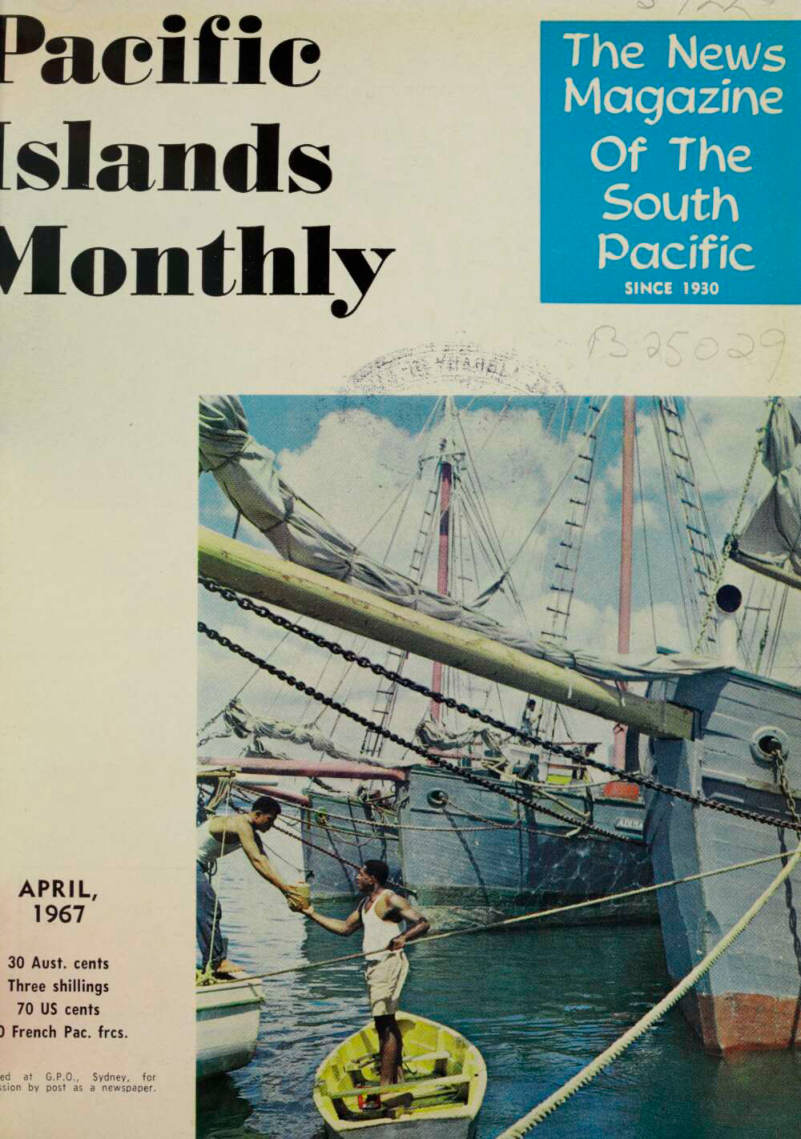 1
1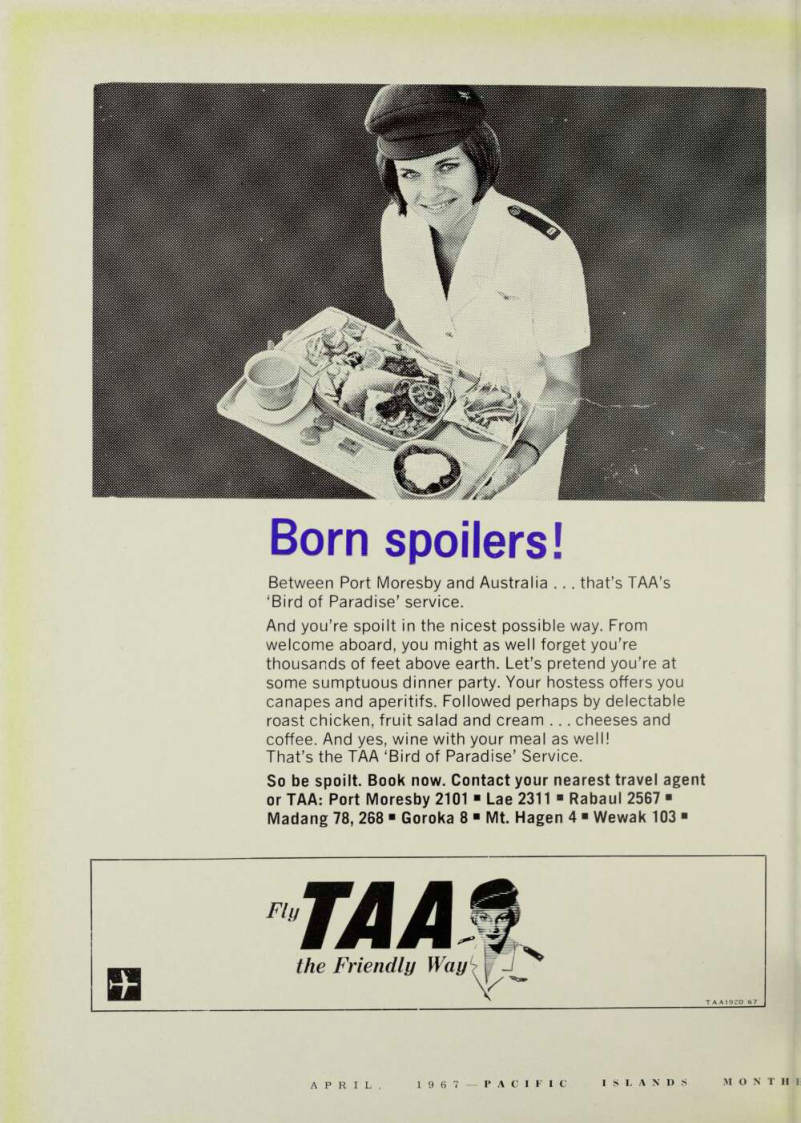 2
2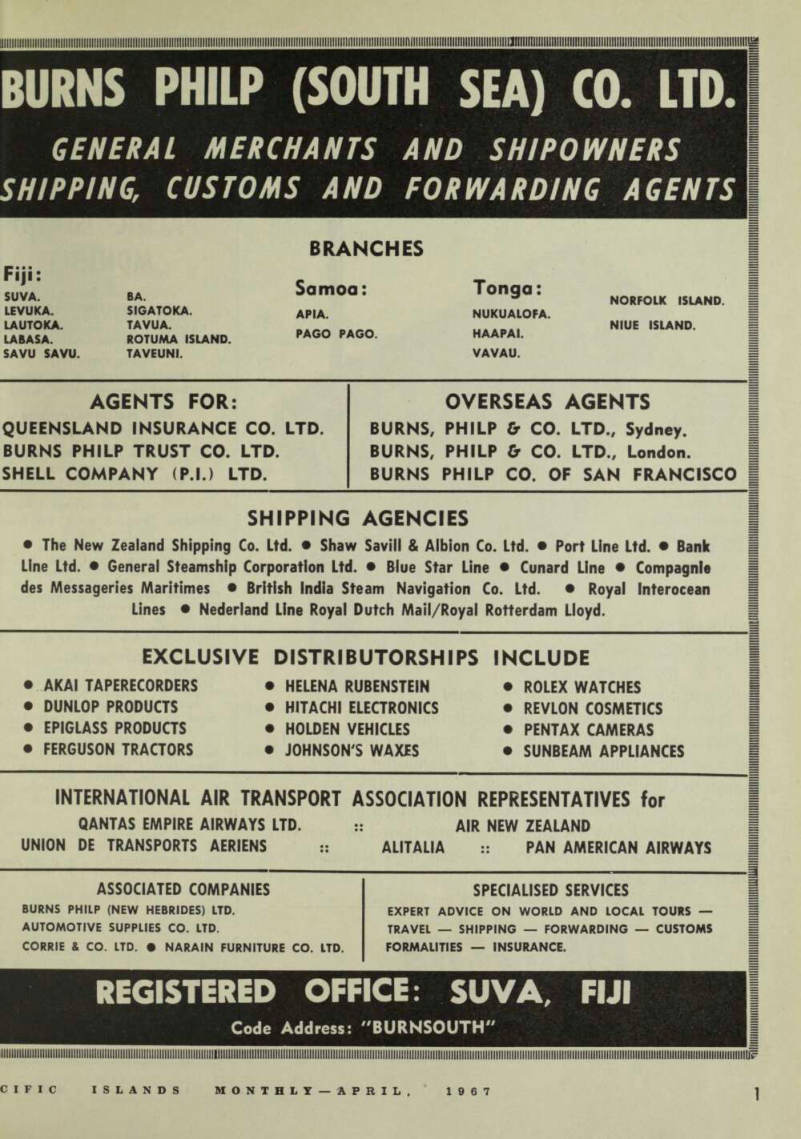 3
3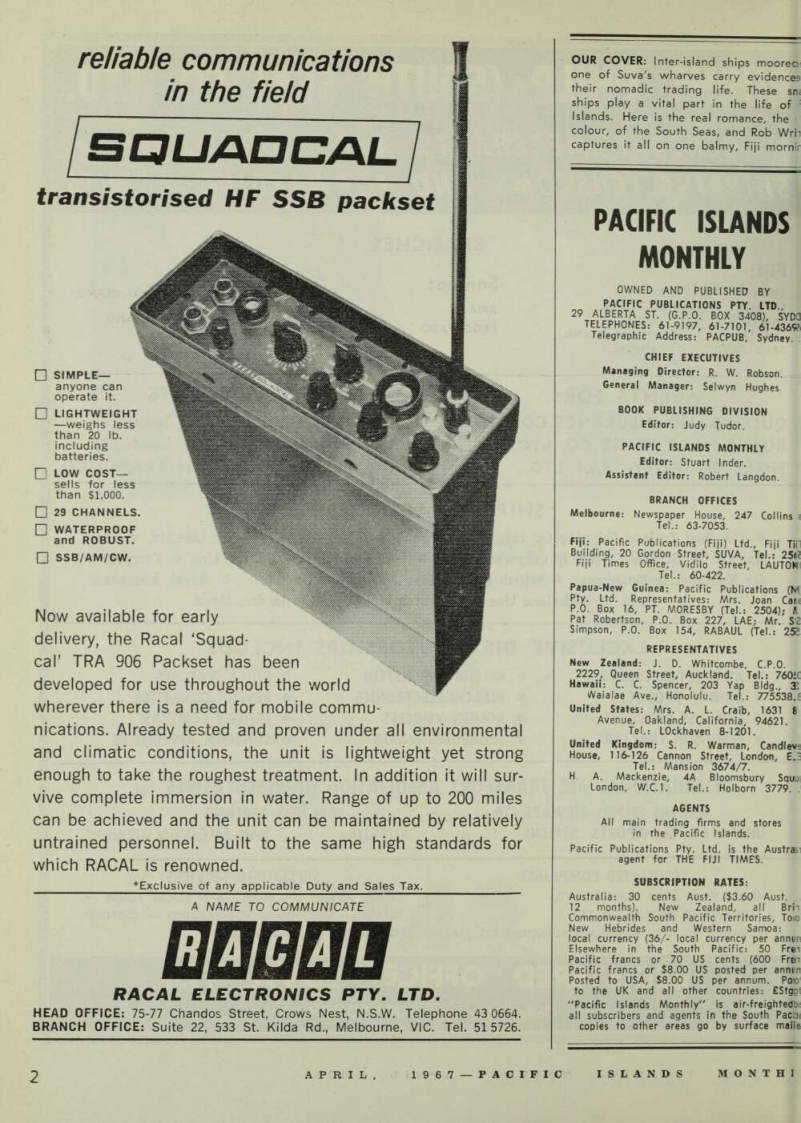 4
4 5
5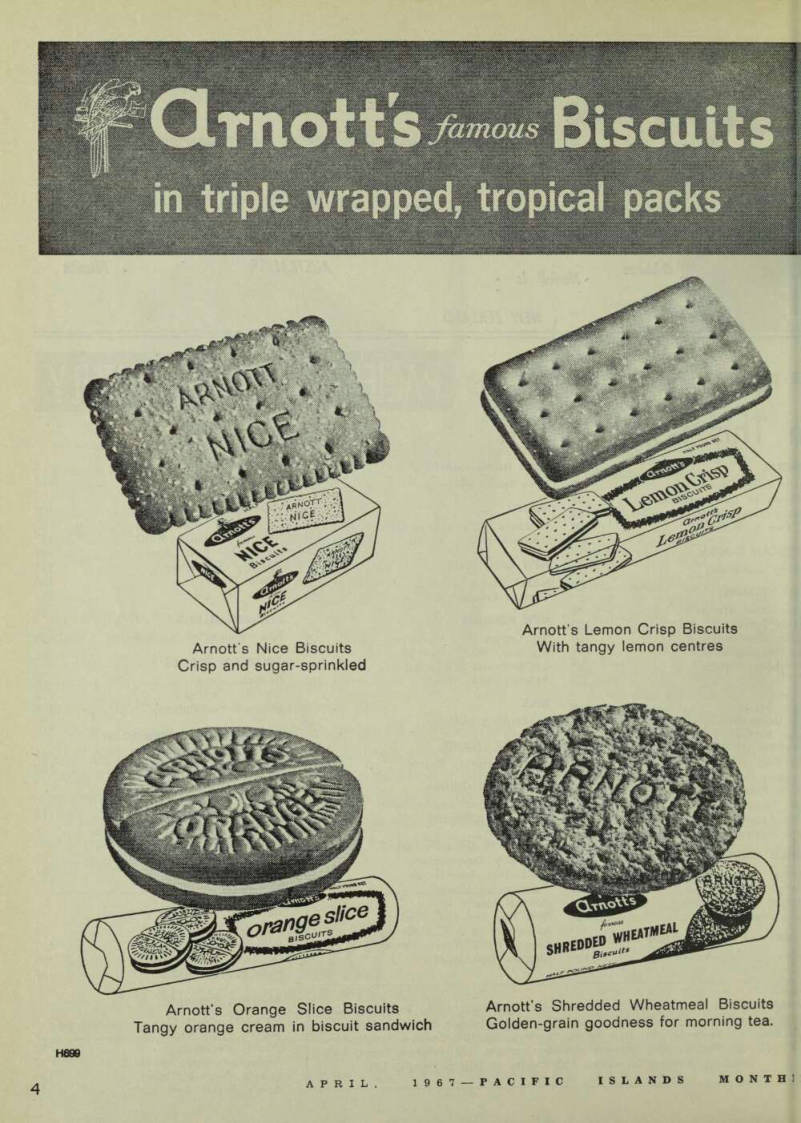 6
6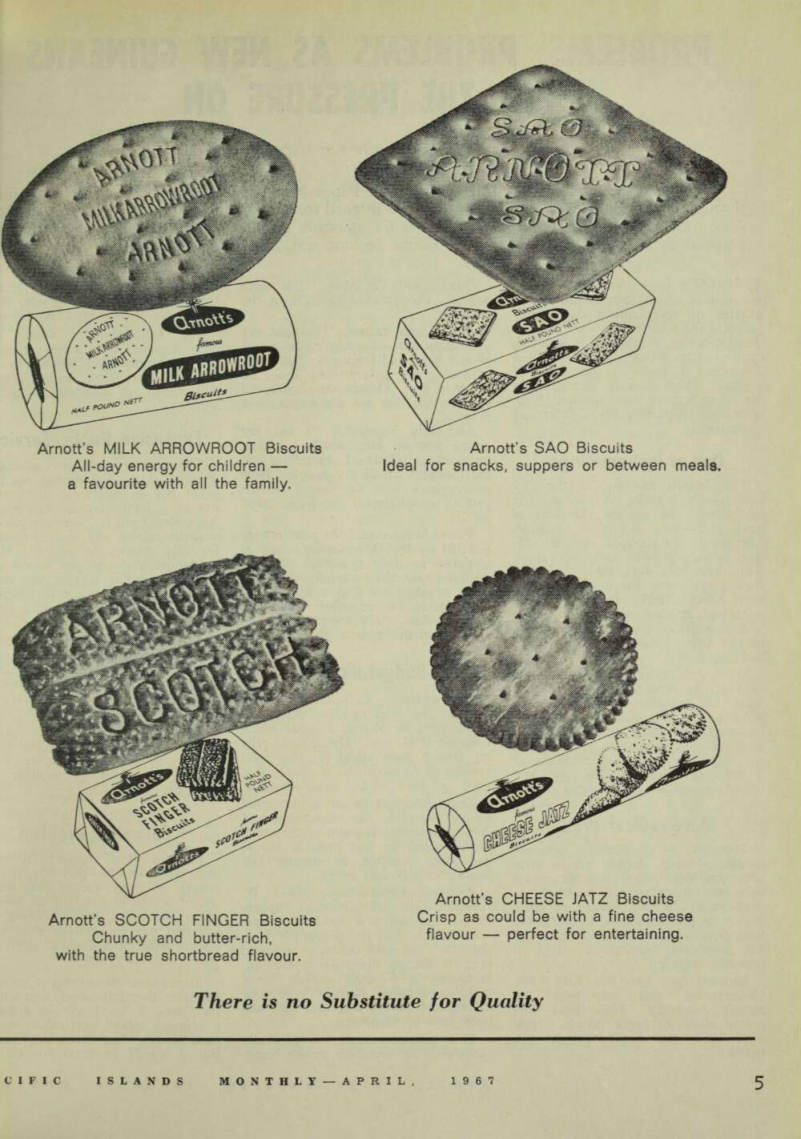 7
7 8
8 9
9 10
10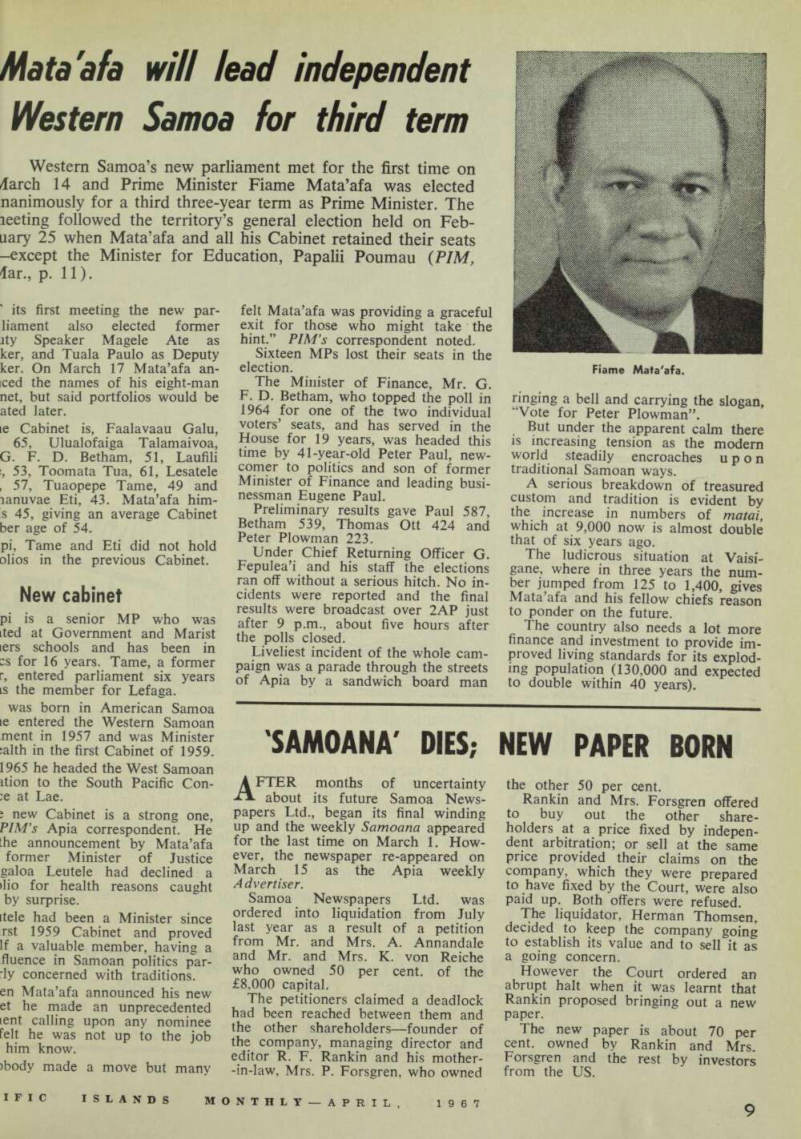 11
11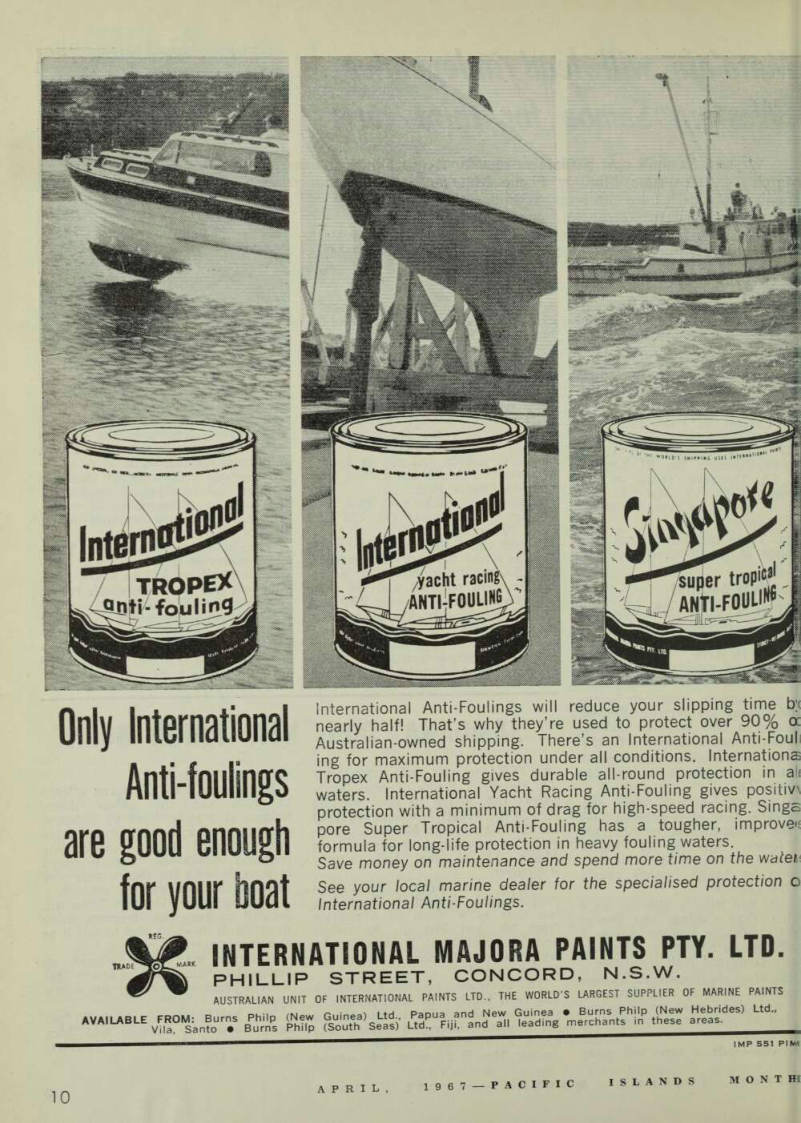 12
12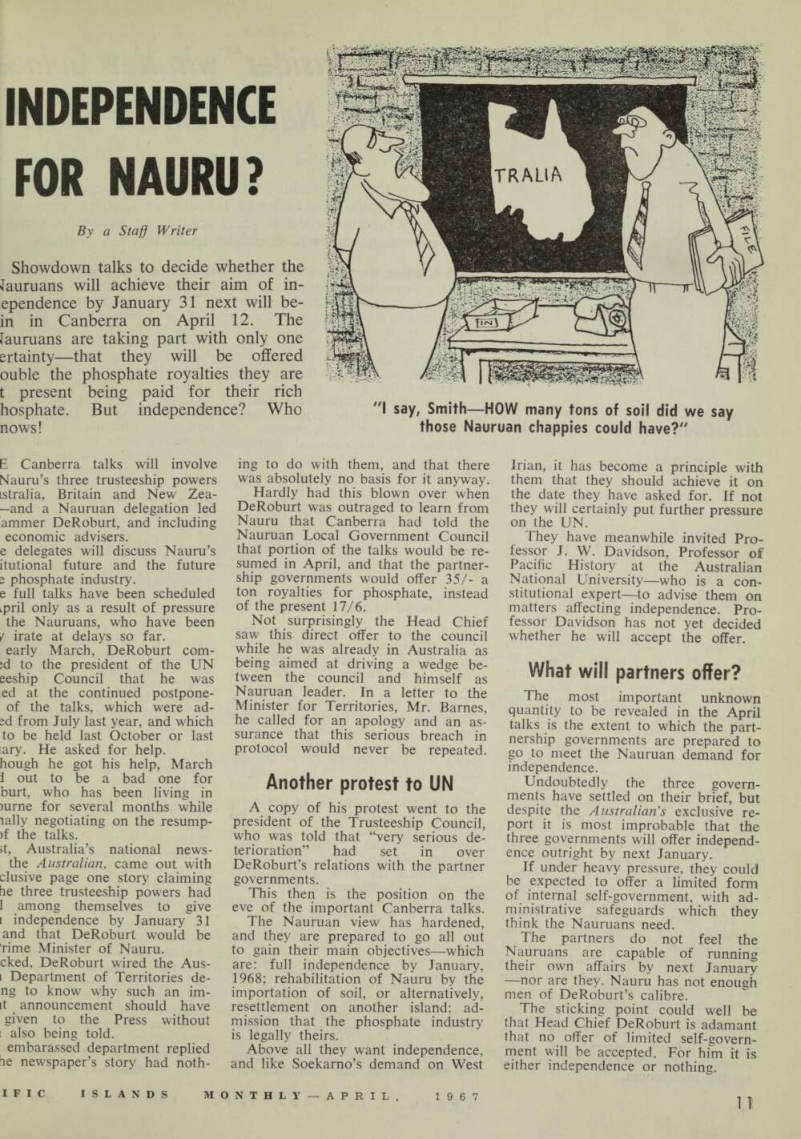 13
13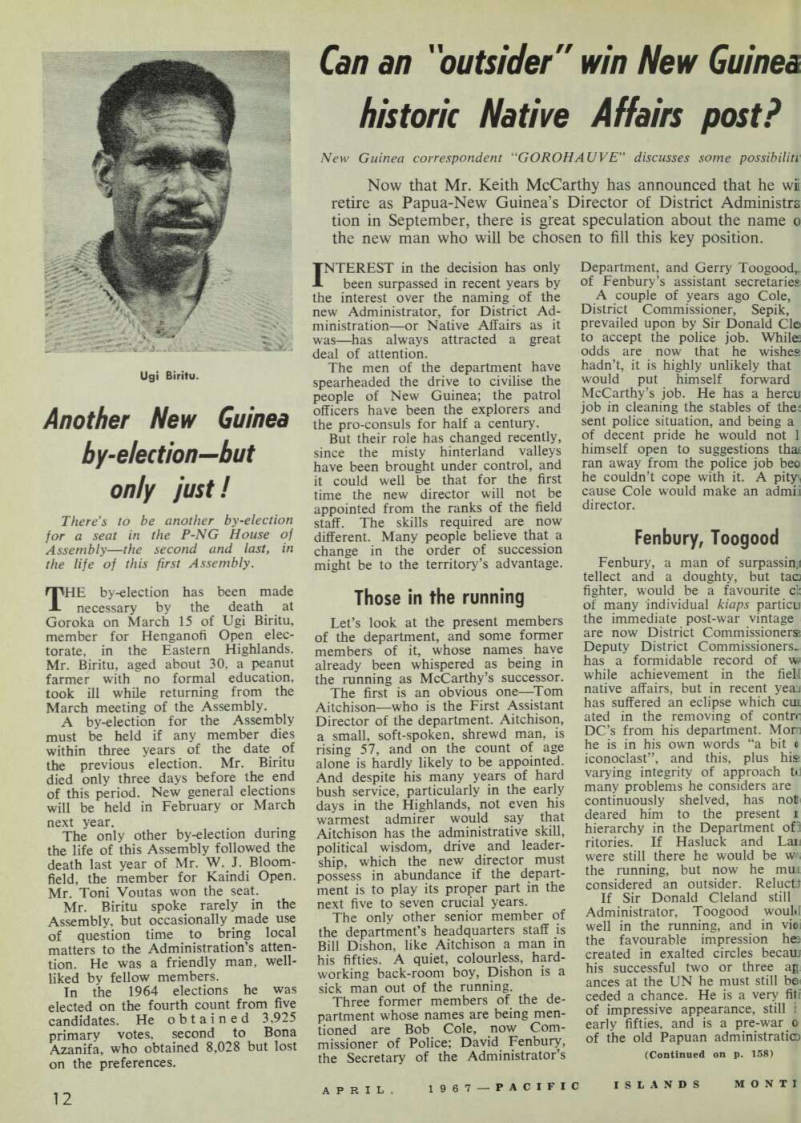 14
14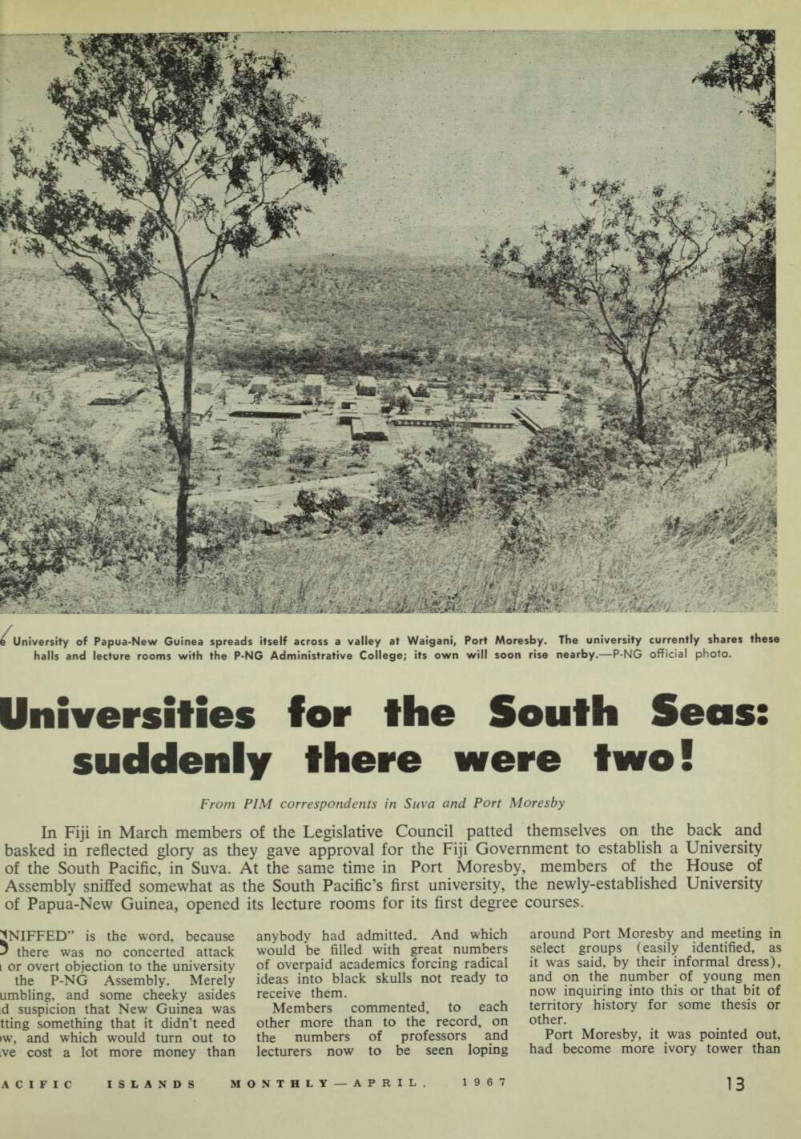 15
15 16
16 17
17 18
18 19
19 20
20 21
21 22
22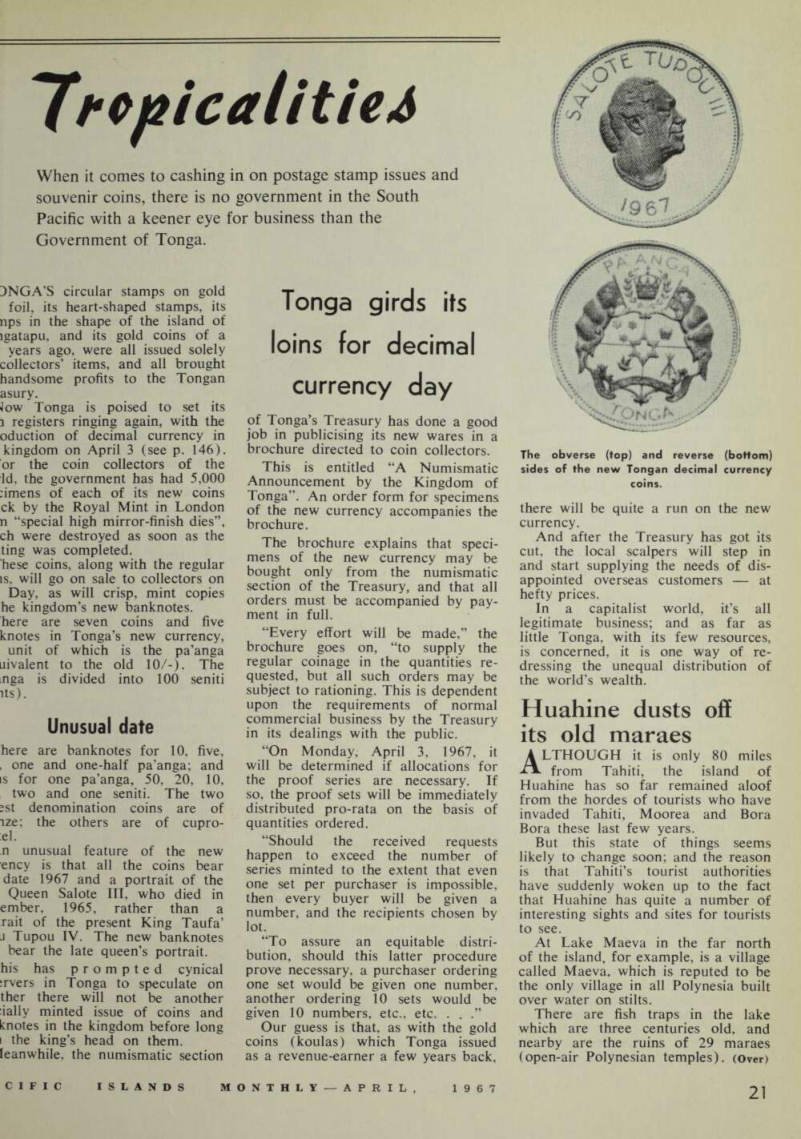 23
23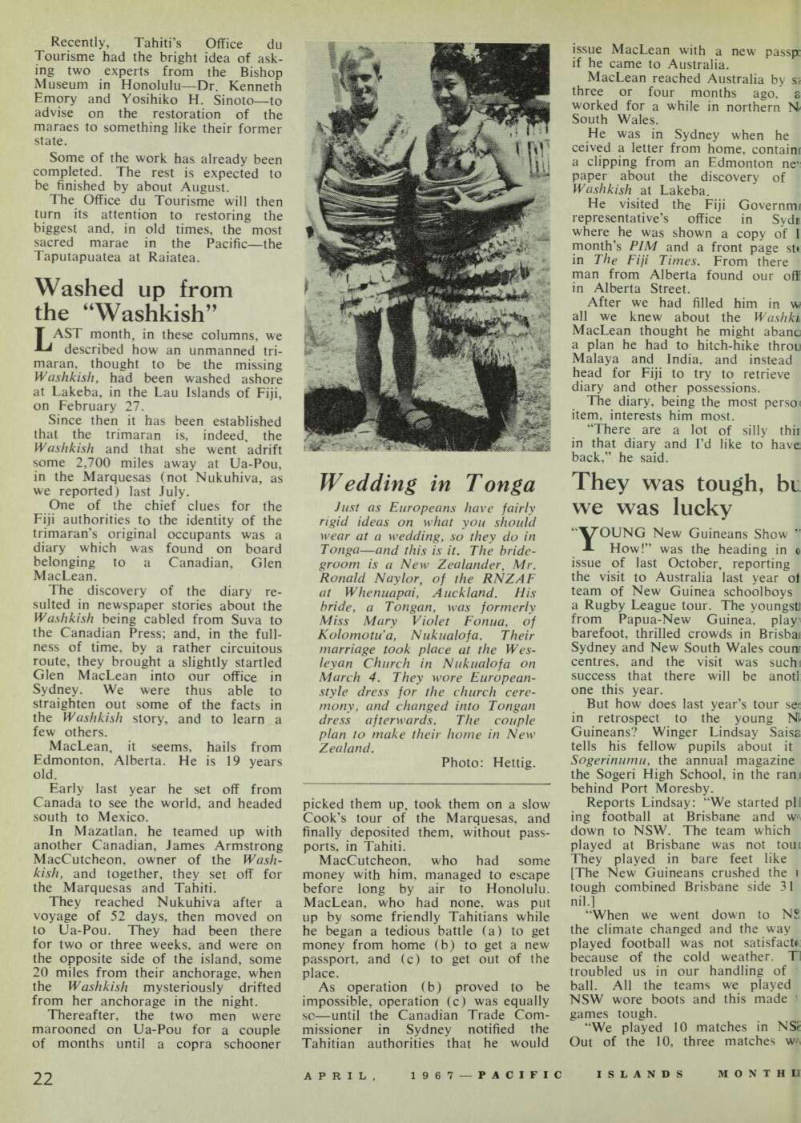 24
24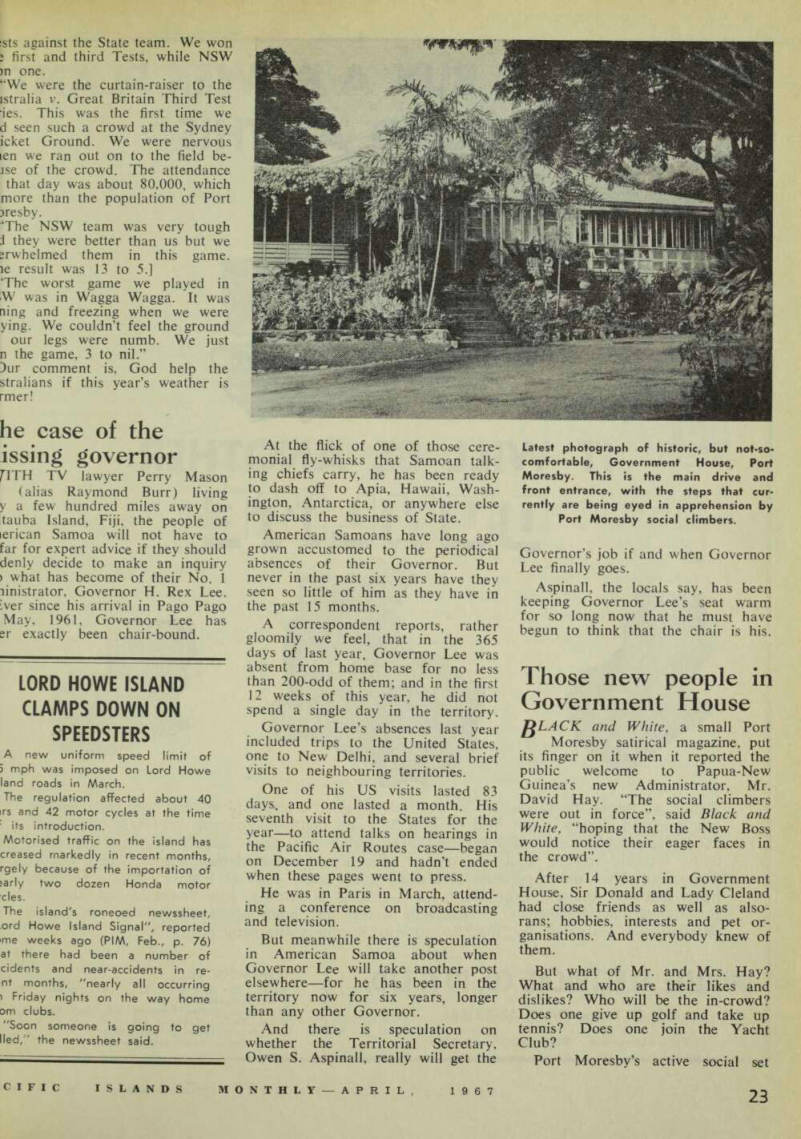 25
25 26
26 27
27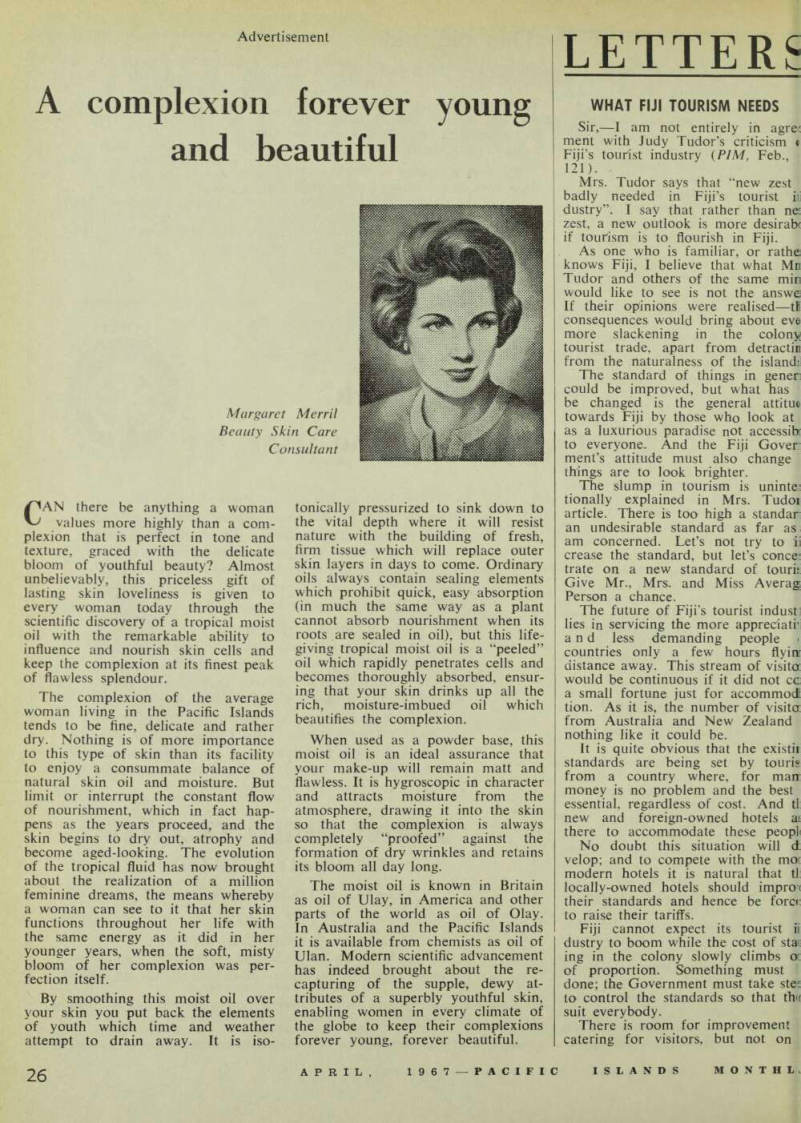 28
28 29
29 30
30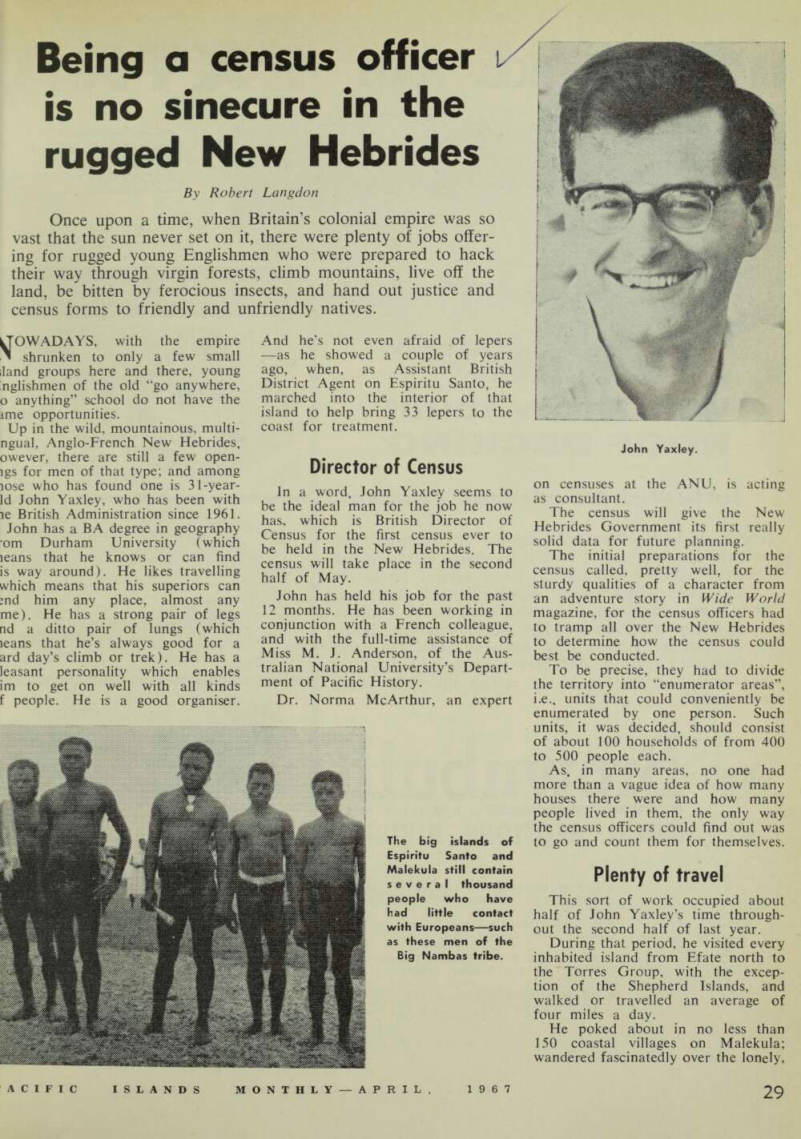 31
31 32
32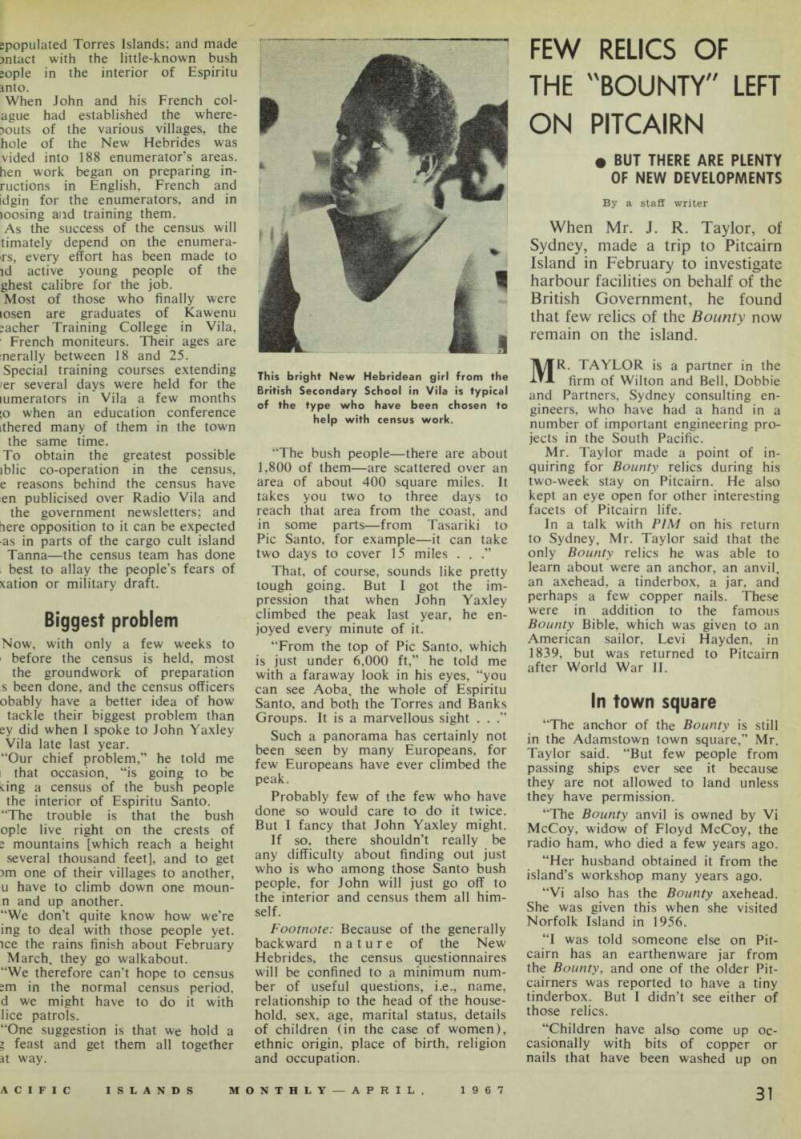 33
33 34
34 35
35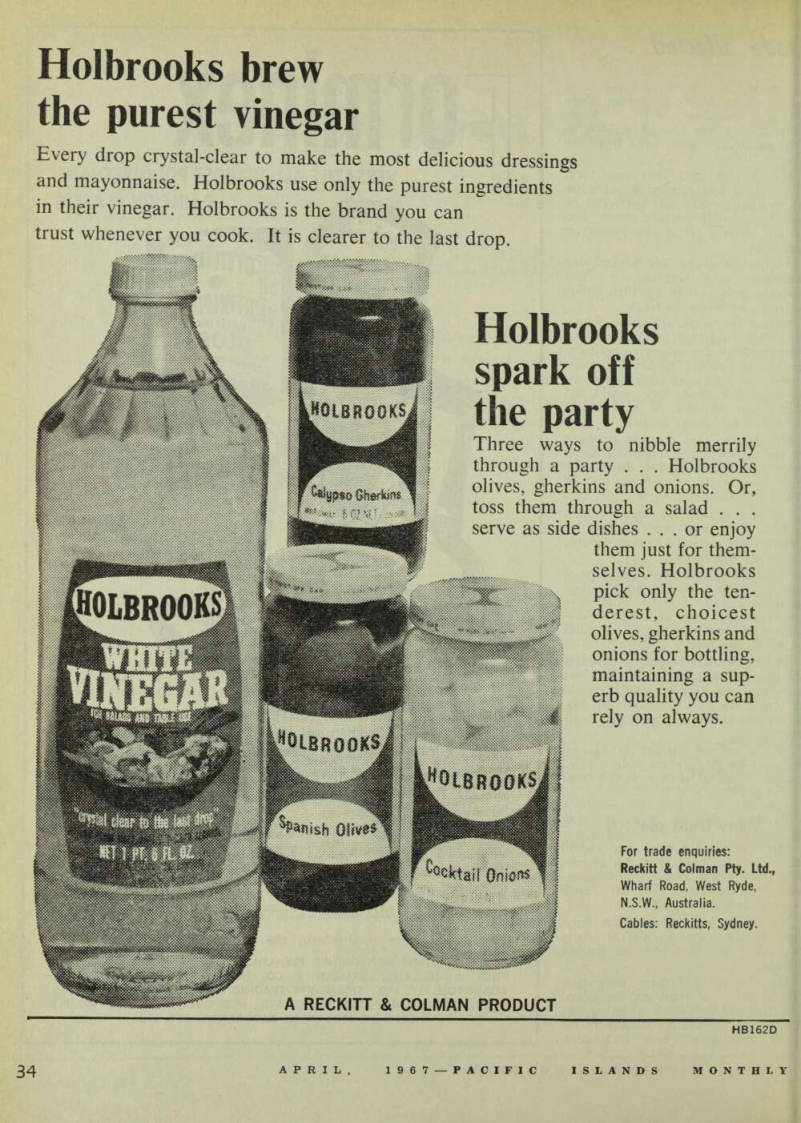 36
36 37
37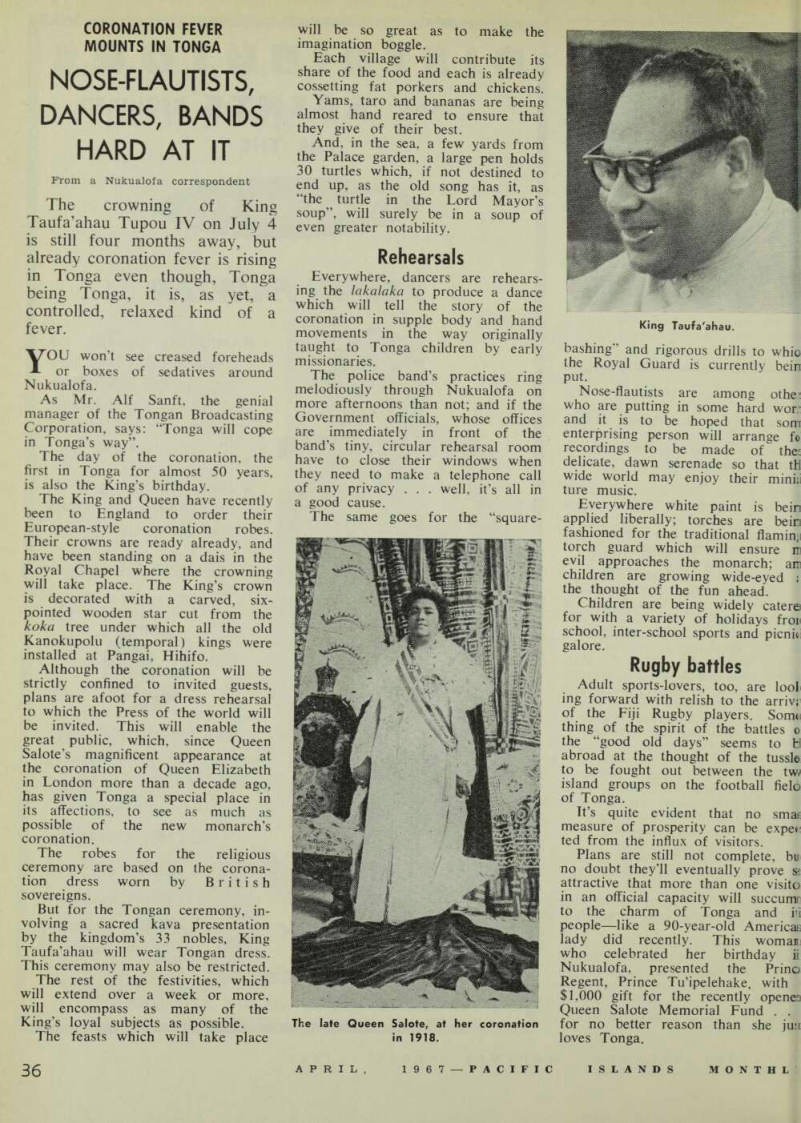 38
38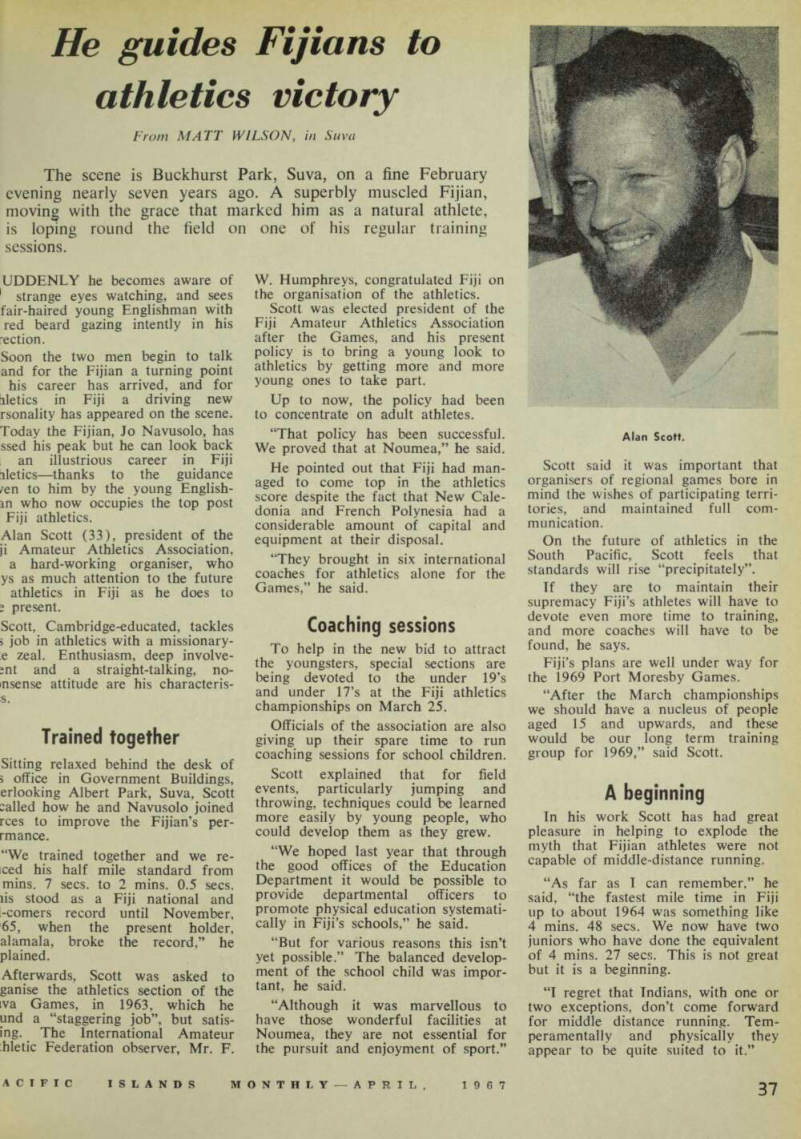 39
39 40
40 41
41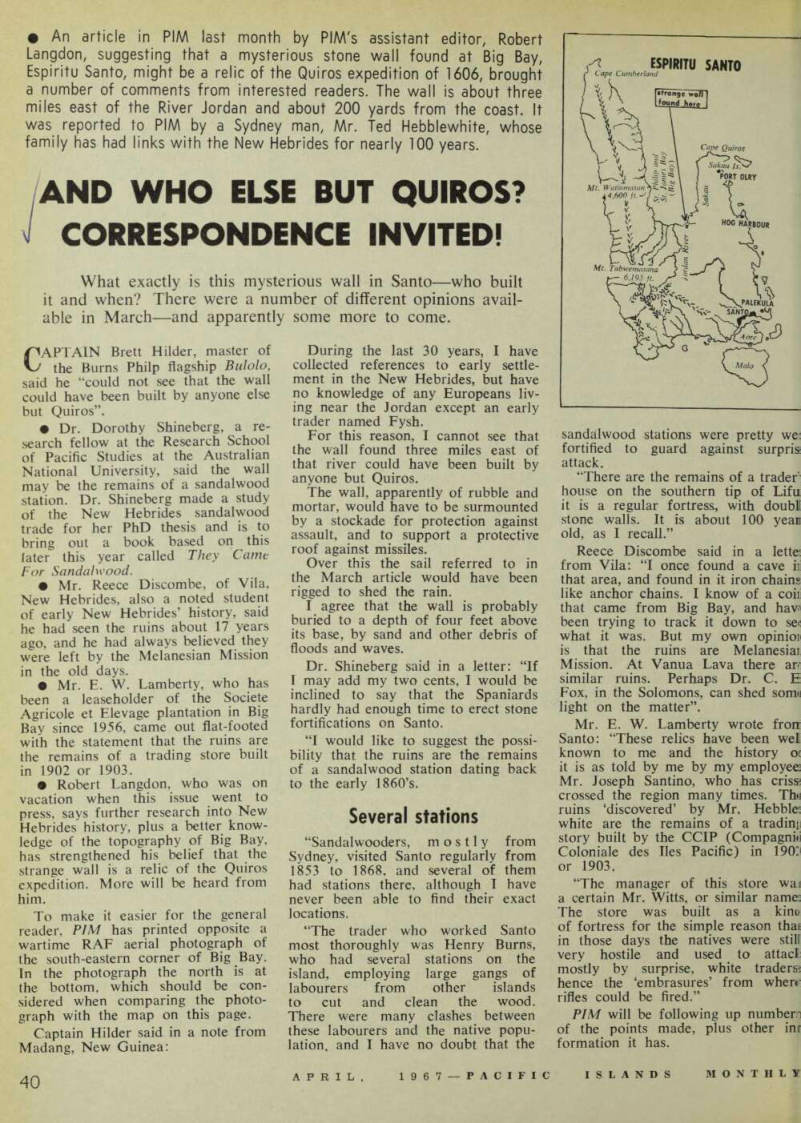 42
42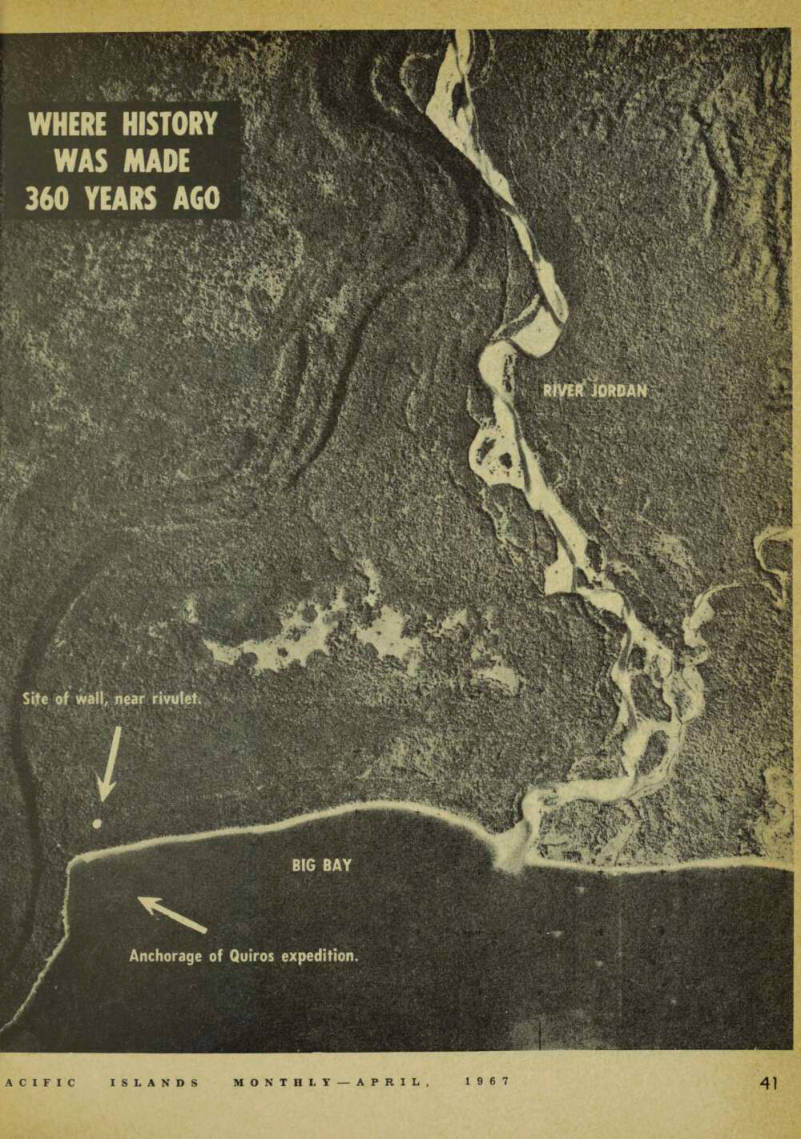 43
43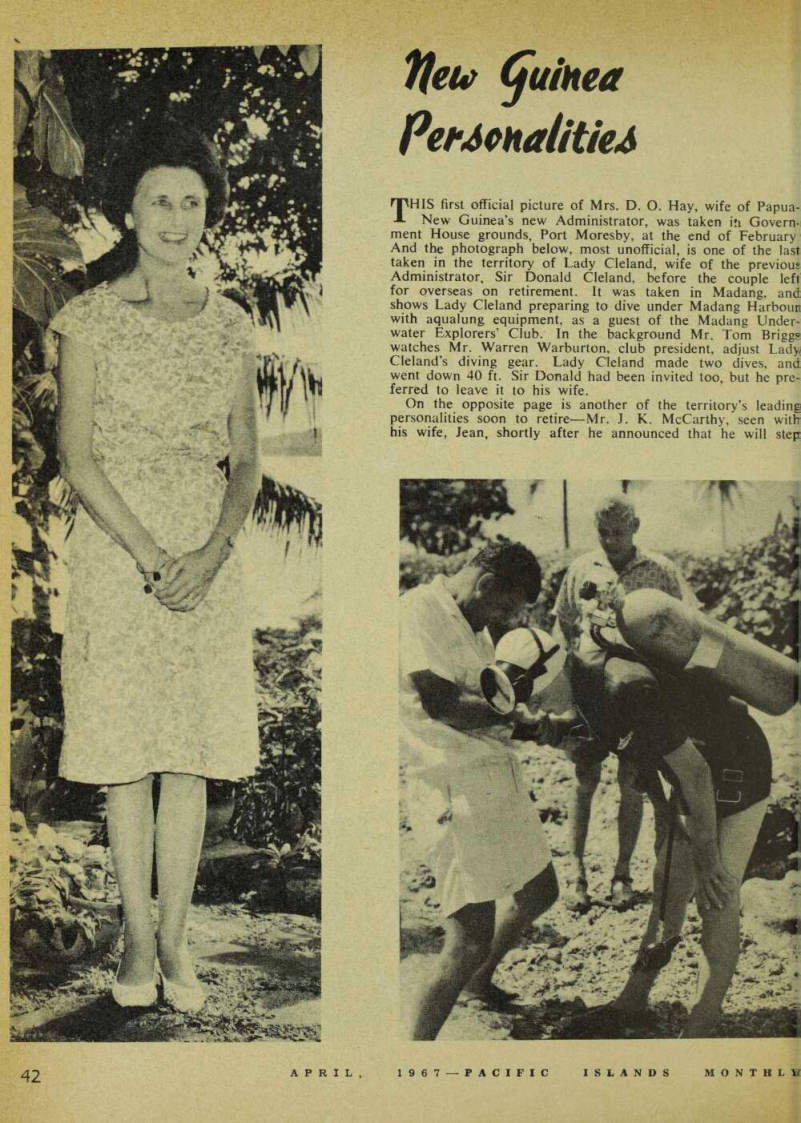 44
44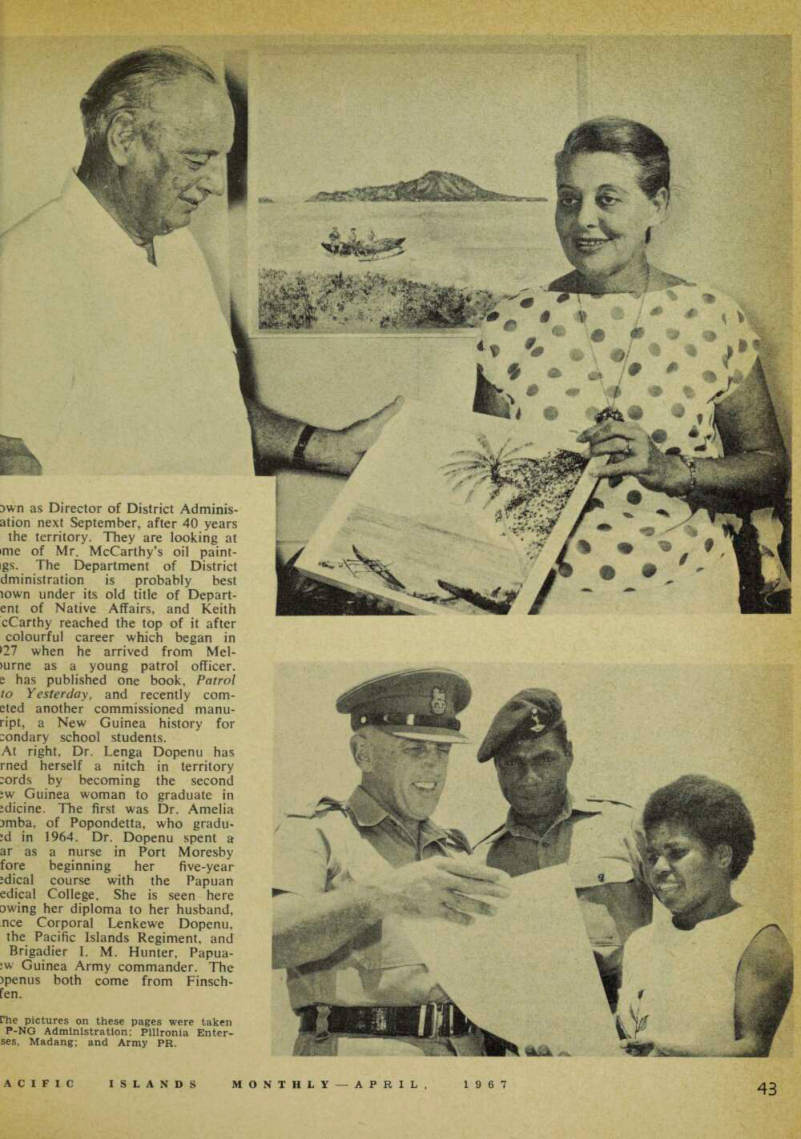 45
45 46
46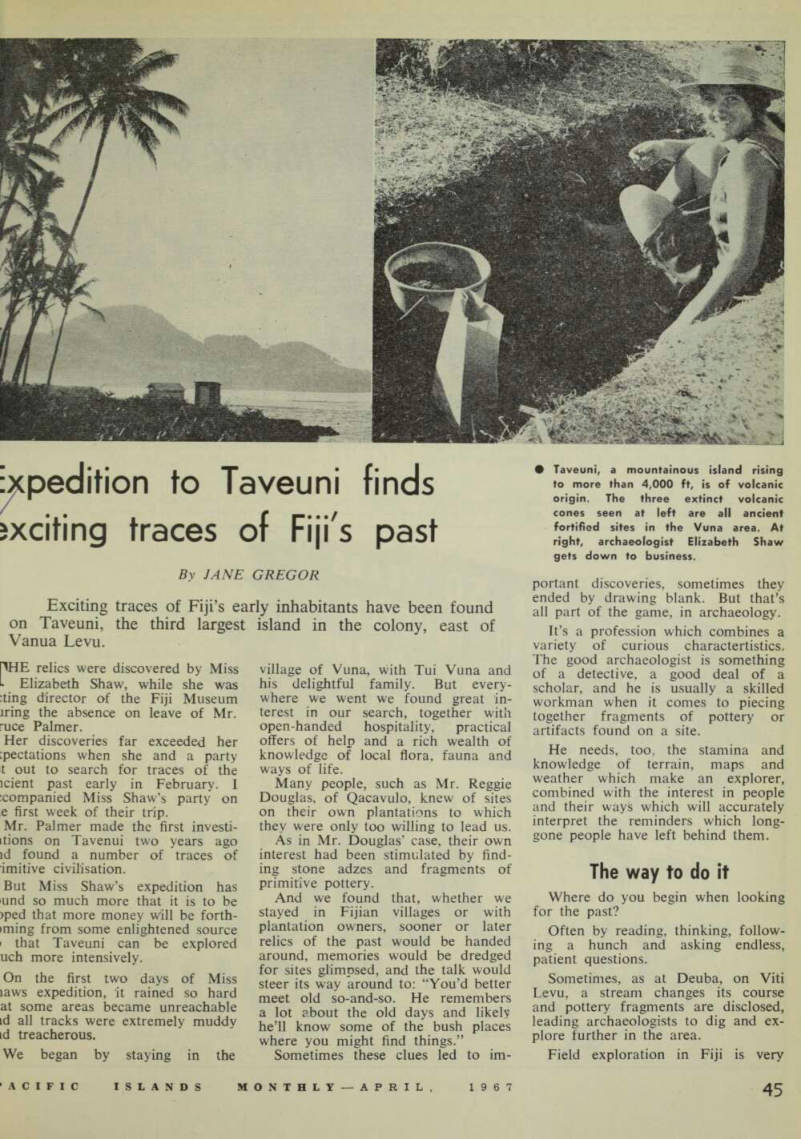 47
47 48
48 49
49 50
50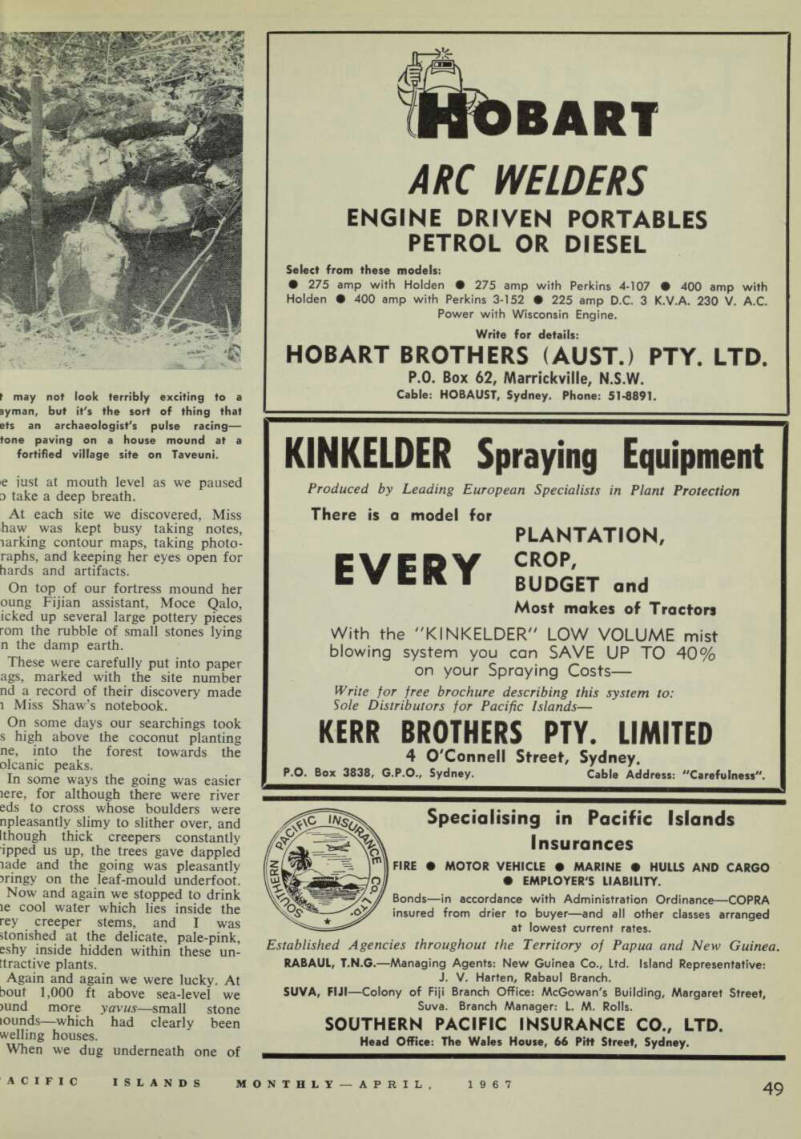 51
51 52
52 53
53 54
54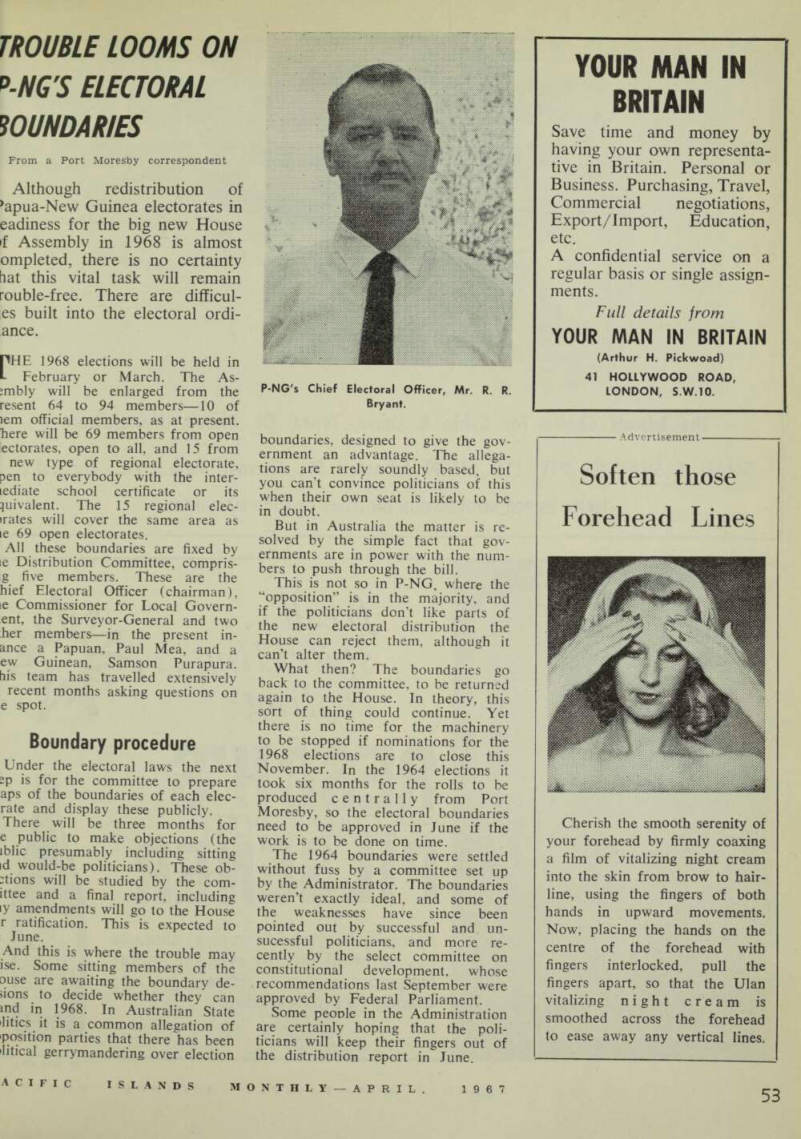 55
55 56
56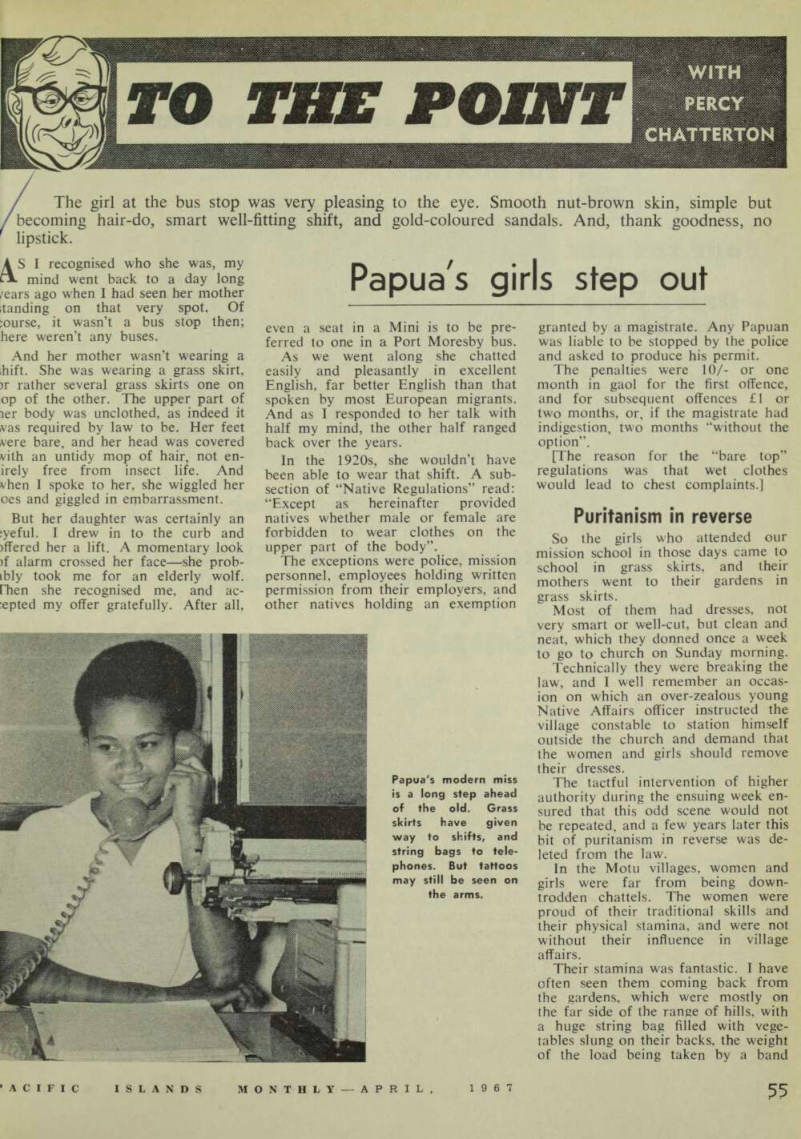 57
57 58
58 59
59 60
60 61
61 62
62 63
63 64
64 65
65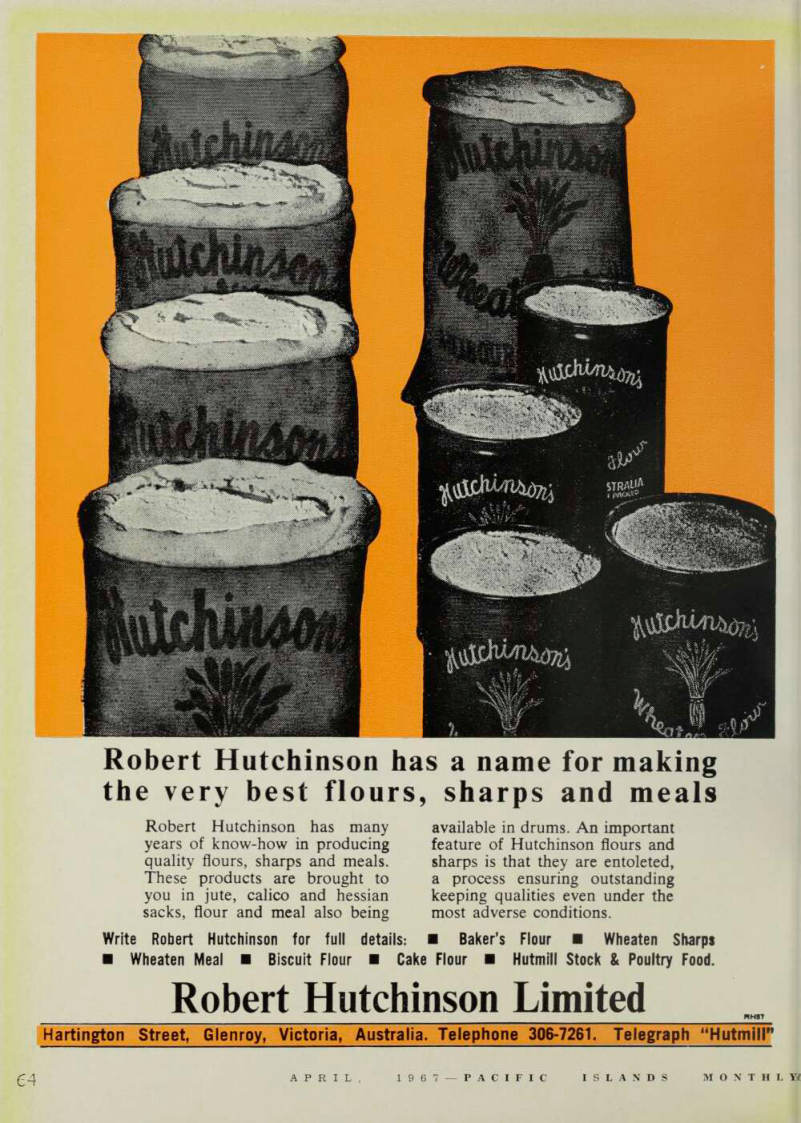 66
66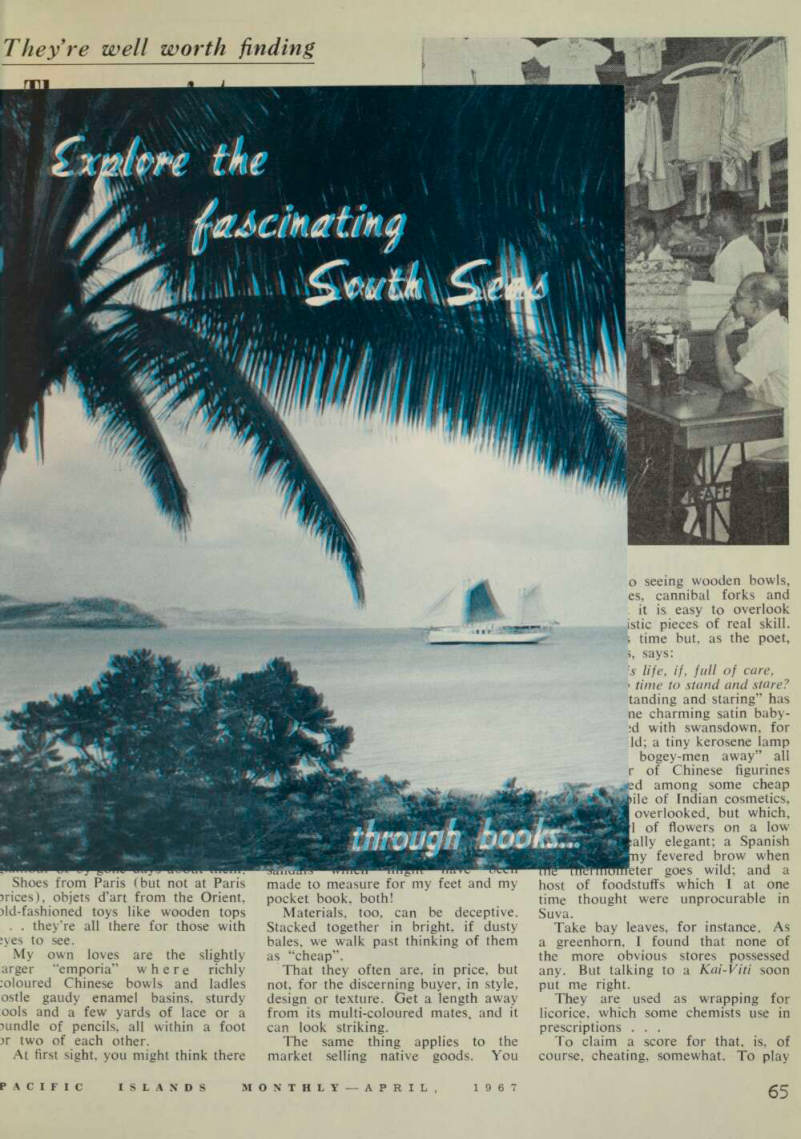 67
67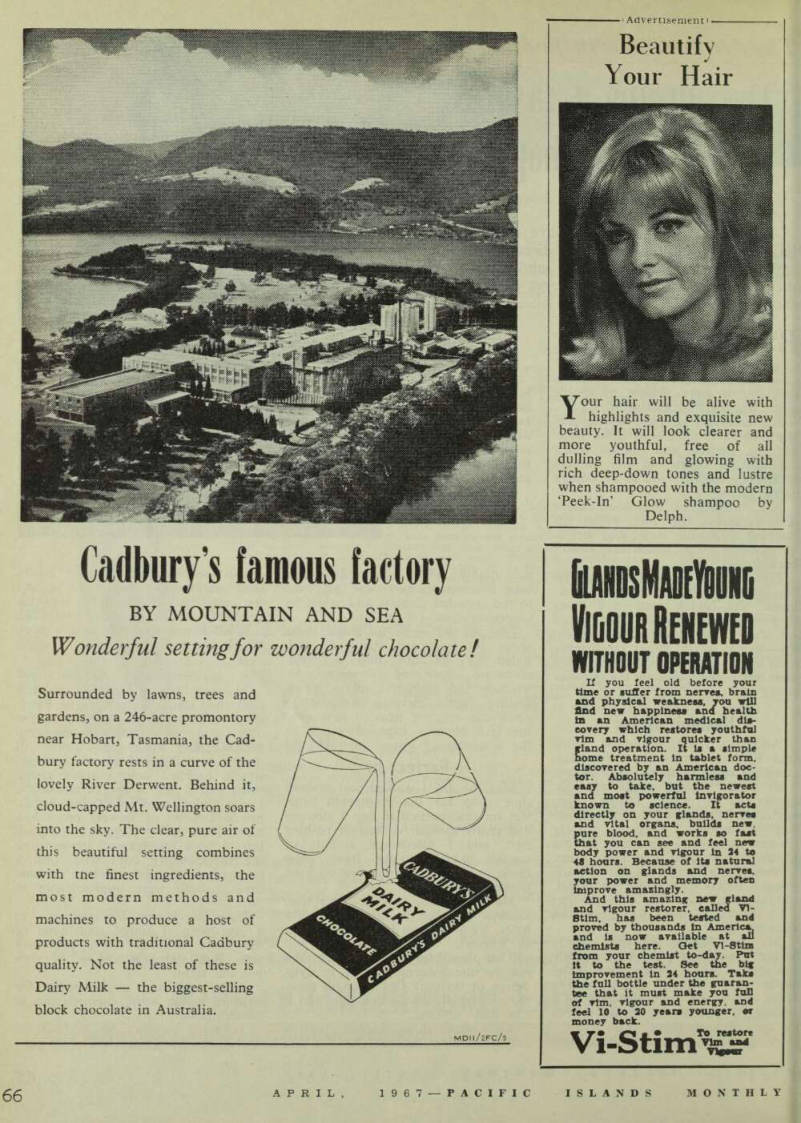 68
68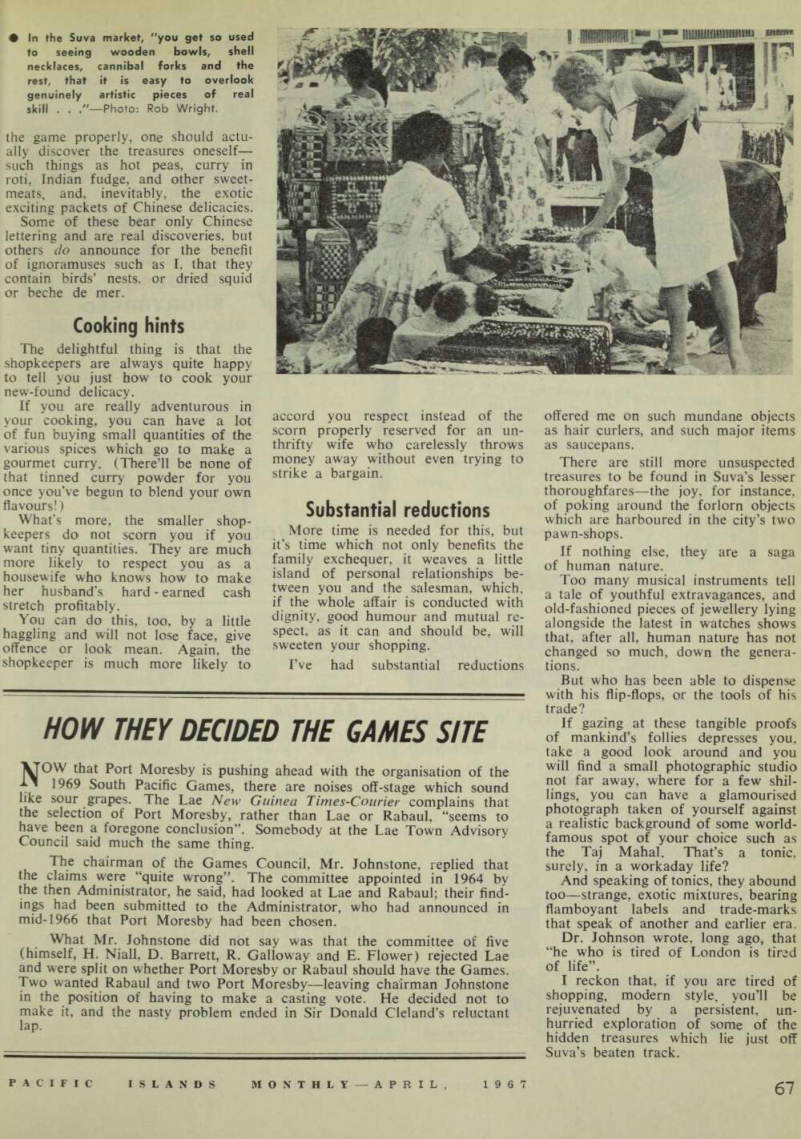 69
69 70
70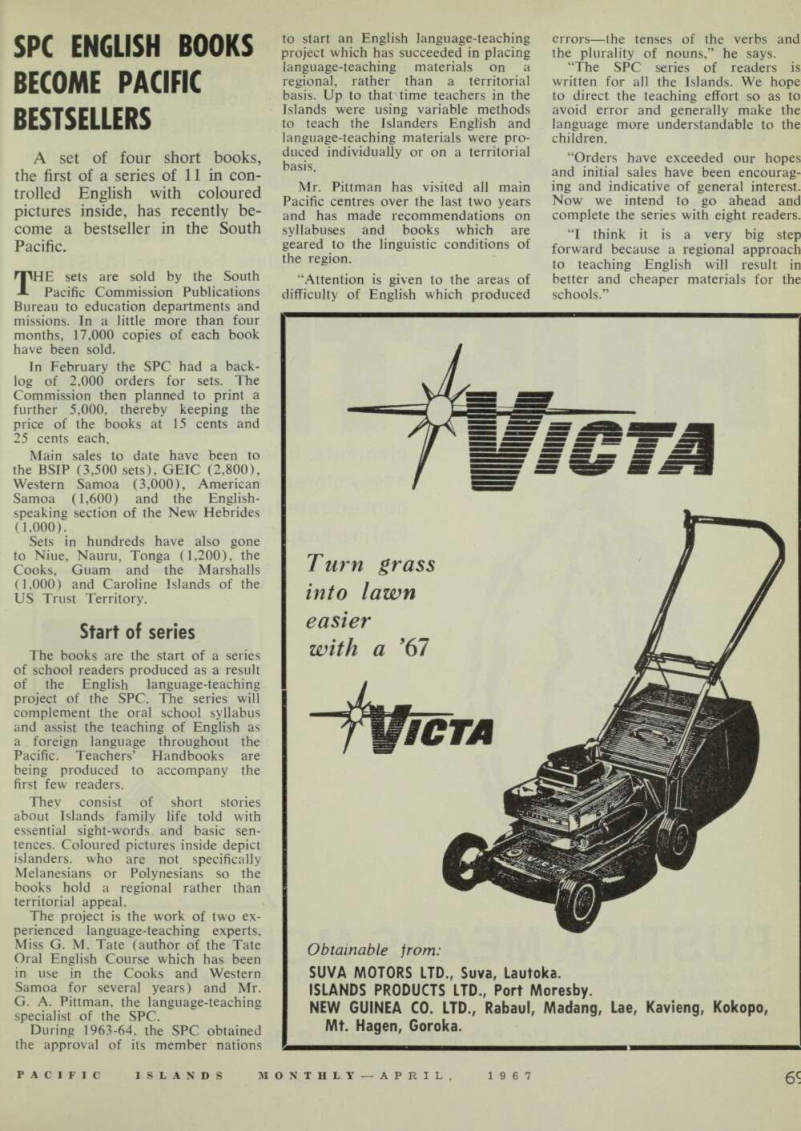 71
71 72
72 73
73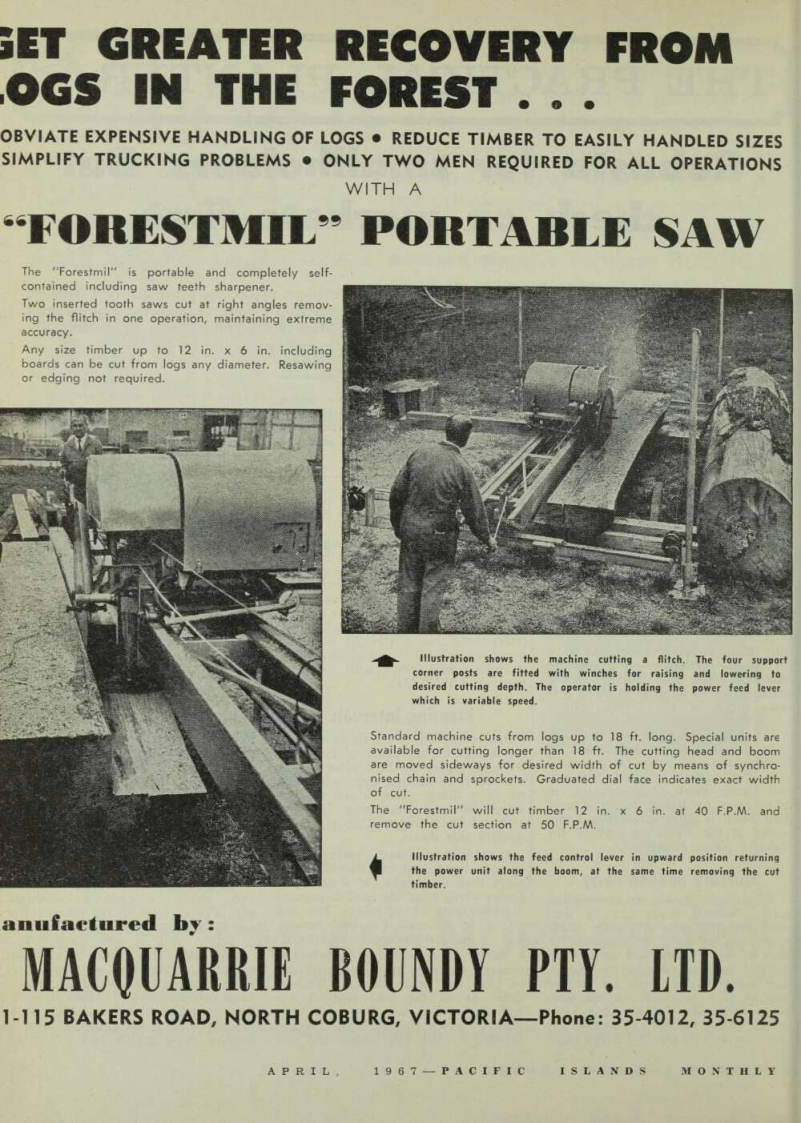 74
74 75
75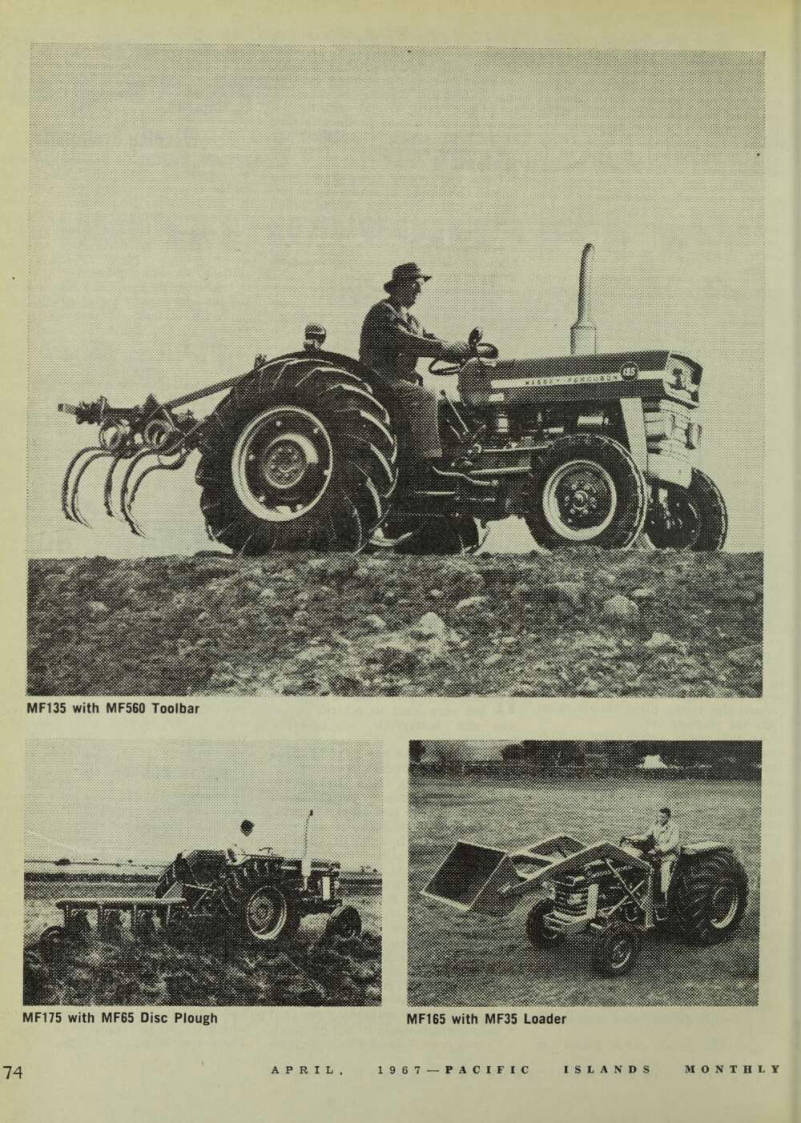 76
76 77
77 78
78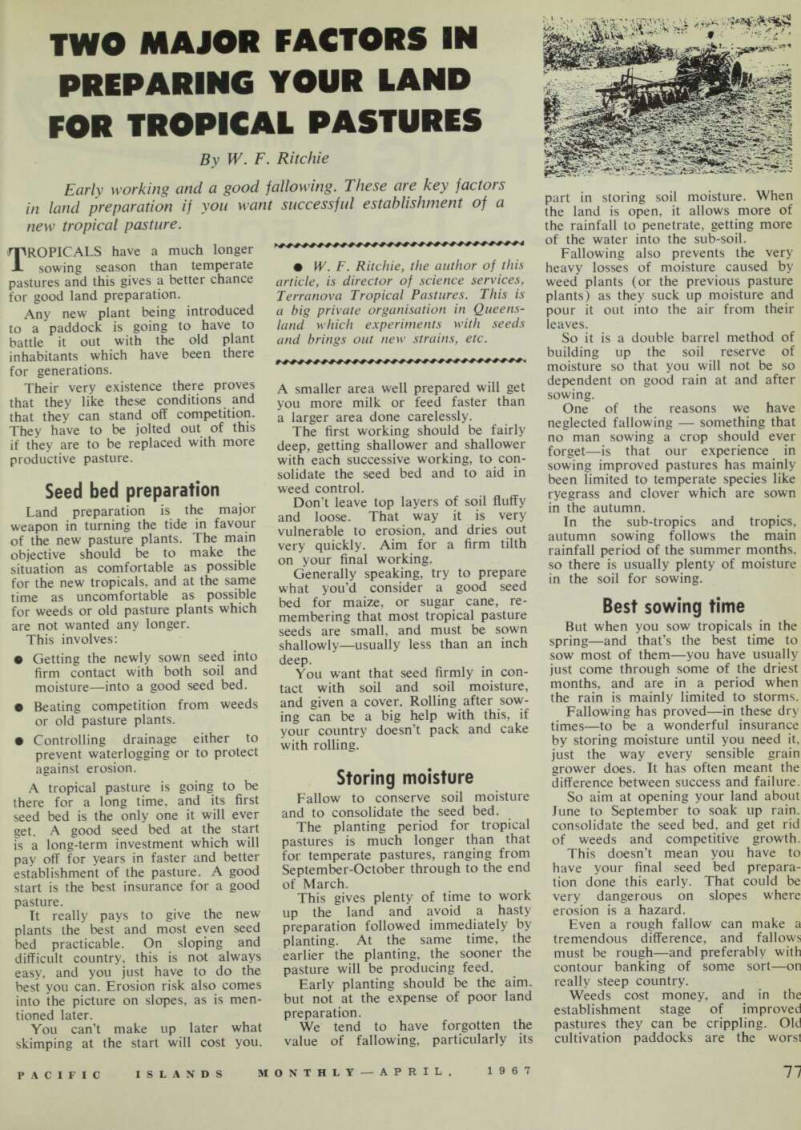 79
79 80
80 81
81 82
82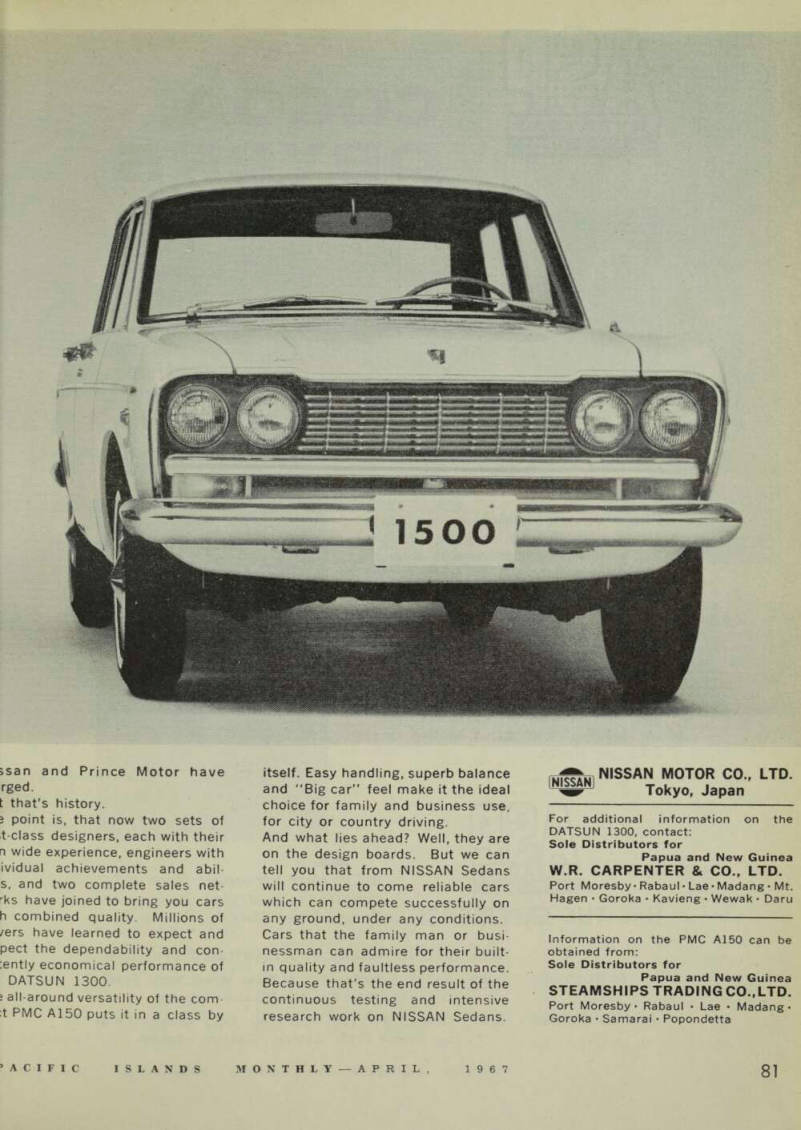 83
83 84
84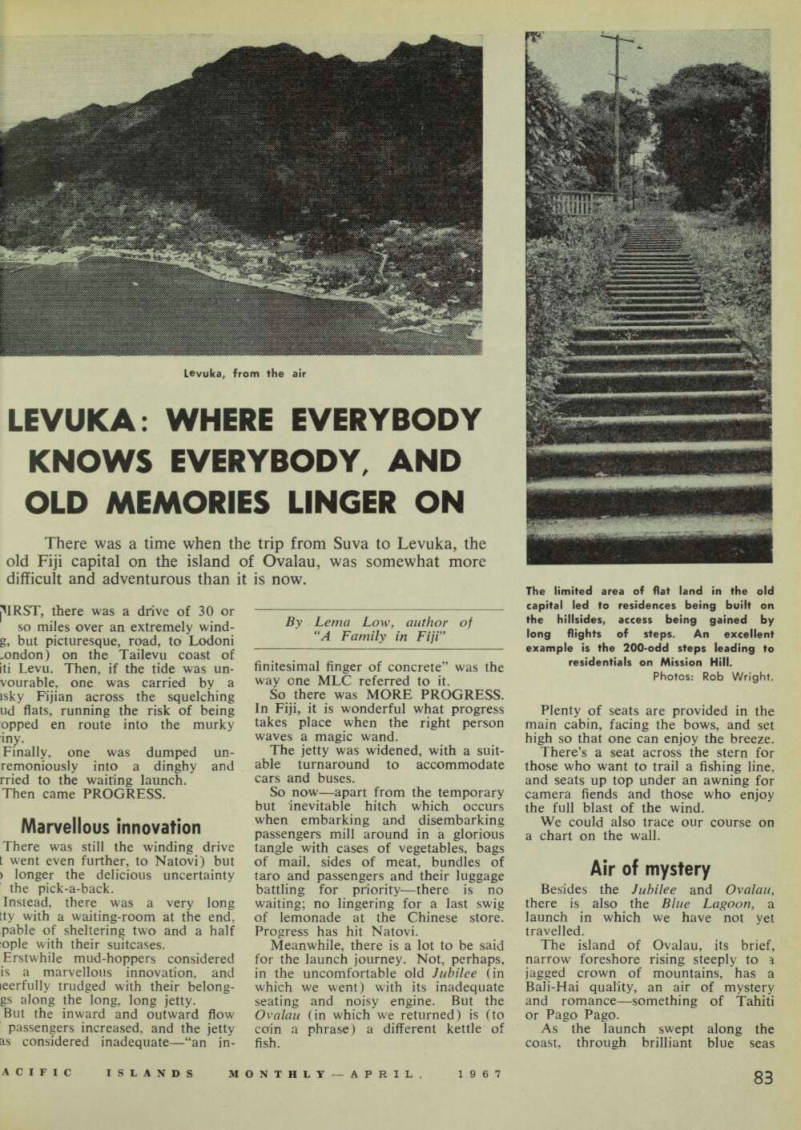 85
85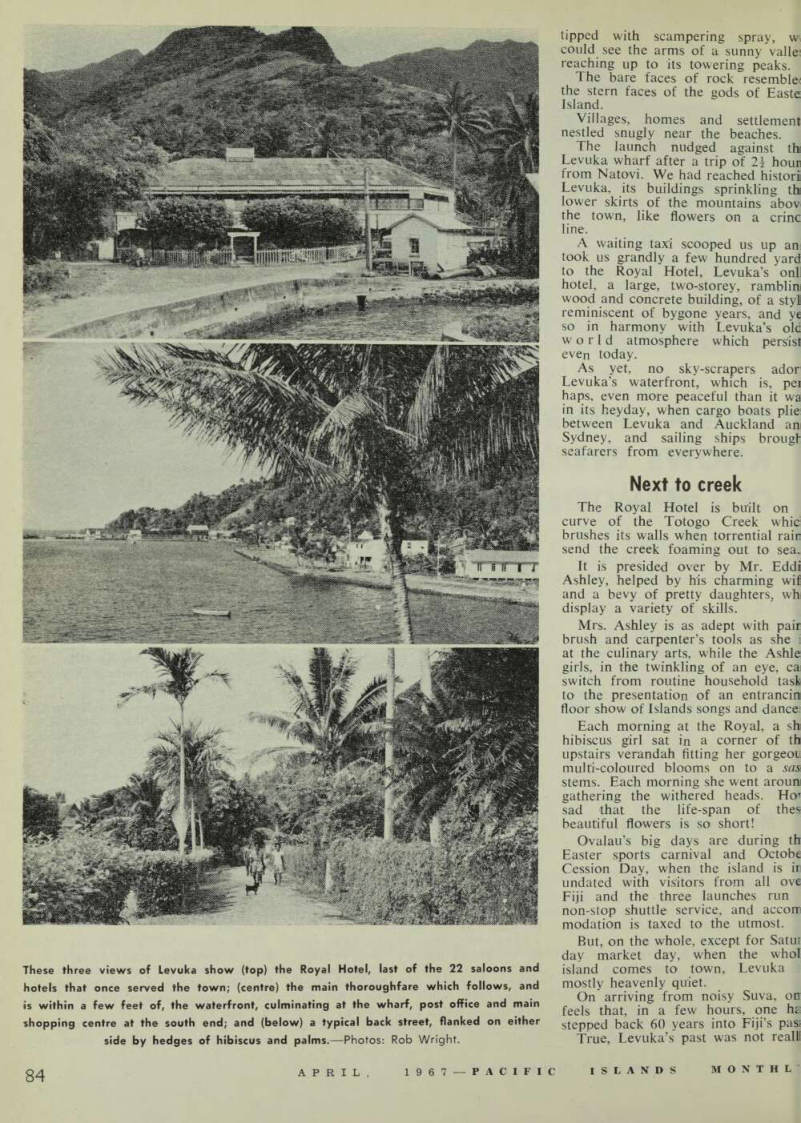 86
86 87
87 88
88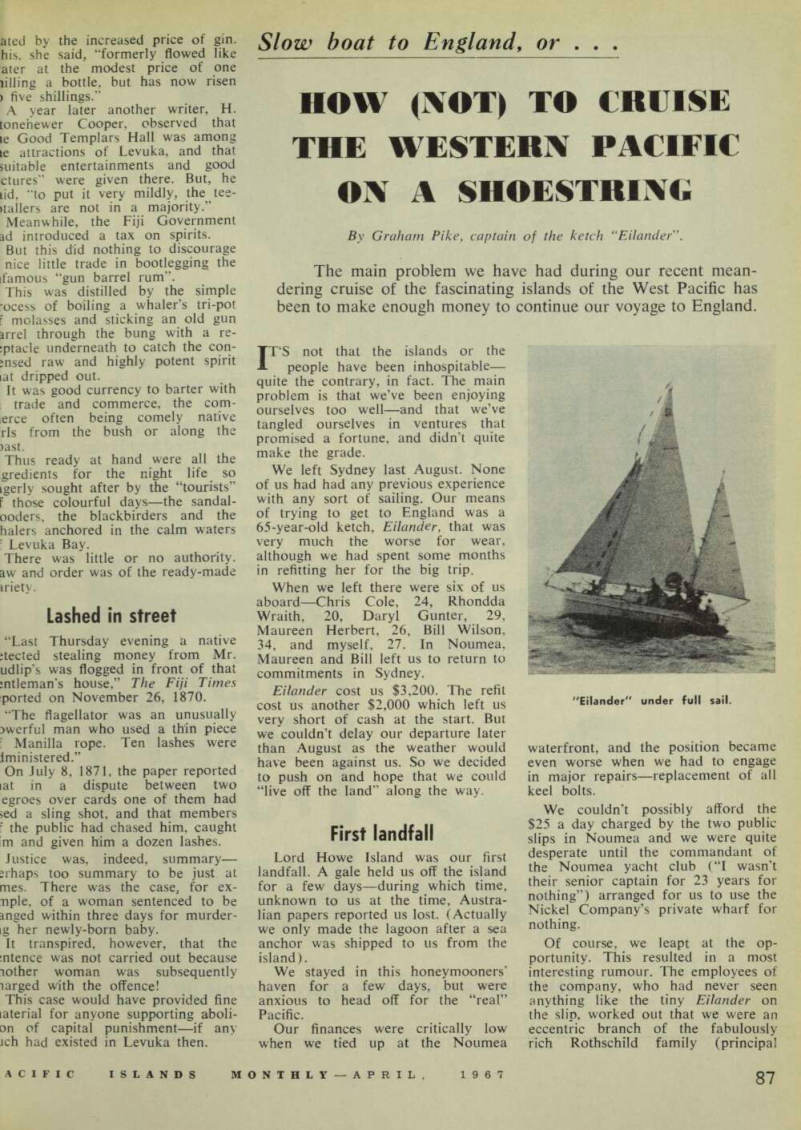 89
89 90
90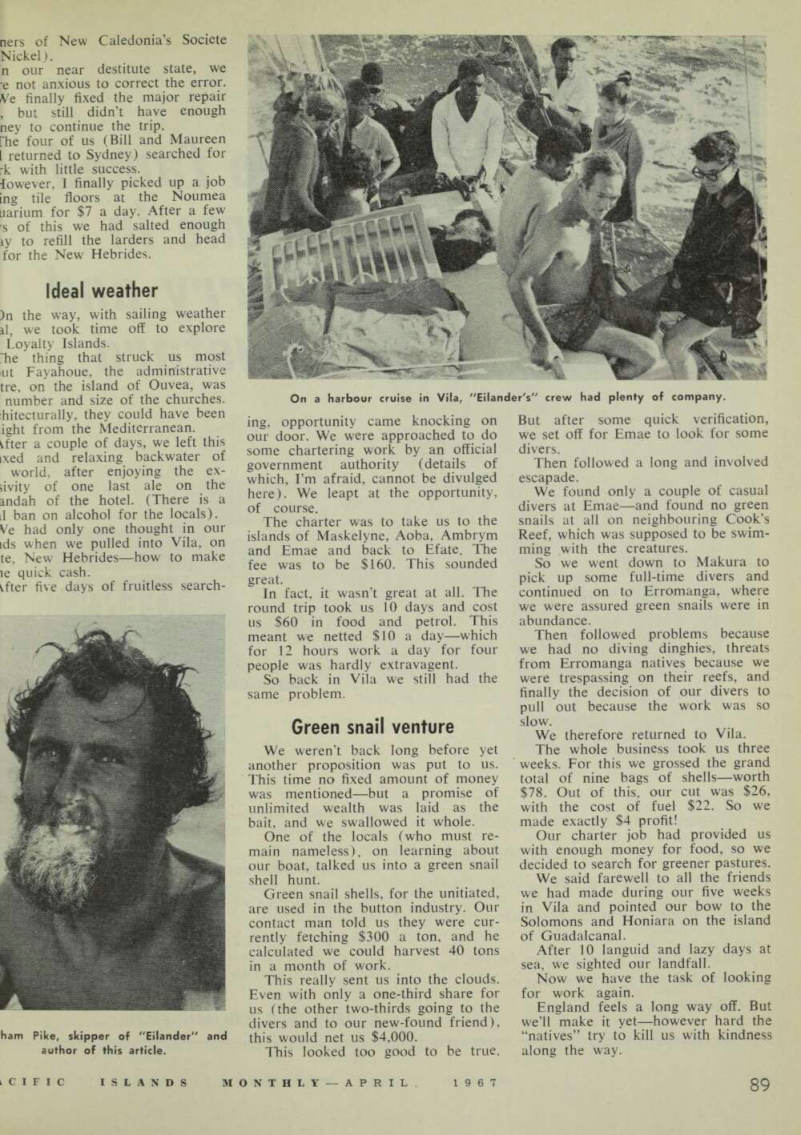 91
91 92
92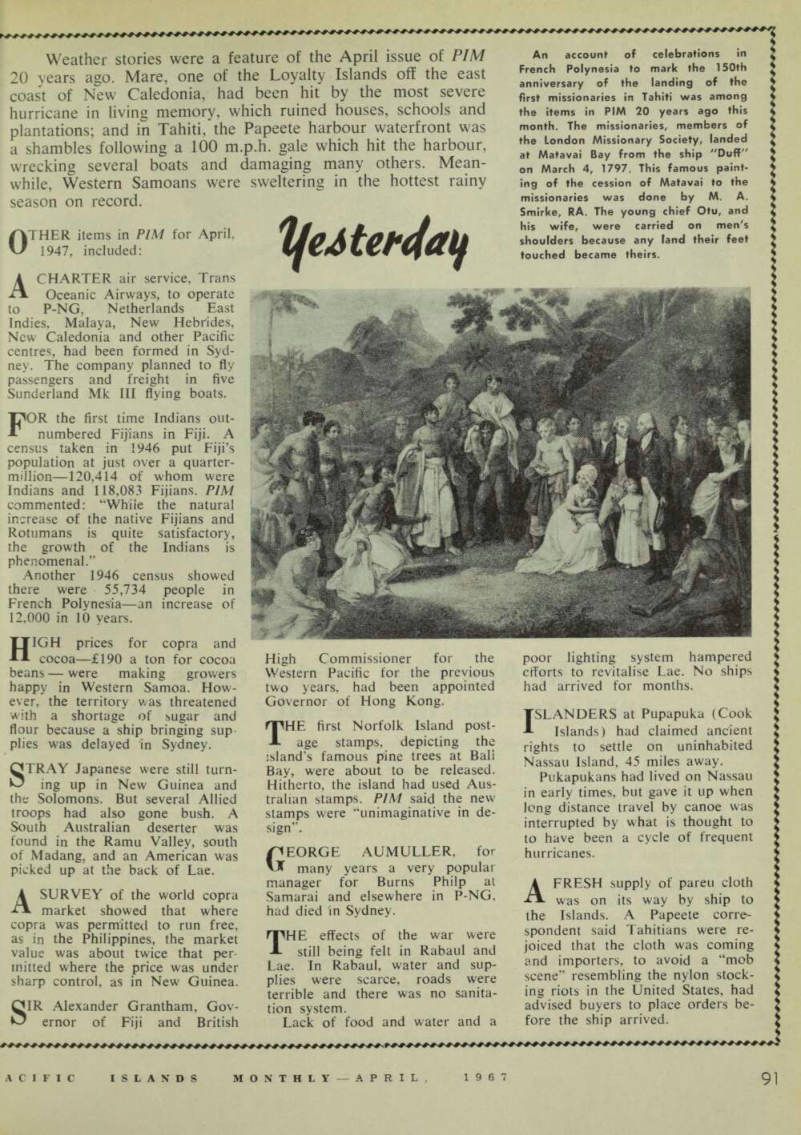 93
93 94
94 95
95 96
96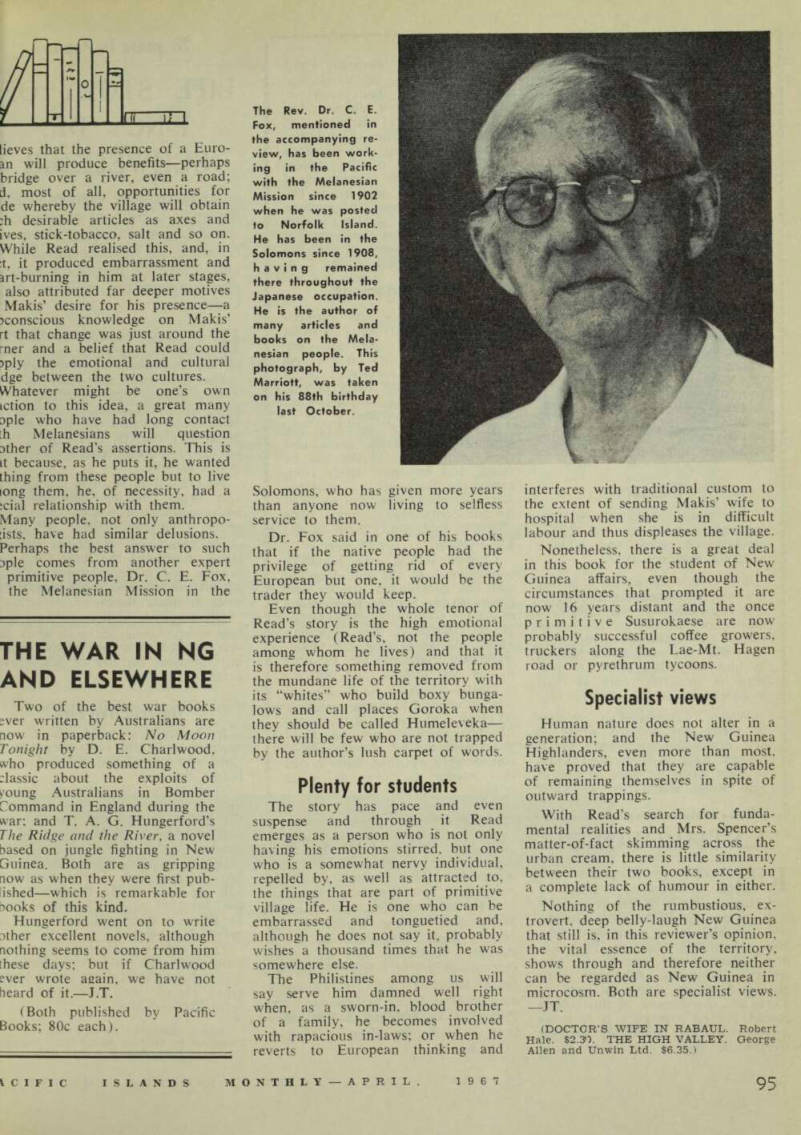 97
97 98
98 99
99 100
100 101
101 102
102 103
103 104
104 105
105 106
106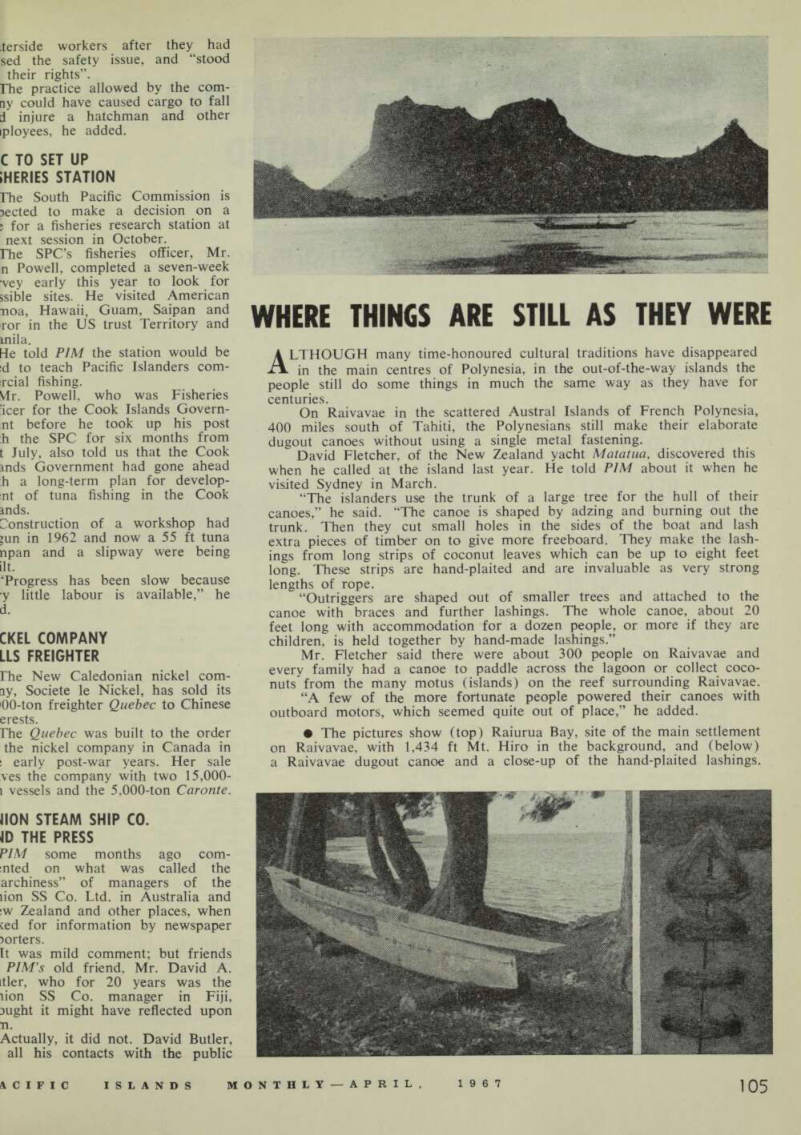 107
107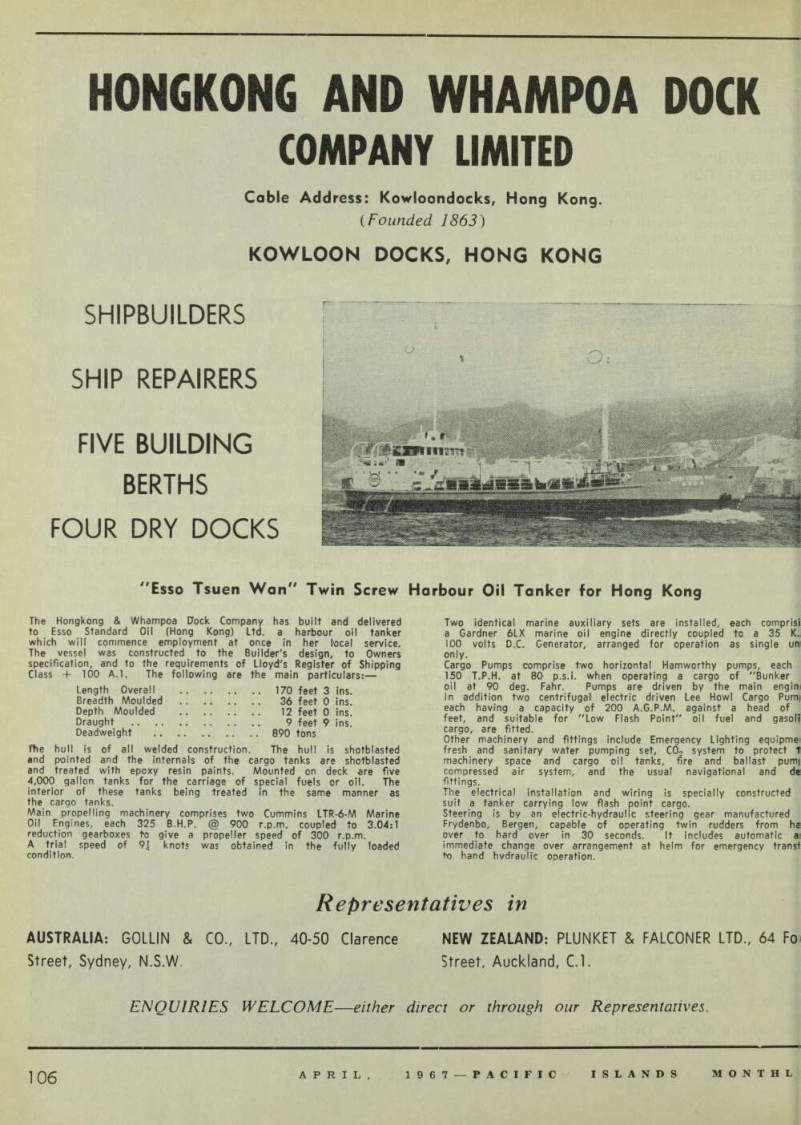 108
108 109
109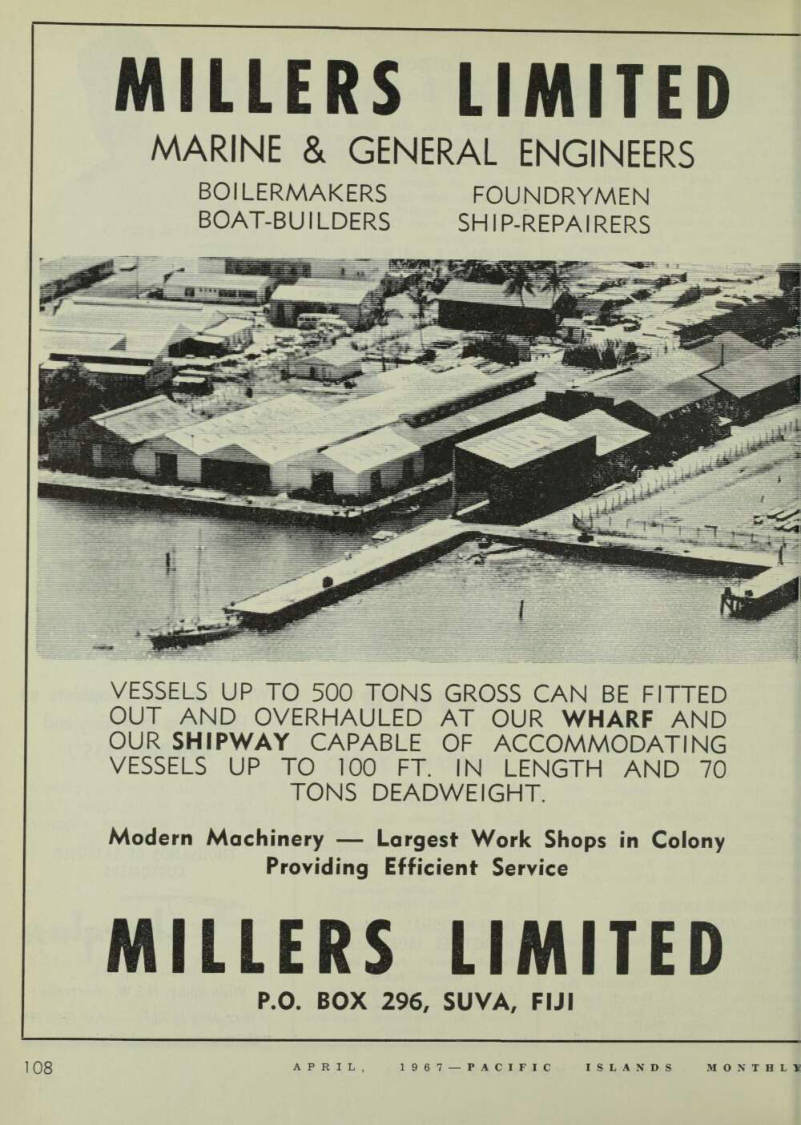 110
110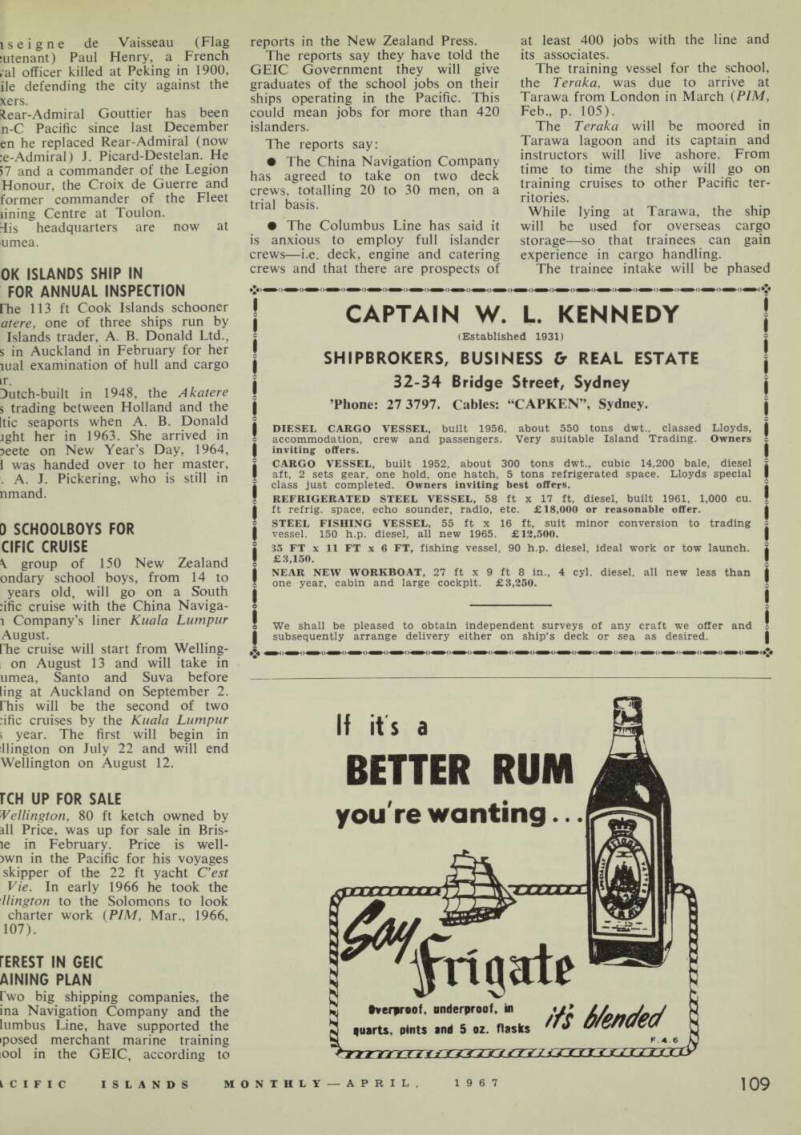 111
111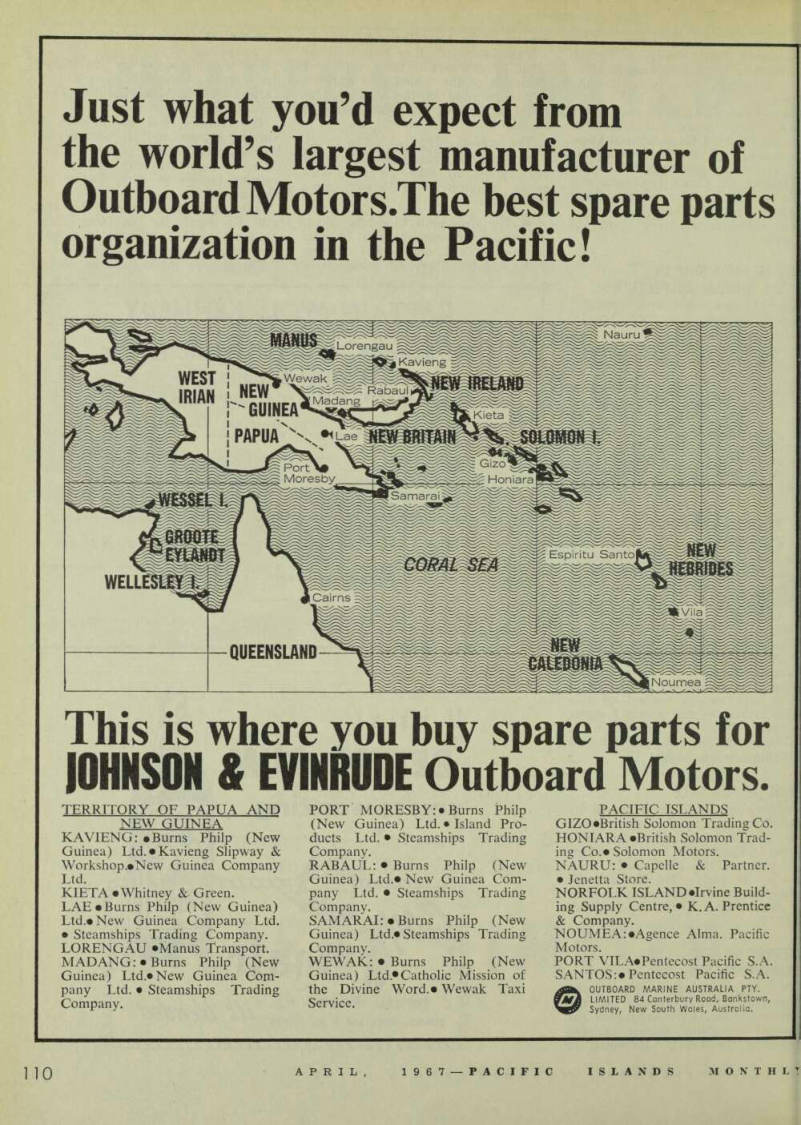 112
112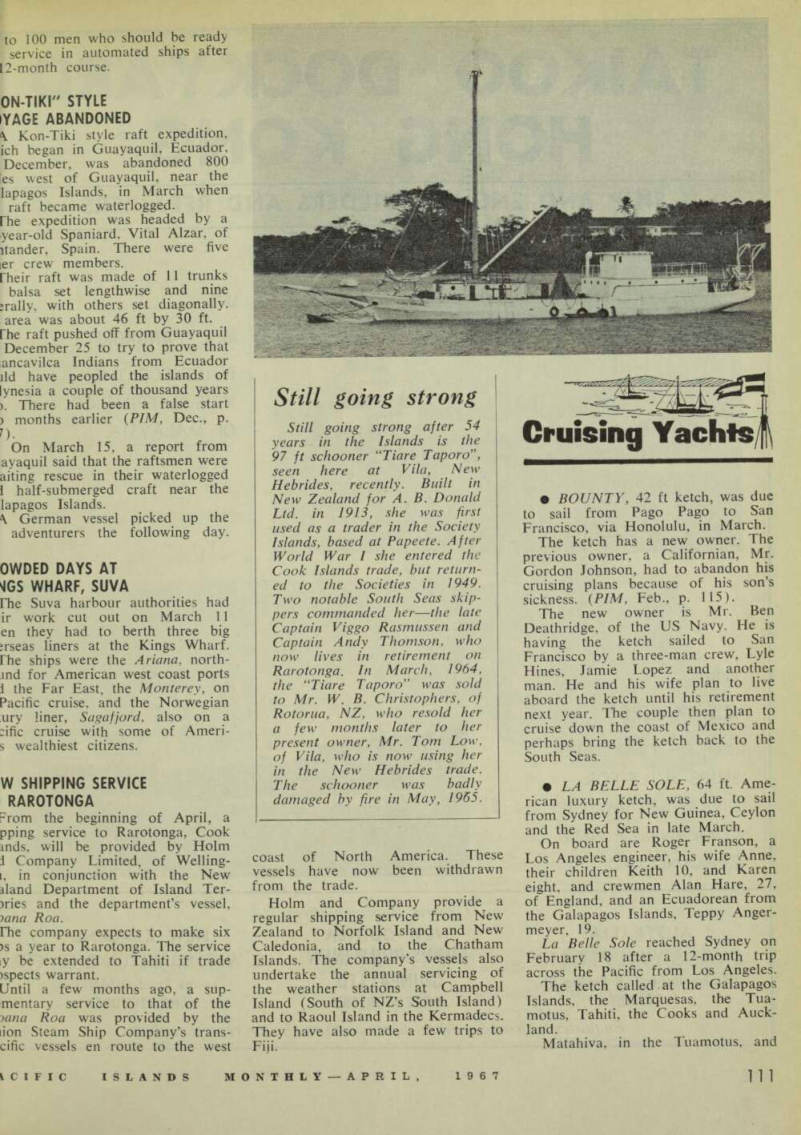 113
113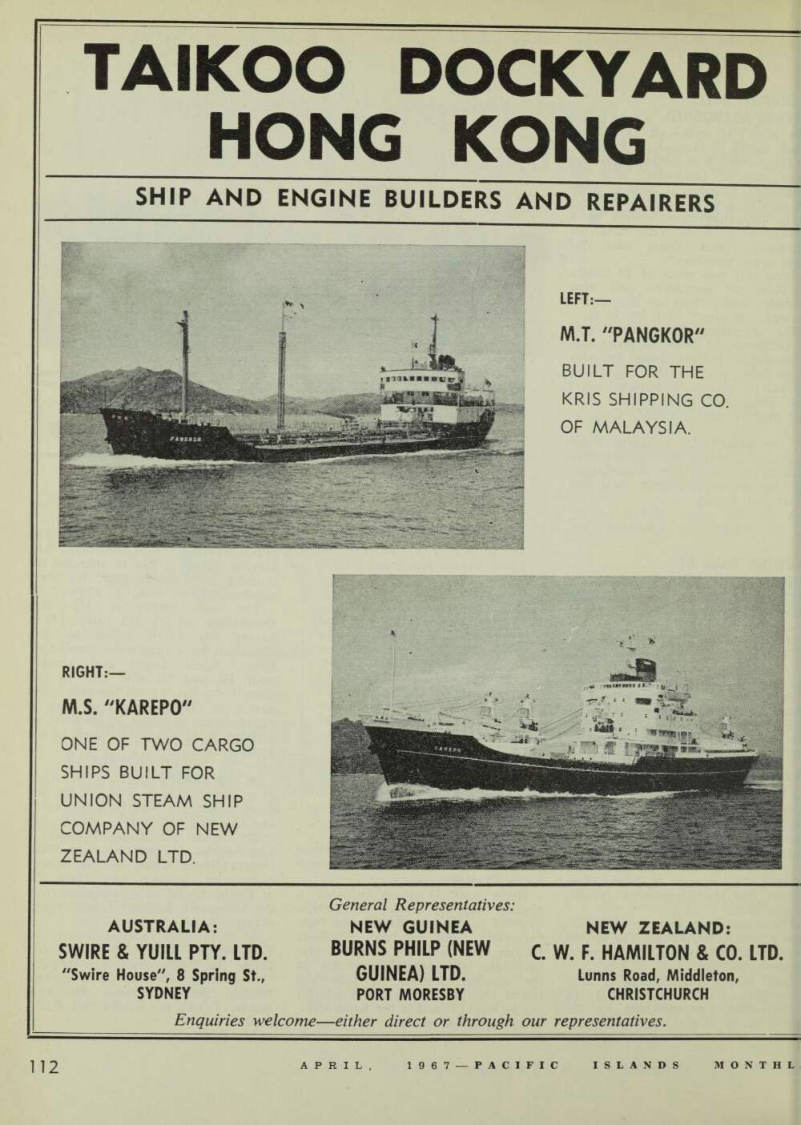 114
114 115
115 116
116 117
117 118
118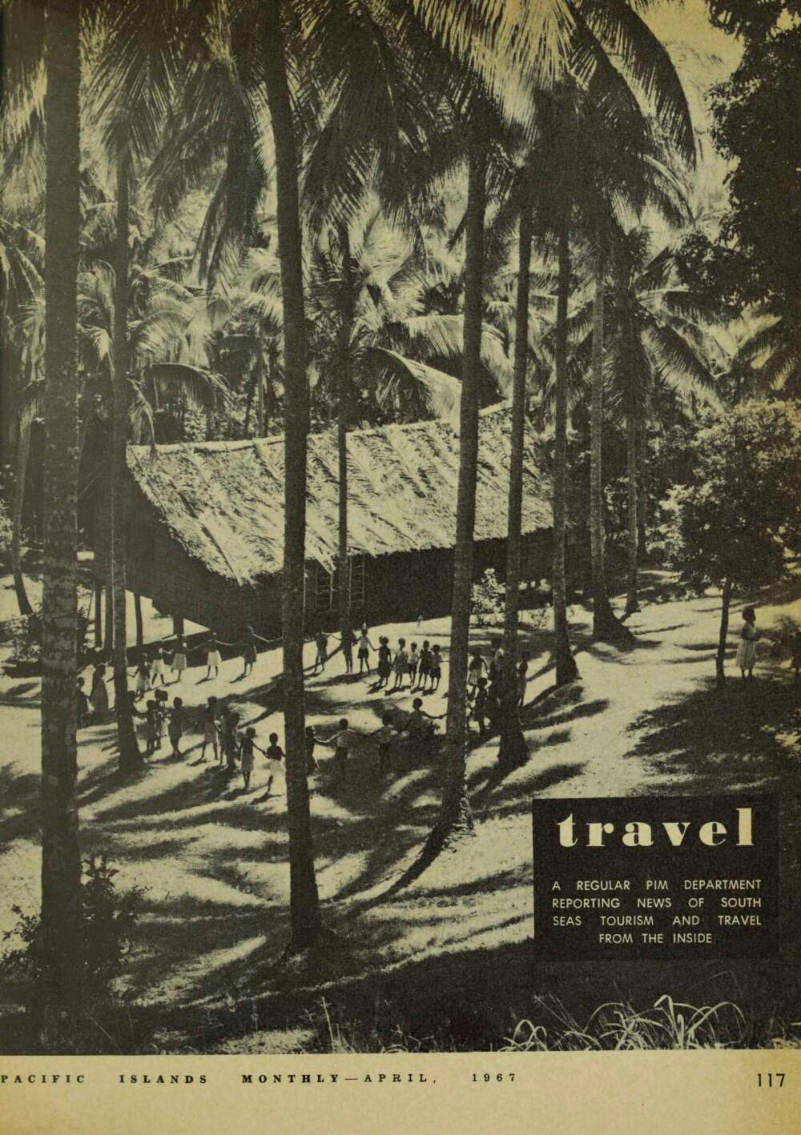 119
119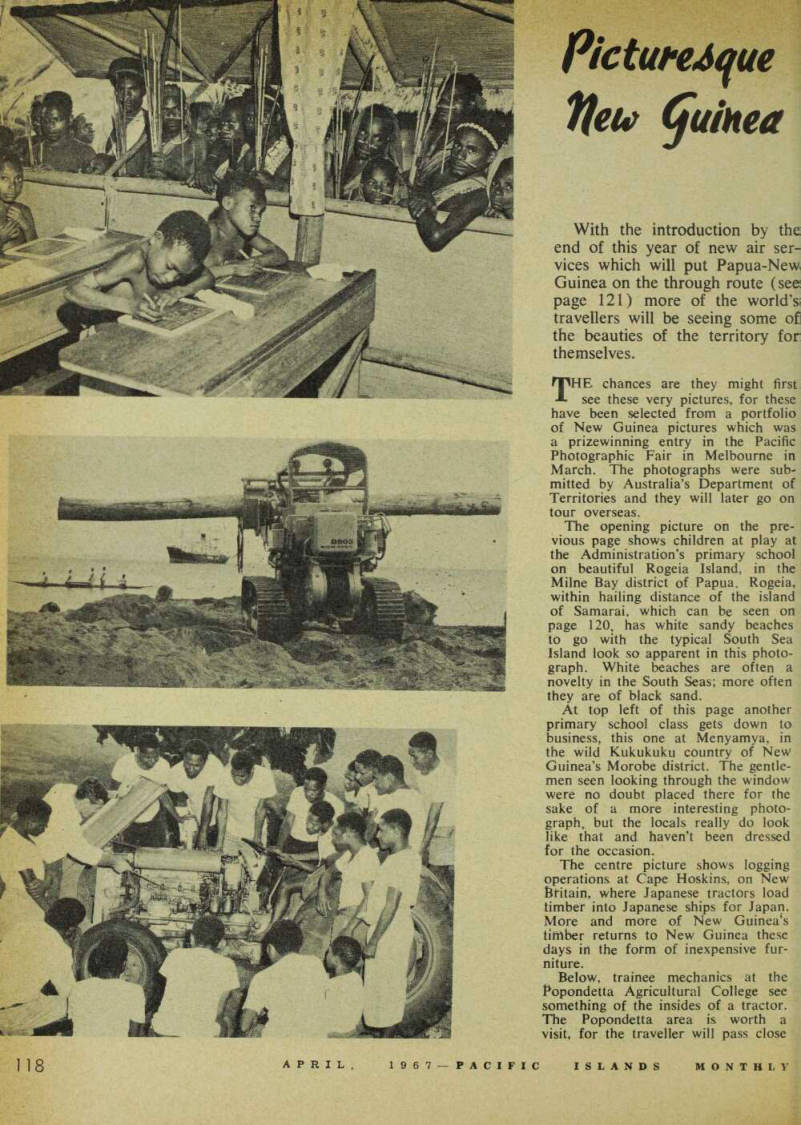 120
120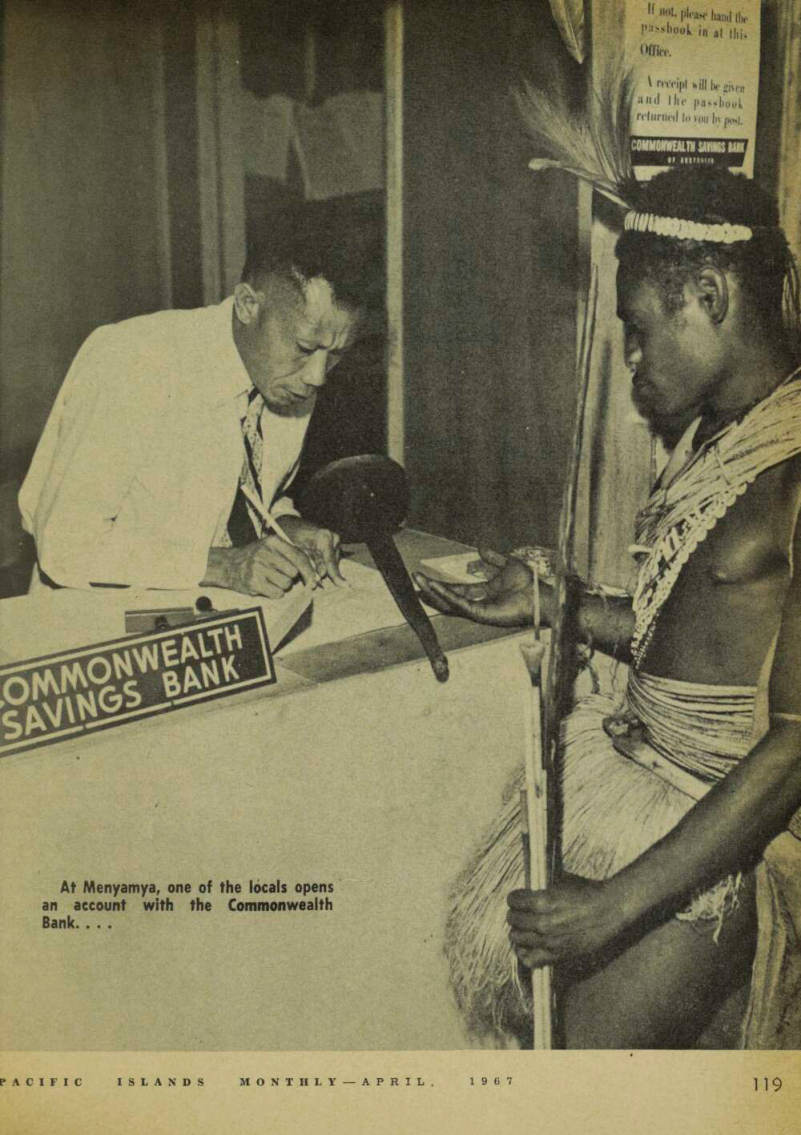 121
121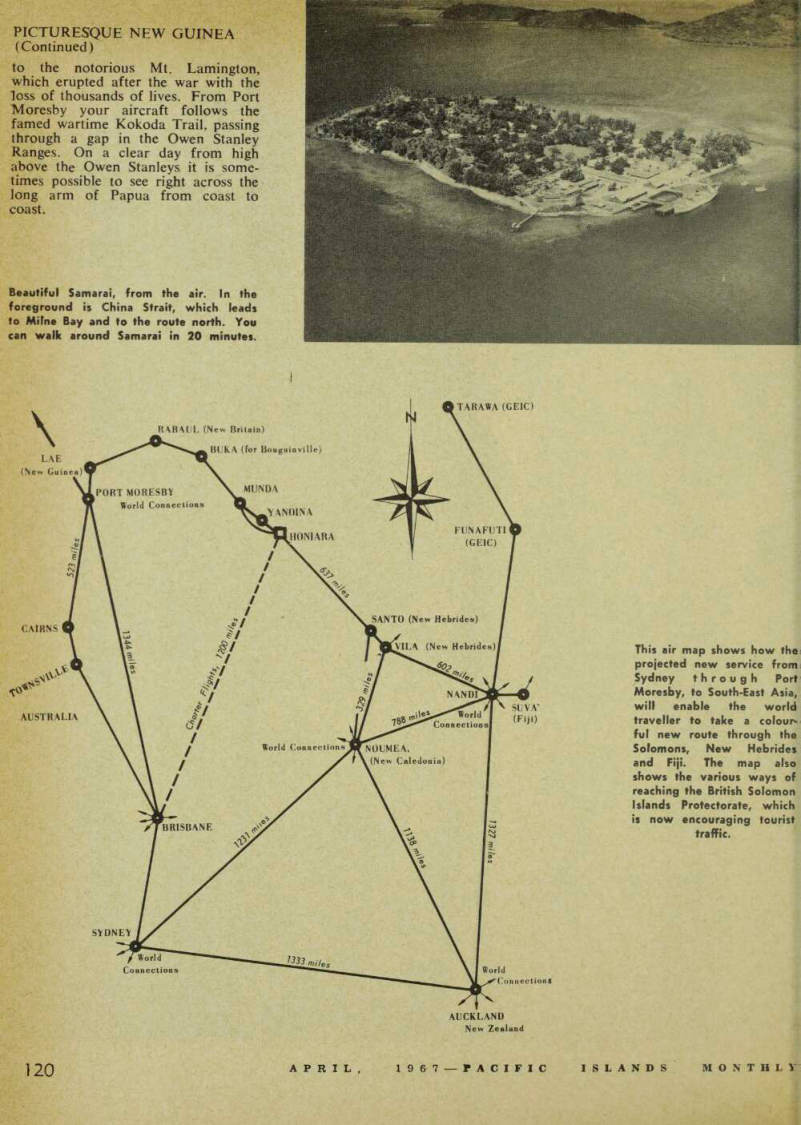 122
122 123
123 124
124 125
125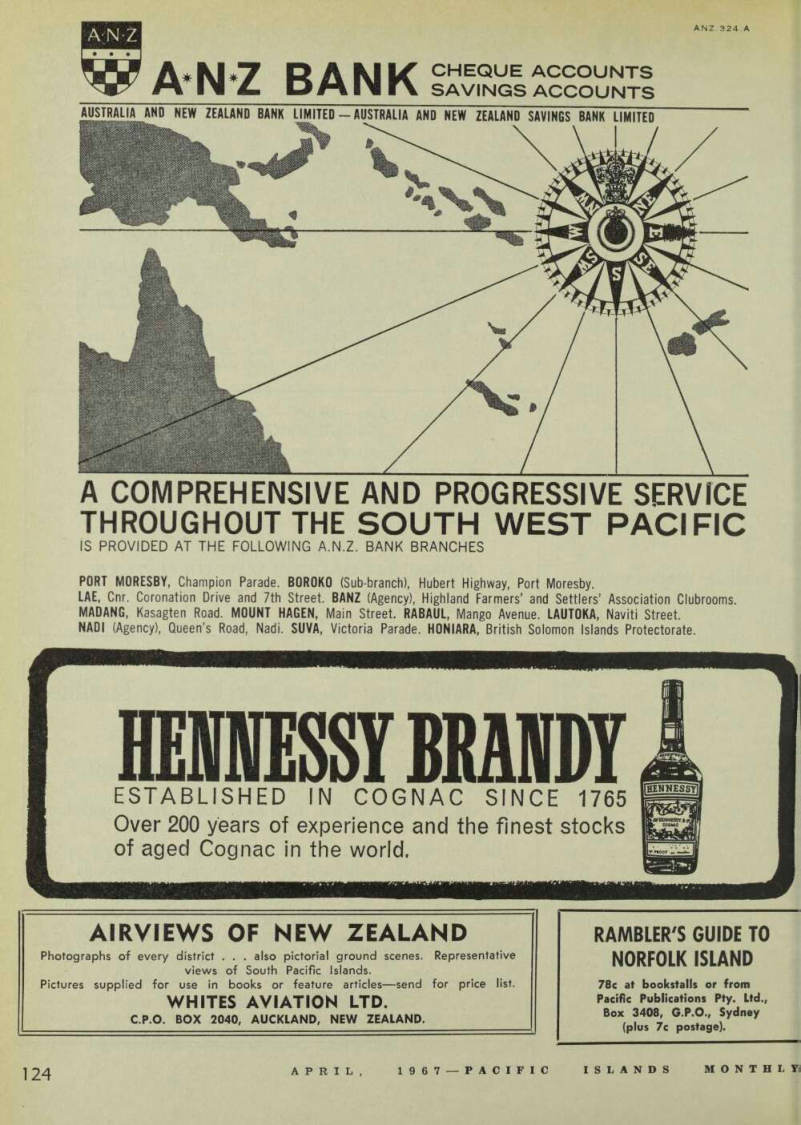 126
126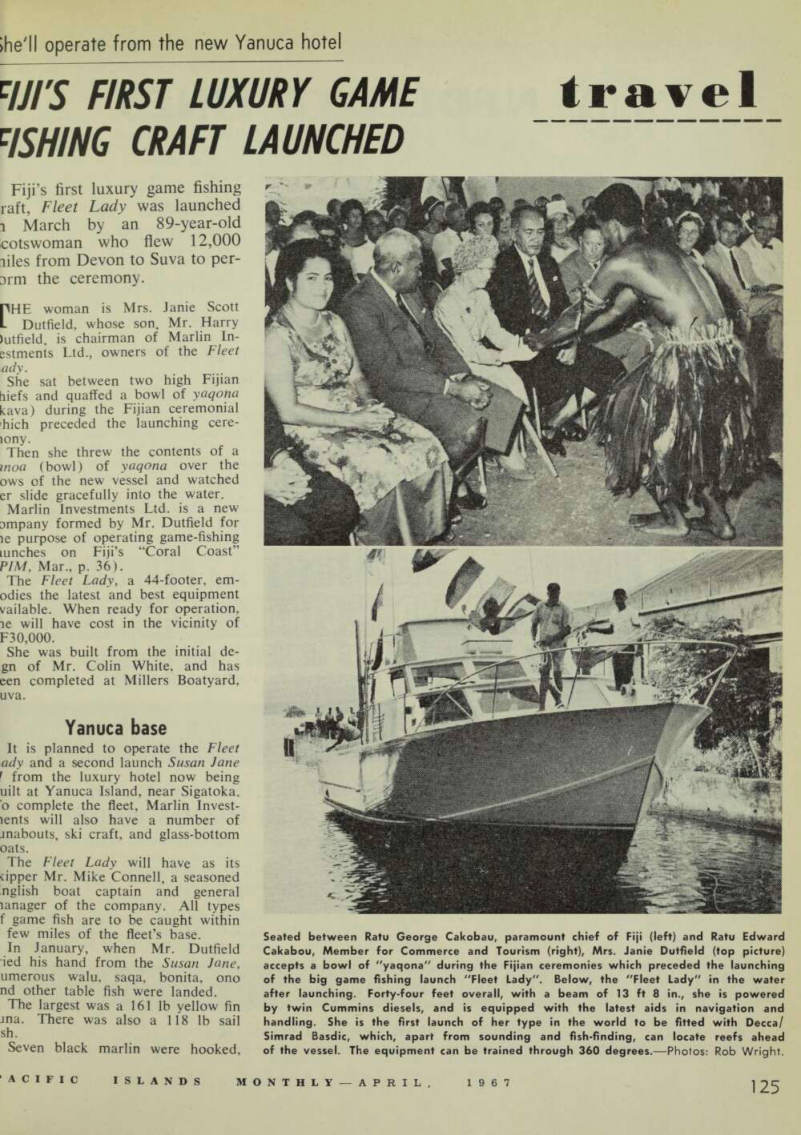 127
127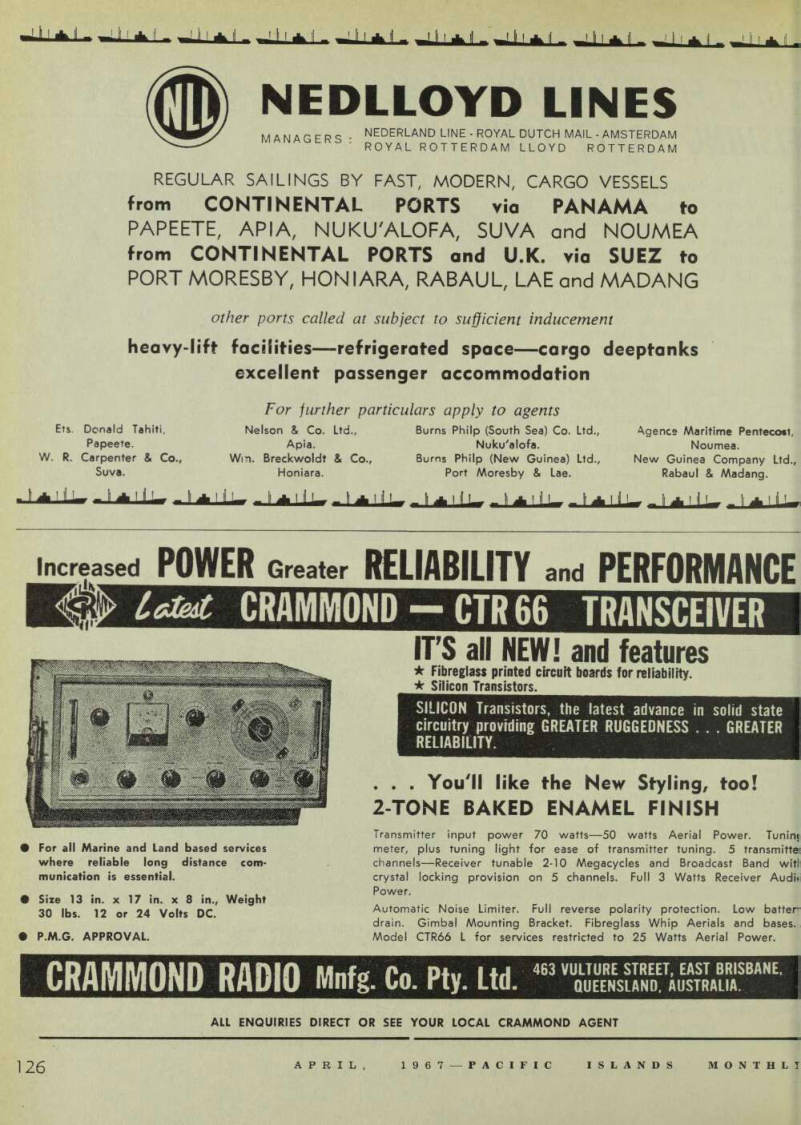 128
128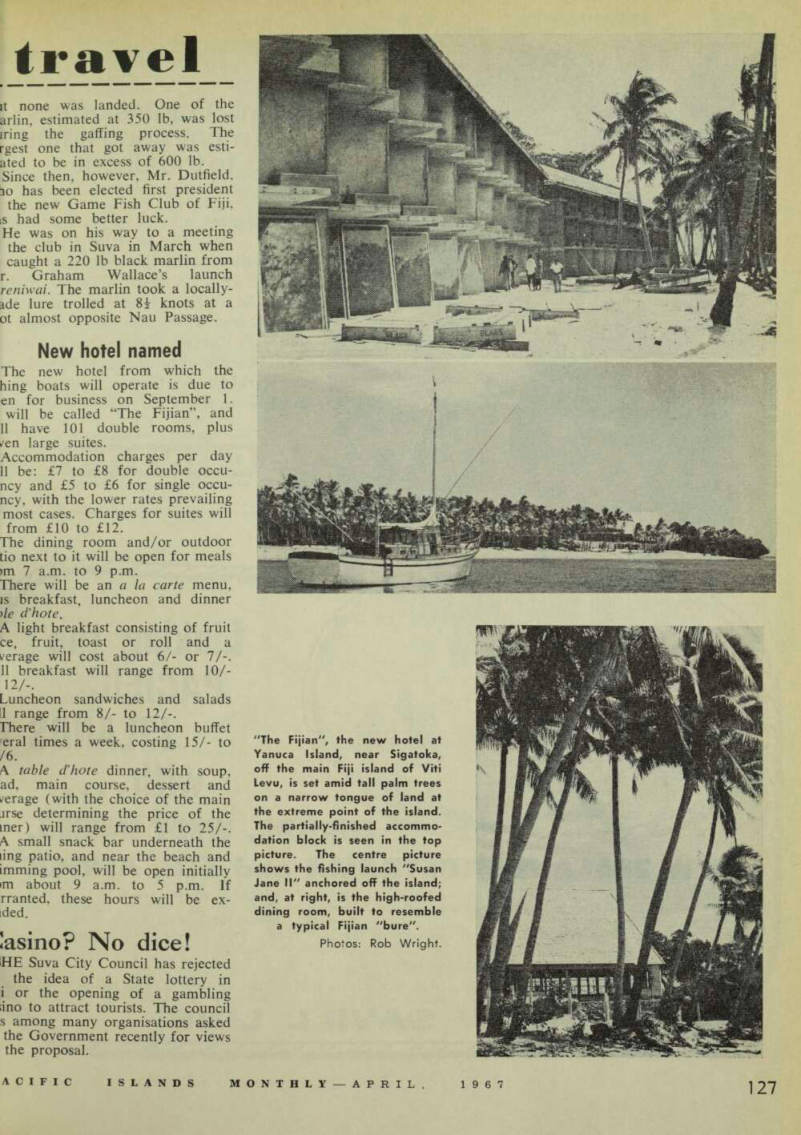 129
129 130
130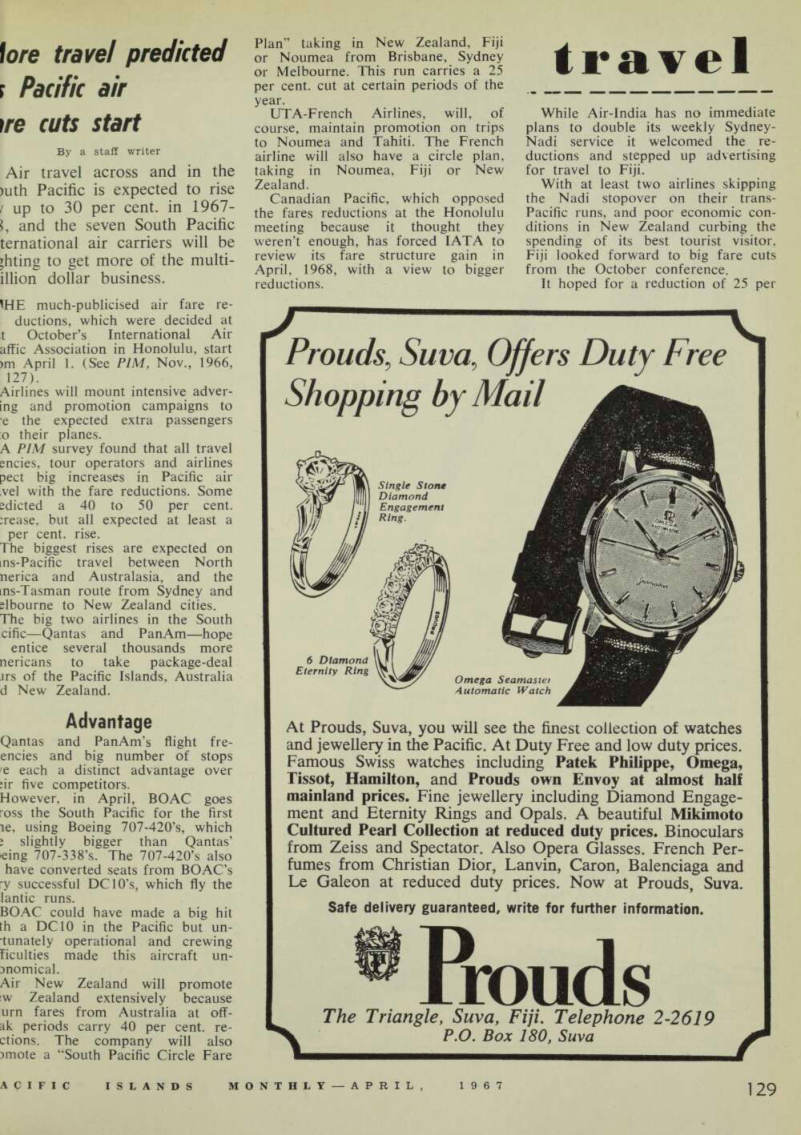 131
131 132
132 133
133 134
134 135
135 136
136 137
137 138
138 139
139 140
140 141
141 142
142 143
143 144
144 145
145 146
146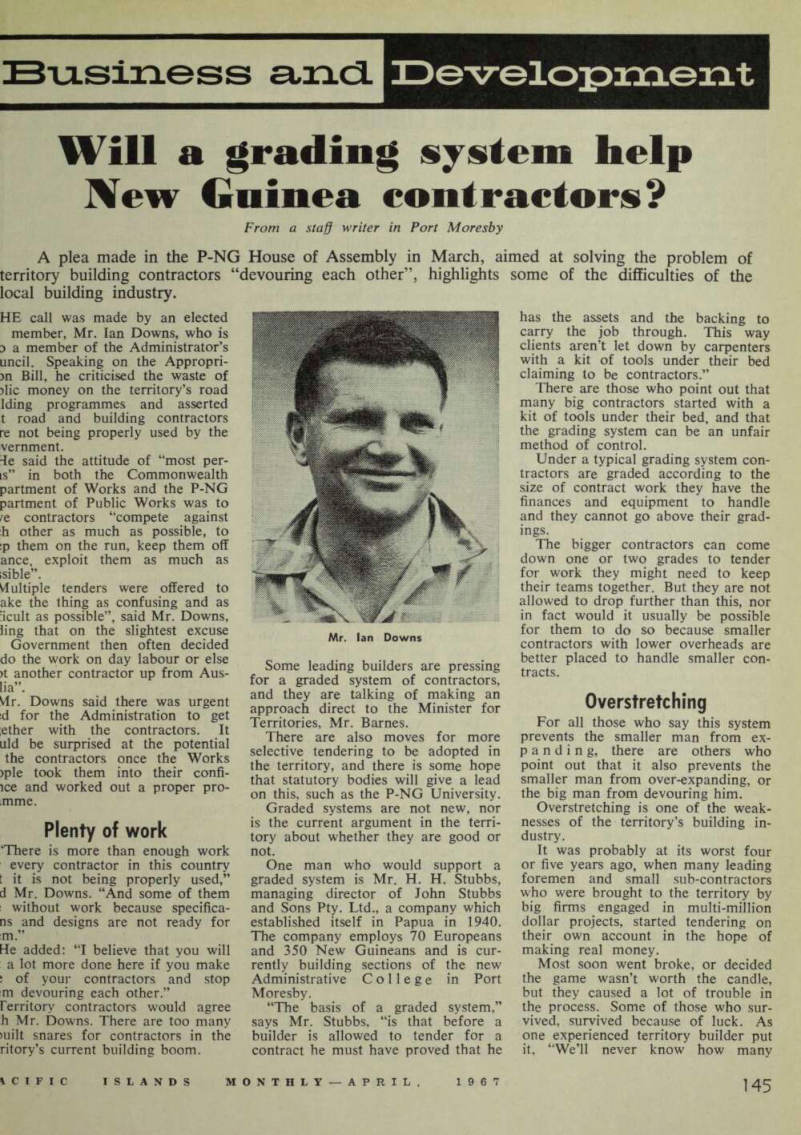 147
147 148
148 149
149 150
150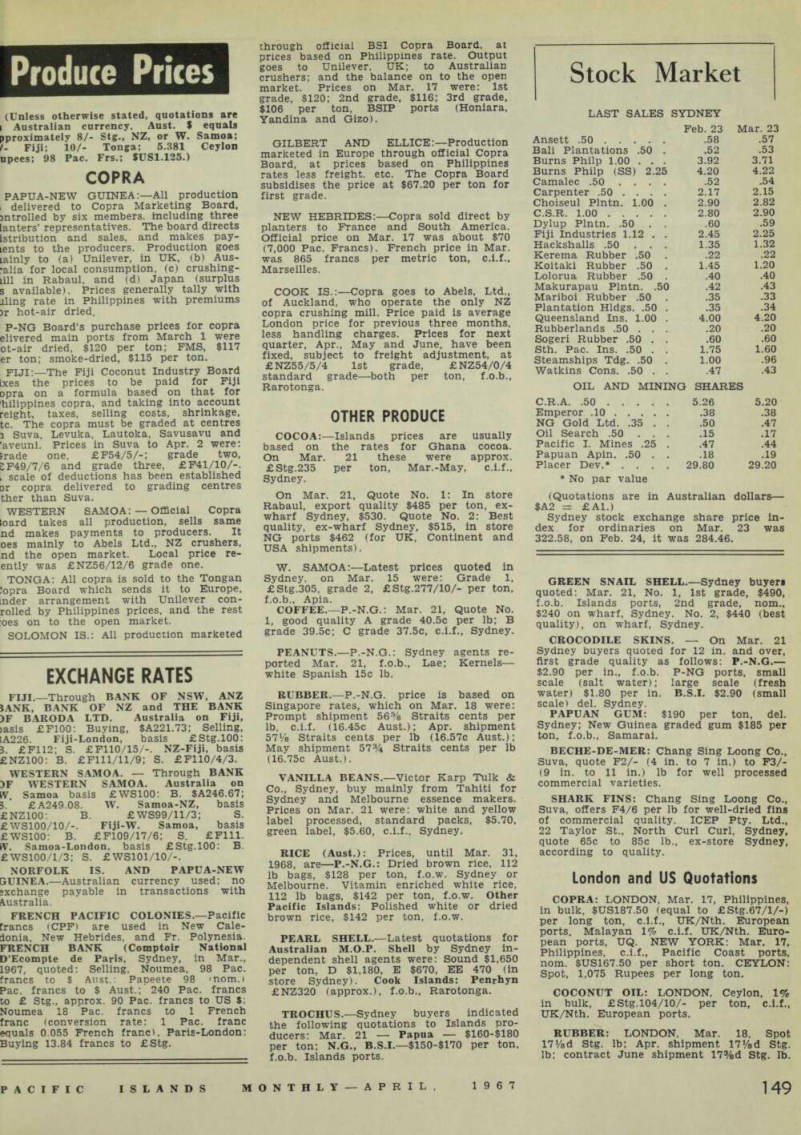 151
151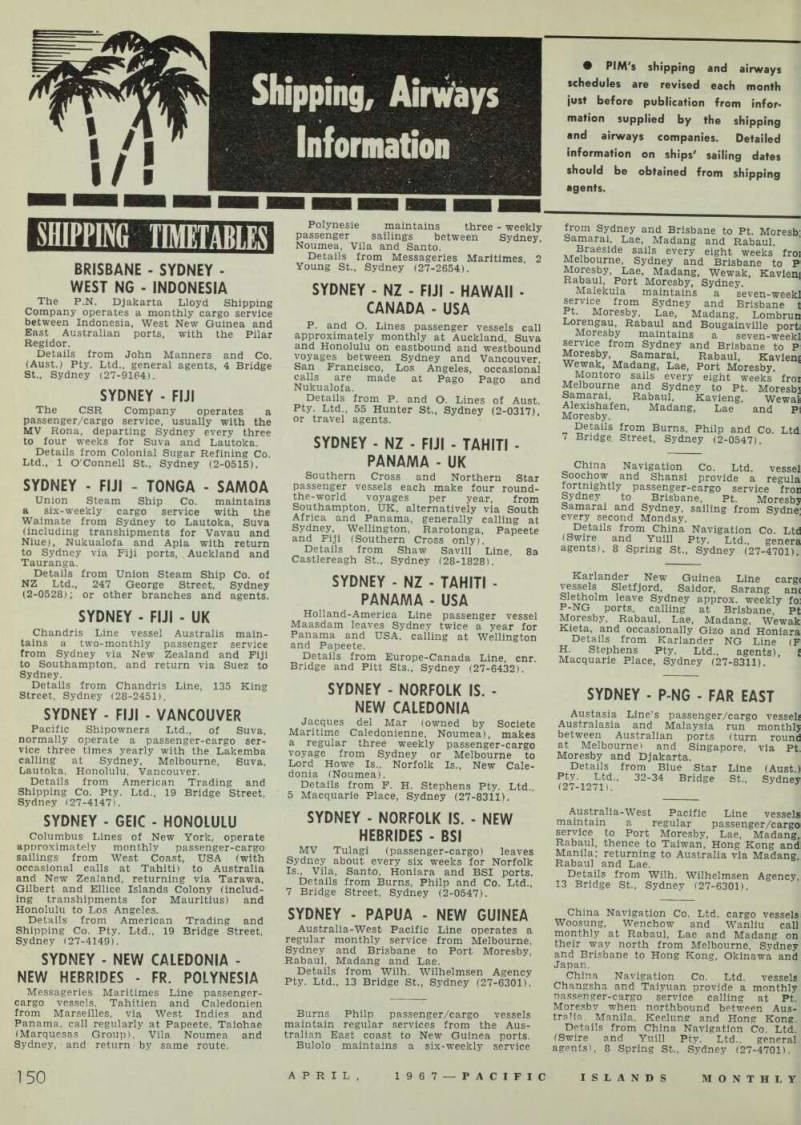 152
152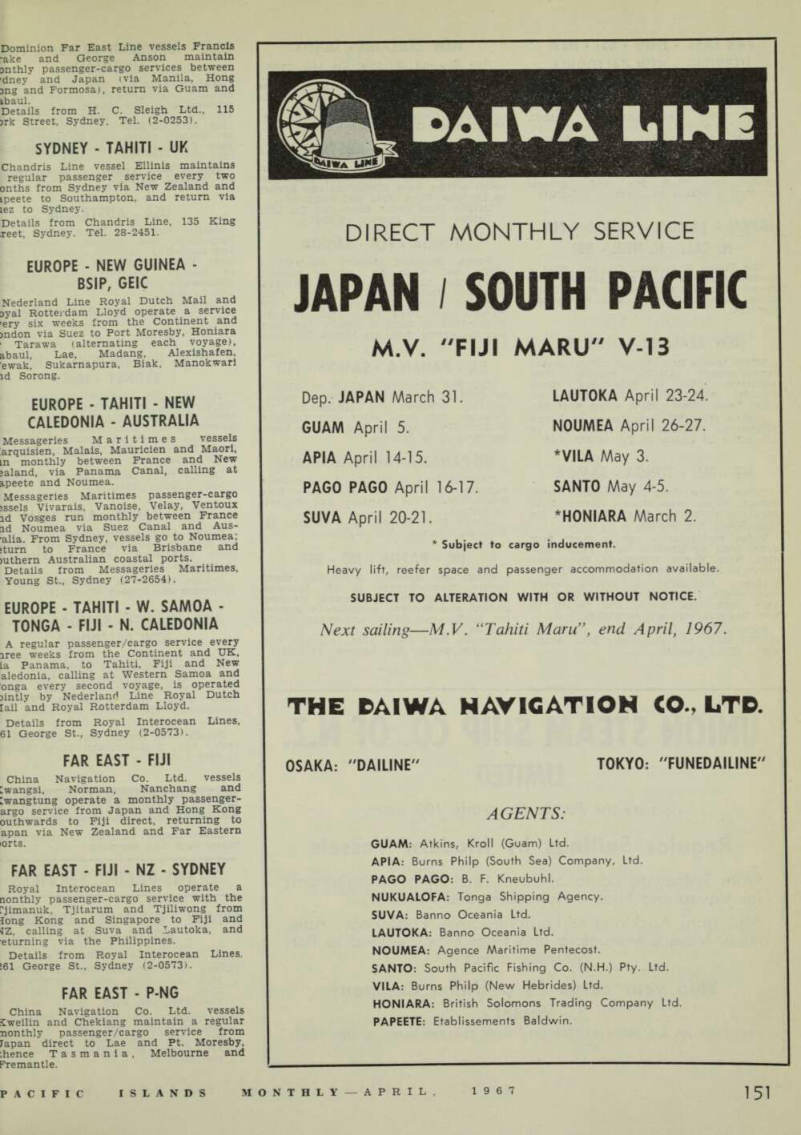 153
153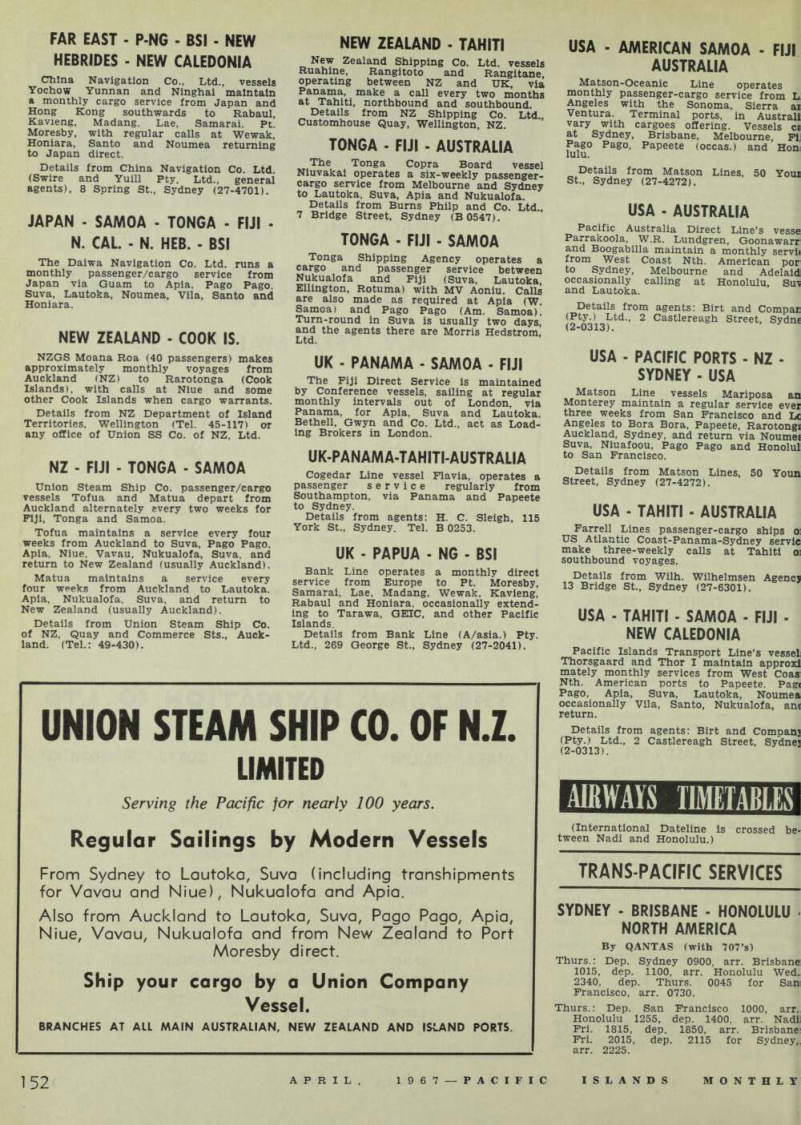 154
154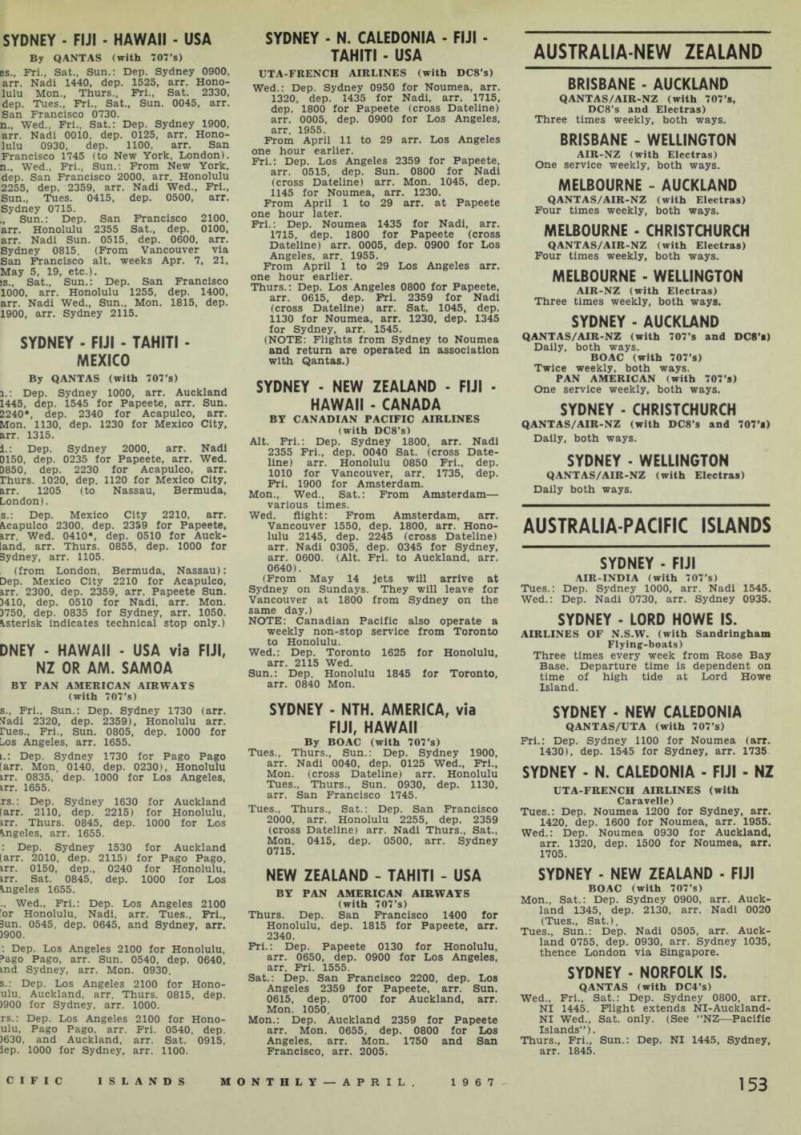 155
155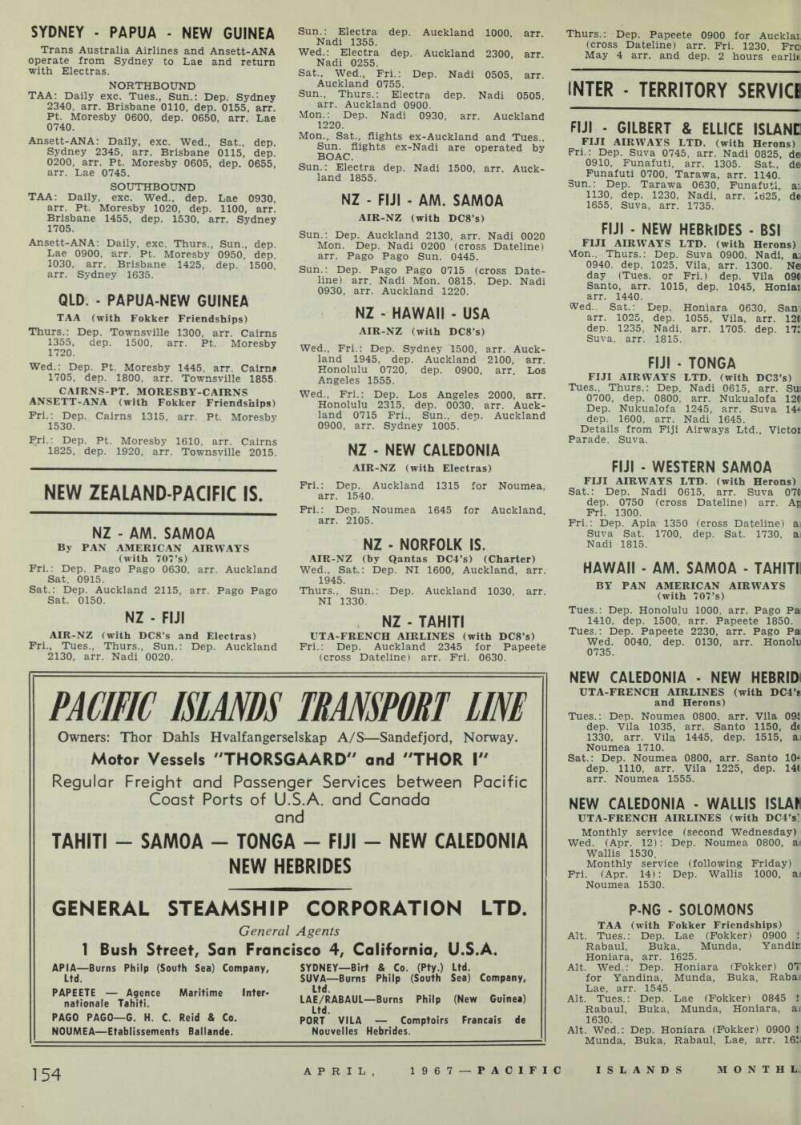 156
156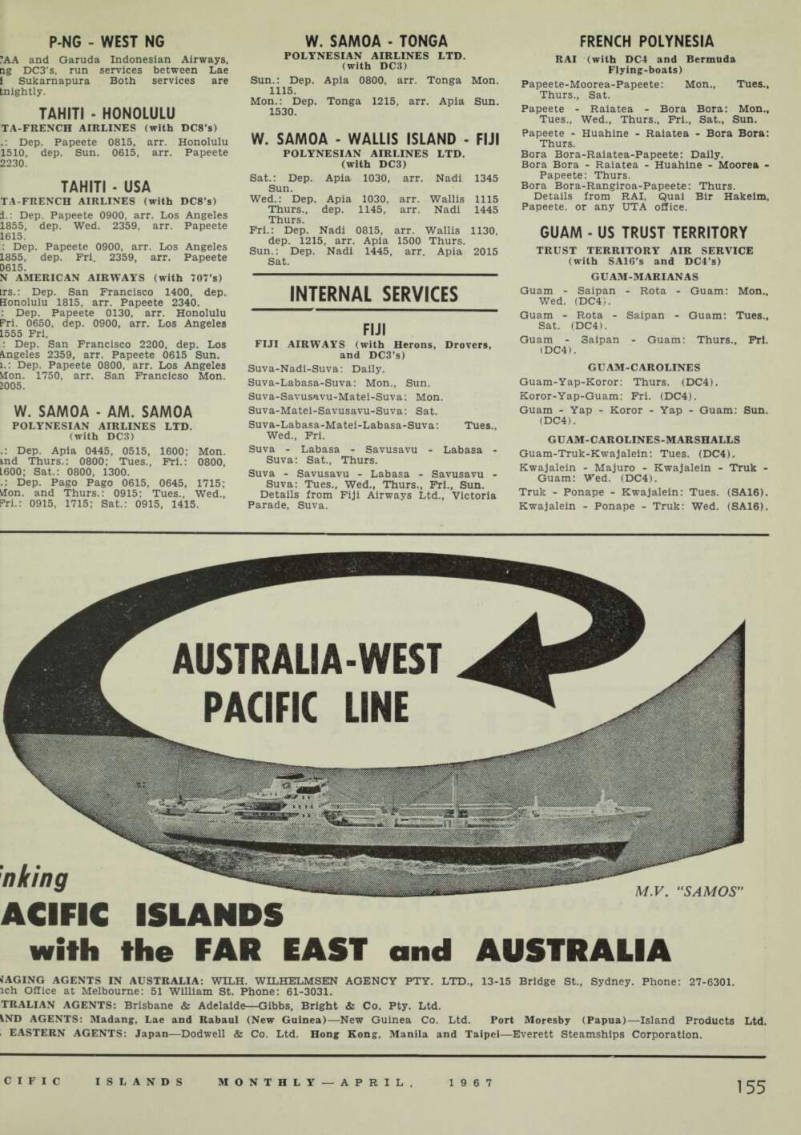 157
157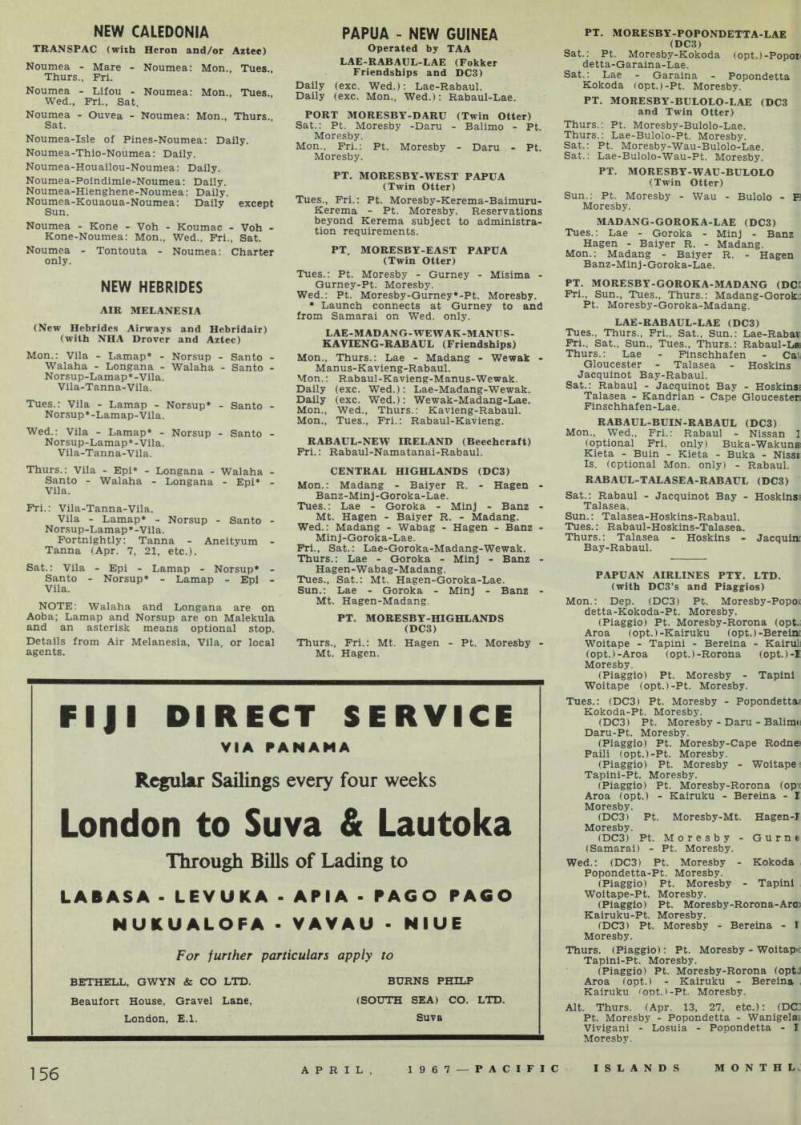 158
158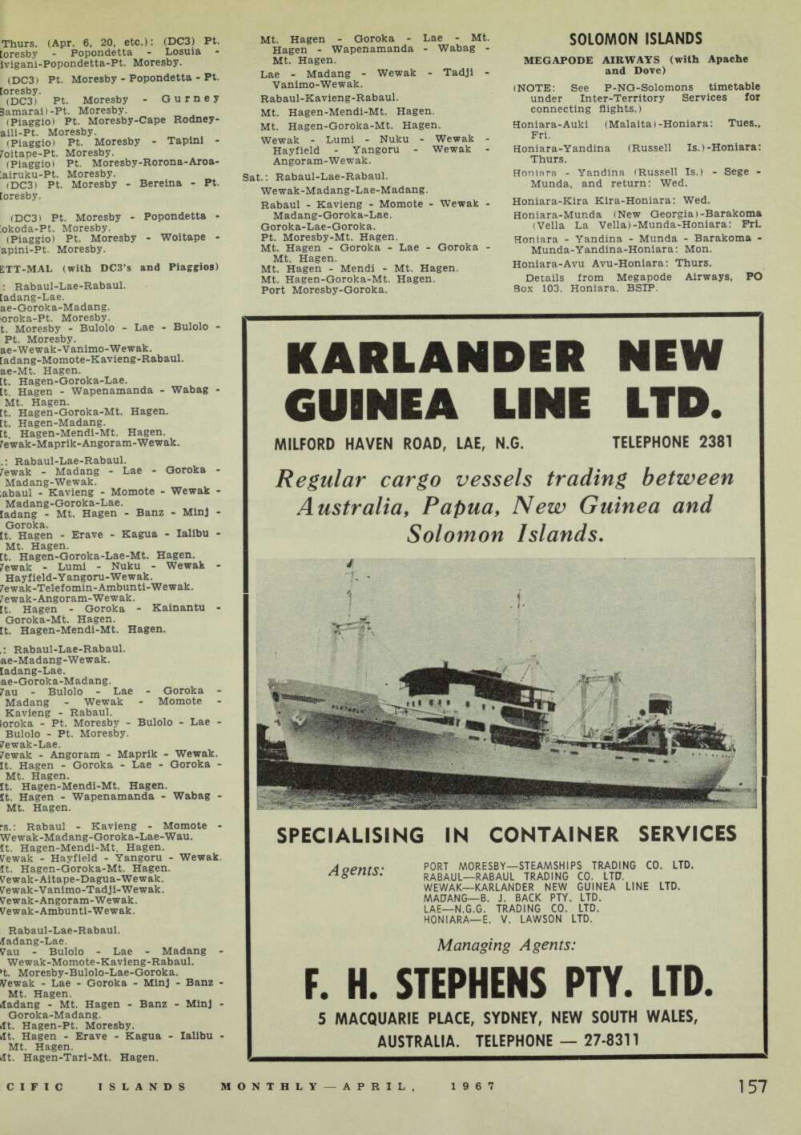 159
159 160
160 161
161 162
162 163
163 164
164