The Western Pacific
pp. 89-91 · Read in the full issue

Slow boat to England , or . . .
How (Not) To Cruise
On A Shoestring
By Graham Pike, captain of the ketch “Eilander”.
The main problem we have had during our recent mean dering cruise of the fascinating islands of the West Pacific has been to make enough money to continue our voyage to England.
IPS not that the islands or the people have been inhospitable— quite the contrary, in fact. The main problem is that we’ve been enjoying ourselves too well—and that we’ve tangled ourselves in ventures that promised a fortune, and didn’t quite make the grade.
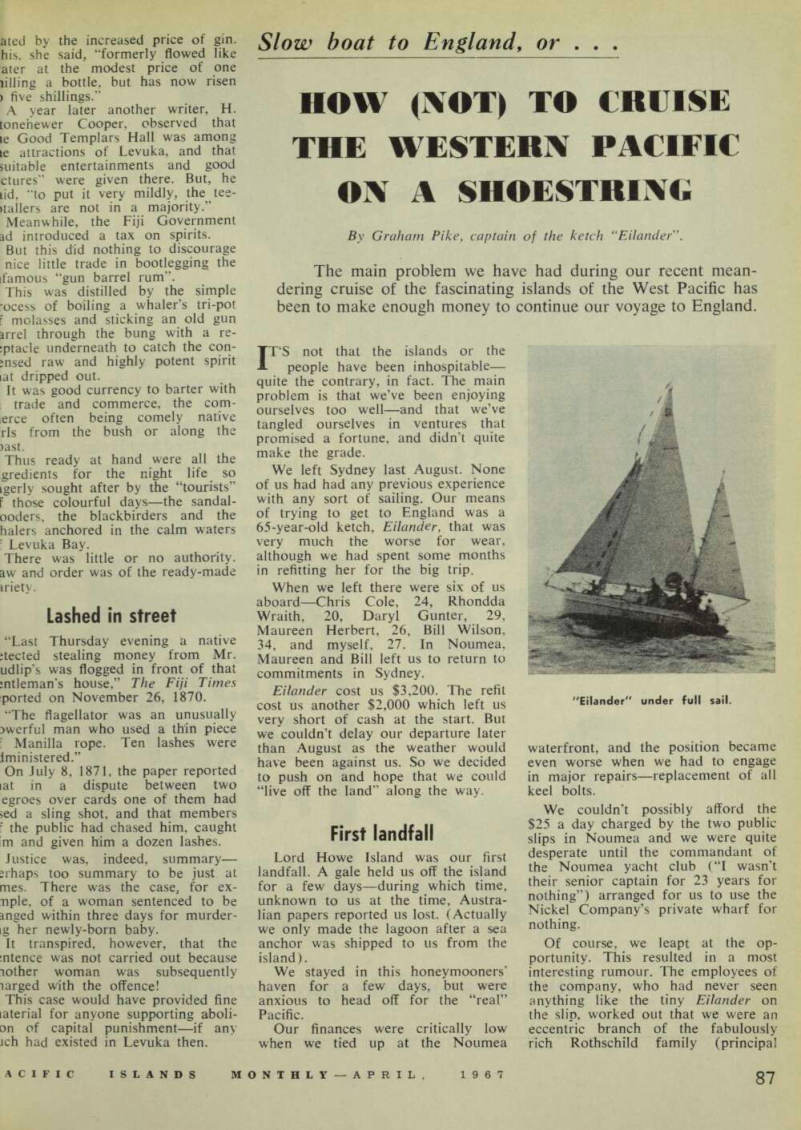
We left Sydney last August. None of us had had any previous experience with any sort of sailing. Our means of trying to get to England was a 65-year-old ketch, Eilander, that was very much the worse for wear, although we had spent some months in refitting her for the big trip.
When we left there were six of us aboard—Chris Cole, 24, Rhondda Wraith, 20, Daryl Gunter, 29, Maureen Herbert, 26, Bill Wilson, 34, and myself, 27. In Noumea, Maureen and Bill left us to return to commitments in Sydney.
Eilander cost us $3,200. The refit cost us another $2,000 which left us very short of cash at the start. But we couldn’t delay our departure later than August as the weather would have been against us. So we decided to push on and hope that we could “live off the land” along the way.
First landfall
Lord Howe Island was our first landfall. A gale held us off the island for a few days—during which time, unknown to us at the time, Austra lian papers reported us lost. (Actually we only made the lagoon after a sea anchor was shipped to us from the island).
We stayed in this honeymooners’ haven for a few days, but were anxious to head off for the “real”
Pacific.
Our finances were critically low when we tied up at the Noumea
waterfront, and the position became even worse when we had to engage in major repairs—replacement of all keel bolts.
We couldn’t possibly afford the $25 a day charged by the two public slips in Noumea and we were quite desperate until the commandant of the Noumea yacht club (“I wasn’t their senior captain for 23 years for nothing”) arranged for us to use the Nickel Company’s private wharf for nothing.
Of course, we leapt at the op portunity. This resulted in a most interesting rumour. The employees of the company, who had never seen anything like the tiny Eilander on the slip, worked out that we were an eccentric branch of the fabulously rich Rothschild family (principal
"Eilander" under full sail.
ners of New Caledonia’s Societe Nickel). n our near destitute state, we ■e not anxious to correct the error.
Ve finally fixed the major repair , but still didn’t have enough ney to continue the trip. [he four of us (Bill and Maureen 1 returned to Sydney) searched for rk with little success, iowever. I finally picked up a job ing tile floors at the Noumea Liarium for $7 a day. After a few s of this we had salted enough ly to refill the larders and head for the New Hebrides.
Ideal weather
)n the way, with sailing weather al, we took time off to explore Loyalty Islands. :he thing that struck us most ut Fayahoue, the administrative tre, on the island of Ouvea, was number and size of the churches, hitecturally, they could have been ight from the Mediterranean.
Lfter a couple of days, we left this ixed and relaxing backwater of world, after enjoying the ex iivity of one last ale on the andah of the hotel. (There is a il ban on alcohol for the locals).
Ve had only one thought in our ids when we pulled into Vila, on te, New Hebrides —how to make le quick cash.
Lfter five days of fruitless search-
ing, opportunity came knocking on our door. We were approached to do some chartering work by an official government authority (details of which, I’m afraid, cannot be divulged here). We leapt at the opportunity, of course.
The charter was to take us to the islands of Maskelyne, Aoba, Ambrym and Emae and back to Efate. The fee was to be $l6O. This sounded great.
In fact, it wasn’t great at all. The round trip took us 10 days and cost us $6O in food and petrol. This meant we netted $lO a day—which for 12 hours work a day for four people was hardly extravagent.
So back in Vila we still had the same problem.
Green snail venture
We weren’t back long before yet another proposition was put to us.
This time no fixed amount of money was mentioned—but a promise of unlimited wealth was laid as the bait, and we swallowed it whole.
One of the locals (who must re main nameless), on learning about our boat, talked us into a green snail shell hunt.
Green snail shells, for the unitiated, are used in the button industry. Our contact man told us they were cur rently fetching $3OO a ton, and he calculated we could harvest 40 tons in a month of work.
This really sent us into the clouds.
Even with only a one-third share for us (the other two-thirds going to the divers and to our new-found friend), this would net us $4,000.
This looked too good to be true.
But after some quick verification, we set off for Emae to look for some divers.
Then followed a long and involved escapade.
We found only a couple of casual divers at Emae —and found no green snails at all on neighbouring Cook’s Reef, which was supposed to be swim ming with the creatures.
So we went down to Makura to pick up some full-time divers and continued on to Erromanga, where we were assured green snails were in abundance.
Then followed problems because we had no diving dinghies, threats from Erromanga natives because we were trespassing on their reefs, and finally the decision of our divers to pull out because the work was so slow.
We therefore returned to Vila.
The whole business took us three weeks. For this we grossed the grand total of nine bags of shells—worth $7B. Out of this, our cut was $26, with the cost of fuel $22. So we made exactly $4 profit!
Our charter job had provided us with enough money for food, so we decided to search for greener pastures.
We said farewell to all the friends we had made during our five weeks in Vila and pointed our bow to the Solomons and Honiara on the island of Guadalcanal.
After 10 languid and lazy days at sea, we sighted our landfall.
Now we have the task of looking for work again.
England feels a long way off. But we’ll make it yet—however hard the “natives” try to kill us with kindness along the way.
ham Pike, skipper of "Eilander" and author of this article.
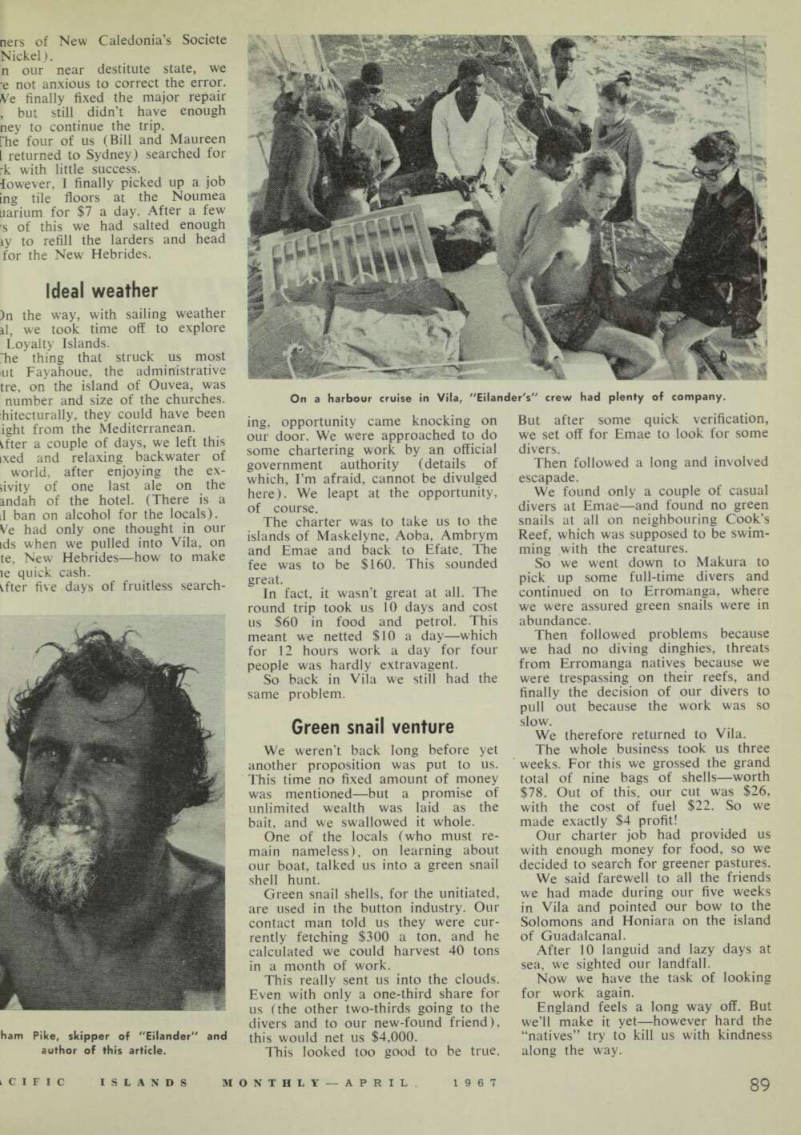
On a harbour cruise in Vila, "Eilander's" crew had plenty of company.