Yesterday
p. 95 · Read in the full issue
Things were pretty quiet in the Pacific this month 20 years ago. The biggest news was the inauguration of weekly trans-Pacific air services by Australian National Airways and Pan-American Airways. ANA’s route was Sydney-Fiji- Canton Island-Honolulu-San Francisco. Pan-Am’s was the same except that a call was also made at New Caledonia.
OTHER items in PIM for March, 1947, were: A NOUMEA air company had been given permission to set up a regular service between New Caledonia and the New Hebrides.
Its ultimate aim was to link New Caledonia with Tahiti via the New Hebrides and Wallis Island. The company was Societe Francaise de Transposes Aeriens du Pacifique Sud.
THE South Pacific Commission, which was one month old, was preparing to set up a tem porary headquarters in Sydney.
TRADE was booming in many parts of the Pacific. Fiji was to get an extra £Stg.3/5/- a ton for sugar, which would bring in an extra f5tg.750,000 a year; Western Samoa was selling plenty of cocoa beans and copra; and Tahiti was doing well out of mother-of-pearl shell, vanilla beans and, of all things, shark’s livers. Papua and New Guinea, however, were not doing so well. Lack of labour and transport were to blame.
THE P-NG Administration was steadily extending its rule over the highlands of central New Guinea. Headquarters for the central district had been set up at Goroka, in the Bena Bena country, and reports said tea and quinine were to be produced be tween the Ramu Watershed and Mt. Hagen.
THE betrothal of two Tongan princes, Crown Prince Tupouto’ a-Tungi and Prince Fatafehi Tu’ipelehake, to two Tongan girls was announced. The girls were Mata’aho ’Ahome’e, 21, and Melenaite, 22, respec tively. Tungi is today King Taufa’ahau and his brother is Premier.
ON the coast of Peru, a party of Norwegians was preparing for the epic voyage of the raft Kon Tiki. Led by Thor Heyerdahl, the voyagers hoped to prove that
the ancient Polynesians could have drifted to their islands from Peru—rather than from Asia, as was generally accepted.
TRANS-PACIFIC freight ship ping services were almost back to 1939 standards. The Canadian-Australasian Line, Union Steam Ship Company, Matson Line and W. R. Carpenter (Canada) Ltd., all had ships ply ing between Pacific ports. Most of their ships carried some passengers.
Mr. Harrison Smith, Well
known for the great variety of fruit-bearing trees and plants he collected on his own estate in the Vaiari district of Tahiti, had died in Tahiti after a long illness.
He was in his mid-seventies,
A Correspondent On
Mangaia, Cook Islands, was anxious to get some of the giant Bermuda onions of Tahiti because the home-grown onions were too mild. “Unless imports are forth coming, no improvements in the local stews are possible”, he said.
A PETITION signed by 46 Samoan chiefs, praying for self-government for a united Samoa (Western and American Samoa) had come before the Trusteeship Council of the United Nations in New York. PIM said the Samoan people appeared determined to press on with their demand for “an ever-increasing measure of self-government”.
A N old-time resident wrote from Edie Creek: “Transportation is difficult owing to the roads being closed by landslides. Cargo handling at Lae is bad, the customs shed is a shambles and postal arrangements are very
poor. If it were not so in convenient perhaps it would be funny”.
SOME Sydney wharf labourers, unloading a consignment of candlenuts from the East Indies, thought the nuts looked appetis ing; so they drank the milk from the nuts. Very soon 15 wharfies “bit the dust”, PIM said. All of them became intoxicated and then violently ill; three were hospita lised and one went blind for an hour. “It opens up new and excit ing possibilities for consistent Islands drinkers,” PIM added.
LARGE numbers of new cars, particularly British, were arriving in Fiji. But American cars were in greatest demand be cause Fiji, like Australia and New Zealand, wanted big cars with full-width tracks and plenty of power. Dealers couldn’t get enough American cars, while they were unable to sell all their British cars.
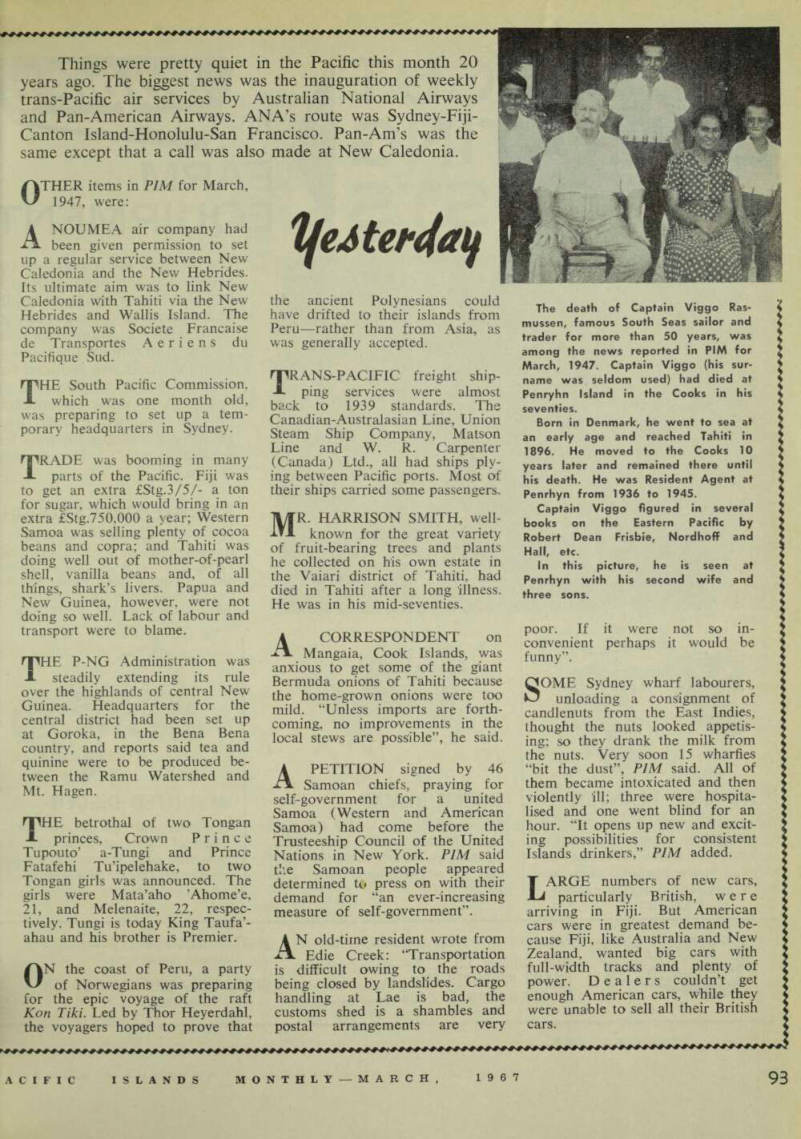
The death of Captain Viggo Ras mussen, famous South Seas sailor and trader for more than 50 years, was among the news reported in PIM for March, 1947. Captain Viggo (his sur name was seldom used) had died at Penryhn Island in the Cooks in his seventies.
Born in Denmark, he went to sea at an early age and reached Tahiti in 1896. He moved to the Cooks 10 years later and remained there until his death. He was Resident Agent at Penrhyn from 1936 to 1945.
Captain Viggo figured in several books on the Eastern Pacific by Robert Dean Frisbie, Nordhoff and Hall, etc.
In this picture, he is seen at Penrhyn with his second wife and three sons.