It's 25 Years
pp. 91-93 · Read in the full issue

Since The War
Came To Ng
By Jim Huxley
January 21 this year (the day
I wrote this article) was the 25th anniversary of the day that civilians on the New Guinea mainland went to war with
Japan.
1 REMEMBER the day well. It was a Wednesday. Japanese Zeros swooped on the coastal towns of Lae and Salamaua, bringing destruction and death with their strafing, while others flew over the mountains to Bulolo.
At Bulolo, they destroyed Bulolo Gold Dredging Ltd.’s three tri motored Junker aircraft, which were parked on the airstrip.
A high-flying Japanese recon naissance flying-boat had flown over Bulolo the previous Friday, no doubt taking pictures.
One of the Junker pilots, Bertie Heath, and his crew, had time to get out of their plane before the Zeros attacked, and from a nearby slit trench they watched the destruction of the aircraft and its cargo—mainly a shipment of good Victorian lager. (Mr. Heath has given up flying long since, but has retained his interest
War's forgotten men
beer—he’s a dispatch clerk at the mth Pacific Brewery at Lae).
While the mainland towns were ing attacked, the Japanese were moping on Rabaul, which they ptured from an Australian garrison, inforced by “C” Company of the ew Guinea Volunteer Rifles.
Hundreds of male civilians, who id stayed behind in Rabaul when eir women and children were acuated some weeks earlier, were unded up and interned. Most lost eir lives before the war was over -many of them in the ill-fated ontevideo Maru.
On the mainland things didn’t ippen as quickly as in Rabaul and her island centres. After the “quick t” raids by the Zeros on January I, life became reasonably quiet ;ain, and there was time to get e “troops” organised.
Members of the NGVR (whose •Idiering had previously been con led to Friday night parades and eekend bivouacs) were quickly obilised. I was one of them.
On the morning the Zeros attacked, had just got to sleep after doing night shift on one of the three gold edges working at Bulwa in the ulolo Valley.
Soon after a panic-stricken house >y woke me up, I was told to report i Bulolo Gold Dredging’s mess hall, here, I and other members of the GVR were sworn in as full-time ddiers on active service.
It wasn’t long before most of the her non-natives in the area were in e NGVR as well.
Among the new recruits were hinese, Malays, mixed race people, id some missionaries, who were ven the choice of joining up or
spending the rest of the war in an internment camp.
The recruits were told that their call-up was legal, but it was learned later that it was not. Anyway, the makeshift NGVR became more than 500 strong and was used as the nucleus of what was known as the Kanga Force. Other members of this force were about 200 men of the 2/5 Australian Independent Company, who had been flown up from Forster, Victoria.
A 23-year-old Western Australian, Major Fleahy, was sent in to take over as commander. He was pro moted to Lieut.-Colonel, to give him seniority over the NGVR’s Major Bill Edwards and Major Ted Jenyns, Edwards’ second-in-command.
The NGVR on the mainland split up three ways. Headquarters company stayed in the Bulolo Valley at Bulwa (later it was moved into the scrub at nearby Reidy’s Creek), at Bulolo and Wau, “A” Company, under Capt. Ted Mainwaring, moved to the Nadzab- Markham River area at the back of Lae; and “B” Company, under Capt.
“Umph” Umphelby, moved to
Salamaua, Mubo and the Black Cat to keep watch on the Salamaua front.
Scattered over the rest of the country were others of the unit who worked independently until eventu ally linking up with one company or another.
Expected Japanese landings came at Salamaua and Lae in the early hours of March 8.
Kanga Force did very little hand to-hand fighting at first, but it did later on.
Its main function in the beginning was to harass the enemy, keep him guessing, and keep supplying forward scouts and coastwatchers in the area.
This went on until the night of June 29, 1942, when the first Allied offensives—small as they were —took place at Salamaua and Heath’s Plantation, near Lae.
Taken by surprise
Troops of Kanga Force, especially at Salamaua, caught the enemy by complete surprise in these offensives and inflicted heavy casualties.
This action was the culmination of many months of hard work in the jungle, with food, by this time, run ning short, no mail from home, and little encouragement from Kanga Force headquarters in Wau.
All the way with the Kanga Force were the New Guinea natives, who were either forced into service or who volunteered to go with their pre war employers.
My own personal servant, Inogu, from Vanimo, never left my side.
Very little recognition has been to such New Guineans, although the native units which were later formed have been feted.
Four of the “forgotten men” who come especially to mind were civilian stretcher bearers, who carried wounded out of Mubo under mortar fire.
This is a reconstructed version of a Japanese Zero. It was put together by an Australian on New Ireland a couple of years ago from two shot-down Zeros.
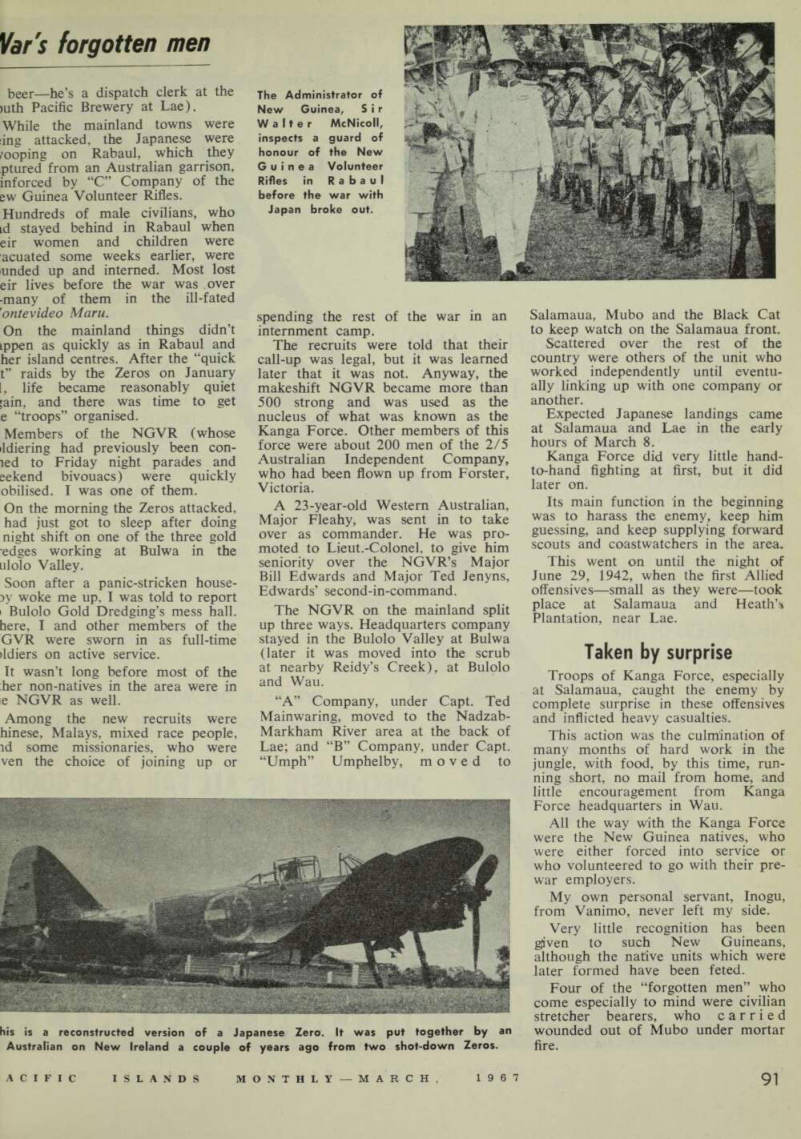
The Administrator of New Guinea, Sir Walter McNicoll, inspects a guard of honour of the New Guinea Volunteer Rifles in Rabaul before the war with Japan broke out.