The Month's New Reading
pp. 97-98 · Read in the full issue
Story Of Epic
Drift Voyage
In Open Boat
The Month's New Reading
On the morning of October
4, 1963, we were all going
uietly about our business at the
acific Islands Monthly office
hen a telephone call came from r ila, which set our pulses beat ig somewhat faster than usual. call was from our old friend, L Reece Discombe, Vila’s in ffatigable handyman and its nearest iproximation to a public informa- Dn bureau.
Reece had the details of a thrilling ory. Three starving, emaciated en had just arrived in Vila from rromanga after surviving a voyage f a couple of thousand miles in an ien boat with little food or water.
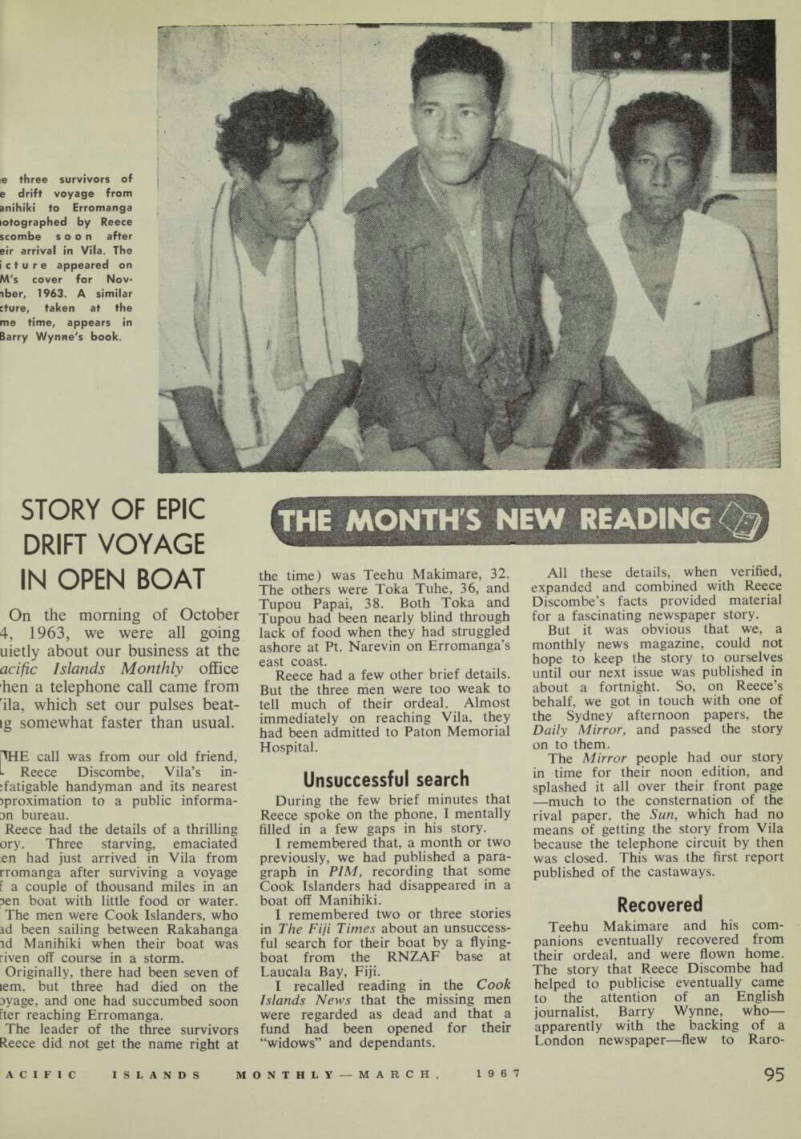
The men were Cook Islanders, who ad been sailing between Rakahanga id Manihiki when their boat was riven off course in a storm.
Originally, there had been seven of lem, but three had died on the Dyage, and one had succumbed soon [ter reaching Erromanga.
The leader of the three survivors Reece did not get the name right at
the time) was Teehu Makimare, 32.
The others were Toka Tube, 36, and Tupou Papai, 38. Both Toka and Tupou had been nearly blind through lack of food when they had struggled ashore at Pt. Narevin on Erromanga’s east coast.
Reece had a few other brief details.
But the three men were too weak to tell much of their ordeal. Almost immediately on reaching Vila, they had been admitted to Paton Memorial Hospital.
Unsuccessful search
During the few brief minutes that Reece spoke on the phone, I mentally filled in a few gaps in his story.
I remembered that, a month or two previously, we had published a para graph in PIM, recording that some Cook Islanders had disappeared in a boat off Manihiki.
I remembered two or three stories in The Fiji Times about an unsuccess ful search for their boat by a flying boat from the RNZAF base at Laucala Bay, Fiji.
I recalled reading in the Cook Islands News that the missing men were regarded as dead and that a fund had been opened for their “widows” and dependants.
All these details, when verified, expanded and combined with Reece Discombe’s facts provided material for a fascinating newspaper story.
But it was obvious that we, a monthly news magazine, could not hope to keep the story to ourselves until our next issue was published in about a fortnight. So, on Reece’s behalf, we got in touch with one of the Sydney afternoon papers, the Daily Mirror, and passed the story on to them.
The Mirror people had our story in time for their noon edition, and splashed it all over their front page —much to the consternation of the rival paper, the Sun, which had no means of getting the story from Vila because the telephone circuit by then was closed. This was the first report published of the castaways.
Recovered
Teehu Makimare and his com panions eventually recovered from their ordeal, and were flown home.
The story that Reece Discombe had helped to publicise eventually came to the attention of an English journalist, Barry Wynne, who— apparently with the backing of a London newspaper—flew to Raro-
[?]e three survivors of [?]e drift voyage from [?]anihiki to Erromanga photographed by Reece scombe soon after eir arrival in Vila. The
[?]cture appeared on
M's cover for Nov ember, 1963. A similar [?]cture, taken at the me time, appears in Barry Wynne's book.
tonga to interview the three voyagers to obtain material for a book.
Subsequently, the Royal Humane Society of New Zealand awarded a gold medal to Makimare for his leadership and courage on his epic voyage; and the Royal Humane Society of Great Britain gave him its 1964 Stanhope Medal for Bravery— the highest yearly award for bravery in the British Commonwealth.
For the latter award, Makimare was flown to London in December, 1965, to receive his medal from the Duke of Gloucester. He was also presented to the Queen. Simul taneously, one of the London Sunday newspapers began serialising Barry Wynne’s book which was called The Man Who Refused to Die.
Book Society choice
In June last year, Wynne’s book became the alternative choice of the Book Society for that month.
Copies of the book have now reached Australia. It is a short (158page) book, which tells in detail what The Guardian, of London, has described as “one of the most re markable sea stories of all time”.
It is told in simple, but often exciting language; and it is one of those books, which, once started, is hard to put down.
There are only one or two things to carp at, Reece Discombe gets no credit for three pictures of the survivors which he supplied; and the author seems to have made no effort to check on the authenticity of several geographi cal names mentioned in his narrative.
Dillon’s Bay, Erromanga, for example, has come out as Tallons Bay. Tanna (or what is apparently meant to be Tanna) has come out as
Tauna.-
RL.
(The Man Who Refused To Die.
Souvenir Press. $2.65.)