[?] Stormy Passage
pp. 91-93 · Read in the full issue
Discoverer of the Solomons in 400th anniversary trouble
For Don Alvaro
De Menda
By a staff writer
In Honiara, capital of the ritish Solomon Islands Pro
jctorate, Captain Don Alvaro
e Mendana, the Spaniard who iscovered the Solomons in Feb jary, 1568, has always been
eld in pretty high esteem. At
;ast, I used to think that he was ecause of the number of places nd businesses named after him.
CHE main street, for example, is called Mendana Avenue; the >wn’s main hostelry is the Hotel lendana; there’s an electrical firm died Mendana Electrics; and there’s Iso a Mendana Enterprises (SI) td., which goes in for planting and isurance agency work.
But just as you can never tell a □ok by its cover, so you can’t really ;11 how many friends Mendana has i Honiara from the amount of attery he gets in the local nomen lature.
Memorial proposed
This is evident from a perusal of le minutes of the BSIP Legislative Council meeting in Honiara in >ecember, when almost every second lember got “stuck into” poor old lendana, even though there may lever have been any Solomon slands if it hadn’t been for him.
It all began when Mr. Macdonald Western Solomons) suggested that, s the 400th anniversary of Men lana’s discovery of the Solomons was oming up soon, Mendana should be ;iven “twice if not 10 times” the >rominence he now had, and that he government should contribute
“dollar for dollar” towards a fund to build some kind of memorial to him.
Mr. E. V. Lawson (Honiara) retorted that Mr. Macdonald’s sug gestion was “a load of rubbish,” and he said that if anyone was to build a monument to Mendana, the Spanish people should do it.
Mendana, Mr. Lawson added, was a “cruel and vicious man,” who came to the Solomons to enslave the people and enrich himself so that he could become a grandee back hom£.
Mr. Mariano Kelesi (North Malaita) agreed that Mendana was cruel. In fact, he said that all sailors who went to the Solomons were cruel.
But he respected Mendana for having put the Solomons on the world map, and he suggested that a statue should be erected to him at his land ing place at Point Cruz (Honiara).
The statue, Mr. Kelesi added, amid laughter, should have one arm point ing towards Malaita.
Father J. M. Wall, one of the nominated unofficial members, re buked Mr. Lawson for his “in temperate and unfair” views on Mendana, and added that he thought that a memorial fund would be sup ported by a number of local organisa tions.
However, Miss Lily Ogatina, a Solomon Islander representing the
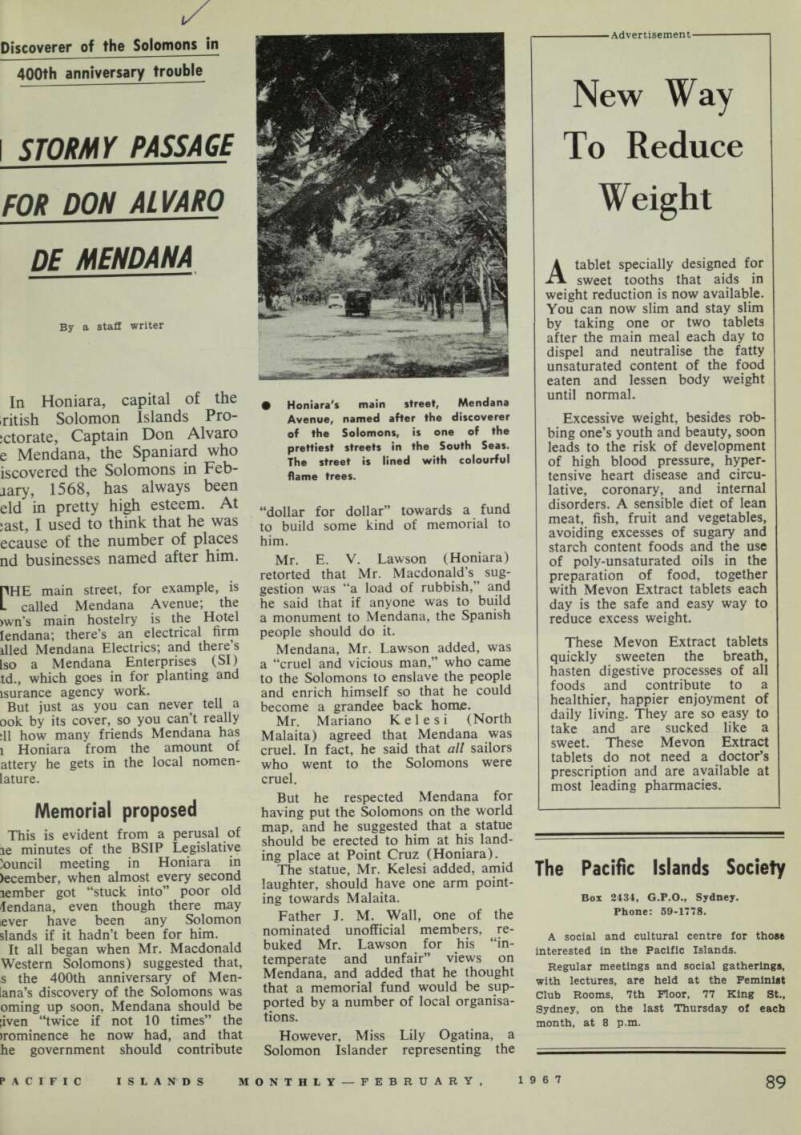
Honiara's main street, Mendana Avenue, named after the discoverer of the Solomons, is one of the prettiest streets in the South Seas.
The street is lined with colourful flame trees.
Central Solomons, was not keen on the idea of the British putting up a memorial. Like Mr. Lawson, she thought that if anyone was to do anything about it, the Spaniards should; and she was all for dropping the whole problem into the lap of the Spanish Government.
The Chief Secretary, Mr. L. M.
Davies, was rather inclined to play down Mendana’s achievements when he spoke, although he said, in effect, that the government would give its blessing to anyone who wanted to commemorate the explorer in some way.
Mr. Davies said it was a fact that Mendana had given the Solomons their name; that he was the first European to have come to the islands as far as was known; and that he had died in Santa Cruz.
More remarkable
However, other people had come to the Solomons before Mendana did, and they had probably made even more remarkable voyages.
Mr. Davies went on to say that the government was not lacking in a sense of history and it would not deny any genuine feeling that there might be to commemorate the Spaniard’s voyage.
Nevertheless, he had been sur prised to hear Mr. Kelesi speak in favour of a commemoration, as he (Davies) had previously received a letter from him saying that none was necessary.
Mr. Davies wondered also whether any monument to the explorer should, in fact, be at Point Cruz when Mendana’s first landing had taken place on the island of Santa Isabel.
At this point, Mr. Davies took the skids from under any member who may have had hopes of the govern ment helping to pay for a Mendana memorial, for he said that although the government might give some “modest encouragement” to “any groups or organisations with the zeal and energy to get things done,” he did not think that this would be in the form of money.
Mr. Davies added that the govern ment proposed to commemorate Mendana’s discovery with a special issue of postage stamps—and with that, the debate on the subject closed and the council dispersed for Christ mas.
All in all, there doesn’t seem to be much chance at this stage of any statues going up to Mendana at Point Cruz or anywhere else—with or without the right hand pointing in the direction of Mr. Kelesi’s electorate.