Prehistoric
p. 93 · Read in the full issue
Who Was Hiu's
Michaelangelo?
By Robert Langdon
The work of a prehistoric artist, who painted handprints on the ceil ing of a cave at Hiu, New Hebrides —just as Michaelangelo painted madonnas on the Sistine Chapel ceil ing in Rome —has been “discovered” and described for the first time by an American archaeologist, Dr.
Richard Shutler.
HIU is the northernmost of the four small Torres Islands of the New Hebrides, which lie due north of the large island of Espiritu Santo.
The four islands have only a couple of hundred people. They were almost unknown to Europeans until about 60 years ago, and even today they are seldom visited.
Dr. Shutler, who arrived in the New Hebrides several months ago to continue an archaeological survey of the Group which he began in 1964, visited Hiu in the Melanesian Mission vessel Selwyn in mid- October with Archdeacon D. A.
Rawcliffe, who had seen the cave
paintings previously.
Dr. Shutler told me in Vila in December that he did not know when the paintings (pictographs) were first seen by Europeans, but he believed it was only a few years ago.
He said the cave containing the pictographs was on the northern most tip of Hiu, which is about 8 miles long by 31 across. It was of coralline limestone, about 25 to 30 feet above sea level, and with a large opening. The cave was 60 to 70 feet deep, and its ceiling was
about 70 feet high. Nearby was a larger cave with a smaller opening, which was full of bats.
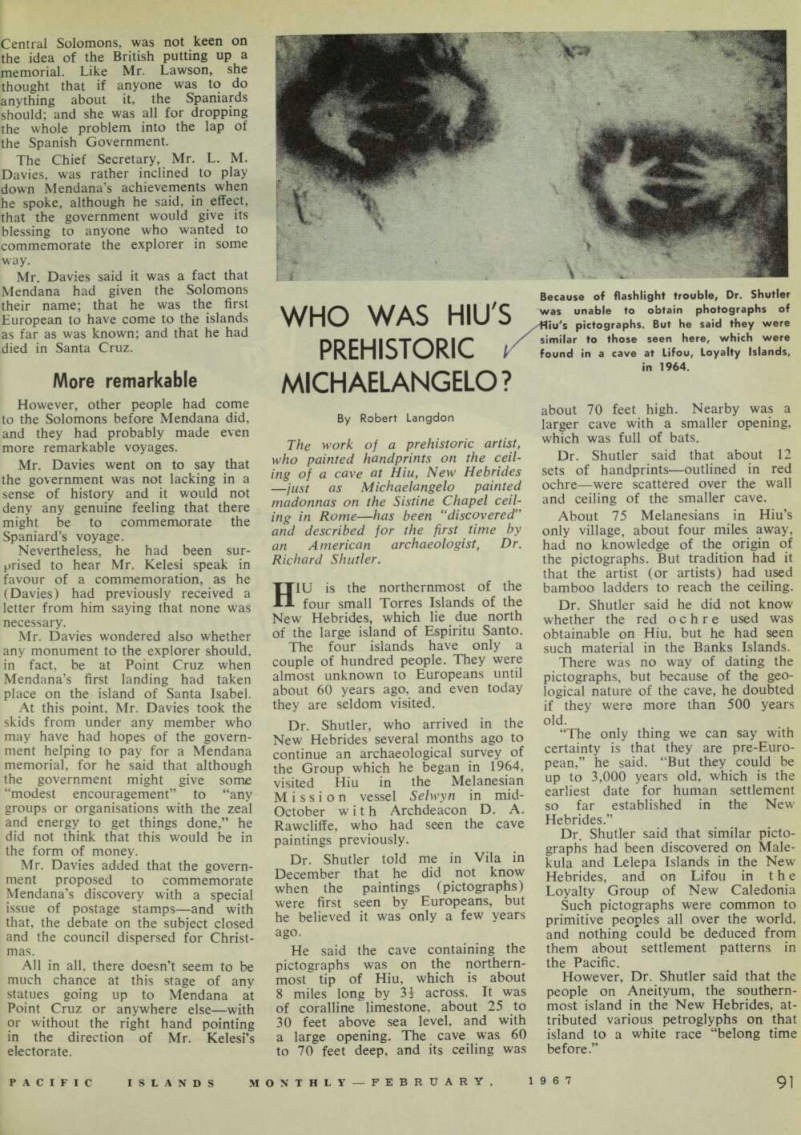
Dr. Shutler said that about 12 sets of handprints—outlined in red ochre —were scattered over the wall and ceiling of the smaller cave.
About 75 Melanesians in Hiu’s only village, about four miles away, had no knowledge of the origin of the pictographs. But tradition had it that the artist (or artists) had used bamboo ladders to reach the ceiling.
Dr. Shutler said he did not know whether the red ochre used was obtainable on Hiu, but he had seen such material in the Banks Islands.
There was no way of dating the pictographs, but because of the geo logical nature of the cave, he doubted if they were more than 500 years old.
“The only thing we can say with certainty is that they are pre-Euro pean,” he said. “But they could be up to 3,000 years old, which is the earliest date for human settlement so far established in the New Hebrides.”
Dr. Shutler said that similar picto graphs had been discovered on Male kula and Lelepa Islands in the New Hebrides, and on Lifou in the Loyalty Group of New Caledonia Such pictographs were common to primitive peoples all over the world, and nothing could be deduced from them about settlement patterns in the Pacific.
However, Dr. Shutler said that the people on Aneityum, the southern most island in the New Hebrides, at tributed various petroglyphs on that island to a white race “belong time before.”
Because of flashlight trouble. Dr. Shutler was unable to obtain photographs of Hiu's pictographs. But he said they were similar to those seen here, which were found in a cave at Lifou, Loyalty Islands, in 1964.