Sulphur Deposits
pp. 88-89 · Read in the full issue
"Not Worth
Exploiting"
By Robert Langdon
Vanua Lava’s sulphur de posits are too difficult of access, too difficult to extract, and too small in extent to be worth exploiting commerci ally, according to Mr. Arthur
Warden, Senior Geologist in
the Geological Survey in Vila,
who examined the deposits in 1963.
THIS is also the opinion of Dr.
C. V. G. Phipps, lecturer in economic geology at Sydney University, who evaluated the deposits for D. J. Gubbay and Co., of Santo, in 1962.
Mr. Warden told me in Vila in December that when he visited Vanua Lava, he saw only 30 mounds of native sulphur, the largest of which were about eight feet high and 12 feet in diameter at the base.
These were distributed over an area of hot ground extending about a quarter of a mile along the northern side of the Sulphur River and about 200 yards up the slope.
Vents at summit
Gas and steam issued from vents at the summits of these mounds, around the mouth of which the sulphur had crystallised.
“It is on account of this mode of occurrence that it seems im probable that the sulphur may occur in quantity at depth, as has been suggested,” Mr. Warden said.
“The sulphur crystallises as the gas cools in contact with the atmosphere, building up mounds above the ground. Below the surface crust in many places is an emulsion of mud and boiling water.
“Dr. Phipps inadvertently put his foot through this crust when he visited the deposit and incurred extensive burns.
“It is evident that the sulphur present below ground level occurs in solution or in the escaping gas and not in the form of a solid deposit.”
Mr. Warden said that the
statement by T. J. McMahon, quoted in PIM in October, that Vanua Lava was “one huge mass of pure sulphur from ocean shores to summit” was presumably meant to be taken figuratively rather than literally.
He also thought that the quoted figure of 15,000 tons was an “extremely optimistic” estimate for the size of the island’s surface deposits; and he saw all sorts of barriers to exploiting such deposits as do exist.
Labour, he said would have to be brought in from other islands; a large capital outlay would be required to build a cableway to the coast over extremely rugged terrain; and lighters or special loading gear would be required because, except for Sola on the south side of Port Patteson, there was no spot on the eastern coast which was not exposed to the south-east trades.
Malarial
Mr. Warden pointed out also that Vanua Lava was far from free of tropic ailments, and he made it clear that it was no place for cissies.
“Vanua Lava is malarial,” he said. “The mosquitoes are parti cularly virulent along the east coast, where operations would be staged if the deposits were worked, especially in the fringing man grove swamps, one of the rare haunts of crocodiles in the New Hebrides.
“Moreover, Vanua Lava con tains some of the most rugged terrain in the Group. The slopes of Suretamati, the main mountain peak in the north of the island, are incised by deep radial gorges.
“Rainfall is higher than in most of the islands of the Group, pro bably exceeding 200 inches a year.
“It gives rise to even deeper vegetation than elsewhere in the New Hebrides. A meshwork of creepers festoon the trees and form a matting over the forest canopy in places.
“The vegetation is so thick that it took a Geological Survey field party 15 minutes per 100 yards over long stretches to cut tracks beyond the head streams of the Sulphur River.”
In short, Mr. Warden gave the thumbs down for mining sulphur on Vanua Lava, and he indicated that the locals would almost certainly be sticking to copra for the time being.
Nalglatac, and there was some pre rugged country in between.
In those days for me, this was jj a stroll. I was only 31 then and had been scarping around t mountains in Gippsland, Vaniko and New Caledonia for the previo 10 years as a timber cutter.
Carrying a 60 lb pack I could the climb up from the beach— miles—inside an hour, and run do’< again in the afternoon with my nat:; helpers for another load of supplies?
It was a different matter when I we up there with my sponsors, Mess Dunstan and Richards. It took whole day to do the trip, and I Ir visions of them passing out on t way up. But what with pushi behind, and pulling on the hands a£ knees sections, we got there.
Impatient
(I guess I was a somewhat ii patient young chap in those dai But now when I think of it all* wouldn’t feel so confident mys? about getting up there without a f«: stops to “admire the view”).
When we arrived, I introduc them to the kunai- roofed shac. boiled the billy, and had a meal o of tins.
Then the rains came—it rains abo 300 days a year up there—and whc we retired to our respective can stretchers, it dripped steadily throut the reed roof.
I can still recall Richards sittii up with his umbrella over him 100 ing like Hamlet’s ghost.
Two days of that dampened tt exploratory spirits of Richards as his partner, and they departed, nev to be seen again, leaving me like s shag on a rock for nine monti without any wages.
In Noumea, incidentally, the tv:
(from previous page)
icn had shown me a document, or tie, which they had got from some Id woman in Melbourne, showing tat the natives of Vanua Lava, and articularly Nalglatac village, had fid all their rights to the sulphur rea.
It was a typical agreement ot lose days—so many bolts of red dico, a keg of nails, etc., and (1 m still remember it) a framed Drtrait of Queen Victoria.
Syndicate
A couple of years after the unstan-Richards episode, I was down i Sydney, where I got involved with syndicate called the Pacific Minerals development Company, and I went ack to Vanua Lava with promises f a manager’s job, plus shares in te company.
I sank hundreds of prospecting Dies containing black sulphur for ic syndicate; and I had to supply ly native workmen with rubber sea Dots for the job because of the heat.
The boots, though, didn’t give them luch protection when a jet of steam mrted out on their backsides.
At weekends, the natives would il take off for the village of falglatac and leave me alone on uretamati. But sometimes I would et fed up and make the big trek own the hills, through five miles of langroves, and all the way round ort Patteson to where my wife (one f Frank Whitford’s daughters) and aughters were stationed at Sola lantation, which belonged to “Tibby” lagen.
Pacific Minerals’ venture on Vanua ,ava must have cost at least £5,000 efore it fizzled out. Then BHP came ito the game in 1934, sending up ne of their mining engineers, K. C.
'hurch, to investigate the pos ibilities.
He camped with me for about two weeks, on the edge of the deposits, and didn’t feel very comfortable at nights with the ground pulsating underneath his bamboo bed.
That was the end of the general interest in sulphur, for by 1934 it was only worth about £5 per ton, and the job of mining it, and getting it down to Nalglatac Bay for ship ment would have been prohibitive.
Some time after Church’s visit, the deposits caught fire and all that could be seen from across the bay were huge clouds of smoke. I made a special trip to Nalglatac, where the natives were very frightened, and went up to the top.
The whole area was ablaze with streams of molten sulphur rolling downhill into the river, where it solidified in great slabs.
There were also thousands of dead birds scattered all over the place, evidently caught by the fumes.
The only reason I can give is that it was all started by a lightning strike.
My final farewell to the Vanua Lava sulphur came in about August, 1934, when I took off in the old Makambo for Vila to catch the Morinda to Sydney.
When I got there, I went down with a dose of blackwater fever, which, if I had contracted it two weeks earlier, would have been the end of me.
Despite everything, Vanua Lava and its sulphur deposits still have an enormous attraction for me, and trying to get them out is the only proposition that I would like to tackle again.
I should mention, though, that there is more than just sulphur on top of Vanua Lava. There are vast beds of ochres, for example. I dis covered a waterfall at 2,000 ft which was the confluent of two streams running over beds of red and blue ochre—it was most impressive—and there is a great crater about 1,500 ft deep.
When I first saw this, it was half full of water flowing out through a hole in the side, and the Nalglatac natives said there was a patch of hot water out at sea off their village.
Yet when I saw the crater again it was dry and I walked on the bed of it and it was covered with great slabs of kaolin.
Vanua Lava is a strange place.
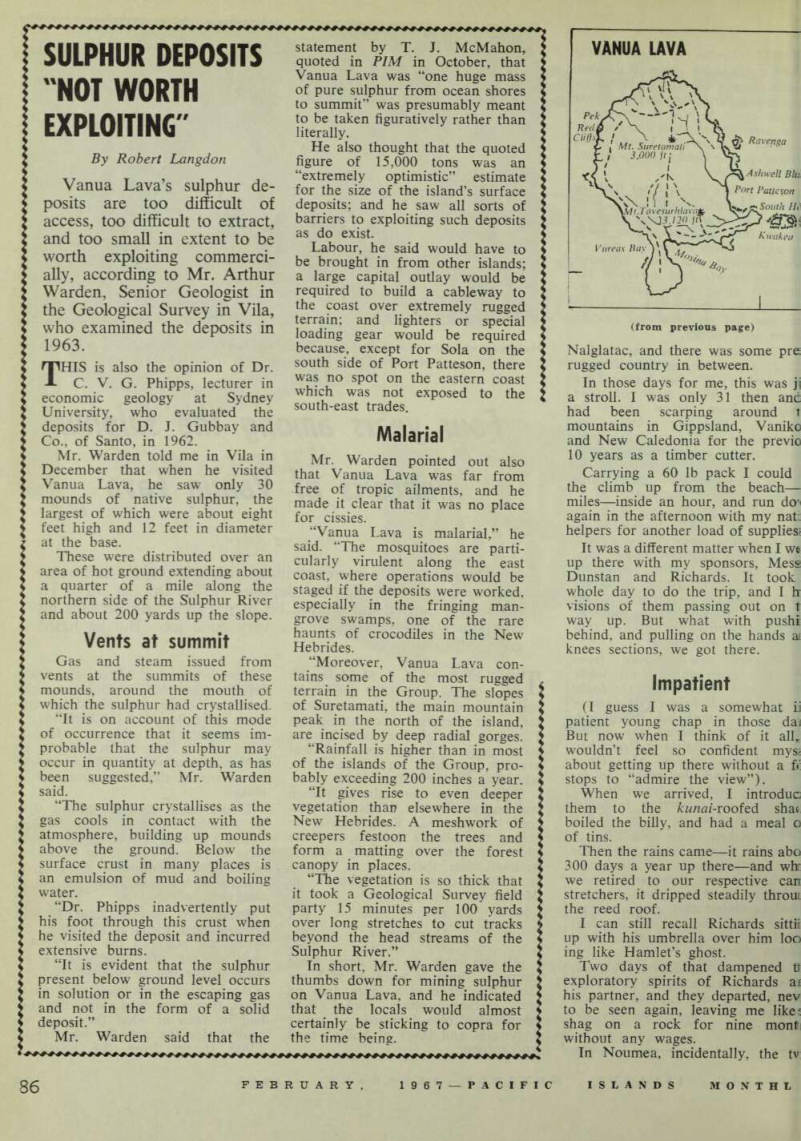
Doug Askew (left) and his team of native workmen are seen here at a camp site on the edge of a crater on Vanua Lava's main mountain range, which rises to more than 3,000 ft. The crater was about 600 ft deep.
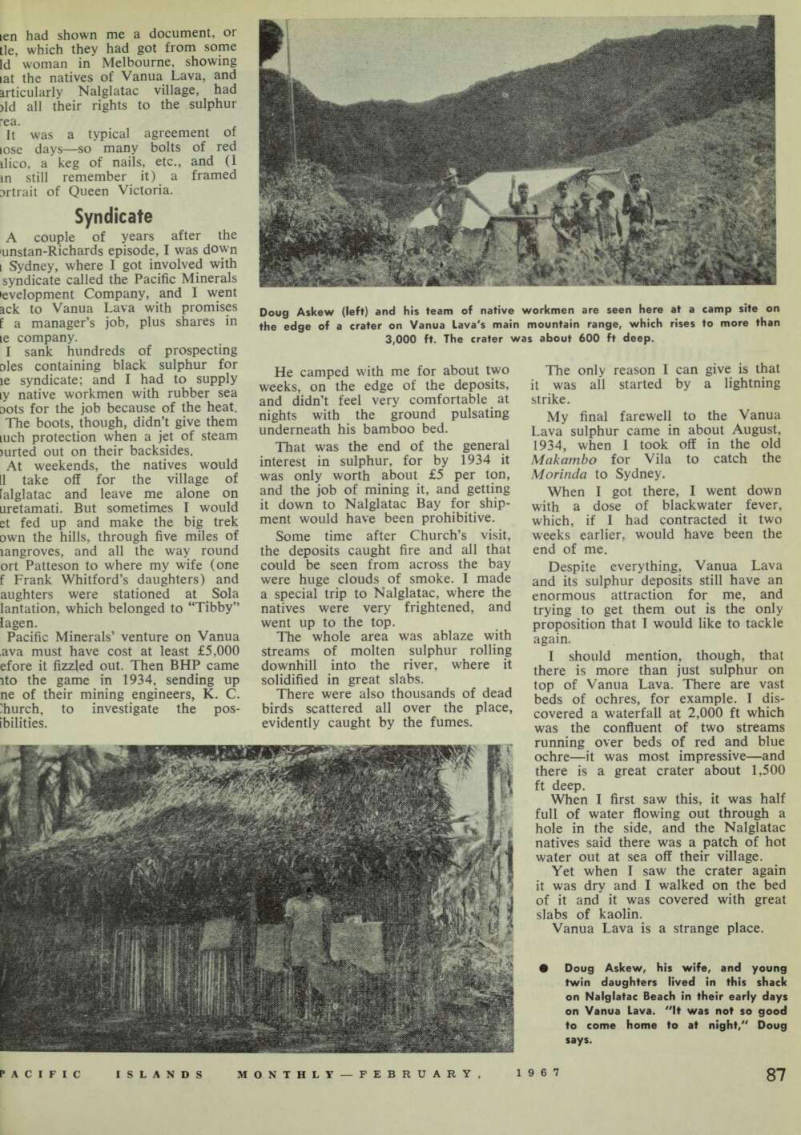
Doug Askew, his wife, and young twin daughters lived in this shack on Nalglatac Beach in their early days on Vanua Lava. "It was not so good to come home to at night," Doug says.