Tuna, Japanese-Style,
pp. 63-65 · Read in the full issue

Adventurous
French Raftsmen
Show How
It's Done
They've Been Catching
Tuna, Japanese-Style,
In The Cook Islands
From W. H. Percival in Rarotonga
Two adventurous Frenchmen from Tahiti, the brothers Michel and Alain Brun, have recently completed a 12-month survey of the commercial possibilities of long-line tuna fishing in Rarotonga waters.
THEY made the survey for a New Zealand company, Greggs Ltd., Dunedin, which has a fruit juice canning factory on Rarotonga operated by a subsidiary company, Island Foods Ltd.
It is believed that the Bruns have found enough fish in Rarotongan waters to make commercial fishing a success —a discovery that should be of great interest to the fish starved Rarotongans.
The Brun brothers are commercial fishermen with five years of scientific fisheries research behind them. They are also veterans of a couple of trans pacific Kon-Tiki style raft voyages.
They made a study of tuna migra tions in French Polynesia before coming to Rarotonga with the fishing boat Hakua Nui.
The Hakua Nui, which they sold to Island Foods Ltd., was built for them in Japan. The name, in Tahitian, means “big marlin,” a reference to a monster black marlin
which the Bruns caught 15 miles out of Papeete.
The marlin put up a terrific fight, and towards the end, when the brothers were trying to tie it to their boat, it smashed a big hole in the hull. Their boat, Puaotu, began to sink—and then their engine failed.
Luckily, an island schooner had appeared on the scene and two of the crew helped to make temporary repairs. Meanwhile the captain of the schooner had the marlin hoisted on board his ship.
It weighed 1,320 lb, which is a world record according to Michel Brun.
The brothers spent four years in experimental fishing out of Papeete with the Puaotu, then they went to Japan to learn long-line tuna fishing.
The Japanese, who invented the long-line technique, are still the only nation to use it successfully. It is a very difficult technique to master.
In Japan, three years’ training is required for ordinary seamen engaged
in this occupation. Technicians, officers and fishing masters must graduate from fisheries universities.
Michel, who married a Japanese, learned to speak Japanese fluently and even to read it, and this helped him greatly in mastering the long-line technique.
He claims that he and his brother are the only Europeans to have carried out long-lining successfully.
This they did out of Tahiti after they had navigated the Hakua Nui from Japan.
They invented and manufactured some of their gear, including an automatic long-line hauler. Their dedicated work paid off handsomely.
Hard work
In five months they caught twice as many tuna as 97 other Tahitian fishing boats combined.
In 1962, a report on their activities, with photographs of their boat and home-made gear, was published in Long-Line Fishing in the South Pacific, a publication by the Japanese Government’s Fishing Research Agency.
Long-line tuna fishing, as practised by Japanese fleets operating in the Pacific, is very hard work indeed.
And it is with the Bruns, too.
When the Brun brothers go long lining they start at 3 a.m. and often do not return to port before 9 p.m. —an 18 hour day.
In Tahiti, they sold their catches
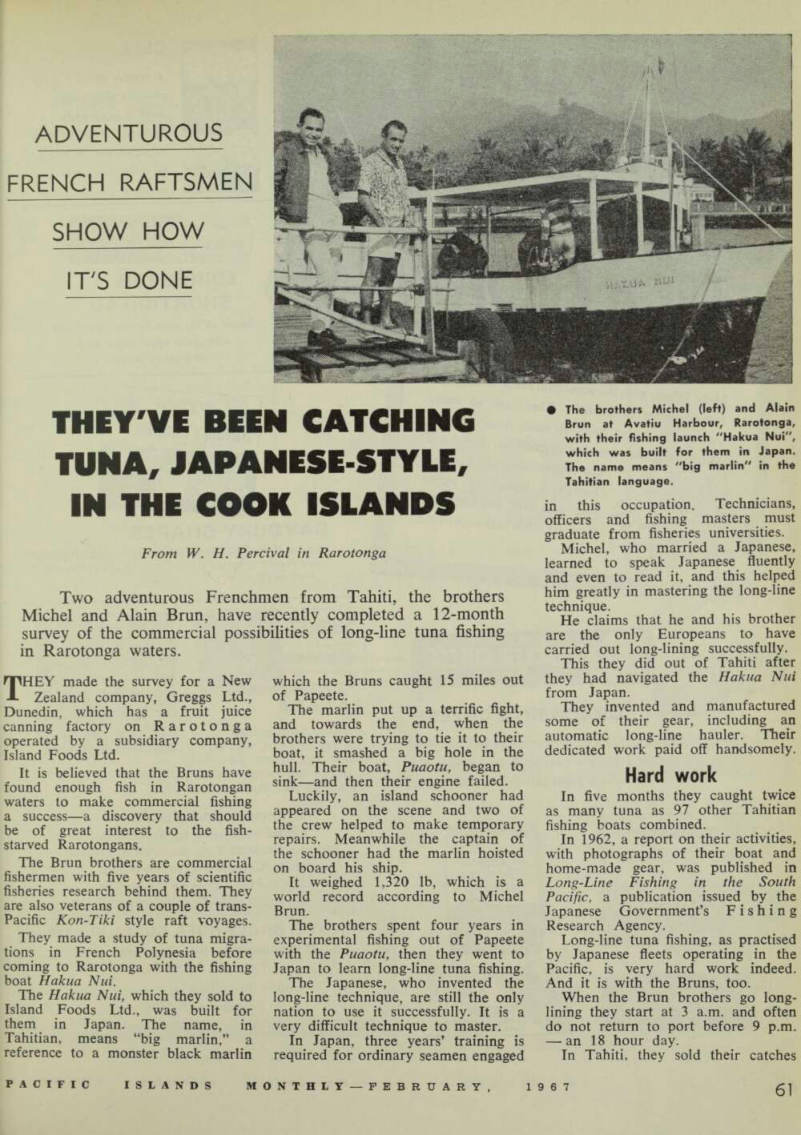
The brothers Michel (left) and Alain Brun at Avatiu Harbour, Rarotonga, with their fishing launch "Hakua Nui", which was built for them in Japan.
The name means "big marlin" in the Tahitian language.
to a local trader who retailed them at prices well below those for frozen fish imported from New Zealand.
Sometimes they catch very rare fish. One of the rarest was a Lophotes capellei which was sent to a South African museum. Others were the first “big eye” tuna caught in the Cook Islands, and the first lampris.
The two brothers have shared an adventurous past.
In Tahiti 10 years ago, they teamed up with the late Eric de Bisschop, an almost legendary French seaman, famed for his voyages in a variety of strange craft.
The Brun brothers helped de Bisschop to build a bamboo raft in which they set out for Chile to try to prove de Bisschop’s theory that the early Polynesians had made two way voyages between Polynesia and South America.
They were near Juan Fernadez island, only 600 miles or so from Valparaiso, when they were struck by a terrific hurricane.
A radio message to Valparaiso brought the Chilean frigate Baquedano to their aid.
The Baquedano took the raft’s crew aboard and the raft in tow. But the raft foundered some time later after covering 7,500 miles in 200 sailing days.
The Brun brothers are convinced that the Tahiti Nui could have reached Valparaiso easily if the hur ricane had not overtaken them.
Second voyage
One experience of this sort would have been enough for most men, but Eric de Bisschop, although in his mid-sixties, was determined to at tempt a similar voyage from Peru to Tahiti.
Aided by Alain (but not Michel) Brun and some other young adven turers, he built a new raft of Chilean cypress logs, which was named Tahiti Nui 11.
The voyage began in mid-February, 1958, when the raft was towed 10 miles from the Chilean coast and set adrift.
Forty-one days later it reached Callao, Peru, from where it set off for Polynesia in mid-April.
A week after leaving Peru the radio failed. Months later the raft became so waterlogged that the deck ing sank three to four feet below the surface and the crew had to sit on top of the deckhouse. A much
smaller raft was then constructed from empty water tanks and the best remaining timber, and Tahiti Nui II was abandoned.
Storms drove the new raft off course and adverse winds and tides bedevilled the crew.
Finallly, with their food and water almost gone and their position desperate, they decided to try to land at Rakahanga Atoll, in the Northern Cooks. They sighted this island at 5 p.m. on August 30, 1958, after covering about 5,700 miles.
Waves carried them on to the reef at 8.30 that evening. The raft cap
sized on the reef, pinning them beneath it, but following waves broke it up, allowing all but de Bisschop to struggle clear. De Bisschop received fatal head injuries in the accident.
A few days later, a French mine sweeper, took the survivors and de Bisschop’s body home to Tahiti, where Alain Brun was reunited with his brother.
Alain later providedd much of the information for Bengt Danielsson’s book From Raft to Raft, telling the story of the South America-Raka hanga voyage.