[?]N Scientists'
p. 61 · Read in the full issue
[?]Un For Porpoises
[?]Ea-Bed Quest
From a Honiara correspondent A party of American scientists board the United States research essel Machias have recently dis
overed some fascinating infor
aation about the sea bed in the icinity of the Solomons, while
providing local porpoises with
»lenty of harmless fun.
CHE scientists are members of a 19-man team from the Hawaii □stitute of Geophysics who have een taking part in the geophysical urvey of the Solomons, which has ieen going on for the past four ears.
The survey has involved authori ies and institutions of four different lations, and the cost of it is now pproaching $2,500,000.
Wobbling satellites
One of the factors behind the urvey was the discovery that satel ites were inclined to wobble (or uffer orbital perturbations) when assing over the Solomons. This icinted to gravity anomalies in the rea, which, besides indicating pos ibly interesting deposits of minerals, re also of basic scientific interest.
To investigate the anomalies, urveys of the earth’s crust in the lolomons area have been made by everal different methods—the latest >y the scientists from the Hawaii institute of Geophysics.
They have been financed by the JS Office of Naval Research and lave been working aboard the ships, \iachias, California and Taranui.
The principal aim of their project las been to determine the velocities 3f transmission of shocks of earth quake energy through the crustal and nantle rocks beneath the sea.
To this end, explosions are made n the sea every few seconds, as the ship follows a traverse, and the echoes from the bed of the sea are picked up by hydrophones and recorded in the form of a continuous profile.
The energy of the explosions is sufficient to reach the bottom of the sea and penetrate the sediment a few thousand feet before being reflected
back to the surface by hard layers of bedrock.
The explosions are produced by a Sparker unit, powered by a generator, which releases 5,000 joules of energy into the sea, forming a football-sized bubble of gas just below the surface.
The gas in the bubble is a mixture of hydrogen and oxygen, and the heat accompanying this rapid elec trolysis is sufficient to spark the ex plosive mixture, which, being con fined and producing water again as its end product, “implodes” rather than “explodes”.
Most of the energy then released travels down through the water in the form of a shock wave.
Eerie bubbles
As the bubbles of incandescent gas are only just below the surface of the sea, they can readily be seen, especially at night.
At that time, the sea for a distance of about 100 yards, the ship itself, and the clouds overhead are illumi nated by an eerie blue light.
Porpoises have been intrigued by the phenomenon and have played to within a foot or two of the blue bubble without any harm.
The Machias took a Sparker profile of the sea bed recently when she sailed the 4,000 miles from Hawaii to the Solomons.
This revealed an astonishing pic ture of the sea bed approaching the Solomons—sediment more than a kilometre deep for vast distances, with distinct basins here and there, erosion features on the rises and finally the sudden, steep rise of the
underlying rocks in a series of faulted steps, kilometres high, with the islands on top.
The Sparker profile and other data obtained by the Machias will, when “fed” to computers, help to explain why satellites wobble when passing over the Solomons —among other things.
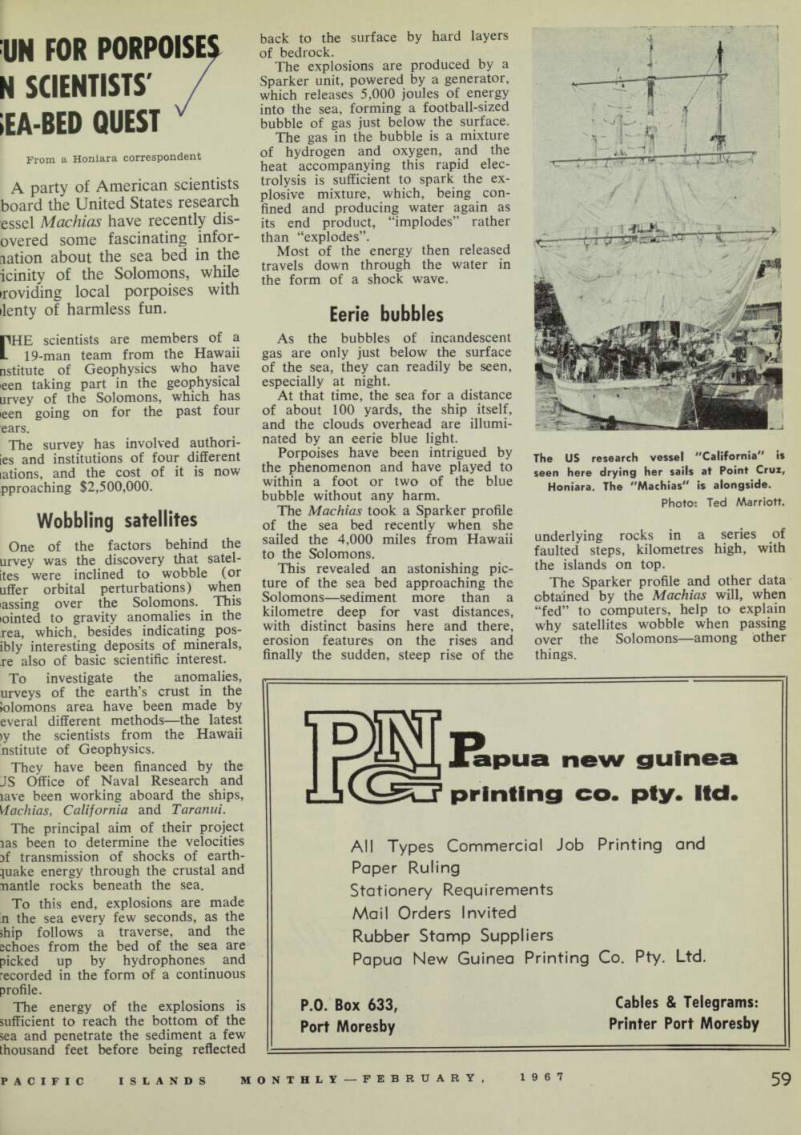
The US research vessel "California" is seen here drying her sails at Point Cruz, Honiara. The "Machias" is alongside.
Photo: Ted Marriott.