Takes Over
pp. 56-59 · Read in the full issue
Crisis Year Looms For
S.P.C. As New Secretary
By Stuart Inder
The 20th birthday of the South Pacific Commission and the arrival in Noumea of a new secretary-general early this year find the SPC at a point in its life when it has achieved .greater success in the South Seas than at any time, yet is faced with more serious problems.
THIS next year could be a crisis year, a year which decides whether the commission really comes of age.
The commission was born on February 6, 1947, as a result of an agreement signed in Canberra by Australia, France, the Netherlands, New Zealand, the UK and the US.
Its purpose was to “encourage and strengthen international co-operation in promoting the economic and social welfare and advancement of the peoples of the South Pacific region”, but as an advisory and con sultative body only.
The membership has changed little. The Netherlands left on December 31, 1962, following the loss of West New Guinea, and Western Samoa was admitted as a member on July 17, 1965, as a result of attaining independence.
TTiere have been some changes in the agreement and in various pro cedures since 1947, but the objects of the organisation have changed not at all. Political matters are still taboo, as they were 20 years ago.
Accepted
But in 20 years the SPC has be come generally accepted. There is not now the attitude of impatience to its work, and particularly to its travelling officers and experts, that there once was.
Busy public servants in the various Islands territories do not now run for cover when SPC men appear, or mumble rude comments to their col leagues about people with soft jobs.
Not generally.
The commission lately has been doing more competently what most of its member governments have always insisted it should be doing— offering worthwhile technical as sistance, and being a clearing house for territories seeking answers to social, economic and health problems commonly met with in the area.
The commission is saving the Islands time and money by investigat ing many of their problems for them, and virtually its only limitations are set by the reluctance or otherwise of territories to turn to the commission for help.
The commission each year discusses a growing number of proposals for technical meetings, seminars and training courses and selects those which it considers most useful.
In 1967 there are more than 20 courses or meetings arranged, includ ing courses in dental health, nutri tion, mental health, business methods., home economics, youth leadership, plant protection and animal hus bandry.
Technical meetings
There will be technical meetings to discuss the health problems of coral atolls, to discuss family plan ning, coconut and general agricul tural production, social welfare pro blems, South Seas trade relations, and the assessment of pupils for voca tional guidance.
Arrangements are being made to establish training schools in forestry, marine mechanics, and reef and marine fisheries.
A demographer is being appointed this year to help territories con duct and analyse censuses, and thus overcome one of the Pacific’s bigger worries—the lack of statistical in formation to enable effective plan ning to be carried out. A year or two ago a medical statistician was appointed.
The commission is continuing other work started earlier, such as the publishing of basic readers in English for schools, and work on environ mental sanitation, plant production and protection (including an in vestigation into the Rhinoceros beetle menace) urbanisation problems, fish eries, rat control and many more.
Of special practical interest an the experiments in the developmen of solar stills to supply drinkim water for small communities. Fiw territories are co-operating on this.
The budget for this year’s won totals £5tg362,793, which is sum marised this way:
The member governments provid money each year in these propoi< tions: Australia, 32 per cent.; US, 2< per cent.; UK, 17 per cent.; NZ, 1J per cent.; France, 14 per centf Western Samoa, 1 per cent.
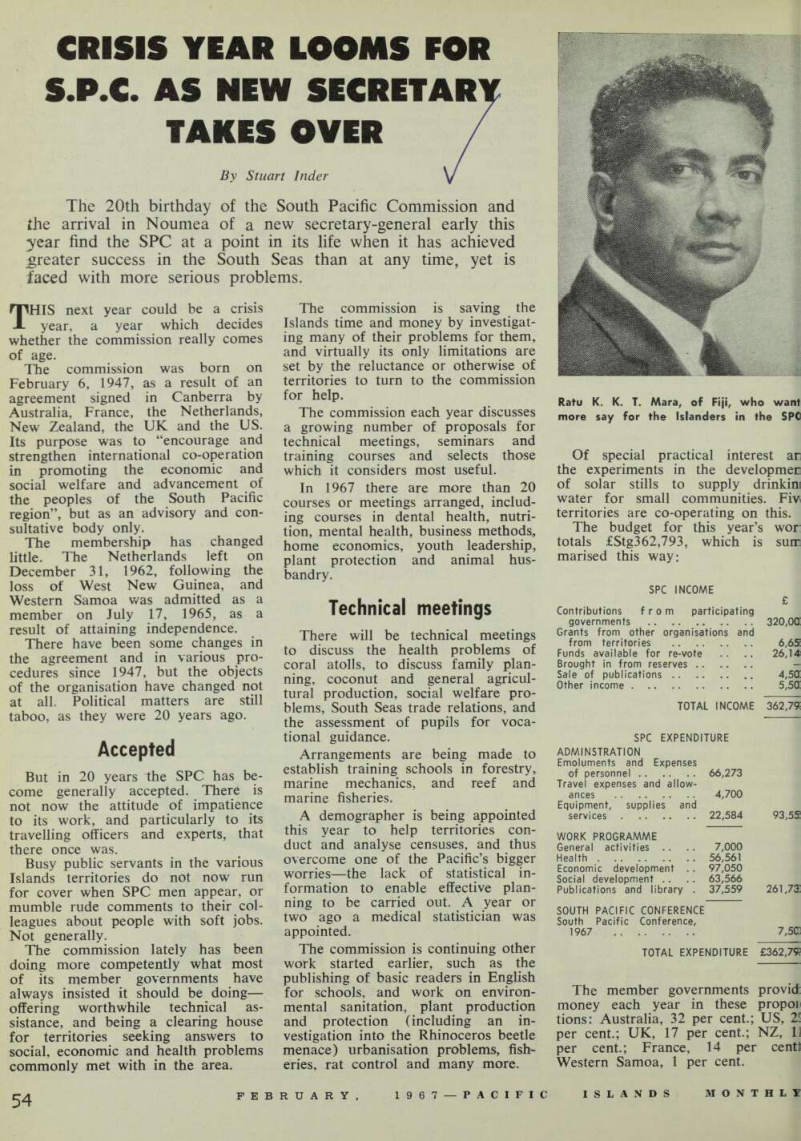
Ratu K. K. T. Mara, of Fiji, who want more say for the Islanders in the SPO
Spc Income
Contributions from participating governments Grants from other organisations and from territories Funds available for re-vote Brought in from reserves Sale of publications Other income t 320,0(1 6,655 26,14 4.50 5.50
Total Income
362,79;
Spc Expenditure
Adminstration
Emoluments and Expenses of personnel Travel expenses and allowances Equipment, supplies and services 66,273 4,700 22,584 93,552
Work Programme
General activities Health Economic development ..
Social development Publications and library . 7,000 56,561 97,050 63,566 37,559 261,732
South Pacific Conference
South Pacific Conference, 1967 7,50
Total Expenditure
£362,79?
Not a lot of money comes from international agencies (FAO, UNESCO, etc.) but this generally suits the SPC membership, who rear that they could otherwise be swam ped by richer organisations and lose control of their projects. The SPC is a small organisation with limited funds, and huge amounts could not be spent easily.
A point, too (which has been dis cussed at meetings) is that America already puts a great deal of money into international organisations and if some of these funds were used more widely by the SPC, the US would in fact be contributing a dis proportionate sum to the work of the commission. Already its contribution is high compared to what it is reap ing from the SPC.
Much of the progress in technical aid has been made during the three year term of Mr. W. D. Forsyth as secretary-general. His term expired on December 31 and he is now back in Canberra with the Department of External Affairs. Greater co-operation has followed from the specialised agencies during his term.
A secretary-general is not, of course, a policy-maker. It is his function to carry out the policy of the commission as laid down by its members.
Australia's attitude
Nevertheless a secretary-general can steer the commission in many small ways, and leave an imprint on the whole organisation by the way he handles developing problems, and by the way he visualises the com mission’s role.
Undoubtedly Mr. Forsyth, an Aus tralian, has been in sympathy with Australia’s attitude to the SPC, which is that it is a technical as sistance body that should not ex pand in any other direction.
The new secretary-general, Sir Gawain Bell, may well take a wider view.
Sir Gawain was appointed as a result of Britain’s nomination, and Britain has been unhappy with many aspects of the commission. It feels that it is not keeping pace sufficiently with changing circumstances.
This attitude was brought into the open—although with far more force than the British Government itself would have done—at the South Pacific Conference in Lae, New Guinea, in July, 1965.
The man who did it was Ratu K. K. T. Maru, Leader of Govern ment Business (embryo Premier) in Fiji’s new Government.
Ratu Mara undoubtedly spoke for
the Islanders, as distinct from their metropolitan governments; and, as he said, the Islanders are the people who matter if the SPC is to have a future.
At Lae, Ratu Mara described the commission as “an exclusive club” for the metropolitan governments, which was out of date.
Each government was trying to inculcate the idea of self-government in its own territory, he said, yet it refused to have anything to do with politics in the SPC. It should be teaching politics.
"Fact of life"
“Politics is a fact of life and we cannot hide it or ignore it,” he said.
He, and others, pointed out that under the present agreement, quali fication for membership of the SPC was independence, but a number of territories did not want independence and thus they would have no say in SPC affairs.
The Cook Islands, which have internal self-government, are a case in point, and so is Fiji.
There isn’t any doubt that the leaders in Fiji and the Cooks regard themselves as equally responsible in
political matters, and in solving economic problems, as the leaders of independent Western Samoa, bolstered as it is by New Zealand.
Yet Western Samoa is a full member of the commission and also has voting rights at South Pacific Con ferences.
Ratu Mara wants some formula worked out to enable territories to have a greater say in what goes on in the commission—to be able to say what they think, even if that means talking politics.
There has been no significant changes in the Commission since that attack was launched in 1965.
At the 29th session of the SPC in Noumea last October Ratu Mara brought up the matter again, but was soon faced with a blank wall in France’s direction and gave up. The French do not want any enlarge ment in the role of the SPC.
What Ratu Mara needs is a lead from the most active members, Aus tralia and New Zealand, and he hasn’t been getting it.
They are ultra-conservative to the point of being dangerously narrow, and not until they widen their vision will there be any progress with the
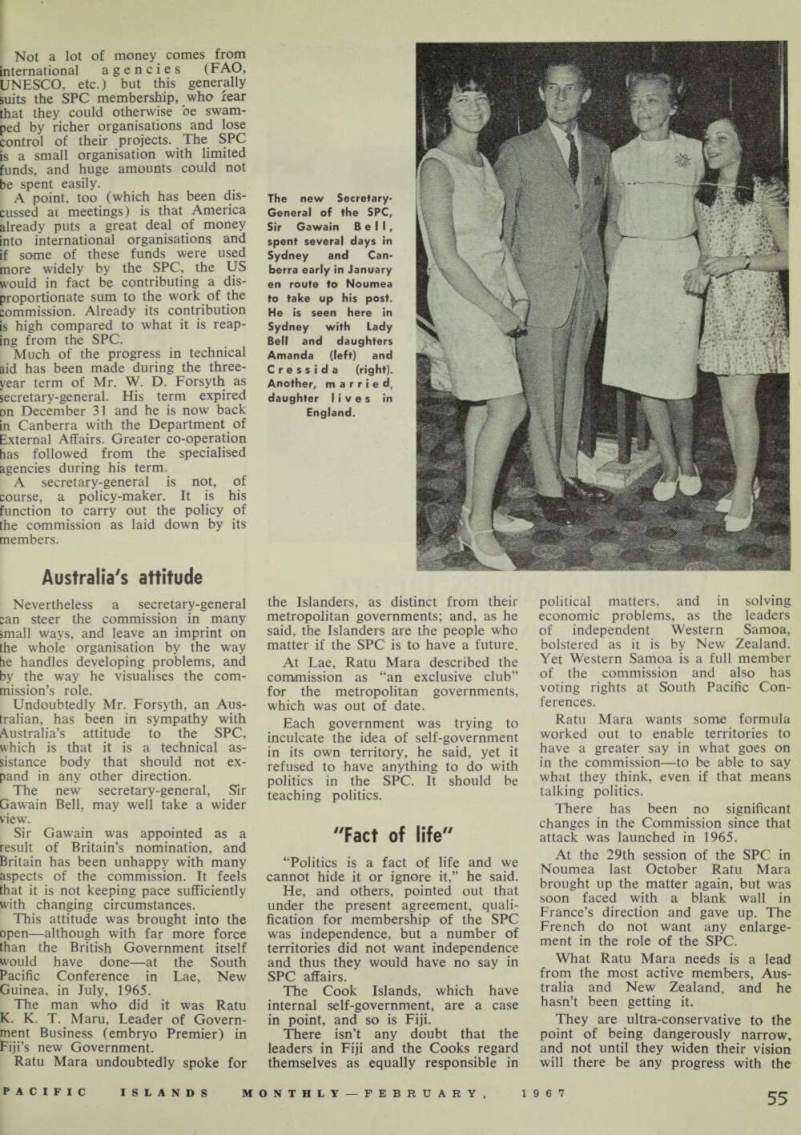
The new Secretary- General of the SPC, Sir Gawain Bell, spent several days in Sydney and Can berra early in January en route to Noumea to take up his post.
He is seen here in Sydney with Lady Bell and daughters Amanda (left) and Cressida (right).
Another, married, daughter lives in England.
Dlitical problems the commission is ow facing.
America is anxious to help, but oesn’t know how. American deie ates come a long way to attend PC sessions, and always go away rustrated, wondering what their role 5. Their interests in the Pacific re not large and they don’t want d rock the boat any more than it i being rocked now. But they are nhappy.
Western Samoa has not been a lember long enough to have any olicy. It reflects the New Zealand iewpoint.
All the pushing has been done by tritain, and Britain will continue to iush. Like America, Britain is not □re exactly what must be done but : does know that changes must come, ,nd thinks they could be along the ines expressed by Ratu Mara.
When Britain’s last Secretary of fate for the Colonies, Mr. Fred Lee, isited the South Pacific a few months go ( PIM , Sept., p. 10) he tried to ;et greater co-operation in the British sector, and this has already ►orne some fruit.
Well primed
In Sydney last November, follow ng the October session in Noumea, op SPC delegates from Britain, New Zealand and Australia got their heads ogether to discuss exchange plans ind various other ways the commis lion could be made to work better or their own ends.
The meeting was strictly private.
Nothing emerged of shattering sig lificance, but it was a start. More ievelopments will follow, but it is mportant that Australia takes up Britain’s lead.
There isn’t any doubt that the new iecretary-general. Sir Gawain Bell, is well primed on British attitudes, and it is reasonable to assume that tie is sympathetic to them.
He is an extremely intelligent, widely experienced administrator with the easy manner and faultless social graces of the British diplomat.
In the time he spent in Canberra and Sydney en route to Noumea in lanuary he impressed a wide range of men connected with Islands affairs, including top businessmen, academics and old-hands.
“He listens,” as one man explained it, with some surprise.
Sir Gawain Bell will be secretary general when the SPC turns 21 next year. He is a man who might well help it come of age.