The Editers' Maillag
pp. 53-55 · Read in the full issue

A New Hebrides Red Cross
Sir, — The Condominium flies two flags and all things must be duplicat ed. Fair enough. But, when it comes to the Red Cross, with two separate French and British committees, each raking in whatever can be squeezed out of backward peoples, this is carrying things too far!
The Red Cross knows no nationa lity and, as far as people in the New Hebrides are concerned, it should remain that way—uncomplicated and un-political. If it is to be given a name, as most countries do to show that they are helping the good inten tions of the society and contributing their lot, then the Red Cross in our islands should be known as the New Hebrides Red Cross.
Perhaps our two governments are worried about dividing the spoils of a joint Red Cross should one or the other decide to move out. If so, then it would show a poor sporting spirit.
Surely, Britain and France are above quibbling over a few meagre hundred pounds which their respective Red Crosses are able to draw out of the public occasionally, when committee ladies find spare, energetic moments.
Madam X.
Santo, New Hebrides.
Unhappy Samoans
Sir, —I have waited for your November issue to see what kind of response Robert Langdon’s article on American Samoa “All That Glit ters . . would bring. The conflict ing views you published were well chosen; now may I add an additional two-bits worth?
Having been a serious student of the social and economic revolution in the South Pacific for two decades I can speak with some authority. For months I have lived on the tiny islands that make up a part of the Mariana, Marshall, Gilbert, Ellice and Samoan Groups. It has been difficult to stand back and see what my [the American] Government has done, albeit in good faith, to the simple unspoiled peoples of these areas.
The impact of our “giveaway pro grams” on the native population has resulted in tragic loss of interest.
In one case the native people have gone so far as to forget how to
maintain plantations for their own survival.
My real interest, however, has been the Samoas. My association with these people has been a very close one, going back to 1950.
Currently there are two Samoans living with me, going to school. It is my sincere desire to see that their education will help to bring some order out of the chaos that has come to their families during the past few years. Their education, I hope, will not only be from books and by rote, but also an education in the customs and morals of my people for, after all, if Samoa is to be a haven for the tourist, then the Samoan people must be prepared.
I speak their language well and am in daily contact and discourse with the largest “out of Samoa population” in the world.
It is obvious that the Samoan people are not happy with happenings in their country and to their culture and language. Futhermore, they are confused and don’t quite understand.
My leaders seem to forget the simplicity of their original way of life (not socially, incidentally) and they have no basic understanding of the ways of the people.
I am not a “tripper” either, but then who of us could be. when, even as an American citizen, I must prove a need to remain on the islands for more than 21 days and have to present a return trip ticket before landing? And this is the self-same
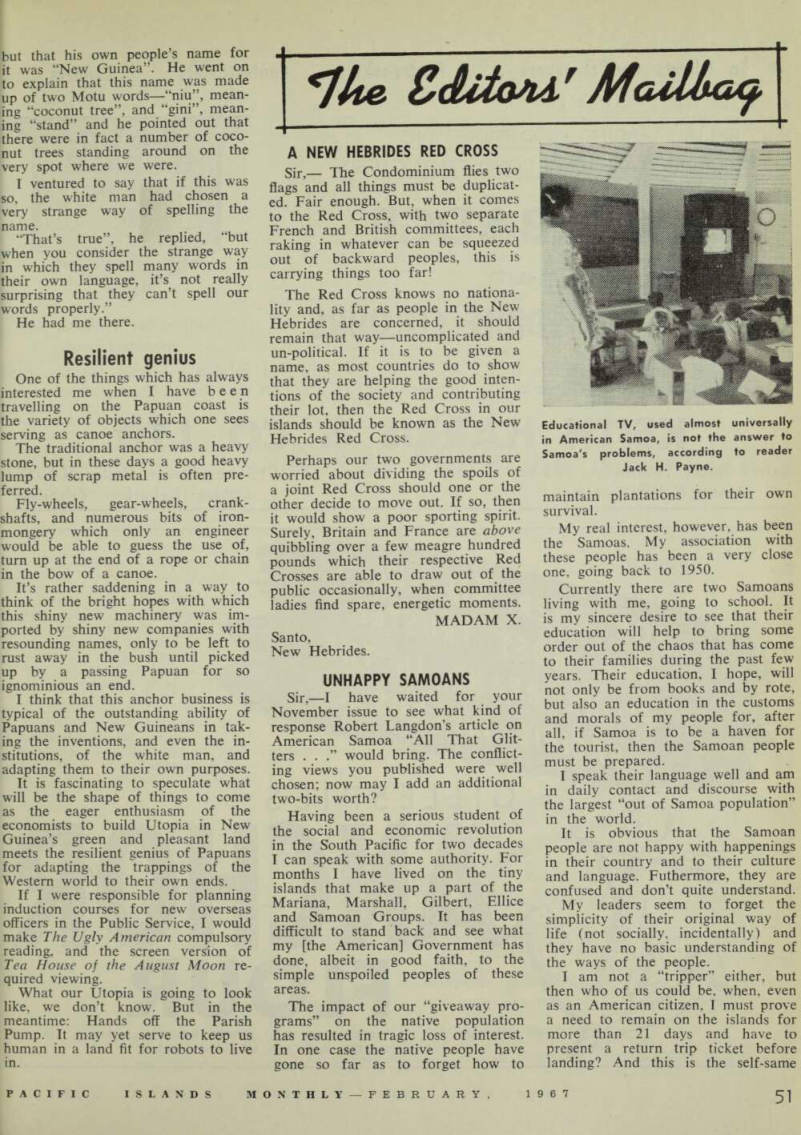
Educational TV, used almost universally in American Samoa, is not the answer to Samoa's problems, according to reader Jack H. Payne.
government my tax dollars are help ing to support.
How may I get the Governor’s ap proval for a stay of more than 21 days, when the Governor does not give such approvals. Mrs. Otto’s statement {PIM, Nov., p. 34) is correct. Those of us who really want to help and be a part of the orderly progress of the Samoans are not permitted to do it.
I, too, find it incredible that Governor Lee has been able to prevent criticism of his management of American Samoa for so long. He has, on the contrary, received a good press on the Mainland, and even articles like yours would not be favourably received by our editors.
Even in Washington it is difficult to find an understanding ear.
My wish is that those of us who are really interested in a planned, slow, understood-by-the-Samoans way of progress toward the 21st century could get our ideas into print, along with Lee’s.
It would be good if those who administer the Islands would spend more time studying history, and in particular our 50th State over the past 100 years, including the Office of Governor. There is overwhelming evidence of history repeating itself.
And what has happened to the Hawaiian, his native speech and way of life? How many of your readers have heard REAL Hawaiian music, seen real Hawaiian dancing or at tended a real native feast?
Even at the Polynesian Cultural Center, it has been doctored for the benefit of tourism, and in the country of Hawaii the native practices have completely vanished.
If the administration of the Samoans is, as it portends to be, interested in protecting the Samoan way of life, then the teachers such as Mr. Stoltz ( PIM, Nov. p. 34) had better get busy and change or we will have another proud, magnificient and truly self-sufficient people gone from our midst—and herein lies the real pity.
As modern man we can learn so much from those people who spent ages refining their way of life, free from outside influences.
They were happy; now it’s despair and anxiety, the great social sicknesses of our age, and educational television certainly is not the answer.
Jack H. Payne.
P.O. Box 664, San Francisco, California.
Profitable Reading
Sir, —Looking at our sea-sprayed, slightly mouldy-smelling and well thumbed copy of your invaluable publication. Pacific Islands Year Book, I can honestly wonder what we should have done without it on our 11-month cruise of the South Pacific.
My husband and I, as well as our children and crew members, have profited enormously by reading ahead about the groups and specific islands at which we have called on this voyage. We have never had less than 11 persons aboard our yacht, Sans Souci, during the trip, so try to imagine the last-minute grab and scramble to read about a certain island as soon as we sighted land!
The Year Book often gave help ful information not even included in the Sailing Directions for the area.
We have also enjoyed the Pacific
Islands Monthly very much and found it the only way to keep track of other cruising yachts and new friends we met along the way at various harbours and ports. And, of course, the news coverage of current events in the South Pacific gives one a better insight for understanding the ways in which it is growing and, perhaps regrettably, changing.
This is the final leg of our voyage, having left Honolulu on December 3 for San Pedro, California, our home port.
After calling at over 40 islands in the various groups we are already dreaming of some day revisiting the New Hebrides, where we had many interesting experiences and were pleasantly surprised at their beauty.
(Mrs.) Betty Schiff
Yacht Sans Souci At Sea, en route to San Pedro, California, USA.