To The Point
pp. 47-53 · Read in the full issue
With
Percy
Chatterton
As an elected member of the House of Assembly of the Territory of Papua and New Guinea, I am tired of being told that I mustn’t be parochial in my outlook. I am not only tired of it. I resent it.
*OR one thing I resent the debase ment of a fine old English word, and I am not at all placated to find it the Oxford English Dictionary pports this debasement. For another, don’t think that it’s good advice.
After all, a parliamentary con tuency is a sort of parish, and its scted member has a duty to be con med for its welfare. In the case the P-NG House of Assembly, the ligenous members are in almost ery case natives of their “parishes”.
Unlike the situation in Australia or itain, where the “member” is all 5 often an outsider foisted on the ictorate by a party machine, here Papua-New Guinea he is gener y a son of the soil.
He was born and has grown to mhood in the electorate he now presents. He has lived among its ople and shared their way of life.
Sons of the soil
This may not continue to be so. lere may come a time when many the electorates will be represented members of an educated and phisticated elite who have grown ray from and no longer understand sympathise with the life of the lage or the resettlement area.
Whether the fact that they will be tter able to cope with the mass of per that accumulates on the parlia
jntarian’s desk will adequately
mpensate for this disability remains be seen.
Anyhow, at present our indigen es MHA’s are sons of the soil. They e deeply concerned for the welfare their people. And why shouldn’t ey be?
Of course, they mustn’t stop there —and they don’t. They must look beyond the welfare of their “parishes” to the welfare of the territory—and they do.
On the whole, I think that they do pretty well in balancing the needs of their own electorates against the needs of the territory as a whole.
Sneers about “parish pump politics” are quite uncalled for.
Incidentally, many members of the House would be only too thankful to have a few pumps in their parishes.
Most of their people don’t even have that much. They get their water from open wells and water holes, or run ning streams.
I repeat that most indigenous members do realise that they must look at things from a territoiy-wide viewpoint, and are doing their best to do this.
But to expect them to give a hearty “aye” to schemes which mean in effect that their kith and kin will be
Hands off the parish pump!
left to stagnate in poverty and squalor while others more fortunate in their terrain advance along the road to prosperity is to ask too much of human nature.
We need a dash of the parish pump in our politics to keep us human.
Especially just now, when our more cold-blooded economists are telling us that we must sacrifice everything to top-speed economic development.
Sentimental nonsense
Every effort must go into the de velopment of areas of maximum economic potential. Those of a lesser economic potential must be by-passed; the fact that they are inhabited by human beings with a yearning for a better way of life is of no importance.
Even the kids must be sacrificed.
The ideal of universal education is just sentimental nonsense.
What we need to do is to calculate in advance just how many doctors.
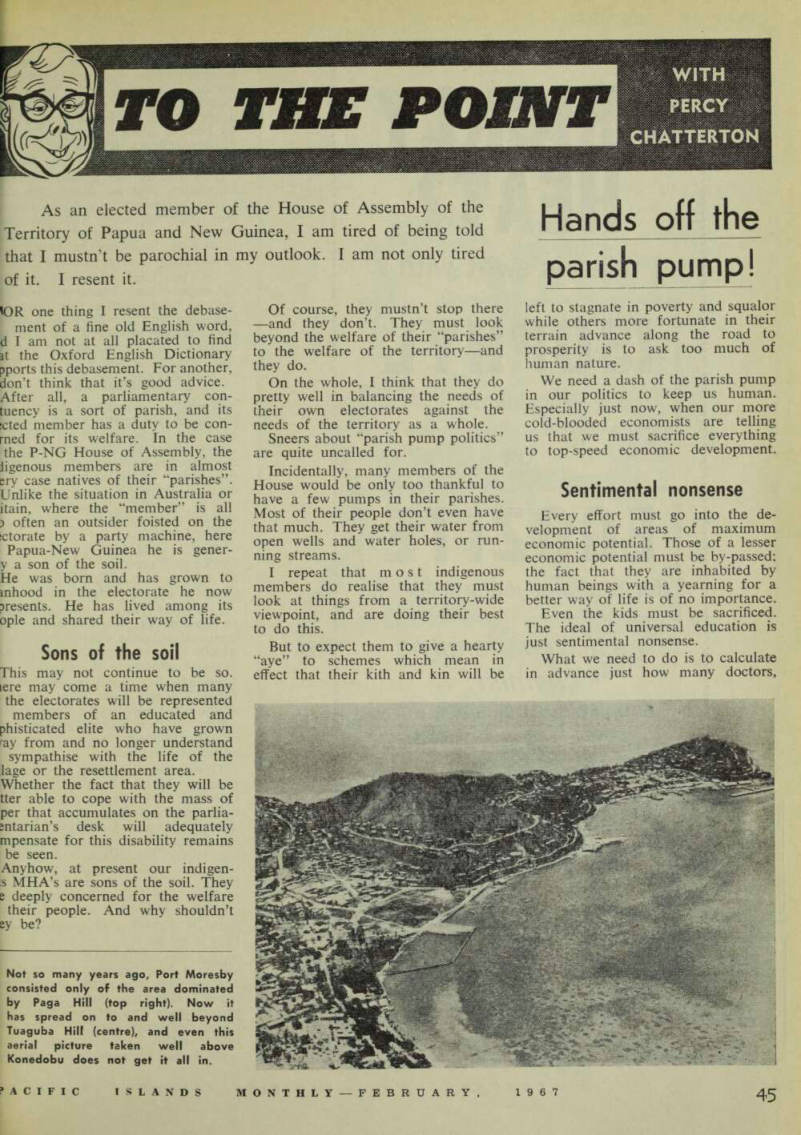
Not so many years ago, Port Moresby consisted only of the area dominated by Paga Hill (top right). Now it has spread on to and well beyond Tuaguba Hill (centre), and even this aerial picture taken well above Konedobu does not get it all in.
teachers, lawyers, engineers, sc veyors, accountants —and, of com economists—we shall need, and thr working backwards and allowing “wastage” at each stage, arrive at figure for the number of six-year-a we need to admit to the prep, clas of our primary schools to get tl output at the other end of the facte This sounds like a fairly diffic calculation, but no doubt the ell tronic computers can do it for And once we know what the nu ber is, it would be foolish sei mentalism to offer the benefits education to a larger number.
To be fair, our top territ* economists and educators are i quite so hard-boiled as this. But wh there are any around who advoc: such devilish doctrines, what I • is: Hands off the parish pump.
National unity
Nowadays, our administrators a politicians are loudly proclaming i need for “national unity”. What sometimes overlooked is the fact tl the churches have been quietly woi ing away for three-quarters of century in this field, beginning at t bottom, at village level, and world upward towards district, regional a national levels.
Perhaps this is a better way tackling the problem than starting at the top with a synthetic natioi anthem, and working downwards.: For many years I was responsil for guiding the life and work ofi group of village churches in an ai which covered several tribal a linguistic groupings.
Periodically, representatives of t village congregations came togetll at the local mission headquarters confer on their mutual problems, co-ordinate their work, and to pi united action.
During the day, they met in co ference. In the evenings, they their hair down by lamplight or fii light in the village street or t mission compound, singing, danci and miming, not as a single gra but village by village, each singi its own songs and dancing its o T ' dances to the enthusiastic applau of those who had already made thi contribution to the entertainment at those who were still awaiting thi turn to do so.
Was this unity? Or should tk all have been wearing Beatle ha dos and Hawaiian shirts and playit phony Polynesian music on Spanij guitars made in Japan? I think tH it was not only unity, but the b« sort of unity.
Of course, it’s possible to carry tl;
oca! rules
►rt of thing too far, as when at le stage it was found difficult to :omote inter-village netball, because ic women and girls of each village id their own local rules.
Talking of local rules reminds me [ a very odd one I once came across, [y predecessor on that particular ission station had been an en msiastic cricketer and also a jdicated gardener. The cricket ound was bordered on one side by lugh bush, and on the other by the issionary’s garden.
Under this gentleman’s coaching, cal cricket had reached a high andard. But his divided loyalty had d to the curious local rule to hich I have referred. A lusty dpe into the bush scored six. But similar swipe into the missionary’s irden put the batsman out.
Getting back to unity. My illus ation was drawn from the field 1 fun and games, but it does perhaps ake a point, or even two.
The first is that the only sort of lity likely to succeed amid such diversity of tribes and cultures as s have in New Guinea is one tiich accepts and uses this diversity, ping to find out how each group n make its appropriate contribu >n to the common good.
In the second place, there is plenty evidence from other parts of the arid to suggest that a unity im >sed from the top, or left as a gacy from colonial administration, unlikely to survive the strains and resses of independence. The only sting unity is one that grows )wards from village to district to gion to nation.
Not all my Papuan friends see eye eye with me on this. Many think at regionalism would be a ndrance to national unity. I believe at it could be a stepping stone to itional unity.
Delightful word
I have lost count of the number names proposed for the Territory, om Paradesia onwards. The one at intrigued me most was Newpap.
Tiat a delightful word!
Frankly, I don’t think that it ould do as the name of the one mdred-and-somethingth member of e United Nations. But as a de ription of some of the schemes wised by the Department of Terri ries it is superb.
For instance, what better code ime could be found for the latest lan for a reconstructed Public irvice than Newpap?
Papuans and New Guineans who
Filipino example
feel that with the coming of inde pendence the territory must have a lew name have perhaps been direct ing their gaze too exclusively oward Africa. They might do worse han look north instead of west.
Not long ago I had the privilege if meeting a charming woman eacher from the Philippine Islands.
Phis group of islands was discovered md colonised by the Spaniards, and lamed after a Spanish king—King Philip 11.
I don’t know what sort of a ruler ting Philip II was, but if only a fraction of what we read in our listory books is true, the Spaniards were, as colonisers, a pretty harsh md brutal lot.
Yet this highly educated Filipino ady, who was no doubt familiar with the history of her country, ippeared to find no embarrassment in alking about “my country, the s hilippine Islands”, and even spoke )f our national language, the Filo >ino language”, referring presum ibly to Tagalog, the principal ver lacular of the islands.
It seems to me that if the numer >us tribes which make up the popula ion of the independent Republic of he Philippines can get along as well is they do with the name given to hem by their Spanish discoverers, here should be no real difficulty in >ur making do with “New Guinea”.
As a dyed-in-the-wool “Papuan”, ’ shall naturally regret the passing )f the name “Papua”. But at least ve do all pronounce “New Guinea” n the same way.
How do YOU say it?
How do you pronounce “Papua”?
Do you say PAH-pooer? or Pah -s<DOer? or Parp-youer? Or Papp fouer?
Personally I say Pah-pooer, and in ieference to Melanesian practice 1 try to avoid throwing a strong stress an either syllable.
But I know one very distinguished erritorian who, after many years in ;he territory, still says Papp-youer, with the same sort of dogged de termination with which Winston Churchill insisted on calling his memies Narzies when everyone else was calling them Nahtzies.
As I say, we all pronounce “New Guinea” in the same way. And it’s an easy word for New Guineans to pronounce. In fact, it could easily be a New Guinean word.
When I was still a fledging terri torian, I was taken in hand by a bright young Hanuabadan who ex plained to me that “Papua” was the white man’s name for his country,
but that his own people’s name for it was “New Guinea”. He went on to explain that this name was made up of two Motu words —“niu”, mean ing “coconut tree”, and “gini”, mean ing “stand” and he pointed out that there were in fact a number of coco nut trees standing around on the very spot where we were.
I ventured to say that if this was so, the white man had chosen a very strange way of spelling the name.
“That’s true”, he replied, “but when you consider the strange way in which they spell many words in their own language, it’s not really surprising that they can’t spell our words properly.”
He had me there.
Resilient genius
One of the things which has always interested me when I have been travelling on the Papuan coast is the variety of objects which one sees serving as canoe anchors.
The traditional anchor was a heavy stone, but in these days a good heavy lump of scrap metal is often pre ferred.
Fly-wheels, gear-wheels, crank shafts, and numerous bits of iron mongery which only an engineer would be able to guess the use of, turn up at the end of a rope or chain in the bow of a canoe.
It’s rather saddening in a way to think of the bright hopes with which this shiny new machinery was im ported by shiny new companies with resounding names, only to be left to rust away in the bush until picked up by a passing Papuan for so ignominious an end.
I think that this anchor business is typical of the outstanding ability of Papuans and New Guineans in tak ing the inventions, and even the in stitutions, of the white man, and adapting them to their own purposes.
It is fascinating to speculate what will be the shape of things to come as the eager enthusiasm of the economists to build Utopia in New Guinea’s green and pleasant land meets the resilient genius of Papuans for adapting the trappings of the Western world to their own ends.
If I were responsible for planning induction courses for new overseas officers in the Public Service, I would make The Ugly American compulsory reading, and the screen version of Tea House of the August Moon re quired viewing.
What our Utopia is going to look like, we don’t know. But in the meantime: Hands off the Parish Pump. It may yet serve to keep us human in a land fit for robots to live in.