From Apprentice To
pp. 67-69 · Read in the full issue
Manager, Fiji Licks
'Em Into Shape
From a Suva Correspondent
Fiji, like other territories,
albeit unwillingly, is heading for independence. But unlike some, she is making the paddles with which to paddle her own canoe.
THE paddles are the technical skills which frequently offset the mistakes of the politicians. They are being shaped mainly at Suva at the Derrick Technical Institute and in a wooden hut at the rear of the Labour Department.
The operation carries the typical civil servants’ label—Localisation Training. But there is no red tape about the job, which is being done by the Departments of Labour and Education.
It’s a kind of three-decked opera tion, with the Fiji Apprenticeship Scheme on the ground floor, schemes for training job supervisors in the middle, and training for management at the top.
Since the Apprenticeship Scheme was established in 1963, it has taken more than 500 registered apprentices under its wing.
Allowing for apprenticeship com pletions and terminations, it now
embraces nearly 400 apprentices in training from 33 different employers.
There is nothing hit and miss about the operation.
Training is controlled by the Ap prenticeship Council, which was set up by law in 1965.
In many remote villages in the bush, students burn the midnight kerosene with overseas correspon dence course lessons arranged by the Industrial Training Officer, Mr. Basil Townsend, who, for years, did much the same thing in Africa.
City-dwelling apprentices go to “night school”, a familiar sound in the United Kingdom, Australia and New Zealand, but a stranger to Fiji until now.
Employers are co-operating by allowing their apprentices time off during the day to go to the Derrick, which, in the last three years, has grown into the largest and most modern technical college in the South Pacific. As others attend evening classes, the institute is now running almost 24 hours a day.
Administration of the scheme and supervision of “on the job” training is done for the Apprenticeship Council by the Labour Department.
A boon for the apprentices, whose pockets are far from full, is a tool allowance scheme.
The apprentices have to buy trade tools from a list prepared by the council, and in return they qualify
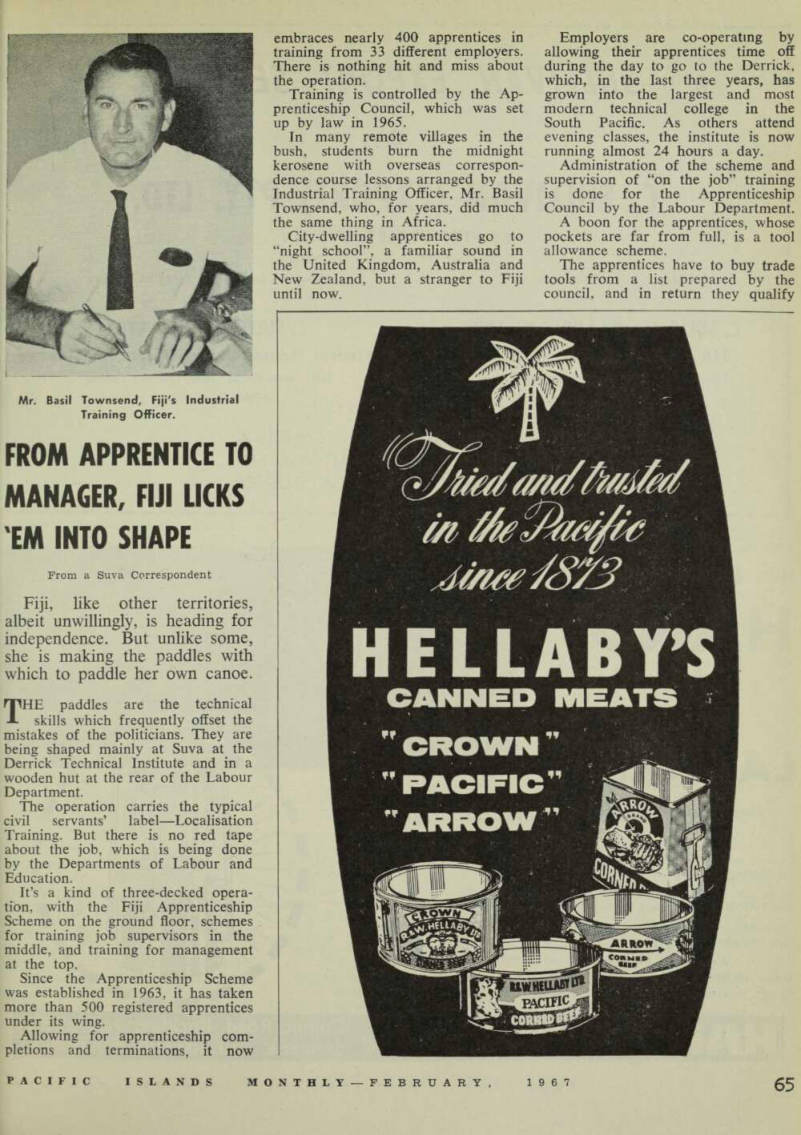
Mr. Basil Townsend, Fiji's Industrial Training Officer.
for a Government tool allowance to offset the cost. In this way, the ap prentices build up worthwhile sets of tools for very modest outlays.
The Apprenticeship Council keeps them all on their toes with a hustling promotion programme which is devised to extend the scheme still further.
Employers, apprentices and schools are supplied with “digest” booklets which explain in basic terms the intricacies of the apprenticeship legislation.
There are apprenticeship exhibi tions —one vies with the cows for popularity at the Fiji Show —and “open” days at the technical institute, all designed to attract more ap prentices and more employers.
There are talks by Labour officials to school leavers and advisory panels which untangle the snags.
Many of the Colony’s top com mercial and industrial brass sit on the panels and keep them down to earth.
The Apprentices’ Council hands out certificates to apprentices who have successfully carried out their trade courses and apprenticeship contracts.
These, in time, will be the open sesame to a job in Fiji, rather than what obtains in many jobs at the moment —how low a wage the ap plicant is prepared to work for.
Holiday prize
Prize-giving schemes give another lift. One this year was a two-week working holiday in Australia.
To the teenagers of the Colony, many of whom have never been further than the city lights of Suva, such a prize is worth working for.
Apprenticeship training takes care of the tradesmen.
But who takes care of the floor boss, the foreman?
Thanks to the energies of the people in the Education Depart ment’s technical branch, plans will go into operation this year for technician training.
This will create a pool of the higher-level technicians and sub professional men needed to boss the tradesmen, for as in the factories and workshops elsewhere, the tradesmen will have little time for a boss who can’t teach them a thing or two.
The Labour Department has estab lished a “training within industry” (TWI) scheme which helps to develop the skills of the existing job super visors and the potential floor bosses.
This idea came in just over a year ago. It was successful from the start.
Already it has trained nearly 600 work supervisors in 60 courses in a wide variety of industries and Govern ment undertakings.
Most of the training has been done by training officers from the depart ment, but local firms, realising the value of the scheme, are now using training officers of their own — personnel specially trained through the department’s scheme for training the trainers.
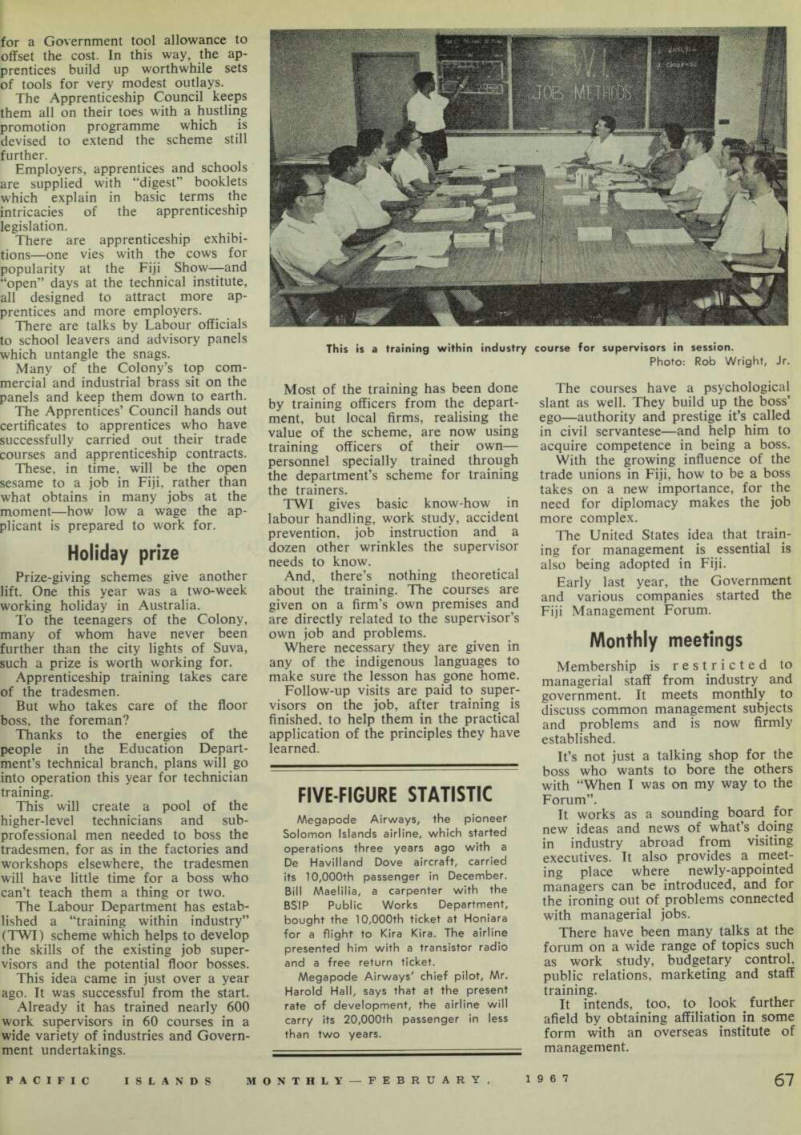
TWI gives basic know-how in labour handling, work study, accident prevention, job instruction and a dozen other wrinkles the supervisor needs to know.
And, there’s nothing theoretical about the training. The courses are given on a firm’s own premises and are directly related to the supervisor’s own job and problems.
Where necessary they are given in any of the indigenous languages to make sure the lesson has gone home.
Follow-up visits are paid to super visors on the job, after training is finished, to help them in the practical application of the principles they have learned.
The courses have a psychological slant as well. They build up the boss’ ego—authority and prestige it’s called in civil servantese —and help him to acquire competence in being a boss.
With the growing influence of the trade unions in Fiji, how to be a boss takes on a new importance, for the need for diplomacy makes the job more complex.
The United States idea that train ing for management is essential is also being adopted in Fiji.
Early last year, the Government and various companies started the Fiji Management Forum.
Monthly meetings
Membership is restricted to managerial staff from industry and government. It meets monthly to discuss common management subjects and problems and is now firmly established.
It’s not just a talking shop for the boss who wants to bore the others with “When I was on my way to the Forum”.
It works as a sounding board for new ideas and news of what’s doing in industry abroad from visiting executives. It also provides a meet ing place where newly-appointed managers can be introduced, and for the ironing out of problems connected with managerial jobs.
There have been many talks at the forum on a wide range of topics such as work study, budgetary control, public relations, marketing and staff training.
It intends, too, to look further afield by obtaining affiliation in some form with an overseas institute of management.
This is a training within industry course for supervisors in session.
Photo: Rob Wright, Jr.