Police-Army
pp. 57-61 · Read in the full issue



How harmless is New Guinea's Police-Army rivalry?
From Susan Young, in Port Moresby Everybody agrees that there is rivalry between the police and the army in the Territory of Papua and New Guinea.
\ T first glance this may seem a false statement in view of the :ontroversy that has been bubbling n the territory precisely over the luestion of whether such rivalry sxists. But a little bit of digging ipeedily reveals that this is not what he real argument is about.
The argument is not whether here is rivalry, but about the nature )f that rivalry.
Everyone I spoke to on the subject agreed that there was rivalry, even those who at the beginning of a dis cussion had aggressively denied its existence. It soon became apparent that what they really meant was that this rivalry was essentially harmless.
Thus, what the matter boils down to is this: Does the rivalry between police and army matter? Is it dangerous?
As is so often the case, these are questions which are far more easily posed than answered. After having talked with sundry persons until there were spots in front of my eyes, I align myself with those who say that, while they do not expect the situation to blow up any day, they would not be surprised if in fact it did.
The latest round of speculation about police-army relationships has been provoked by an incident which took place some time ago outside a Boroko, Port Moresby, cinema.
A fight started as some troops were emerging from the cinema one night and police detained one of the soldiers who, in the words of an official account, “resisted arrest, was aided by one of the bystanders and removed from the control of the police”.
And that really was about the sum of it, though three native soldiers were later discharged from the army for their part in the incident.
But as the story got round, many people chose to interpret it as being
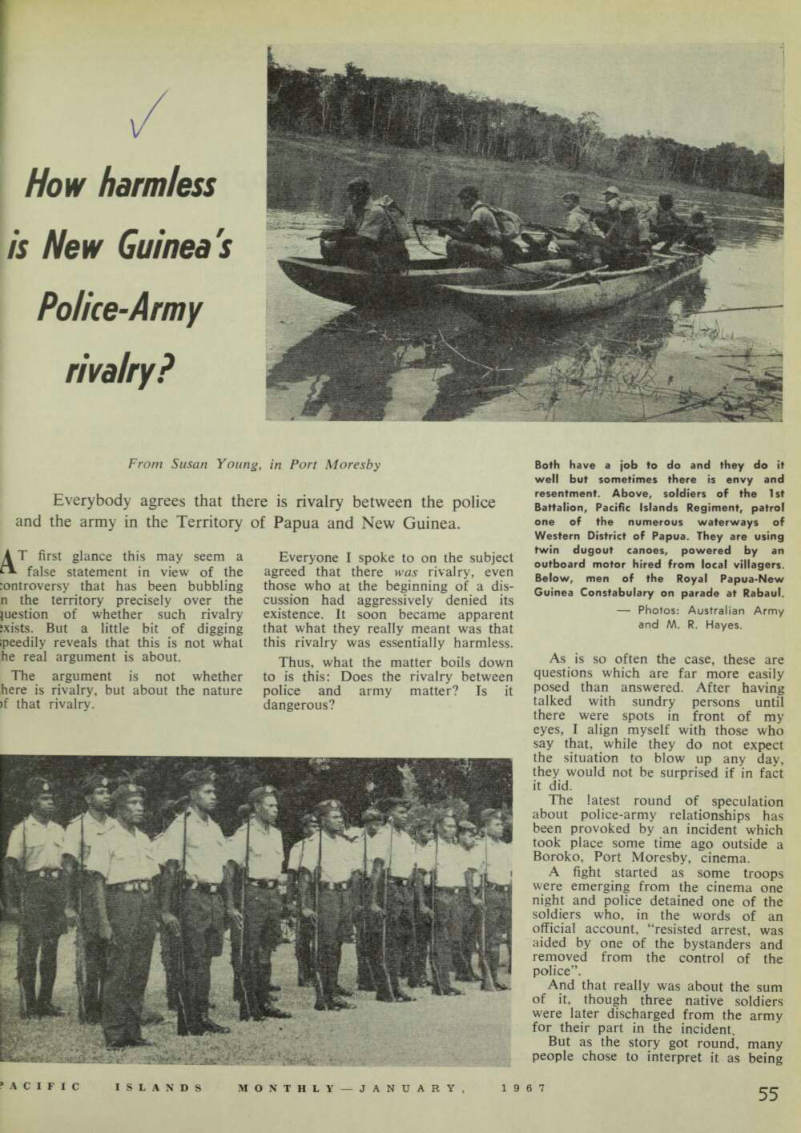
Both have a job to do and they do it well but sometimes there is envy and resentment. Above, soldiers of the Ist Battalion, Pacific Islands Regiment, patrol one of the numerous waterways of Western District of Papua. They are using twin dugout canoes, powered by an outboard motor hired from local villagers.
Below, men of the Royal Papua-New Guinea Constabulary on parade at Rabaul.
Photos: Australian Army and M. R. Hayes.
There's A Mystical Attachment To Army
indicative of barely-suppressed tension between the police and army. Police failure to re-capture the soldier con cerned and their subsequent wil lingness to leave disciplinary action to the army was interpreted as being due to the authorities’ fear of height ening that tension.
I gather that the Police Chief, Commissioner R. Cole, and the commander of the army in P-NG, Brigadier lan Hunter (both of whom were in Canberra at the time), are pretty angry over what they regard as excessive and misleading publicity about a totally misinterpreted event.
Their view, and that of officialdom generally, is that this was “merely a combination of liquor, troops and police, in a pattern which will be familiar with many ex-servicemen”.
I think they are right about this incident, but I think they are wrong in insisting that the general rivalry that exists is “normal and harmless”.
The mistake they are making is in judging this business by Western habits of behaviour.
Soldiers anywhere may occasionally clash with police; and afterwards the incident is unlikely to be remembered as anything much more than a rattling good punch-up; certainly it’s most unlikely to develop into a vendetta.
Many Reasons
As for rivalry between regiments or forces, it rarely amounts to much more than a mutual amiable con tempt, with the occasional bloody nose dished out as a defiant gesture.
But it can’t be assumed that there will be a similar pattern in Papua- New Guinea, where troops and police come from a vastly different back ground—a background in which the payback philosophy looms large.
There are other factors, too. “The army,” one man told me, “regard the police as trash and the police are bitterly envious of the army”.
Many native soldiers have formed a sort of mystical attachment to the army—almost as though they have transferred their traditionally pas sionate tribal loyalties to the force.
Also, there is a prestige here in being a soldier that is not found in Aus-
Conditions Exist For 'Blow-Up'
Iralia; so the native troops are proud men.
And despite constant efforts to disabuse them of the idea, they persist in feeling that they should be above the civil law, answerable only to their own authorities. This, of course, gives rise to resentment whenever the civil police detain a soldier. (Explanation of the Boroko trouble: no civil police action was taken after the initial attempt at arrest because it was “mainly con cerned with military discipline”).
On the other hand the police, as the older force, regard themselves as the senior service, entitled to superior conditions to, and proper respect from, their inferiors —to wit, the army.
Police Catching Up
In fact, for a long time the army has had it better than the police, though much is being done now to level things out.
While it is true, as the authorities claim, that there is a good deal of co-operation between the forces, it ought to be admitted that the con ditions exist for a blow-up should anything act as a trigger.
That’s why small incidents like that at Boroko should never be dis missed lightly. A nobleman’s carriage rolls over a peasant’s foot and a revolution flares; a Chinese accident ally jostles a Malay in a crowded street and the East erupts.
But there is plenty of hope. As the Bishop of New Guinea, the Rt.
Rev. David Hand, observed recently, the army (and presumably also the police) have a great chance to act as a unifying force in the territory, instead of becoming a devisive or “boss group” as has happened in so many developing nations.
These men come from many different tribes, yet work together. By territory standards they are well educated, well trained and keen.
Given watchfulness and perceptive leadership, it should be possible not merely to avoid trouble but to develop two fine, efficient, integrated forces.