Hobby That
pp. 63-64 · Read in the full issue
Became Lucrative
Export Business
By Matt Wilson, in Suva
Two hundred temperamental travellers were packed into water-filled plastic bags at Suva one recent Saturday, loaded into a Nadi-bound taxi and a few hours later were among the passengers on a flight to America.
DURING the flight, the travellers— marine tropical fish—relaxed in special VIP accommodation, and just over 20 hours after leaving Fiji were safely installed in their new homes in New York.
And for Mr. Harold Storck at Suva another job was over.
The fish were one of hundreds of Suva consignments which have been exported to many parts of the world during the last few years.
An interest in marine tropical fish which began as a hobby about eight years ago, has turned into a lucrative concern for Mr. Storck and brother Vince —well known to hundreds of tourists as operators of the 00100100 and Ooloolootoo, glass - bottomed launches which visit the coral gardens in Suva harbour.
Harbour Lights
In their Harbour Lights Aquarium, scores of brightly-coloured fish caught on the reefs and foreshores near the city provide an eye-catching spectacle for holidaymakers, before Deing shipped off to fish dealers over seas.
It all started when the Storck crothers installed an aquarium in the vindow of a travel agent’s premises is an advertisement for their cruises.
Harold, a burly 39-year-old, who ias been connected with the sea from lis boyhood, said: “This caught the ittention of an American dealer in narine tropical fish, who took some )f our fish to America. As soon as 3ther dealers found out where they came from they got in touch with ne and we supplied them.
“We started in a small way at
home but when the business of tak ing water to the installation at home became too much, we decided to move the business near to the water front.”
The results of the trial shipments were encouraging enough for the Storcks to press on with the project.
Now, Fijian men and women fish the reefs and shallows round Suva harbour for the fish, which stock the tanks at the Harbour Lights Aquarium.
Working in twos with nets, they have perfected their own techniques and can earn useful cash from their forays among the reefs—especially when Mr. Storck has big orders in hand.
Said Mr. Storck: “They have be come very skilful and are able to bring me fish that at one time were very rarely seen”.
Sometimes they are out every day of the week and sometimes they go out only one or two days a week, depending on the demand.
They are paid on a piece basis.
When orders are coming in fast, the fishermen can earn a week’s wages in a day.
In the aquarium’s tanks, the fish are kept under surveillance to ensure that they are in peak condition when they leave Fiji.
Mr. Storck makes it his personal job to act as “nursemaid” to these delicate denizens of the Suva reefs.
Ingenious Packing
The way the fish are packed for their journeys overseas is an ingenious and scientific operation requiring a high degree of skill.
They are sorted out and placed in plastic bags containing water and oxygen.
As many as 50 may be placed in one bag. But other fish which are “anti-social” are put in bags by them selves.
The technique includes using anti biotics, tranquillizers and chemicals,
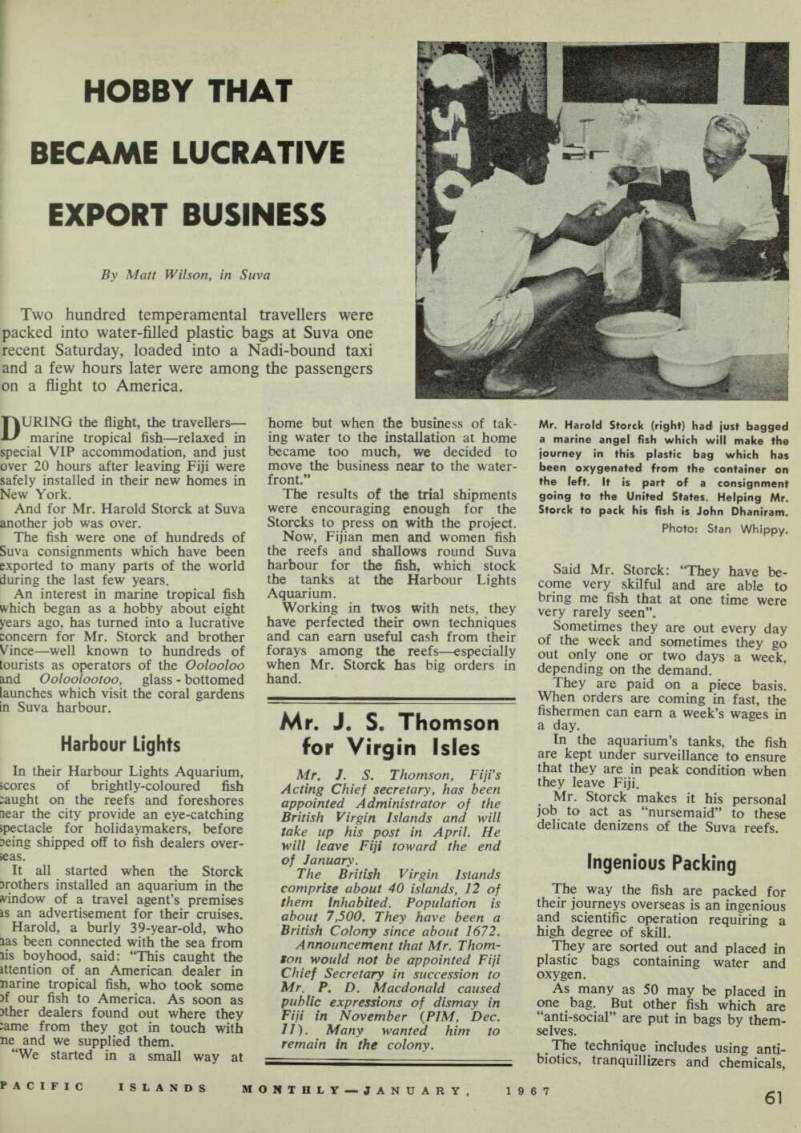
Mr. Harold Storck (right) had just bagged a marine angel fish which will make the journey in this plastic bag which has been oxygenated from the container on the left. It is part of a consignment going to the United States. Helping Mr.
Storck to pack his fish is John Dhaniram.
Photo: Stan Whippy.
Most Fish Go To America
which maintain the chemical balai of the water.
“By tests we have been able; determine how much water j oxygen is needed to sustain a cert number of fish for a certain perio said Mr. Storck.
The plastic bags containing fish are transported in “styrafoa insulated boxes, which protect the from sudden temperature changes Paying tribute to the co-operat given by airlines, Mr. Storck ss “Qantas have actually gone to extent of building into many of tl aircraft thermostically-controx heated shelves where the boxes c taining the fish are placed”.
Most of Mr. Storck’s orders co from America, with Japan runm second.
He said: “I have shipped to Eur: but not on a large scale. The hok of keeping marine tropical fishi gradually establishing itself there.. is a potential market”.
Fish from the Storck establishm have found their way into mostl the world’s major aquariums.
Most popular of the varieties; deals with are less than three ino long and brilliantly coloured. Nej all end up in home aquariums.
Due to losses sustained from time of being caught to the d they arrive at their destinations, the cost of air-freighting them gij distances, the fish become a hi priced commodity by the time tt reach the customer. One type of i “trigger” fish has so far eluded nets of Mr. Storck’s fishermen.
“This fish is very much sod after because of its colouring the fact that it is easy to keepc an aquarium. Just about ev aquarium in the world regard tH as prize exhibits,” said Mr. Store “I have seen them swimming abi( We will keep on trying.” • Australian shark authority, Peter Goadby, will spend about days fishing for 800 pound marlin Fiji in January. He will also c<: plete research for his second bo Game Fishing in the South W Pacific, which he hopes to have n lished by next Christmas. Mr. Goae wrote Sharks and Other Predaw Fish in Australia six years ago.
“Graham Wallace, a charter s? per I know, invited me to comes and stay with him at Korolevu,” : Mr. Goadby.