And Orphans
p. 55 · Read in the full issue
She's Mother’
To Fiji's Waifs
From Beryl Cates, in Suva
For the past 20 years mother, nurse, friend md confidant to 50 orphans and waifs at Dil :usha Orphanage, 14 miles from Suva—has >een Methodist nursing sister Gwenneth Davey.
A TRIPLE certificated Australian "a. nurse trained in Victoria, Miss )avey came to Fiji just after the far because “she felt called to do lissionary work”. She has stayed on wing and rearing the unwanted nth such happy devotion her name as become something of a by-word i Suva and beyond.
Dilkusha building is a large, ambling, two-storey wooden struc ■ire set high on a hill overlooking he Rewa River near Nausori. Almost 11 of the children are Indians, and Imost all arrive at the home from ragic circumstances.
One bright-eyed, vivacious oungster now at the home arrived s a two-year-old 12 months ago. he was as feeble as a new born •aby, having been fed almost ex lusively on black tea.
Because of the nature of the •rphanage the nursery is never with out two or three babies who naturally lemand feeding during the night, rtiss Davey sleeps five nights out ►f seven in a tiny bedroom off the ick bay and within call of the tursery so that she can respond •romptly when called. The other two lights she sleeps in her own cottage iway from the home to ensure some inbroken rest.
Sickness Rare
Apart from such juvenile com plaints as measles and chickenpox, ickness is surprisingly rare at the tome. There are, however, always a prinkling of asthmatics, a complaint eemingly prevalent among Indians.
The home has a deputy matron, Miss Dhanraji, and two assistants.
Work is lessened because children follow a big-and-little-sister system whereby each girl over 12 years takes under her special care one younger child over three years. Big “sister” supervises younger “sister” with her teeth cleaning, washing, dressing and bed-making. After school she does her washing and ironing as well as her own, and keeps both lockers tidy.
If there is any marked clash of personalities between the two sisters they are re-allocated.
Self-help
Older children also help get break fast and spend from five minutes to 20 minutes (depending on the age of the child) helping with household chores.
Each girl makes her own bed and before leaving for the Methodist Dil kusha District School nearby, girls are lined up alongside their beds to have checked their bed, folded towel and belongings, and also nails, teeth and clean handkerchiefs.
Girls under three years are attended by the staff, which has remained at the home without change for years.
The 50-year-old orphanage building is kept spotless, and is, in the main, solid, although parts of it are
antiquated. Showers face on to an open courtyard with no protection for the girls running from showers to the home. The huge kitchen stove is an adaptation of the low-cost smokeless concrete stove now being introduced into villages by the Fiji Women’s Interests Office and into other Islands territories by the South Pacific Commission through its training centre.
The pink and soft grey nursery, complete with well-equipped adjoin ing washroom is the result of funds donated the home from the Hibiscus Festival Community Chest fund.
Food is good, most children eating better than in their original environ ments. The atmosphere is noisy and happy, the only really quiet spot being the chapel, where the girls go night and morning for family prayers.
Miss Davey keeps in touch with a great many of her old girls and many visit the home periodically for holi days. No girl is sent from the home unless she has an approved working position to go to, and all girls capable of secondary school work are sent to secondary school.
The name Dilkusha means “Delight to the heart”. The orphanage is aptly named.
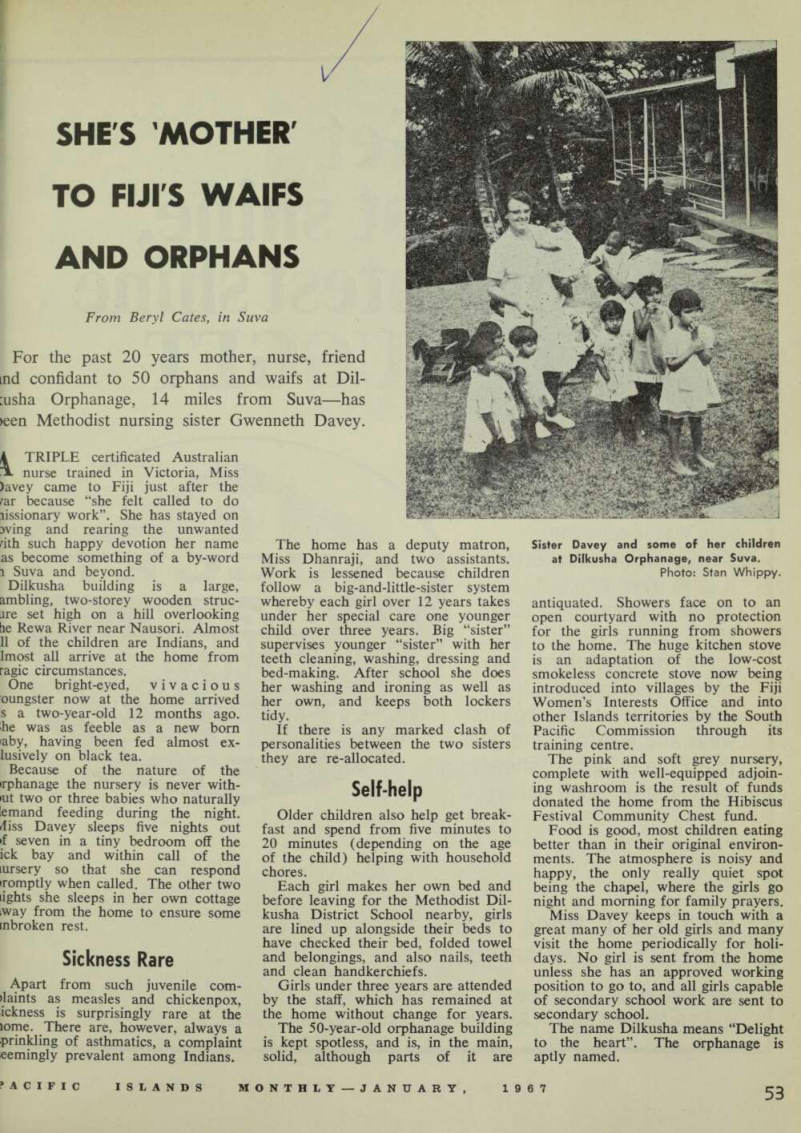
Sister Davey and some of her children at Dilkusha Orphanage, near Suva.
Photo: Stan Whippy.