of N. Hebrides Airways
pp. 53-54 · Read in the full issue
Down-draught theory in fatal crash
New Errontanga industry a big factor in future of N. Hebrides Airways
From Robert Langdon in Vila
An investigation into the cause of the fatal air crash in October and discussions on the future of his airline kept Mr.
R. U. (Bob) Paul, of Tanna, New Hebrides, a busy man in December.
/|R. PAUL is chairman of directors rl of New Hebrides Airways, hich lost one of its two Drover rcraft in October when it crashed rugged, mountainous country in ie south of Tanna. All eight people >oard, including NHA’s pioneer lot Paul Burton, were killed ( PIM, ov., p. 17).
Following a flight over the scene ot e crash in early December, Mr. aul believes that a violent down aught of air was responsible for e accident.
Mr. Paul made his flight in a elio-Courier 11, a plane about the me size as a Drover, which spent veral days in the New Hebrides i route from the US to Australia December.
“We took off at exactly the same ne as the Drover, and with a similar ind of 20 to 25 knots,” Mr. Paul Id me afterwards.
“We flew up the same gully as the rover, between Mt. Tokusmera and [t. Melin.
Aircraft now banned
“As I was pointing out the site ' the crash to the pilot, Jim azelton, we were caught in a down aught and we dropped 300 feet in >out 10 seconds. The pilot had great fficulty in controlling the aircraft.”
Mr. Paul said that there was a ddle between the two mountains, id when the wind struck this from certain direction, it went suddenly jwnhill.
“No more of our planes will fly that vicinity,” he added.
While the Helio-Courier was at anna, the pilot gave flying demon rations over a number of villages an effort to restore confidence in dation among the Tannese, many ? whom were badly shaken by the ash.
Twenty-seven groups of Tannese are shareholders in NHA. The re maining shares are held by Mr.
Paul; a Noumea businessman, Mr.
A. Ardimanni; Mrs. Burton, widow of the late Paul Burton; and Sister M. Heard, of Lenakel Hospital, Tanna.
Following the crash, the New Hebrides Condominium Government offered to subsidise NHA’s opera tions. But this move, which was sponsored by the French Administra tion, was rejected by NHA because the conditions were unacceptable.
Under the conditions, NHA would have had to hand over control to the Condominium of the six air fields it now has in the Group.
These airfields are at Lake Siwi (Tanna), Futuna, Aniwa, Sara (Pentecost), Walaha and Longana (Aoba).
There are 14 other airfields in use in the group. Seven of these are owned and/or maintained by the Condominium Government; two are
owned by Hebridair; and the rest are variously owned.
Since last June, NHA and Hebridair (a French company) have operated jointly under the name of Air Melanesia, with Mr. Joe Mulders, a Belgian, as manager.
The aircraft of the two companies are pooled to the best advantage, and income is shared in proportion to the number of hours flown by each company’s aircraft. Each company bears the basic operating costs of its own equipment, while administration costs are a joint charge.
Air Melanesia proved a success from the outset, with traffic increas ing by 30 per cent, in three months, and 1,110 passengers being carried in August.
Talks with Qantas
In December, however, NHA was the only active partner in Air Melanesia, as Hebridair’s only air craft, a Dornier, was in Noumea for repairs; and an Aztec aircraft, which it had rented for some weeks from the Avis company in Sydney, was sent back to Australia.
Meanwhile, NHA was holding dis cussions about its future with Mr.
Chris Ritchie, general manager of Fiji Airways from 1959 to 1965, who flew to Vila from Sydney. Mr. Ritchie is now a senior Qantas official.
Among the matters under dis cussion was the type of aircraft NHA should acquire to replace its ill-fated Drover.
If money were no object, the
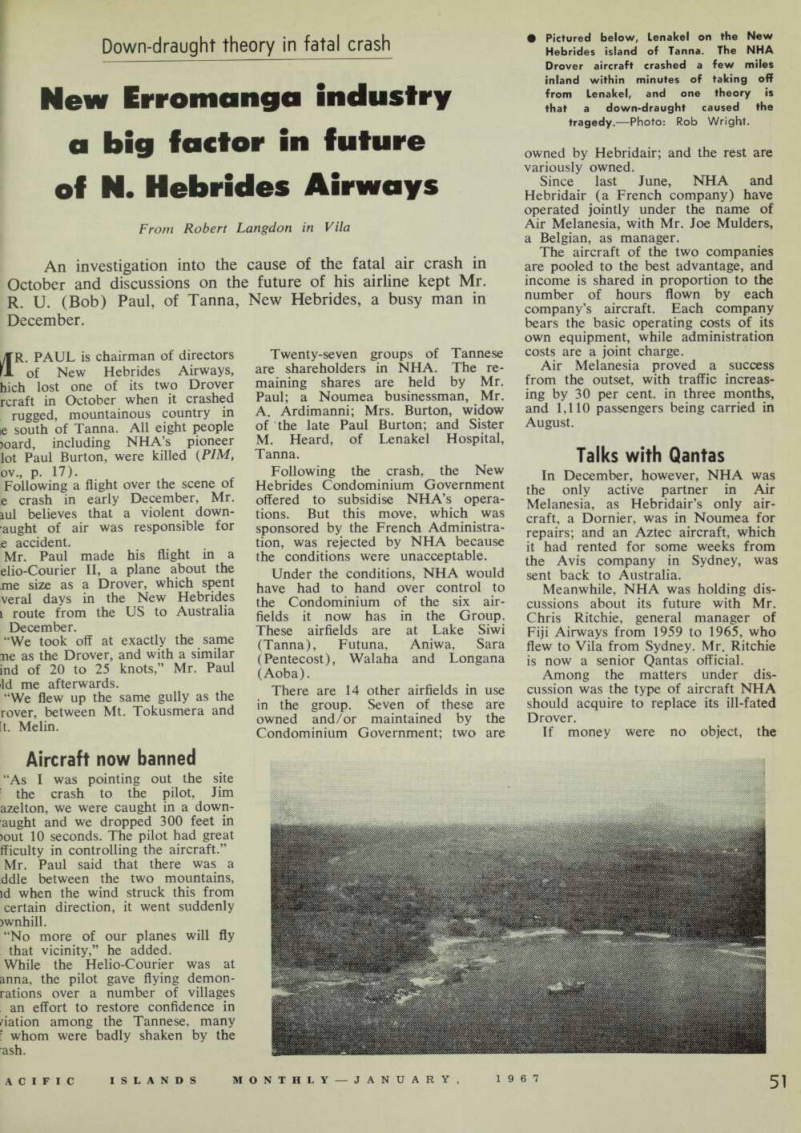
• Pictured below, Lenakel on the New Hebrides island of Tanna. The NHA Drover aircraft crashed a few miles inland within minutes of taking off from Lenakel, and one theory is that a down-draught caused the tragedy.—Photo: Rob Wright.
choice would probably be a Tv Otter, which would run out at son thing over $250,000. Against this, nine-seater Britten Norman BP Islander (a promising aircraft 1 cause it is almost STOL) would c< $55,000, and a Drover Mk. 11l more powerful version of NIL present Drover) would cost $20,0» Because of the fine performar of Drovers in the rugged N Hebrides up to the fatal crash October, NHA is almost certain choose the Drover again, especially one of these aircraft could obtained almost immediately, when a Britten Norman might not obtainable until 1968.
However, an important factor tl NHA must consider before choosi a new aircraft is the requirements the timber extraction industry tl will get under way soon on the isla of Erromanga.
A French company, Etablisseme Rougier et Fils, will extract timl from the southern part of the isla under an arrangement with Mr.
C. Rouleau, who obtained a timl rights agreement from local nati 1 several years ago.
New airstrip for Erromani
Operations may also begin later northern Erromonga, as Mr. Roule and the Fletcher Timber Co., New Zealand, have opposing clai to timber rights in that part of 1 island, which will probably be hej by the Joint Court of the N Hebrides this year.
The Rougier company, which s< heavy equipment and a field mana] to Vila in late November, did i then have a forestry licence Erromanga, but this was expeci to be granted as soon as export ta: and other terms had been agreed with the government.
One of the first things the compa proposes to do is build an airst between Pt. Narevin and Cook E on the eastern side of Erromanga that men and equipment can be flo in. (There is already a Condominii airstrip on the western side of 1 island).
When built, the new airstrip v almost certainly become one of 1 busiest in the group, and N Hebrides Airways should have plei of business there, if it gets an a craft capable of meeting the requi ments of the timber company.
Erromanga is estimated to ha enough timber to keep an extract! industry going for at least 20 yea As the island’s population is oi about 600, labour will probably brought in from neighbouring Tam where there are more than 8.0 people.